
Life, 1895-07-18 · page 4 of 16
Life — July 18, 1895 — page 4: what you’re looking at
What you’re looking at
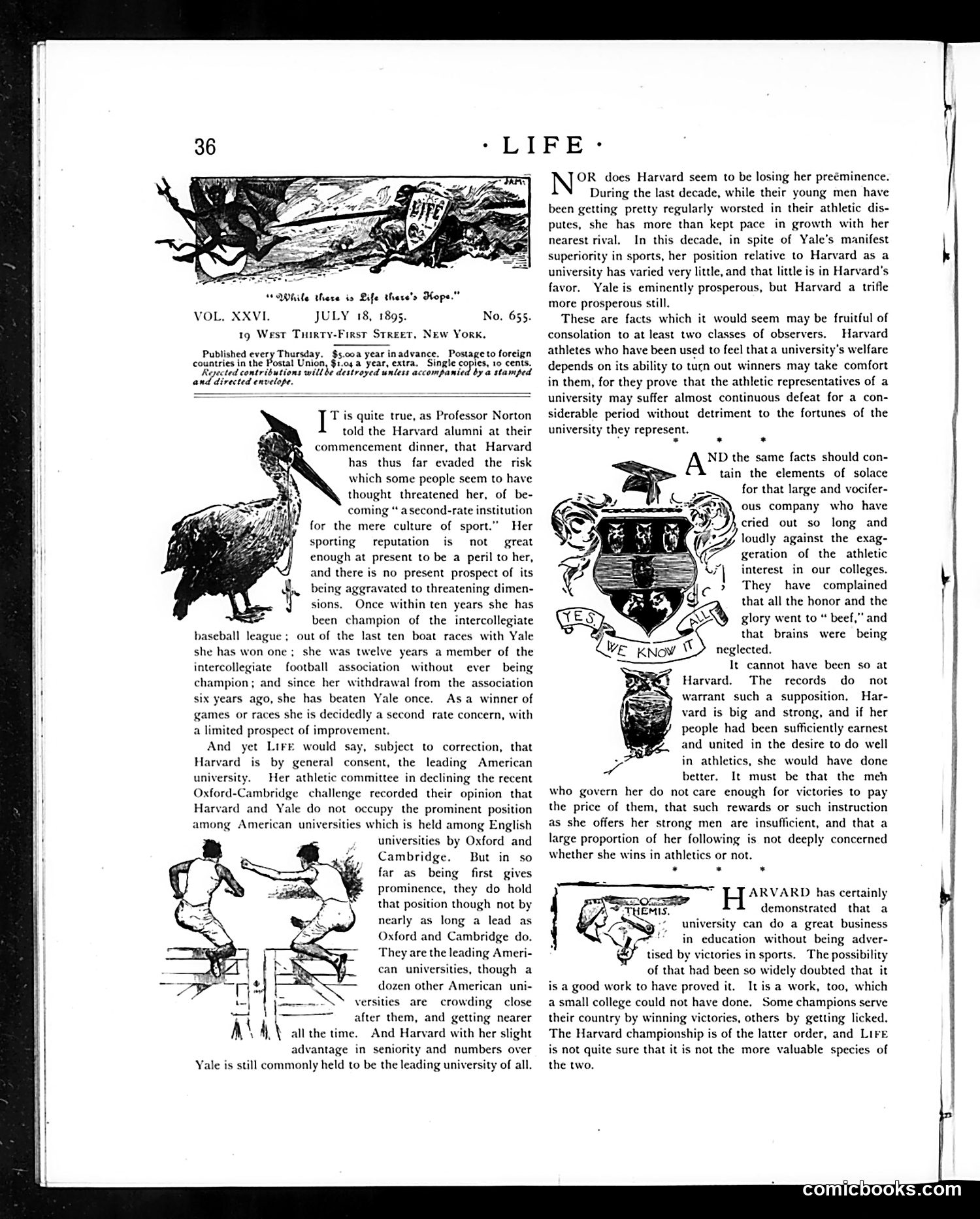
This page critiques Harvard University's athletic program and its administration's lack of commitment to winning. The text argues that Harvard, despite being America's leading university, has underperformed in sports compared to Yale, which is "still commonly held to be the leading university of all." The article satirizes Harvard's defensive position: the university's leaders claim athletics aren't crucial to institutional prestige, yet they simultaneously suffer embarrassment from athletic losses. The cartoons depicting athletes (a baseball player and runners) illustrate the disconnect between Harvard's academic status and its athletic mediocrity. The central irony: Harvard administration refuses to seriously invest in athletics, then complains about losing. The author suggests Harvard could excel at both academics and sports if it actually prioritized winning.
📄 Transcribed text from this page (OCR, searchable)
Machine-transcribed from the original scan — historical spelling and the odd misread are preserved.
“While there is Life there’s Hope.” VOL. XXVI. JULY 18, 1895 No. 655. 19 West Turty-First STREET w YORK, Published every Thursday. $s.coa year inadvange. Postage to foreign countries in the Vostal Union, $1.04 8 year, extra. Single copies, 10 cents, Rejected contributions willbe destroyed unless accompanied by a stamped and directed envelope. T is quite true, as Professor Norton told the Harvard alumni at their commencement dinner, that Harvard has thus far evaded the risk which some people seem to have thought threatened her, of be- coming “a second-rate institution for the mere culture of sport." Her sporting reputation is not great enough at present to be a peril to her, and there is no present prospect of its being aggravated to threatening dimen- sions, Once within ten years she has been champion of the intercollegiate baseball league ; out of the last ten boat races with Yale she has won one; she was twelve years a member of the intercollegiate football association without ever being champion; and since her withdrawal from the association six years ago, she has beaten Yale once. Asa winner of games or races she is decidedly a second rate concern, with a limited prospect of improvement. And yet Lire would say, subject to correction, that Harvard is by general consent, the leading American university. Her athletic committee in declining the recent Oxford-Cambridge challenge recorded their opinion that Harvard and Yale do not occupy the prominent position among American universities which is held among English universities by Oxford and Cambridge. But in so far as being first gives prominence, they do hold that position though not by nearly as long a lead as Oxford and Cambridge do. They are the leading Ameri- can universities, though a dozen other American uni- versities are crowding close ra — after them, and getting nearer A . A all the time. And Harvard with her slight advantage in seniority and numbers over Yale is still commonly held to be the leading university of all. iN Ry at -LIFE-: OR does Harvard seem to be losing her preéminence. During the last decade, while their young men have been getting pretty regularly worsted in their athletic dis- putes, she has more than kept pace in growth with her nearest rival. In this decade, in spite of Yale’s manifest superiority in sports, her position relative to Harvard as a university has varied very little, and that little is in Harvard's favor. Yale is eminently prosperous, but Harvard a trifle more prosperous still. These are facts which it would seem may be fruitful of consolation to at least two classes of observers. Harvard athletes who have been used to feel that a university's welfare depends on its ability to turn out winners may take comfort in them, for they prove that the athletic representatives of a university may suffer almost continuous defeat for a con- siderable period without detriment to the fortunes of the university they represent. . . ND the same facts should con- tain the elements of solace for that large and vocifer- ous company who have cried out so long and loudly against the exag- geration of the athletic a) interest in our colleges. » They have complained that all the honor and the glory went to “ beef,” and that brains were being neglected. It cannot have been so at Harvard. The records do not warrant such a supposition, Har- vard is big and strong, and if her people had been sufficiently earnest and united in the desire to do well in athletics, she would have done better. It must be that the meh who govern her do not care enough for victories to pay the price of them, that such rewards or such instruction as she offers her strong men are insufficient, and that a large proportion of her following is not deeply concerned whether she wins in athletics or not. * . * - H ARVARD has certainly demonstrated that a university can do a great business in education without being adver- y victories in sports. The possibility had been so widely doubted that it is a good work to have proved it. It is a work, too, which a small college could not have done. Some champions serve their country by winning victories, others by getting licked. The Harvard championship is of the latter order, and Lire is not quite sure that it is not the more valuable species of the two. — nt