
Life, 1895-07-18 · page 10 of 16
Life — July 18, 1895 — page 10: what you’re looking at
What you’re looking at
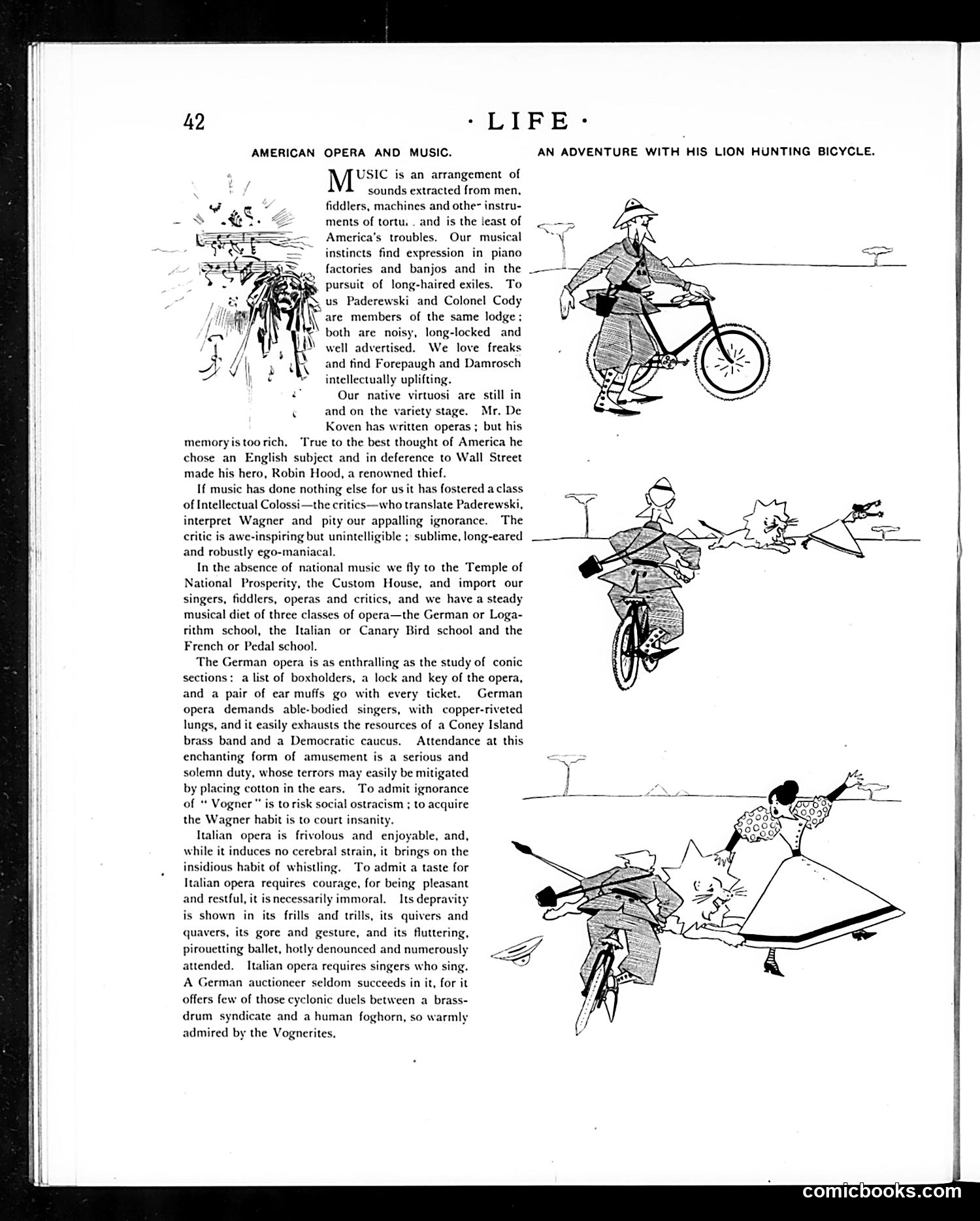
This page satirizes American opera and classical music pretensions. The left column mocks imported European opera traditions—German, Italian, and French styles—as intellectually exhausting and culturally snobbish. The author attacks critics who translate complex European composers like Paderewski while ignoring American composers. The right side features cartoons of a figure on a bicycle performing increasingly absurd stunts (hunting lions, acrobatic tricks). This "lion hunting bicycle" adventure appears to mock the disconnect between highbrow cultural pursuits and practical American entertainment—suggesting that circuses or vaudeville spectacle might be more honest expressions of American culture than pretentious opera imports. The satire argues Americans should develop authentic native music rather than imitating European forms.
📄 Transcribed text from this page (OCR, searchable)
Machine-transcribed from the original scan — historical spelling and the odd misread are preserved.
-LIFE-: AMERICAN OPERA AND MUSIC. Ms". is an arrangement of sounds extracted from men, fiddlers, machines and othe- instru- ments of tortu. . and is the least of America’s troubles. Our musical instincts find expression in piano factories and banjos and in the pursuit of long-haired exiles. To us Paderewski and Colonel Cody are members of the same lodge ; both are noisy, long-locked and well advertised. We love freaks and find Forepaugh and Damrosch intellectually uplifting. Our native virtuosi are still in and on the variety stage. Mr. De Koven has written operas ; but his memoryistoorich, True to the best thought of America he chose an English subject and in deference to Wall Street made his hero, Robin Hood, a renowned thief. If music has done nothing else for us it has fostered aclass of Intellectual Colossi—the critics—who translate Paderewski, interpret Wagner and pity our appalling ignorance. The critic is awe-inspiring but unintelligible ; sublime, long-eared and robustly ego-maniacal. In the absence of national music we fly to the Temple of National Prosperity, the Custom House, and import our singers, fiddlers, operas and critics, and we have a steady musical diet of three classes of opera—the German or Loga- rithm school, the Italian or Canary Bird school and the French or Pedal school. The German opera is as enthralling as the study of conic sections: a list of boxholders, a lock and key of the opera, and a pair of ear muffs go with every ticket. German opera demands able-bodied singers, with copper-riveted lungs, and it easily exhausts the resources of a Coney Island brass band and a Democratic caucus. Attendance at this enchanting form of amusement is a serious and solemn duty, whose terrors may easily be mitigated by placing cotton in the ears. To admit ignorance of “ Vogner" is to risk social ostracism ; to acquire the Wagner habit is to court insanity. Italian opera is frivolous and enjoyable, and, while it induces no cerebral strain, it brings on the insidious habit of whistling. To admit a taste for Italian opera requires courage, for being pleasant and restful, it isnecessarily immoral. Its depravity is shown in its frills and trills, its quivers and quavers, its gore and gesture, and its flutteri pirouetting ballet, hotly denounced and numerously attended. Italian opera requires singers who sing. A German auctioneer seldom succeeds in it, for it offers few of those cyclonic duels between a brass- drum syndicate and a human foghorn, so warmly admired by the Vognerites, AN ADVENTURE WITH HIS LION HUNTING BICYCLE. comicbooks.com