
A complete issue · 16 pages · 1895
Life — June 20, 1895
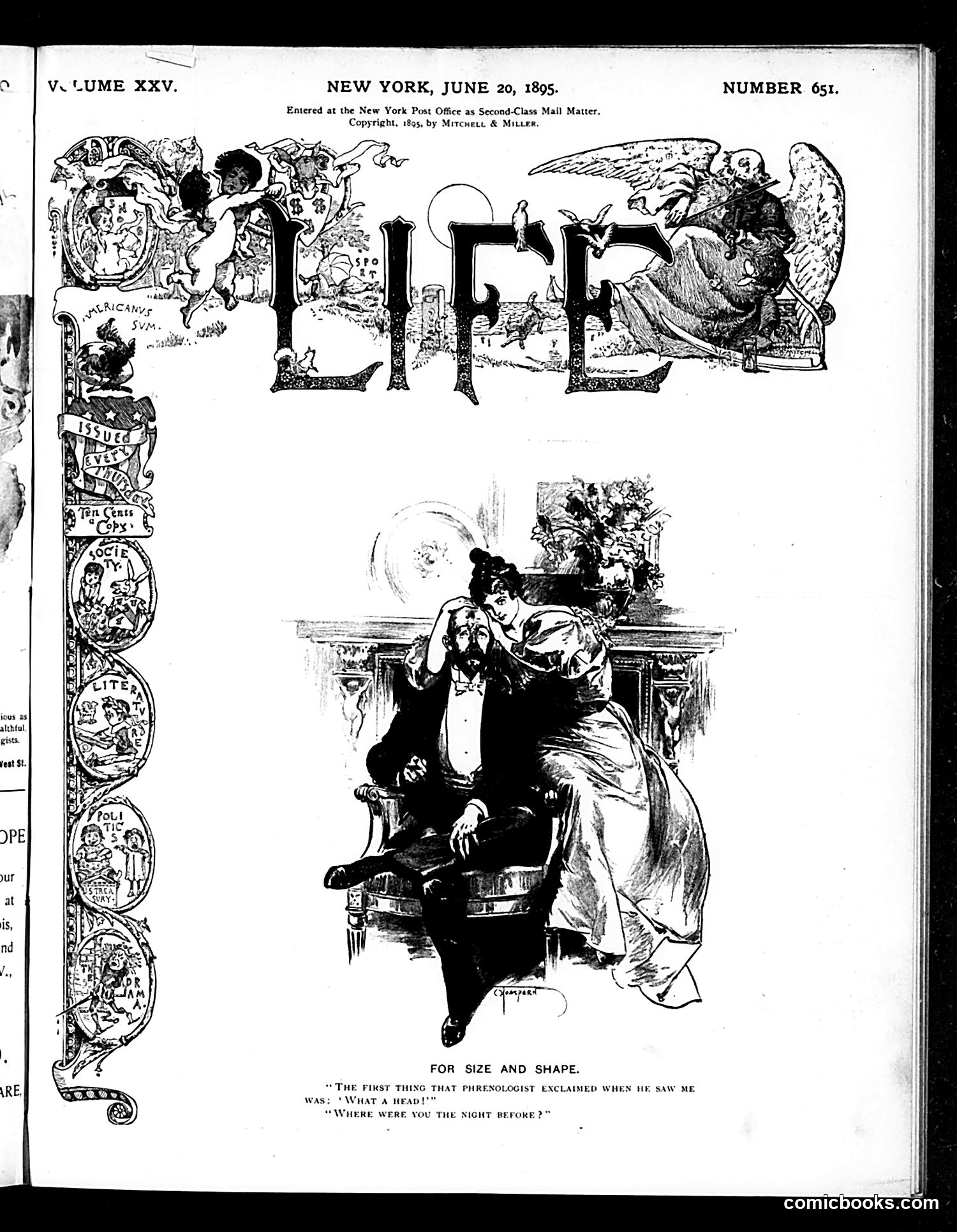
This page features a satirical cartoon about a phrenologist's examination. The caption reads: "The first thing that phrenologist exclaimed when he saw me was: 'What a head!' 'Where were you the night before?'" The joke mocks both phrenology—the pseudoscience claiming skull shape revealed character—and suggests the subject's disheveled appearance (implied "the night before") made their head look unusually misshapen, possibly from drinking or debauchery. The elaborate decorative borders contain small vignettes typical of Life's design style. The cartoon satirizes the pretensions of phrenology while making a bawdy implication about the subject's nocturnal activities and resulting physical condition.
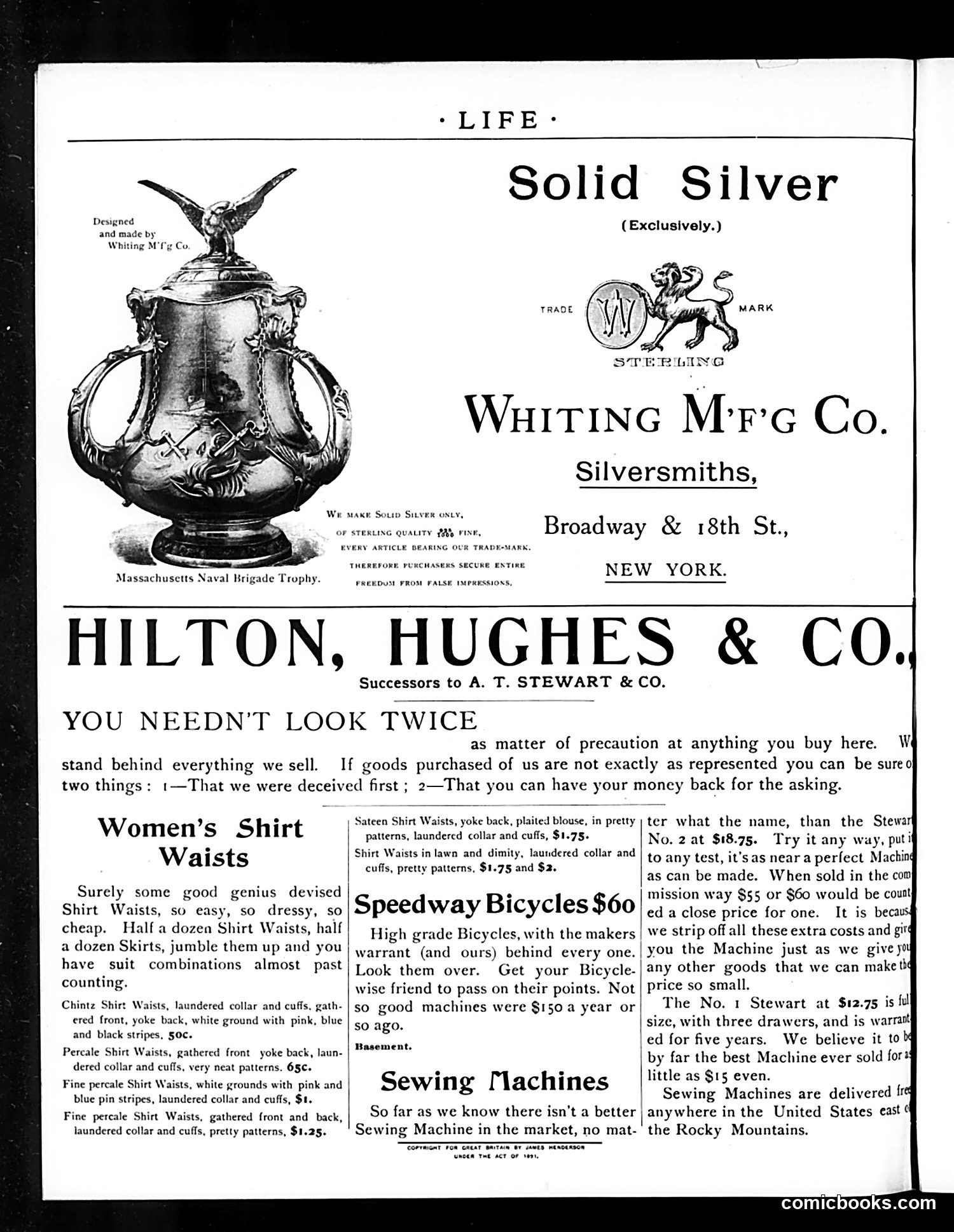
This page contains **primarily advertisements**, not political cartoons or satire. The content includes: 1. **Whiting Mfg Co.** - A sterling silver manufacturer advertising solid silver goods, featuring an ornate trophy labeled "Massachusetts Naval Brigade Trophy" 2. **Hilton, Hughes & Co.** - A general retailer (successors to A.T. Stewart & Co.) advertising women's shirt waists, Speedway bicycles ($60), and sewing machines 3. **Merchandise focus** - The ads emphasize quality and value: shirt waists ($0.50–$1.25), bicycles ($60), sewing machines (compared favorably to $150 competitors) The page reflects **late 19th/early 20th-century consumer culture**, showcasing goods targeting middle-class American women—clothing, transportation, and domestic technology. There is **no apparent political satire or caricature** on this particular page.
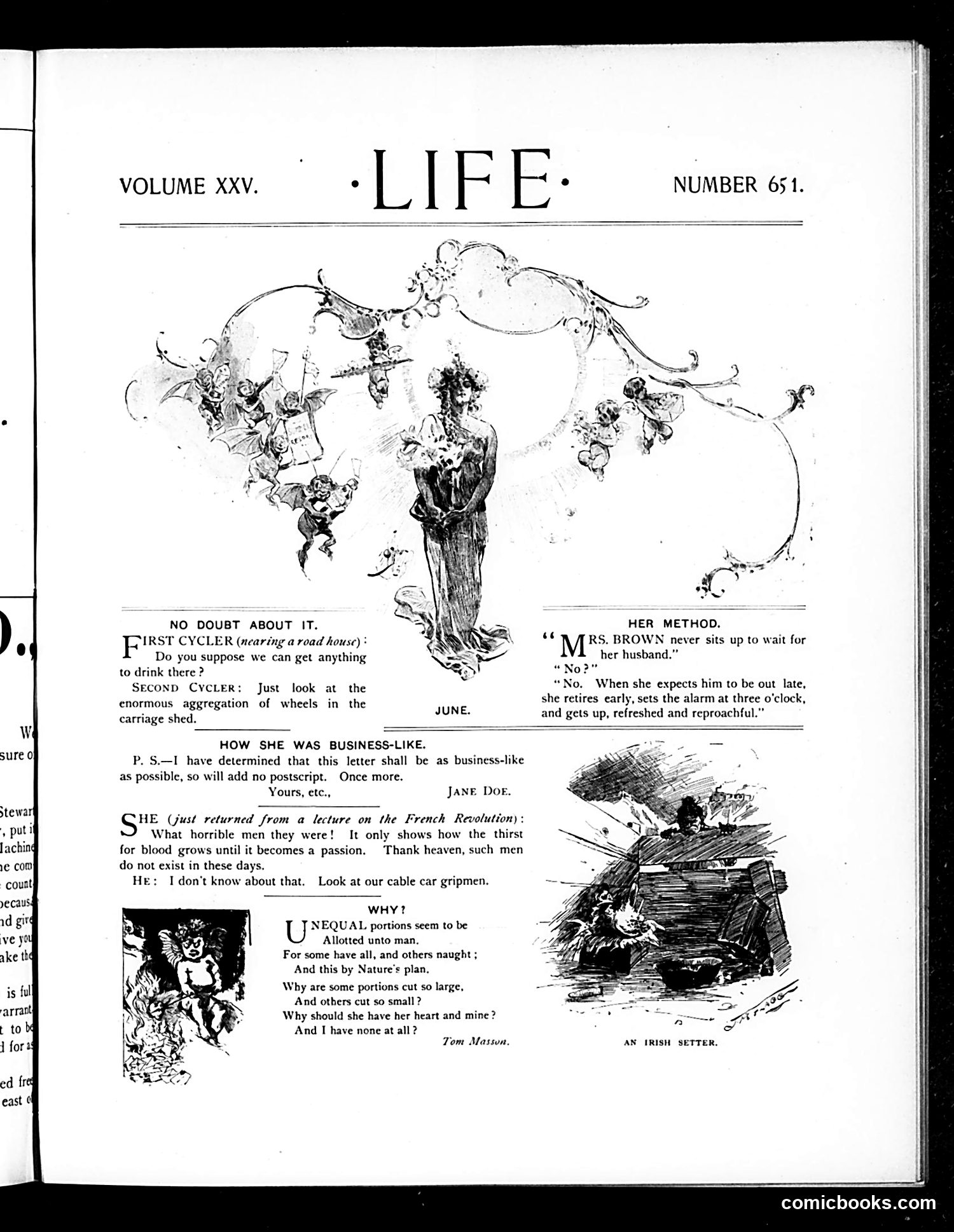
This page from *Life* (Volume XXV, Number 651) contains several satirical pieces about gender and social behavior: **"No Doubt About It"** mocks bicycle culture and marital dynamics—a "first cycler" asks about drinking; the "second cycler" comments on the "enormous aggregation of wheels in the carriage shed," suggesting bicycles as a social status symbol. **"Her Method"** satirizes wives who manipulate husbands by setting alarms early and appearing refreshed, implying deliberate performance of marital duties. **"How She Was Business-Like"** features a letter from "Jane Doe" presenting correspondence as if it were a formal business transaction—likely mocking women's attempts at professional communication. **"Why!"** questions unequal social portions allotted by nature, using philosophical language to critique gender inequality in inheritance and opportunity. The illustrations throughout employ exaggerated Victorian-era artistic styles typical of satirical magazines of this period.
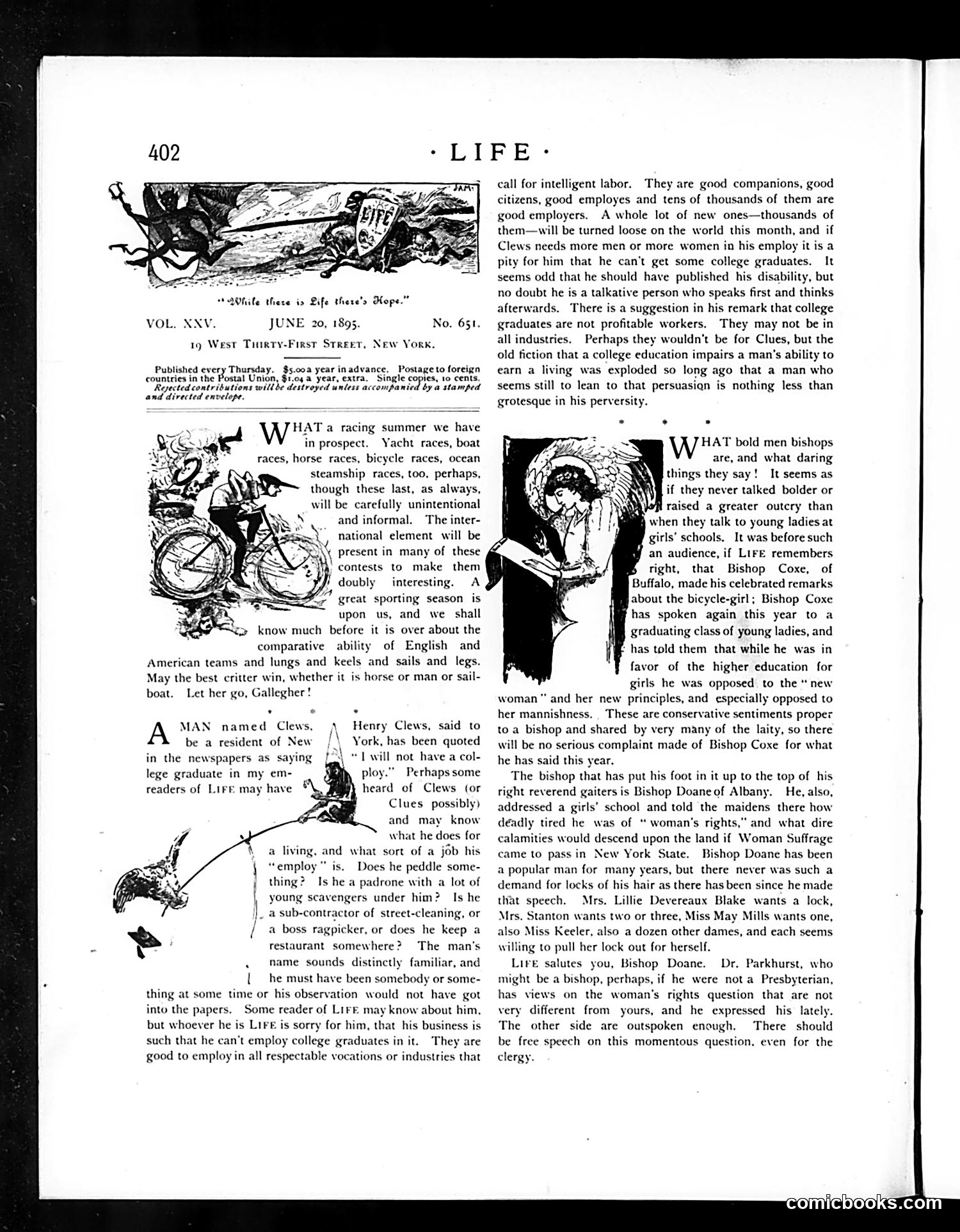
The page contains two main satirical pieces: **Left section ("What a racing summer"):** Satirizes the proliferation of summer racing events—yacht races, horse races, bicycle races, ocean steamship races. The cartoon mocks how these competitions have become numerous and commercially driven, with the implicit critique that they're "carefully unintentional and informal" while actually being nationalistic spectacles comparing English versus American athletic prowess. **Right section ("What bold men bishops are"):** Satirizes Bishop Coxe of Buffalo for his recent controversial remarks to schoolgirls opposing the "new woman" and women's rights/suffrage. The piece suggests his anti-feminist stance is outdated compared to more progressive clergy like Dr. Parkhurst, arguing even clergymen should support free speech on women's rights rather than actively opposing them. Both pieces critique conservative institutional resistance to social change.
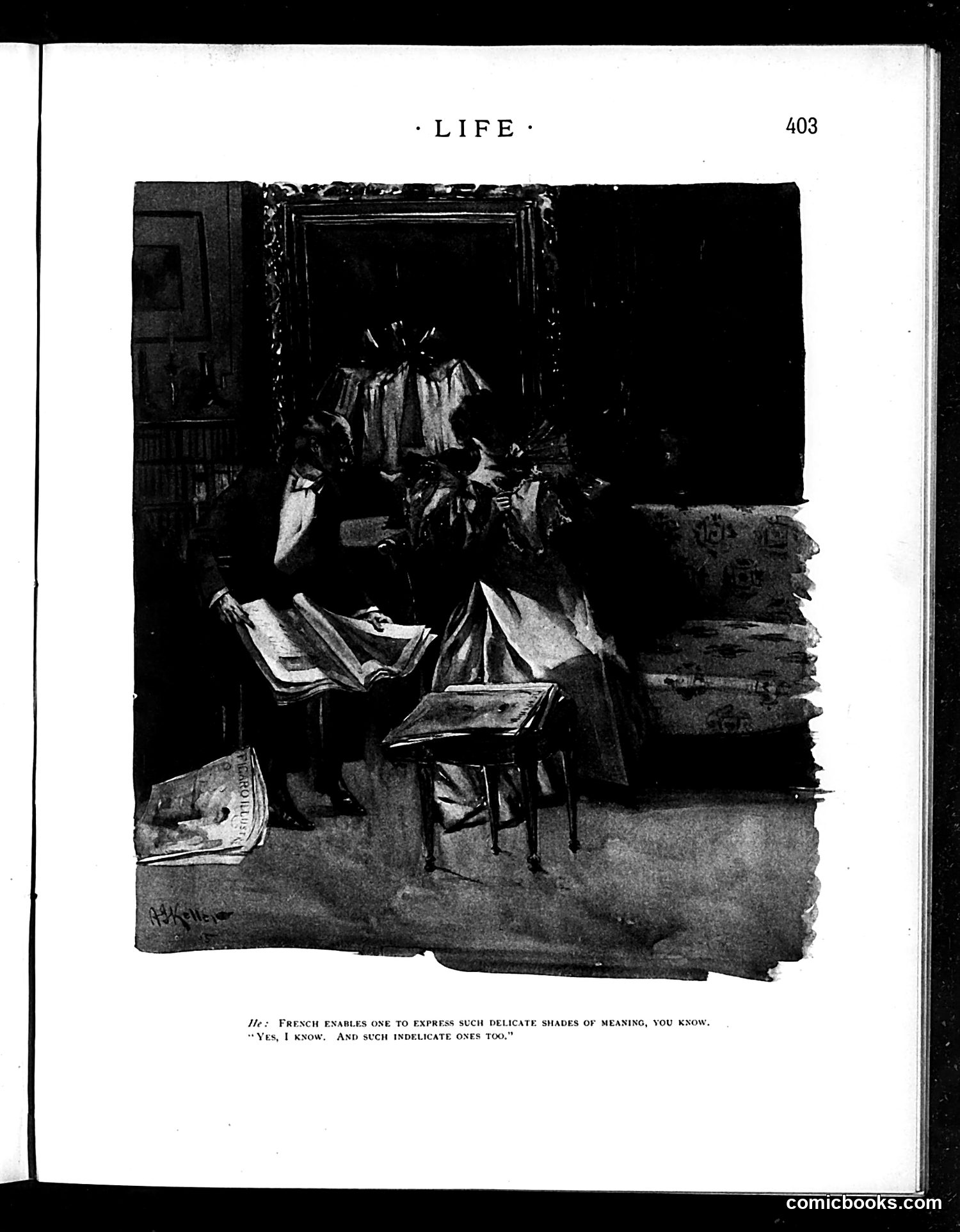
This page from *Life* magazine (page 403) contains a satirical illustration and dialogue. The image shows what appears to be a domestic interior scene with figures in period dress. The dialogue reads: "He: 'FRENCH ENABLES ONE TO EXPRESS SUCH DELICATE SHADES OF MEANING, YOU KNOW.' 'Yes, I KNOW. AND SUCH INDELICATE ONES TOO.'" The satire targets the pretentious use of French language among the upper classes—a common *Life* magazine theme. The male figure attempts to appear cultured by claiming French allows subtle expression, but the female character's response suggests French (or his use of it) equally accommodates crude or vulgar meanings. The joke mocks linguistic affectation and the irony that adopting French doesn't necessarily confer actual refinement or taste.
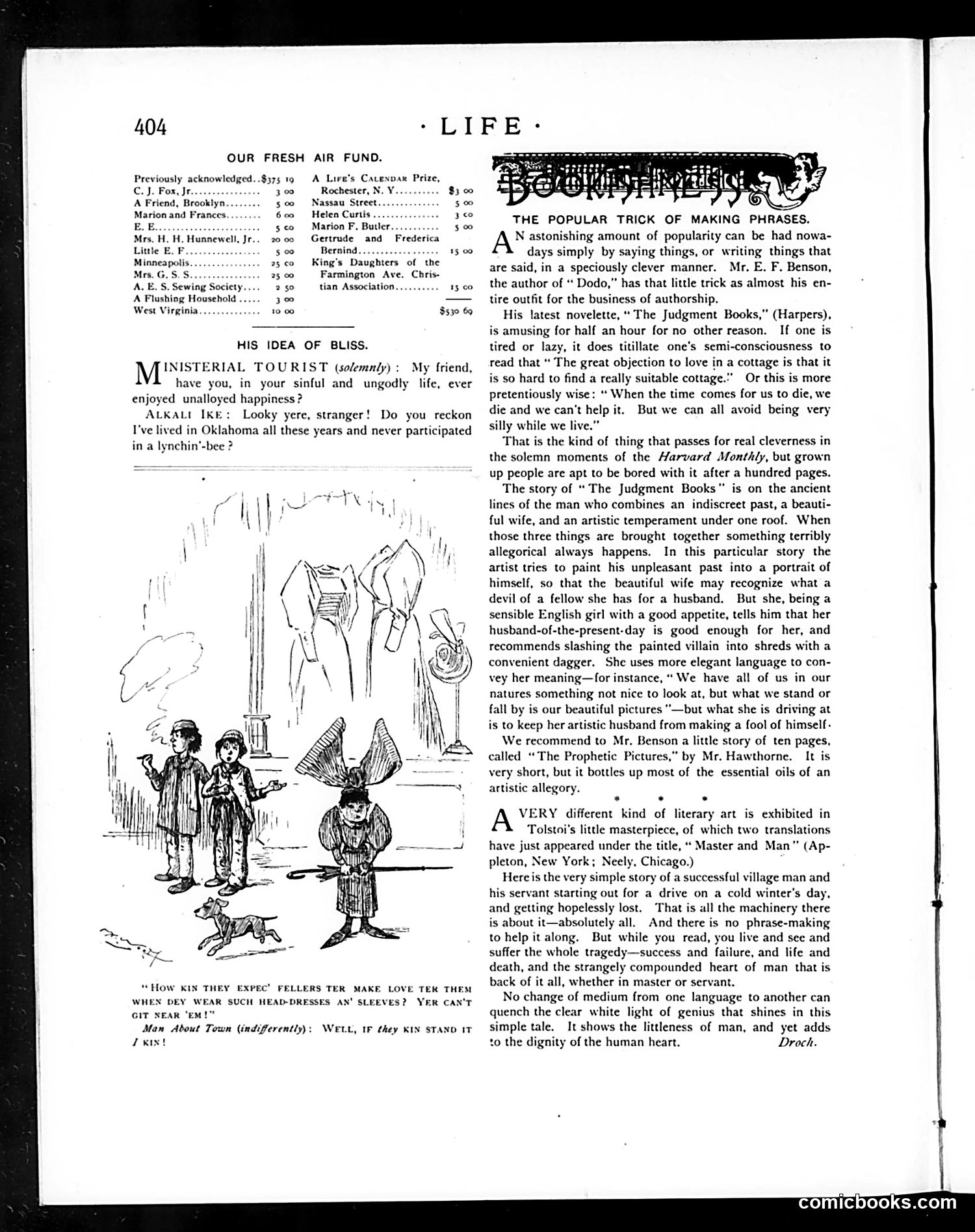
The left side features a cartoon titled "HIS IDEA OF BLISS" depicting a dialogue between a "MINISTERIAL TOURIST" (apparently a clergyman) and "MAN ABOUT TOWN." The ministerial tourist boasts of never participating in a "lynch-bee" despite living in Oklahoma, while the man about town skeptically responds that if such kin (relatives) "stood it," then "yer can't git near 'em!" This satirizes the contrast between Northern religious visitors' moral posturing about Southern lynch violence and the grim reality that such horrors were commonplace and normalized. The cartoon mocks the naive optimism of outsiders regarding racial violence in the American South during this era. The right side discusses literary works, not political satire.
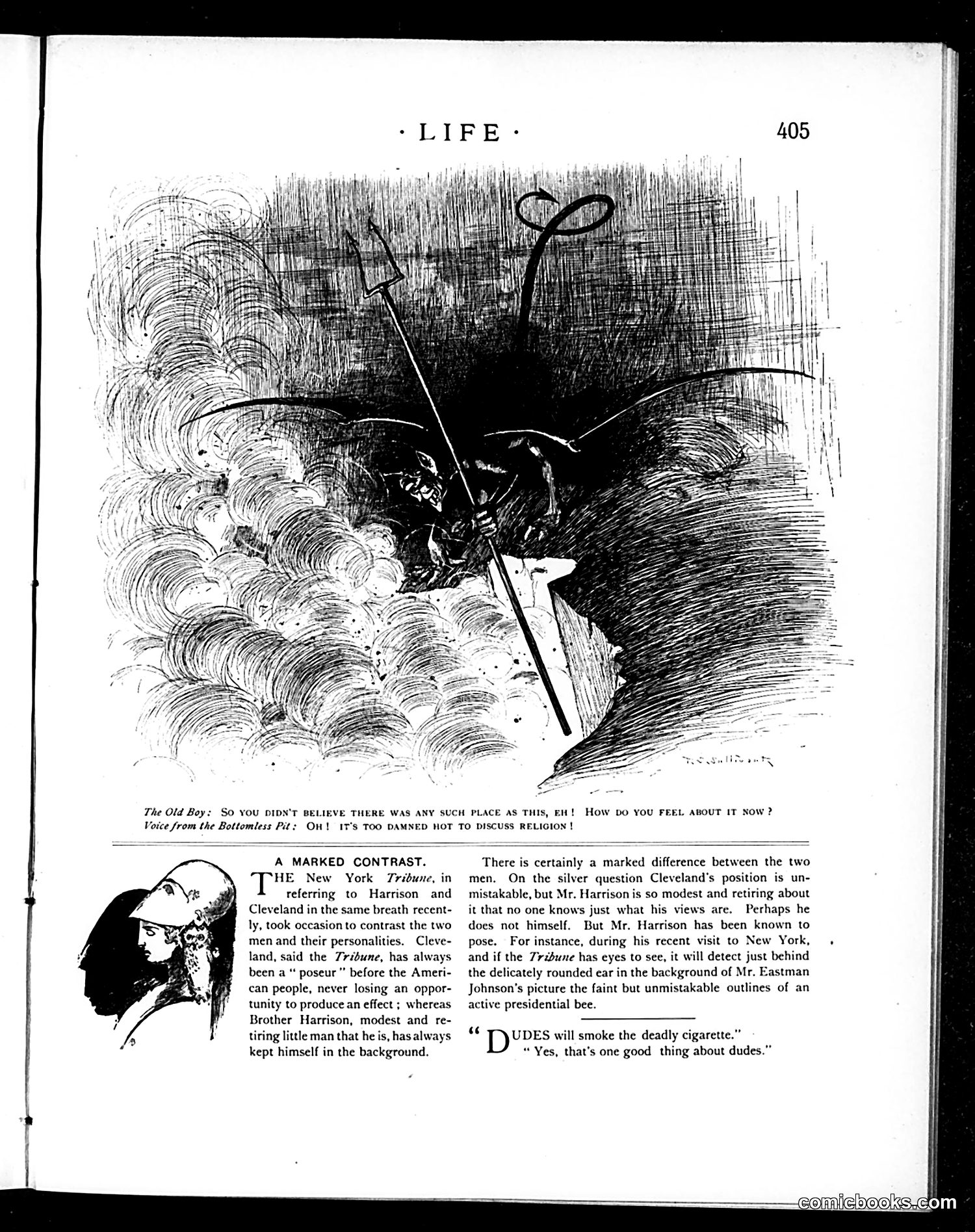
This Life magazine page features political commentary contrasting two figures: **Cleveland** and **Harrison** (likely President Grover Cleveland and Benjamin Harrison, rivals in 1880s-90s politics). The main cartoon depicts an ant or insect in fire, illustrating "The Old Boy's" complaint about religious discussion being "too damned hot." The article "A Marked Contrast" compares the two men's personalities and public personas. The *Tribune* characterized Cleveland as a "poseur" seeking attention, while Harrison is described as modest and retiring, avoiding the spotlight. The piece suggests Harrison maintains a dignified background presence, contrasting sharply with Cleveland's more visible public engagement. The final quoted joke about "dudes" smoking cigarettes appears unrelated commentary on contemporary social habits.
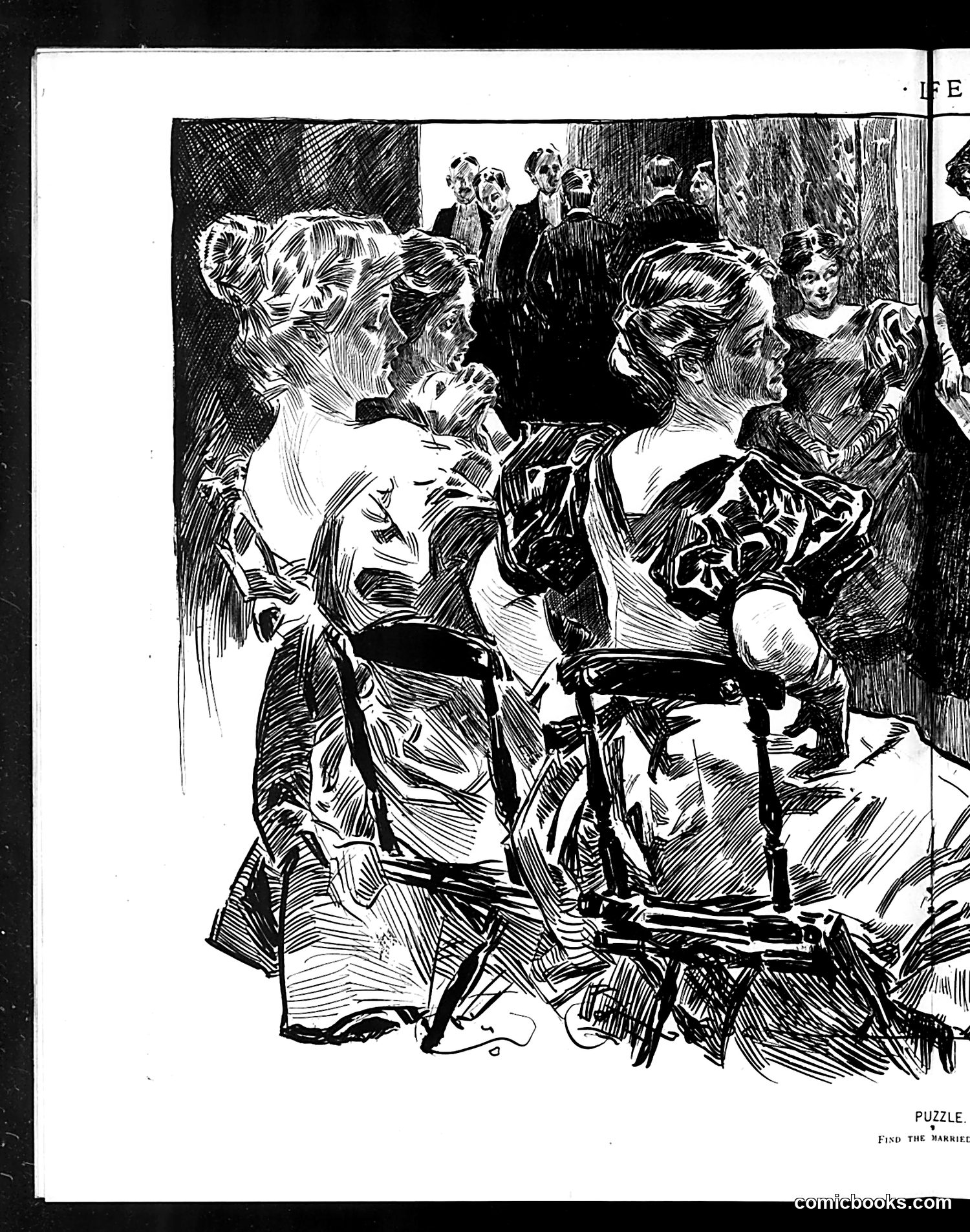
This page contains a puzzle titled "FIND THE MARRIAGE" (visible at bottom right). The illustration shows a social gathering or salon scene with multiple figures in Edwardian-era dress. Two women in the foreground appear to be the focal point, positioned prominently with detailed rendering. The puzzle format—a common feature in Life magazine—asks readers to identify something hidden within the busy scene. In this case, readers must locate visual evidence of a marriage among the many figures present. Without additional context or captions identifying specific individuals, I cannot determine which historical figures or social commentary this references. The style and clothing suggest early 20th-century America, but the specific satirical target remains unclear from the image alone.
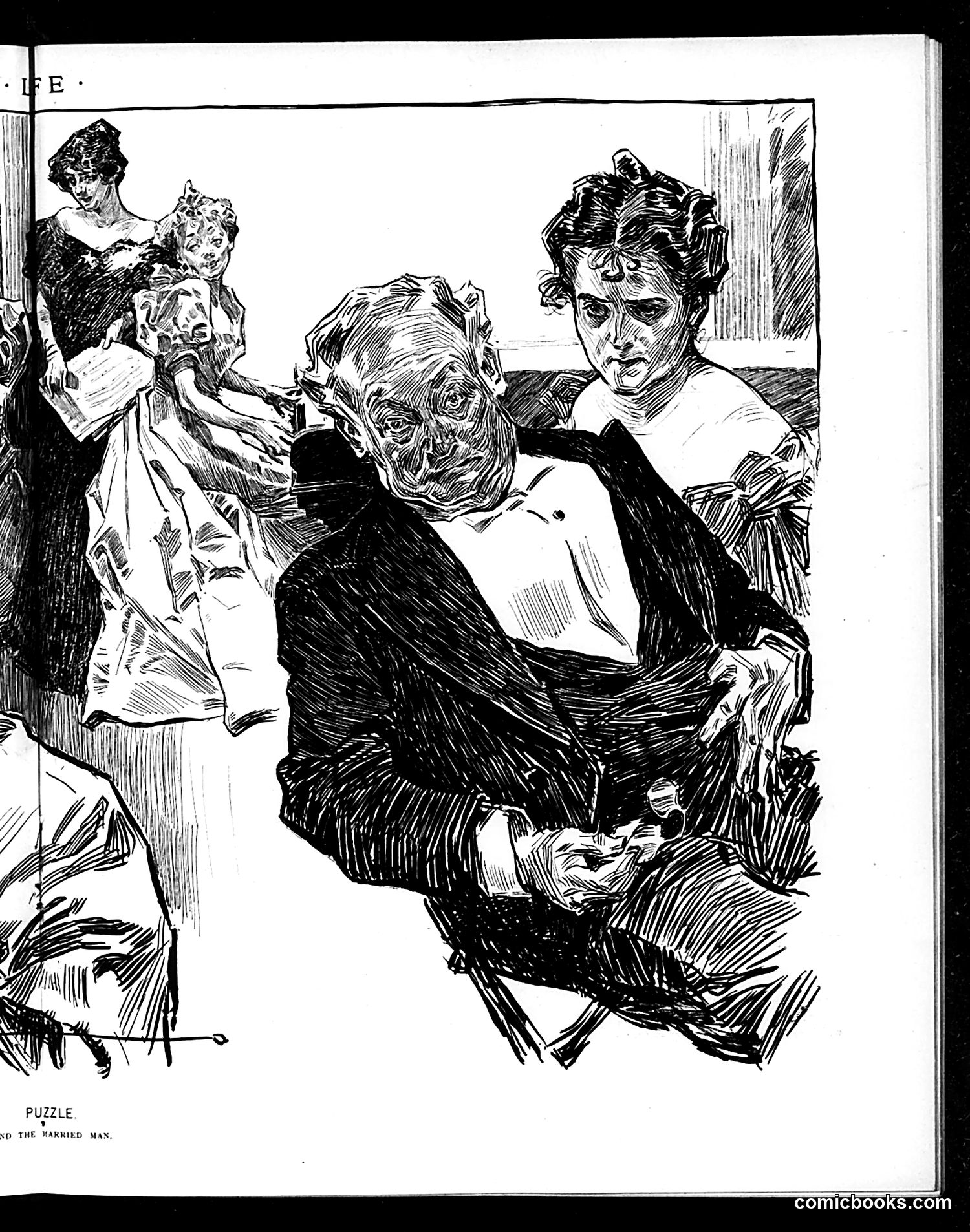
This illustration, titled "Puzzle" and subtitled "And the Married Man," depicts a social scene with multiple figures observing a central male character. The cartoon appears to satirize the confusion or predicament of married men in social situations, likely from the early 1900s based on the artistic style and clothing. The composition suggests commentary on the married man's awkward position—surrounded by women (including what appears to be his wife and other female observers), he seems caught between competing social expectations or interests. The title "Puzzle" implies that understanding or managing marriage and social propriety represents an unsolvable problem for men. The satirical tone typical of *Life* magazine suggests this mocks contemporary anxieties about marital dynamics and male social vulnerability.
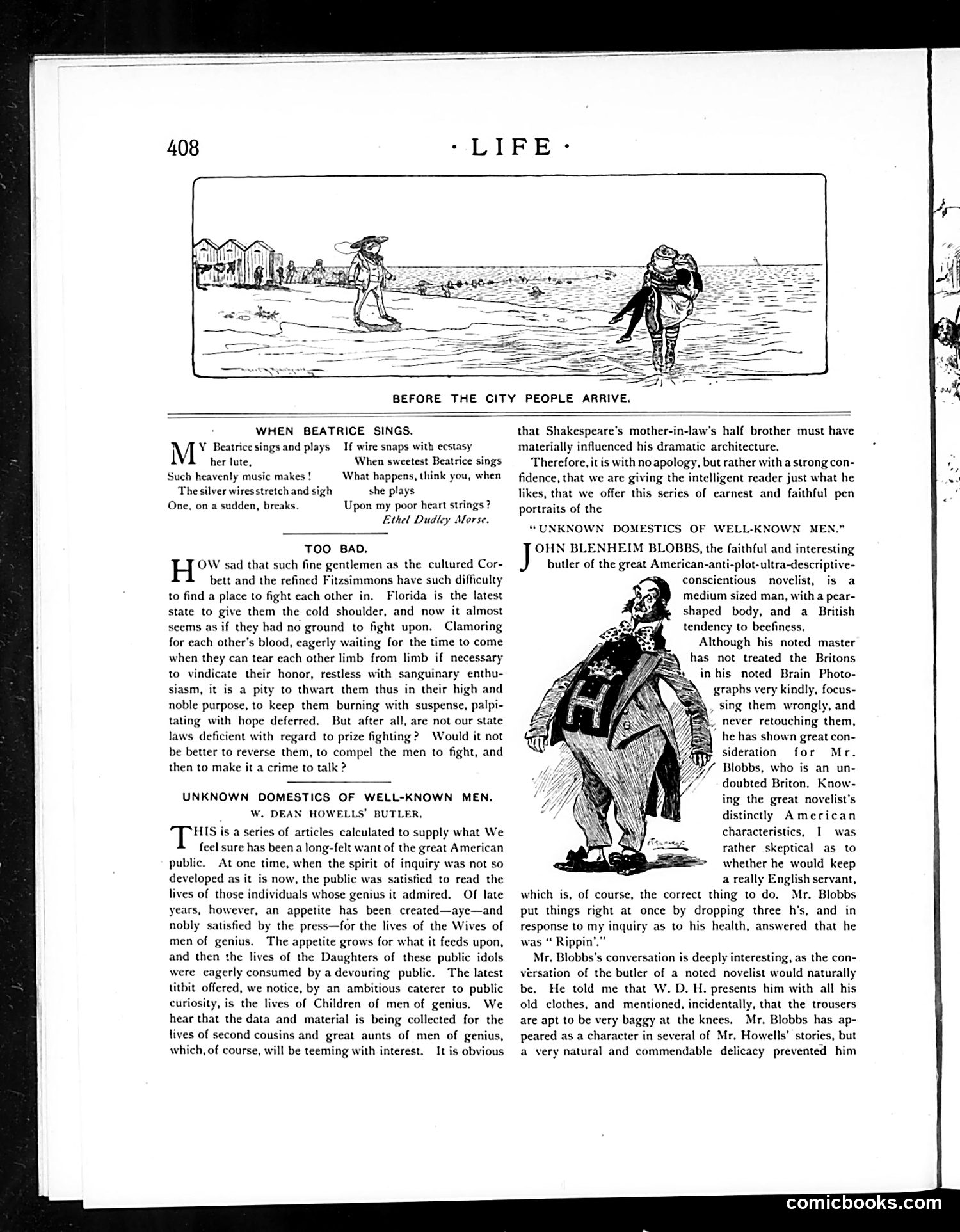
The illustration at the top ("Before the City People Arrive") depicts a beach scene with figures in water and on shore, likely satirizing the contrast between rural/natural simplicity and urban sophistication. The text discusses **W. Dean Howells' butler** and **John Blenheim Blobbs**, a character created by H.G. Wells (the American novelist described as "anti-plot-ultra-descriptive"). The satirical point appears to be commentary on how Wells portrayed English servants in his fiction—specifically criticizing the author's characterization of English butlers as inaccurate or overly baggy at the knees. The piece seems to mock literary pretension and the gap between fictional depictions and reality, while also poking fun at English social conventions.
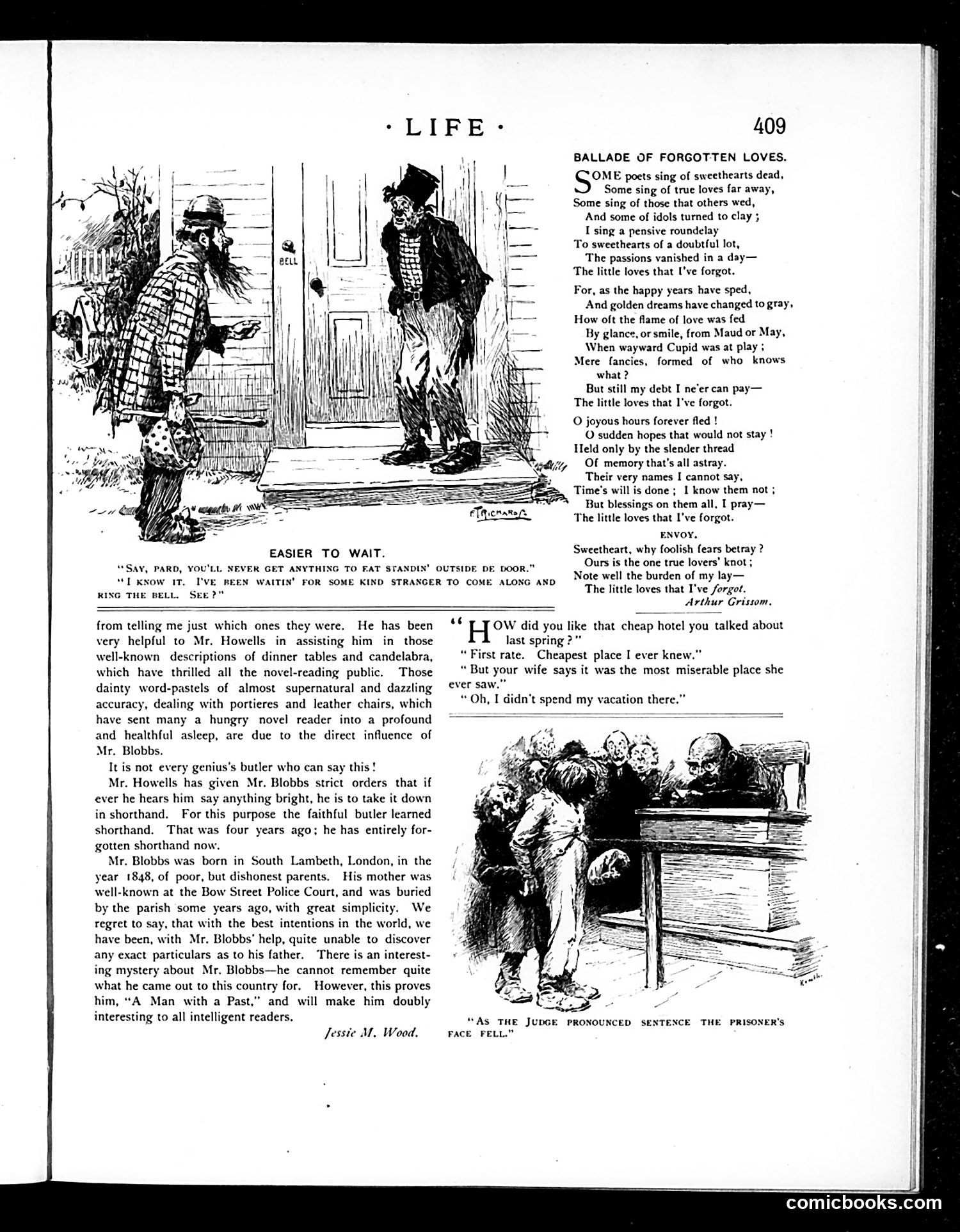
This page contains two separate pieces: 1. **"Easier to Wait"** (top): A cartoon showing two men at a doorway. One tells the other that standing outside a restaurant is useless—he should wait for a "stranger" to invite him in. The joke satirizes either poverty, social climbing, or freeloading behavior—the implication being that the man hopes to gain a free meal through an invitation rather than paying himself. 2. **"Ballade of Forgotten Loves"** (right): A poem by Arthur Grimm about past romantic relationships that have faded from memory over time. It's a sentimental piece reflecting on how passionate loves eventually become forgotten. 3. **Bottom section**: An article about Mr. Hobbs, apparently a butler/servant character, with a biographical narrative and courtroom illustration about a legal sentence. The page mixes humor, sentiment, and biographical content typical of Life magazine's varied editorial approach.
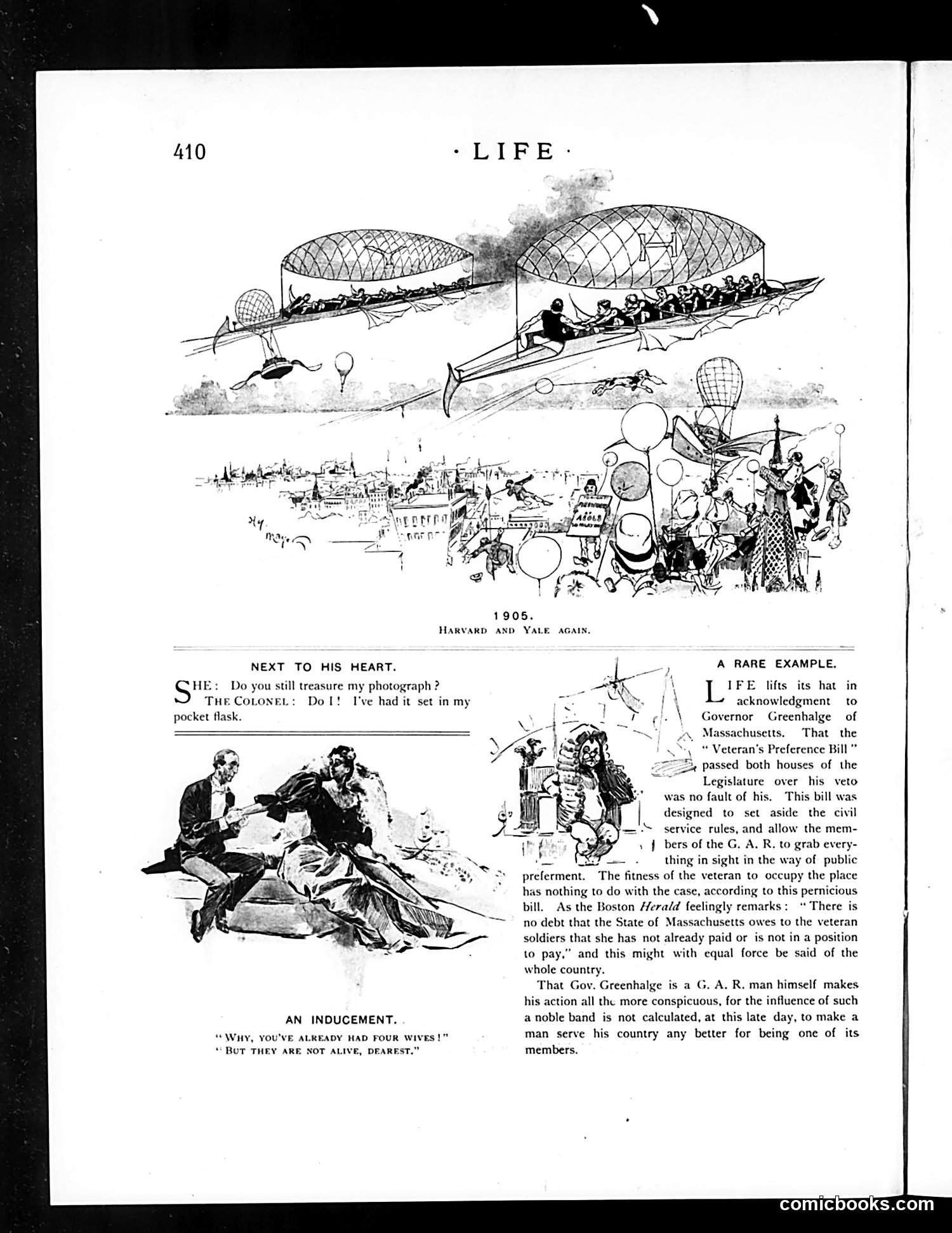
This page contains three separate satirical pieces: **Top illustration** ("Harvard and Yale Again"): Shows fantastical airships above a city, likely mocking the competitive rivalry between these elite universities. **"Next to His Heart"**: A romantic joke where a colonel keeps his sweetheart's photograph in a liquor flask—prioritizing drink over sentiment. **"An Inducement"**: Dark humor about serial marriage, with a man joking he's had four wives who are "not alive"—implying he murdered them for money. **"A Rare Example"**: The substantive political commentary. Life *praises* Governor Greenhalge (Massachusetts) for *vetoing* a "Veteran's Preference Bill" that would have exempted Civil War veterans (G.A.R. members) from civil service merit requirements, allowing them to monopolize government jobs regardless of fitness. Life argues veterans deserve payment, but not preferential hiring that undermines competent governance—a critique of cronyism disguised as patriotism.
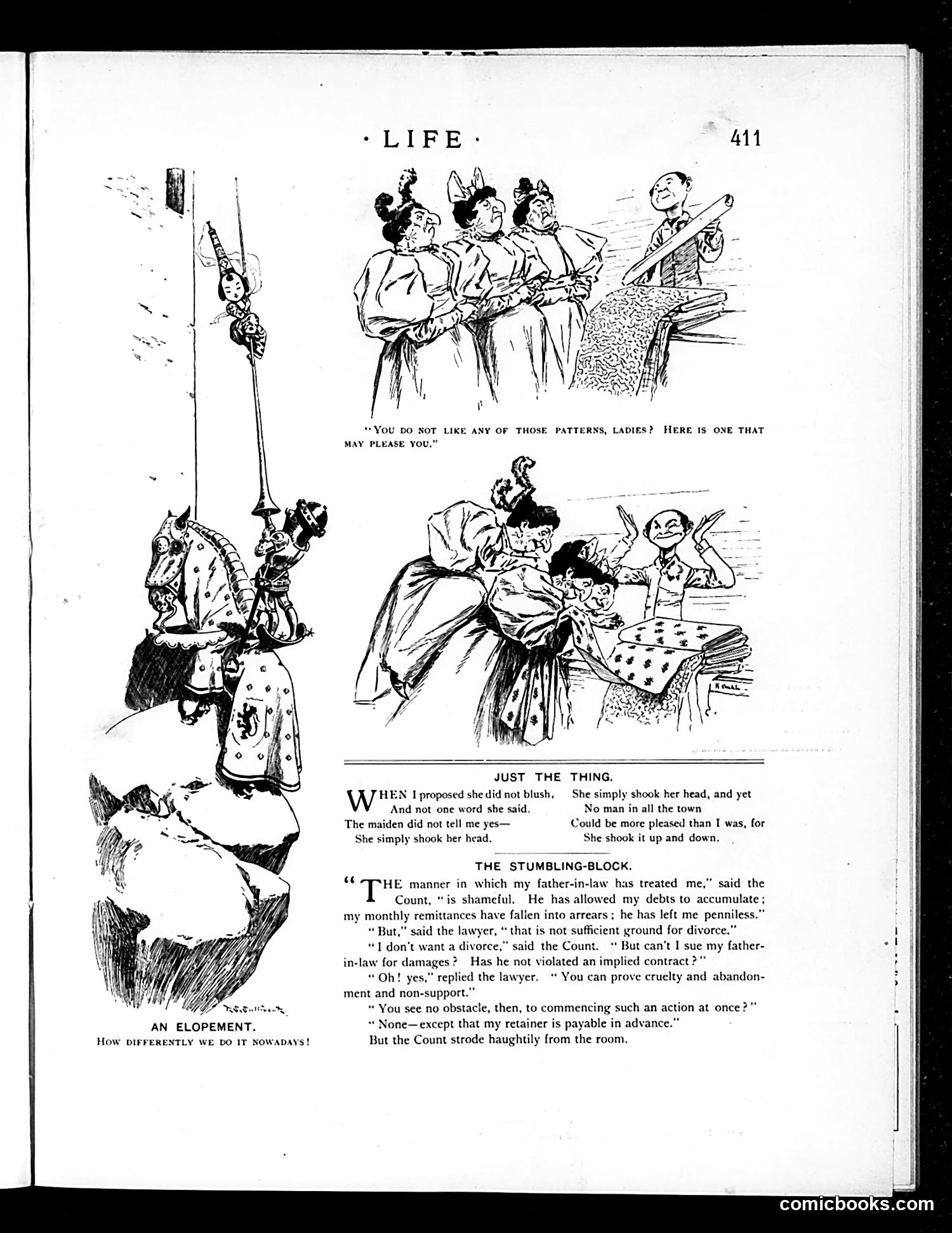
This page contains three satirical pieces typical of Life's humor: **"An Elopement"** (left): A visual joke about changing courtship customs. The dramatic, classical elopement scene contrasts with the caption "How differently we do it nowadays!"—suggesting modern romance lacks the romantic grandeur of earlier eras. **"Just the Thing"** (top right): A humorous poem about a proposal where the woman simply shakes her head "up and down" instead of speaking. The joke plays on ambiguous body language—her nodding could mean yes or no, leaving the suitor hopeful but uncertain. **"The Stumbling-Block"** (center): A satirical legal dialogue. A Continental nobleman (referred to as "Count") seeks to sue his father-in-law for non-support, hoping to profit from family mismanagement. The lawyer agrees grounds exist—until revealing his retainer must be paid upfront. The joke mocks both the Count's mercenary opportunism and lawyers' mercenary nature. All three pieces use humor to critique social pretension, romantic uncertainty, and legal chicanery.
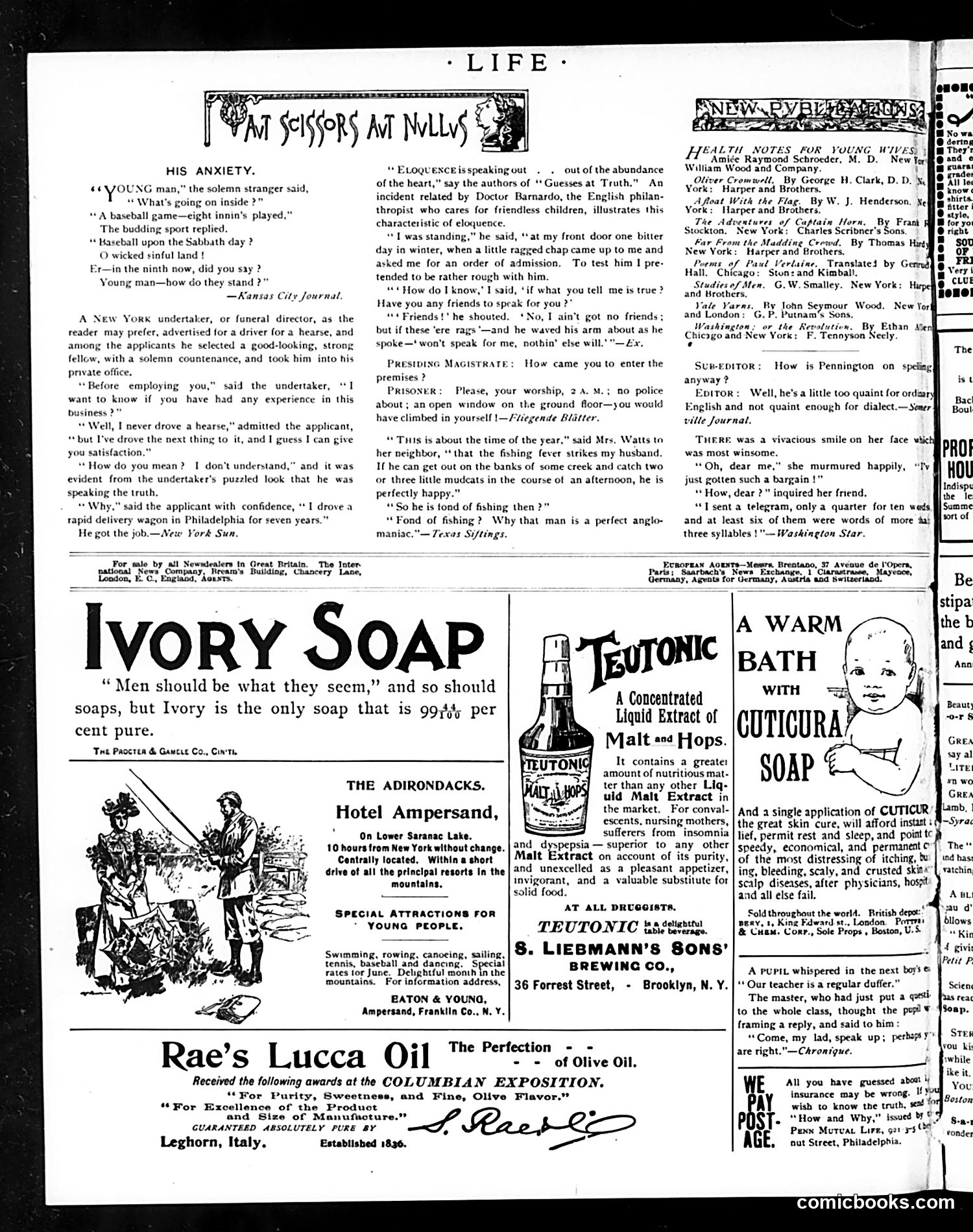
This page contains three distinct humor pieces satirizing social attitudes of the era: **"His Anxiety"** mocks religious hypocrisy. A stern stranger condemns baseball on the Sabbath as "wicked sinful," then—learning the game is in the ninth inning—eagerly asks about the score. The satire targets selective moralism: the man's piety evaporates when entertainment interest takes hold. **The Undertaker Story** (from New York Sun) jokes about euphemistic language. A funeral director hires a "rapid delivery wagon" driver as a hearse driver, finding the skills transferable. The humor lies in the absurd comparison—both involve transporting cargo quickly, but one carries the dead. **The Magistrate Piece** satirizes criminal excuses. A burglar claims he broke in through an open window "you would have climbed in yourself"—essentially arguing the homeowner was negligent, not that the crime was serious. It mocks criminals' illogical self-justifications. The remaining content is period advertisements (Ivory Soap, hotels, beverages), typical of Life's revenue model.
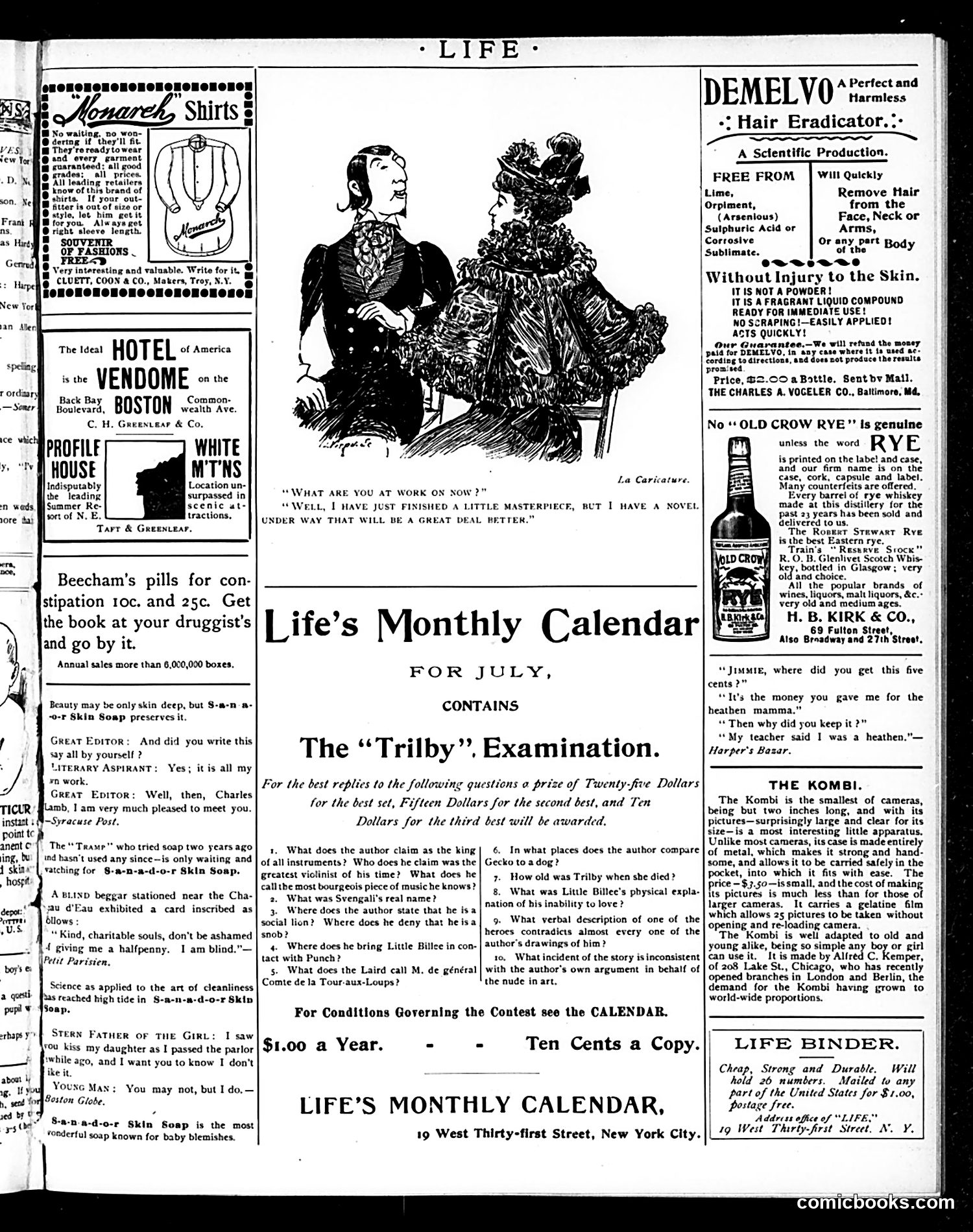
This page is primarily a **advertisements and contest announcement** for *Life* magazine's July issue, not a political cartoon. The central feature is **"The Trilby Examination"**—a literary contest about George du Maurier's novel *Trilby* (1894), then wildly popular. Readers answered trivia questions about the book to win prizes ($25, $15, or $10). The cartoon shows two writers discussing their work, with one claiming his finished "masterpiece" is good, but his novel-in-progress will be "a great deal better"—a gentle satire on literary pretension and the gap between self-perception and reality. The surrounding ads hawked period remedies: Beecham's pills for constipation, S-a-n-a-d-o-r skin soap, DEMELVO hair removal, and "Old Crow Rye" whiskey. The Monarch Shirts ad and Vendome Hotel ads complete the commercial clutter typical of magazines then.
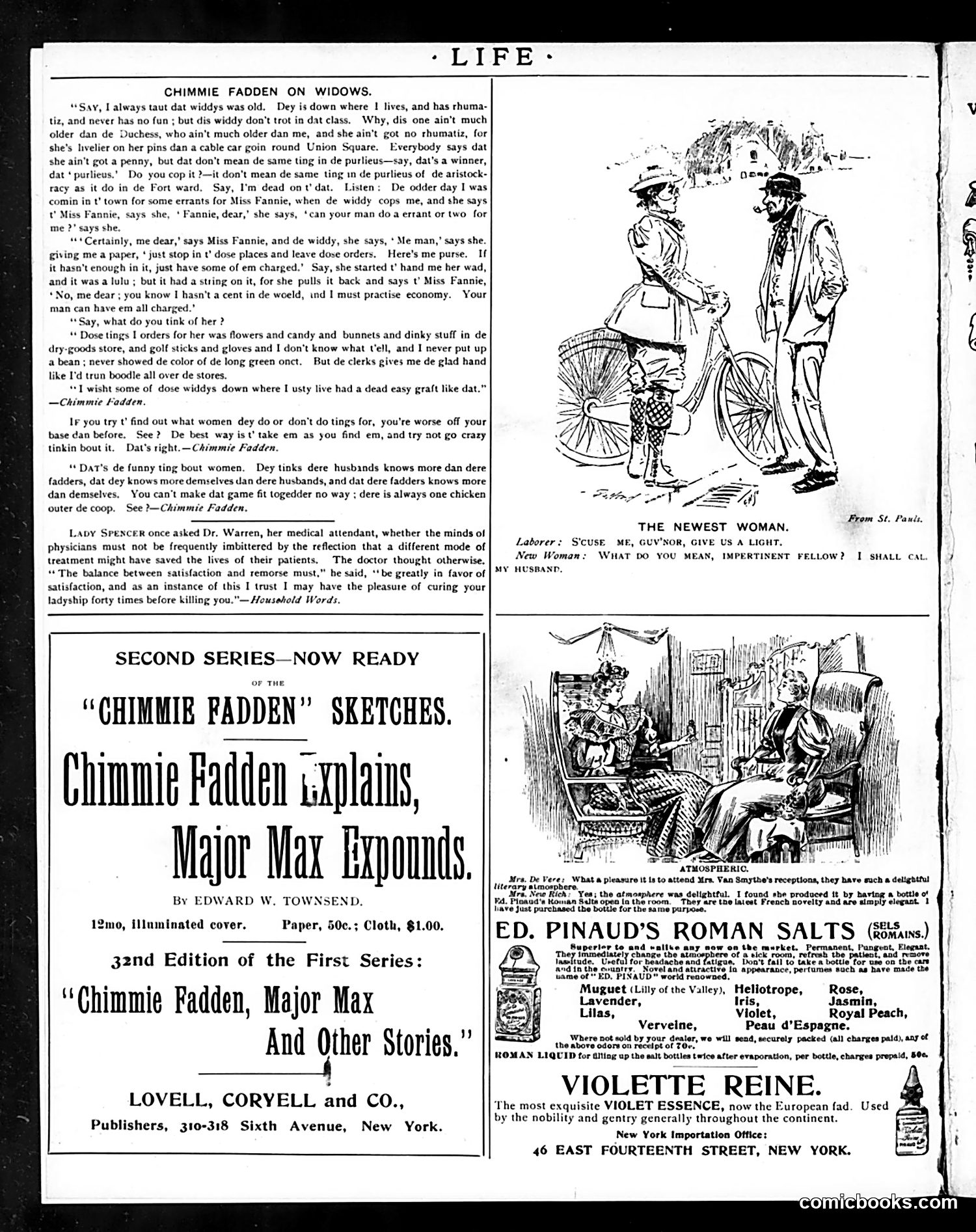
This page showcases **Chimmie Fadden**, a working-class character created by Edward W. Townsend who spoke in exaggerated Lower East Side dialect. The humor relies on Fadden's shrewd observations of social hypocrisy, particularly regarding a wealthy widow who claims poverty while spending freely on credit. The cartoons satirize the "New Woman"—a contemporary social anxiety. The top illustration shows a woman confidently addressing a laborer, disrupting gender norms by her forwardness. The bottom cartoon mocks pretentious "atmospheric" social climbing—Mrs. De Vere and another society woman discussing how opening a bottle of salts creates an elegant ambiance, suggesting their sophistication is entirely artificial. Both segments mock class pretense and changing gender roles. Chimmie represents working-class wit exposing upper-class fakery; the "New Woman" represents anxieties about female independence. The page balances social commentary with lighthearted ridicule of contemporary American society's affectations.