
Life, 1895-06-20 · page 6 of 16
Life — June 20, 1895 — page 6: what you’re looking at
What you’re looking at
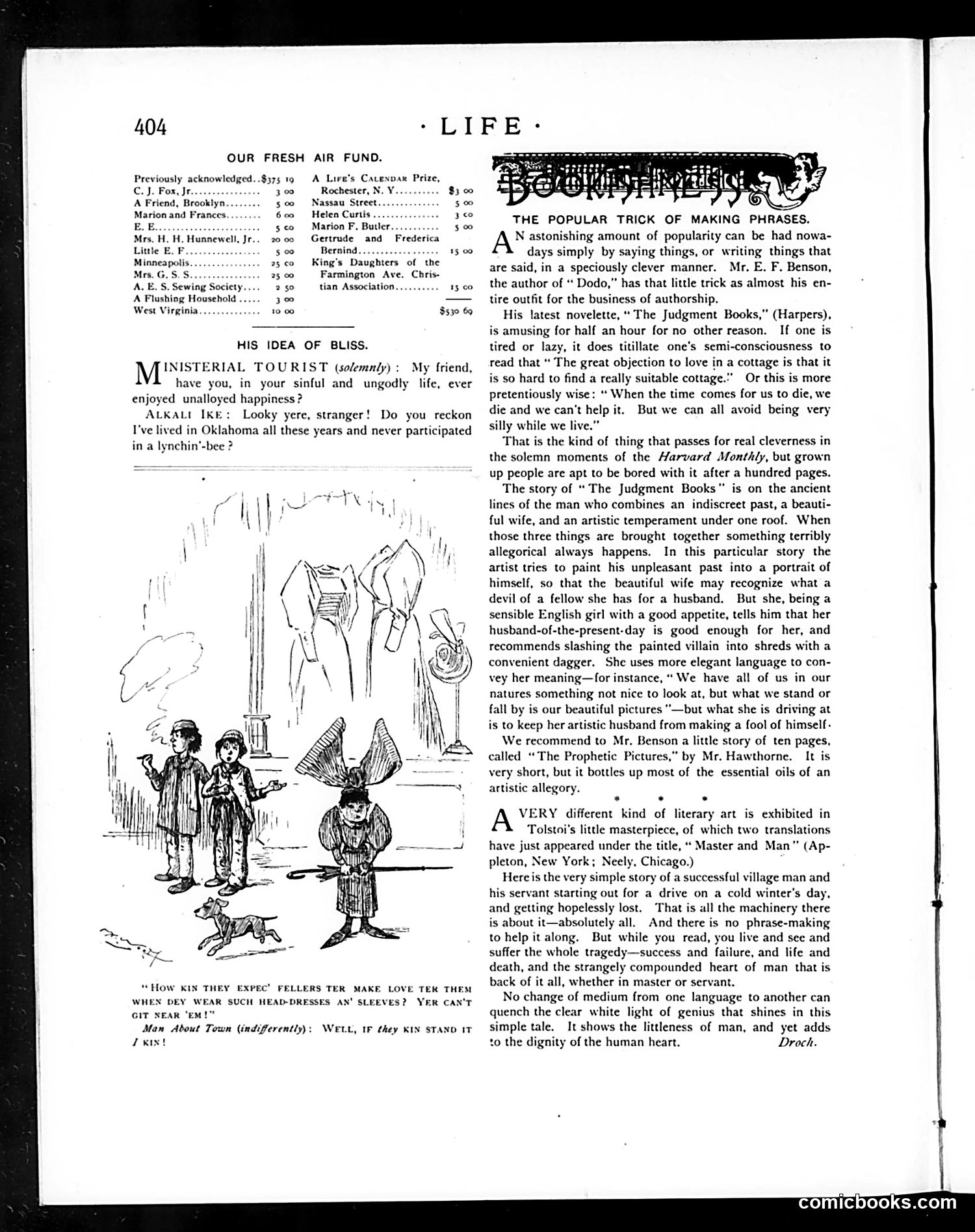
The left side features a cartoon titled "HIS IDEA OF BLISS" depicting a dialogue between a "MINISTERIAL TOURIST" (apparently a clergyman) and "MAN ABOUT TOWN." The ministerial tourist boasts of never participating in a "lynch-bee" despite living in Oklahoma, while the man about town skeptically responds that if such kin (relatives) "stood it," then "yer can't git near 'em!" This satirizes the contrast between Northern religious visitors' moral posturing about Southern lynch violence and the grim reality that such horrors were commonplace and normalized. The cartoon mocks the naive optimism of outsiders regarding racial violence in the American South during this era. The right side discusses literary works, not political satire.
📄 Transcribed text from this page (OCR, searchable)
Machine-transcribed from the original scan — historical spelling and the odd misread are preserved.
404 OUR FRESH AIR FUND. Previously acknowledged..$375 19 A_Live’s Cacexpax Prize, Helen Curtis... 5 i Marion F, Butler Mrs. H Frederica Little was King’s Daughters of the aoeten Farmington Ave. Chris- Sewing Society. tian Association... A Flushing Household . West Virginia... . HIS IDEA OF BLISS. INISTERIAL TOURIST (solemnly): My friend, have you, in your sinful and ungodly life, ever enjoyed unalloyed happiness ? ALKALI IKE: Looky yere, stranger! Do you reckon I've lived in Oklahoma all these years and never participated in a lynchin'-bee ? “How KIN THEY EXPEC’ FELLERS TER MAK: WHEN DEY WEAR SUCH HEAD-DRESSES AN' SLEEVES? YER CAN'T GIT NEAR 'EM!” Man About Town (indifferently): 7 KIN! WELL, IF they KIN STAND IT THE POPULAR TRICK OF MAKING PHRASES. A” astonishing amount of popularity can be had nowa- days simply by saying things, or writing things that are said, in a speciously clever manner. Mr. E. F. Benson, the author of “ Dodo,” has that little trick as almost his en- tire outfit for the business of authorship. His latest novelette, * The Judgment Books,” (Harpers), is amusing for half an hour for no other reason. If one is tired or lazy, it does titillate one’s semi-consciousness to read that “ The great objection to love in a cottage is that it is so hard to find a really suitable cottage.:’ Or this is more pretentiously wise: ‘‘ When the time comes for us to die, we die and we can’t help it. But we can all avoid being very silly while we live.” That is the kind of thing that passes for real cleverness in the solemn moments of the Harvard Monthly, but grown up people are apt to be bored with it after a hundred pages. The story of “The Judgment Books" is on the ancient lines of the man who combines an indiscreet past, a beauti- ful wife, and an artistic temperament under one roof. When those three things are brought together something terribly allegorical always happens. In this particular story the artist tries to paint his unpleasant past into a portrait of himself, so that the beautiful wife may recognize what a devil of a fellow she has for a husband. But she, being a sensible English girl with a good appetite, tells him that her husband-of-the-present-day is good enough for her, and recommends slashing the painted villain into shreds with a convenient dagger. She uses more elegant language to con- vey her meaning—for instance, * We have all of us in our natures something not nice to look at, but what we stand or fall by is our beautiful pictures "—but what she is driving at is to keep her artistic husband from making a fool of himself. We recommend to Mr. Benson a little story of ten pages, called “The Prophetic Pictures,” by Mr. Hawthorne. It is very short, but it bottles up most of the essential oils of an artistic allegory. . . VERY different kind of literary art is exhibited in Tolstoi’s little masterpiece, of which two translations have just appeared under the title, “ Master and Man" (Ap- pleton, New York; Neely, Chicago.) Hereis the very simple story of a successful village man and his servant starting out for a drive on a cold winter's day, and getting hopelessly lost. ‘That is all the machinery there is about it—absolutely all. And there is no phrase-making to help it along. But while you read, you live and see and suffer the whole tragedy—success and failure, and life and death, and the strangely compounded heart of man that is back of it all, whether in master or servant. No change of medium from one language to another can quench the clear white light of genius that shines in this simple tale. It shows the littleness of man, and yet adds to the dignity of the human heart. Droch. comicbooks.com