
Life, 1895-06-20 · page 10 of 16
Life — June 20, 1895 — page 10: what you’re looking at
What you’re looking at
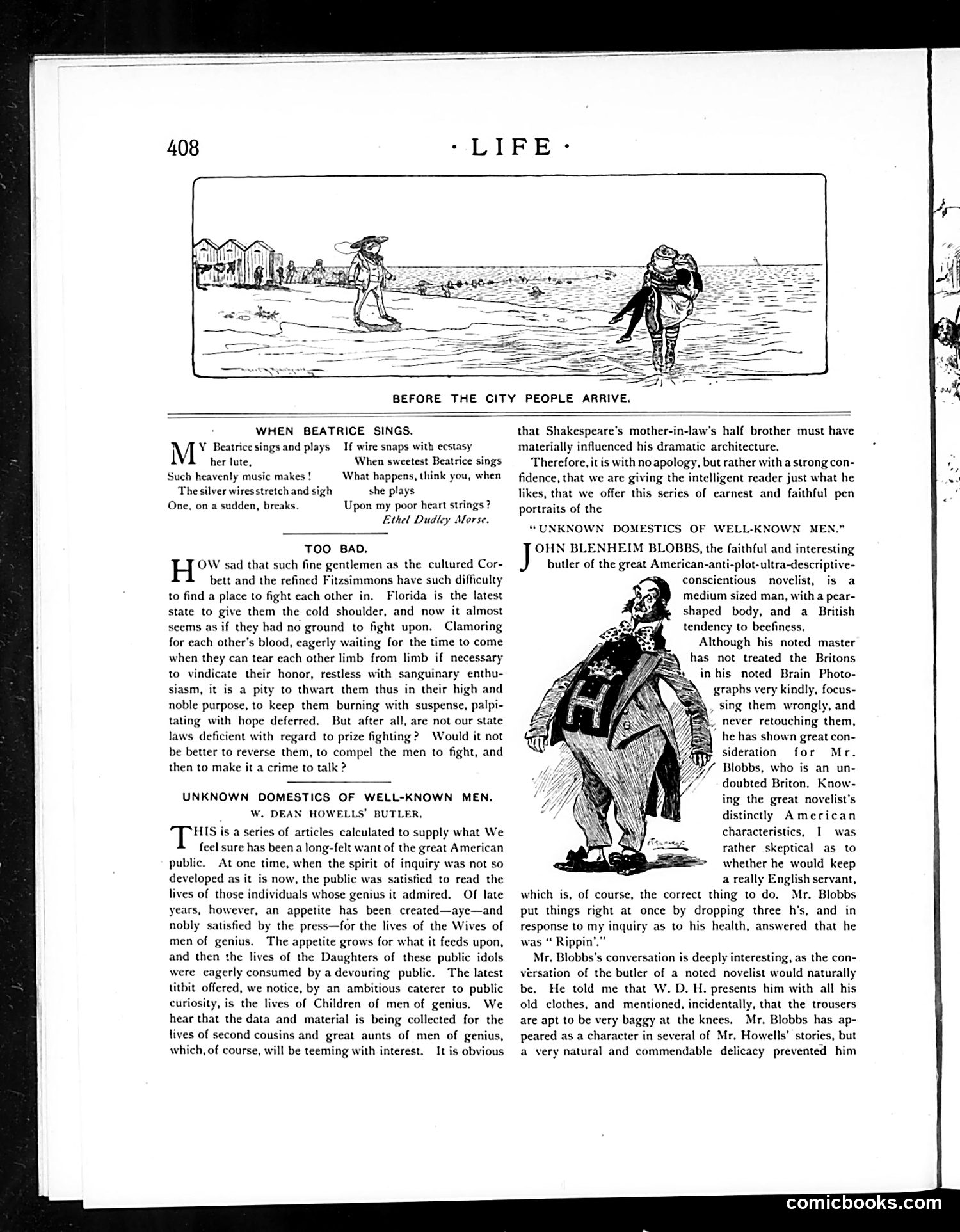
The illustration at the top ("Before the City People Arrive") depicts a beach scene with figures in water and on shore, likely satirizing the contrast between rural/natural simplicity and urban sophistication. The text discusses **W. Dean Howells' butler** and **John Blenheim Blobbs**, a character created by H.G. Wells (the American novelist described as "anti-plot-ultra-descriptive"). The satirical point appears to be commentary on how Wells portrayed English servants in his fiction—specifically criticizing the author's characterization of English butlers as inaccurate or overly baggy at the knees. The piece seems to mock literary pretension and the gap between fictional depictions and reality, while also poking fun at English social conventions.
📄 Transcribed text from this page (OCR, searchable)
Machine-transcribed from the original scan — historical spelling and the odd misread are preserved.
BEFORE THE CITY PEOPLE ARRIVE. WHEN BEATRICE SINGS. Y Beatrice singsand plays If wire snaps with ecstasy i her lute, When sweetest Beatrice sings Such heavenly music makes! What happens, think you, when The silver wires stretch and sigh she plays One, on a sudden, breaks. Upon my poor heart strings? Ethel Dudley Morse. TOO BAD. Ho sad that such fine gentlemen as the cultured Cor- bett and the refined Fitzsimmons have such difficulty to find a place to fight each other in. Florida is the latest state to give them the cold shoulder, and now it almost seems as if they had no ground to fight upon. Clamoring for each other's blood, eagerly waiting for the time to come when they can tear each other limb from limb if necessary to vindicate their honor, restless with sanguinary enthu- siasm, it is a pity to thwart them thus in their high and noble purpose, to keep them burning with suspense, palpi- tating with hope deferred. But after all, are not our state laws deficient with regard to prize fighting? Would it not be better to reverse them, to compel the men to fight, and then to make it a crime to talk ? UNKNOWN DOMESTICS OF WELL-KNOWN MEN. W. DEAN HOWELLS’ BUTLER. HIS is a series of articles calculated to supply what We feel sure has been a long-felt want of the great American public. Atone time, when the spirit of inquiry was not so developed as it is now, the public was satisfied to read the lives of those individuals whose genius it admired. Of late years, however, an appetite has been created—aye—and nobly satisfied by the press—for the lives of the Wives of men of geni The appetite grows for what it feeds upon, and then the lives of the Daughters of these public idols were eagerly consumed by a devouring public. The latest titbit offered, we notice, by an ambitious caterer to public curiosity, is the lives of Children of men of genius. We hear that the data and material is being collected for the lives of second cousins and great aunts of men of genius, which, of course, will be teeming with interest. It is obvious that Shakespeare's mother-in-law’s half brother must have materially influenced his dramatic architecture. Therefore, it is with no apology, but rather with a strong con- fidence, that we are giving the intelligent reader just what he likes, that we offer this series of earnest and faithful pen portraits of the “UNKNOWN DOMESTICS OF WELL-KNOWN ME) OHN BLENHEIM BLOBBS, the faithful and interesting J butler of the great American-anti-plot-ultra-descriptive- conscientious novelist, is a medium sized man, with a pear- shaped body, and a British tendency to beefiness. Although his noted master has not treated the Britons in his noted Brain Photo- graphs very kindly, focus- , sing them wrongly, and never retouching them, he has shown great con- py, sideration for Mr. yf Blobbs, who is an un- doubted Briton. Know- ing the great novelist’s distinctly American characteristics, I was rather skeptical as to whether he would keep a really English servant, which is, of course, the correct thing to do. Mr. Blobbs put things right at once by dropping three h's, and in response to my inquiry as to his health, answered that he was “ Rippin’, Mr. Blobbs’s conversation is deeply interesting, as the con- versation of the butler of a noted novelist would naturally be. He told me that W. D. H. presents him with all his old clothes, and mentioned, incidentally, that the trousers are apt to be very baggy at the knees. Mr. Blobbs has ap- peared as a character in several of Mr. Howells’ stories, but a very natural and commendable delicacy prevented him comicbooks.com