
Life, 1895-06-20 · page 4 of 16
Life — June 20, 1895 — page 4: what you’re looking at
What you’re looking at
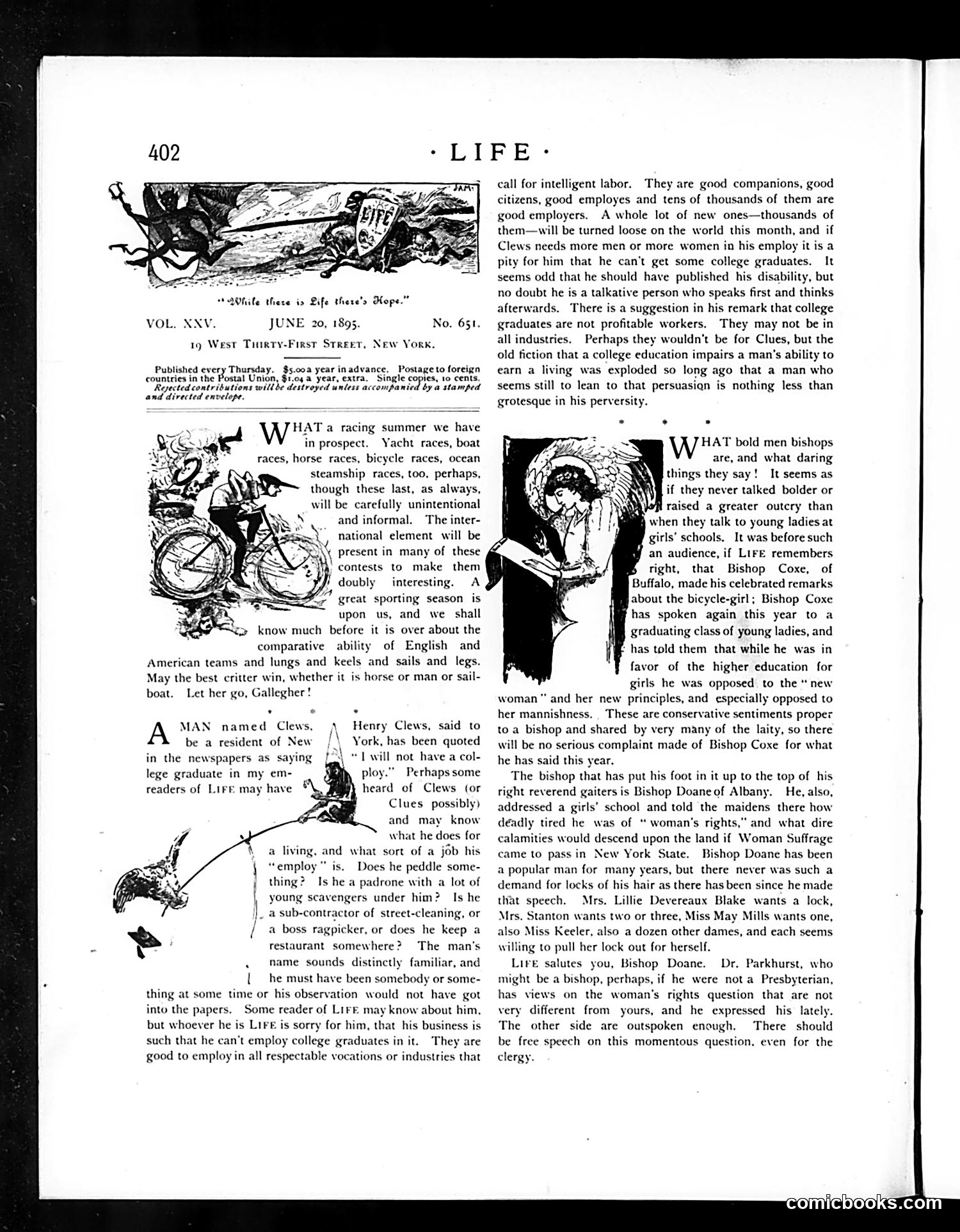
The page contains two main satirical pieces: **Left section ("What a racing summer"):** Satirizes the proliferation of summer racing events—yacht races, horse races, bicycle races, ocean steamship races. The cartoon mocks how these competitions have become numerous and commercially driven, with the implicit critique that they're "carefully unintentional and informal" while actually being nationalistic spectacles comparing English versus American athletic prowess. **Right section ("What bold men bishops are"):** Satirizes Bishop Coxe of Buffalo for his recent controversial remarks to schoolgirls opposing the "new woman" and women's rights/suffrage. The piece suggests his anti-feminist stance is outdated compared to more progressive clergy like Dr. Parkhurst, arguing even clergymen should support free speech on women's rights rather than actively opposing them. Both pieces critique conservative institutional resistance to social change.
📄 Transcribed text from this page (OCR, searchable)
Machine-transcribed from the original scan — historical spelling and the odd misread are preserved.
-LIFE: hile there is Life there's Hope.” VOL. XXV. JUN 19 West Tinrty-First Street, New York. 20, 1895. No. 651. Published every Thursday. $5.00a year inadvance. Postage to foreign countries in the Postal Union, $1.04 a year, extra. Single copies, 10 cents. Rejected contributions willbe destroyed untess accompanied by a stamped and directed envelope. HAT a racing summer we have in prospect. Yacht races, boat races, horse races, bicycle races, ocean steamship races, too, perhaps, though these last, as always, will be carefully unintentional and informal. The inter- national element will be \ present in many of these }' contests to make them Ji doubly interesting. A ee’ great sporting season is o— upon us, and we. shall <x know much before it is over about the comparative ability of English and American teams and lungs and keels and sails and legs. May the best critter win, whether it is horse or man or sail- Let her go, Gallegher ! MAN named Henry Clews, said to be a resident of New / \ York, has been quoted apers as saying [| “1 will not have a col- fy ploy.” Perhaps some boat. Clews, in the news; lege graduate in my em- readers of Lire may have ae 23) heard of Clews (or Clues possibly) and may know what he does for a living, and what sort of a job his “employ ” is. Does he peddle some- thing? Is he a padrone with a lot of young scavengers under him? Is he _ a sub-contractor of street-cleaning, or a boss ragpicker, or does he keep a restaurant somewhere? The man’s «fame sounds distinctly familiar, and [he must have been somebody or some- thing at some time or his observation would not have got into the papers, Some reader of LiFe may know about him, but whoever he is LiFe is sorry for him, that his business is such that he can't employ college graduates in it. They are good to employ in all respectable vocations or industries that call for intelligent labor. They are good companions, good citizens, good employes and tens of thousands of them are good employers. A whole lot of new ones—thousands of them—will be turned loose on the world this month, and if Clews needs more men or more women in his employ it is a pity for him that he can’t get some college graduates. It seems odd that he should have published his disability, but no doubt he is a talkative person who speaks first and thinks afterwards. There is a suggestion in his remark that college graduates are not profitable workers. They may not be in all industries. Perhaps they wouldn't be for Clues, but the old fiction that a college education impairs a man’s ability to earn a living was exploded so long ago that a man who seems still to lean to that persuasiqn is nothing less than grotesque in his perversity. . . VV Bar bold men bishops are, and what daring things they say! It seems as if they never talked bolder or raised a greater outcry than when they talk to young ladies at girls’ schools. It was before such an audience, if LiFe remembers right, that Bishop Coxe, of Buffalo, made his celebrated remarks about the bicycle-girl; Bishop Coxe has spoken again this year to a graduating class of young ladies, and - has told them that while he was in favor of the higher education for girls he was opposed to the “new woman" and her new principles, and especially opposed to her mannishness. These are conservative sentiments proper toa bishop and shared by very many of the laity, so there will be no serious complaint made of Bishop Coxe for what he has said this year. The bishop that has put his foot in it up to the top of his right reverend gaiters is Bishop Doane of Albany. He, also, addressed a girls’ school and told the maidens there how deadly tired he was of “woman's rights,” and what dire calamities would descend upon the land if Woman Suffrage came to pass in New York State. Bishop Doane has been a popular man for many years, but there never was such a demand for locks of his hair as there has been since he made that speech. Mrs. Lillie Devereaux Blake wants a lock, Mrs. Stanton wants two or three, Miss May Mills wants one, also Miss Keeler, also a dozen other dames, and each seems willing to pull her lock out for herself. Lire salutes you, Bishop Doane. Dr. Parkhurst, who might be a bishop, perhaps, if he were not a Presbyterian, has views on the woman's rights question that are not very different from yours, and he expressed his lately. The other side are outspoken enough. There should be free speech on this momentous question. even for the clergy.