
A complete issue · 18 pages · 1895
Life — May 2, 1895
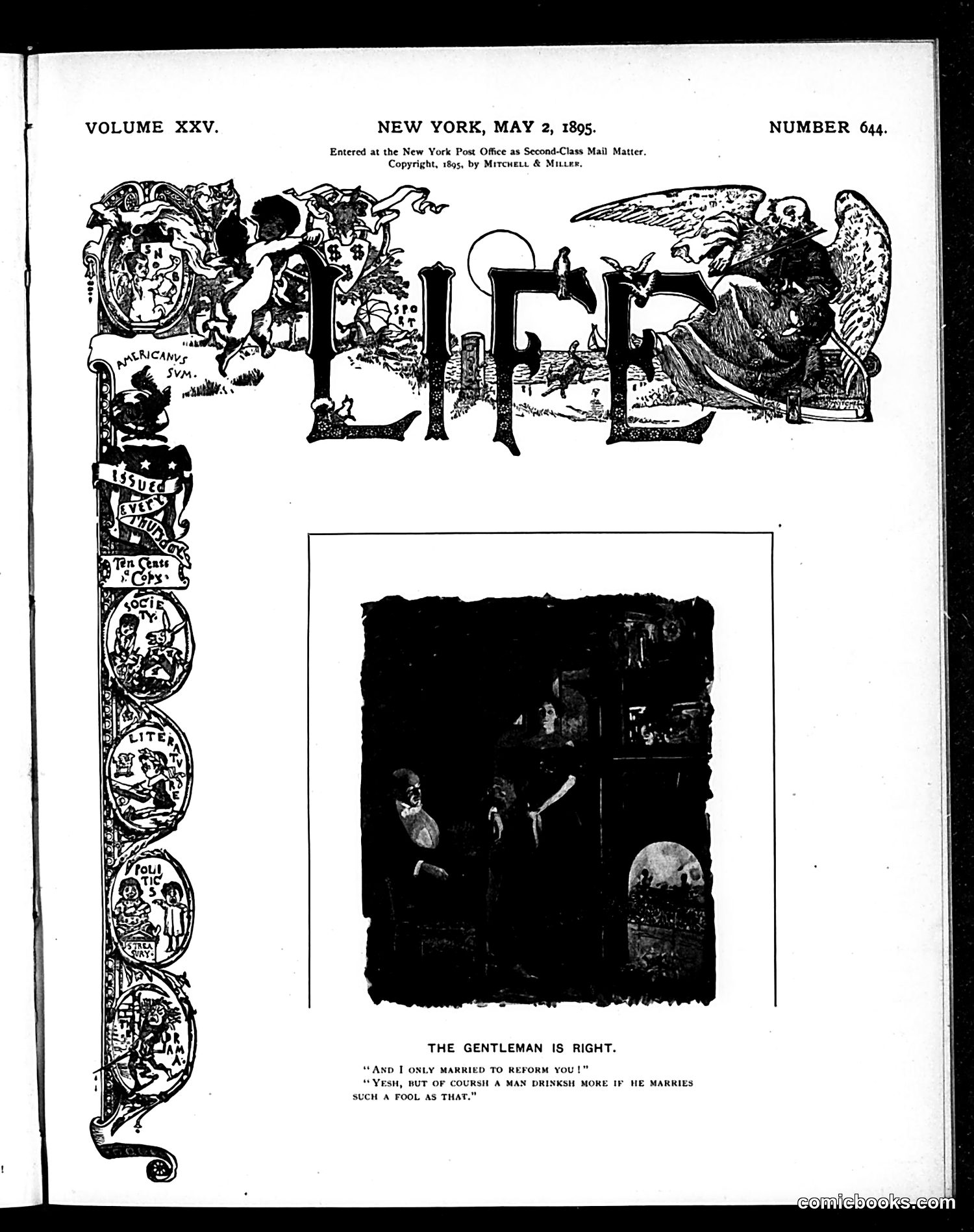
This page features a satirical illustration titled "The Gentleman Is Right," accompanied by a dialogue quote about marriage and drinking. The main image shows what appears to be a domestic scene with figures in period clothing, though the photograph's darkness makes specific details difficult to discern. The accompanying text presents a cynical exchange about marriage: a man claims he married "to reform you," while a woman responds that "of course a man drinketh more if he marries such a fool as that"—suggesting marital discord and the husband's continued drinking habits. The ornate decorative border on the left contains small vignettes illustrating various scenes, typical of Life's design aesthetic. This appears to be satirizing Victorian marriage expectations and male behavior, a recurring theme in 1890s American humor magazines.
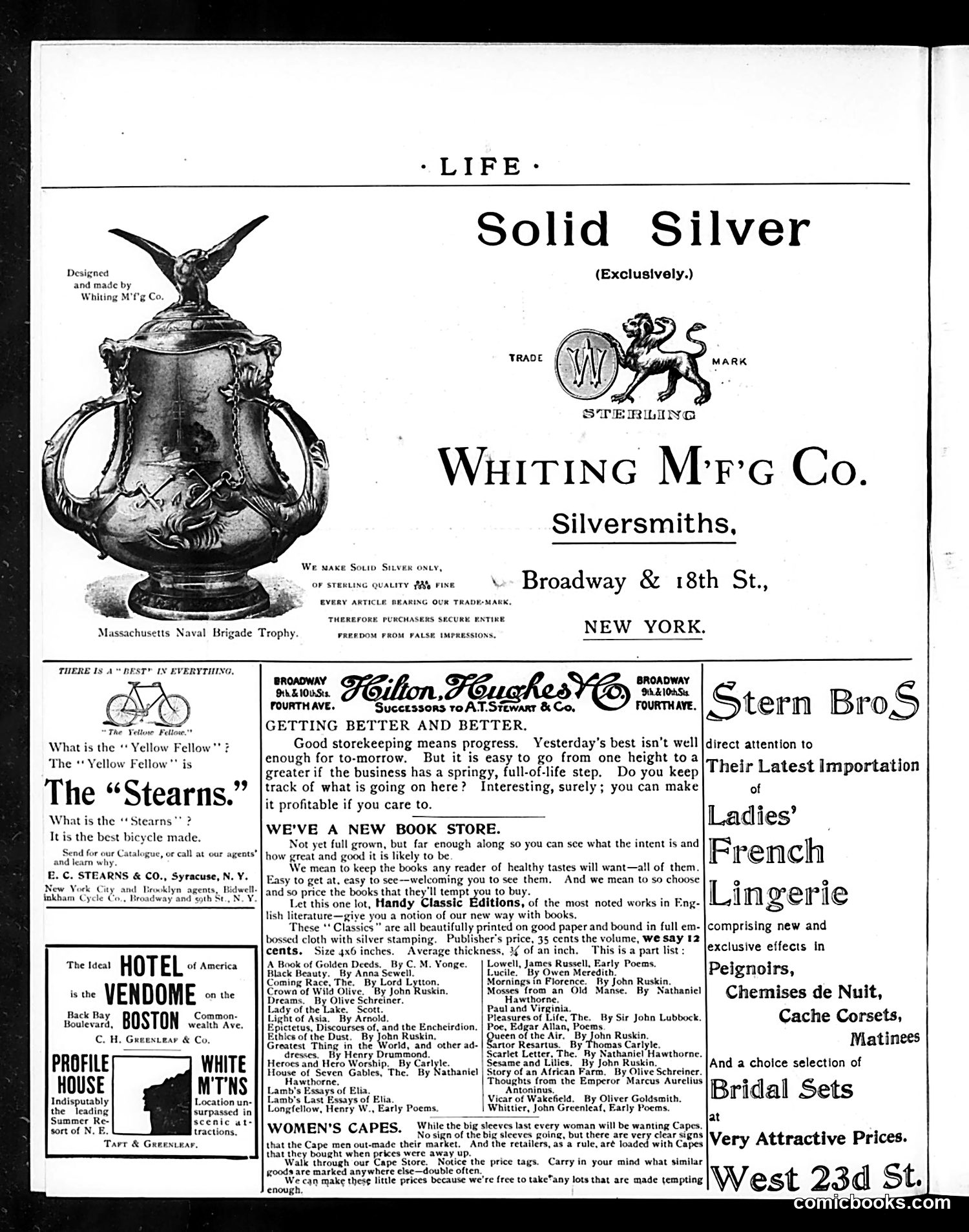
This page is **primarily advertising** with minimal satirical content. The dominant features are commercial advertisements for: - **Whiting Mfg Co.** (solid silver items) - **The Stearns** bicycle company - **Stern Bros.** (French lingerie and bridal sets) - **Holton, Feuches & Co.** bookstore The only potentially satirical element is a small bicycle advertisement for "The 'Stearns'" with the tagline "THERE IS A 'BEST' IN EVERYTHING," which appears to be humorous product positioning rather than political satire. The page reflects the magazine's business model: mixing lightweight advertising with editorial content. No clear political cartoons or social commentary are evident here—it's a commercial page typical of early 20th-century magazines.
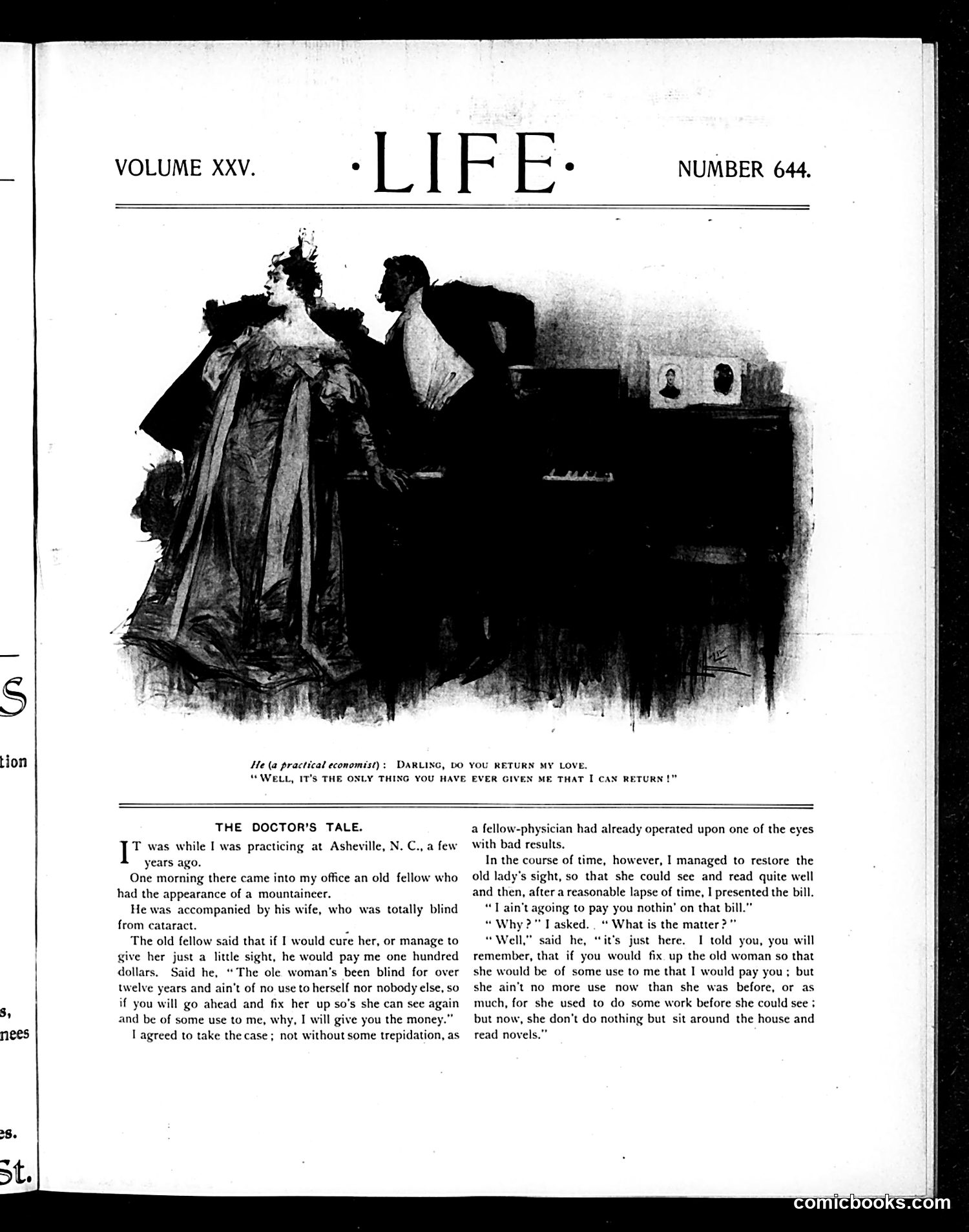
The illustration shows a romantic scene with a well-dressed couple at a piano. The caption reads: "He (a practical economist): DARLING, DO YOU RETURN MY LOVE. 'WELL, IT'S THE ONLY THING YOU HAVE EVER GIVEN ME THAT I CAN RETURN!'" This is domestic humor satirizing economic inequality within marriage. The joke targets a "practical economist" husband who apparently gives his wife nothing of material value—only emotional gestures. Her retort suggests financial stinginess, implying he won't even provide her gifts or money she could hypothetically return. The accompanying story, "The Doctor's Tale," describes a physician's experience restoring sight to a poor blind woman, ultimately revealing her ingratitude. Both items appear designed for gentle domestic comedy rather than sharp political satire.
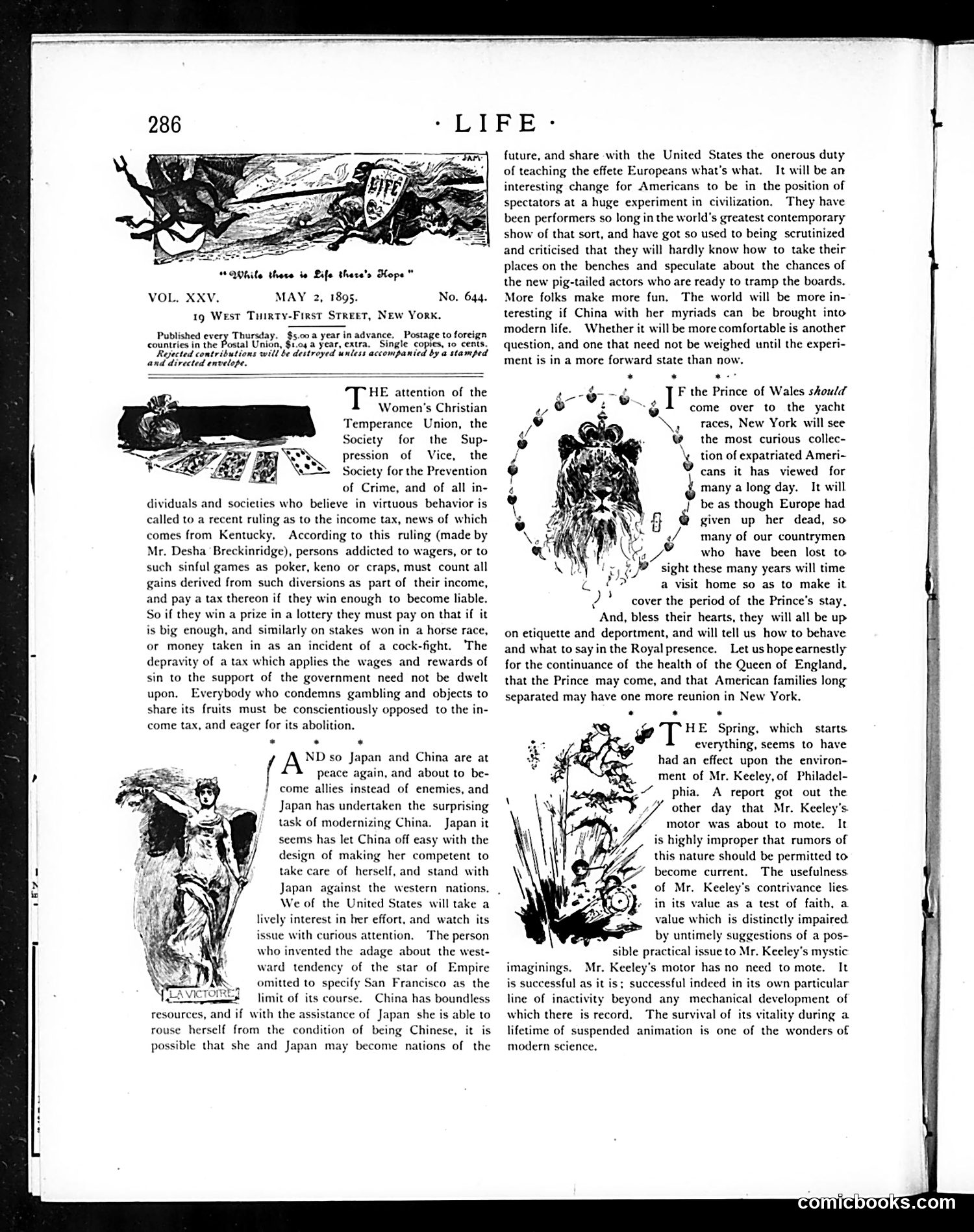
The page contains three distinct editorial cartoons and commentary: 1. **Top cartoon**: Shows a figure in bed labeled "With these is Life there's Hope"—likely commentary on mortality or hardship. 2. **Middle cartoon**: Depicts a woman at a table with cards/documents, accompanying text about the Women's Christian Temperance Union and a Kentucky court ruling. The ruling required lottery winners and those deriving income from vice (gambling, horse racing, cock-fighting) to count such gains as taxable income. The cartoon satirizes the tension between morality enforcement and taxation. 3. **Bottom cartoon**: Shows a figure labeled "CIVILIZATION," critiquing Western intervention in China and Japan's modernization efforts amid geopolitical concerns. The page reflects 1895 American anxieties about temperance, gambling, and imperial competition in Asia.
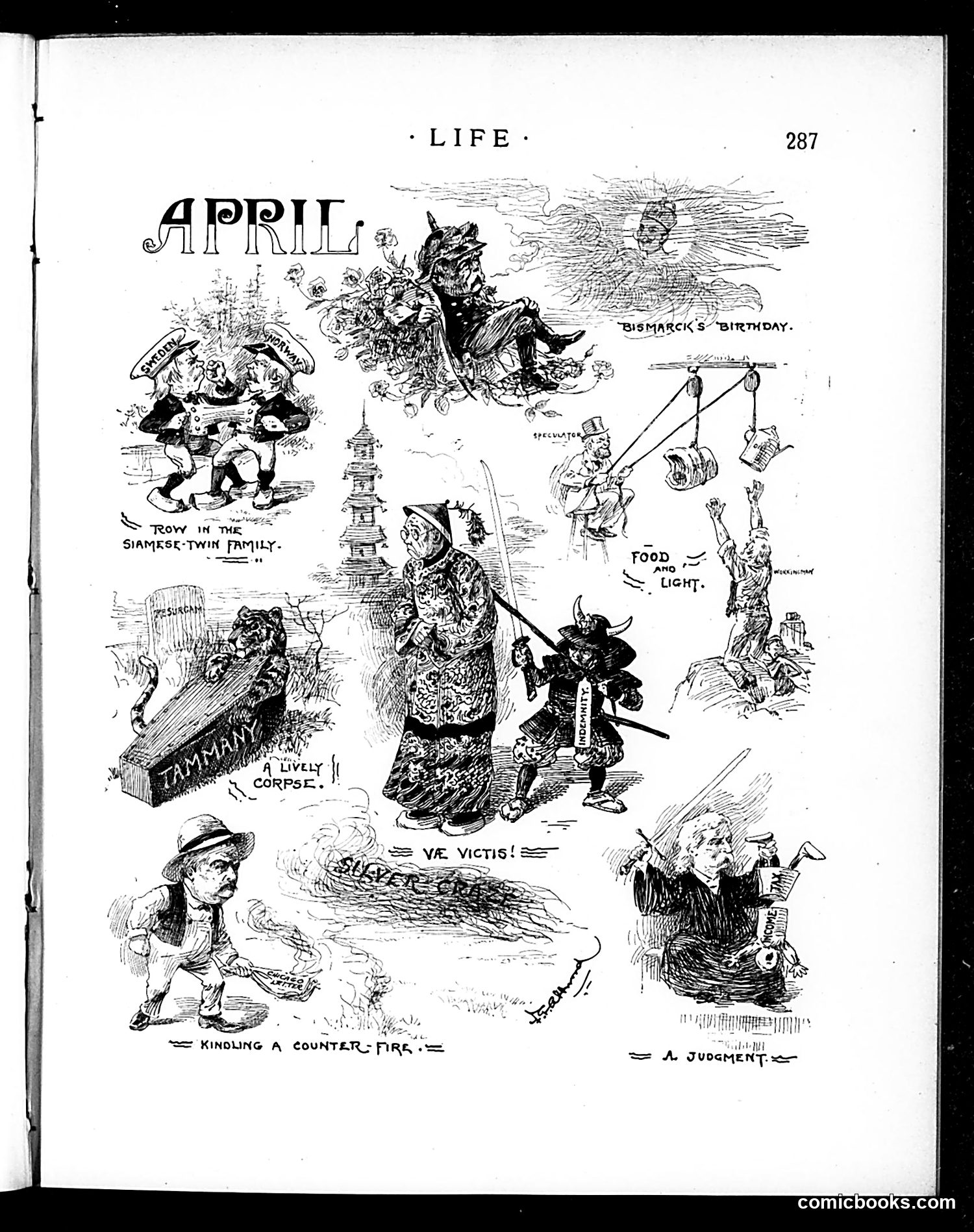
This page presents April-themed political satire using caricatured figures and allegorical imagery. The cartoons reference several early 20th-century themes: **"Bismarck's Birthday"** appears to commemorate the German statesman, showing military/political figures. **"Troy of the Siamese-Twin Family"** and **"A Lively Corpse"** use grotesque imagery—likely satirizing political partnerships or failed policies kept artificially alive. **"Food and Light,"** **"Ve Victis,"** and **"Kindling a Counter-Fire"** reference resource scarcity or economic/political conflict, possibly relating to industrial disputes or international tensions. **"A Judgment"** depicts an angelic or authoritative figure, suggesting divine commentary on earthly political matters. The style is typical of Life's satirical approach: exaggerated caricature, allegorical personification, and dark humor targeting contemporary politics and power struggles.
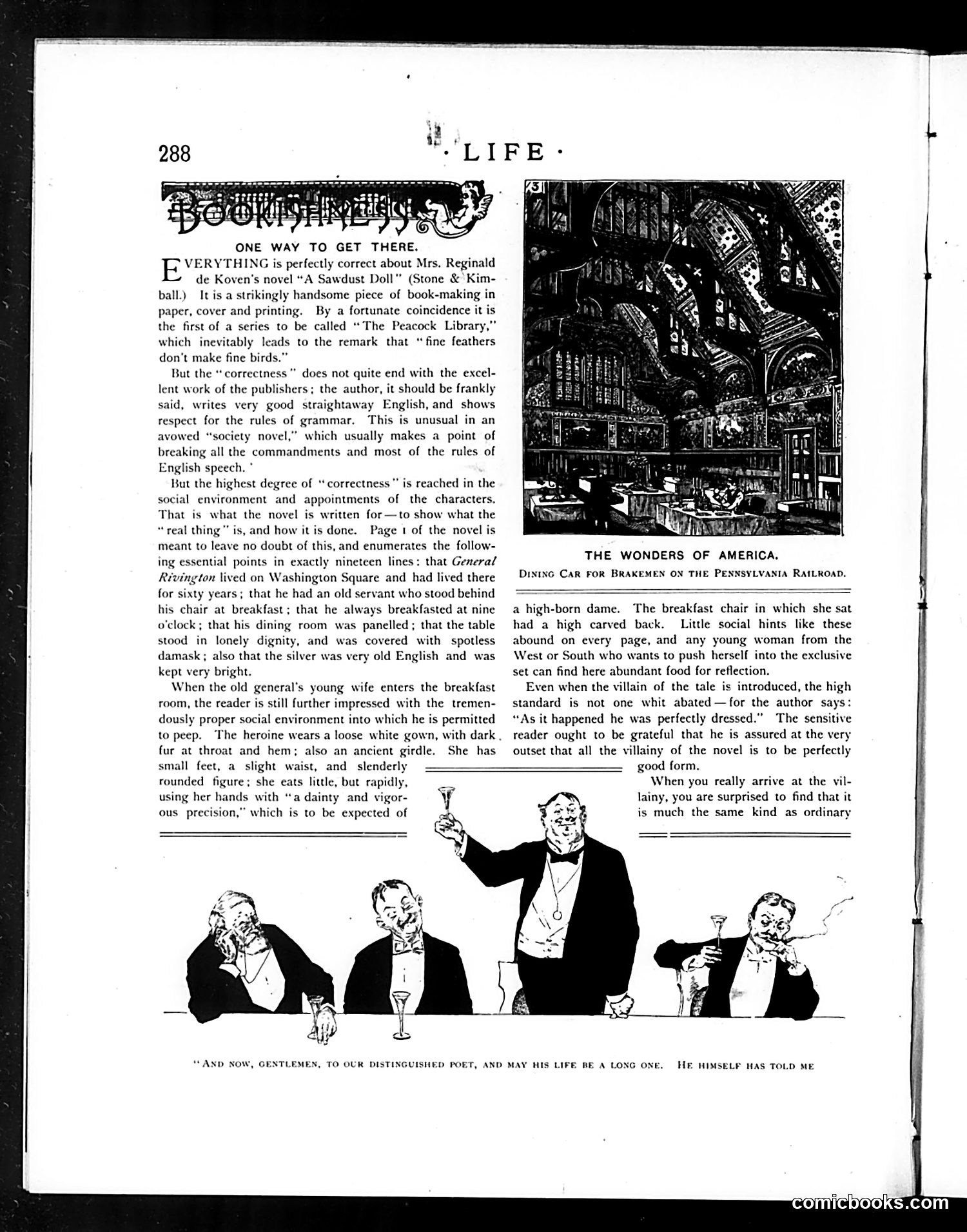
**Main Content:** A literary review of Mrs. Reginald de Koven's novel "A Sawdust Doll," praising its grammatical correctness and accurate social depiction of aristocratic life. **The Cartoon:** Below the text, four men in formal dinner attire sit at a table with drinks. One stands, raising his glass in a toast. The caption reads: "And now, gentlemen, to our distinguished poet, and may his life be a long one. He himself has told us..." **Meaning:** This appears to be satirizing the pretentiousness of high society dinner toasts and possibly poking fun at how wealthy men celebrate fellow poets or intellectuals—suggesting self-aggrandizing or insincere formal ceremonies among the elite. The humor likely lies in the anticipation of whatever self-flattering claim the "distinguished poet" has made.
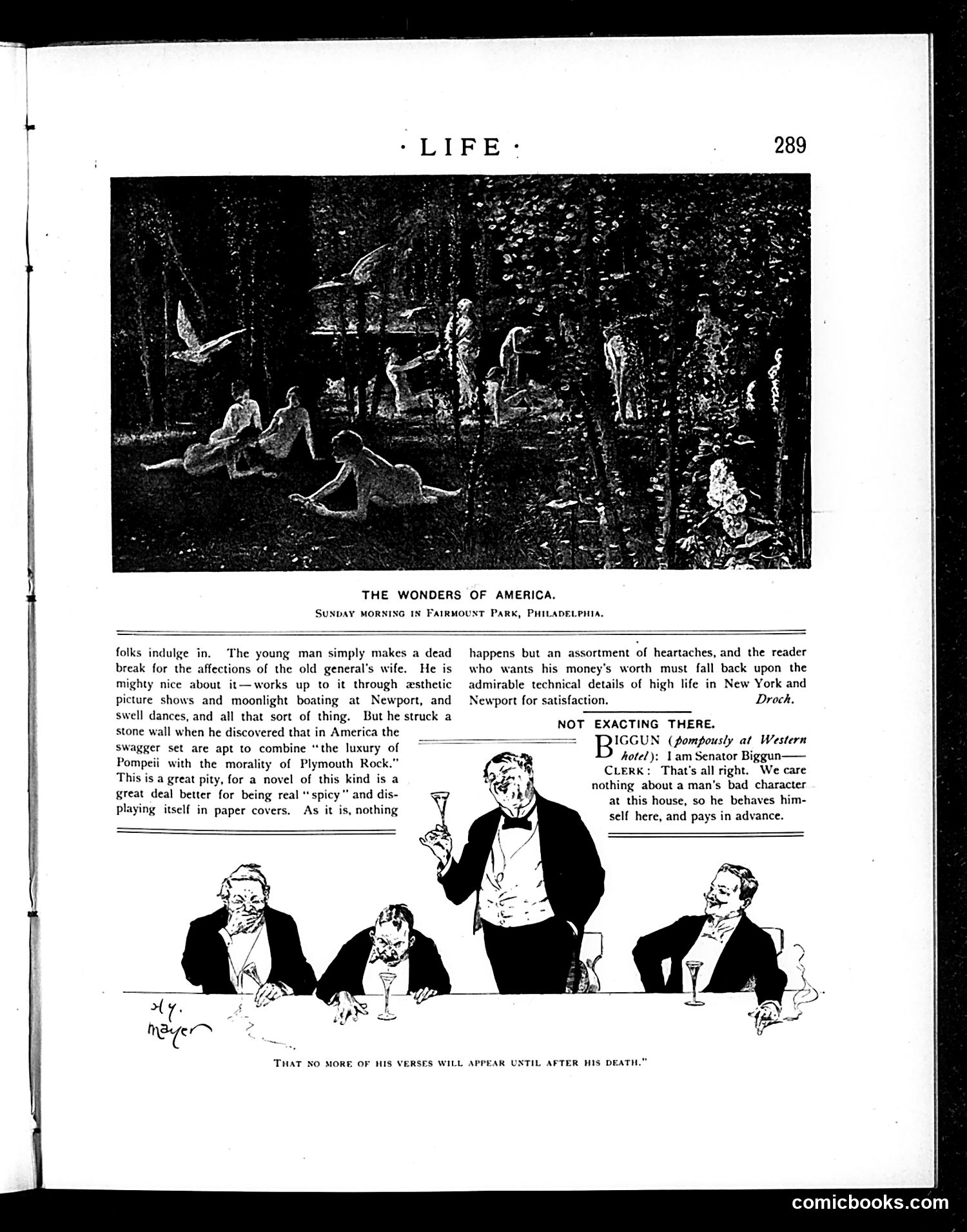
**Top Image:** "The Wonders of America—Sunday Morning in Fairmount Park, Philadelphia" depicts a moonlit forest scene with numerous figures engaged in intimate encounters among the trees—a satirical commentary on public moral behavior and discretion (or lack thereof) in American parks. **Bottom Cartoon:** "Not Exactly There" shows four well-dressed men at what appears to be a hotel. A Senator Biggun announces he'll pay in advance and behaves properly, assuring the clerk the establishment needn't worry about guests' "bad character." The final caption—"That no more of his verses will appear until after his death"—suggests this is satirizing a specific political figure known for scandalous poetry or writing, implying his morality is questionable despite his reassurances.
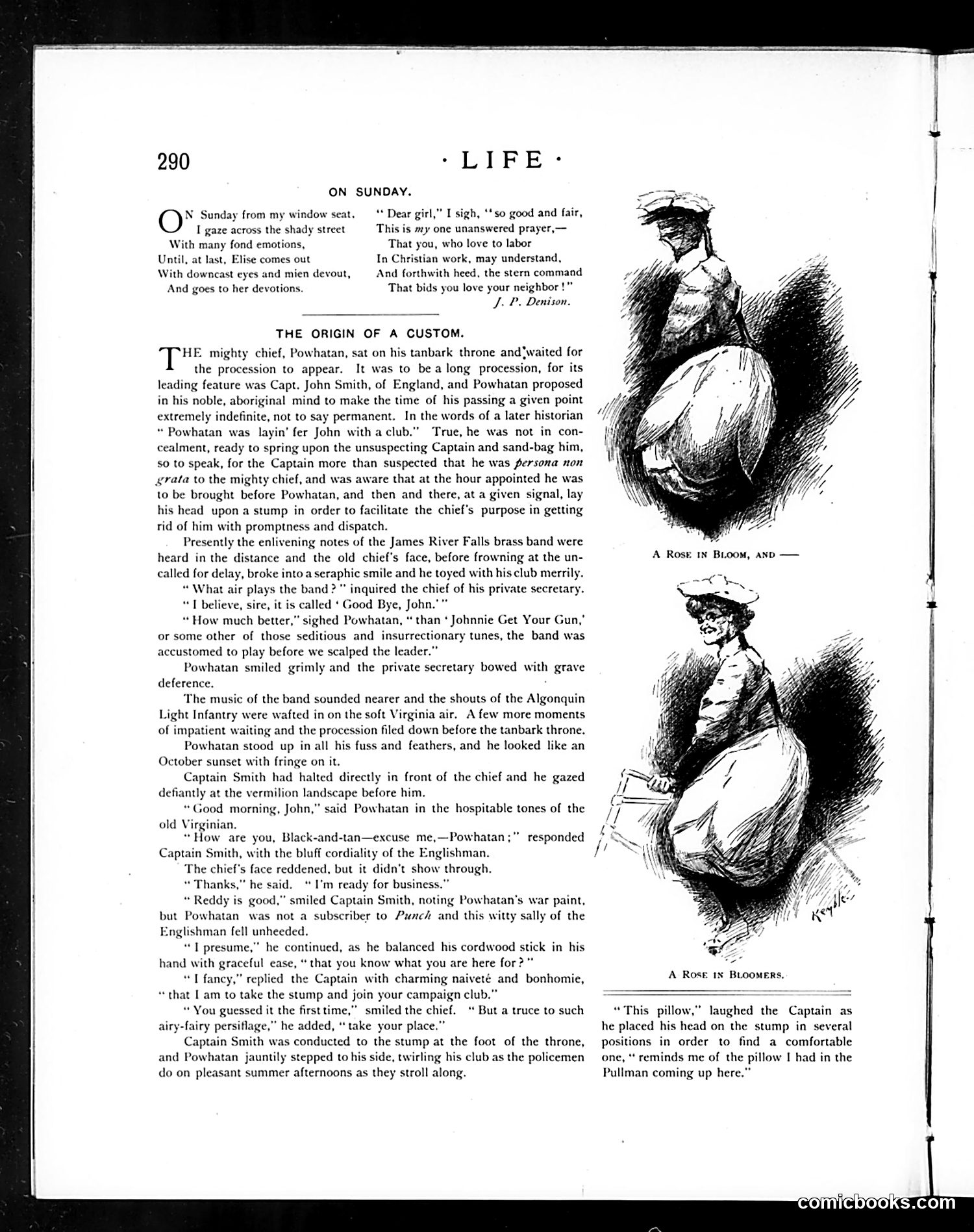
This page contains two distinct literary/satirical pieces rather than political cartoons: 1. **"On Sunday"** - A short poem about observing a devout woman from a window, paired with a prayer quote attributed to "J.P. Denison" about Christian charity. 2. **"The Origin of a Custom"** - A humorous anecdote about Chief Powhatan meeting Captain John Smith of England. The joke turns on Powhatan's witty use of a club as a "campaign club" to strike Smith, then explaining he's simply establishing a pleasant custom of striking visitors—which Powhatan and Smith then practice "as they stroll along." The accompanying sketches show women in period dress labeled "A Rose in Bloom" and "A Rose in Bloomers." This appears to be literary satire and humor rather than topical political commentary, showcasing Life magazine's mix of poetry, historical anecdotes, and illustration.
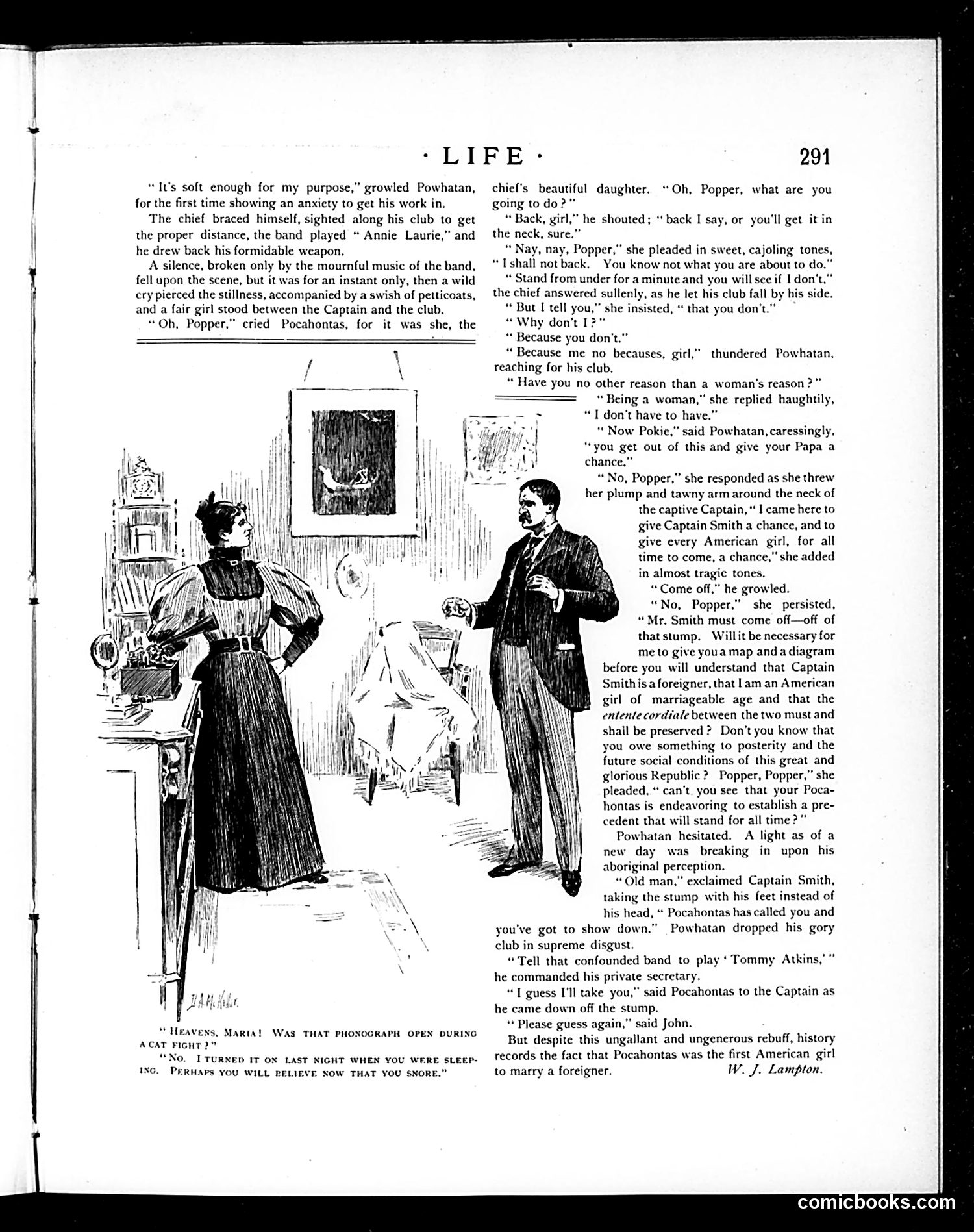
This page illustrates a satirical story about **Pocahontas and Captain Smith**. The illustration shows a woman (Pocahontas) and a man (likely Captain Smith) in what appears to be a domestic interior. The narrative mocks the **historical legend of Pocahontas saving Smith's life**, presenting it as a romantic American origin story. The dialogue reveals the satire: a character named "Powhatan" argues that Pocahontas should marry Smith to establish a "precedent" for American girls marrying foreigners and preserve "social conditions of this great and glorious Republic." The concluding text notes that history records Pocahontas was indeed "the first American girl to marry a foreigner," treating the historical fact with gentle irony about American exceptionalism and cross-cultural marriage as national legacy.
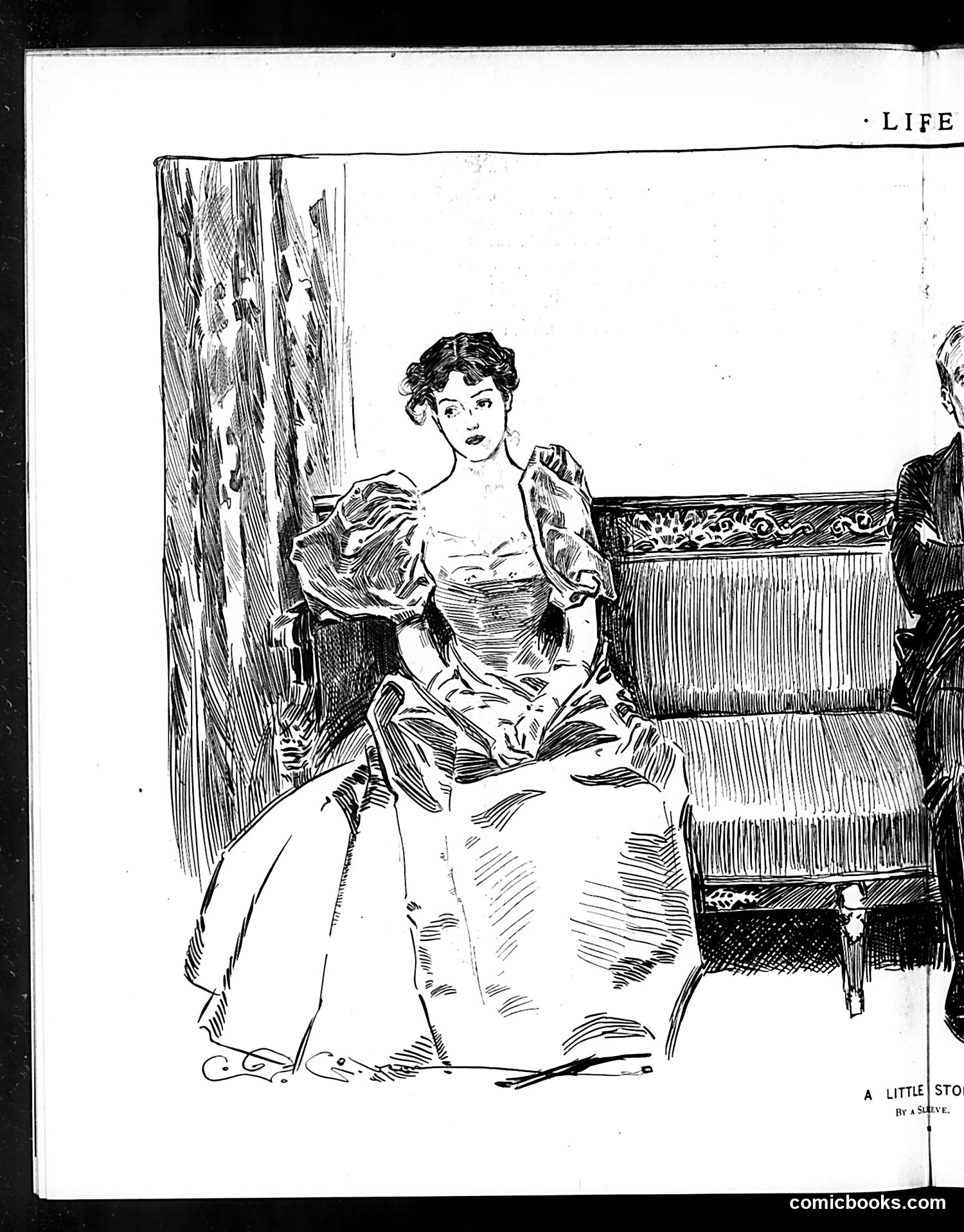
This is a sketch titled "A Little Story" (partially visible at bottom right, "By a Slave"). The illustration shows a woman in elegant Edwardian-era dress seated on a sofa, with a man partially visible on the right edge of the frame. The satirical title "By a Slave" appears to comment on the woman's domestic or social position—likely critiquing the restrictive role of women in wealthy households of this era. The woman's elaborate clothing and posed, somewhat theatrical expression suggest satire about superficial gentility and constrained femininity. Without additional visible text, the specific narrative remains unclear, but the work appears to critique gender dynamics and women's limited agency within upper-class society of the early 20th century.
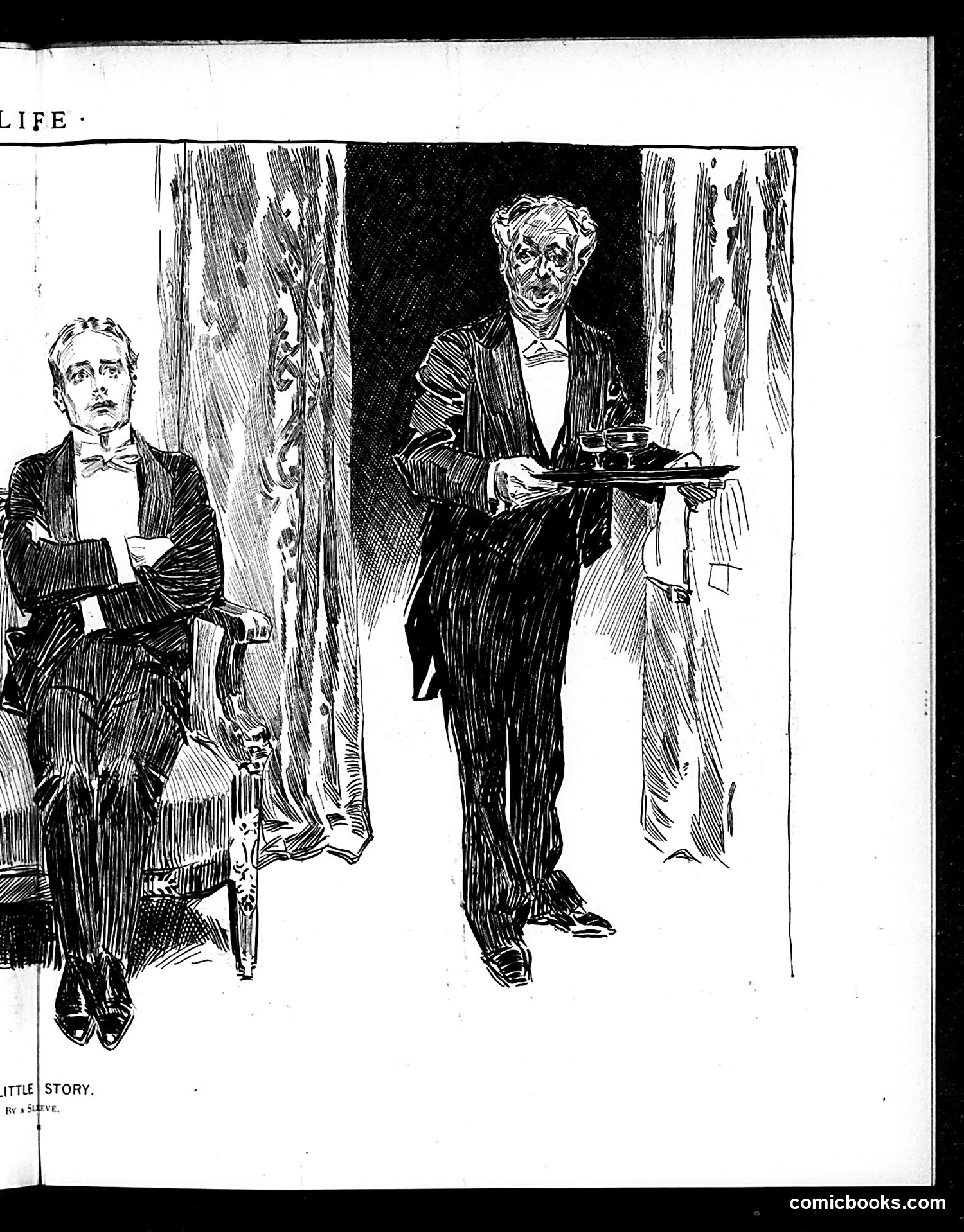
This cartoon depicts a domestic service scene with clear class commentary. On the left sits a well-dressed young man in formal attire (tuxedo and bow tie), looking upward pensively. On the right stands a waiter or servant in formal dress, holding a serving tray. The title "A Little Story by a Serve" (likely "Serve") suggests the servant is narrating or witnessing a scene. The satire appears to comment on the relationship between social classes—the servant's perspective on his employer's emotional or romantic life. The young man's upward gaze and the servant's knowing expression suggest some unspoken drama or secret being observed from the working-class vantage point. This reflects early 20th-century magazine humor about domestic life and class dynamics.
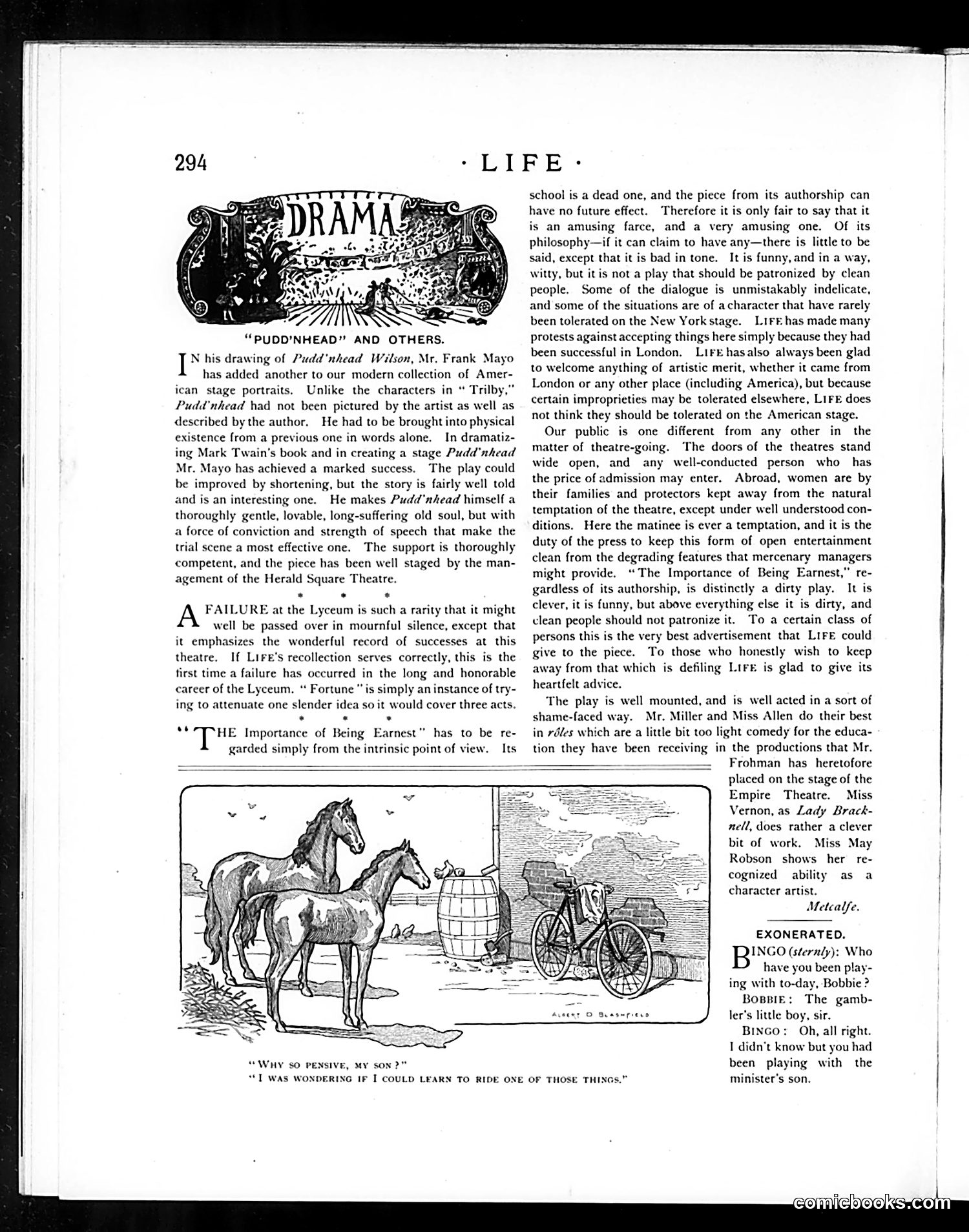
This page reviews three theatrical productions. The main cartoon depicts a young boy asking his father if he can learn to ride a horse, captioned "Why so pensive, my son?" — a humorous domestic scene unrelated to the drama reviews. The text critiques three plays: a stage adaptation of Mark Twain's *Pudd'nhead Wilson* (praised as well-executed), a play called *Fortune* at the Lyceum (dismissed as thin), and Oscar Wilde's *The Importance of Being Earnest* (condemned as indecent). Life's review of Wilde's play is notably prudish and moralistic. The magazine criticizes it as a "dirty play" with "indelicate" dialogue and improper situations unsuitable for respectable audiences, particularly women and matinee attendees. The editors insist American theaters have a duty to maintain higher moral standards than London's, reflecting late-19th-century American attitudes about theatrical propriety and gender. Life positions itself as a moral guardian of public entertainment.
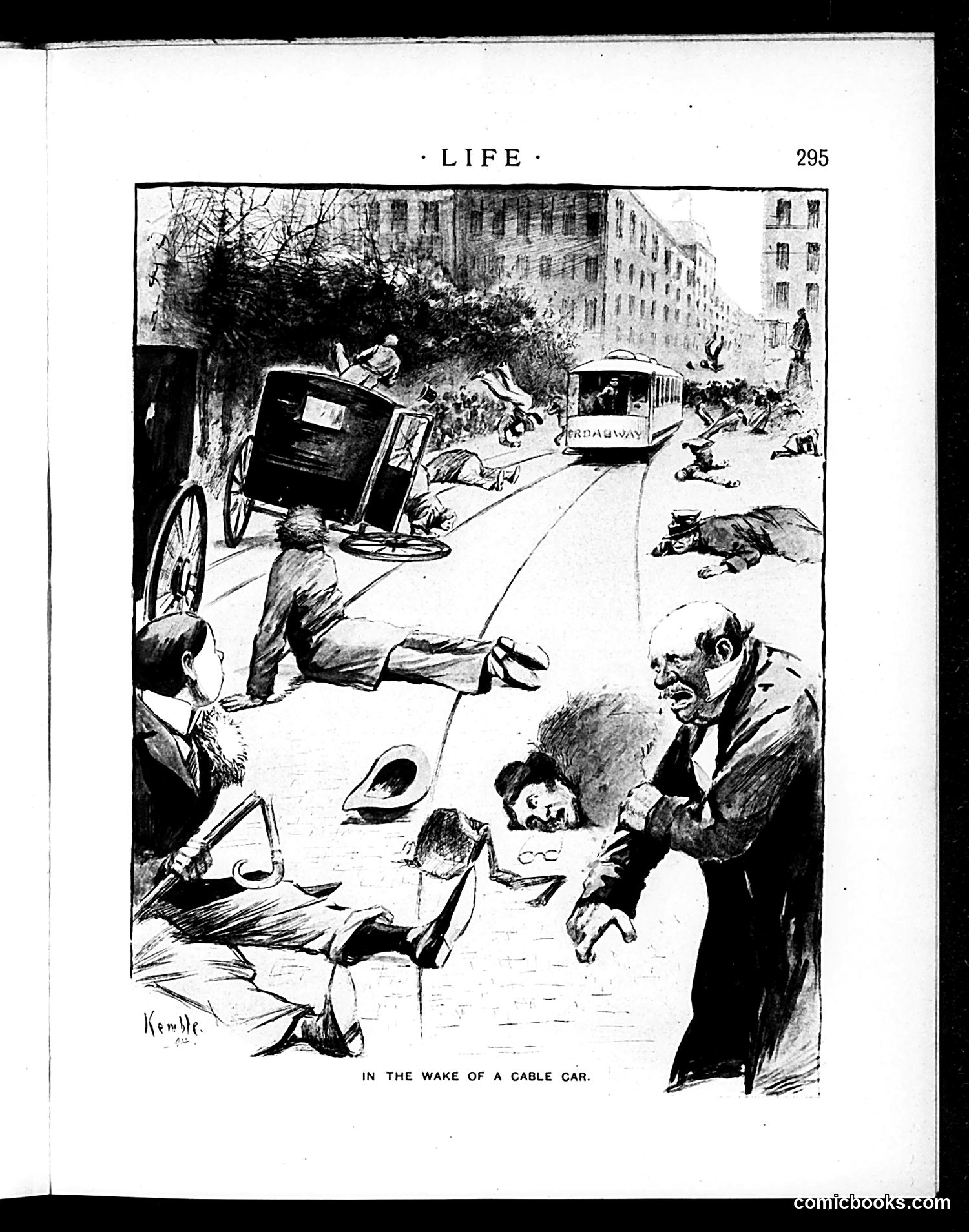
This cartoon satirizes the danger posed by San Francisco's cable cars to pedestrians and street life. The scene depicts chaos in the street following a cable car accident—bodies are strewn across the pavement, people are injured or unconscious, and bystanders react with alarm. A cable car labeled "BROADWAY" is visible in the background. The cartoon critiques the hazards of rapid urban transit technology in crowded city streets. The exaggerated carnage serves as dark social commentary on the casualties caused by cable cars operating through densely populated neighborhoods. This reflects genuine public concern about transportation safety during the early cable car era in American cities.
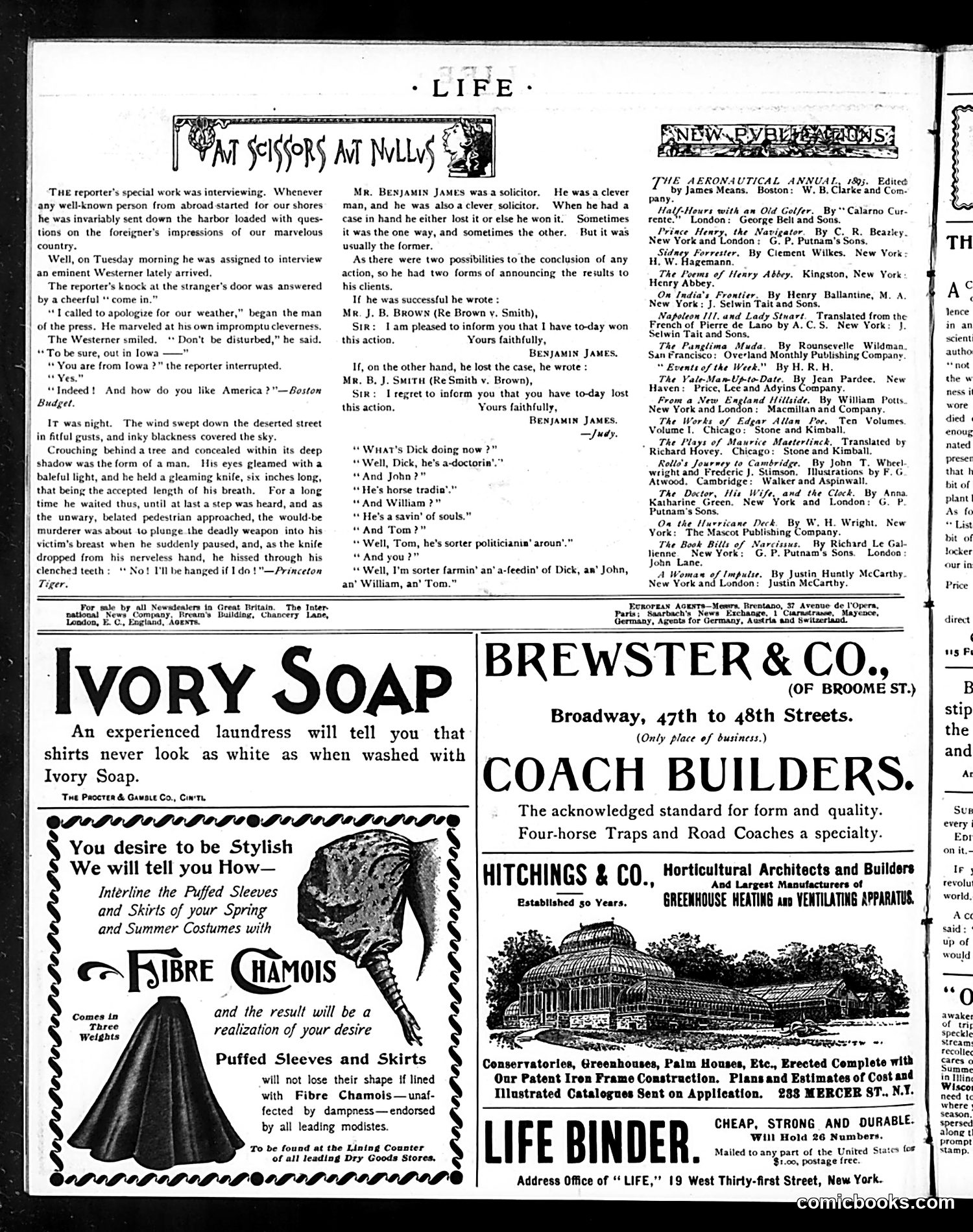
This page is primarily **advertising and book reviews**, not satirical content. The small text at the top contains a humorous anecdote about a newspaper reporter interviewing a visiting Westerner from Iowa about America—a gentle joke about journalistic clichés and the reporter's awkward small talk. Below that is a darker satirical piece (appearing to be reprinted from *Princeton Tiger*) depicting a would-be mugger who abandons his attack, concluding he'd "be hanged if I do"—presumably social commentary on crime deterrence or the fear of execution. The bulk of the page consists of **advertisements** (Ivory Soap, Fibre Chamois fabric, coach builders, etc.) and a **book review section** listing recent publications on aeronautics, golf, history, and literature. There are **no identifiable political caricatures or figures** on this page. The content reflects turn-of-century American commercial life and literary culture rather than satirical commentary on specific public figures or events.
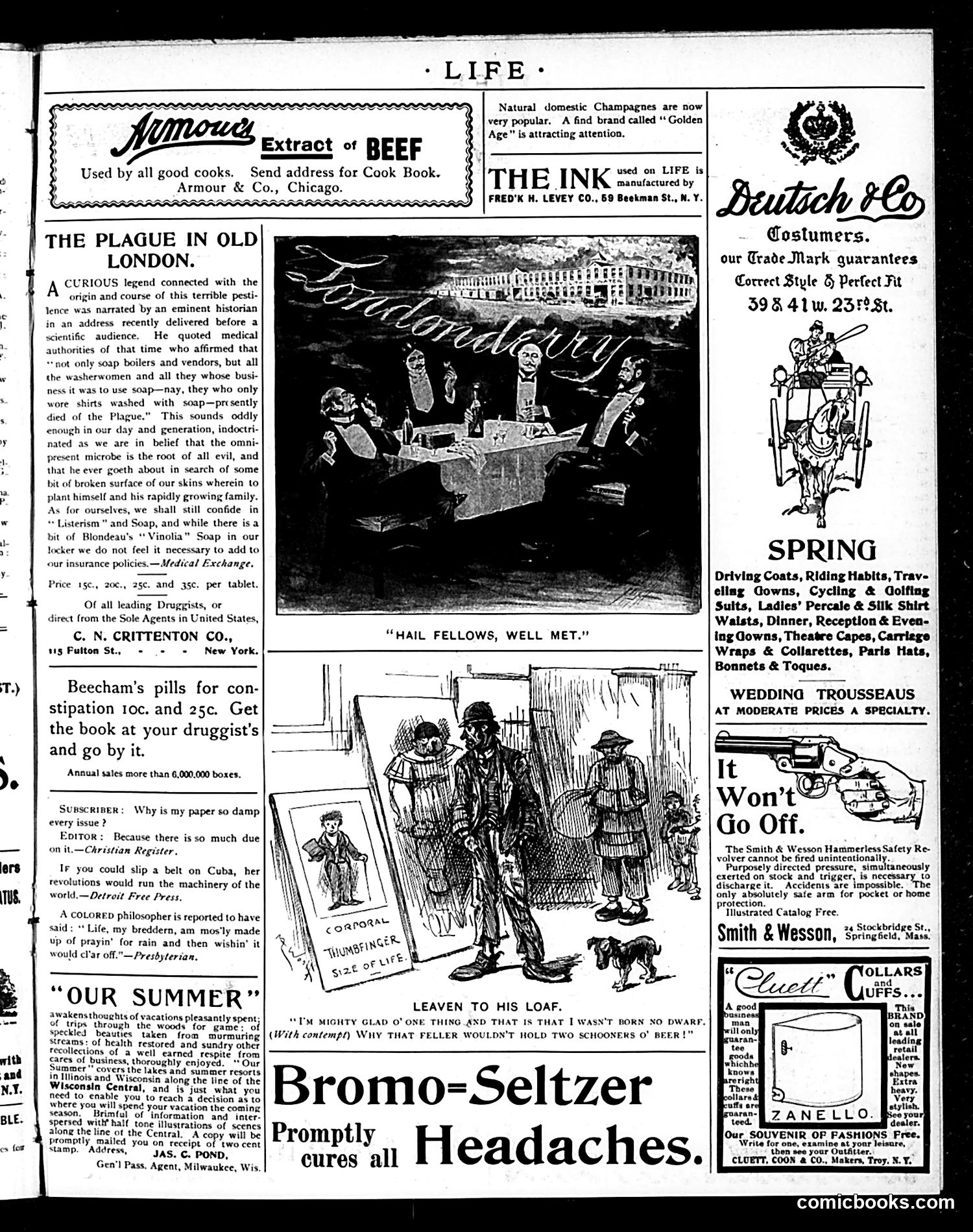
This page's main cartoon depicts three men greeting each other on a street, with one man making a contemptuous remark about another's small stature. The speaker boasts that the short man "wouldn't hold two schooners o' beer"—a reference to beer capacity, suggesting the man is so diminutive he couldn't consume much alcohol. The joke satirizes casual masculine bravado and prejudice of the era. The reference to "schooners" (large beer glasses) and the speaker's self-satisfied tone mock working-class attitudes toward physical size and drinking capacity as measures of manhood. The caption "HAIL FELLOWS, WELL MET" (suggesting friendly camaraderie) ironically contrasts with the actual contempt being expressed. The cartoon critiques the casual cruelty and mockery embedded in period working-class culture, where physical difference invited ridicule disguised as fellowship.
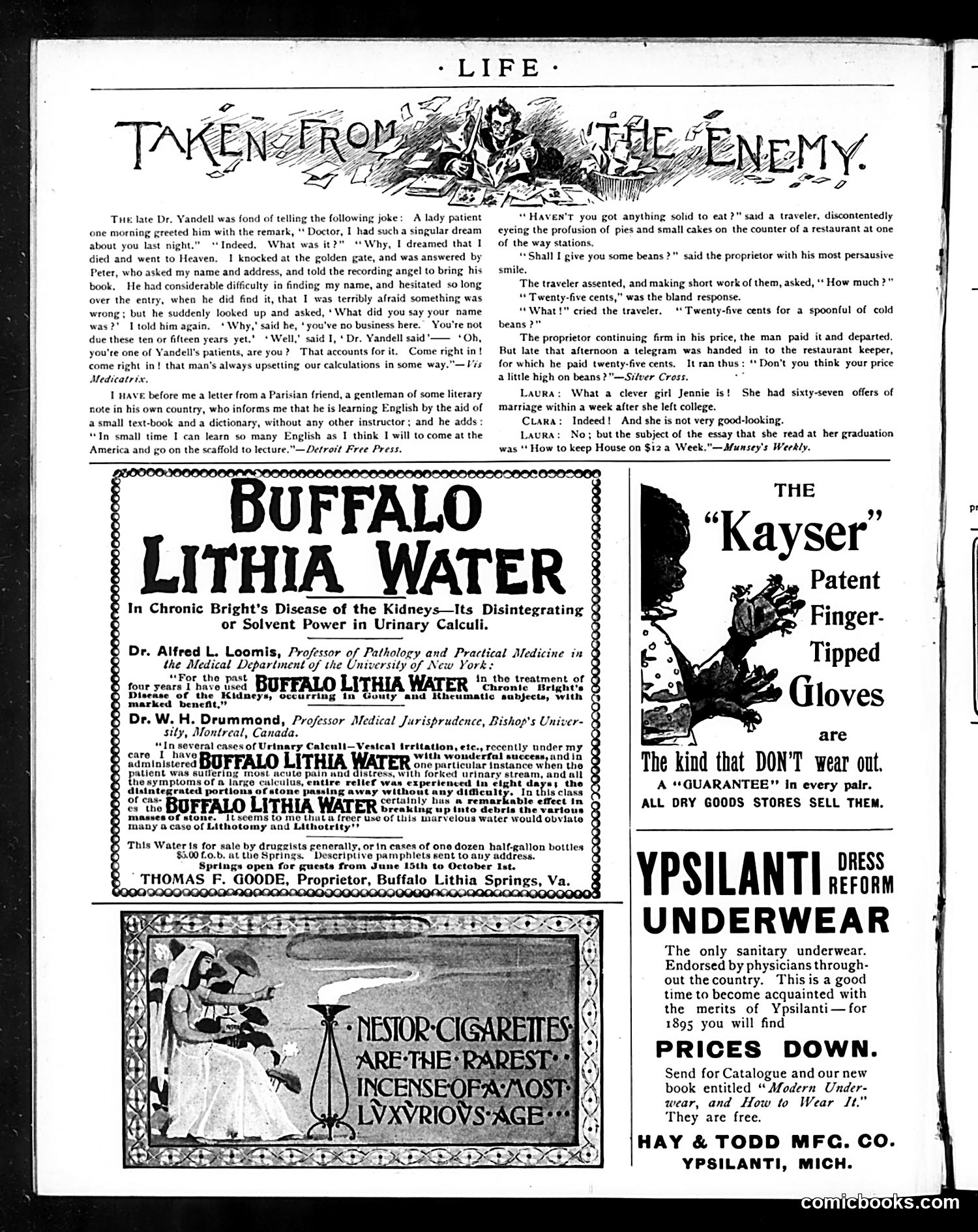
This page contains four separate humorous anecdotes typical of Life magazine's satirical humor: 1. **Dr. Yandell joke**: A doctor is so skilled at healing that Saint Peter mistakes his patients for people not yet due in Heaven—they've been kept alive longer than expected. The satire mocks both medical pretension and the idea of doctors "playing God." 2. **English learner's letter**: A foreigner learning English from a textbook plans to "go on the scaffold to lecture"—he means "go to the scaffold" (speaking platform), but the malapropism suggests he'll be hanged. Satire on language barriers and immigrant education. 3. **Restaurant beans**: A traveler is overcharged twenty-five cents for beans, then sends an angry telegram—also costing twenty-five cents. The satire targets rural restaurant owners' absurd pricing. 4. **Jennie's marriage proposals**: A homely girl receives 67 marriage proposals after giving a graduation speech on budgeting. Satire on mercenary marriage motivations and practical domestic economy. The page is primarily **text-based humor**—no political cartoon visible—with period advertisements below.
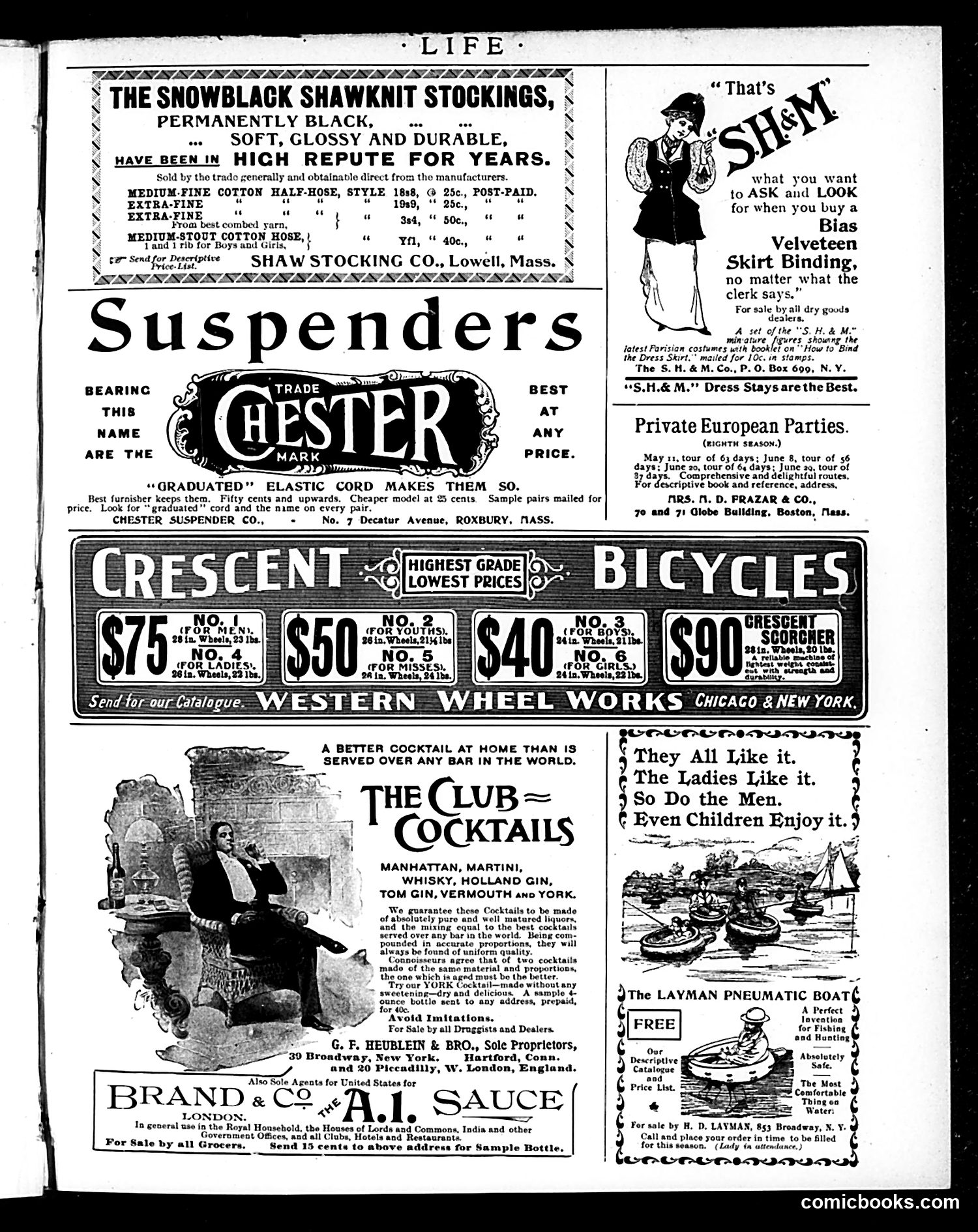
This is primarily an **advertising page** from Life magazine, not a satirical cartoon. The page contains numerous product advertisements typical of early 20th-century publications, including: - **Snowblack Shawknit Stockings** and **Chester Suspenders** — men's and women's hosiery and clothing accessories - **Crescent Bicycles** — offered at various price points ($40-$90) for different demographics - **The Club Cocktails** — pre-mixed alcoholic beverages by Heublein & Bro. - **Bias Velveteen Skirt Binding**, **dress stays**, and European travel tours The only image with narrative content shows two men in formal dress examining cocktail ingredients, captioned as advertising "a better cocktail at home than is served over any bar in the world." **For modern readers:** This reflects the consumer culture of the era and notably includes an advertisement for pre-packaged cocktails—legal at the time, before Prohibition (1920-1933).
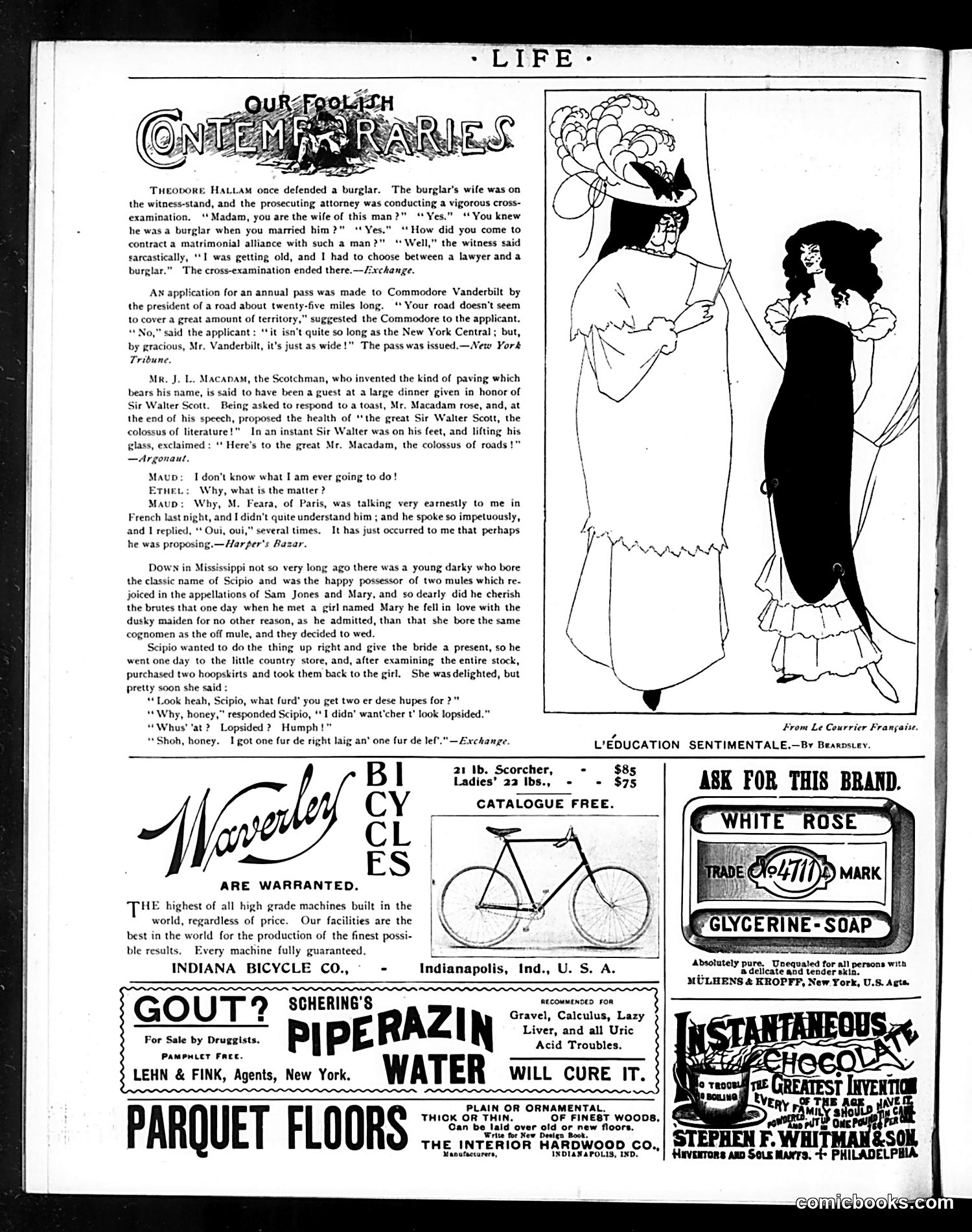
This page from *Life* magazine is primarily a **humor column** presenting anecdotes rather than political satire. The jokes focus on social and personal situations: 1. **Theodore Hallam anecdote**: A woman chooses marrying a burglar over a lawyer—satirizing both professions as equally undesirable. 2. **Commodore Vanderbilt joke**: Playing on railroad terminology—Vanderbilt grants a pass by interpreting "territory" as width rather than length, praising the road's boldness. 3. **Macadam/Sir Walter Scott**: A Scotsman's humorous toasting exchange, each praising the other's accomplishments (roads vs. literature). 4. **Maud's mishap**: A woman accidentally accepts a marriage proposal in French she didn't understand. 5. **Scipio's hoopskirts**: A satirical story about an enslaved man buying matching hoopskirts as wedding gifts, misunderstanding their purpose—the humor relies on crude racial stereotypes common to the era. The page is otherwise dominated by **period advertisements** for bicycles, soap, and other goods.