
Life, 1895-05-02 · page 8 of 18
Life — May 2, 1895 — page 8: what you’re looking at
What you’re looking at
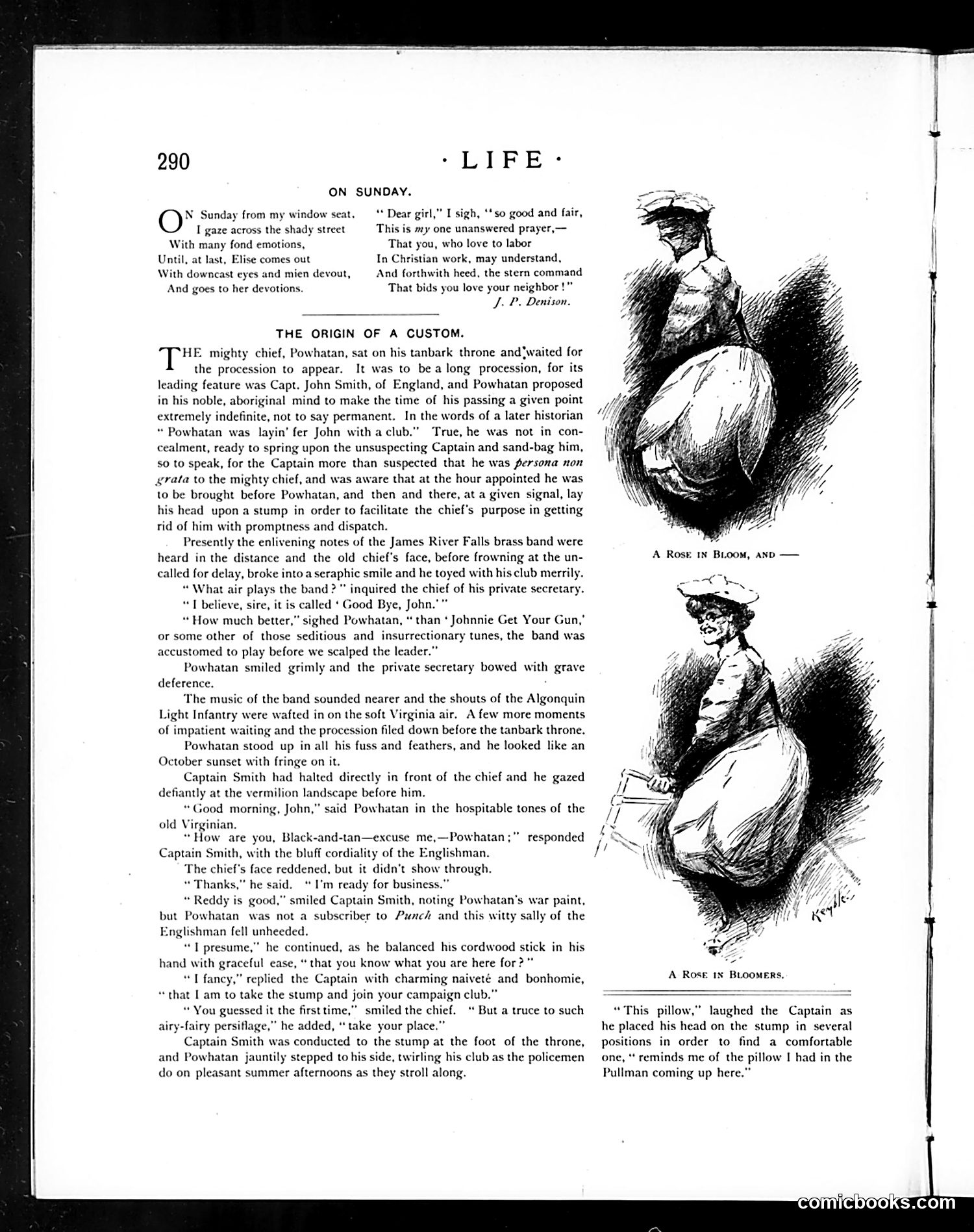
This page contains two distinct literary/satirical pieces rather than political cartoons: 1. **"On Sunday"** - A short poem about observing a devout woman from a window, paired with a prayer quote attributed to "J.P. Denison" about Christian charity. 2. **"The Origin of a Custom"** - A humorous anecdote about Chief Powhatan meeting Captain John Smith of England. The joke turns on Powhatan's witty use of a club as a "campaign club" to strike Smith, then explaining he's simply establishing a pleasant custom of striking visitors—which Powhatan and Smith then practice "as they stroll along." The accompanying sketches show women in period dress labeled "A Rose in Bloom" and "A Rose in Bloomers." This appears to be literary satire and humor rather than topical political commentary, showcasing Life magazine's mix of poetry, historical anecdotes, and illustration.
📄 Transcribed text from this page (OCR, searchable)
Machine-transcribed from the original scan — historical spelling and the odd misread are preserved.
290 -LIFE: ON SUNDAY. N Sunday from my window seat,‘ Dear girl," I sigh, *so good and fair, I gaze across the shady street. This is my one unanswered prayer,— With many fond emotions, That you, who love to labor Until, at last, Elise comes out In Christian work, may understand, With downcast eyes and mien devout, And forthwith heed, the stern command And goes to her devotions That bids you love your neighbor !" J. P. Denison. THE ORIGIN OF A CUSTOM. HE mighty chief, Powhatan, sat on his tanbark throne and ‘waited for the procession to appear. It was to bea long procession, for its leading feature was Capt. John Smith, of England, and Powhatan proposed in his noble, aboriginal mind to make the time of his passing a given point extremely indefinite, not to say permanent. In the words of a later historian “ Powhatan was layin’ fer John with a club.” True, he was not in con- cealment, ready to spring upon the unsuspecting Captain and sand-bag him, so to speak, for the Captain more than suspected that he was persona non grata to the mighty chief, and was aware that at the hour appointed he was to be brought before Powhatan, and then and there, at a given signal, lay his head upon a stump in order to facilitate the chief's purpose in getting rid of him with promptness and dispatch. Presently the enlivening notes of the James River Falls brass band were heard in the distance and the old chief's face, before frowning at the un- called for delay, broke into a seraphic smile and he toyed with his club merrily. “ What air plays the band ? " inquired the chief of his priv “T believe, sire, it Hed * Good Bye, John.’ “How much better,” sighed Powhatan, “ than ‘ Johnnie Get Your Gun,’ or some other of those seditious and insurrectionary tunes, the band was accustomed to play before we scalped the leader.” Powhatan smiled grimly and the private secretary bowed with grave deference. The music of the band sounded nearer and the shouts of the Algonquin Light Infantry were wafted in on the soft Virginia air. A few more moments of impatient waiting and the procession filed down before the tanbark throne. Powhatan stood up in all his fuss and feathers, and he looked like an October sunset with fringe on it. Captain Smith had halted directly in front of the chief and he gazed defiantly at the vermilion landscape before him. “Good morning, John,” said Powhatan in the hospitable tones of the old Virginian. “How are you, Black-and-tan—excuse me,—Powhatan ;" responded ain Smith, with the bluff cordiality of the Englishman. The chief's face reddened, but it didn’t show through. “ Thanks,” he said.“ I'm ready for business.” “ Reddy is good,” smiled Captain Smith, noting Powhatan’s war paint, but Powhatan was not a subscriber to Punch and this witty sally of the Englishman fell unheeded. “| presume,” he continued, as he balanced his cordwood stick in his hand with graceful ease, “ that you know what you are here for?” “T fancy,” replied the Captain with charming naiveté and bonhomie, “that [am to take the stump and join your campaign club.” “ You guessed it the firsttime,” smiled the chief.“ But a truce to such ry persiflage,” he added, ‘take your place.” aptain Smith conducted to the stump at the foot of the throne, and Powhatan jauntily stepped to his side, twirling his club as the policemen do on pleasant summer afternoons as they stroll along. Cap Bioomers, This pillow,” laughed the Captain as he placed his head on the stump in several positions in order to find a comfortable reminds me of the pillow I had in the Pullman coming up here.”