
Life, 1895-05-02 · page 12 of 18
Life — May 2, 1895 — page 12: what you’re looking at
What you’re looking at
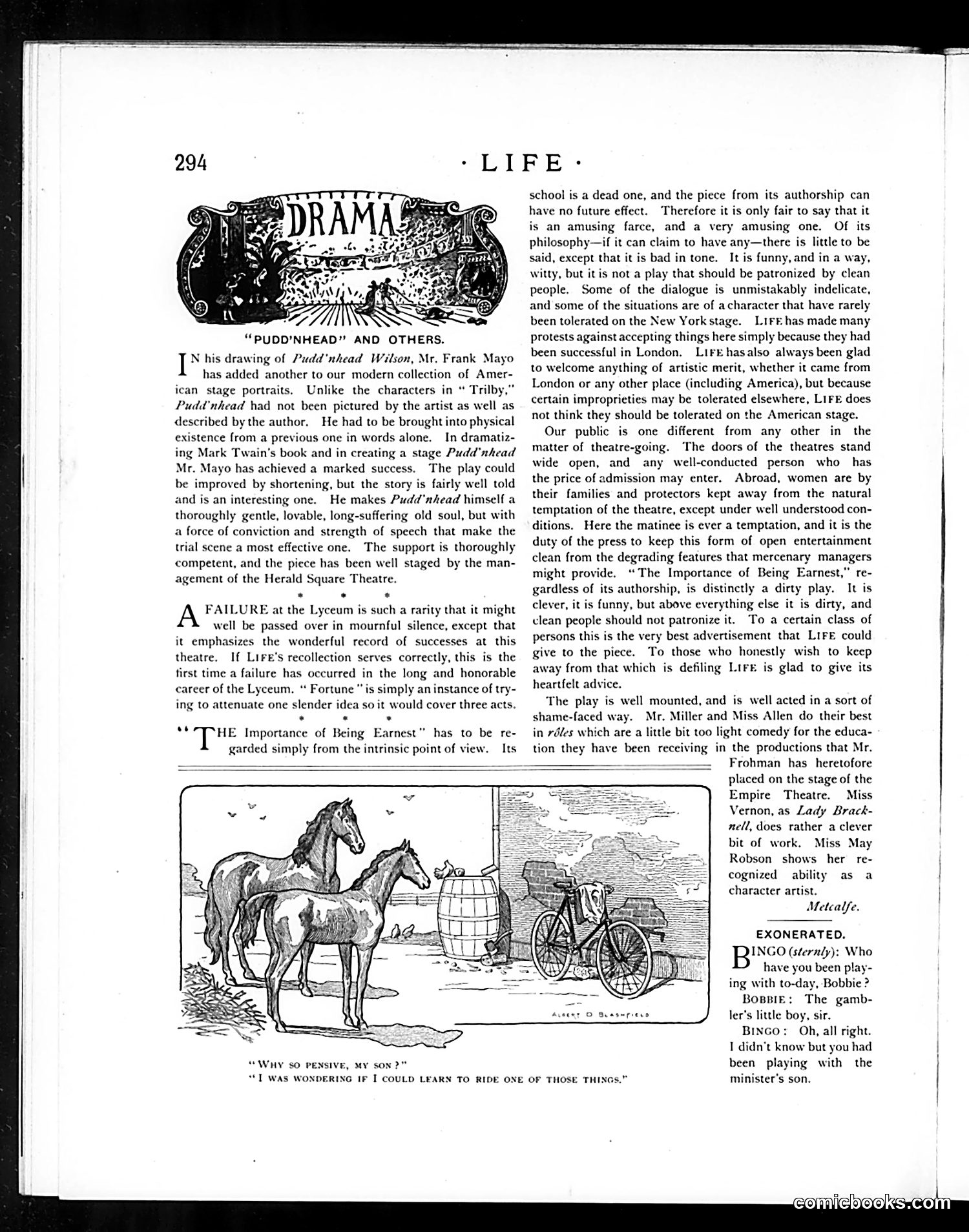
This page reviews three theatrical productions. The main cartoon depicts a young boy asking his father if he can learn to ride a horse, captioned "Why so pensive, my son?" — a humorous domestic scene unrelated to the drama reviews. The text critiques three plays: a stage adaptation of Mark Twain's *Pudd'nhead Wilson* (praised as well-executed), a play called *Fortune* at the Lyceum (dismissed as thin), and Oscar Wilde's *The Importance of Being Earnest* (condemned as indecent). Life's review of Wilde's play is notably prudish and moralistic. The magazine criticizes it as a "dirty play" with "indelicate" dialogue and improper situations unsuitable for respectable audiences, particularly women and matinee attendees. The editors insist American theaters have a duty to maintain higher moral standards than London's, reflecting late-19th-century American attitudes about theatrical propriety and gender. Life positions itself as a moral guardian of public entertainment.
📄 Transcribed text from this page (OCR, searchable)
Machine-transcribed from the original scan — historical spelling and the odd misread are preserved.
s added another to our modern collection of Amer- ican stage portraits. Unlike the characters in “ Trilby,” Pudd'nhead had not been pictured by the artist as well as described by the author, He had to be brought into physical existence from a previous one in words alone. In dramatiz- ing Mark Twain's book and in creating a stage Pudd'nhead Mr. Mayo has achieved a marked success. The play could be improved by shortening, but the story is fairly well told and is an interesting one. He makes Pudd'nhead himself a thoroughly gentle, lovable, long-suffering old soul, but with a force of conviction and strength of speech that make the trial scene a most effective one. The support is thoroughly competent, and the piece has been well staged by the man- agement of the Herald Square Theatre. * . . A FAILURE at the Lyceum is such a rarity that it might well be passed over in mournful silence, except that it emphasizes the wonderful record of successes at this theatre. If Lire’s recollection serves correctly, this is the first time a failure has occurred in the long and honorable career of the Lyceum. “ Fortune "is simply an instance of try- ing to attenuate one slender idea so it would cover three acts. . . . HE Importance of Being Earnest” has to be re- garded simply from the intrinsic point of view. — Its vy -LIFE- school is a dead one, and the piece from its authorship can have no future effect. Therefore it is only fair to say that it is an amusing farce, and a very amusing one. Of its philosophy—if it can claim to have any—there is little to be said, except that it is bad in tone. It is funny, and in a way, witty, but itis not a play that should be patronized by clean people. Some of the dialogue is unmistakably indelicate, and some of the situations are of acharacter that have rarely been tolerated on the New York stage. Lire has made many protests against accepting things here simply because they had been successful in London, LiFe hasalso always been glad to welcome anything of artistic merit, whether it came from London or any other place (including America), but because certain improprieties may be tolerated elsewhere, LIFE does not think they should be tolerated on the American stage. Our public is one different from any other in the matter of theatre-going. The doors of the theatres stand wide open, and any well-conducted person who has the price of admission may enter. Abroad, women are by their families and protectors kept away from the natural temptation of the theatre, except under well understood con- ditions. Here the matinee is ever a temptation, and it is the duty of the press to keep this form of open entertainment clean from the degrading features that mercenary managers might provide. “The Importance of Being Earnest,” re- gardless of its authorship, is distinctly a dirty play. It is clever, it is funny, but above everything else it is dirty, and clean people should not patronize it. To a certain class of persons this is the very best advertisement that LIFE could give to the piece. To those who honestly wish to keep away from that which is defiling Lire is glad to give its heartfelt advice. ‘The play is well mounted, and is well acted in a sort of shame-faced way. Mr. Miller and Miss Allen do their best in réles which are a little bit too light comedy for the educa- tion they have been receiving in the productions that Mr. — Frohman has heretofore “WHY SO PENSIVE, MY SON?” “TWAS WONDERING IF I COULD LEARN TO RIDE ONE OF THOSE THINGS.” placed on the stage of the Empire Theatre. Miss Vernon, as Lady Brack- nell, does rather a clever bit of work. Miss May Robson shows her re- cognized ability as a character artist. Metcalfe. EXONERATED. INGO (sternly): Who have you been play- ing with to-day, Bobbie ? The gamb- boy, sir. Oh, all right. I didn’t know but you had been playing with the minister's son.