
Life, 1895-05-02 · page 6 of 18
Life — May 2, 1895 — page 6: what you’re looking at
What you’re looking at
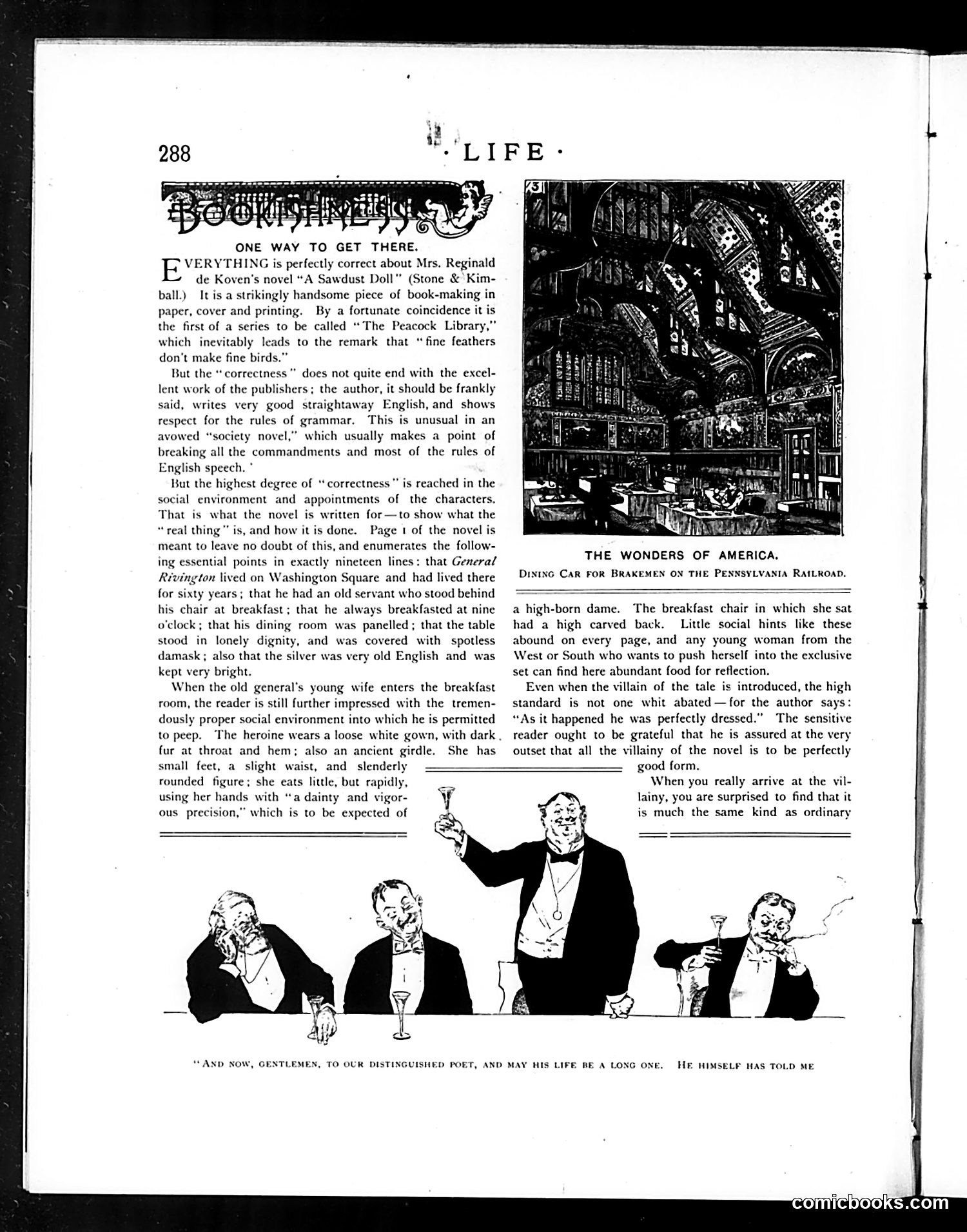
**Main Content:** A literary review of Mrs. Reginald de Koven's novel "A Sawdust Doll," praising its grammatical correctness and accurate social depiction of aristocratic life. **The Cartoon:** Below the text, four men in formal dinner attire sit at a table with drinks. One stands, raising his glass in a toast. The caption reads: "And now, gentlemen, to our distinguished poet, and may his life be a long one. He himself has told us..." **Meaning:** This appears to be satirizing the pretentiousness of high society dinner toasts and possibly poking fun at how wealthy men celebrate fellow poets or intellectuals—suggesting self-aggrandizing or insincere formal ceremonies among the elite. The humor likely lies in the anticipation of whatever self-flattering claim the "distinguished poet" has made.
📄 Transcribed text from this page (OCR, searchable)
Machine-transcribed from the original scan — historical spelling and the odd misread are preserved.
ONE WAY TO GET THERE. E VERYTHING is perfectly correct about Mrs. Reginald de Koven’s novel “A Sawdust Doll” (Stone & Kim- ball.) It is a strikingly handsome piece of book-making in paper, cover and printing. By a fortunate coincidence it is the first of a series to be called “The Peacock Library,” which inevitably leads to the remark that “fine feathers don’t make fine birds.” But the “correctness " does not quite end with the excel- lent work of the publishers; the author, it should be frank! said, writes very good straightaway English, and shows respect for the rules of grammar. This is unusual in an avowed “society novel,” which usually makes a point of breaking all the commandments and most of the rules of English speech. * But the highest degree of “correctness " is reached in the social environment and appointments of the characters. That is what the novel is written for—to show what the Page 1 of the novel is “real thing" is, and how it is done. meant to leave no doubt of this, and enumerates the follow- ing essential points in exactly nineteen lines: that General Rivington lived on Washington Square and had lived there for sixty years; that he had an old servant who stood behind his chair at breakfast; that he always breakfasted at nine o'clock ; that his dining room v panelled ; that the table stood in lonely dignity, and w covered with spotless damask ; also that the silver was very old English and was kept very bright. When the old general's young wife enters the breakfast room, the reader is still further impressed with the tremen- dously proper social environment into which he is permitted to peep. fur at throat and hem; also an ancient girdle. small feet, a slight waist, and slenderly She has The heroine wears a loose white gown, with dark . THE WONDERS OF AMERICA. CAR FOR BRAKEMEN ON THE PENNSYLVANIA RAILROAD. a high-born dame. The breakfast chair in which she sat had a high carved back. Little social hints like these abound on every page, and any young woman from the West or South who wants to push herself into the exclusive set can find here abundant food for reflection. Even when the villain of the tale is introduced, the high standard is not one whit abated —for the author says: “As it happened he was perfectly dressed.” The sensitive reader ought to be grateful that he is assured at the very outset that all the villainy of the novel is to be perfectly good form. rounded figure; she eats little, but rapidly, using her hands with “a dainty and vigor- ous precision,” which is to be expected of “AND NOW, GENTLEMEN, TO OUR DISTINGUISHED POET, AND MAY HIS LIFE BE A LONG ONE. When you really arrive at the vil- lainy, you are surprised to find that it is much the same kind as ordinary He HIMSELF HAS TOLD ME