
A complete issue · 18 pages · 1895
Life — April 4, 1895
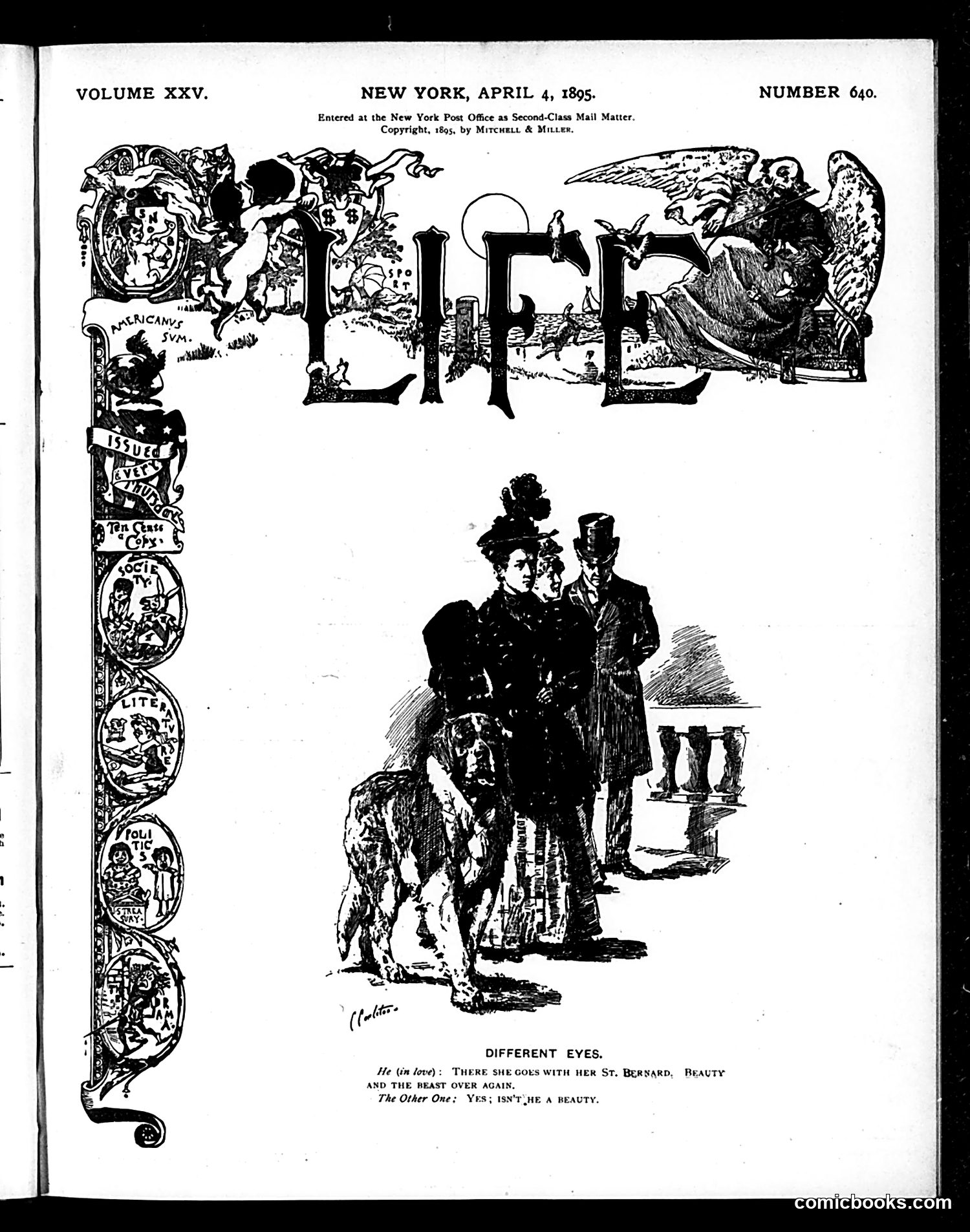
This cartoon illustrates a social commentary on class perception and beauty standards. The scene shows a well-dressed couple (a woman with an elaborate hat and a gentleman in formal attire) walking with what appears to be a St. Bernard dog. The caption reveals the joke's point: one person (likely "he in love") sees the woman walking beautifully with her prized dog, while "the other one" (presumably a servant or working-class observer) sees only that the dog "isn't a beauty." The satire mocks how wealthy people romanticize their possessions and companions, while those outside their social circle view the same subjects more plainly or critically. It's commentary on how class status shapes one's perspective and values.
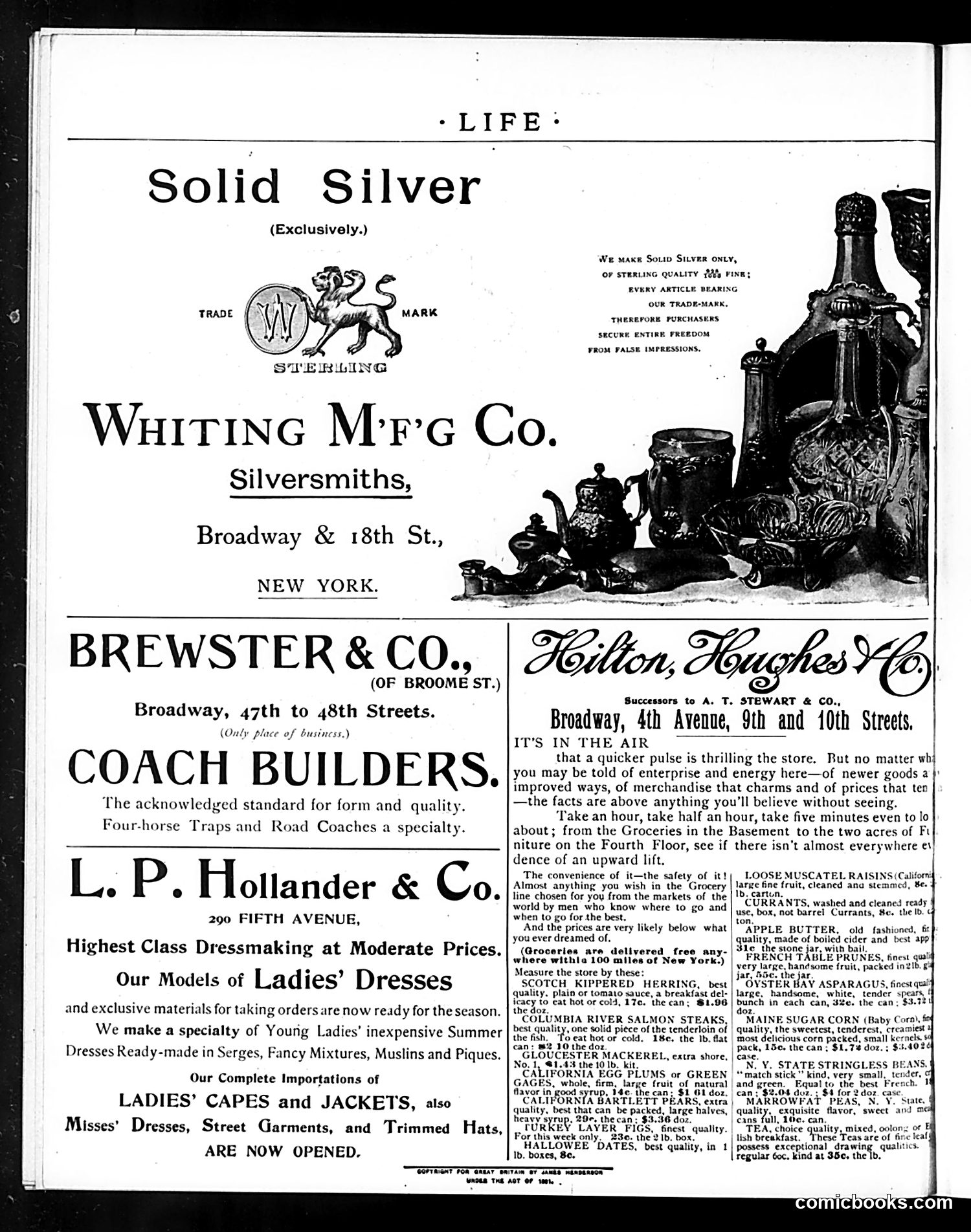
This page is **primarily advertising**, not editorial content or satire. It contains advertisements for various New York businesses including: - **Whiting M'fg Co.** (silversmiths) - **Brewster & Co.** (coach builders) - **L.P. Hollander & Co.** (dressmaking) - **Hilton, Hughes & Co.** (department store successors) The right side features what appears to be a product advertisement with an illustration of bottles and items, accompanied by promotional text about store merchandise and convenience. There is **no political cartoon or satire evident** on this page. The decorative imagery (the lion trademark, the still-life product display) serves purely commercial purposes. This reflects Life magazine's era when publications relied heavily on advertising revenue and mixed commercial content with editorial material.
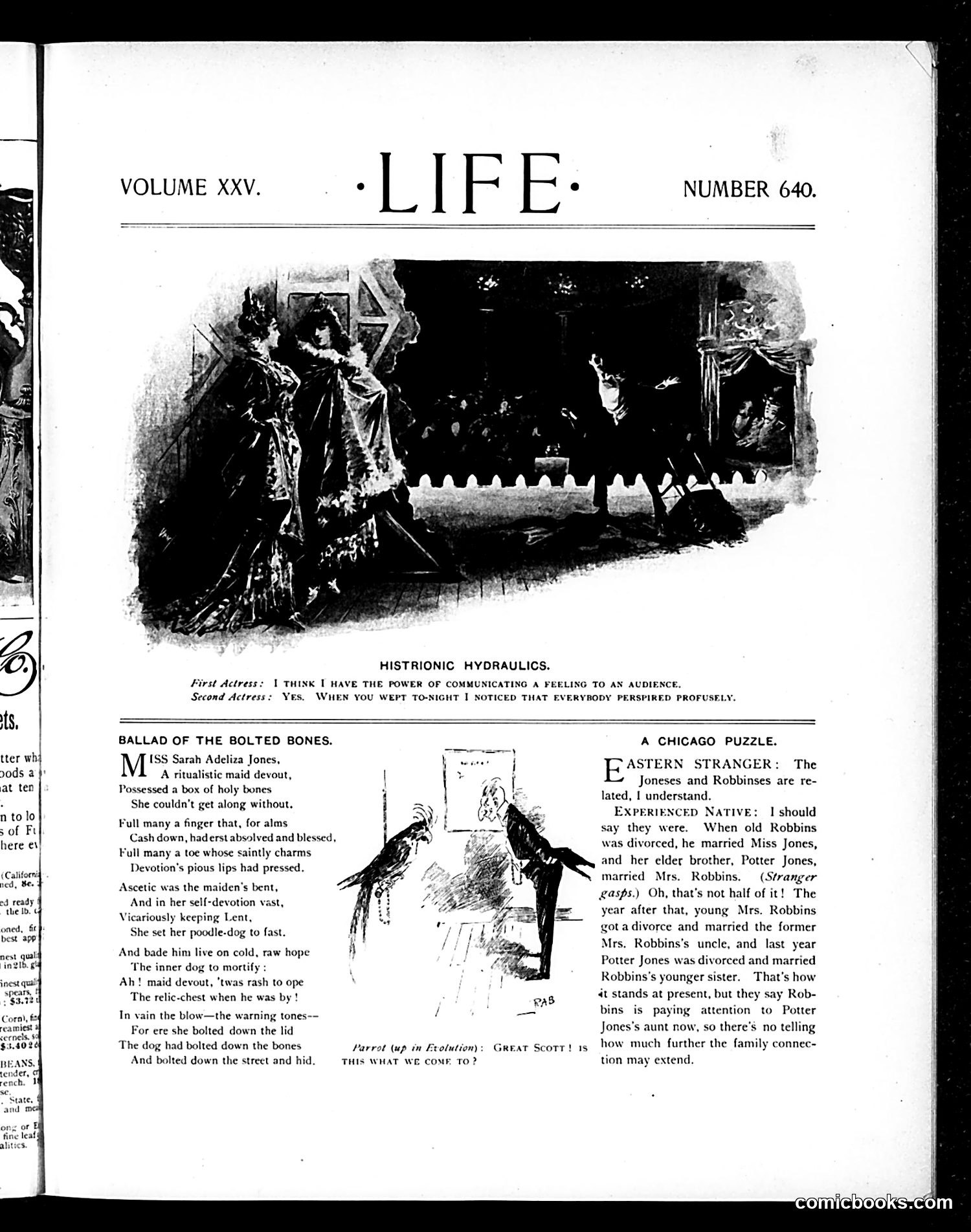
This page from *Life* magazine (Volume XXV, No. 640) contains two distinct pieces of humor: **"Histrionic Hydraulics"** (top illustration) depicts a theatrical scene where an actress claims she can communicate feeling to an audience, while her companion notes the audience wept—but only because everyone nearby perspired profusely. This satirizes overwrought Victorian theatrical performances and the gap between actors' self-importance and actual audience response. **"Ballad of the Bolted Bones"** (left) is a humorous poem about Miss Sarah Adeliza Jones, a maid who possessed a box of bones she couldn't get rid of, suggesting domestic mishaps or waste disposal problems of the era. **"A Chicago Puzzle"** (right) presents a comedic domestic entanglement involving divorces and remarriages among the Jones and Robbins families, mocking the complications of serial marriages among acquaintances.
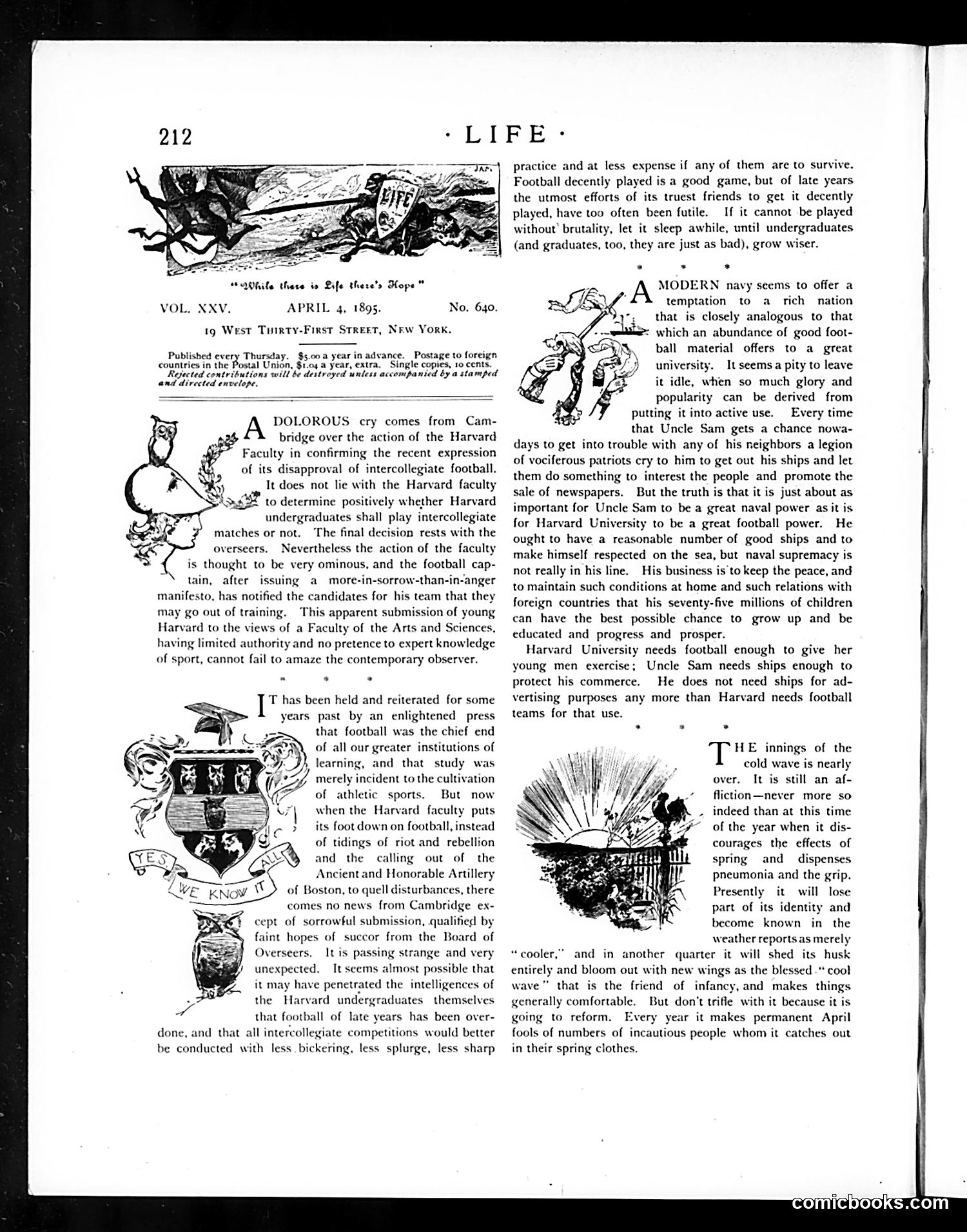
This page critiques Harvard University's decision to discontinue intercollegiate football. The text expresses satirical dismay at the Faculty of Arts and Sciences eliminating the sport, noting the irony that Harvard administrators claim limited authority in athletic matters yet intervened decisively here. The cartoons mock this hypocrisy: an owl (symbolizing academic wisdom) appears confused or disapproving. The piece argues Harvard needs football for student exercise and that "Uncle Sam" (America) benefits from the sport's popularity and the ships/naval prestige it generates. The satire suggests Harvard's faculty overreached by banning football while claiming they shouldn't meddle in athletics—a contradiction the magazine finds absurd and harmful to both the university and national interests.
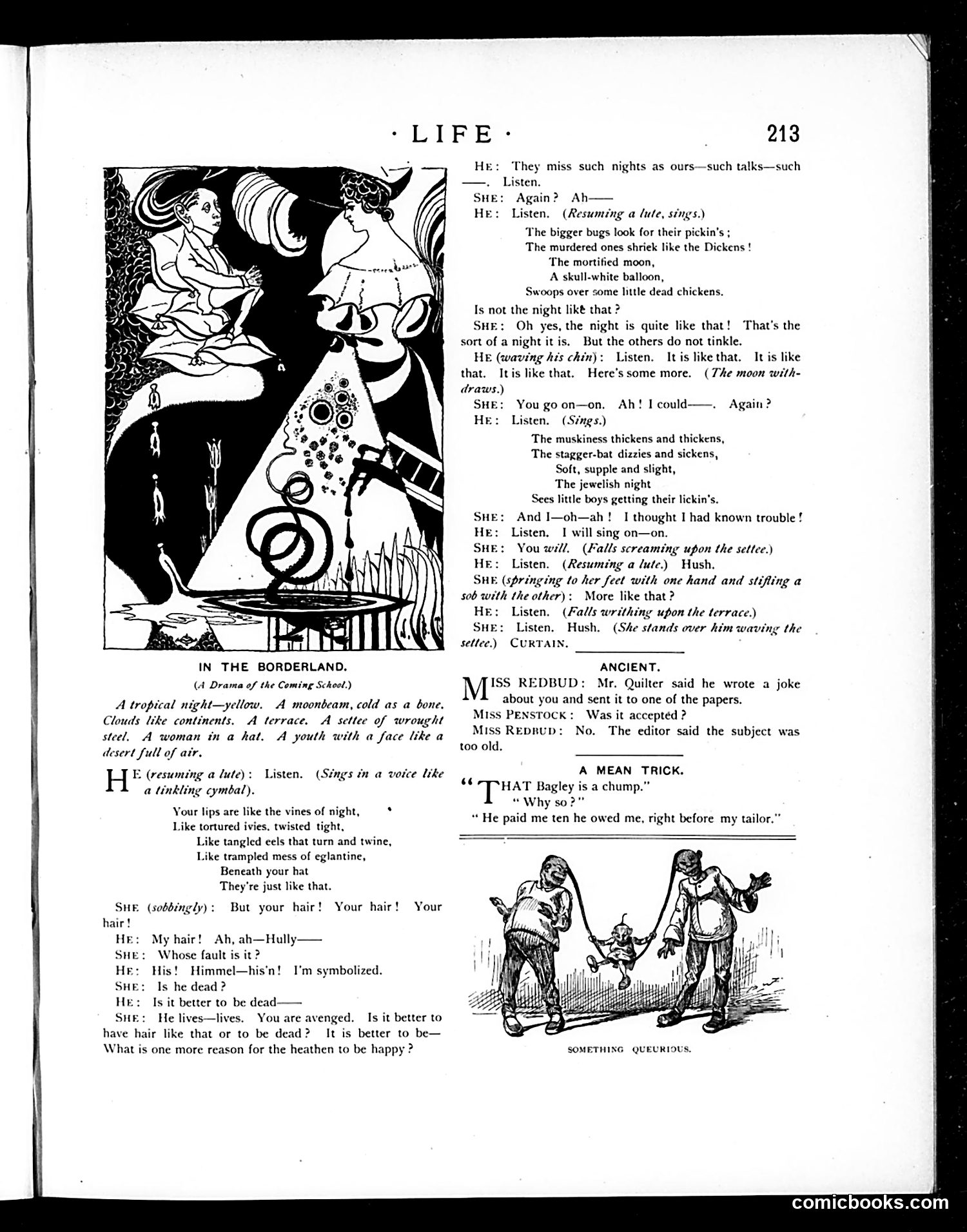
This page contains two distinct pieces: **"In the Borderland"** (top): A dramatic illustration accompanying a theatrical piece or poem about a romantic night scene. The surreal artwork features stylized figures in an exotic landscape with musical and mystical elements. The dialogue between "He" and "She" suggests courtship or seduction, with the woman repeatedly asking him to continue singing or speaking. **"A Mean Trick"** (bottom): A brief humorous anecdote about someone named Bagley, illustrated with a simple sketch. The joke concerns Bagley paying someone ten shillings he owed, "right before my tailor"—implying the tailor witnessed payment, making Bagley appear solvent when he may not be. The humor relies on the irony of deliberately creating a false impression of creditworthiness.
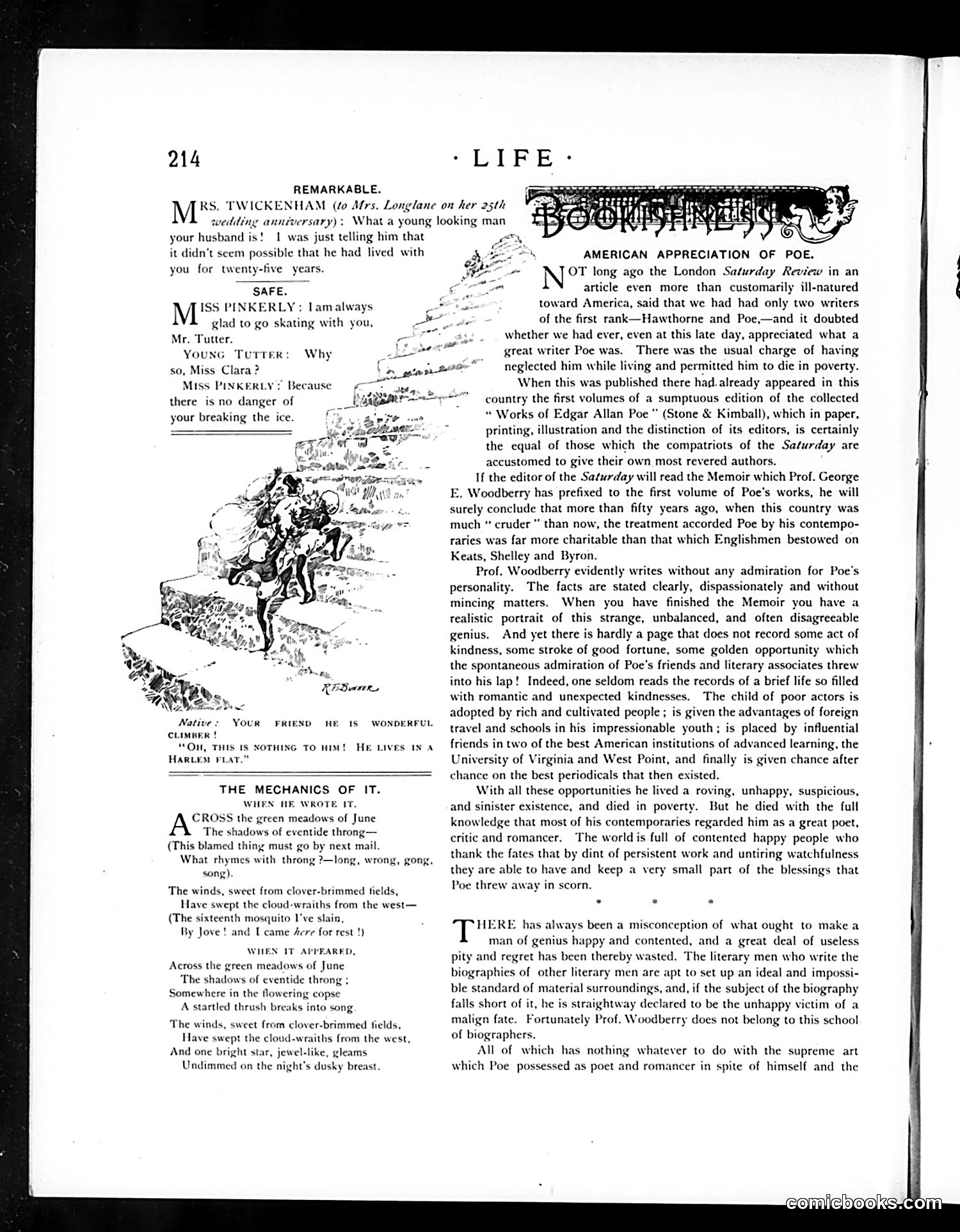
This page contains three distinct sections: **Left side:** Two brief dialogue exchanges labeled "REMARKABLE" and "SAFE" with a sketch titled "Note: 'Your Friend He Is Wonderful Climber!' 'Oh, This Is Nothing To Him! He Lives In A Harlem Flat.'" The cartoon depicts someone climbing a steep, precarious structure, making a joke about living conditions in Harlem—satirizing the cramped, vertical living spaces of the neighborhood. **Center/Right:** "THE MECHANICS OF IT" presents a poem titled "When He Wrote It" about June meadows and wind-swept fields, appearing to be literary content unrelated to satire. **Main article:** "AMERICAN APPRECIATION OF POE" discusses Edgar Allan Poe's treatment during his lifetime versus his later recognition, praising Professor Woodberry's biography for its dispassionate account. The page mixes humor, verse, and literary criticism typical of Life's satirical magazine format.
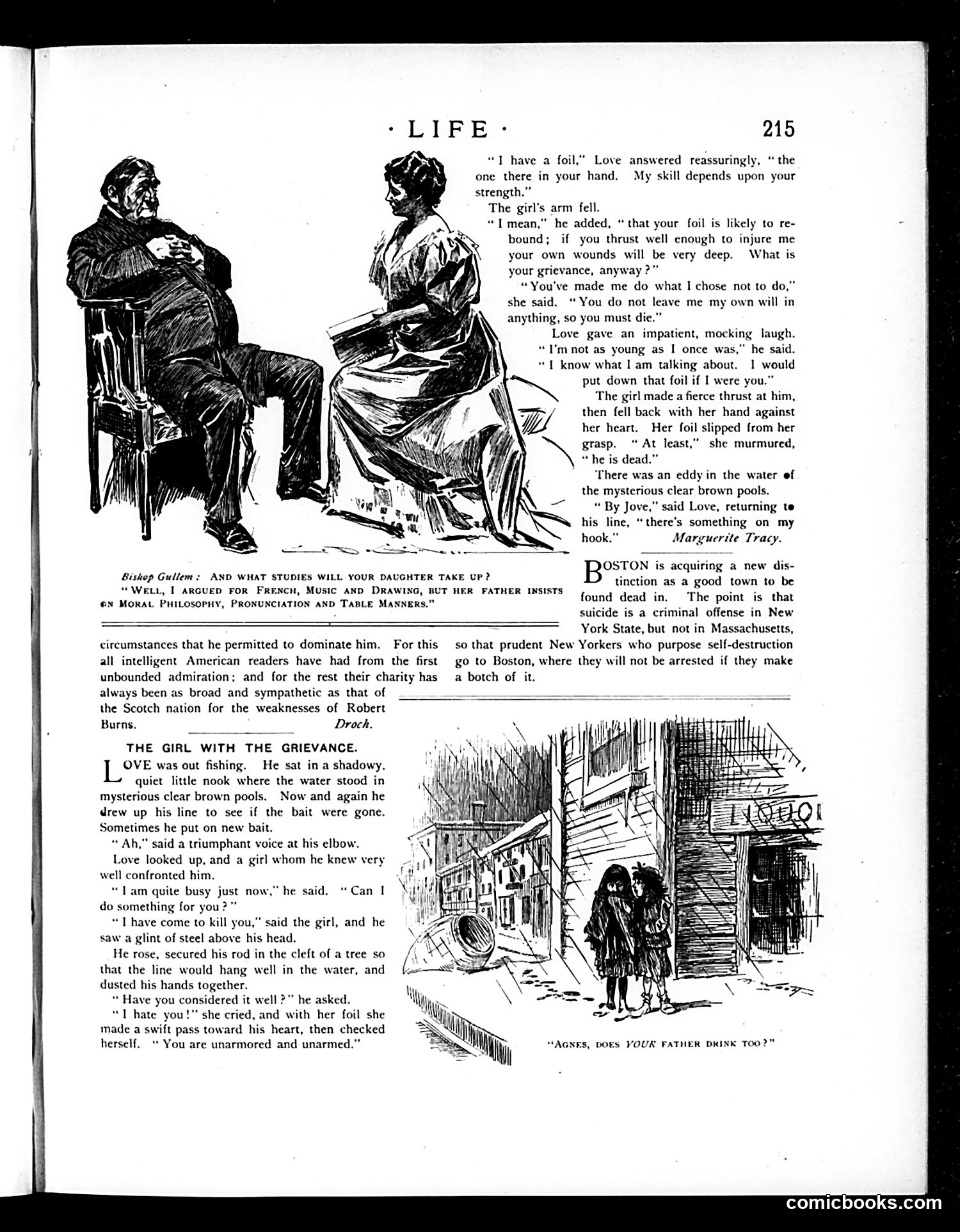
The top cartoon depicts "Bishop Guillem" discussing his daughter's education. The bishop insists she study "Moral Philosophy, Pronunciation and Table Manners" while her father demands French, Music, and Drawing—a satire on Victorian-era debates over women's proper education and the tension between religious morality and secular refinement. "The Girl with the Grievance" story below satirizes melodramatic romantic fiction. A girl confronts a man named Love, threatening him with a foil (fencing sword) because he's rejected her. The narrative mocks overwrought Victorian literature with its exaggerated emotions and theatrical language. The lower illustration shows a beggar child asking "Agnes, does your father drink too?"—social commentary on urban poverty and alcoholism affecting families.
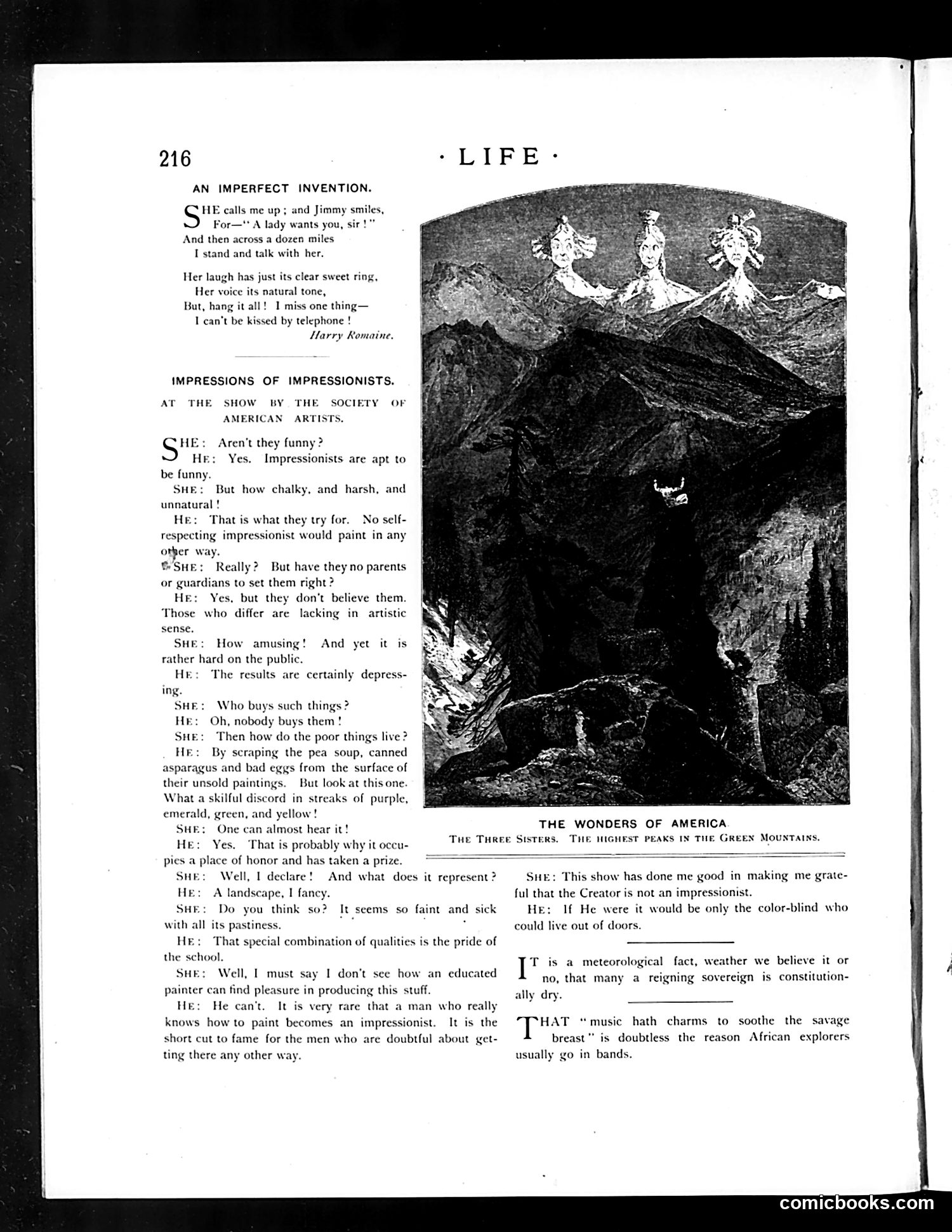
This page contains two satirical pieces: **"An Imperfect Invention"** by Harry Romaine mocks the telephone's limitations—specifically that one cannot kiss through it, a humorous complaint about the technology's inability to convey physical intimacy. **"Impressions of Impressionists"** is a dialogue mocking avant-garde Impressionist art being shown at the Society of American Artists. The satire critiques Impressionism as deliberately ugly, harsh, and unnatural—"chalky" and "depressing." The speakers mock both the artists (lacking proper guidance) and the works themselves, which apparently sold despite their poor quality. The joke ridicules what the author sees as pretentious, talentless modern art gaining acceptance and purchase. The accompanying illustration, "The Wonders of America: The Three Sisters," appears decorative rather than directly tied to the text's satire.
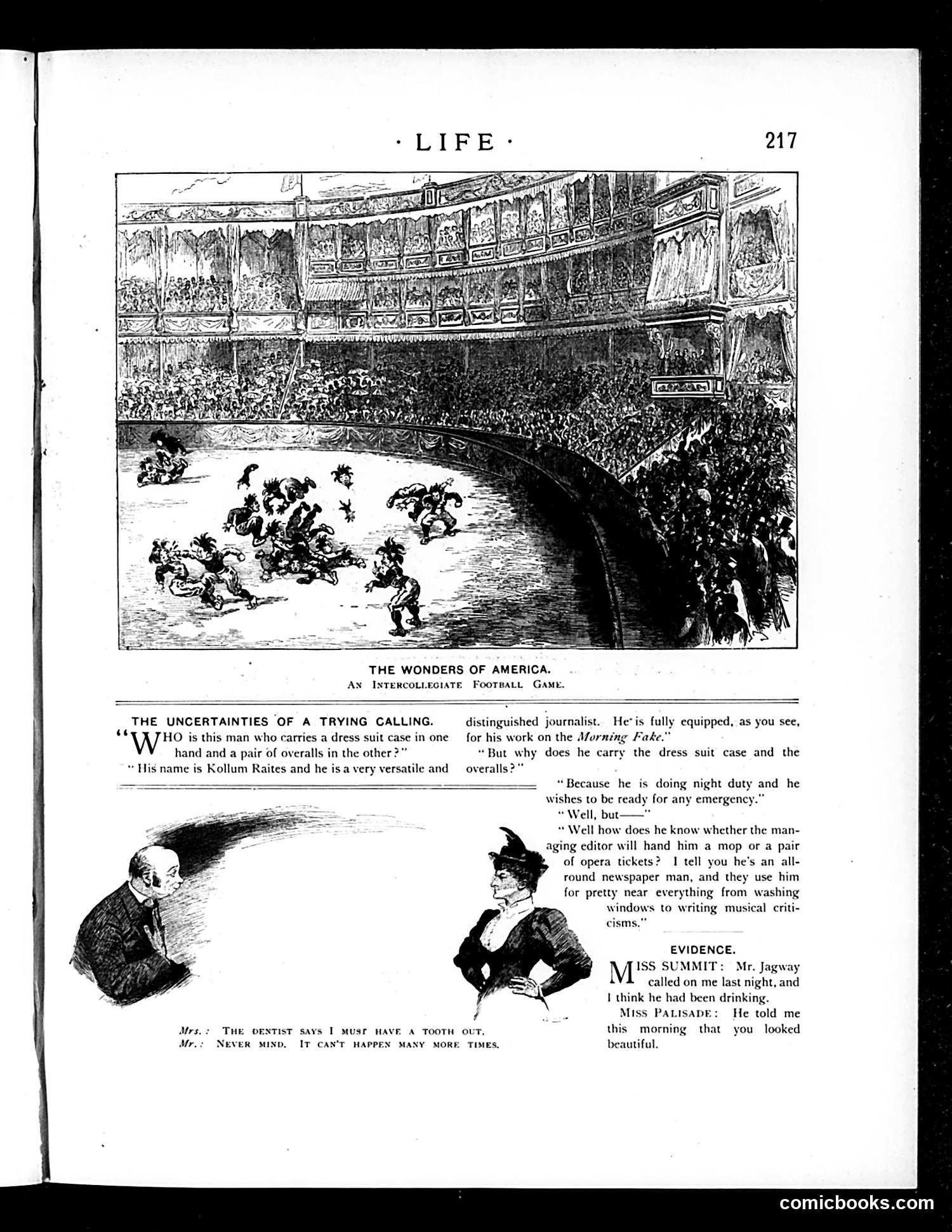
**Top Image:** "The Wonders of America: An Intercollegiate Football Game" depicts a packed stadium arena with horses and riders performing in the center ring. This is satirical commentary on American college football's spectacle and chaos—the drawing style suggests the event resembles a chaotic circus rather than organized sport. **Lower Section:** "The Uncertainties of a Trying Calling" features a man carrying both a dress suit case and overalls. The caption identifies him as Kollum Raites, a versatile newspaper worker. The dialogue explains his dual attire: he works night duty and must be ready for emergencies, never knowing whether his editor will assign him to cover opera, politics, or manual labor. This satirizes the unpredictable demands and low status of early journalism work.
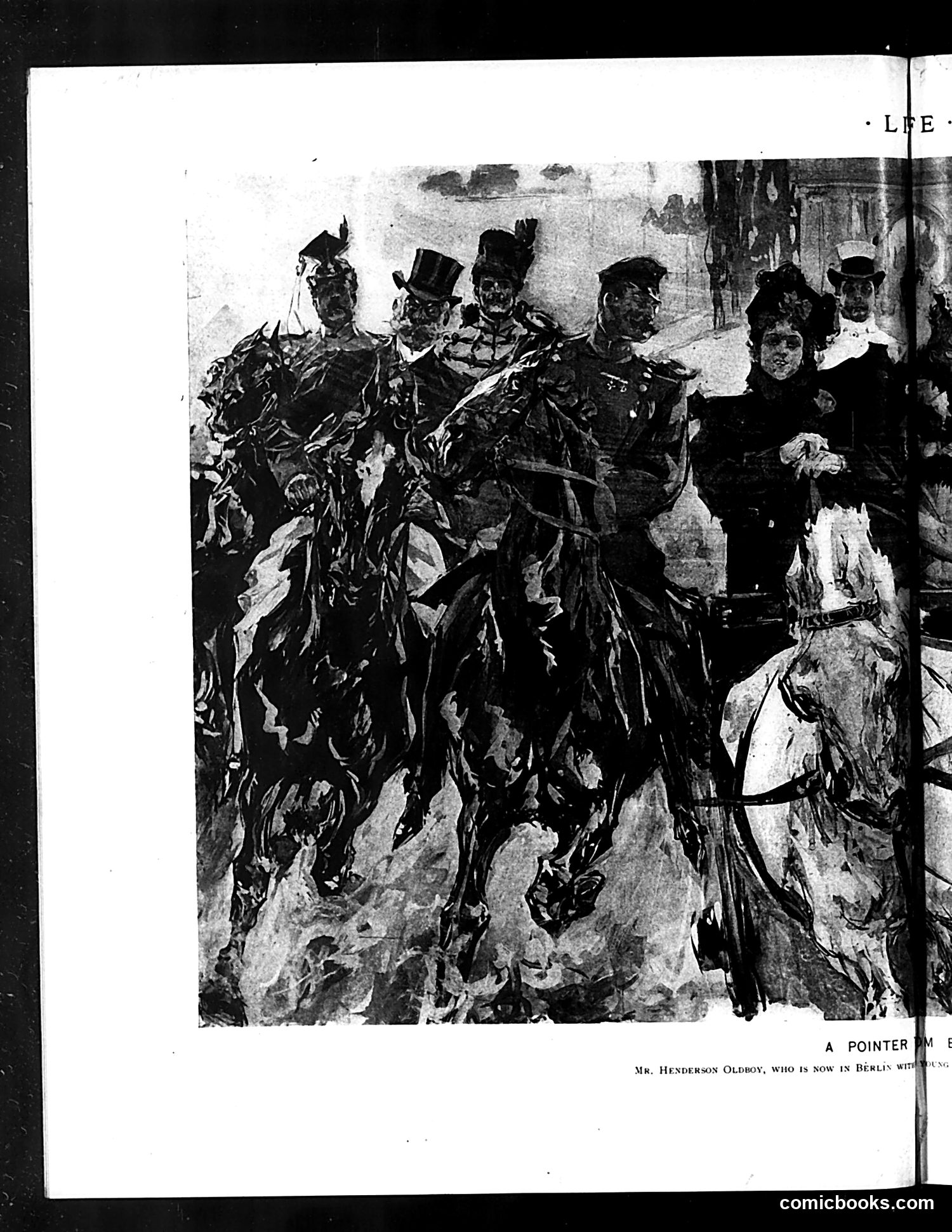
This page from *Life* magazine features a satirical illustration titled "A Pointer in..." (text cut off). The caption identifies "Mr. Henderson Oldroy, who is now in Berlin with..." (incomplete). The image shows mounted military or diplomatic figures in formal dress uniforms and top hats, riding horses in what appears to be a European street setting. The exaggerated, caricatured style typical of *Life*'s political satire suggests commentary on either a diplomatic mission or military official visiting Berlin. Without the complete caption and publication date visible, the specific political context remains unclear. However, the formal military attire and Berlin setting suggest this lampoons either a diplomatic visit or military delegation during a period of international significance—likely early 20th century given the artistic style. The satire's precise target cannot be definitively determined from the visible text alone.
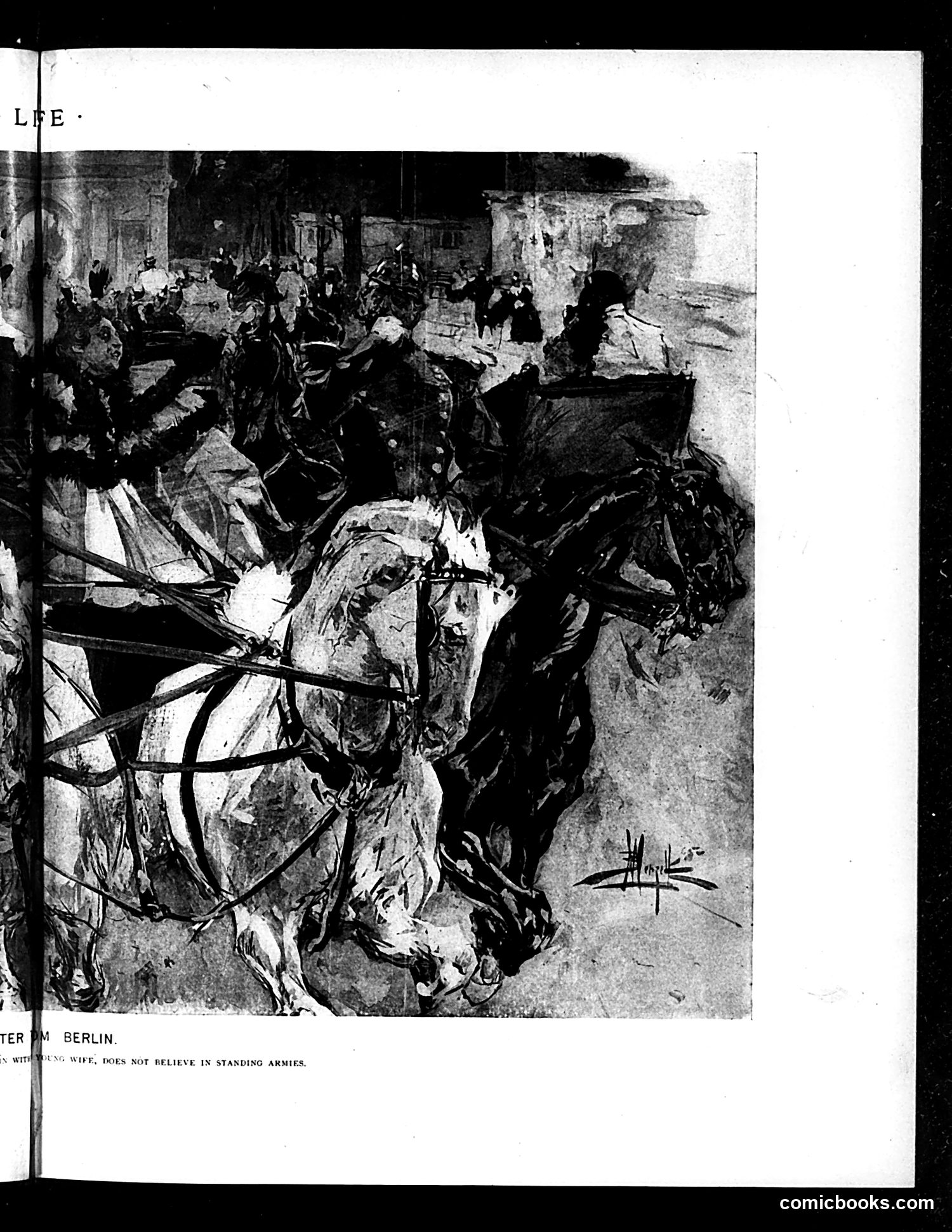
This appears to be a satirical illustration from *Life* magazine depicting a military or diplomatic scene in Berlin. The image shows mounted cavalry or military figures in formal dress with horses, gathered in what seems to be an urban setting with classical architecture in the background. The caption reads: "KAISER WITH HIS WIFE, DOES NOT BELIEVE IN STANDING ARMIES" (though the OCR is partially obscured). The satire likely mocks the German Kaiser's military posture—specifically, the ironic contradiction between his stated position and Germany's actual massive standing army. The mounted soldiers in the image visually emphasize this contradiction. The joke plays on the phrase "standing armies" literally (the soldiers are mounted, not standing) versus the political reality of German militarism. Without a clear date visible, this appears to reference pre-World War I or World War I-era tensions.
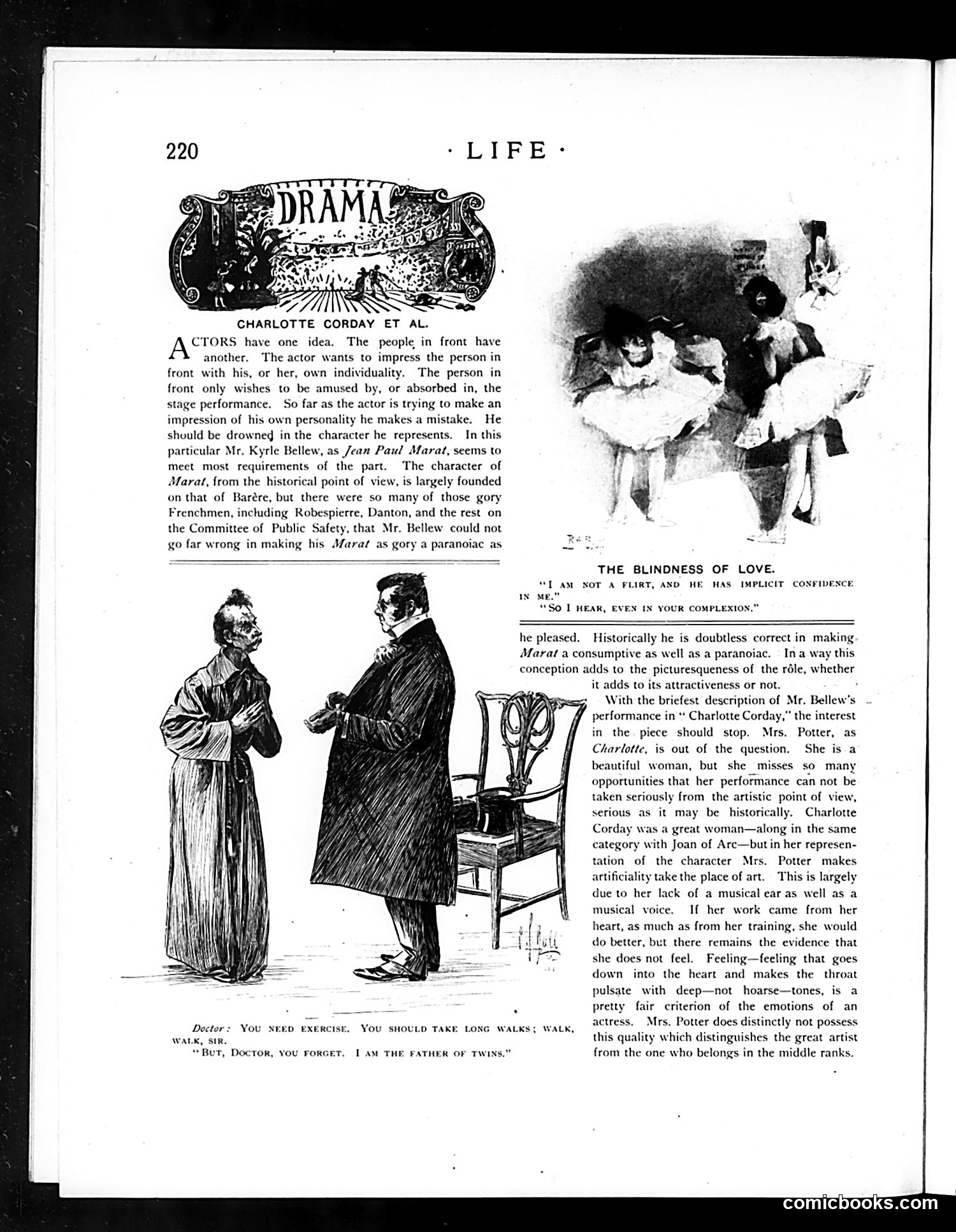
This page reviews a theatrical production of "Charlotte Corday," a play about the French Revolution figure who assassinated radical leader Jean-Paul Marat. **The critique evaluates two performances:** **Kyrle Bellew as Marat** receives praise for disappearing into character rather than projecting his own personality—the text argues this is what good acting requires. **Mrs. Potter as Charlotte Corday** is criticized harshly. Despite being beautiful and the character being historically significant (compared to Joan of Arc), Potter is deemed artificial and emotionally cold. The reviewer faults her lack of musical training and argues she doesn't *feel* the role deeply enough—true artistry requires genuine emotional expression, not mere technical execution. **The cartoon below** (captioned "The Blindness of Love") appears unrelated—it depicts a domestic scene with dialogue about flirtation and infidelity, illustrating a separate social comedy. The satire targets actors who prioritize appearance or technique over authentic emotional commitment to their roles.
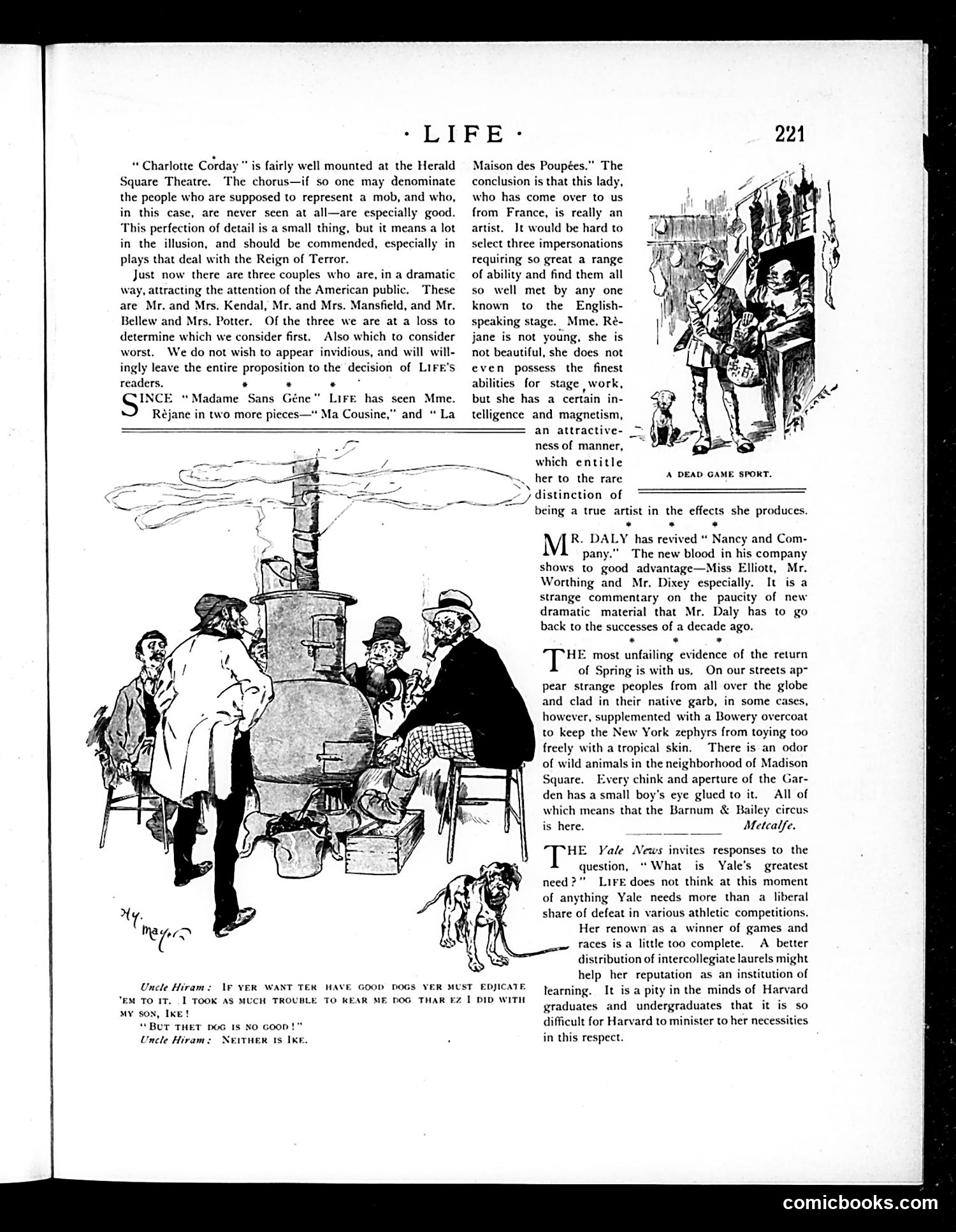
This page contains theatrical reviews and social commentary typical of early Life magazine satire. **Main Cartoon (left):** Depicts "Uncle Hiram" defending his poorly-behaved dog to a neighbor ("Ike"), claiming he educated it as carefully as he raised his child. The humor lies in the implication that Hiram's child is as undisciplined as the dog—a class-based joke about rustic/working-class parenting. **Text Content:** Reviews of stage productions, particularly praising French actress Mme. Rejane's versatility. The page critiques American theater couples (Kendal, Mansfield, Bellew) without choosing favorites, leaving judgment to readers. **Spring Commentary:** Describes seasonal arrival of circus crowds and immigrants in native dress near Madison Square Garden, with casual ethnic mockery typical of the era. **Yale News Jab:** Life sarcastically suggests Yale needs "defeat" in athletics to build character—a Harvard-friendly dig at Yale's athletic dominance, implying excessive winning corrupts institutions.
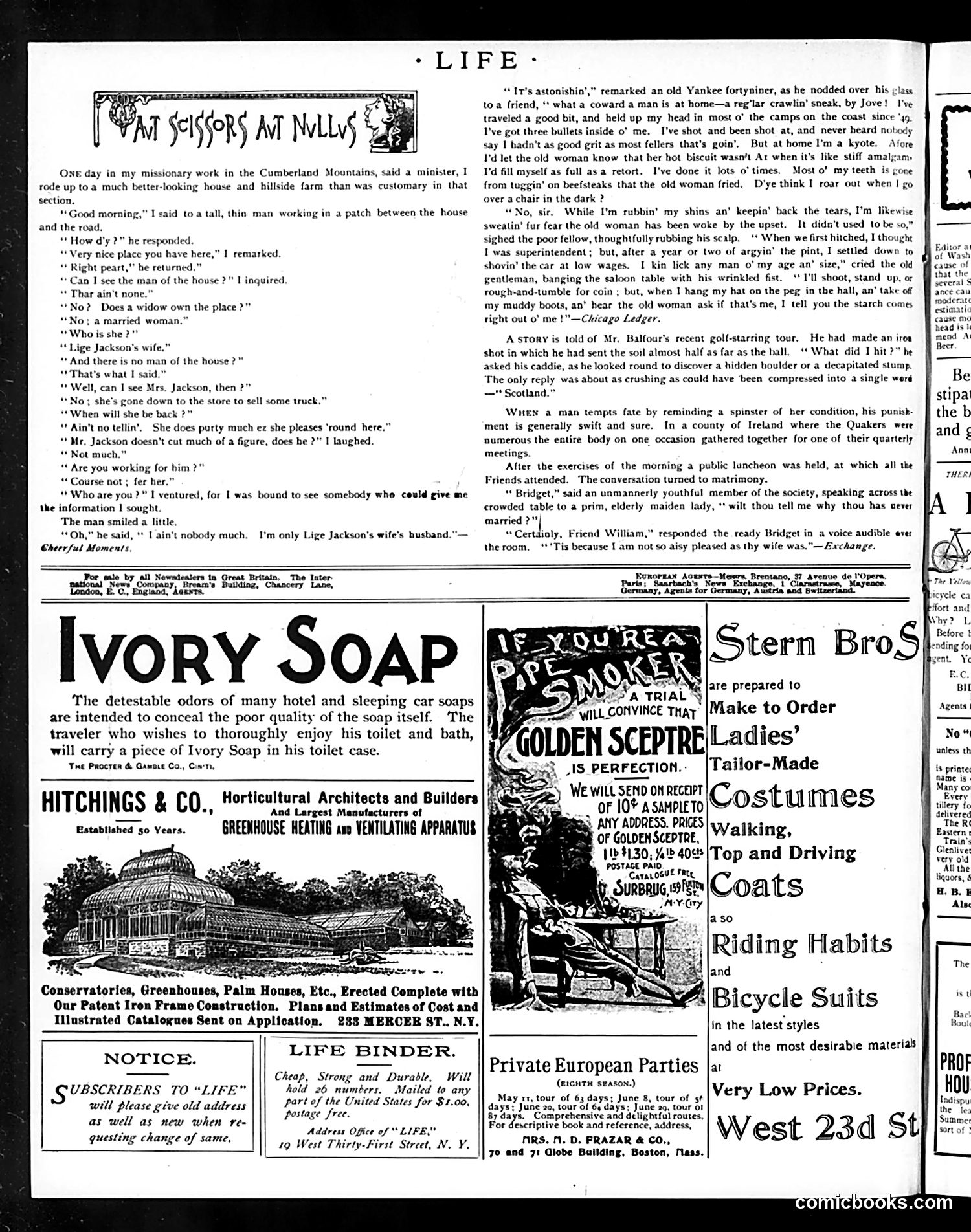
This page contains two humorous dialect stories satirizing gender dynamics in late 19th-century America. **"Lige Jackson's Wife's Husband"** depicts a poor Appalachian farmer who has become completely emasculated—he works for his wife, not himself, and identifies primarily as "her husband" rather than as an independent man. The joke is that economic reversal has inverted traditional gender roles, rendering the husband nearly invisible. **The "Old Yankee" anecdote** presents the inverse: a tough prospector who boasts of fearlessness in dangerous frontier situations but admits he's terrified of his wife at home. He's "a kyote" (coward) domestically—afraid to complain about burnt biscuits or make noise after accidents. Both stories mock how marriage supposedly strips men of authority and courage. These reflect Victorian anxieties about women's growing independence and economic power, portrayed as threats to masculine identity. The humor depends on readers finding male subordination to wives inherently ridiculous.
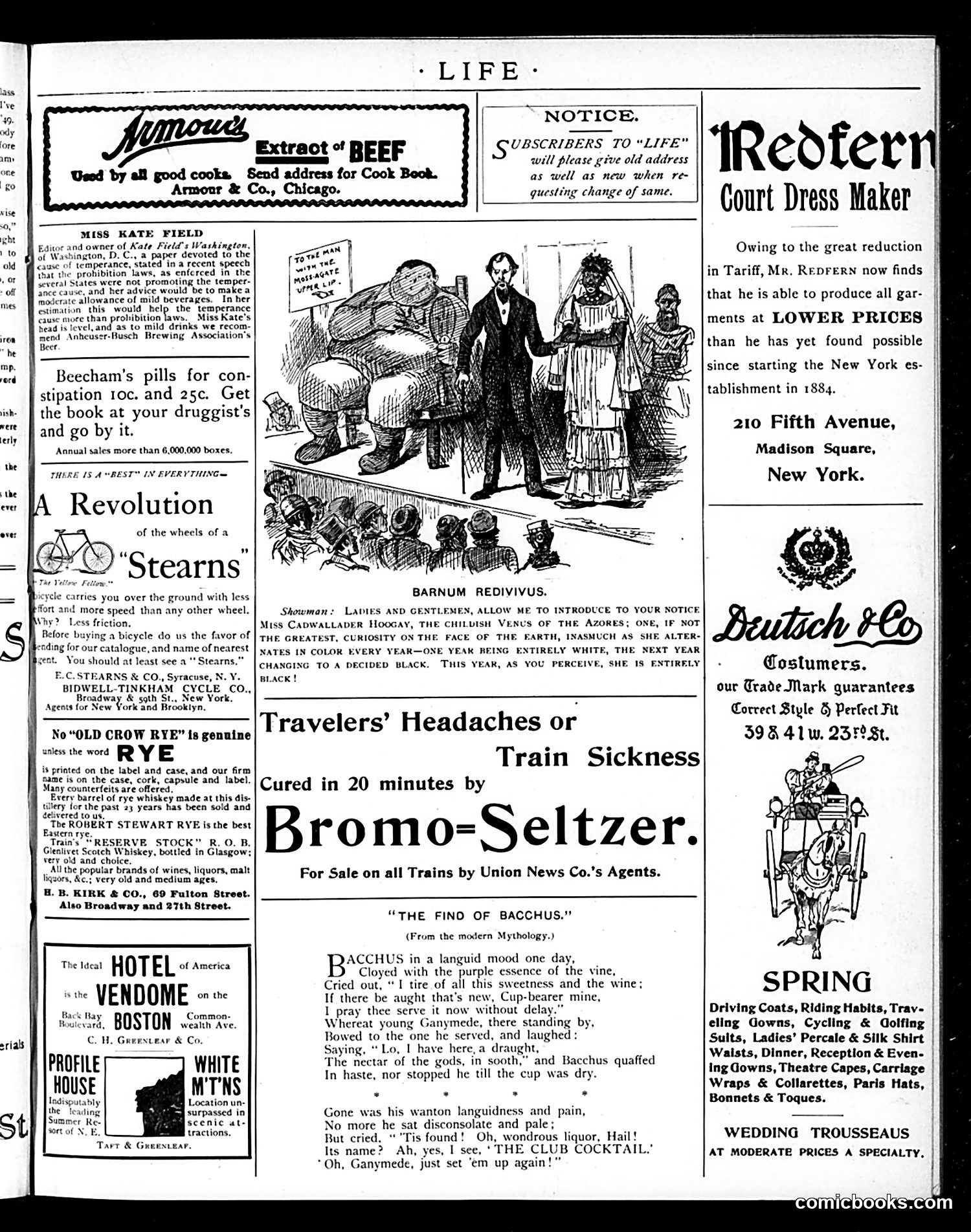
This satirical cartoon parodies P.T. Barnum's famous museum exhibitions by mocking a fabricated "freak show" curiosity. The showman presents "Miss Cadwallader Hoogay, the Childish Venus of the Azores," claiming she changes skin color annually—entirely white one year, entirely black the next. The satire targets two things: Barnum's sensationalist exploitation of human oddities as entertainment, and likely contemporary pseudo-scientific racism. By presenting an obviously impossible and absurd claim (a person whose entire skin color changes seasonally), the cartoonist ridicules both the charlatan showman tradition and credulous audiences willing to believe such nonsense. The title "Barnum Redivivus" (Barnum revived) suggests this type of hucksterism persists despite Barnum's death in 1891. The cartoon mocks the gullibility required to accept such extraordinary, unsubstantiated claims presented as scientific curiosity.
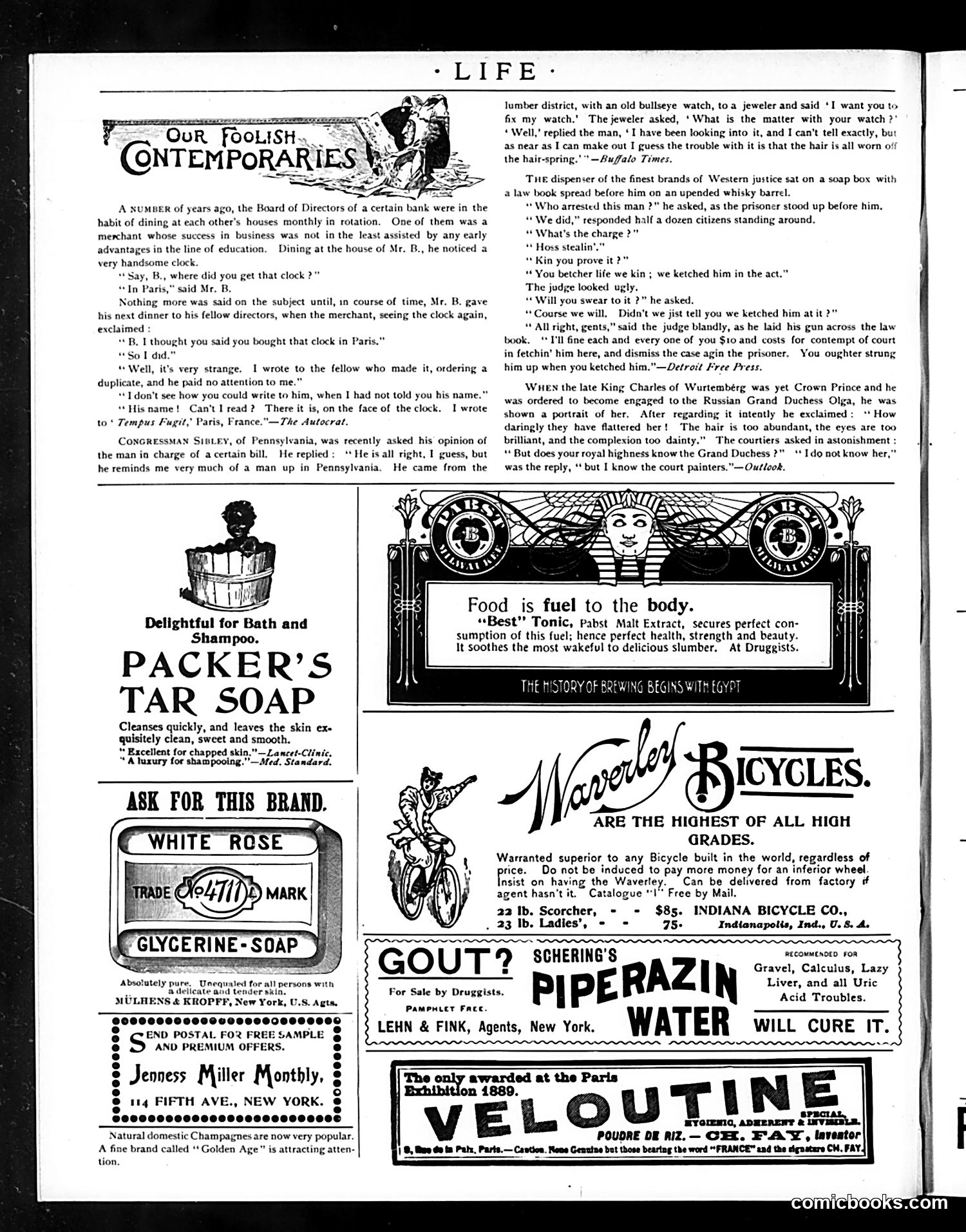
This page collects humorous anecdotes satirizing human folly and miscommunication. The main content includes four short comedic stories: 1. **The Paris Clock**: A merchant mistakes "Tempus Fugit" (Latin for "time flies," printed on the clock face) for the clockmaker's name and address, attempting to order a duplicate from a non-existent person. 2. **The Jeweler's Complaint**: A lumber district man brings a broken watch to a jeweler, diagnosing the problem as "the hair is all worn off the hair-spring"—confusing internal watch mechanisms. 3. **Western Frontier Justice**: A judge fines vigilantes for contempt of court after they testify they caught a horse thief, then dismisses the case—mocking rough frontier justice systems. 4. **Royal Portrait Flattery**: A Prussian Crown Prince, shown a portrait of his betrothed Russian Grand Duchess, complains it's too flattering, then admits he's never met her—satirizing arranged marriages and court painters' exaggerations. The page also includes period advertisements for soaps, bicycles, and patent medicines. The humor relies on misunderstanding, pretension, and cultural gaps.
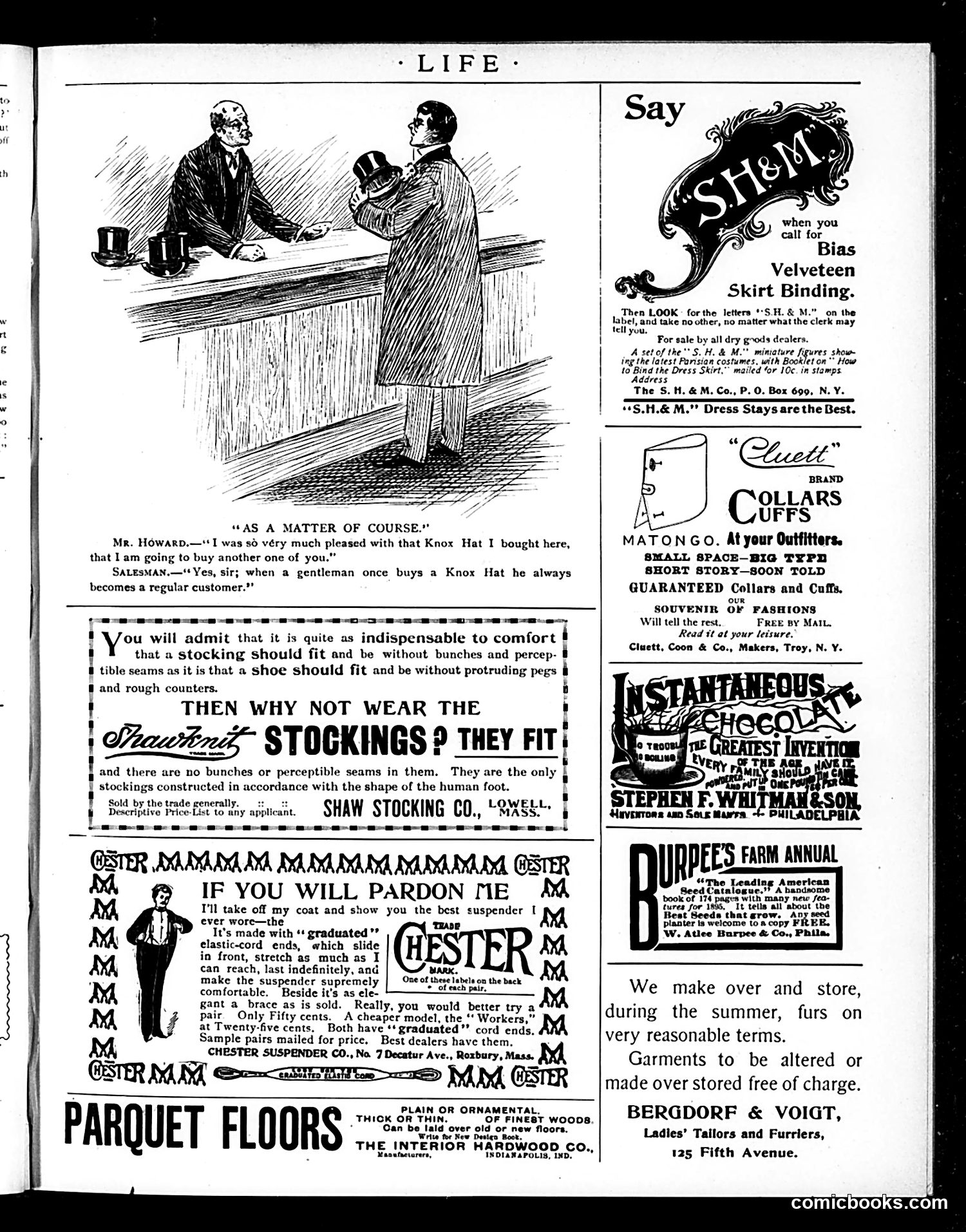
This page is primarily **advertising**, typical of early 20th-century magazines. The main cartoon depicts a haberdashery transaction: a satisfied customer (Mr. Howard) tells a salesman he'll buy another Knox Hat because he became "a regular customer" after his first purchase. The joke is straightforward—quality products create loyal repeat customers. The page contains no political satire or social commentary. Instead, it showcases period advertisements for consumer goods: suspenders (Chester brand), stockings (Pawnbrooke), dress stays, shirt bindings, collars and cuffs, chocolate, and other merchandise typical of the era. The cartoons are light and commercial rather than editorial. They exist solely to promote products through humor and narrative endorsements—common advertising strategy of that time. There are no caricatures of public figures or references to contemporary events visible on this page.
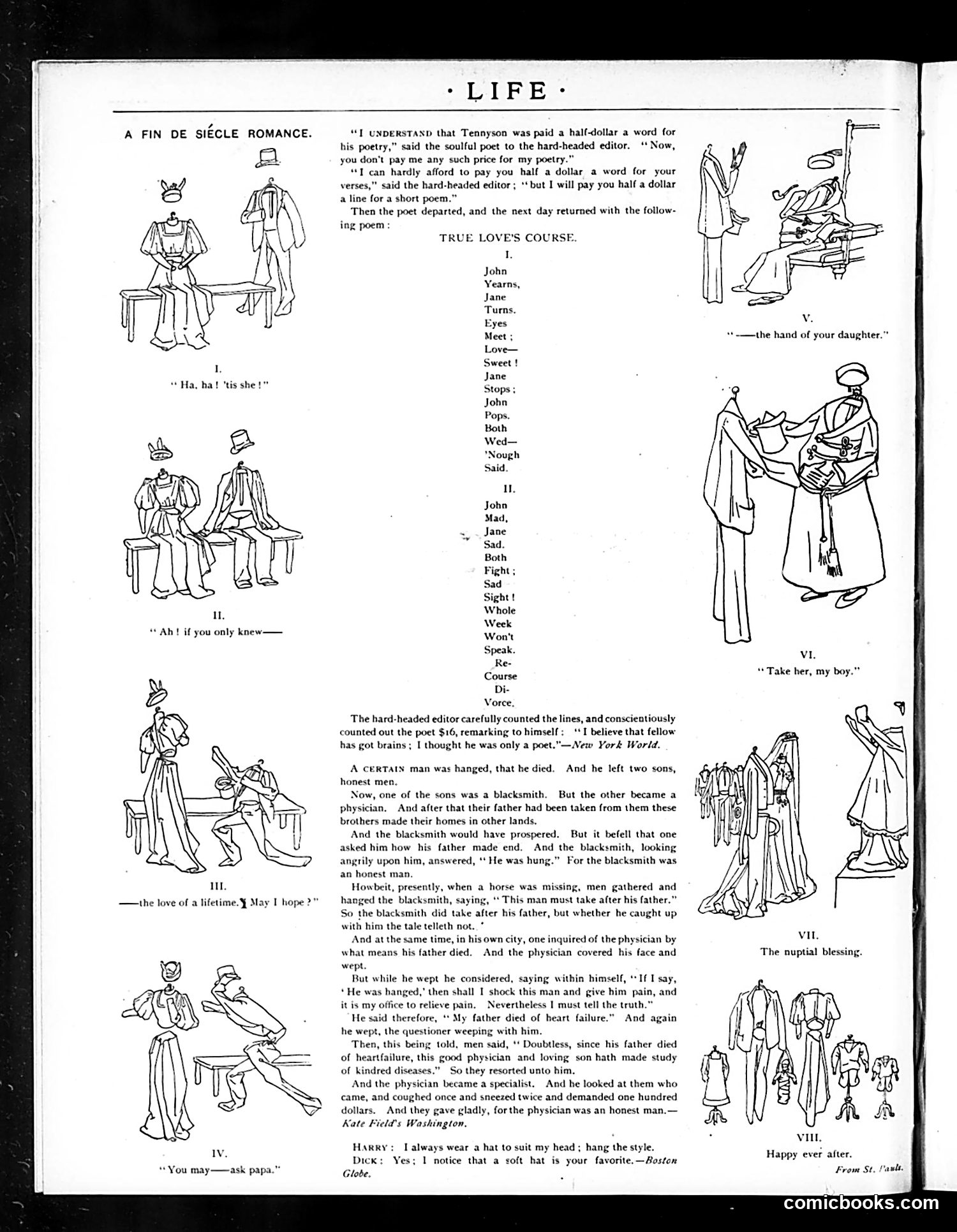
This page contains several unrelated satirical pieces typical of Life magazine's format: **Top**: A dialogue mocking poetic compensation. A poet negotiates with an editor about payment rates, referencing Tennyson's high fees. The poet returns with "True Love's Course"—a deliberately crude, one-word-per-line poem that technically fulfills the contract for $16, exposing the editor's foolish agreement. **Middle**: A moral fable contrasting two brothers whose father was hanged. The blacksmith honestly admits his father's execution and is hanged for it; the physician euphemistically claims "heart failure" and becomes a successful specialist. The satire critiques how society rewards dishonesty and punishes blunt truth-telling. **Bottom**: Simple romantic vignettes showing courtship and marriage progression, with a final joke about hat styles. The page satirizes literary pretension, social hypocrisy, and human nature through humor rather than political commentary.