
Life, 1895-04-04 · page 12 of 18
Life — April 4, 1895 — page 12: what you’re looking at
What you’re looking at
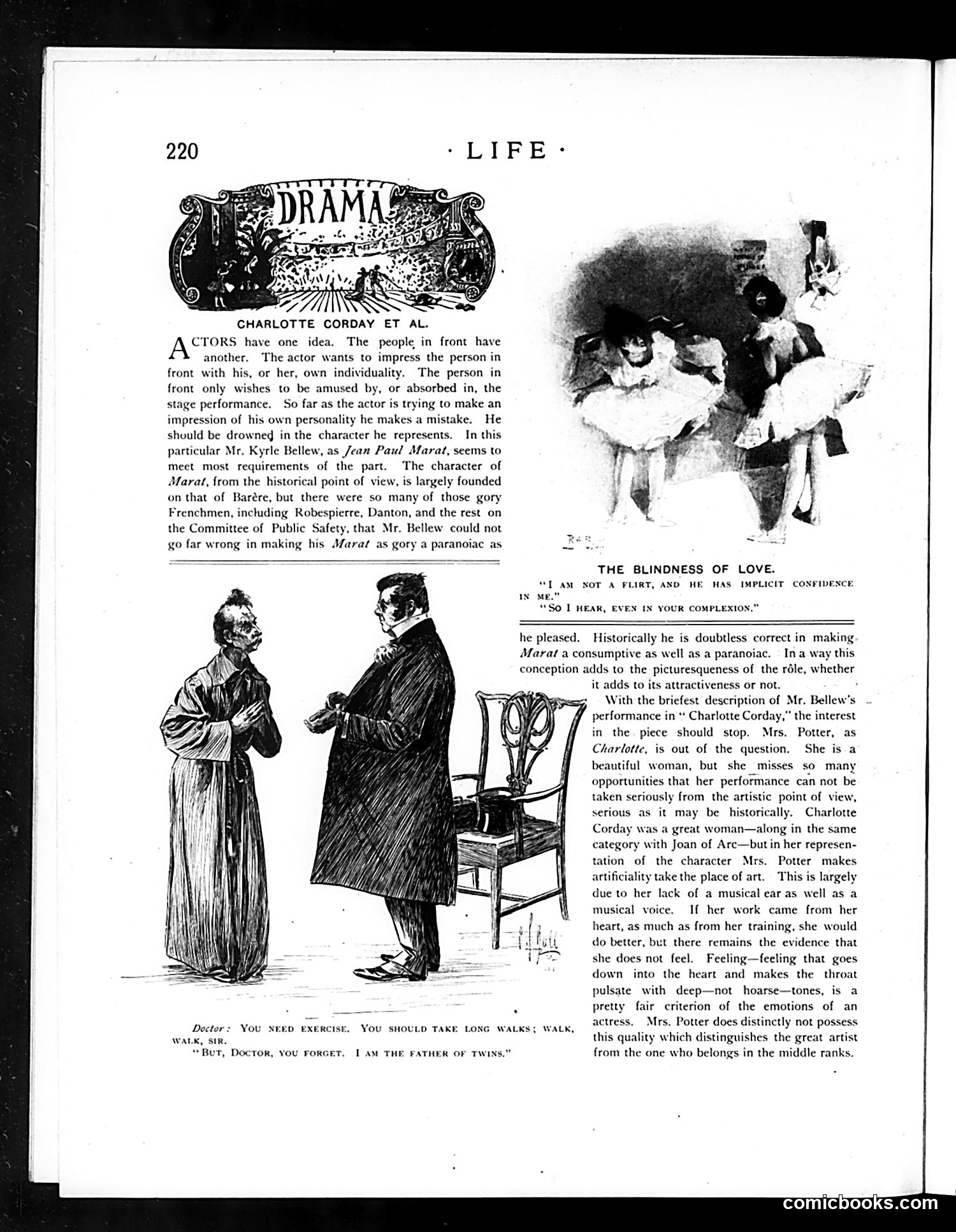
This page reviews a theatrical production of "Charlotte Corday," a play about the French Revolution figure who assassinated radical leader Jean-Paul Marat. **The critique evaluates two performances:** **Kyrle Bellew as Marat** receives praise for disappearing into character rather than projecting his own personality—the text argues this is what good acting requires. **Mrs. Potter as Charlotte Corday** is criticized harshly. Despite being beautiful and the character being historically significant (compared to Joan of Arc), Potter is deemed artificial and emotionally cold. The reviewer faults her lack of musical training and argues she doesn't *feel* the role deeply enough—true artistry requires genuine emotional expression, not mere technical execution. **The cartoon below** (captioned "The Blindness of Love") appears unrelated—it depicts a domestic scene with dialogue about flirtation and infidelity, illustrating a separate social comedy. The satire targets actors who prioritize appearance or technique over authentic emotional commitment to their roles.
📄 Transcribed text from this page (OCR, searchable)
Machine-transcribed from the original scan — historical spelling and the odd misread are preserved.
any CHARLOTTE CORDAY ET AL. CTORS have one idea. The people in front have another. The actor wants to impress the person in front with his, or her, own individuality. The person in front only wishes to be amused by, or absorbed in, the stage performance. So far as the actor is trying to make an impression of his own personality he makes a mistake. He should be drowned in the character he represents. In this particular Mr, Kyrle Bellew, as Jean Paul Marat, seems to meet most requirements of the part. The character of Marat, from the historical point of view, is largely founded on that of Barére, but there were so many of those gory Frenchmen, including Robespierre, Danton, and the rest on the Committee of Public Safety, that Mr. Bellew could not go far wrong in making his Marat as gory a paranoiac as THE BLINDNESS OF LOVE. “TAM NOT A FLIRT, AND HE HAS IMPLICIT CONFIDENCE IN ME. I HEAR, EVEN IN YOUR COMPLEXION,” he pleased. Historically he is doubtless correct in making Marat a consumptive as well as a paranoiac. Ina way this conception adds to the picturesqueness of the réle, whether it adds to its attractiveness or not. G With the briefest description of Mr, Bellew’s performance in ** Charlotte Corday,” the interest in the. piece should stop. Mrs. Potter, as Charlotte, is out of the question. She is a beautiful woman, but she misses so many opportunities that her performance can not be taken seriously from the artistic point of view, serious as it may be historically. Charlotte Corday w great woman—along in the same category with Joan of Arc—butin her represen- tation of the character Mrs. Potter makes artificiality take the place of art. This is largely due to her lack of a musical ear as well as a musical voice. If her work came from her heart, as much as from her training, she would do better, but there remains the evidence that she does not feel. Feeling—feeling that goes down into the heart and makes the throat pulsate with deep—not hoarse—tones, is a pretty fair criterion of the emotions of an WALK, SIR. this quality which distinguishes the great artist “But, Doctor, You FORGET, I AM THE FATHER OF TWINS.” from the one who belongs in the middle ranks. comicbooks.com