
Life, 1895-04-04 · page 6 of 18
Life — April 4, 1895 — page 6: what you’re looking at
What you’re looking at
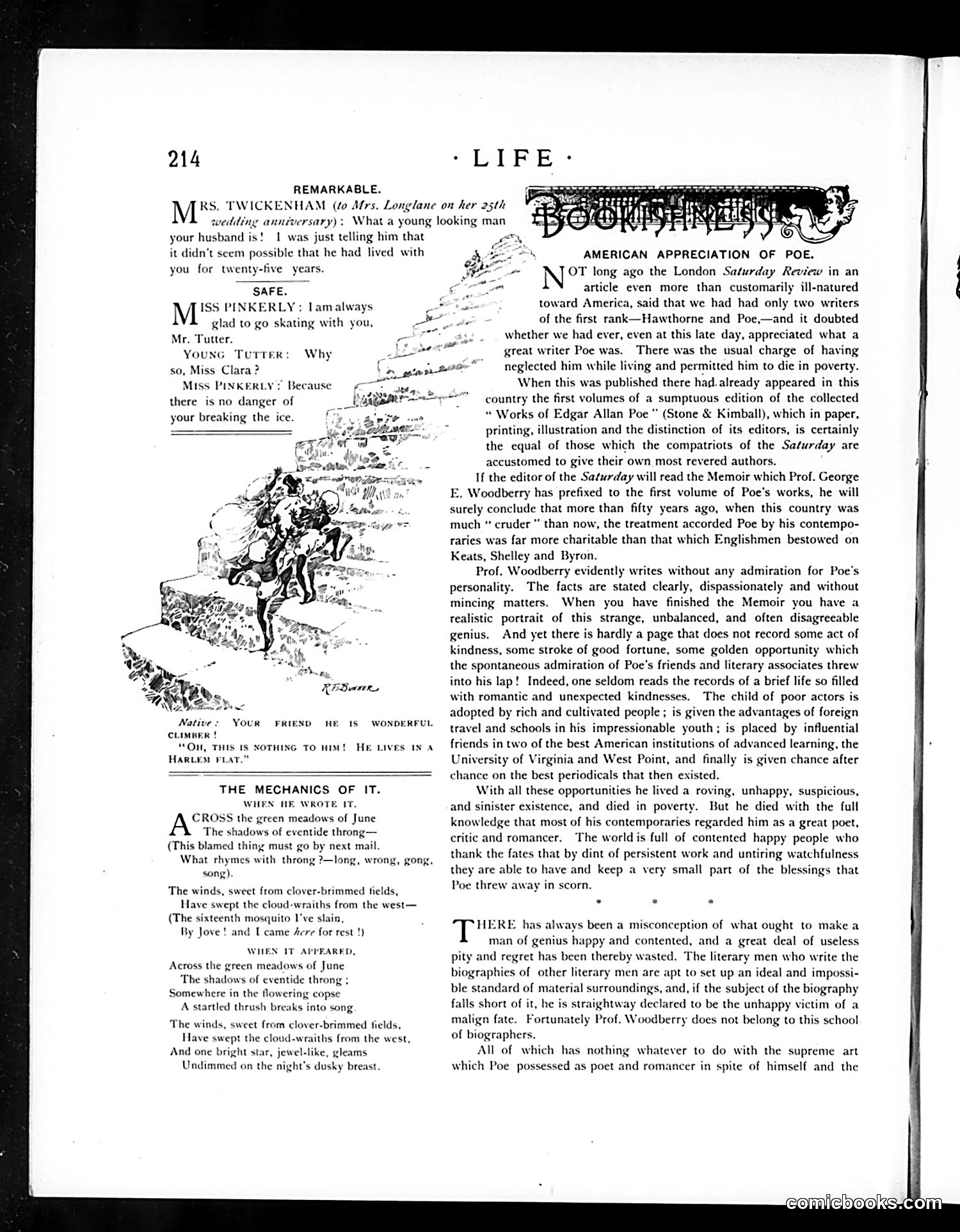
This page contains three distinct sections: **Left side:** Two brief dialogue exchanges labeled "REMARKABLE" and "SAFE" with a sketch titled "Note: 'Your Friend He Is Wonderful Climber!' 'Oh, This Is Nothing To Him! He Lives In A Harlem Flat.'" The cartoon depicts someone climbing a steep, precarious structure, making a joke about living conditions in Harlem—satirizing the cramped, vertical living spaces of the neighborhood. **Center/Right:** "THE MECHANICS OF IT" presents a poem titled "When He Wrote It" about June meadows and wind-swept fields, appearing to be literary content unrelated to satire. **Main article:** "AMERICAN APPRECIATION OF POE" discusses Edgar Allan Poe's treatment during his lifetime versus his later recognition, praising Professor Woodberry's biography for its dispassionate account. The page mixes humor, verse, and literary criticism typical of Life's satirical magazine format.
📄 Transcribed text from this page (OCR, searchable)
Machine-transcribed from the original scan — historical spelling and the odd misread are preserved.
214 REMARKABLE. RS. TWICKENHAM (¢0 Mrs, Longlane on her 25th wedding anniversary): What a young looking man your husband is! 1 was just telling him that it didn’t seem possible that he had lived with you for twenty-five year: ISS PINKERLY: glad to go skating with you, Mr. Tutter. YOUNG Lam always Turrer: Why so, Miss Clara? Miss PINKERLY: Because there is no danger of your breaking the ice. RBar, Native: Your CLIMBER ! “On, THs HARLEM FLAT. FRIEND HE IS WONDERFUL OTHING TO HIM! HE LIVES IN A THE MECHANICS OF IT. WHEN HE WROTE IT, CROSS the green meadows of June The shadows of eventide throng— (This blamed thing must go by next mail. What rhymes with throng ?—long, wrong, gong, song) The winds, sweet from clover-brimmed fields, Have swept the cloud-wraiths from the west— (The sixteenth mosquito I've slain, By Jove ! and [ came ere for rest !) WHEN IT APPEARED, Across the green meadows of June ‘The shadows of eventide throng ; Somewhere in the flowering copse A startled thrush breaks into song The winds, sweet from clover-brimmed fields, Have swept the cloud-wraiths from the west, And one bright star, jewelelike, gleams Undimmed on the night's dusky breast. AMERICAN APPRECIATION OF POE. } OT long ago the London Saturday Review in an article even more than customarily ill-natured toward America, said that we had had only two writers of the first rank—Hawthorne and Poe,—and it doubted whether we had ever, even at this late day, appreciated what a great writer Poe was. There was the usual charge of having neglected him while living and permitted him to die in poverty. When this was published there had. already appeared in this country the first volumes of a sumptuous edition of the collected “ Works of Edgar Allan Poe” (Stone & Kimball), which in paper, printing, illustration and the distinction of its editors, is certainly the equal of those which the compatriots of the Saturday are accustomed to give their own most revered authors. If the editor of the Saturday will read the Memoir which Prof. George =, Woodberry has prefixed to the first volume of Poe's works, he will surely conclude that more than fifty years ago, when this country was much “ cruder ” than now, the treatment accorded Poe by his contempo- raries was far more charitable than that which Englishmen bestowed on Keats, Shelley and Byron. Prof. Woodberry evidently writes without any admiration for Poe's personality. The facts are stated clearly, dispassionately and without mincing matters. When you have finished the Memoir you have a realistic portrait of this strange, unbalanced, and often disagreeable genius. And yet there is hardly a page that does not record some act of kindness, some stroke of good fortune, some golden opportunity which the spontaneous admiration of Poe's friends and literary associates threw into his lap! Indeed, one seldom reads the records of a brief life so filled with romantic and unexpected kindnesses. The child of poor actors is adopted by rich and cultivated people ; is given the advantages of foreign travel and schools in his impressionable youth; is placed by influential friends in two of the best American institutions of advanced learning, the University of Virginia and West Point, and finally is given chance after chance on the best periodicals that then existed. With all these opportunities he lived a roving, unhappy, suspicious, and sinister existence, and died in poverty. But he died with the full knowledge that most of his contemporaries regarded him as a great poet, critic and romancer. The world is full of contented happy people who thank the fates that by dint of persistent work and untiring watchfulness they are able to have and keep a very small part of the blessings that Poe threw away in scorn. HERE has always been a misconception of what ought to make a man of genius happy and contented, and a great deal of useless pity and regret has been thereby wasted. The literary men who write the biographies of other literary men are apt to set up an ideal and impossi- ble standard of material surroundings, and, if the subject of the biography falls short of it, he is straightway declared to be the unhappy victim of a malign fate. Fortunately Prof. Woodberry does not belong to this school of biographers. All of which has nothing whatever to do with the supreme art which Poe possessed as poet and romancer in spite of himself and the