
A complete issue · 18 pages · 1895
Life — March 28, 1895
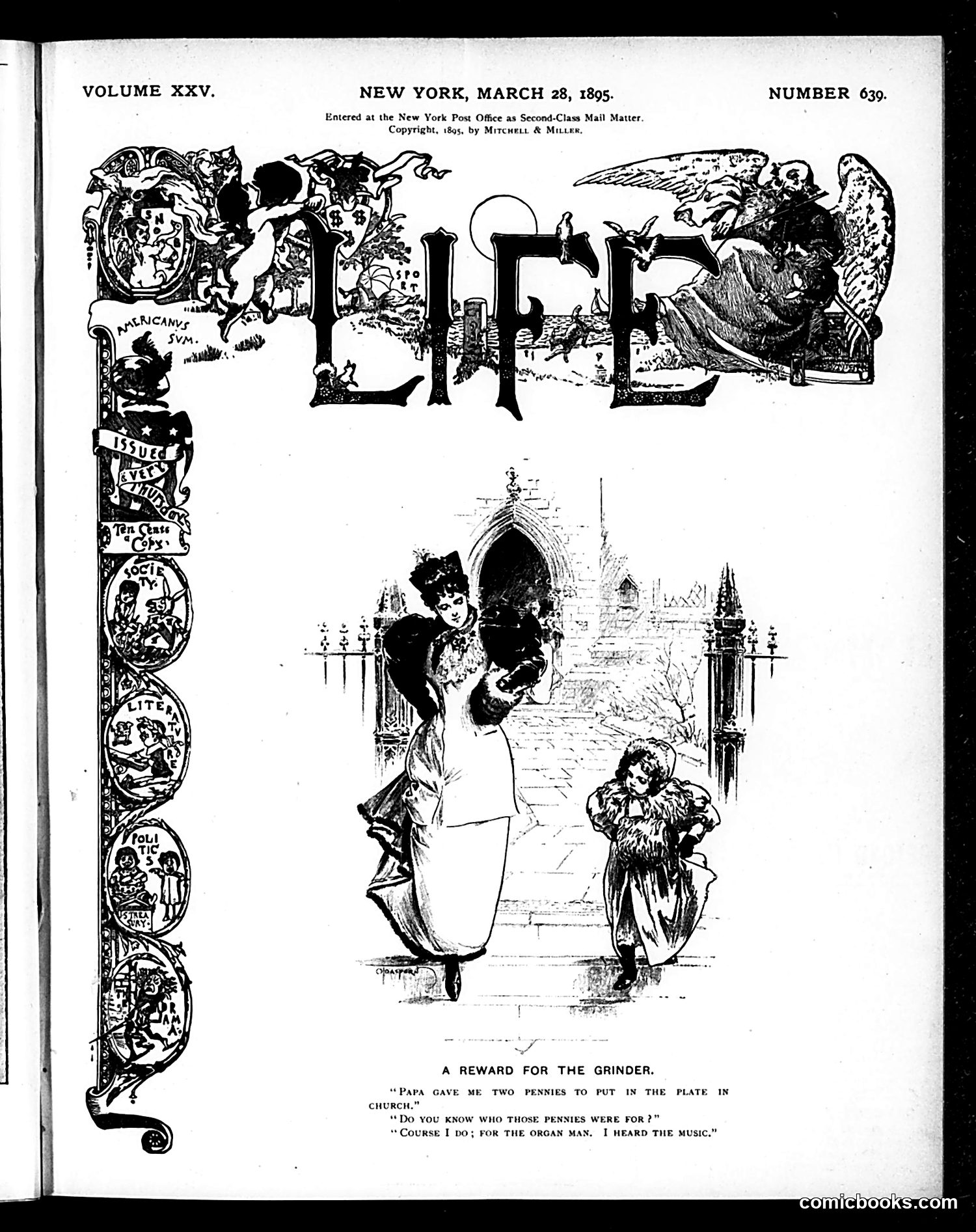
This cartoon satirizes child labor and poverty in 1890s America. It depicts a woman (likely a street organ grinder) with two children in front of a church. The dialogue reveals bitter irony: the father gave the children two pennies for church collection, and the woman asks if the children know those pennies were "for the organ man"—implying the family's extreme poverty forces them to redirect church donations to survive. The ornate left border featuring classical scenes and "Life" branding frames the satirical commentary. The church architecture suggests hypocrisy: organized religion collects from the destitute while street musicians and their families struggle. The cartoon critiques both inadequate wages for working poor and the disconnect between religious institutions and actual poverty relief around 1895 New York.
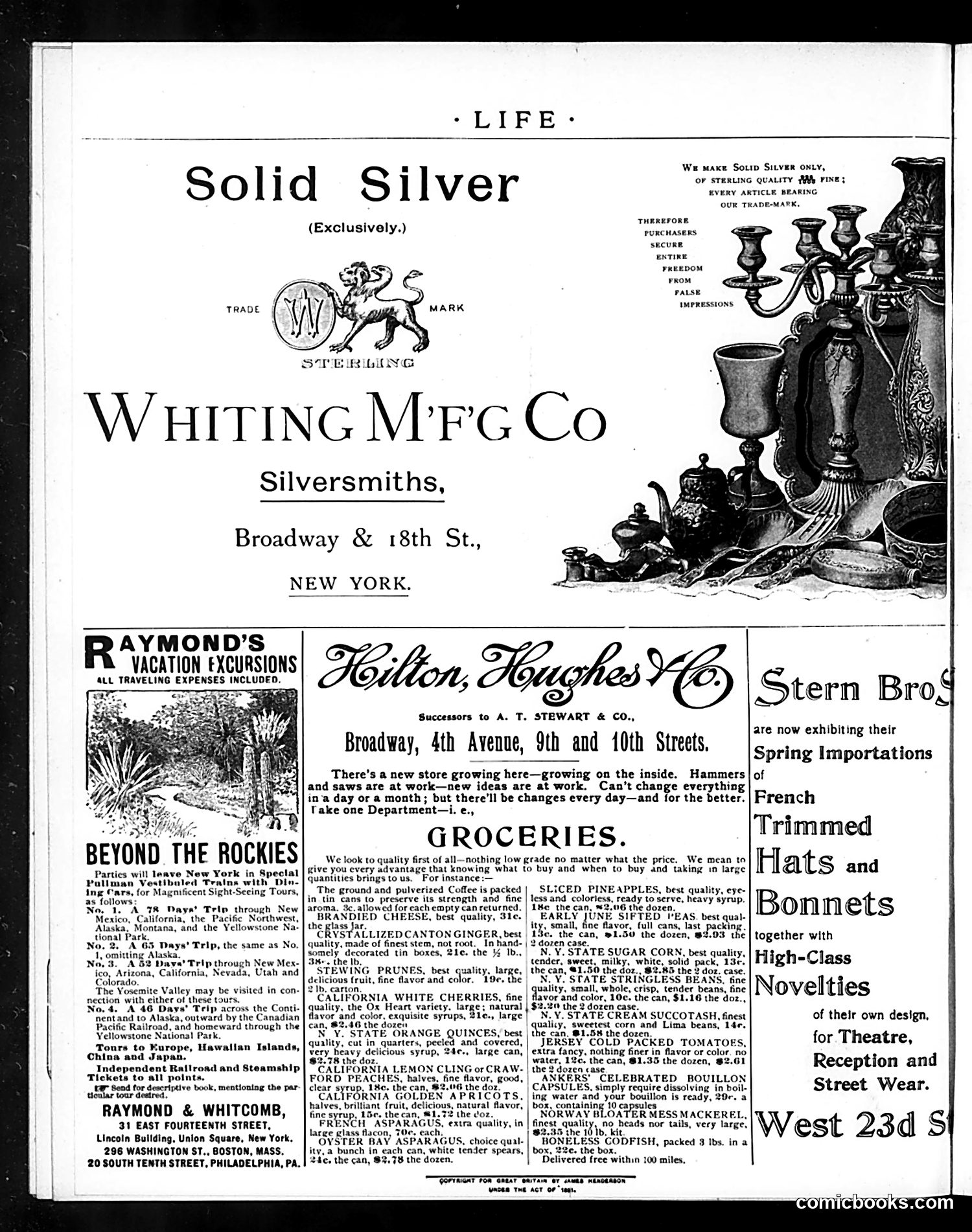
This page is **primarily advertising**, not satirical content. It features: **Main Advertisements:** - Whiting MFG Co (silversmiths, solid sterling silver goods) - Hilton, Houghes & Co (groceries, Broadway location) - Stern Bros (spring hat and bonnet importations) - Raymond & Whitcomb (travel excursions to the Rockies, Alaska, and Hawaiian Islands) **Minor Advertisements:** - Raymond & Whitcomb (railroad/steamship tickets) - Cream separators and other goods The page contains **no political cartoons or satirical commentary**. It represents typical early 20th-century *Life* magazine advertising, targeting upper-middle-class consumers with luxury goods (sterling silver), fashionable millinery, exotic travel, and imported groceries. The decorative imagery is purely commercial—silver vessels and hats—not editorial commentary.
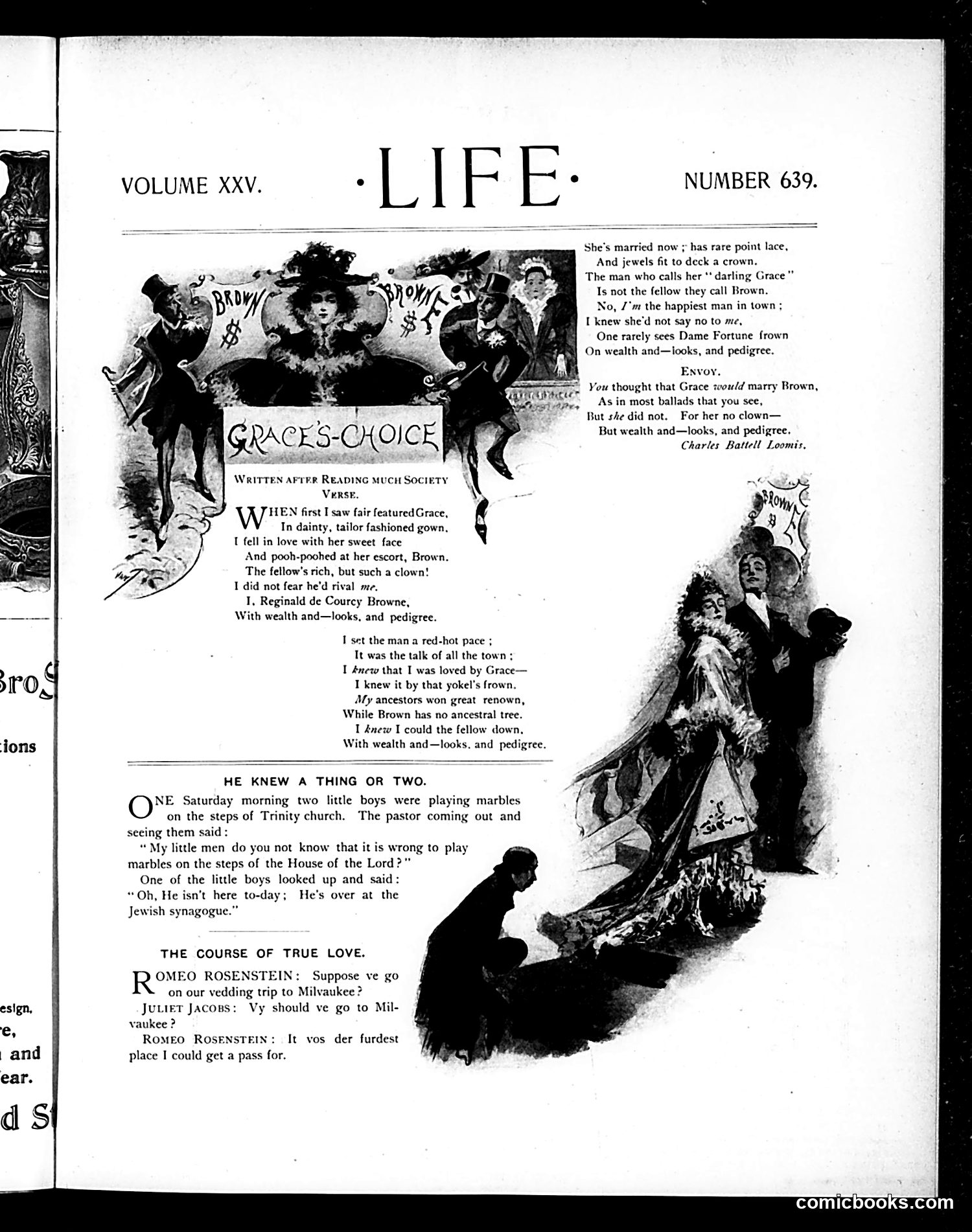
This page satirizes a woman named Grace choosing between suitors based on wealth rather than love. The central illustration depicts Grace flanked by two men labeled "Brown" and "Browne"—a visual pun on their identical names suggesting interchangeable suitors. The poem mocks Grace's mercenary choice: she rejects the poorer Brown despite loving him, marrying the wealthier Browne instead. Lines like "With wealth and—looks, and pedigree" emphasize her prioritization of financial status over genuine affection. The lower section, "He Knew a Thing or Two," contains an unrelated humorous anecdote about boys playing marbles at a church. The satire targets gilded-age materialism and the transactional nature of marriage among society women, a recurring Life magazine theme criticizing wealth-obsessed courtship.
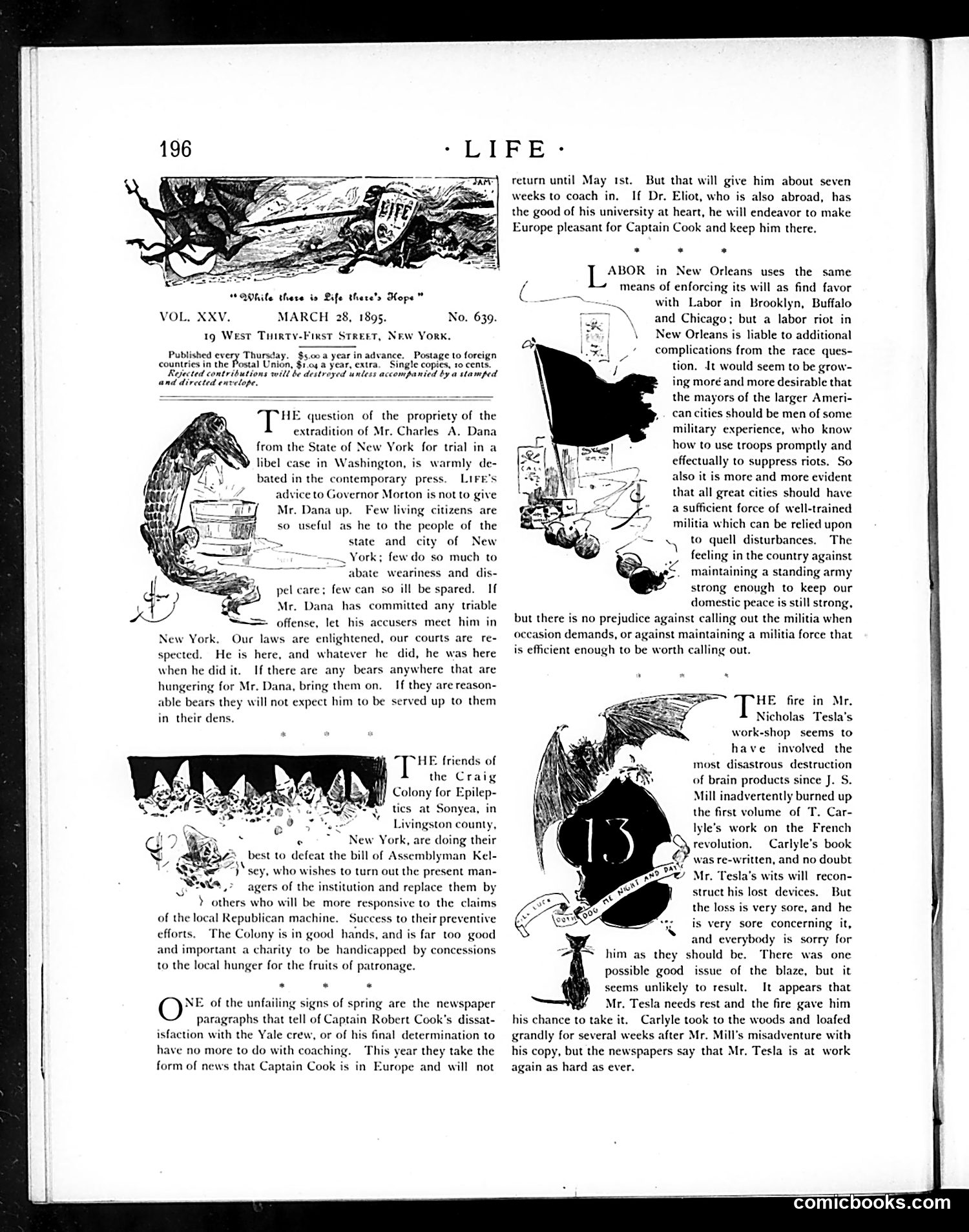
This page contains several brief satirical commentaries on contemporary issues: 1. **Charles A. Dana extradition**: Life defends Governor Morton's decision to allow Dana's extradition from New York for trial in Washington, arguing that useful citizens shouldn't expect special protection from the law. 2. **Labor unrest in New Orleans**: The text advocates for mayors with military experience to manage labor riots effectively, suggesting cities need trained militia forces to suppress disturbances. 3. **Tesla's workshop fire**: A brief note reports that Nicholas Tesla's work-shop fire destroyed the first volume of T. Carlyle's *French Revolution*. The text expresses sympathy for Tesla's loss and notes he's returned to work. The page is primarily text-based commentary rather than elaborate political cartoons, typical of Life's satirical format during this period.
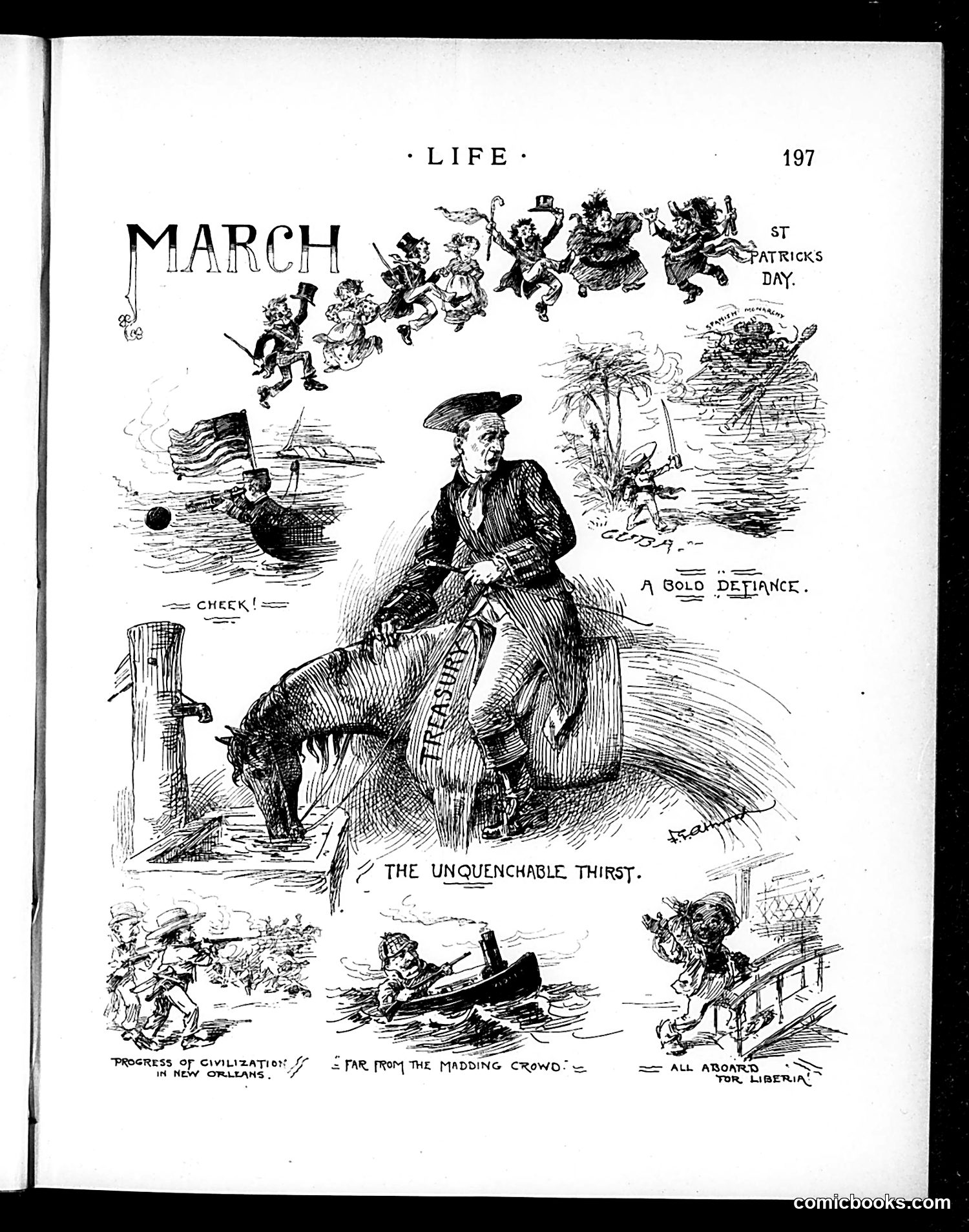
This satirical page combines St. Patrick's Day imagery with political commentary. The central figure "The Unquenchable Thirst" depicts an Irishman drinking, playing on ethnic stereotypes common to the era. The surrounding vignettes reference contemporary events: - "Check!" and "A Bold Defiance" appear to reference naval/military confrontations - "Progress of Civilization in New Orleans" likely satirizes racial or social conditions - "Far from the Madding Crowd" and "All Aboard for Liberia" suggest commentary on migration or emigration The leprechaun procession at top celebrates St. Patrick's Day itself. The overall page blends holiday festivity with political satire typical of Life magazine's approach—mixing entertainment with commentary on current affairs, though specific events require additional historical context to identify precisely.
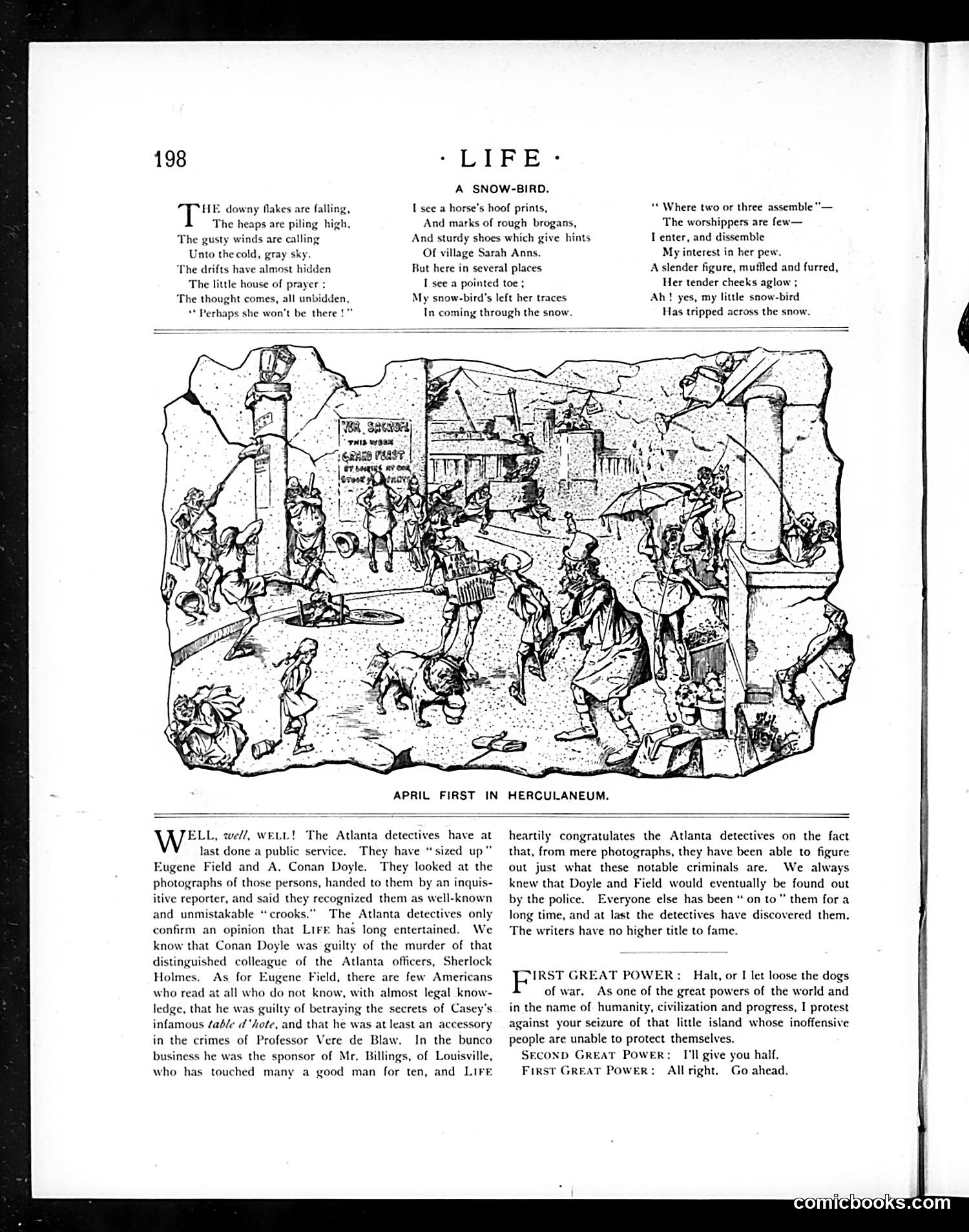
This page contains two distinct sections: **"A Snow-Bird" Poem & Illustration**: A sentimental narrative poem about a snow-bird visiting a village during winter, accompanied by a detailed winter street scene illustration titled "April First in Herculaneum." The poem and image are nostalgic Americana content, not political satire. **Atlanta Detectives Commentary**: Below, Life congratulates Atlanta police detectives for identifying criminals Eugene Field and A. Conan Doyle from photographs. This appears to be satire—Field and Doyle were famous *writers*, not criminals. Life is humorously suggesting these literary figures were actually notorious criminals, likely mocking either the detectives' incompetence or making a joke about the writers' fictional criminal characters (Sherlock Holmes is mentioned). The piece lacks clear political context beyond local Atlanta police matters.
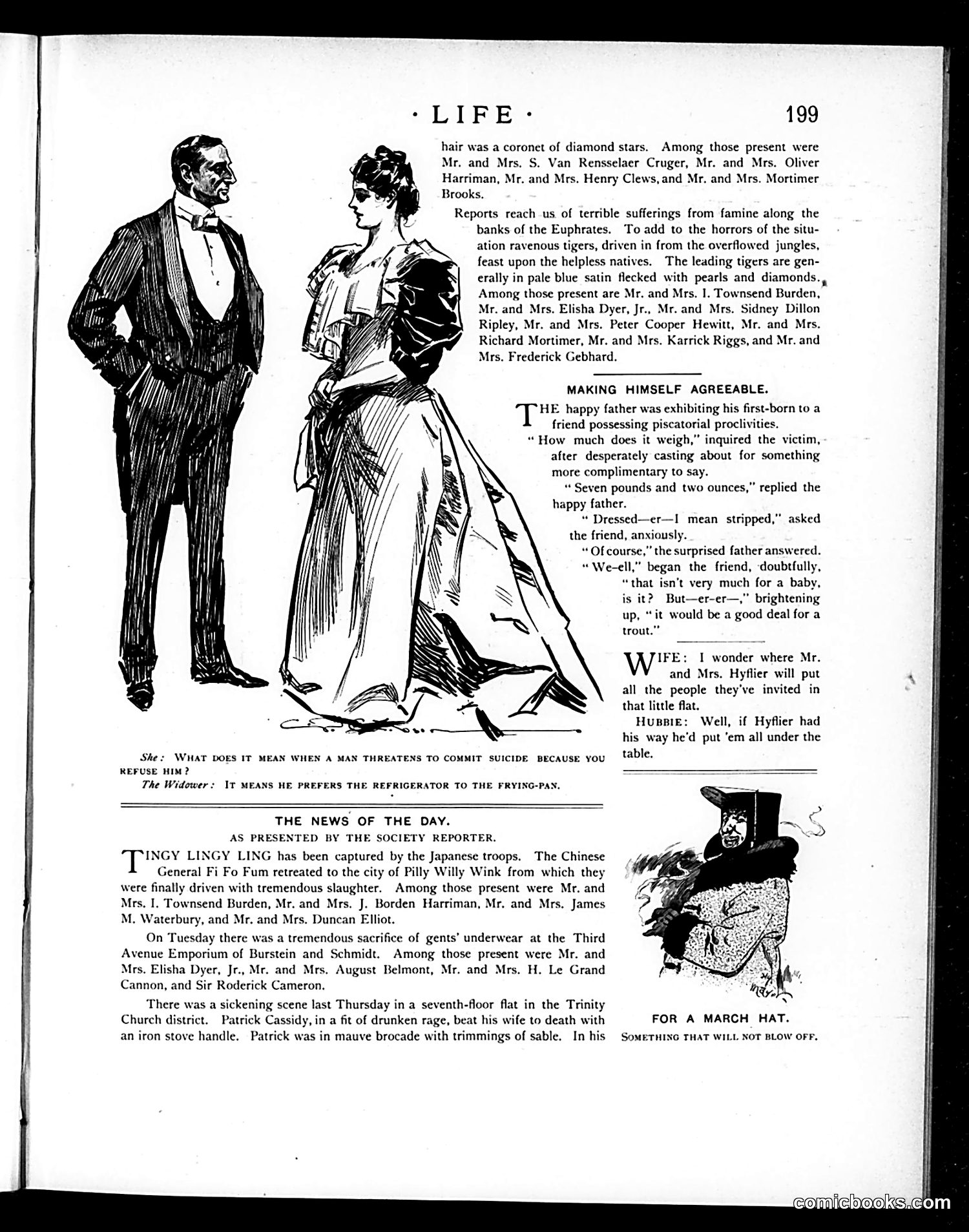
The page contains three distinct satirical pieces: 1. **Main illustration**: Shows a well-dressed couple in conversation, accompanying a joke about a man threatening suicide if refused something. The "punchline" contrasts his threat with preferring "the refrigerator to the frying-pan"—satirizing men who use emotional manipulation while prioritizing comfort over genuine hardship. 2. **"The News of the Day"**: Presents absurdist "news" items in deadpan style, including a Chinese general's retreat and a domestic violence incident. This section satirizes contemporary scandals and tragedies by treating them as casual social gossip, mocking how society trivializes serious events. 3. **"For a March Hat"**: A small cartoon about a hat that "will not blow off"—likely a commercial joke advertisement. The overall tone mocks upper-class pretension and social hypocrisy.
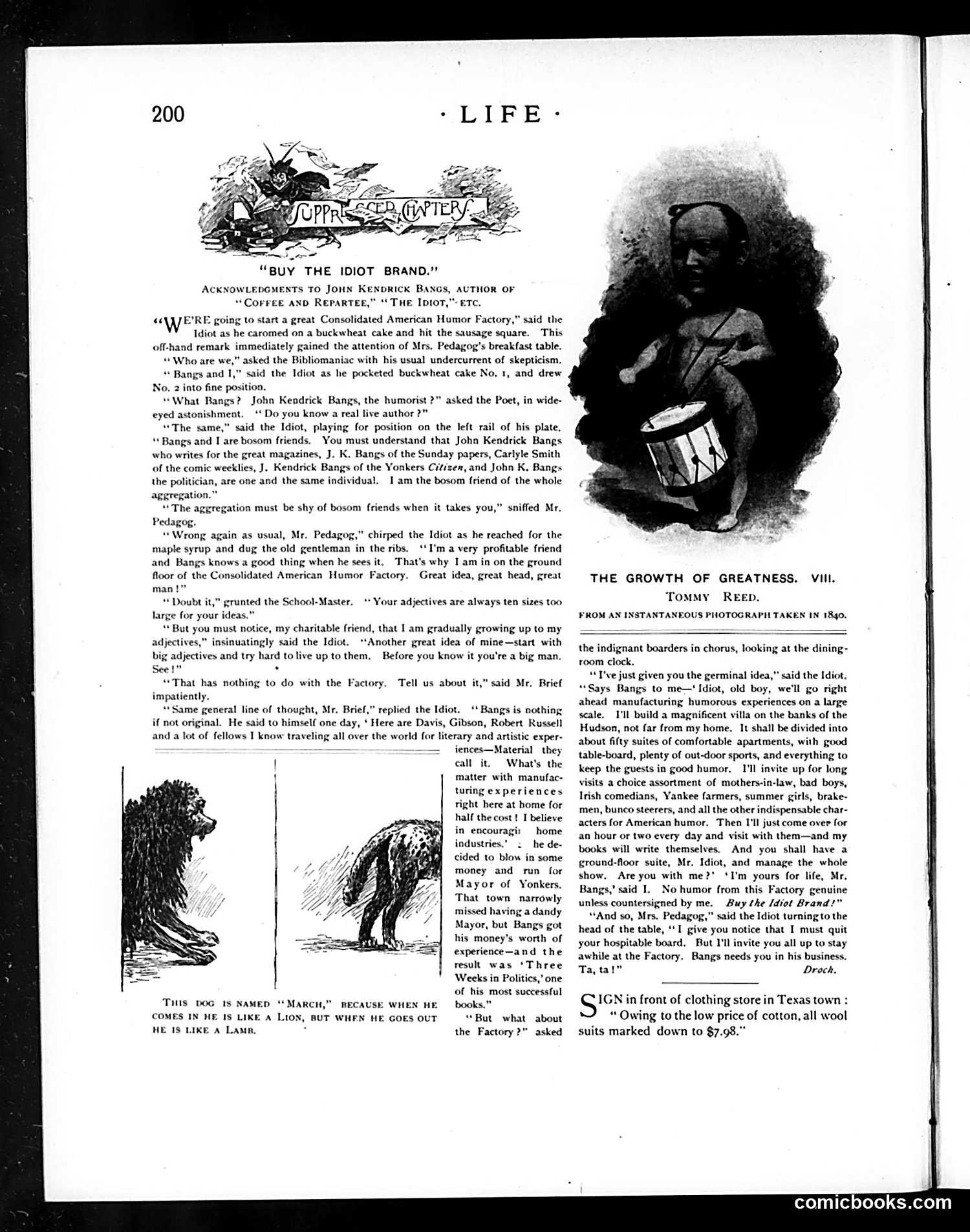
This page satirizes John Kendrick Bangs, a prolific humorist and author of the period. The text mocks his commercial ambitions through dialogue between an "Idiot" character and other figures discussing plans to industrialize humor into a "Consolidated American Humor Factory." The satire targets Bangs' productivity across multiple publications (newspapers, comic weeklies, political commentary), suggesting he's become a mass-production commodity rather than a genuine artist. The caption about a dog named "March" that "comes in like a Lion, but when he goes out he is like a Lamb" appears to be a separate visual joke, though its connection is unclear. The piece critiques the commercialization of American letters and Bangs' apparent willingness to compromise artistic integrity for financial gain.
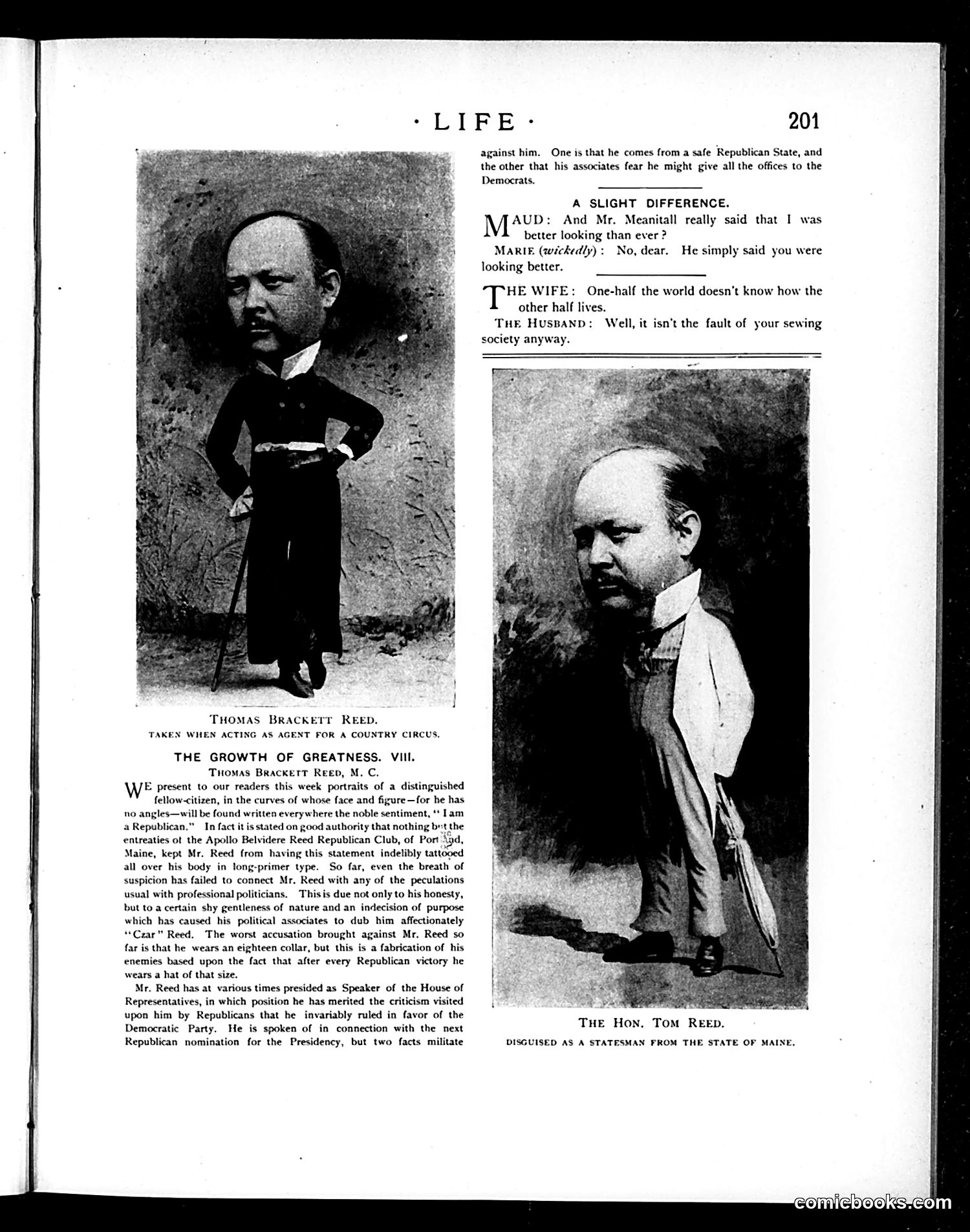
This page from *Life* magazine features satirical portraits of **Thomas Brackett Reed** (left caricature, labeled "takes when acting as agent for a country circus") and **The Hon. Tom Reed** (right photograph, labeled "disguised as a statesman from the state of Maine"). The satire contrasts Reed's actual appearance with an exaggerated caricature, mocking him as someone who performs circus-like theatrics rather than serious statesmanship. The text describes Reed as a distinguished Republican who served as Speaker of the House, but attacks his character—claiming he wears an "eighteen collar" and that his worst accusation is wearing a hat after Republican victories. The brief dialogue joke ("A Slight Difference") plays on marital misunderstanding. Overall, this is partisan political ridicule of a prominent Republican figure.
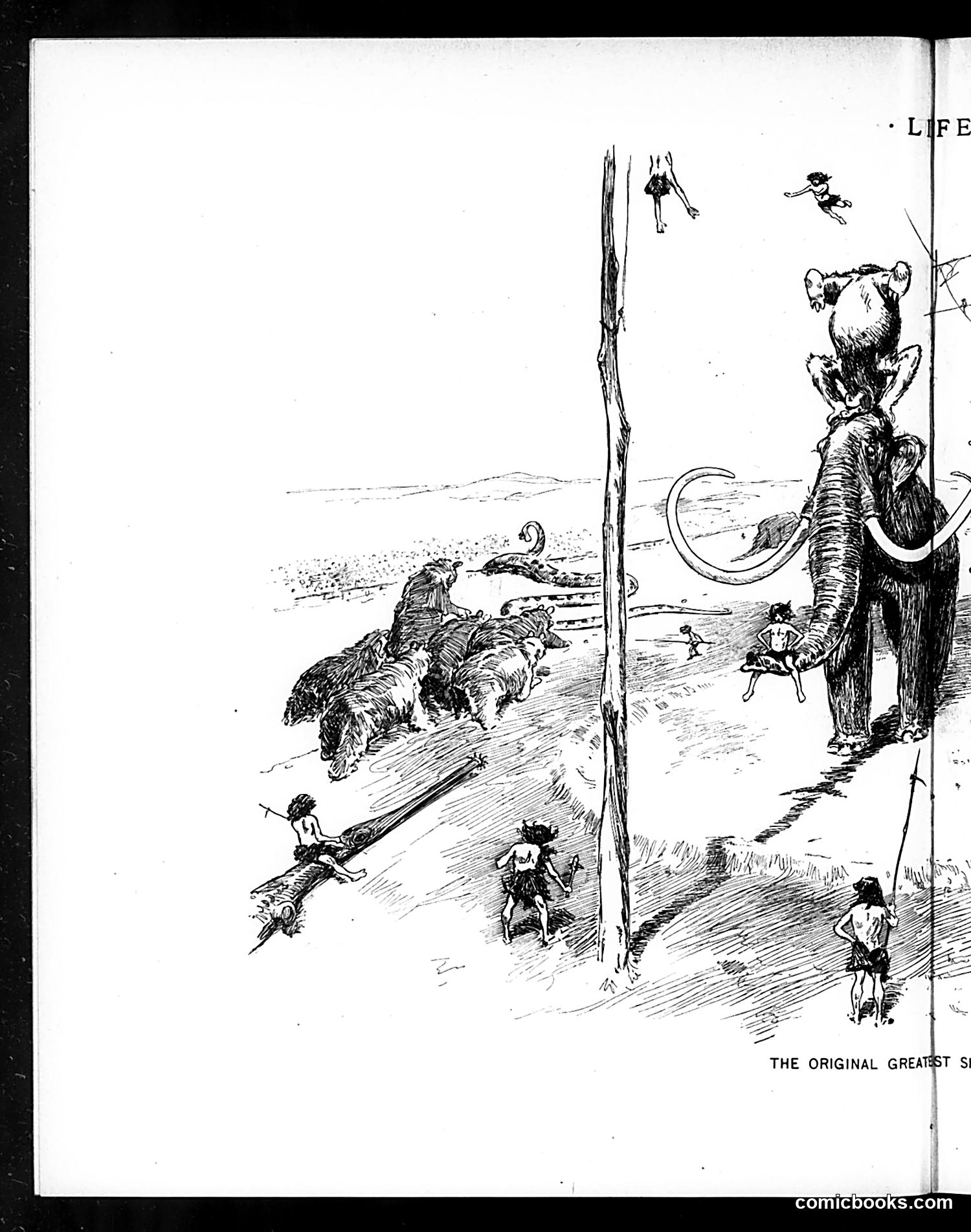
This cartoon depicts what appears to be a prehistoric or caveman-era scene with children playing around large animals (possibly mammoths or elephants) and adult figures. The title "THE ORIGINAL GREATEST SI[ZE]" (text cut off) likely references P.T. Barnum's famous "Greatest Show on Earth" circus. The satire seems to suggest that the earliest human entertainment involved simply observing large, impressive animals in nature—making it "the original" greatest spectacle. This would be a commentary on modern entertainment, implying that elaborate circuses and shows are merely copies of what humans have always found naturally captivating. The crude pen-and-ink style emphasizes the primitive setting, contrasting ancient simplicity with modern commercial entertainment.
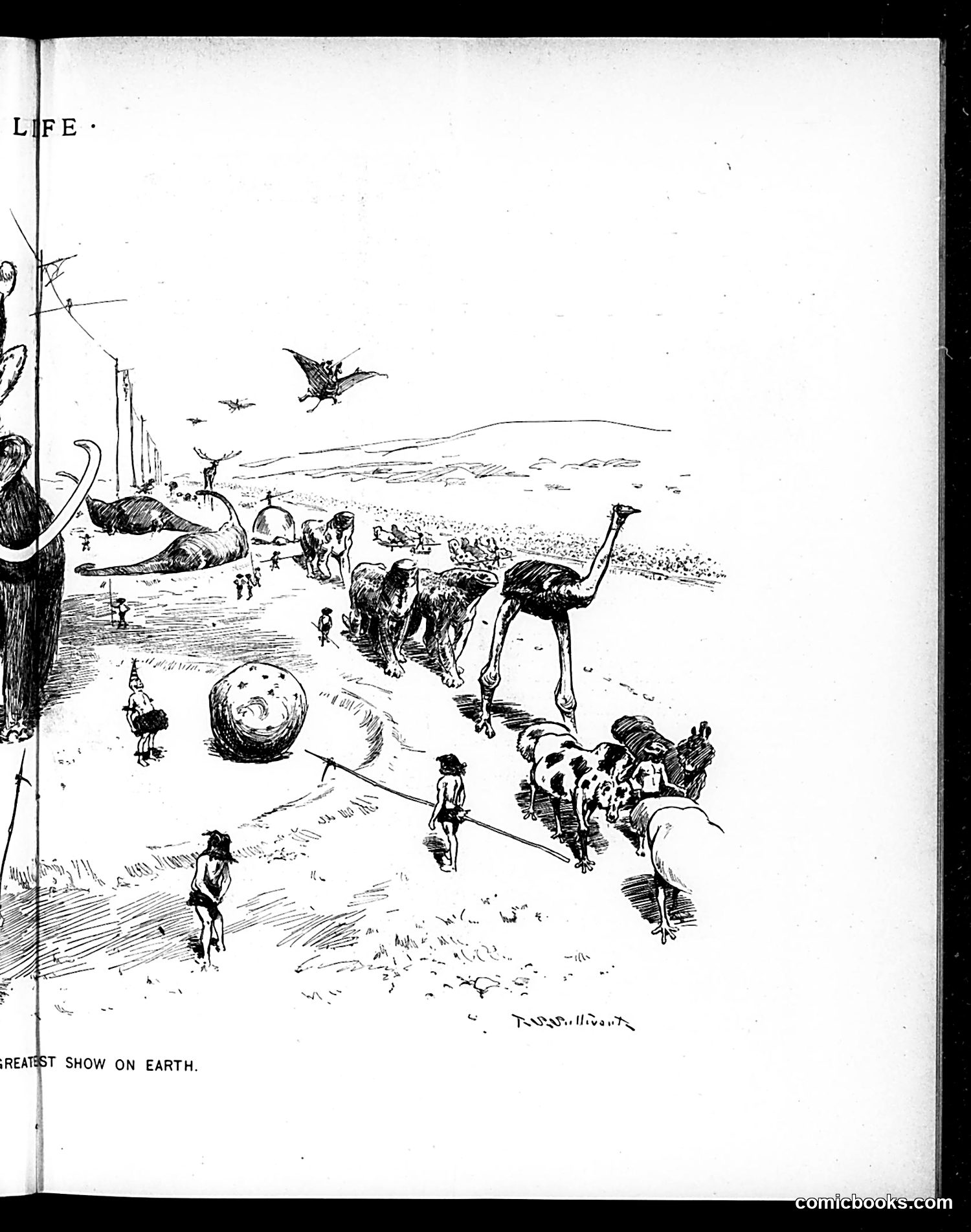
This page from *Life* magazine shows a satirical illustration titled "Greatest Show on Earth." The sketch depicts a circus or carnival scene on a beach, featuring various exotic animals (ostriches, camels, elephants) alongside human performers and spectators. The "greatest show" appears to be a commentary on theatrical or entertainment excess. The left margin shows "LIFE" as the magazine header. The artist's signature appears to be present but is not clearly legible in this reproduction. Without additional context about the publication date or specific events referenced, the exact satirical target remains unclear. The image likely mocks either contemporary circus culture, entertainment industry excess, or possibly political theater—a common *Life* magazine subject. The juxtaposition of exotic animals with human performers suggests commentary on spectacle and entertainment values.
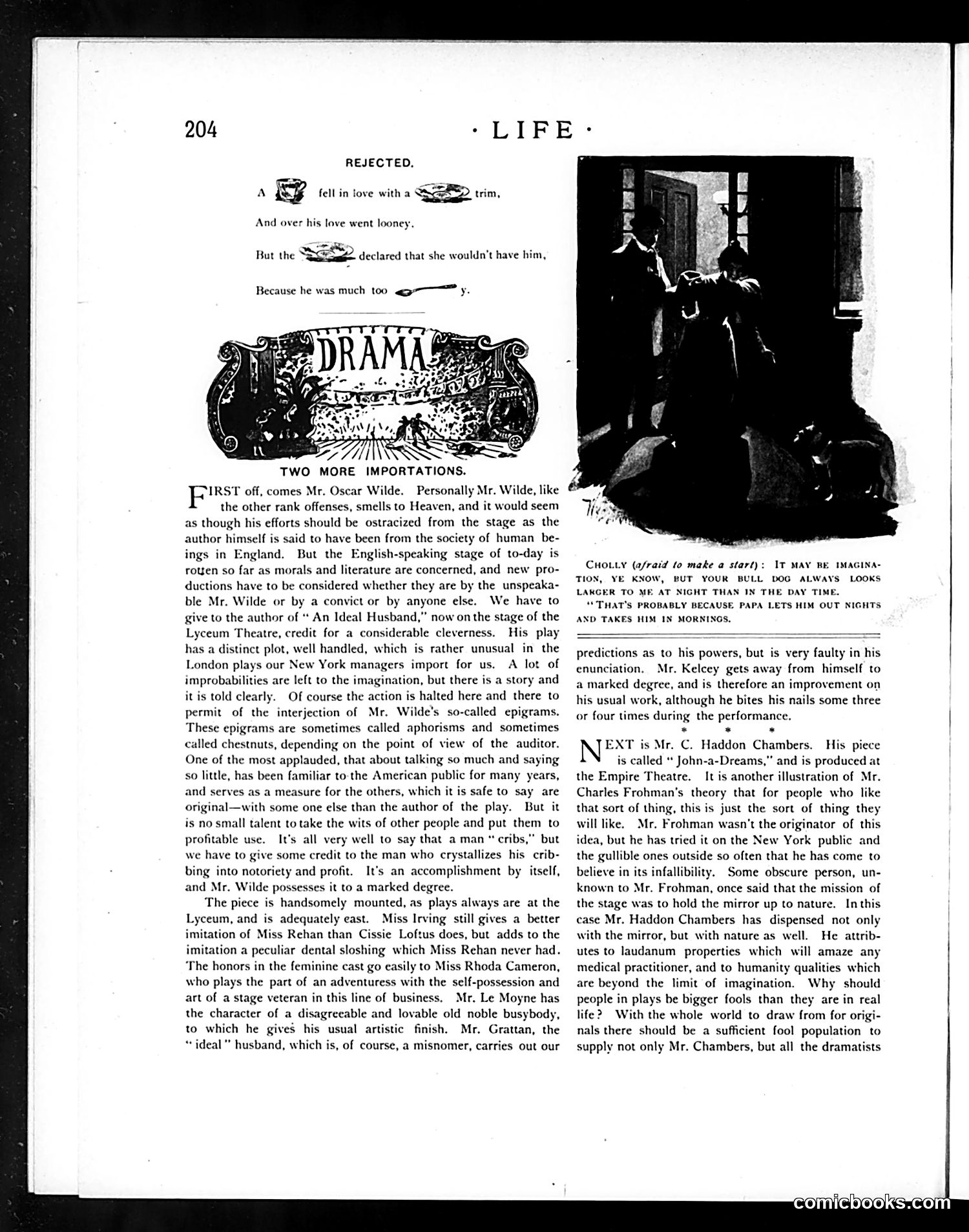
This page reviews two theatrical "importations"—plays brought from England to American stages. The main critique targets **Oscar Wilde** and his play *"An Ideal Husband,"* currently at the Lyceum Theatre. The writer acknowledges Wilde's cleverness and wit but sarcastically suggests his epigrams are largely plagiarized ("cribbed") from others, merely repackaged for profit. The review is morally disapproving—referencing Wilde's exile from English society—yet grudgingly credits him with theatrical skill. The second review discusses **C. Haddon Chambers'** play *"John-a-Dreams"* at the Empire Theatre, which the critic dismisses as pandering entertainment produced by impresario Charles Frohman for undiscerning audiences. The small cartoon at top right, captioned "Cholly (afraid to make a start)," appears to be unrelated satirical humor about a nervous suitor. The commentary reflects American cultural anxiety about imported British drama and skepticism toward both Wilde's reputation and theatrical commercialism generally.
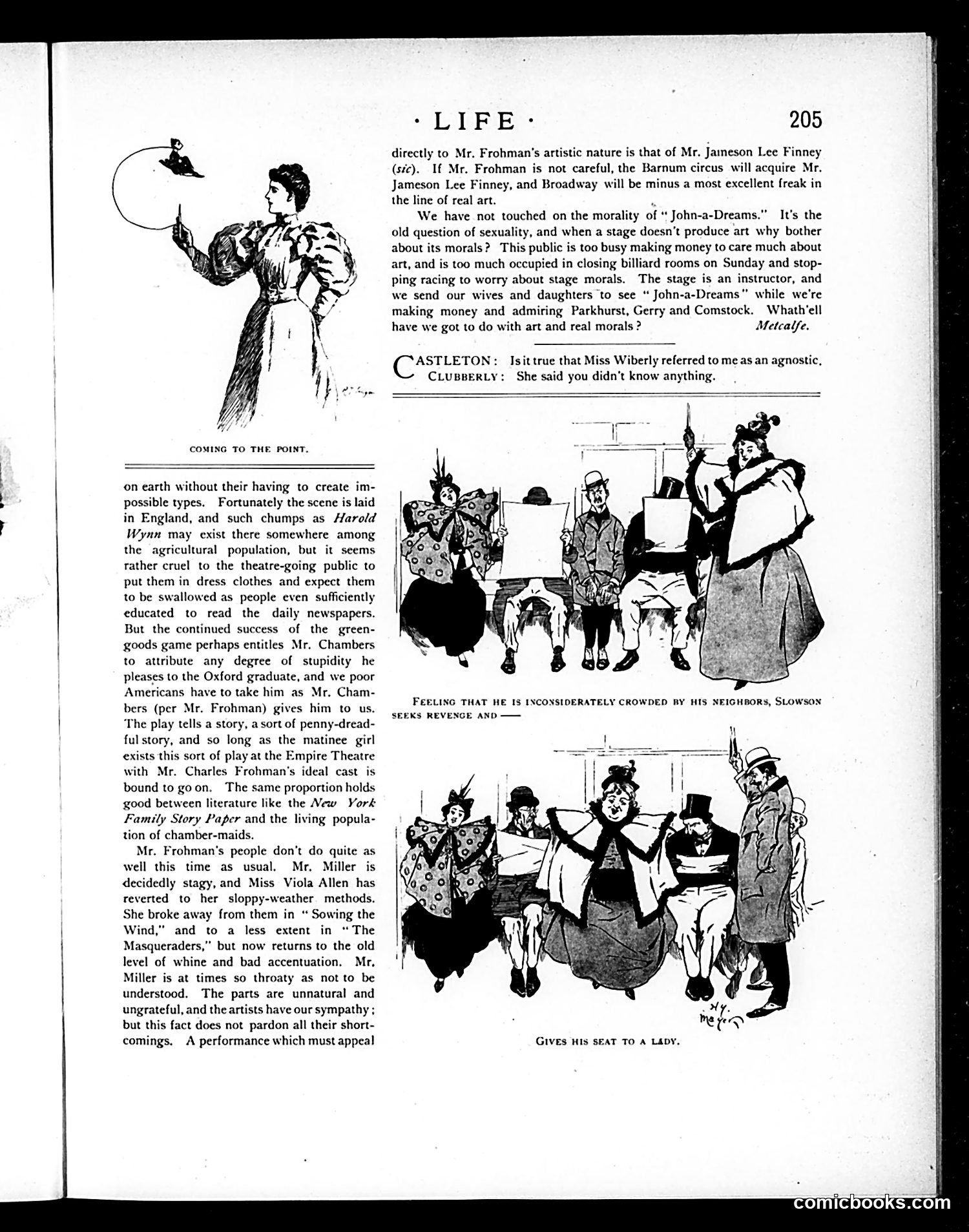
This page contains theater criticism and two satirical comic strips. The main text reviews a play called "John-a-Dreams," critiquing both the production and American audiences' indifference to stage morality compared to their concern with money-making and Sunday closures of billiard rooms. The top comic strip shows a woman with a magnifying glass examining something—likely illustrating the theater review's theme of scrutiny. The lower two strips depict "Slowson," a man feeling crowded by neighbors. In the first panel, he's surrounded by inconsiderately positioned theatergoers. In the second, seeking revenge, he **gives his seat to a lady**—forcing his neighbors to stand and make room for her. The satire mocks petty revenge through exaggerated courtesy: Slowson weaponizes social politeness against those who annoyed him, creating the ironic situation where his "gentlemanly" gesture becomes hostile. This reflects turn-of-the-century etiquette anxieties in crowded public spaces.
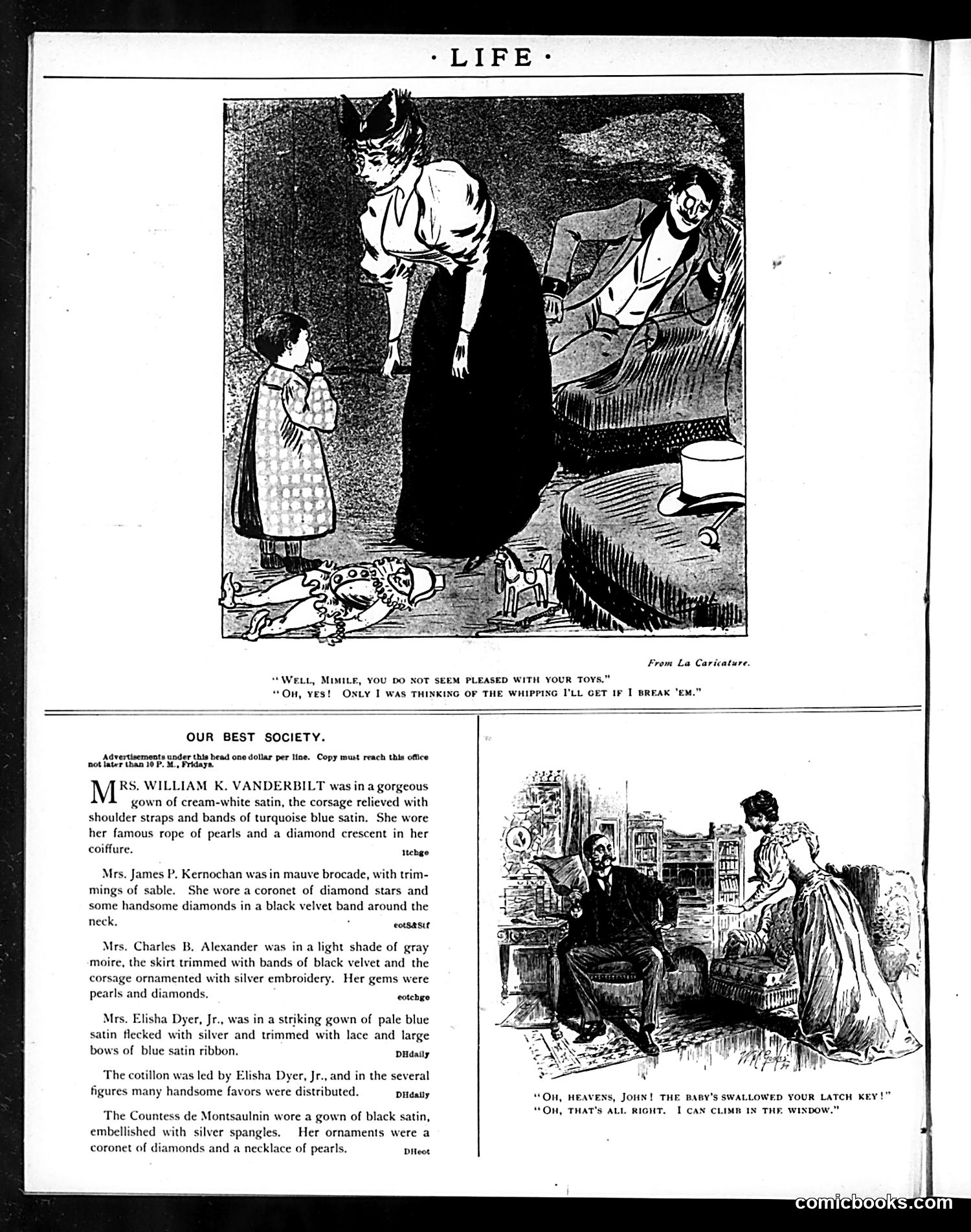
This page combines two distinct satirical pieces: **Top cartoon** (from *La Caricature*): A child receives expensive toys but expresses anxiety about punishment for breaking them—satirizing how wealthy parents give lavish gifts while maintaining harsh discipline. It's social commentary on class attitudes toward childhood. **"Our Best Society" section**: This is *satire through ostensible flattery*. Life mockingly catalogs the jewels and clothing of wealthy society women (Vanderbilt, Kernochan, Alexander, etc.) in breathless, detail-obsessed prose—the kind of fawning coverage society pages actually ran. By listing every diamond, pearl, and satin band with such earnest specificity, Life ridicules the shallow materialism and status-obsession of high society. **Bottom cartoon**: A domestic comedy where a baby swallows a latch key; the husband casually says he'll climb through a window rather than retrieve it. The joke mocks negligent parenting and working-class practicality versus propriety. Together, the page contrasts wealthy society's pretension with working-class pragmatism—a recurring Life magazine theme.
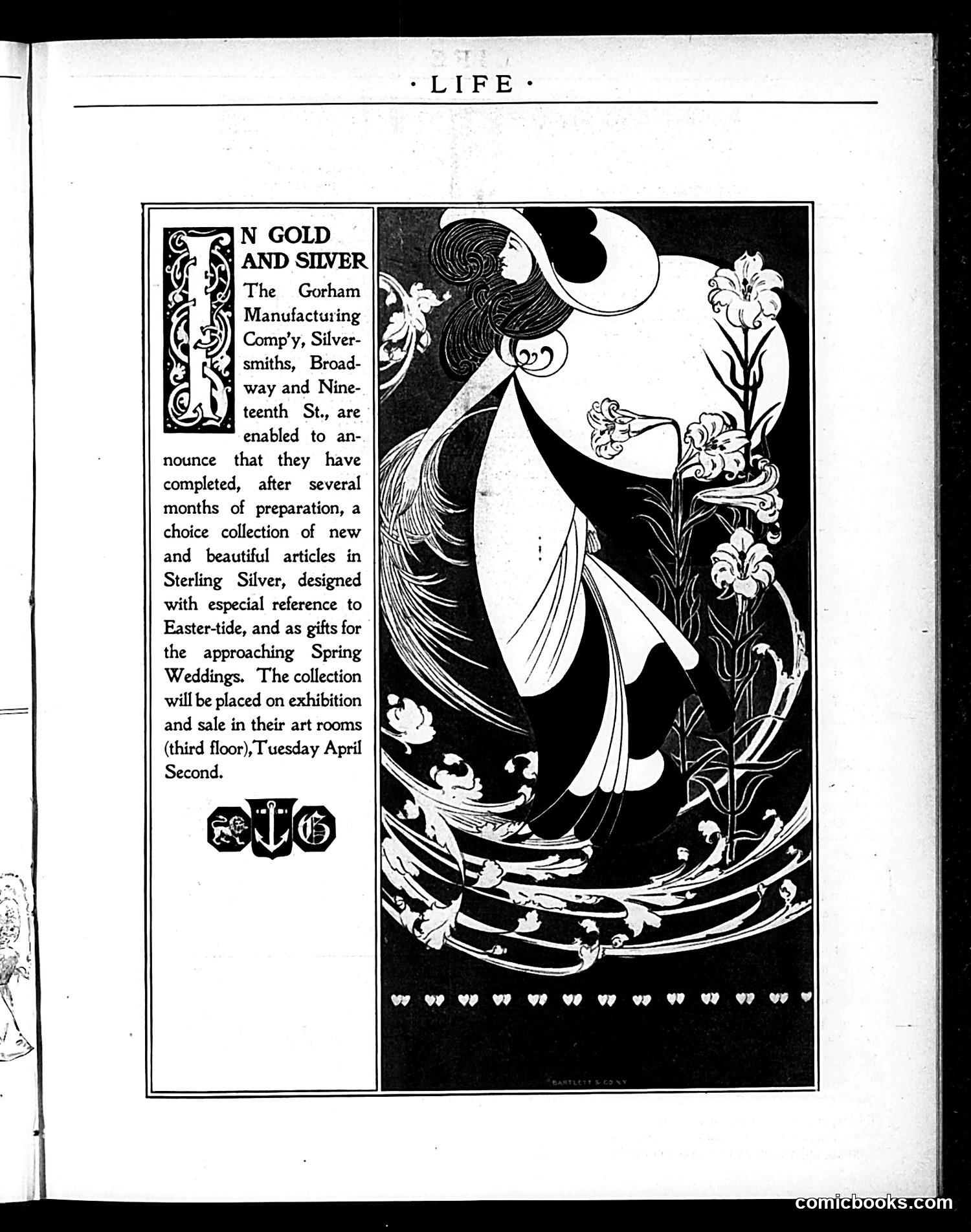
This page is primarily a **commercial advertisement** for Gorham Manufacturing Company, a prominent silversmith. There is no political cartoon or satire here. The advertisement announces a new collection of Sterling Silver items, timed for Easter and Spring Weddings. The art on the right is **decorative advertising illustration** — an Art Nouveau-style design featuring a woman in classical dress with flowing robes, a crescent moon, and flowering iris plants. This stylized imagery was typical of luxury goods advertising in the early 20th century, conveying elegance and sophistication to appeal to wealthy consumers purchasing fine silver. The ornamental initial letter "I" and company crest add to the prestigious presentation. The piece promotes an exhibition opening Tuesday, April 2nd at Gorham's Broadway location. This is essentially a magazine advertisement, not satire or commentary.
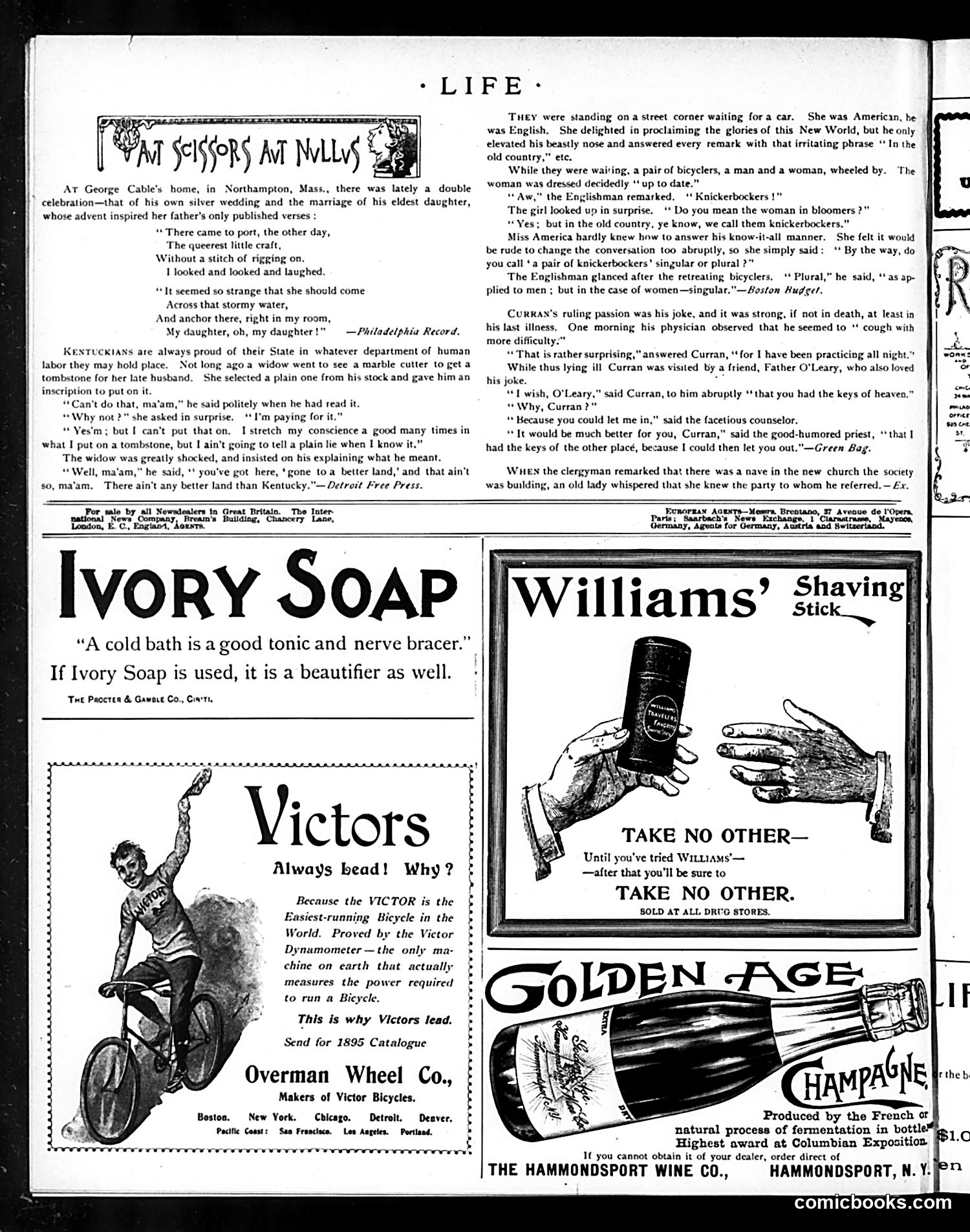
This page contains **humorous anecdotes** rather than political cartoons. The jokes target several social groups: 1. **Regional Pride**: A Kentucky marble-cutter refuses to inscribe "gone to a better land" on a tombstone, insisting Kentucky is superior to heaven—satirizing exaggerated state loyalty. 2. **Anglo-American tensions**: An Englishman repeatedly boasts about "the old country" while encountering American women in bloomers (then called "knickerbockers"). The American woman cleverly traps him in grammatical confusion about whether the plural term applies to women—mocking British snobbery and condescension toward American modernity. 3. **Irish wit**: Anecdotes about the dying lawyer Curran trading jokes with his physician and a priest, illustrating Irish reputation for sharp humor even facing mortality. The page is primarily **advertising** (Ivory Soap, Victor bicycles, Williams' Shaving Stick, Golden Age Champagne), typical of Life's revenue model. The humor reflects late-19th-century stereotypes about regional and national character.
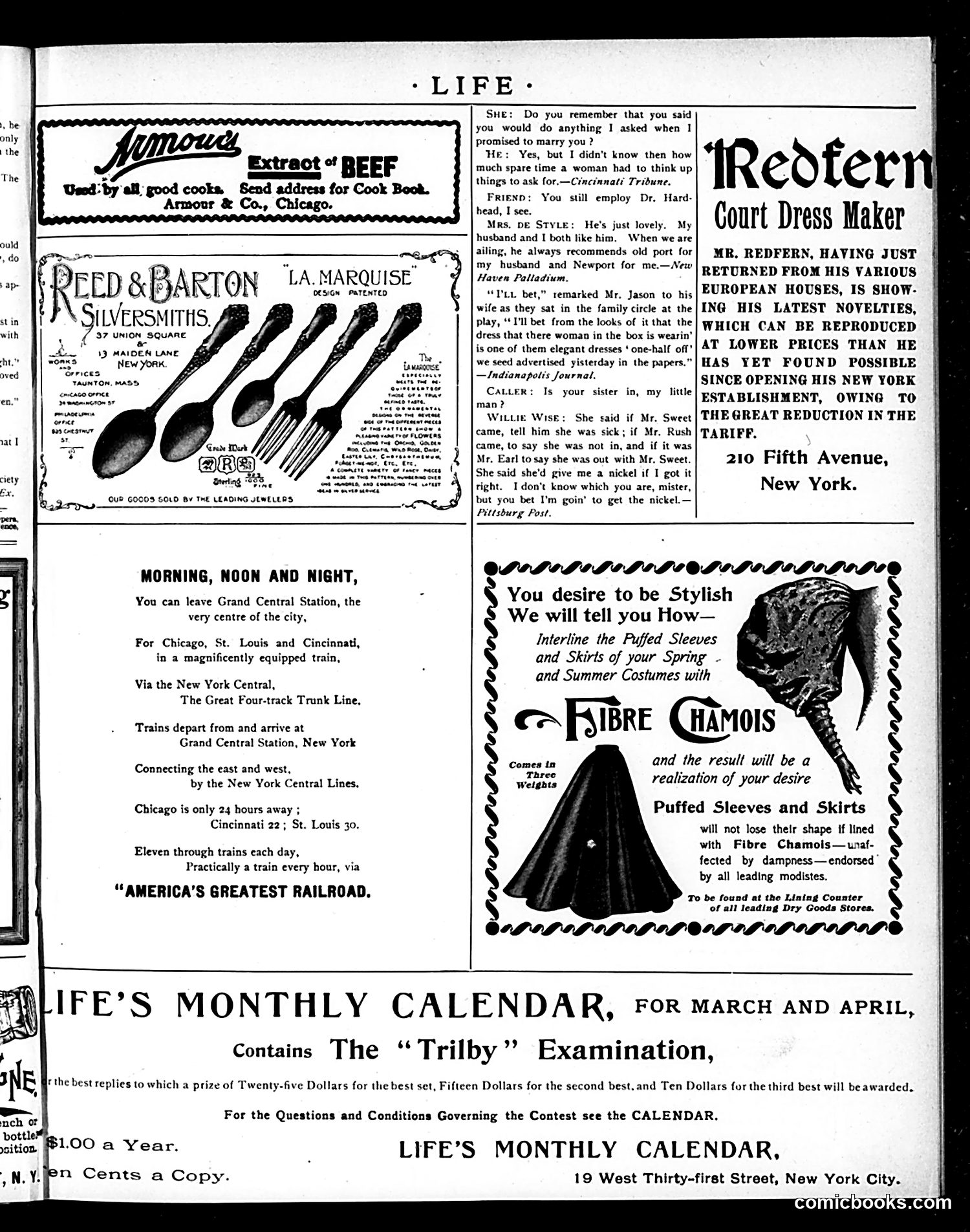
This page is primarily **advertisements and social humor** rather than political satire. The main content includes: **Social Jokes**: Three brief domestic humor pieces about marriage and servants—typical of the era's "battle of the sexes" comedy. One joke mocks a husband's ignorance of how much free time women have to make demands; another satirizes a doctor who recommends alcohol for husbands but spa treatments for wives; a third involves a servant girl confused about distinguishing visitors. **Advertisements**: Reed & Barton silverware, Armour beef extract, the New York Central Railroad, Redfern's dress-making service, and Fibre Chamois fabric lining. **Contest Announcement**: Life's monthly calendar contest based on "Trilby" (a popular 1894 novel), offering cash prizes for best reader responses. The page reflects **turn-of-century consumer culture and domestic humor**—no significant political content. The jokes assume middle-class audiences familiar with hired servants and leisure concerns. This is a typical interior page mixing light comedy with commercial appeals.
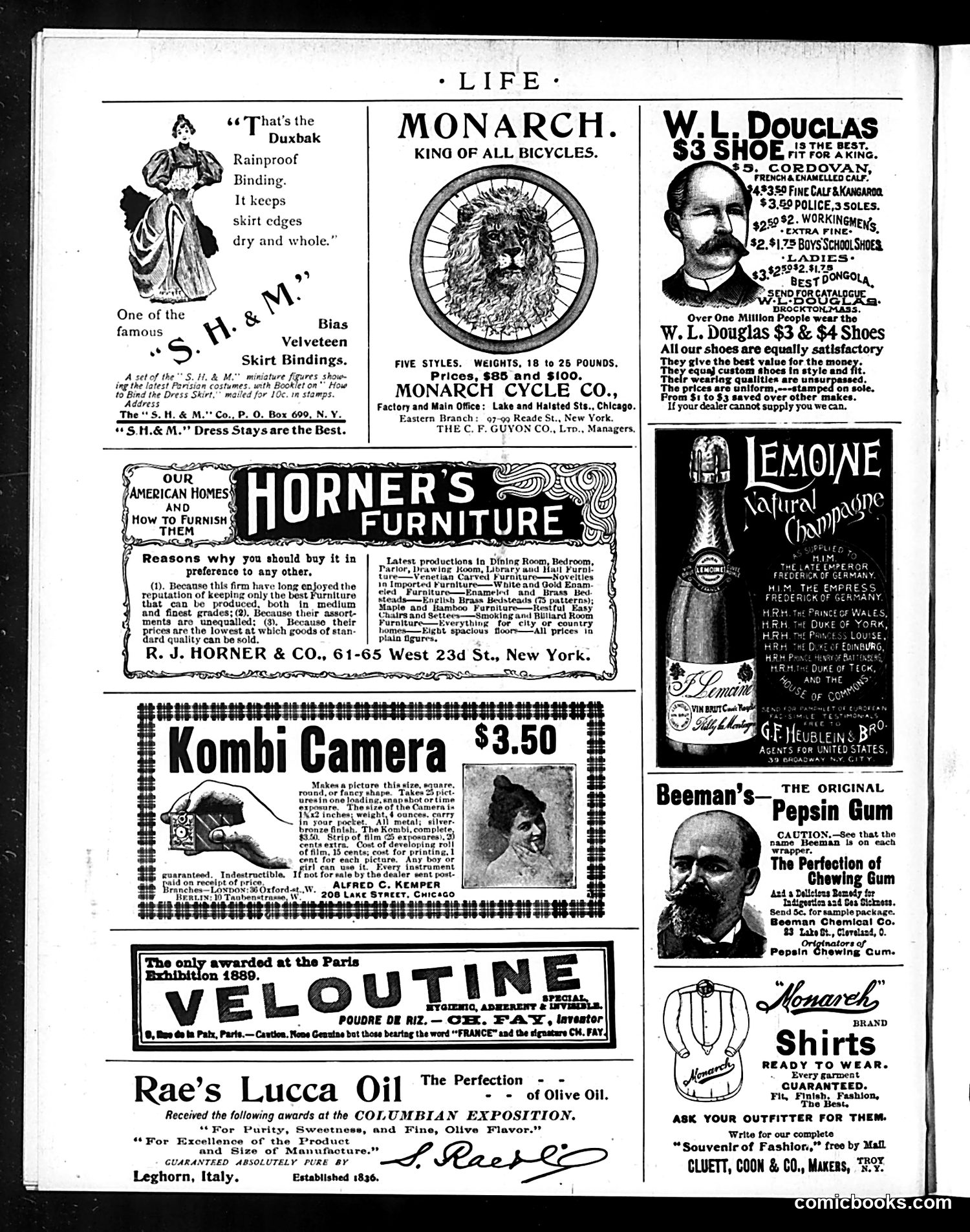
This page is primarily **advertising**, not satirical content. It's a collection of product advertisements from what appears to be an early 1900s issue of *Life* magazine. The ads feature consumer goods typical of the era: bicycles (Monarch), shoes (W.L. Douglas), furniture (Horner's), a simple camera (Kombi), champagne (Lemoine), chewing gum (Beeman's), olive oil (Rae's Lucca), and dress shirts (Monarch Brand). Notable context for modern readers: the W.L. Douglas shoe ad emphasizes that "over one million people" wear their brand—a common sales tactic. The Kombi Camera is presented as an affordable novelty ($3.50) for amateur photographers. The dress-stays and skirt-binding ads reflect early 1900s women's fashion constraints. There is no political cartoon or satire visible on this page—it's a straightforward advertising section typical of *Life*'s revenue model during this period.