
Life, 1895-03-28 · page 12 of 18
Life — March 28, 1895 — page 12: what you’re looking at
What you’re looking at
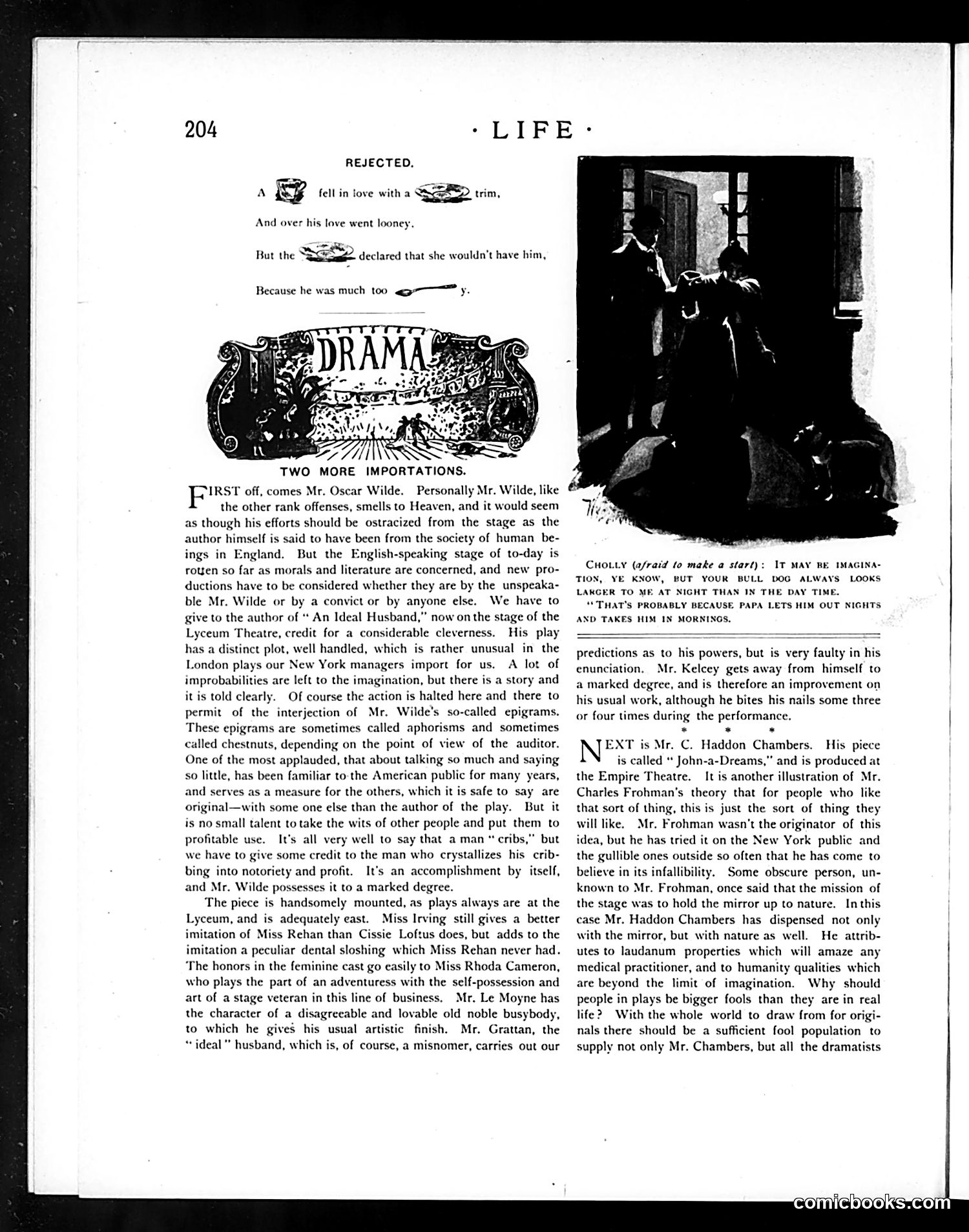
This page reviews two theatrical "importations"—plays brought from England to American stages. The main critique targets **Oscar Wilde** and his play *"An Ideal Husband,"* currently at the Lyceum Theatre. The writer acknowledges Wilde's cleverness and wit but sarcastically suggests his epigrams are largely plagiarized ("cribbed") from others, merely repackaged for profit. The review is morally disapproving—referencing Wilde's exile from English society—yet grudgingly credits him with theatrical skill. The second review discusses **C. Haddon Chambers'** play *"John-a-Dreams"* at the Empire Theatre, which the critic dismisses as pandering entertainment produced by impresario Charles Frohman for undiscerning audiences. The small cartoon at top right, captioned "Cholly (afraid to make a start)," appears to be unrelated satirical humor about a nervous suitor. The commentary reflects American cultural anxiety about imported British drama and skepticism toward both Wilde's reputation and theatrical commercialism generally.
📄 Transcribed text from this page (OCR, searchable)
Machine-transcribed from the original scan — historical spelling and the odd misread are preserved.
REJECTED. A & fell in tove with a SEED trim, And over his love went looney, But the SEGESS2 declared that she wouldn't have him, Because he was much too <>——™" y. : UX ZI SSS TWO MORE IMPORTATIONS. IRST off, comes Mr. Oscar Wilde. Personally Mr. Wilde, like the other rank offenses, smells to Heaven, and it would seem as though his efforts should be ostracized from the stage as the author himself is said to have been from the society of human be- ings in England, But the English-speaking stage of to-day is rouen so far as morals and literature are concerned, and new pro- ductions have to be considered whether they are by the unspeaka- ble Mr. Wilde or by a convict or by anyone else. We have to give to the author of * An Ideal Husband,” now on the stage of the Lyceum Theatre, credit for a considerable cleverness. His play as a distinct plot, well handled, which is rather unusual in the London plays our New York managers import for us. A lot of improbabilities are left to the imagination, but there is a story and it is told clearly. Of course the action is halted here and there to permit of the interjection of Mr. Wilde's so-called epigrams. These epigrams are sometimes called aphorisms and sometimes called chestnuts, depending on the point of view of the auditor. One of the most applauded, that about talking so much and saying so little, has been familiar tothe American public for many years, and serves as a measure for the others, which it is safe to say are original—with some one else than the author of the play. But it is no small talent to take the wits of other people and put them to profitable use. It's all very well to say that a man “ cribs,” but we have to give some credit to the man who crystallizes his crib- bing into notoriety and profit. It’s an accomplishment by itself, and Mr. Wilde possesses it to a marked degree. The piece is handsomely mounted, as plays always are at the Lyceum, and is adequately east. Miss Irving still gives a better imitation of Miss Rehan than Cissie Loftus does, but adds to the imitation a peculiar dental sloshing which Miss Rehan never had. The honors in the feminine cast go easily to Miss Rhoda Cameron, who plays the part of an adventuress with the self-possession and art of a stage veteran in this line of business. Mr. Le Moyne has the character of a disagreeable and lovable old noble busybody, to which he gives his usual artistic finish. Mr. Grattan, the “ideal” husband, which is, of course, a misnomer, carries out our ¥ (afraid to make a start): IT MAY RE IMAGIN. YE KNOW, BUT YOUR BULL DOG ALWAYS LOOKS eR TO ME AT NIGHT THAN IN THE DAY TIME. “THAT'S PROBABLY BECAUSE PAPA LETS HIM OUT NIGHTS AND TAKES HIM IN MORNINGS. predictions as to his powers, but is very faulty in his enunciation, Mr. Kelcey gets away from himself to a marked degree, and is therefore an improvement on his usual work, although he bites his nails some three or four times during the performance. His piece * . . N ‘T is Mr. C. Haddon Chambers. is called * John-a-Dreams,” and is produced at the Empire Theatre. It is another illustration of Mr. Charles Frohman’s theory that for people who like that sort of thing, this is just the sort of thing they will like. Mr. Frohman wasn’t the originator of this idea, but he has tried it on the New York public and the gullible ones outside so often that he has come to believe in its infallibility. Some obscure person, un- known to Mr. Frohman, once said that the mission of the stage was to hold the mirror up to nature. In this Mr. Haddon Chambers has dispensed not only with the mirror, but with nature as well. He attrib- utes to laudanum properties which will amaze any medical practitioner, and to humanity qualities which are beyond the limit of imagination. Why should people in plays be bigger fools than they are in real life? With the whole world to draw from for origi- nals there should be a sufficient fool population to supply not only Mr. Chambers, but all the dramatists ¢