
A complete issue · 20 pages · 1895
Life — March 7, 1895
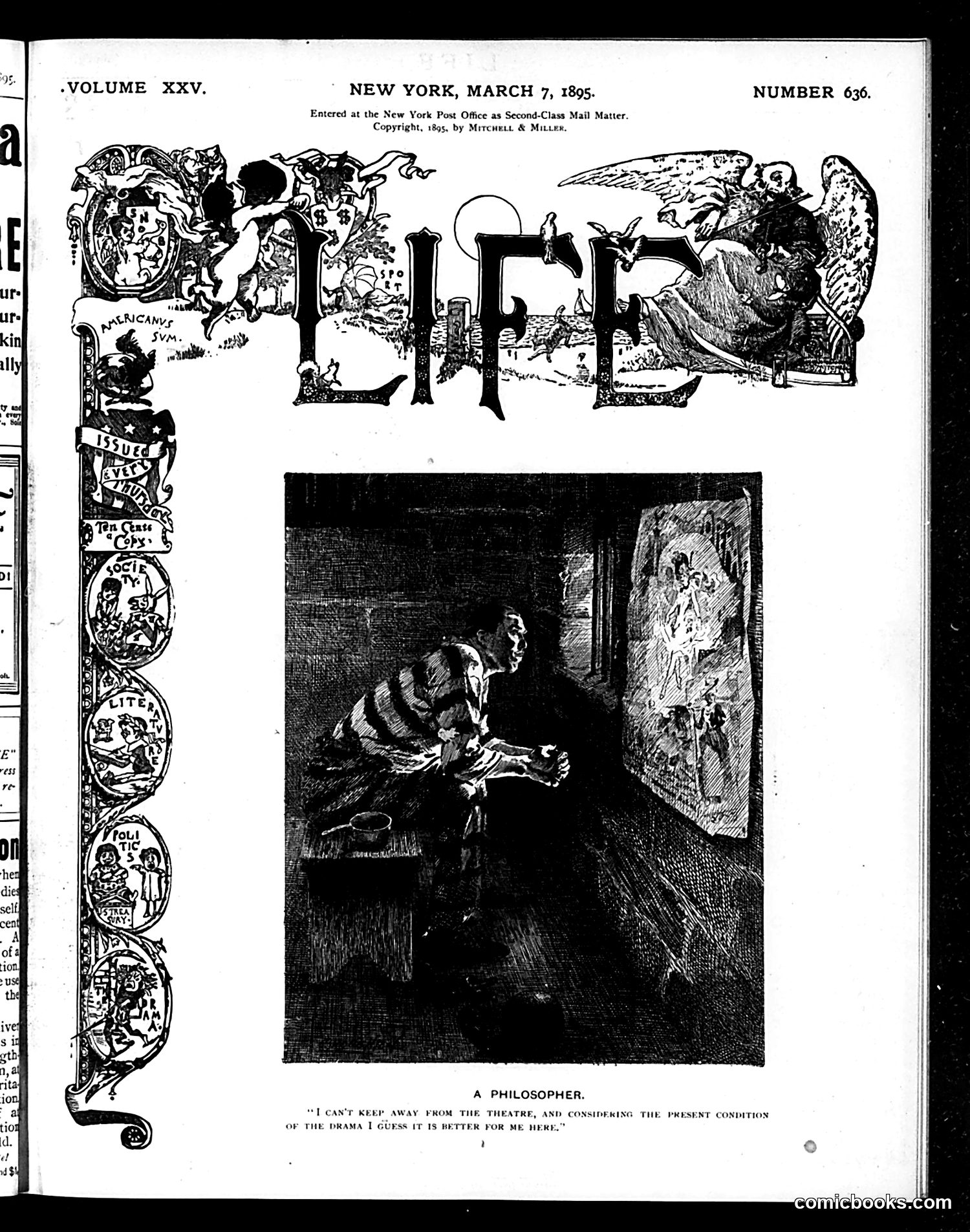
This cartoon depicts a man in shabby clothing hunched over in what appears to be a modest room, looking at or working on something. The caption reads: "I CAN'T KEEP AWAY FROM THE THEATRE, AND CONSIDERING THE PRESENT CONDITION OF THE DRAMA I GUESS IT IS BETTER FOR ME HERE." The satire is straightforward: the figure is a poor man who claims he cannot stay away from theater despite his poverty. Given the "present condition of the drama" (likely referring to contemporary theatrical quality or trends in 1895), he ironically suggests he's better off remaining in his humble circumstances than attending performances. The joke satirizes both the state of American theater at the time and the paradoxical compulsion some felt to engage with it despite its apparent shortcomings.
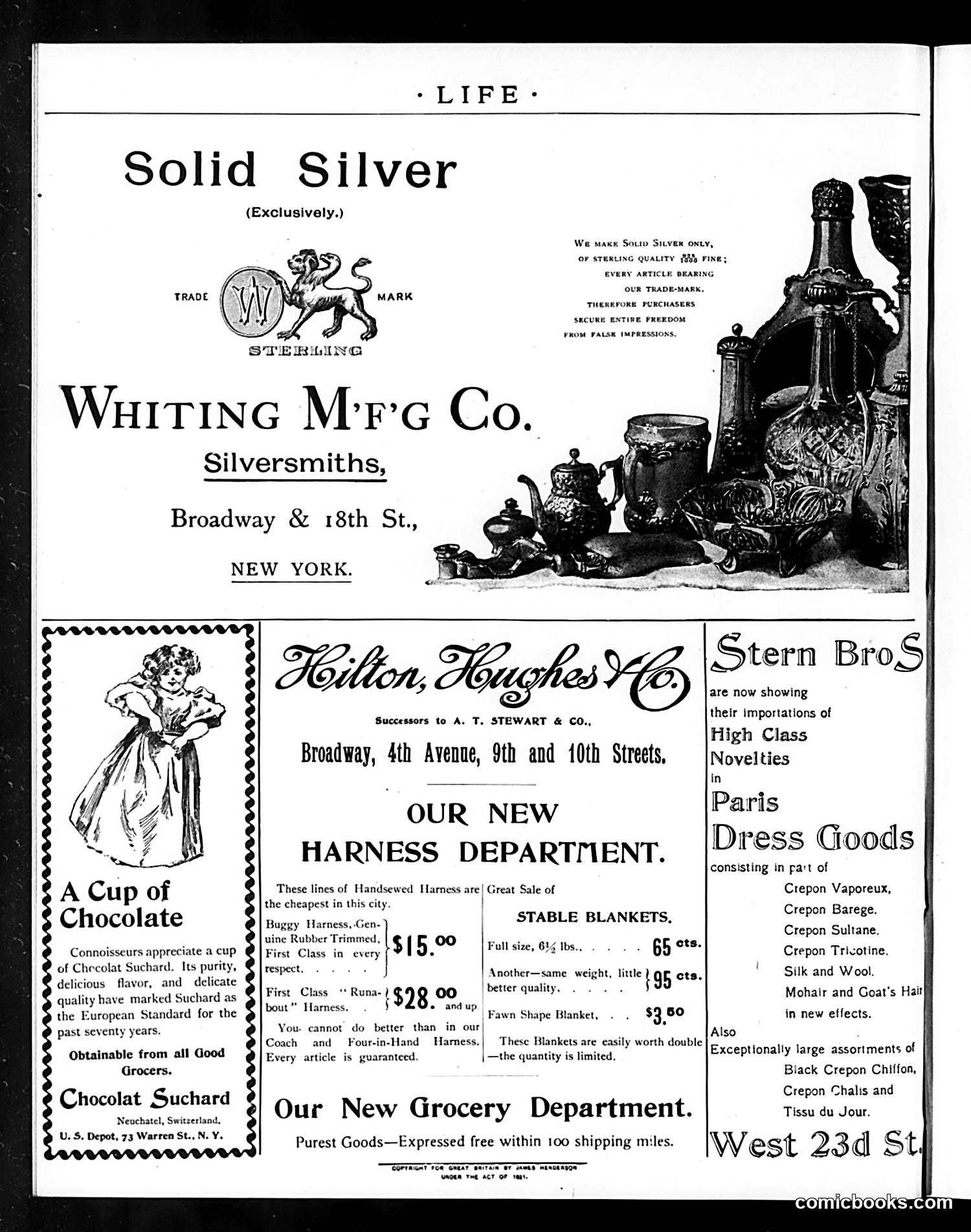
This page is primarily **advertising**, not political satire or editorial content. The top features **Whiting Mfg Co.**, a silversmith advertising solid silver goods from their Broadway location in New York. The ornamental trade mark (a lion with a shield) emphasizes product authenticity. Below are three separate ads: **Chocolat Suchard** (Swiss chocolate), **Holton, Hughes & Co.** (a harness and grocery department store with locations across Broadway and various avenues), and **Stern Bros** (showing Paris dress goods and fabrics). The only illustrated figure is a stylized woman in the Chocolat Suchard ad—a generic advertisement image, not a caricature or political reference. There is no discernible satire or commentary on this page; it represents typical *Life* magazine commercial space from the late 19th or early 20th century.
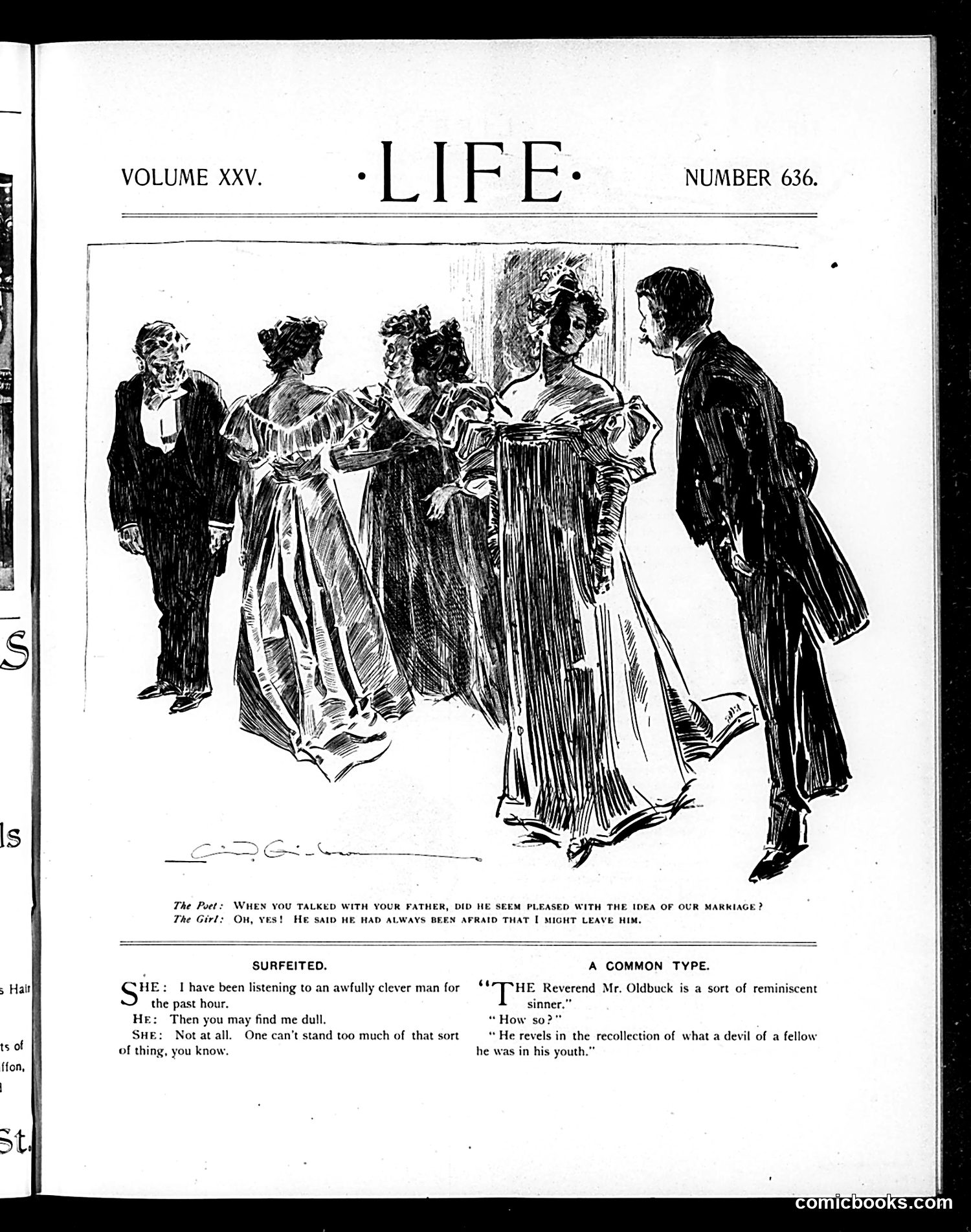
This page contains two separate satirical pieces typical of early 20th-century Life magazine humor. **Top illustration**: A social scene depicting two men and three women in formal dress. The caption presents a dialogue where a poet asks a girl if her father approved of their marriage plans. She replies that her father feared she might leave him—a joke about parental anxiety over losing daughters to marriage. **Bottom section**: Two brief comedic dialogues. "Surfeited" mocks a man's pretentious intellectualism—he's been listening to a clever speaker and finds himself now dull by comparison. "A Common Type" describes Reverend Oldbuck as someone who nostalgically reminisces about his youthful mischief, satirizing aging clergy members who dwell on past misconduct. These represent typical genteel satire of the era, focusing on social manners and character types rather than political commentary.
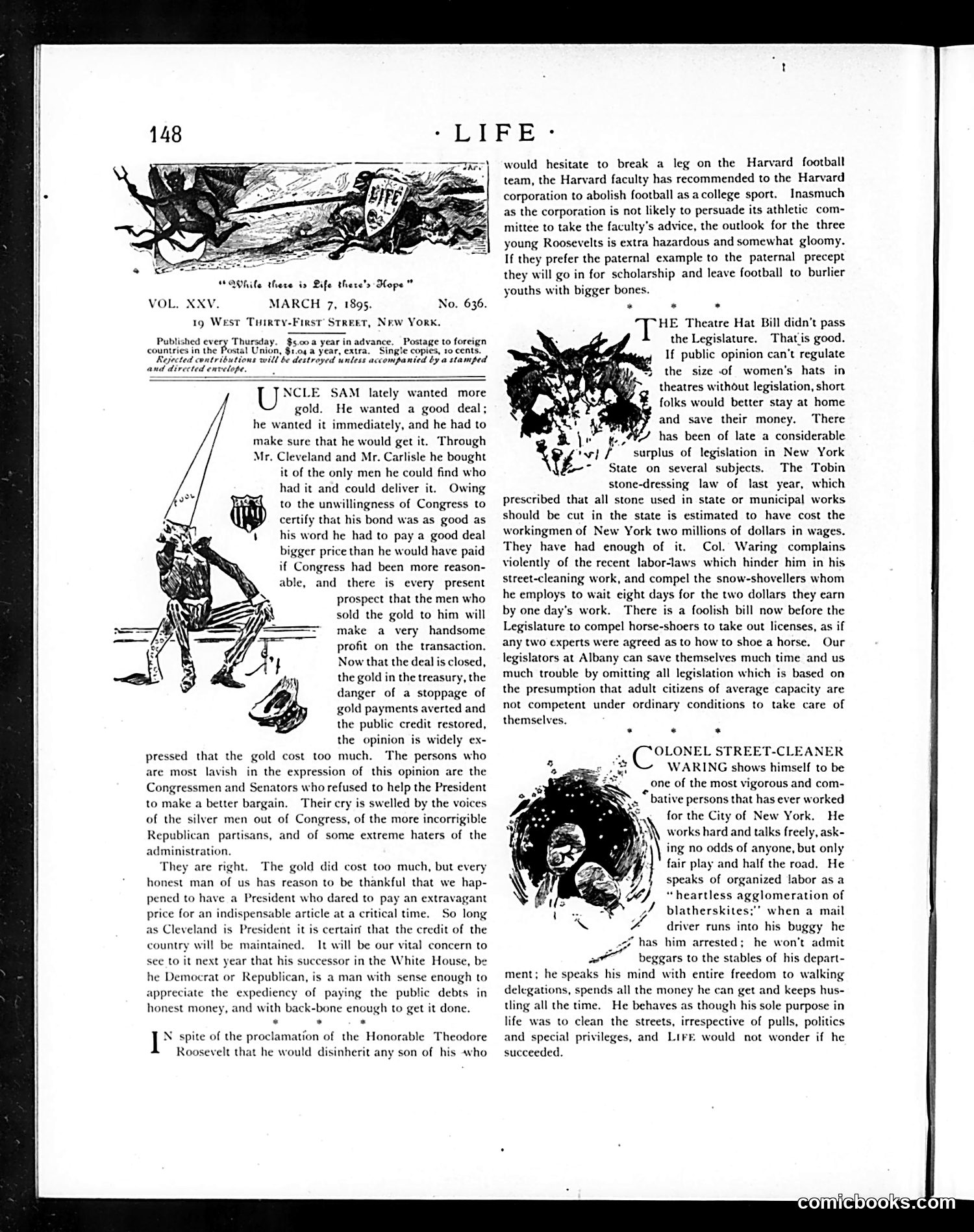
The page contains three distinct satirical pieces: 1. **Uncle Sam and Gold** (left cartoon): Shows Uncle Sam with a sword labeled "BITE," satirizing President Cleveland's negotiations to purchase gold bullion during an economic crisis. The text criticizes Congress for refusing to help, forcing the President to make an expensive private deal that costs the treasury more than necessary. The satire targets Republican congressmen who blocked relief measures. 2. **Theatre Hat Bill**: Mocks a failed New York State law attempting to regulate women's hat sizes in theaters (blocking audiences' views). The piece ridicules excessive legislation, noting the state recently passed costly stone-dressing regulations. 3. **Colonel Street-Cleaner Waring** (right): Praises Theodore Roosevelt's street-cleaning commissioner as "vigorous," contrasting him with organized labor, whom Waring dismisses as "heartless agglomeration of blatherskites." The satire supports Waring's anti-union stance.
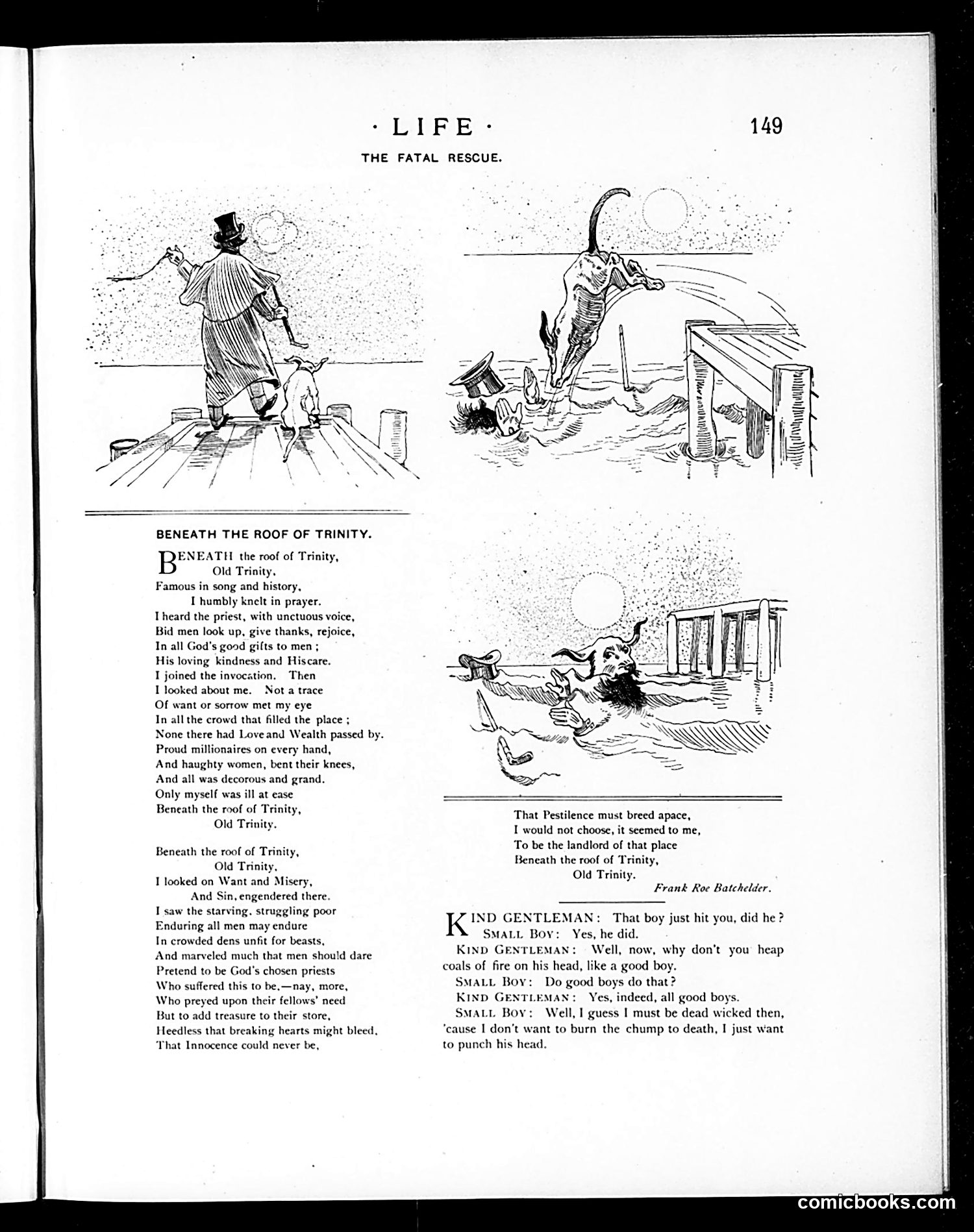
This page from *Life* magazine contains three satirical cartoon illustrations accompanying a poem titled "Beneath the Roof of Trinity" by Frank Roe Batchelder. The cartoons depict a wealthy gentleman attempting to "rescue" poor people from poverty—shown as he distributes charity beneath Trinity Church. The satire critiques condescending charity: the wealthy man appears oblivious to genuine suffering while performing ostentatious good deeds. The final dialogue exchange between a "Kind Gentleman" and "Small Boy" sharpens the joke—the boy's blunt, childlike responses expose the gentleman's patronizing assumptions about morality and "good boys." The satire targets Gilded Age hypocrisy: wealthy New Yorkers performing visible charity at Trinity Church while remaining indifferent to systemic poverty. The title "Fatal Rescue" suggests such superficial charity actually harms recipients by perpetuating rather than solving poverty.
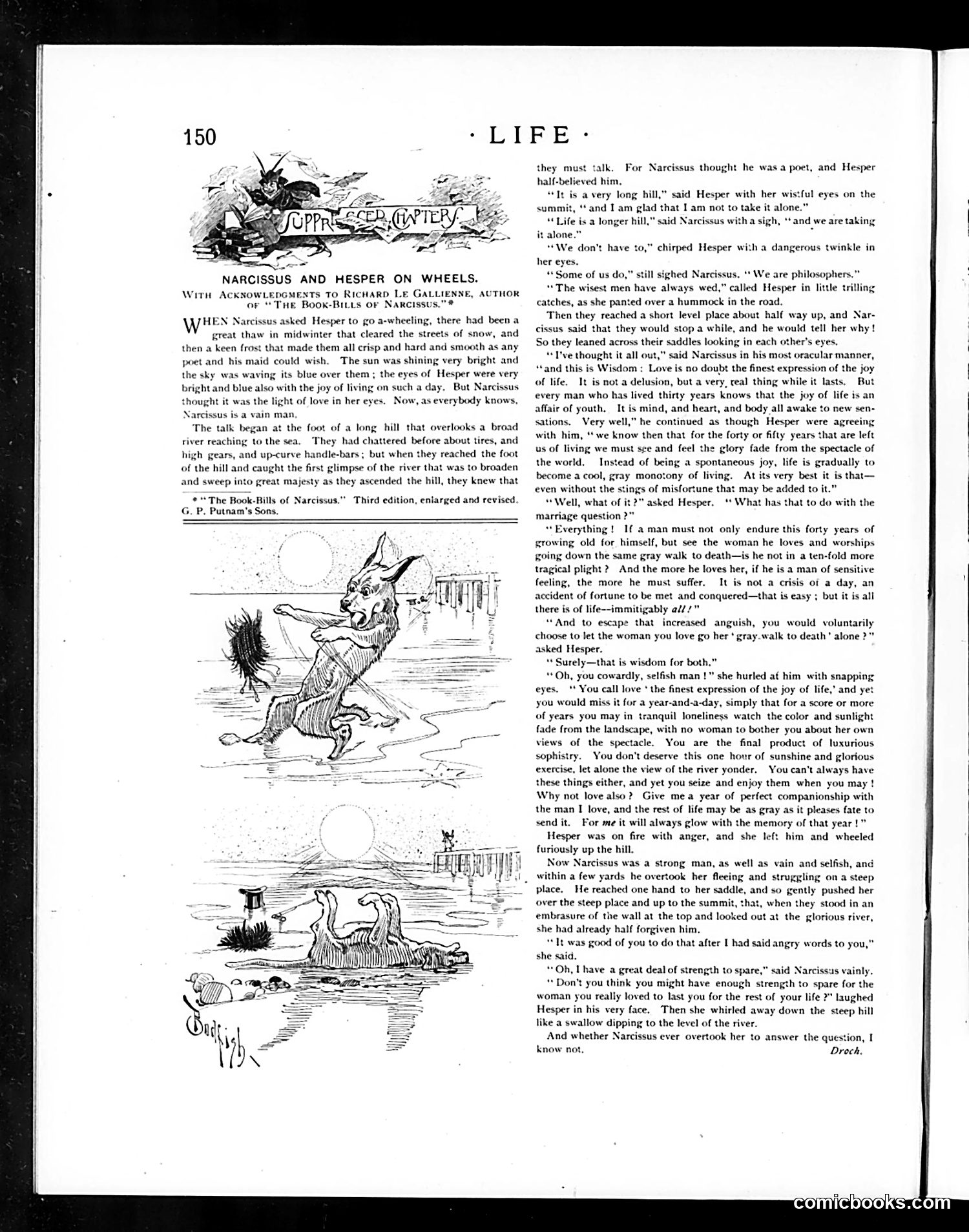
This is a literary piece by John Kendrick Bangs presenting a dialogue between Narcissus (from Greek mythology) and Hesper (likely a female character) who go wheeling—riding bicycles, a popular Victorian-era activity. The conversation explores romantic philosophy: Hesper challenges Narcissus's self-absorption, arguing that love requires vulnerability and shared experience rather than self-admiration. The text debates whether mature love can sustain joy or inevitably becomes "a cool, gray monotony." The accompanying illustrations show two figures on bicycles near water, visualizing their philosophical journey. This appears to be satirical commentary on contemporary romantic ideals and courtship customs of the 1890s bicycle era, when cycling became a venue for unchaperoned social interaction between young people.
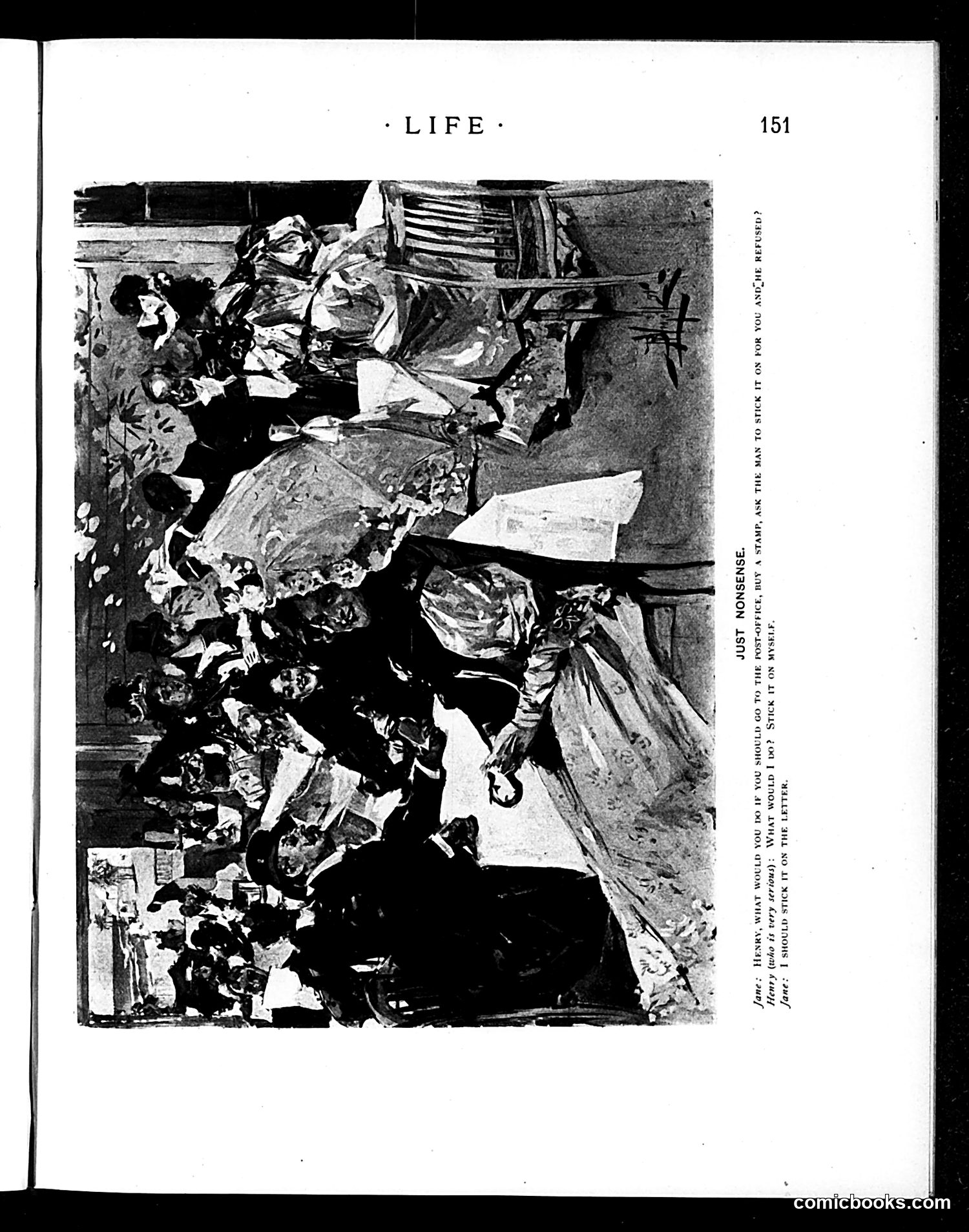
This appears to be a satirical illustration titled "Just Nonsense" from *Life* magazine (page 151). The image depicts a chaotic domestic scene with figures surrounded by elaborate, ornate furnishings and decorative objects in disarray. The caption suggests the satire targets excessive materialism or pretentious home decoration—the "nonsense" likely refers to overindulgent Victorian or Edwardian-era interior design and acquisition of status objects. The jumbled composition and the title imply criticism of people who prioritize ornamental clutter and conspicuous consumption over practical living. Without clearer identifying details, the specific figures remain unclear, but the general message critiques contemporary attitudes toward wealth display and domestic excess.
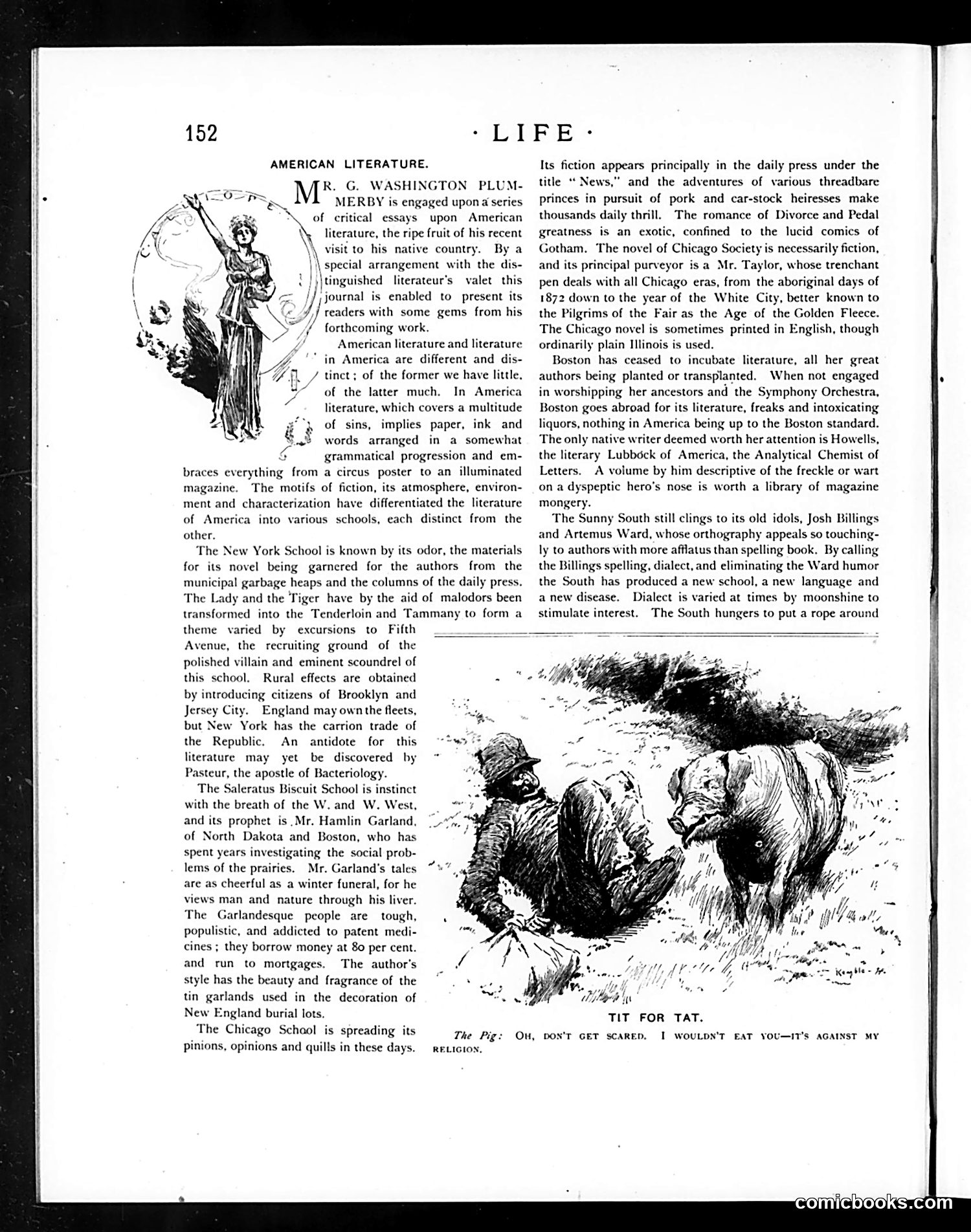
This cartoon illustrates a humorous confrontation between a pig and a person. The pig warns "Oh, don't get scared. I wouldn't eat you—it's against my religion," while the human appears defensive or startled. The satire plays on the assumption that pigs are naturally aggressive meat-eaters (which they're not exclusively), then subverts this with the pig claiming religious dietary restrictions—perhaps mocking human hypocrisy about food ethics and religious observance. The "tit for tat" title suggests role-reversal: just as humans eat pigs without hesitation, the pig ironically claims moral high ground by refusing to reciprocate. The joke relies on anthropomorphizing the animal to comment on human inconsistency regarding animal consumption and religious principles.
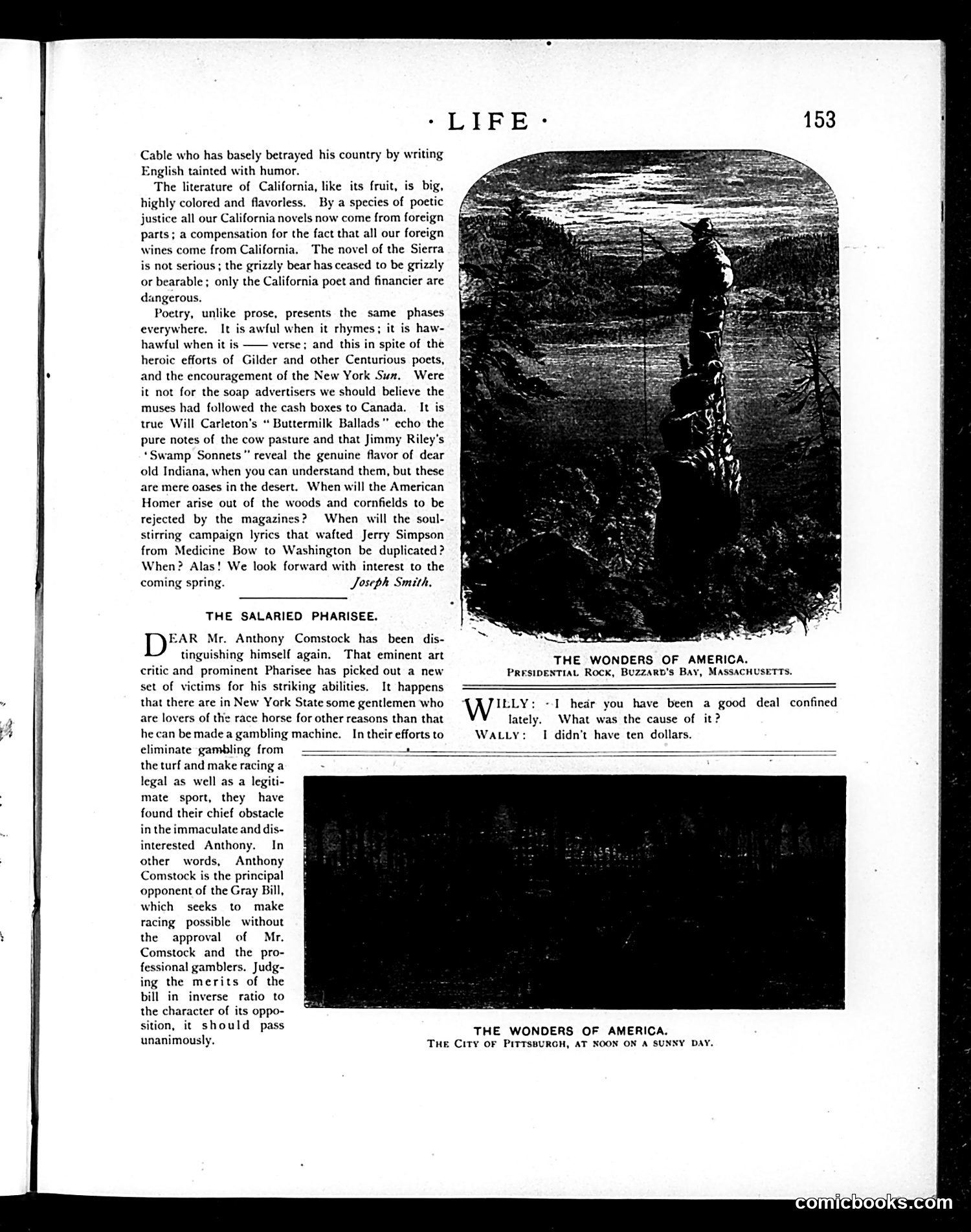
This page contains literary criticism and two illustrations titled "The Wonders of America." **Top section:** Joseph Smith critiques contemporary American literature, particularly California novels, which he describes as "big, highly colored and flavorless." He sarcastically notes that California poets and financiers are "dangerous," and laments the absence of a true American Homer. He mentions specific poets (Will Carleton, Jimmy Riley) and references the New York *Sun*'s promotion of mediocre work. **Bottom section:** The two engravings show American landscapes—Presidential Rock at Buzzard's Bay, Massachusetts, and Pittsburgh at noon. Below the first image is a brief humorous dialogue between "Willy" and "Wally" about confinement and poverty, though its satirical intent is unclear from context alone. The page exemplifies *Life*'s role as a satirical magazine critiquing American culture and literature.
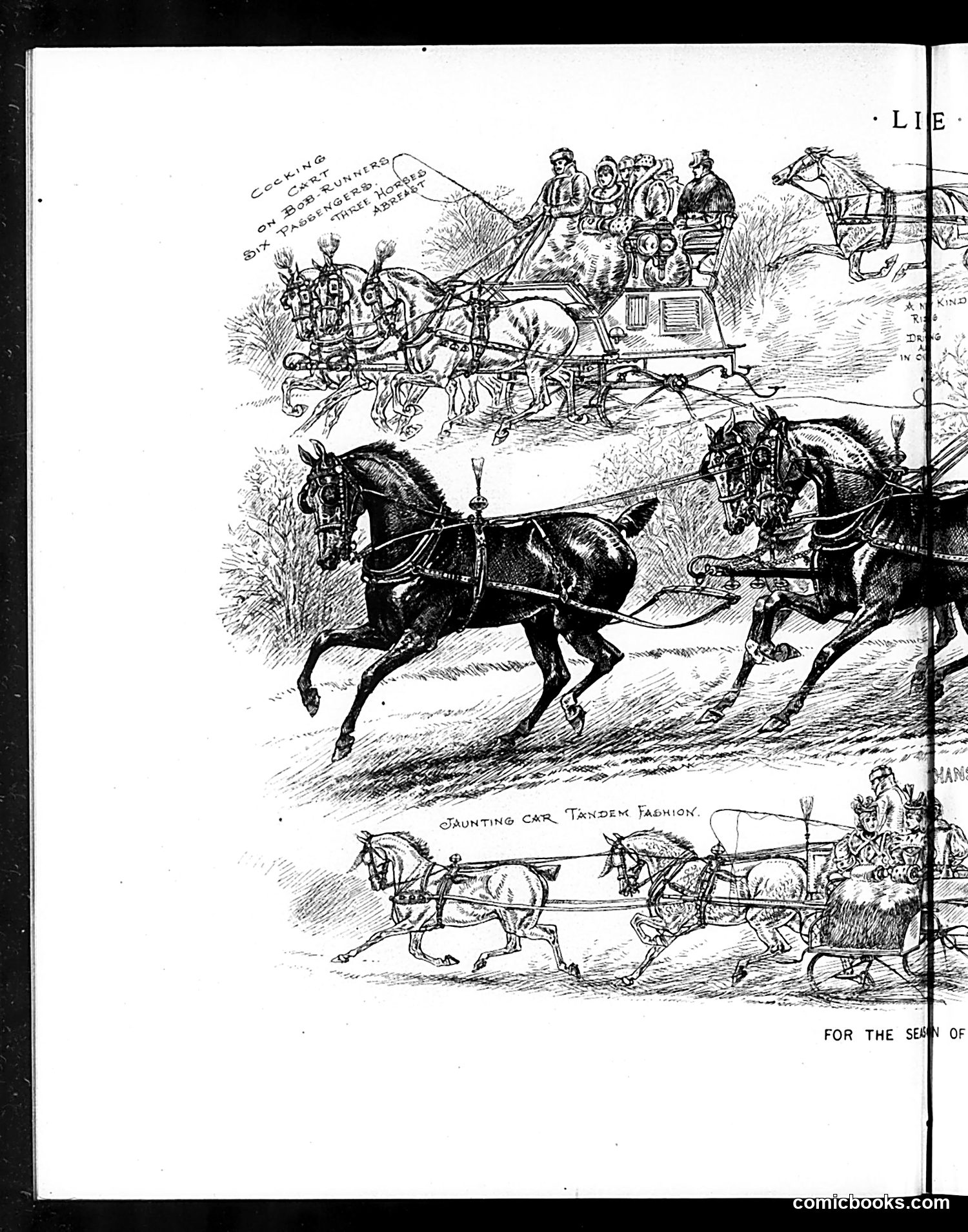
This page from *Life* magazine shows three illustrations of horse-drawn vehicles depicting fashionable transportation styles. The top two panels illustrate "Coaching" and "Box Running" — likely references to popular upper-class recreational driving trends of the era. The bottom panel is labeled "Jaunting Car: Tandem Fashion." The satire appears to target the ostentatious display and competitive one-upmanship among wealthy society figures regarding their choice of conveyances. Each illustration showcases progressively elaborate vehicles and larger groups of fashionably-dressed passengers, suggesting mockery of how the affluent competed to own and display the most impressive carriages and coaching setups. The text fragment "For the seem of" at bottom is incomplete in this OCR'd version, limiting full interpretation of the intended message.
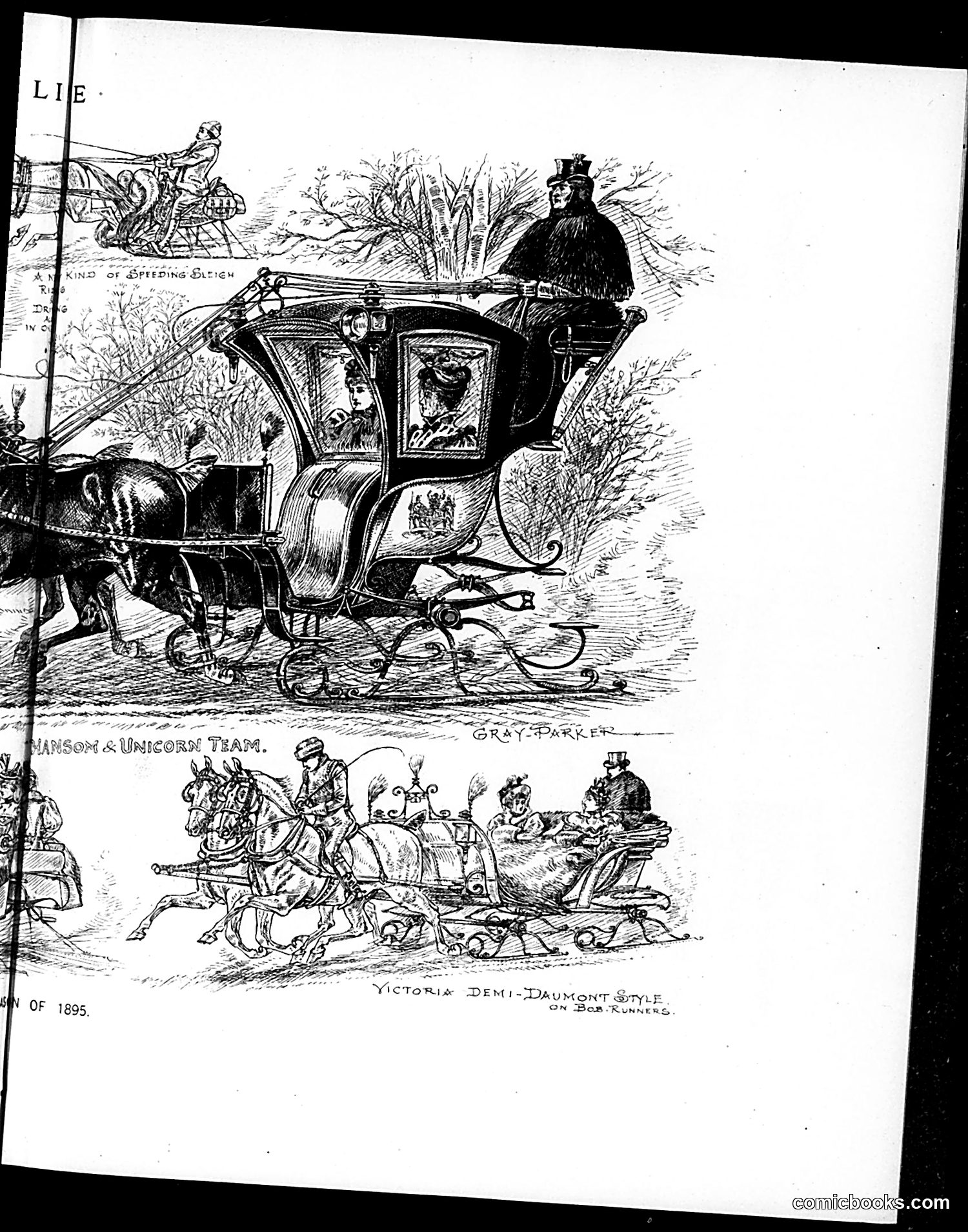
This page from Life magazine (dated 1895) shows two satirical illustrations of horse-drawn carriages by artist Gray Parker: **Top illustration:** A grand, ornate closed carriage labeled "Hansom & Unicorn Team" carries a formally-dressed passenger. The "unicorn team" (three horses arranged in a specific formation) was a fashionable but impractical coaching style among the wealthy. **Bottom illustration:** A "Victoria Demi-Daumont Style on Bar Runners" depicts an elaborate carriage pulled by multiple horses with riders in formal dress, appearing chaotic and over-complicated. Both cartoons likely satirize the excessive pretension and impracticality of late-Victorian wealthy society's obsession with elaborate, unnecessarily complicated carriage styles—mocking the aristocracy's wasteful pursuit of fashionable status symbols that served no functional purpose.
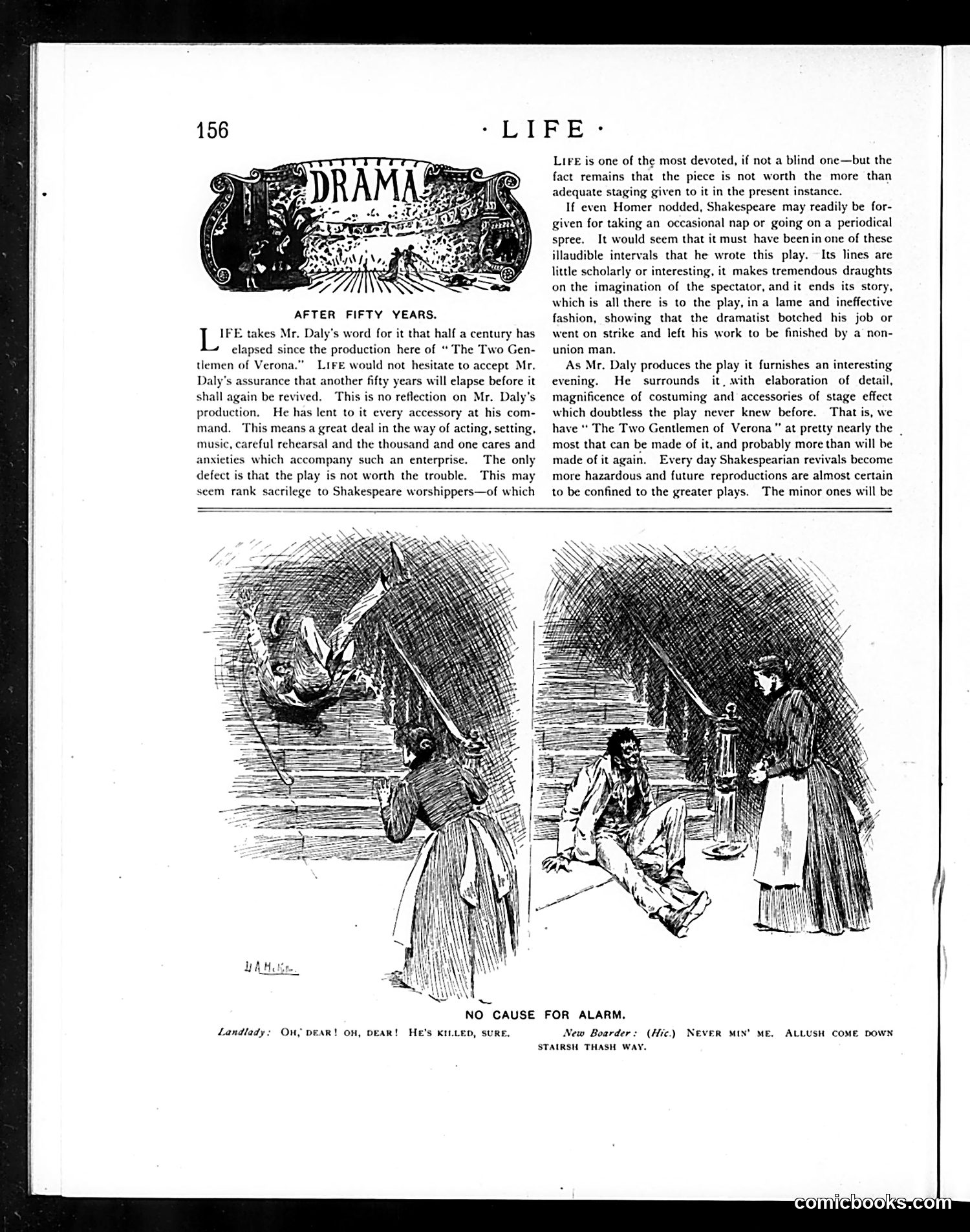
This page contains two separate pieces: **Main Article ("After Fifty Years"):** A review of theatrical producer Augustin Daly's production of Shakespeare's *The Two Gentlemen of Verona*. Life praises Daly's elaborate staging, costuming, and direction while delivering a harsh verdict on the play itself—calling it unworthy of such effort. The critic argues Shakespeare occasionally produced inferior work and sarcastically suggests the play was either botched or finished by a "non-union man." The piece predicts this minor Shakespeare play will rarely be revived, as future productions will focus only on his greater works. **Comic Illustration ("No Cause for Alarm"):** Two sketches showing a landlady discovering what appears to be a dead or injured boarder on the stairs. A new boarder reassures her in an Irish accent ("Allush come down stairsh thash way"), suggesting casual indifference to the apparent disaster—likely playing on period stereotypes about Irish characters.
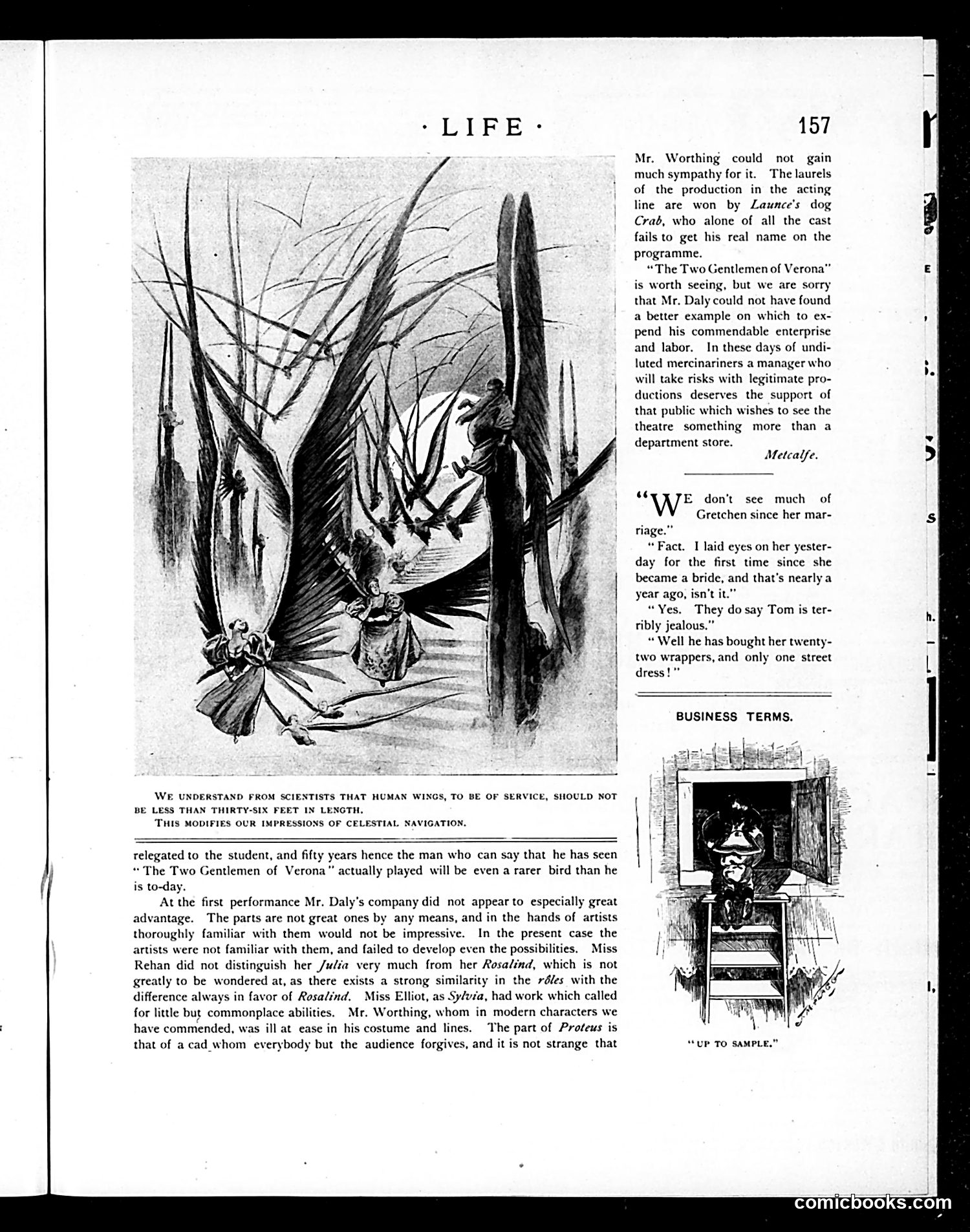
The main cartoon depicts an angel or celestial figure with enormous wings. The caption jokes that scientists say functional human wings need to be at least 36 feet long—a satirical comment on the absurdity of literal "celestial navigation" or heavenly flight. The page's primary content is a theater review of Mr. Daly's production of Shakespeare's "The Two Gentlemen of Verona." The critic praises the dog playing Crab as the only cast member deserving credit, while critiquing the human actors (including Miss Rehan and Mr. Worthing) as underprepared and uninspired. The review commends Daly's willingness to produce legitimate theater rather than commercial fare, arguing such risk-taking deserves public support. A separate anecdote mocks a jealous husband (Tom) who buys his bride 22 wrappers (undergarments) but only one street dress—suggesting misplaced priorities and controlling behavior.
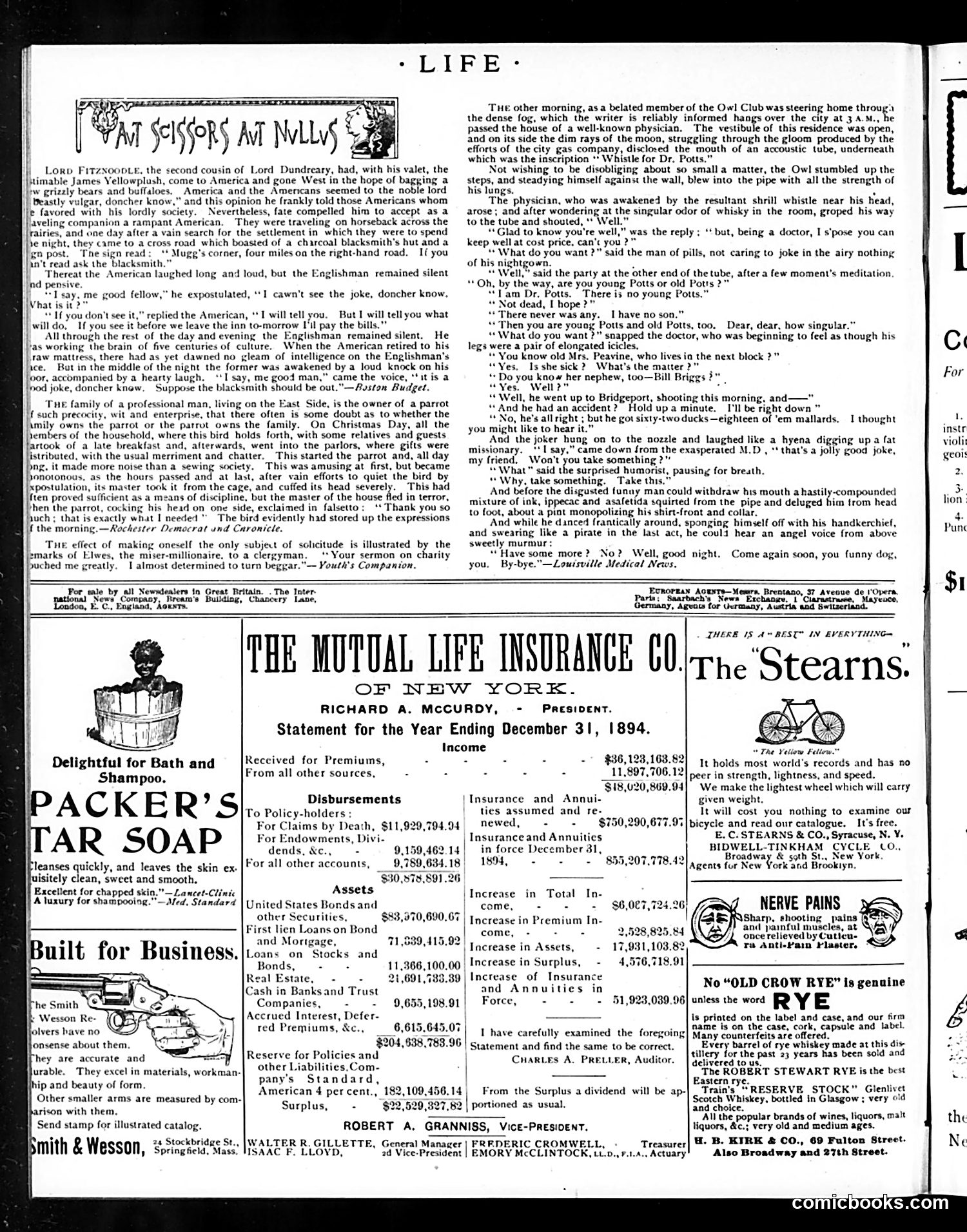
This page from *Life* magazine contains three separate humorous anecdotes rather than political cartoons: 1. **"Lord Fitzoodle at Nulls"**: A satire on English snobbery. A pompous British nobleman and an American travel together. The American jokes about a sign at "Mugg's corner"—the joke being that the sign itself says "If you can't read ask the blacksmith," mocking the Englishman's supposed cultural superiority while highlighting American practical humor. 2. **The Parrot Story**: A tale about a household parrot that mimics harsh language after being struck by its owner, illustrating how actions have unintended consequences. 3. **The Miser Anecdote**: A brief joke about a wealthy but selfish man claiming charity moved him, yet remaining unchanged. The page is primarily **text-based humor**—common in 19th-century satirical magazines—rather than visual satire. The advertisements (Parker's Tar Soap, Smith & Wesson, insurance) occupy significant space, typical of *Life*'s revenue model.
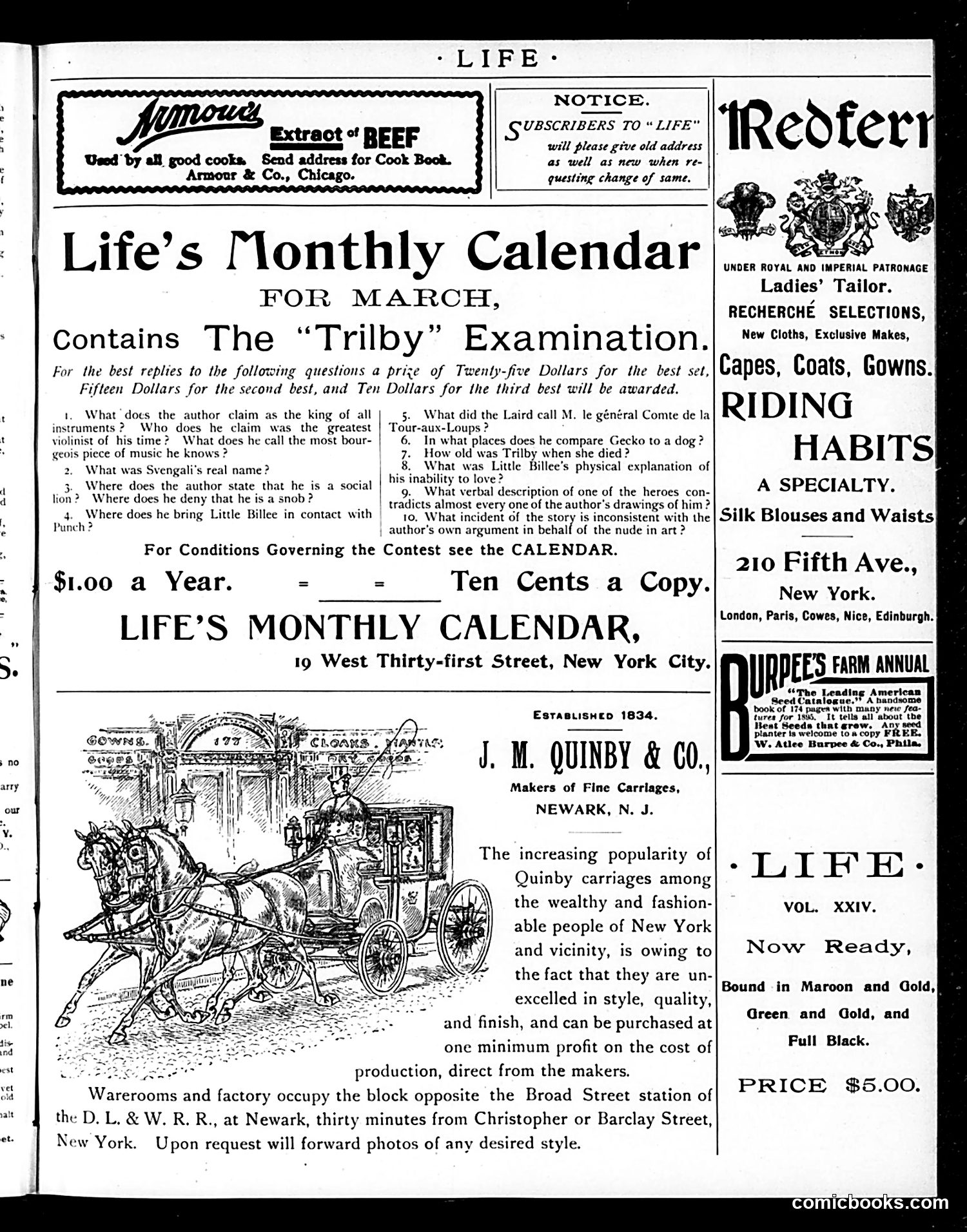
This is primarily an **advertising and editorial page** from Life magazine (Vol. XXIV), not a political cartoon. The main content is a "Monthly Calendar" contest centered on **"Trilby,"** a popular 1894 novel by George du Maurier about bohemian life in Paris featuring the characters Svengali and Little Billee. Life is running a **literary trivia contest** with cash prizes ($25, $15, $10) for readers answering detailed questions about the novel—asking about characters' names, plot points, and the author's arguments about art and nudity. This reflects how serialized novels were major cultural events that magazines leveraged for reader engagement. The page is surrounded by period advertisements: Armour beef extract, a ladies' tailor, Quinby carriages, and Burpee's seed catalog—typical commercial appeals for Life's affluent readership in turn-of-the-century New York.
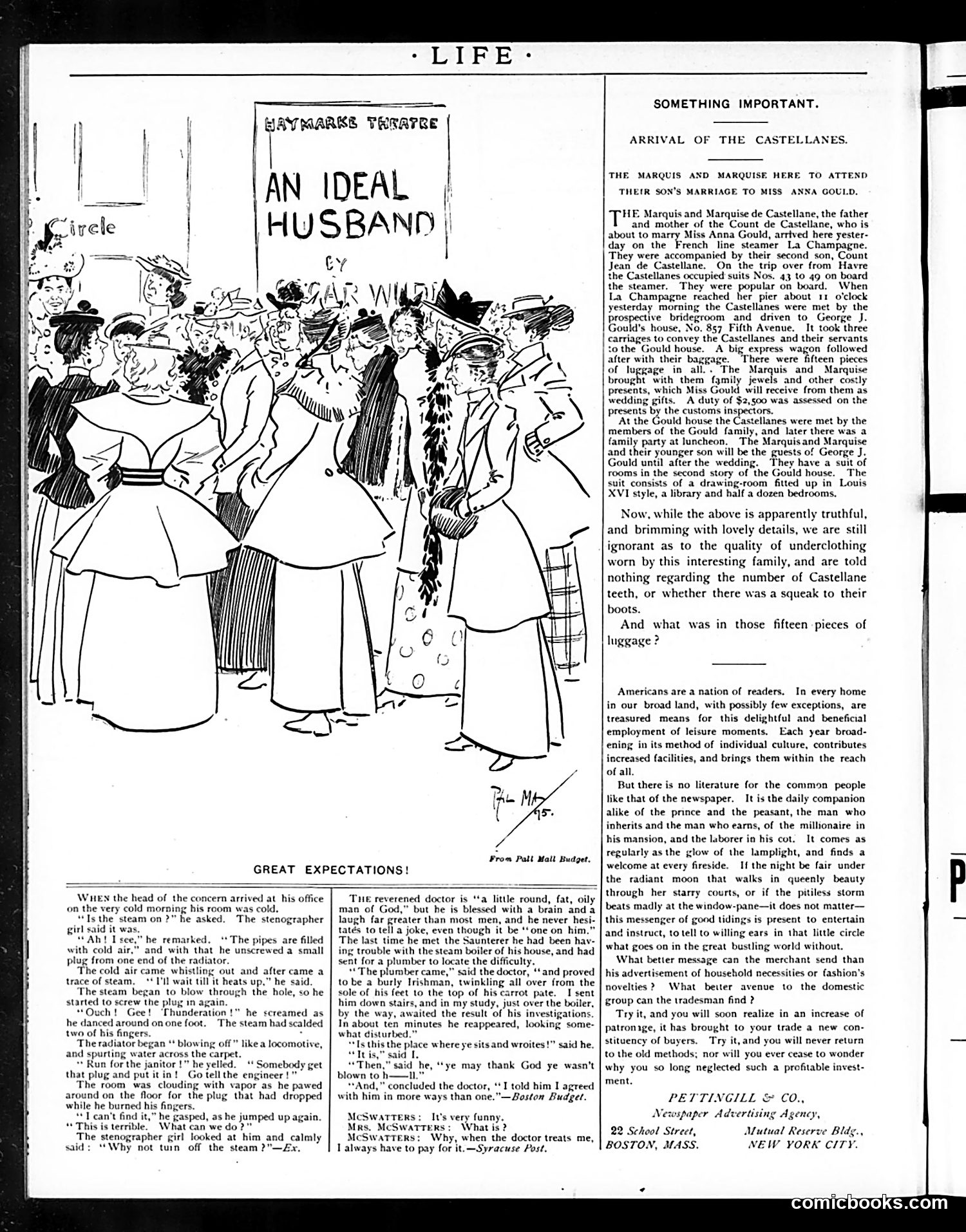
This page contains three humorous anecdotes and a society news item: **"Great Expectations"** depicts an office worker who unscrews a radiator plug to release trapped cold air, then scalds his fingers when steam rushes out. The joke's payoff: the stenographer simply suggests turning off the steam—the obvious solution he overlooked in his panic. **The doctor's anecdote** follows similar comedic logic: a plumber working on the doctor's boiler asks if his study (directly above) is where "ye sits and writes," then warns he's lucky not to have been "blown to h—l." The doctor agrees "in more ways than one"—a mild joke about divine judgment. **"McSwatters"** presents a brief exchange about a doctor's fees. **The news item** reports the arrival of the French Marquis and Marquise de Castellane for their son's wedding to Anna Gould (a wealthy American heiress). Details include their ship accommodations, fifteen pieces of luggage, and a $2,500 customs duty—emphasizing the Old World aristocracy's material grandeur meeting American wealth.
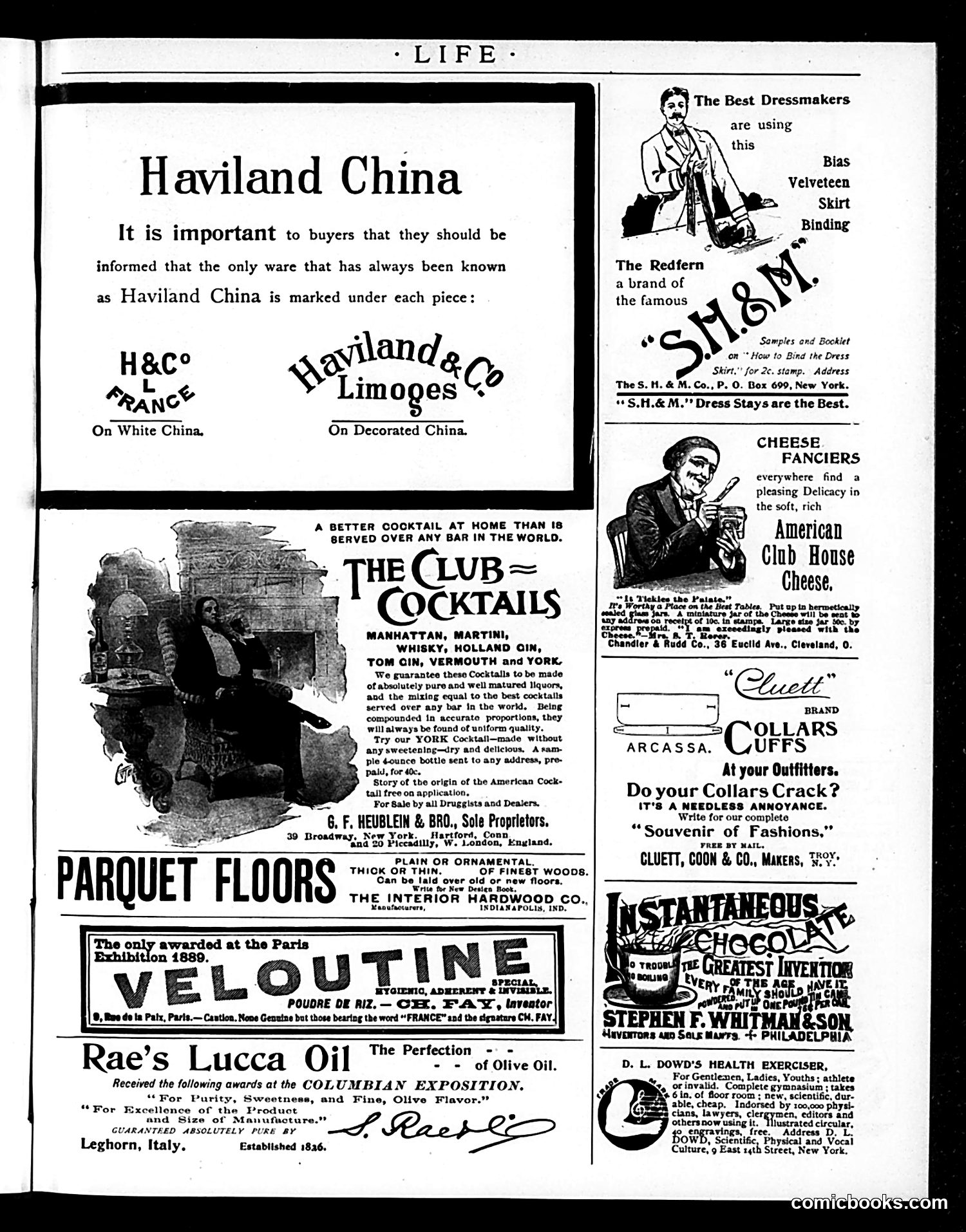
This page is primarily **advertising**, not satirical content. It showcases various consumer products marketed to early 1900s American readers. **Main advertisements include:** - **Haviland China**: French porcelain with marks authenticating genuine pieces - **The Club Cocktails**: Pre-mixed cocktail bottles (Manhattan, Martini, York) sold by mail, emphasizing quality and consistency - **Parquet Floors**: High-end hardwood flooring - **Velveteen Skirt Binding**: Dressmaking supplies marketed to professional dressmakers - **Dress Stays**: Women's undergarment supports - **American Club House Cheese**: Soft cheese product - **Arcassa Collars**: Men's collars advertised as non-cracking - **Instantaneous Chocolate**: Whitman brand chocolate drink mix claiming to be "the greatest invention" - **D.L. Dowd's Health Exerciser**: Home gymnasium equipment The page reflects Gilded Age consumer culture: imported luxury goods, mail-order convenience, and products targeting both domestic and personal grooming needs. No political satire is evident—this is straightforward period advertising.
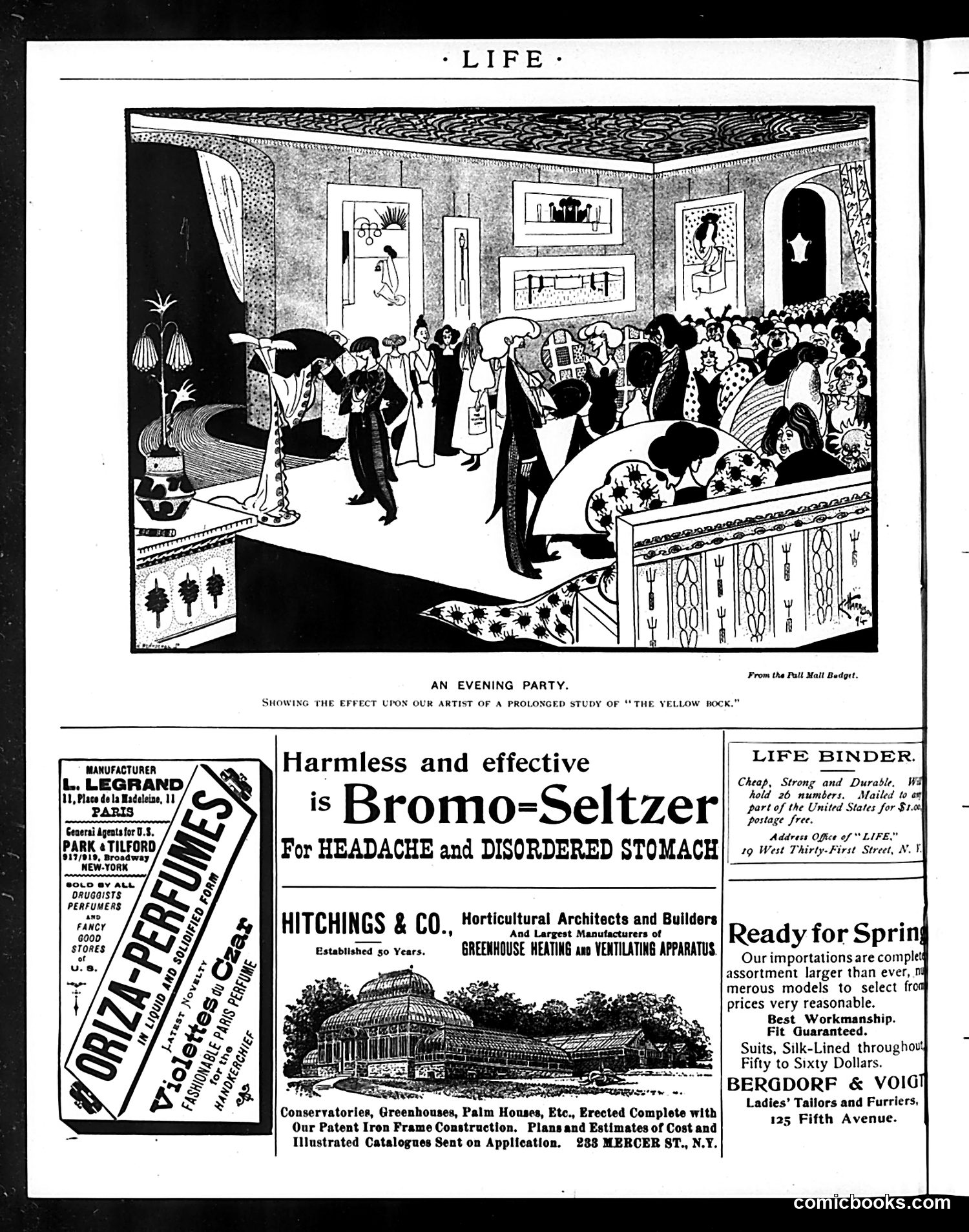
The main cartoon depicts an evening party scene with numerous guests in formal attire. The caption indicates it shows "the effect upon our artist of a prolonged study of 'The Yellow Book.'" **Context:** *The Yellow Book* was a fin-de-siècle British literary journal (1894-1897) associated with aestheticism, decadence, and avant-garde art. It was considered scandalous and provocative by Victorian standards. **The satire:** The cartoon suggests that studying this publication has distorted the artist's perception, causing them to see the ordinary social gathering in a warped, exaggerated manner—the figures appear stylized and grotesque rather than realistic. This is a commentary on *The Yellow Book's* influence as potentially corrupting or skewing one's aesthetic sensibilities toward the artificial and decadent. The page also contains period advertisements for Bromo-Seltzer, a Life magazine binder, greenhouse equipment, and ladies' tailoring—typical of early 20th-century magazine content.
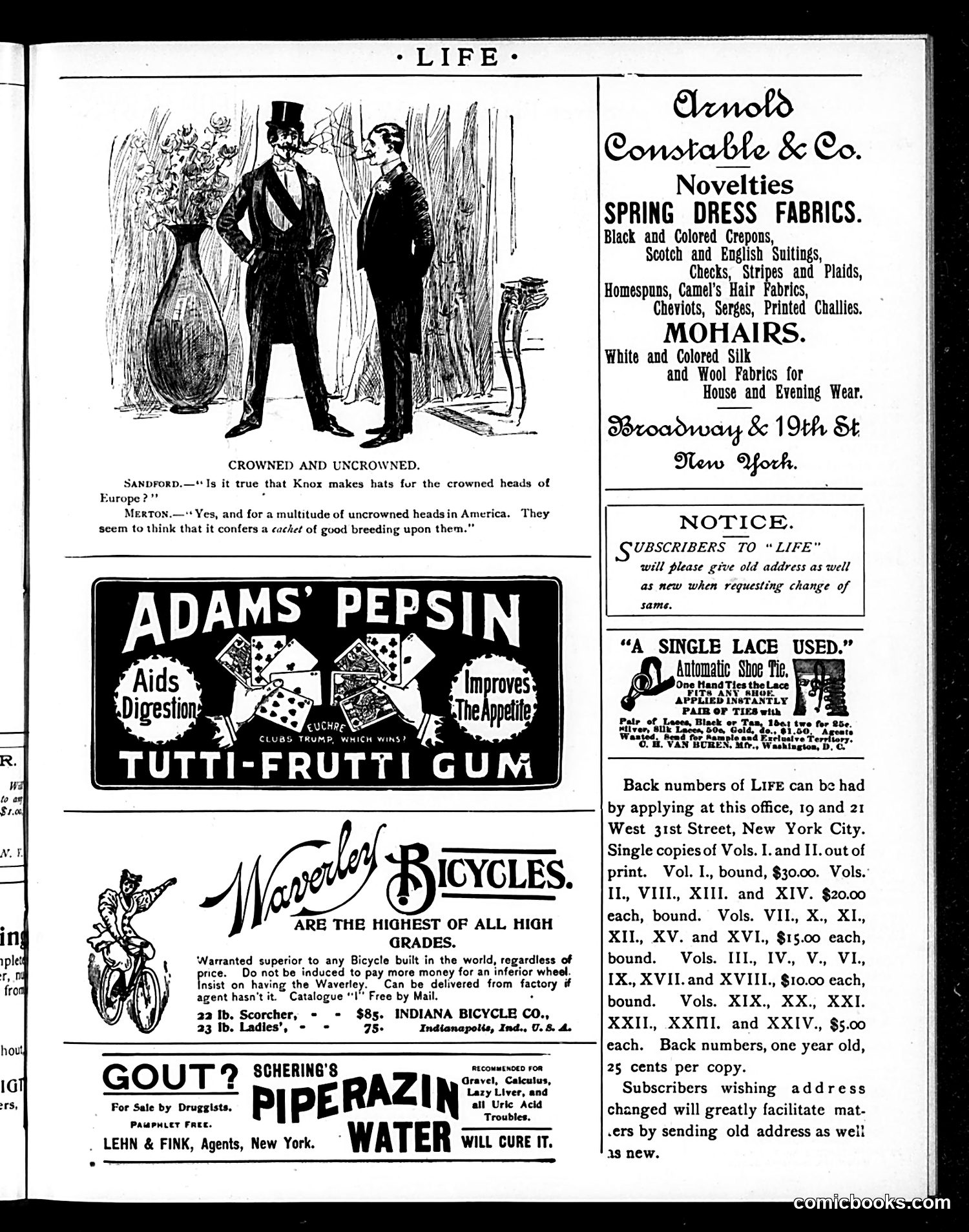
This single-panel cartoon satirizes American social pretension. Two men discuss Knox, apparently a hatmaker for European royalty. The joke hinges on a class commentary: while Knox makes hats for actual crowned European heads of state, he also supplies many "uncrowned" (ordinary) Americans who believe wearing such hats confers social status and "good breeding." The satire targets wealthy Americans' aspirational snobbery—their belief that adopting European aristocratic trappings will elevate their social standing. The term "cachet" (seal of authenticity/prestige) is used mockingly to suggest these Americans naively think a hat's origin automatically grants them respectability. This reflects Gilded Age anxieties about class mobility and the nouveau riche attempting to purchase legitimacy through association with European aristocracy.
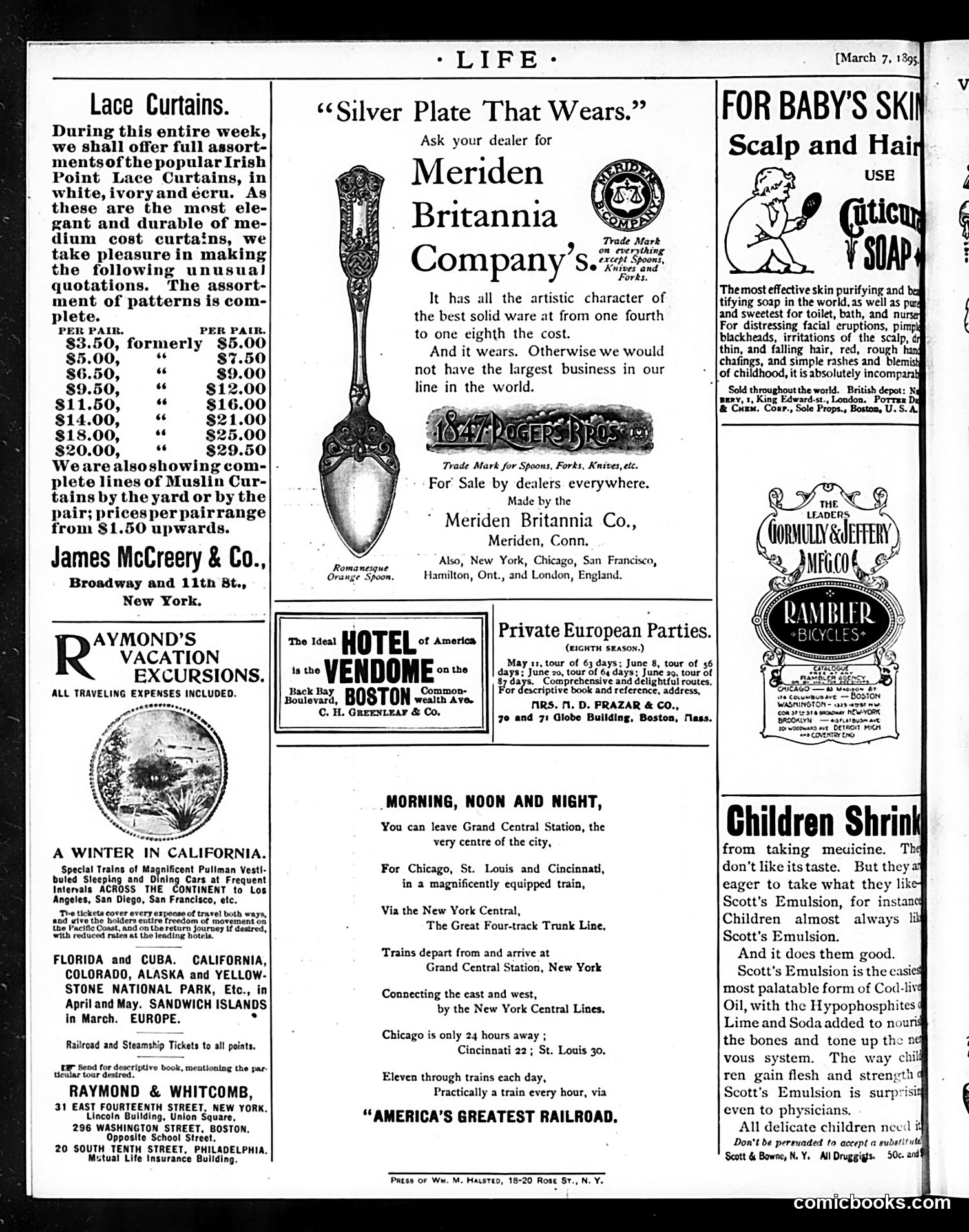
This is primarily a **commercial advertising page** with no political cartoons or satire. The content consists entirely of period advertisements for: - **Lace curtains** (James McCreery & Co.) - **Travel excursions** (Raymond & Whitcomb—winter trips to California, Florida, Cuba, Europe) - **Silverware** (Meriden Britannia Company—affordable plate goods marketed as quality alternatives to solid silver) - **Hotels** (the Vendôme in Boston) - **Railroad services** (New York Central Lines—the "Great Four-track Trunk Line") - **Toiletries** (Cuticura Soap for babies, Scott's Emulsion cough medicine) The page reflects **1890s consumer culture and leisure travel**—note the emphasis on luxurious Pullman rail travel and European tours. The Meriden ad is notable for marketing **electroplated silverware as democratizing luxury**: affordable "artistic character" for middle-class homes. There are no cartoons, caricatures, or satirical commentary visible on this page.