
Life, 1895-03-07 · page 4 of 20
Life — March 7, 1895 — page 4: what you’re looking at
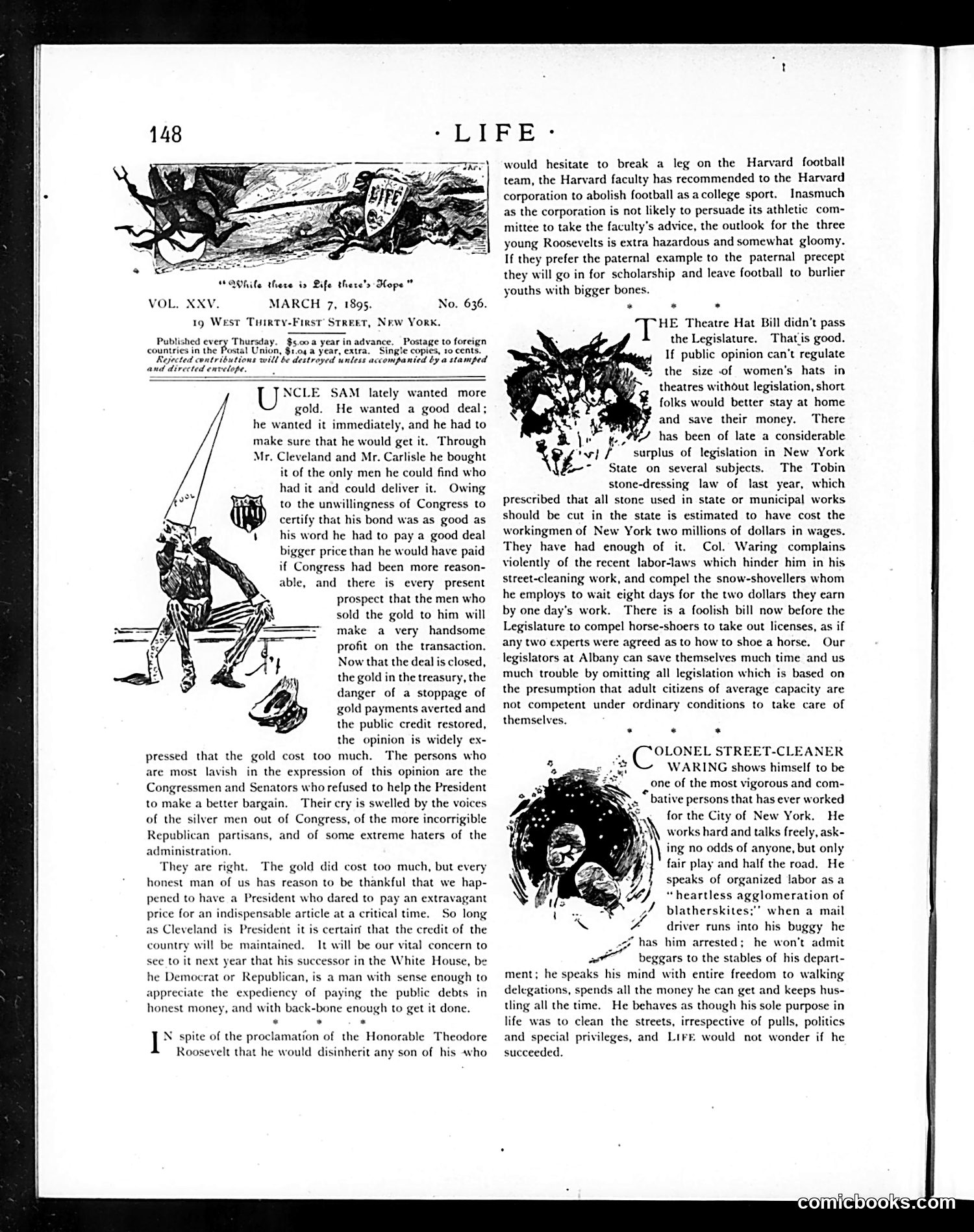
What you’re looking at
The page contains three distinct satirical pieces: 1. **Uncle Sam and Gold** (left cartoon): Shows Uncle Sam with a sword labeled "BITE," satirizing President Cleveland's negotiations to purchase gold bullion during an economic crisis. The text criticizes Congress for refusing to help, forcing the President to make an expensive private deal that costs the treasury more than necessary. The satire targets Republican congressmen who blocked relief measures. 2. **Theatre Hat Bill**: Mocks a failed New York State law attempting to regulate women's hat sizes in theaters (blocking audiences' views). The piece ridicules excessive legislation, noting the state recently passed costly stone-dressing regulations. 3. **Colonel Street-Cleaner Waring** (right): Praises Theodore Roosevelt's street-cleaning commissioner as "vigorous," contrasting him with organized labor, whom Waring dismisses as "heartless agglomeration of blatherskites." The satire supports Waring's anti-union stance.
📄 Transcribed text from this page (OCR, searchable)
Machine-transcribed from the original scan — historical spelling and the odd misread are preserved.
* LIFE: HOMile there is Life there's Hope” MARCH 7, 1895. 1g West THirty-First’ STREET, Published every Thursday. $5.00 a year in advance. Postage to foreign countries in the Postal Union, $1.04 a year, extra, Single copies, 10 cents. Rejected contributions will be destroyed unless accompanied by a stamped and directed envelope. NCLE SAM lately wanted more gold. He wanted a good deal; he wanted it immediately, and he had to make sure that he would get it. Through Mr. Cleveland and Mr. Carlisle he bought it of the only men he could find who had it and could deliver it. Owing to the unwillingness of Congress to certify that his bond was as good as his word he had to pay a good deal bigger price than he would have paid if Congress had been more reason- able, and there is every present prospect that the men who sold the gold to him will make a very handsome profit on the transaction. Now that the deal is closed, the gold in the treasury, the danger of a stoppage of gold payments averted and the public credit restored, the opinion is widely ex- The persons who pressed that the gold cost too much. are most lavish in the expression of this opinion are the men and Senators who refused to help the President to make a better bargain. Their cry is swelled by the voices of the silver men out of Congress, of the more incorrigible Republican partisans, and of some extreme haters of the administration. They are right. The gold did cost too much, but every honest man of us has reason to be thankful that we hap- pened to have a President who dared to pay an extravagant price for an indispensable article at a critical time. So long as Cleveland is President it is certain’ that the credit of the country will be maintained. It will be our vital concern to see to it next year that his successor in the White House, be he Democrat or Republican, is a man with sense enough to appreciate the expediency of paying the public debts in honest money, and with back-bone enough to get it done. N spite of the proclamation of the Honorable Theodore Roosevelt that he would disinherit any son of his avho would hesitate to break a leg on the Harvard football team, the Harvard faculty has recommended to the Harvard corporation to abolish football as a college sport. Inasmuch as the corporation is not likely to persuade its athletic com- mittee to take the faculty's advice, the outlook for the three young Roosevelts is extra hazardous and somewhat gloomy. If they prefer the paternal example to the paternal precept they will go in for scholarship and leave football to burlier youths with bigger bones. * . . HE Theatre Hat Bill didn’t pass e. Thats good. jon can’t regulate the size of women’s hats in theatres without legislation, short folks would better stay at home f . Ft e Wy and save their money. There re te, WY has been of late a considerable 4 tor} f surplus of legislation in New York fA - State on several subjects. The Tobin stone-dressing law of last year, which prescribed that all stone used in state or municipal works should be cut in the state is estimated to have cost the workingmen of New York two millions of dollars in wages. They have had enough of it. Col. Waring complains violently of the recent labor-laws which hinder him in his street-cleaning work, and compel the snow-shovellers whom he employs to wait eight days for the two dollars they earn by one day’s work. There is a foolish bill now before the Legislature to compel horse-shoers to take out licenses, as if any two experts were agreed as to how to shoe a horse. Our legislators at Albany can save themselves much time and us much trouble by omitting all legislation which is based on the presumption that adult citizens of average capacity are not competent under ordinary conditions to take care of themselves . * OLONEL STREET-CLEANER WARING shows himself to be one of the most vigorous and com- eee RSs bative persons that has ever worked . for the City of New York. He works hard and talks freely, ask- ing no odds of anyone, but only fair play and half the road. He speaks of organized labor as a “heartless agglomeration of blatherskites;’ when a mail driver runs into his buggy he <¢ has him arrested; he won't admit ww?" beggars to the stables of his depart- ment; he sp s his mind with entire freedom to walking delegations, spends all the money he can get and keeps hus- tling all the time. He be as though his sole purpose in life was to clean the streets, irrespective of pulls, politics and special privileges, and Lire would not wonder if he succeeded.