
Life, 1895-03-07 · page 6 of 20
Life — March 7, 1895 — page 6: what you’re looking at
What you’re looking at
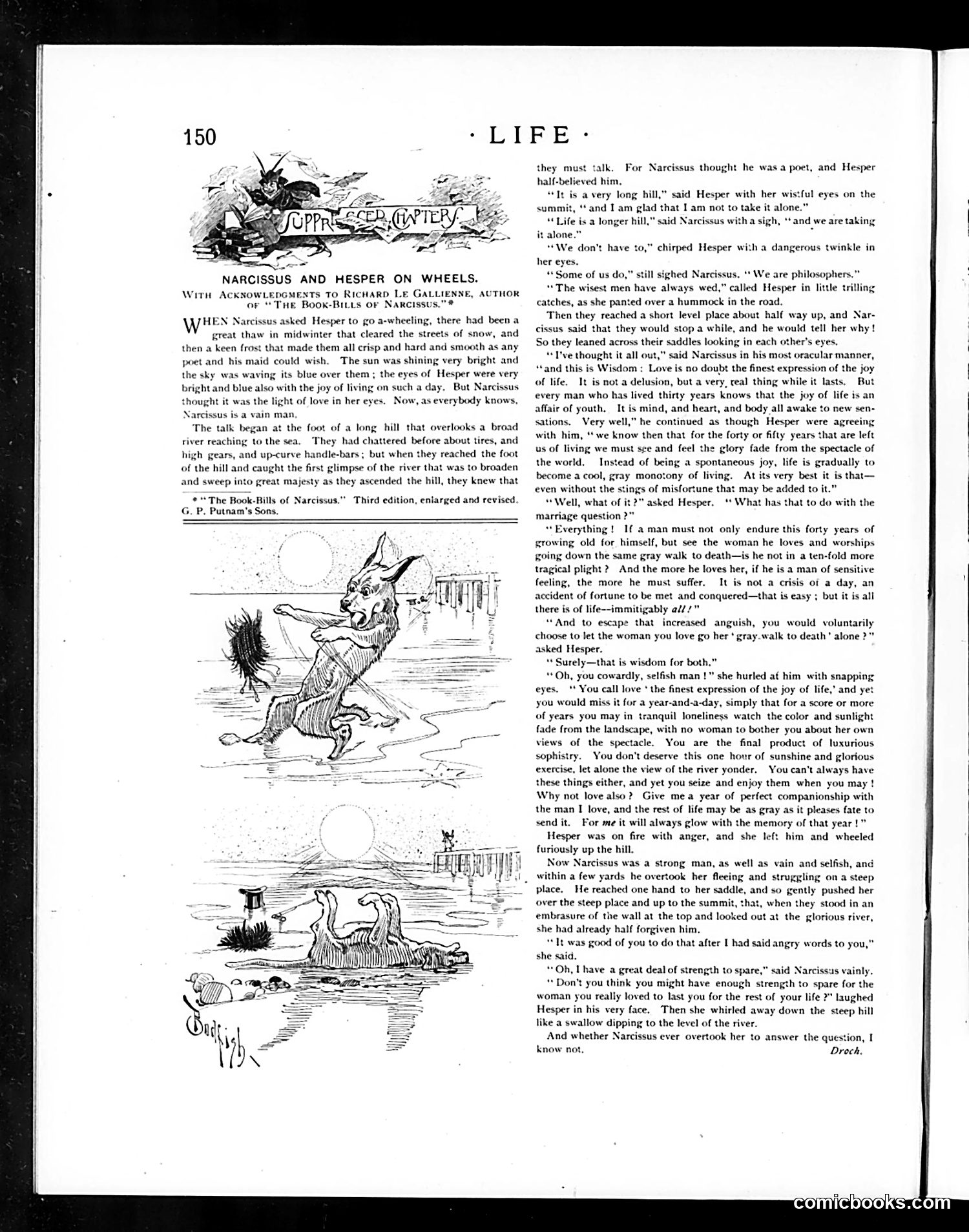
This is a literary piece by John Kendrick Bangs presenting a dialogue between Narcissus (from Greek mythology) and Hesper (likely a female character) who go wheeling—riding bicycles, a popular Victorian-era activity. The conversation explores romantic philosophy: Hesper challenges Narcissus's self-absorption, arguing that love requires vulnerability and shared experience rather than self-admiration. The text debates whether mature love can sustain joy or inevitably becomes "a cool, gray monotony." The accompanying illustrations show two figures on bicycles near water, visualizing their philosophical journey. This appears to be satirical commentary on contemporary romantic ideals and courtship customs of the 1890s bicycle era, when cycling became a venue for unchaperoned social interaction between young people.
📄 Transcribed text from this page (OCR, searchable)
Machine-transcribed from the original scan — historical spelling and the odd misread are preserved.
> LIFE: NARCISSUS AND HESPER ON WHEELS. WITH AckxowLenoMents To RicnarD Le GAL AUTHOR oF “THe Book-BILts oF NaRcIsst HEN Narcissus asked Hesper to go a-wheeling, there had been a great thaw in midwinter that cleared the streets of snow, and then a keen frost that made them all crisp and hard and smooth as any poet and his maid could wish, The sun was shining very bright and the sky was waving its blue over them ; the eyes of Hesper were very bright and blue also with the joy of living on such a day, But Narcissus ought it was the light of love in her eyes, Now, as everybody knows, Narcissus is a vain man, The talk began at the foot of a long hill that overlooks a broad river reaching to the sea, ‘They had chattered before about tires, and high gears, and up-curve handle-bars; but when they reached the foot of the hill and caught the first glimpse of the river that was to broaden and sweep into great majesty as they ascended the hill, they knew that "The Book-Bills of Narcissus.” Third edition, enlarged and revised, G. P. Putnam's Sons. they must talk, For Narcissus thought he was a poet, and Hesper half-believed him, “It is avery long hill,” said Hesper with her wistful eyes on the summit, ‘and Iam glad that [am not to take it alone. Life is a longer hill,” said Narcissus with a sigh, ** and we are taking. alone.” “We don’t have to,” chirped Hesper with a dangerous twinkle in her eyes. Some of us do,” still sighed Narcissus. * We are philosophers.” “The wisest men have always wed,” called Hesper in little trilling catches, as she panted over a hummock in the road. ‘Then they reached a short level place about half way up, and Nar- cissus said that they would stop a while, and he would tell her why ! So they leaned across their saddles looking in each other's eyes, “I've thought it all out,” said Narcissus in his most oracular manner, “sand this is Wisdom : Love is no doubt the finest expression of the joy of life. It is not a delusion, but a very, real thing while it lasts. But every man who has lived thirty years knows that the joy of life is an affair of youth, It is mind, and heart, and body all awake to new sen- sations. Very well," he continued as though Hesper were agreeing with him, “we know then that for the forty or fifty years that are left us of living we must sce and feel the glory fade from the spectacle of the world, Instead of being a spontaneous joy, life is gradually to become a cool, gray monotony of living. At its very best it is that— even without the stings of misfortune that may be added t Well, what of it ?” asked Hesper. ‘ What has that to do with the marriage question ?” verything! If a man must not only endure this forty years of growing old for himself, but see the woman he loves and worships going down the same gray walk to death—is he not in a ten-fold more tragical plight? And the more he loves her, if he is a man of sensitive feeling, the more he must suffer. It is not a crisis of a day, an accident of fortune to be met and conquered—that is easy ; but it is all there is of life—-immitigably a///” “And to escape that increased anguish, you would voluntarily choose to let the woman you love go her * gray.walk to death * alone?” asked Hesper. * Surely—that is wisdom for both.” “Oh, you cowardly, selfish man !" she hurled af him with snapping eyes. You call love * the finest expression of the joy of life,’ and yet you would miss it for a year-and-a-day, simply that for a score or more of years you may in tranquil loneliness watch the color and sunlight fade from the landscape, with no woman to bother you about her own views of the spectacle. You are the final product of luxurious sophistry. You don't deserve this one hour of sunshine and glorious exercise, let alone the view of the river yonder. You can't always have these things either, and yet you seize and enjoy them when you may ! Why not love also? Give mea year of perfect companionship with the man I love, and the rest of life may be as gray as it pleases fate to send it. For me it will always glow with the memory of that year! Hesper was on fire with anger, and she left him and wheeled furiously up the hill. Now Narcissus was a strong man, as well as vain and selfish, and within a few yards he overtook her fleeing and struggling on a steep place. He reached one hand to her saddle, and so gently pushed her over the steep place and up to the summit, that, when they stood in an embrasure of the wall at the top and looked out at the glorious river, she had already half forgiven him, “It was good of you to do that after I had said angry words to you,” she said. “Oh, [have a great deal of strength to spare,” said Narcissus vainly. “Don't you think you might have enough strength to spare for the woman you really loved to last you for the rest of your life ?” laughed Hesper in his very face. Then she whirled away down the steep hill like a swallow dipping to the level of the river. And whether Narcissus ever overtook her to answer the question, I know not, Droch,