
Life, 1895-03-07 · page 8 of 20
Life — March 7, 1895 — page 8: what you’re looking at
What you’re looking at
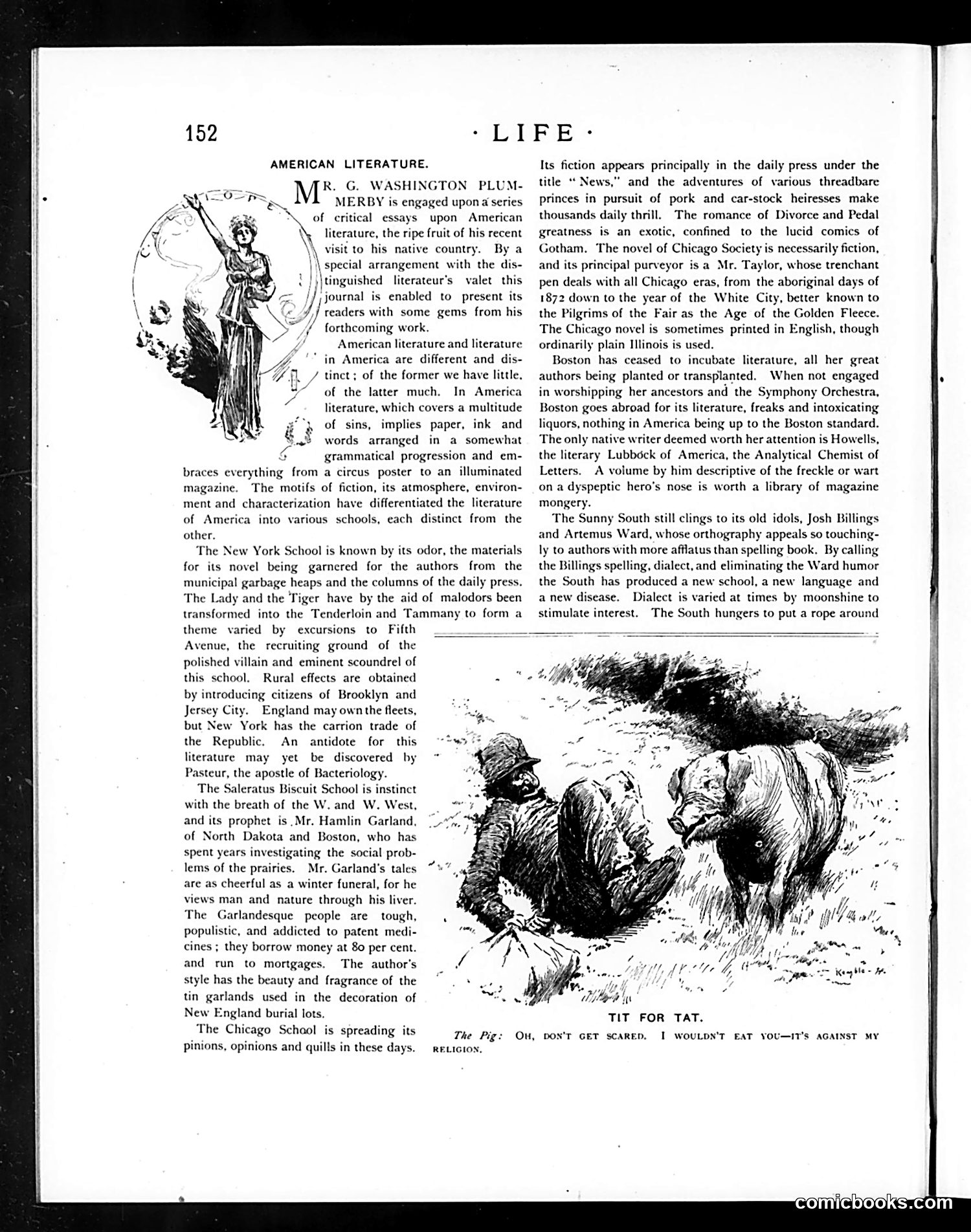
This cartoon illustrates a humorous confrontation between a pig and a person. The pig warns "Oh, don't get scared. I wouldn't eat you—it's against my religion," while the human appears defensive or startled. The satire plays on the assumption that pigs are naturally aggressive meat-eaters (which they're not exclusively), then subverts this with the pig claiming religious dietary restrictions—perhaps mocking human hypocrisy about food ethics and religious observance. The "tit for tat" title suggests role-reversal: just as humans eat pigs without hesitation, the pig ironically claims moral high ground by refusing to reciprocate. The joke relies on anthropomorphizing the animal to comment on human inconsistency regarding animal consumption and religious principles.
📄 Transcribed text from this page (OCR, searchable)
Machine-transcribed from the original scan — historical spelling and the odd misread are preserved.
LIFE AMERICAN LITERATURE. R. G. WASHINGTON PLUM- MERBY is engaged upon a series of critical essays upon American literature, the ripe fruit of his recent \\\ visit to his native country. By a \\ special arrangement with the dis- this \tinguished literateur’s valet /] journal is enabled to present its readers with some gems from his forthcoming work. American literature and literature ‘in America are different and dis- ZAG / tinct; of the former we have little. of the latter much. In America literature, which covers a multitude of sins, implies paper, ink and words arranged in a somewhat grammatical progression and em- braces everything from a circus poster to an illuminated The motifs of fiction, its atmosphere, environ- ment and characterization have differentiated the literature of America into various schools, each distinct from the other. The New York School is known by its odor, the materials for its novel being garnered for the authors from the municipal garbage heaps and the columns of the daily press. The Lady and the Tiger have by the aid of malodors been transformed into the Tenderloin and Tammany to form a theme varied by excursions to Fifth Avenue, the recruiting ground of the polished villain and eminent scoundrel of this school. Rural effects are obtained by introducing citizens of Brooklyn and Jersey City. England may own the fleets, but New York has the carrion trade of the Republic. An antidote for this literature may yet be discovered by Pasteur, the apostle of Bacteriology. The Saleratus Biscuit School is instinct with the breath of the W. and W. West, and its prophet is.Mr. Hamlin Garland, of North Dakota and Boston, who has spent years investigating the social prob- lems of the prairies. Mr. Garland’s tales cheerful as a winter funeral, for he views man and nature through his liver. The landesque people are tough, populistic, and addicted to patent medi- cines ; they borrow money at 80 per cent. and run The author's style has the beauty and fragrance of the tin garlands used in the decoration of New England burial lots. The Chicago School is spreading its pinions, opinions and quills in these days. ar to mortgages. The Pig: RELIGION. Ou, Its fiction appears principally in the daily press under the title “ News,” and the adventures of various threadbare princes in pursuit of pork and car-stock heiresses make thousands daily thrill. The romance of Divorce and Pedal greatness is an exotic, confined to the lucid comics of Gotham. The novel of Chicago Society is necessarily fiction, and its principal purveyor is a Mr. Taylor, whose trenchant pen deals with all Chicago eras, from the aboriginal days of 1872 down to the year of the White City, better known to the Pilgrims of the Fair as the Age of the Golden Fleece. The Chicago novel is sometimes printed in English, though ordinarily plain Illinois is used. Boston has ceased to incubate literature, all her great authors being planted or transplanted. When not engaged in worshipping her ancestors and the Symphony Orchestra, Boston goes abroad for its literature, freaks and intoxicating liquors, nothing in America being up to the Boston standard. The only native writer deemed worth her attention is Howells, the literary Lubbdck of America, the Analytical Chemist of Letters. A volume by him descriptive of the freckle or wart on a dyspeptic hero’s nose is worth a library of magazine mongery. The Sunny South still clings to its old idols, Josh Billings and Artemus Ward, whose orthography appeals so touching- ly to authors with more afflatus than spelling book. By calling the Billings spelling, dialect, and eliminating the Ward humor the South has produced a new school, a new language and Dialect is varied at times by moonshine to stimulate interest. The South hungers to put a rope around TIT FOR TAT. DON'T GET SCARED, I WOULDN'T EAT YOU—IT’S AGAINST MY