
A complete issue · 53 pages · 1894
Life — December 27, 1894
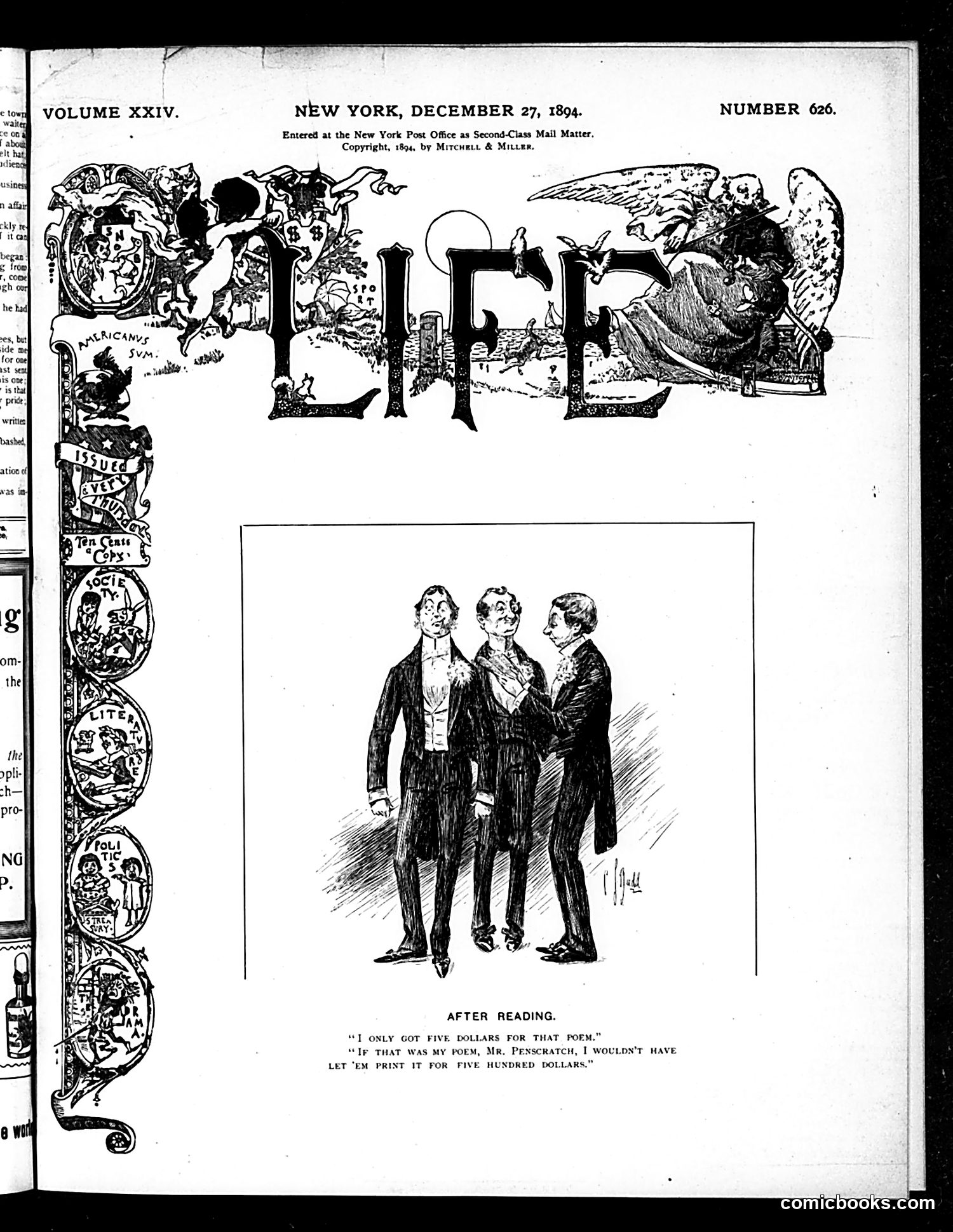
The bottom cartoon titled "After Reading" depicts three men in formal dress. The dialogue indicates a poet or writer received only five dollars for their work, while a character named "Mr. Penscratch" suggests he wouldn't let it print for five hundred dollars—a joke about the poem's poor quality and low commercial value. The elaborate decorative header reading "LIFE" contains various allegorical and artistic vignettes, typical of the magazine's ornamental design. This is straightforward literary satire mocking unsuccessful poets or struggling writers of the 1890s—a common theme in satirical magazines. The humor relies on the contrast between artistic ambition and harsh market realities for creative work.
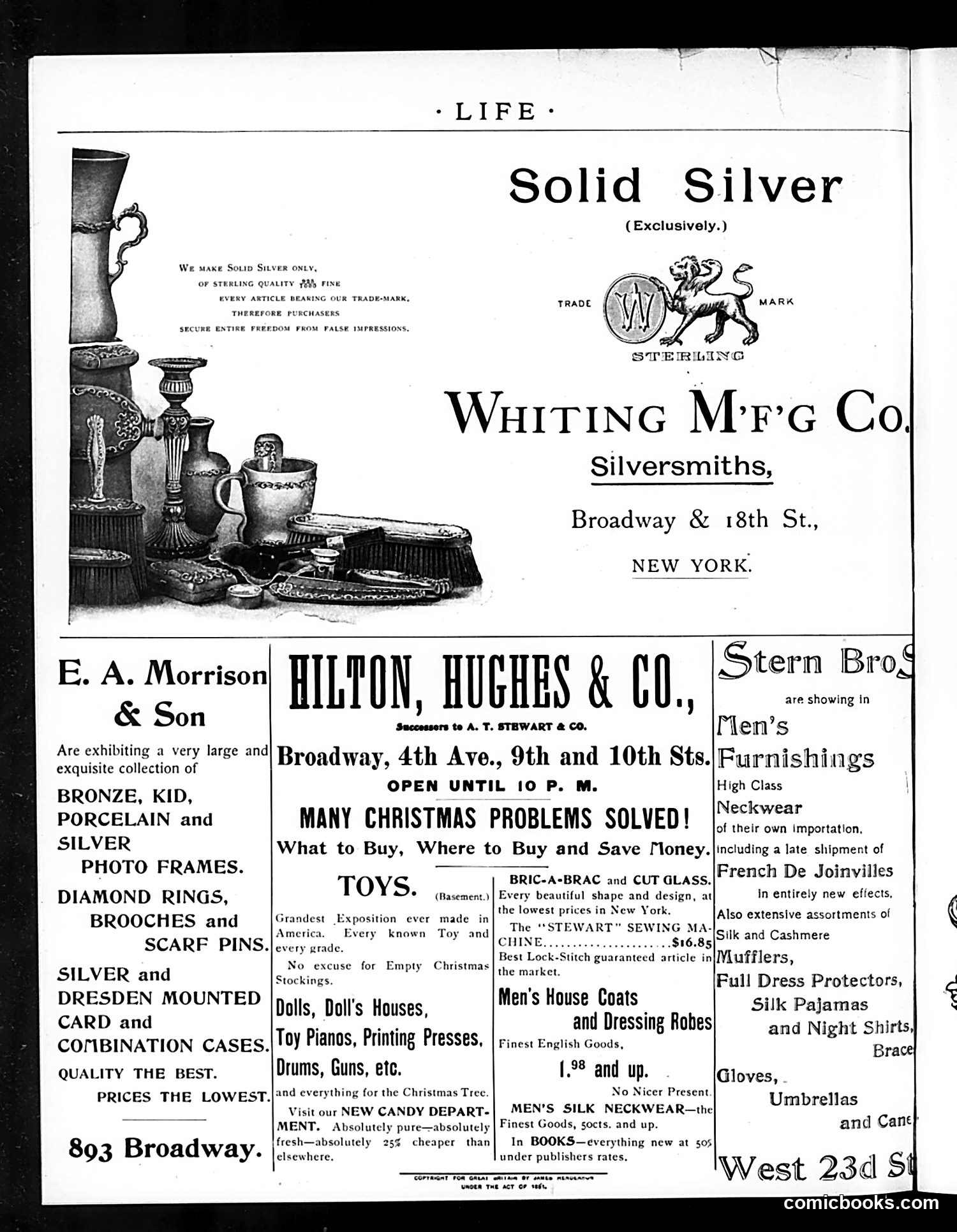
This page is primarily **advertising**, not satirical content. It features multiple commercial advertisements from late 19th-century New York retailers, including: - **Whiting Mfg Co.** (top): A silversmith advertising solid sterling silver goods - **E.A. Morrison & Son**: Selling bronze, porcelain, silver items, and jewelry - **Hilton, Hughes & Co.**: Department store promoting Christmas shopping with toys, dolls, and household goods - **Stern Bros.**: Men's furnishings retailer advertising neckwear, mufflers, and formal wear The page's only thematic connection is Christmas-related commerce. The decorative silverware illustration at top left is purely promotional. There is no political satire or social commentary evident—this is straightforward retail advertising typical of *Life* magazine's revenue model during the period.
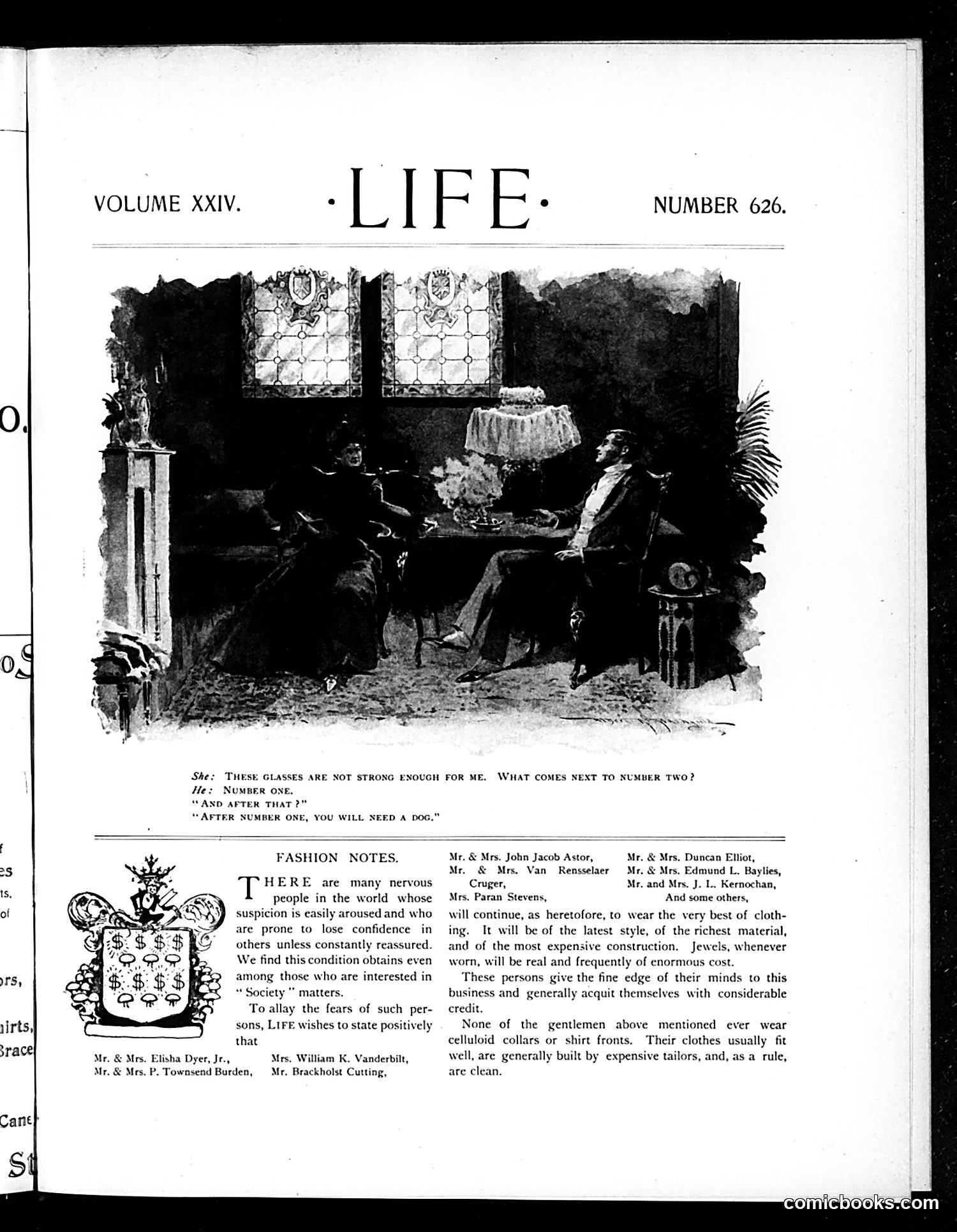
The main illustration shows a domestic scene with a couple dining. The caption presents a joke about eyeglasses: the woman says her current glasses "are not strong enough," asks what comes next, and the man responds "Number one," then "After that?" "After number one, you will need a dog." The satire mocks the progression of vision problems—implying that as eyesight deteriorates through increasingly stronger prescriptions, eventually one becomes so blind they'll need a guide dog. It's dark humor about aging and declining eyesight. The "Fashion Notes" section below discusses nervous wealthy people who wear expensive clothing to maintain social status, listing names of prominent society figures. This mocks the anxiety-driven consumption habits of the wealthy class concerned with appearing respectable through fashion.
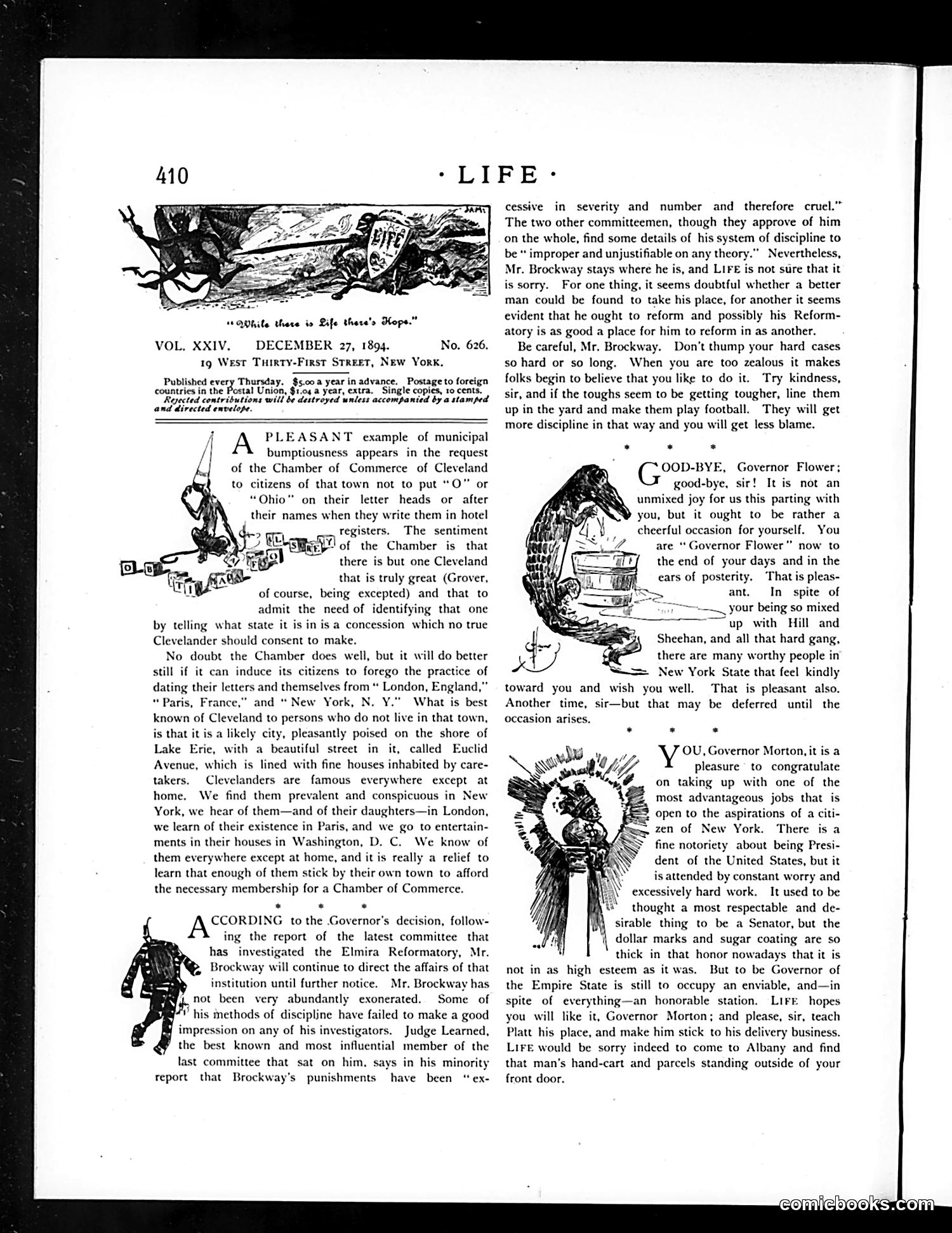
This page contains three separate editorial cartoons/commentaries addressing civic and political matters of 1894. The first cartoon mocks Cleveland's Chamber of Commerce for requesting citizens omit "O" or "Ohio" from their letterheads—a petty effort at civic branding that Life ridicules as absurd. The second cartoon congratulates "Governor Flower" on his new position, sarcastically suggesting the role brings constant worry and hard work, hoping he'll prove better than his predecessor. The third addresses "Governor Morton," apparently offering congratulations mixed with gentle mockery about accepting the governorship despite its burdensome nature. The text indicates ongoing criticism of institutional leadership—specifically referencing Mr. Brockway and Elmira Reformatory disciplinary methods being investigated by a committee.
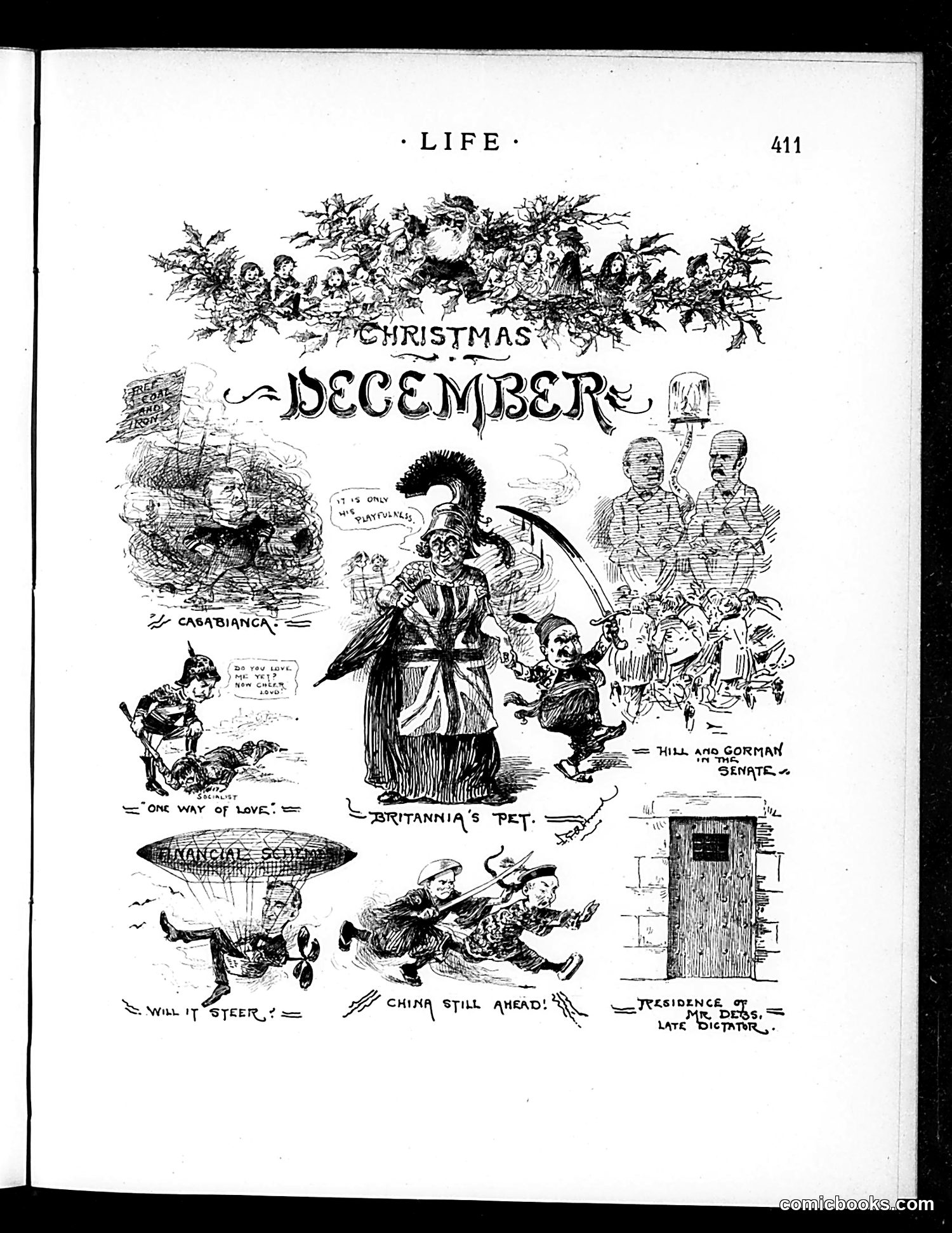
This page contains several political cartoons commenting on December events, likely from the early 20th century. The central figure "Britannia's Pet" depicts a menacing character with a scythe—personifying death or war—with a small child, referencing British military involvement and its consequences. Other panels address contemporary political issues: "Casablanca" (likely referring to the Moroccan crisis), "One Way of Love," "Financial Scrape," "Will It Steer?" (possibly about policy direction), "China Still Ahead!" (referencing Chinese conflicts), "Hill and Gorman in the Senate" (domestic politics), and "Residence of Late Mr. Debs, Dictator" (likely satirizing a specific political figure). The cartoons use dark humor to critique militarism, financial troubles, and political incompetence during the holiday season.
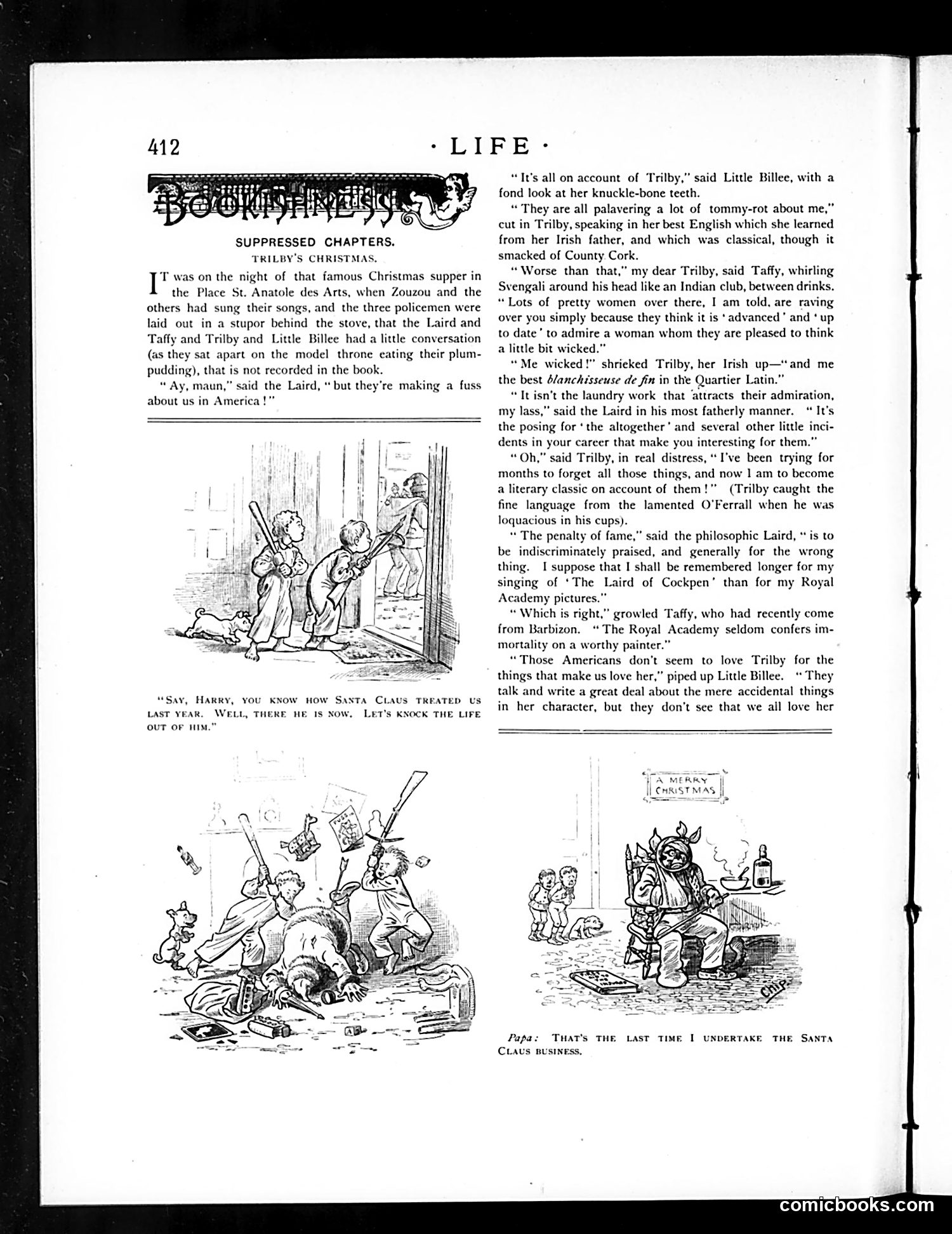
This page presents "Suppressed Chapters: Trilby's Christmas," a satirical story about the character Trilby from George du Maurier's popular novel. The narrative mocks literary pretension and artistic affectation through dialogue between Trilby and other characters (the Laird, Taffy). The satire targets: - **Artistic snobbery**: Characters debate whether being remembered for paintings or literary accomplishments matters more - **Social hypocrisy**: The critique that Americans praise accident-prone characters in fiction while denying such flaws in real people - **Irish stereotypes**: Trilby's Irish father is portrayed in exaggerated dialect The accompanying illustrations show domestic chaos—children wielding weapons, Santa Claus refusing future employment—visualizing the text's humorous critique of pretension versus reality. The joke relies on readers' familiarity with the *Trilby* novel and contemporary literary debates.
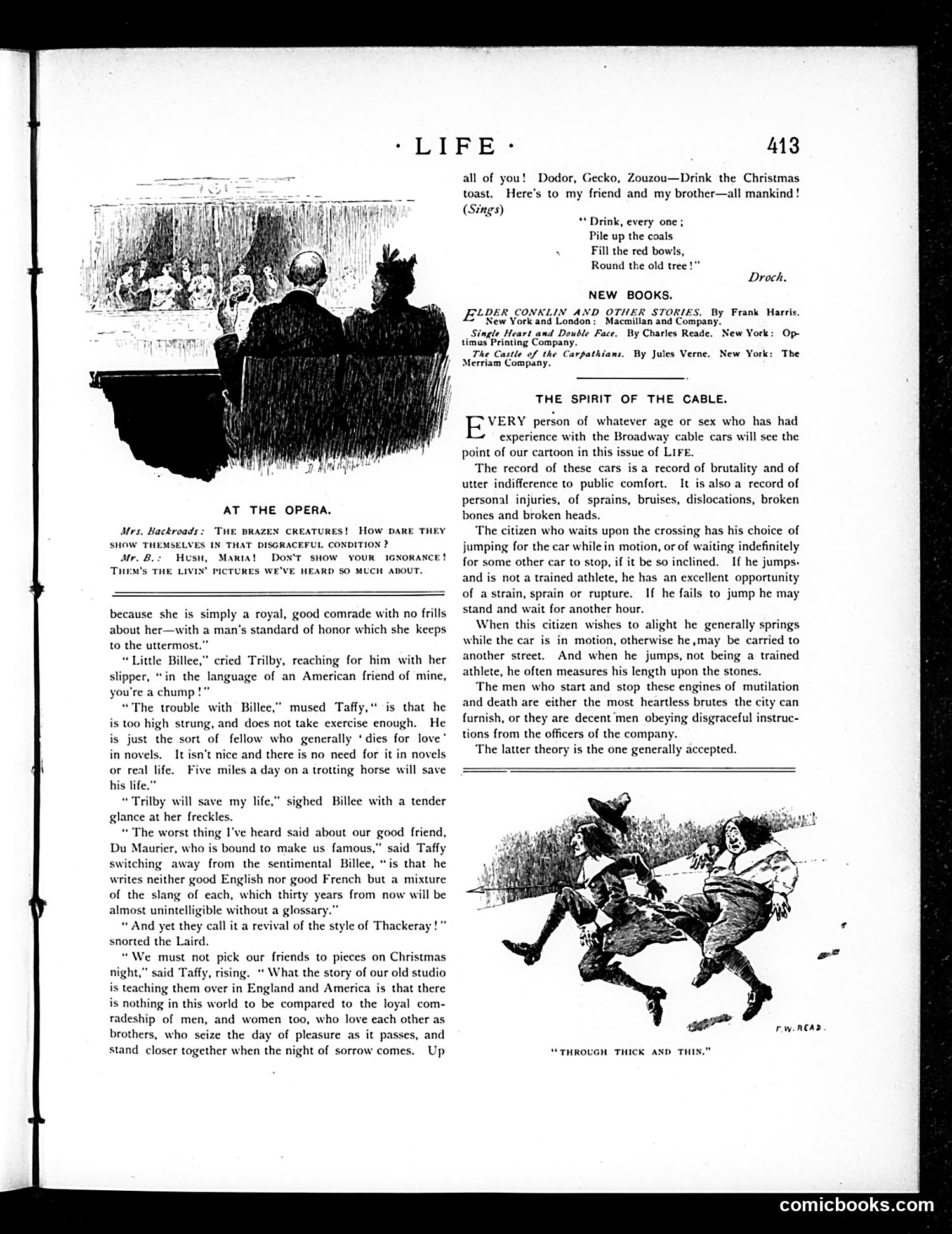
The cartoon depicts two well-dressed opera patrons viewing the performance. The dialogue satirizes theatrical pretension: Mrs. Backwoods criticizes the performers' "brazen creatures" and "disgraceful conditions," while Mr. D. responds with mock outrage about "ignorance" and "living pictures." The satire targets middle-class audience members who attend opera for social status rather than genuine appreciation—they're scandalized by the performance's content while simultaneously judging others. The joke is that such patrons' moral outrage reveals their own superficiality and snobbery. The accompanying text mocks similar theatrical affectations and includes commentary on Du Maurier (likely referencing the novelist George du Maurier) and English literary pretension, suggesting this is broader satire of Victorian/Edwardian cultural hypocrisy.
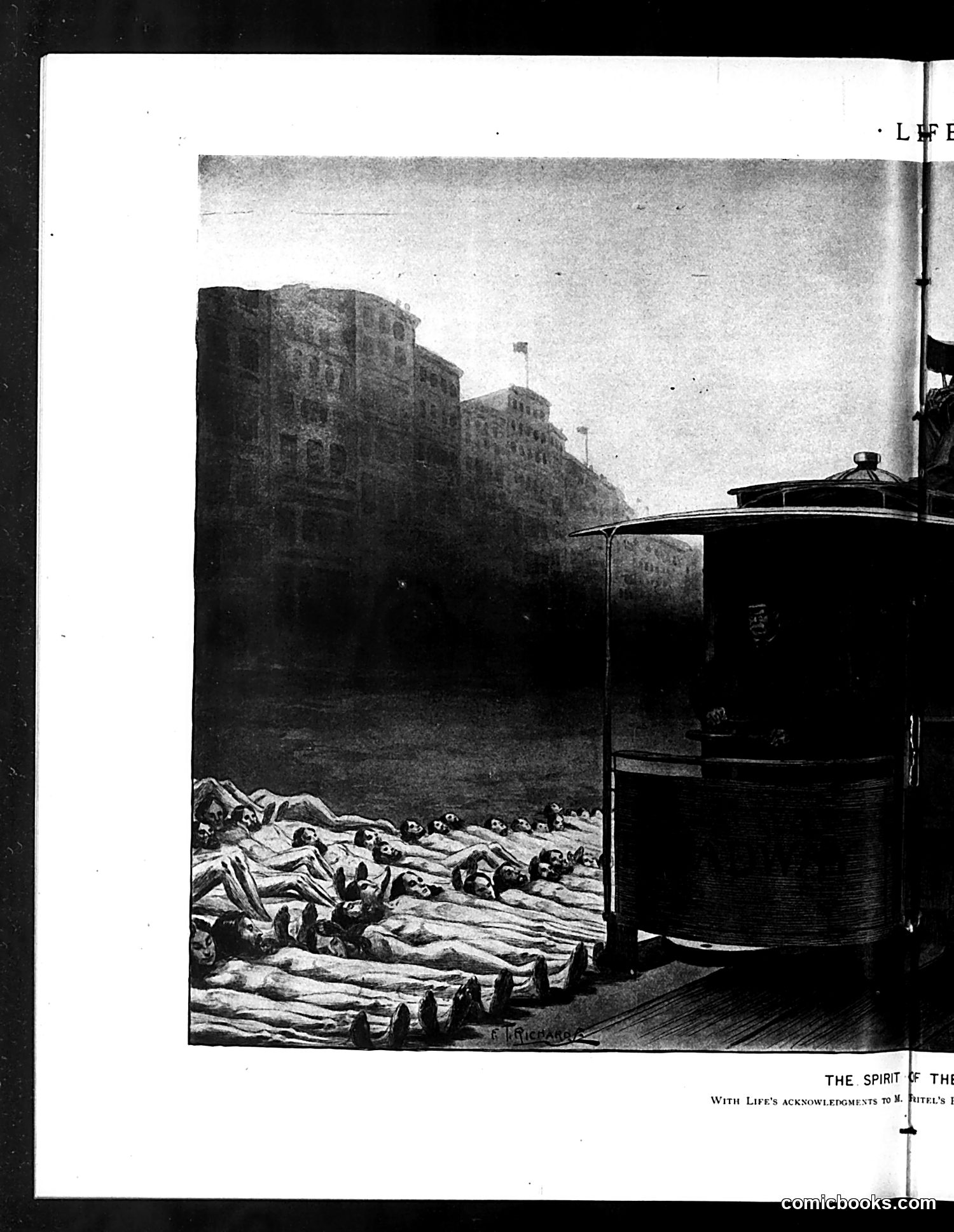
This is a deeply disturbing political cartoon depicting mass death. The image shows numerous corpses laid out on the ground near industrial buildings and what appears to be a large container or tank on the right side. The partial caption reads "THE SPIRIT OF TH[E]" with a reference to "Life's acknowledgments to M. Riffels [or similar]," but the complete text is cut off, making the full satirical point unclear. The stark black-and-white illustration appears to be commentary on industrial-scale death or atrocity—likely referencing a historical tragedy, war, or humanitarian disaster from early-to-mid 20th century America. Without the complete caption and publication date, I cannot definitively identify which specific event this satirizes.
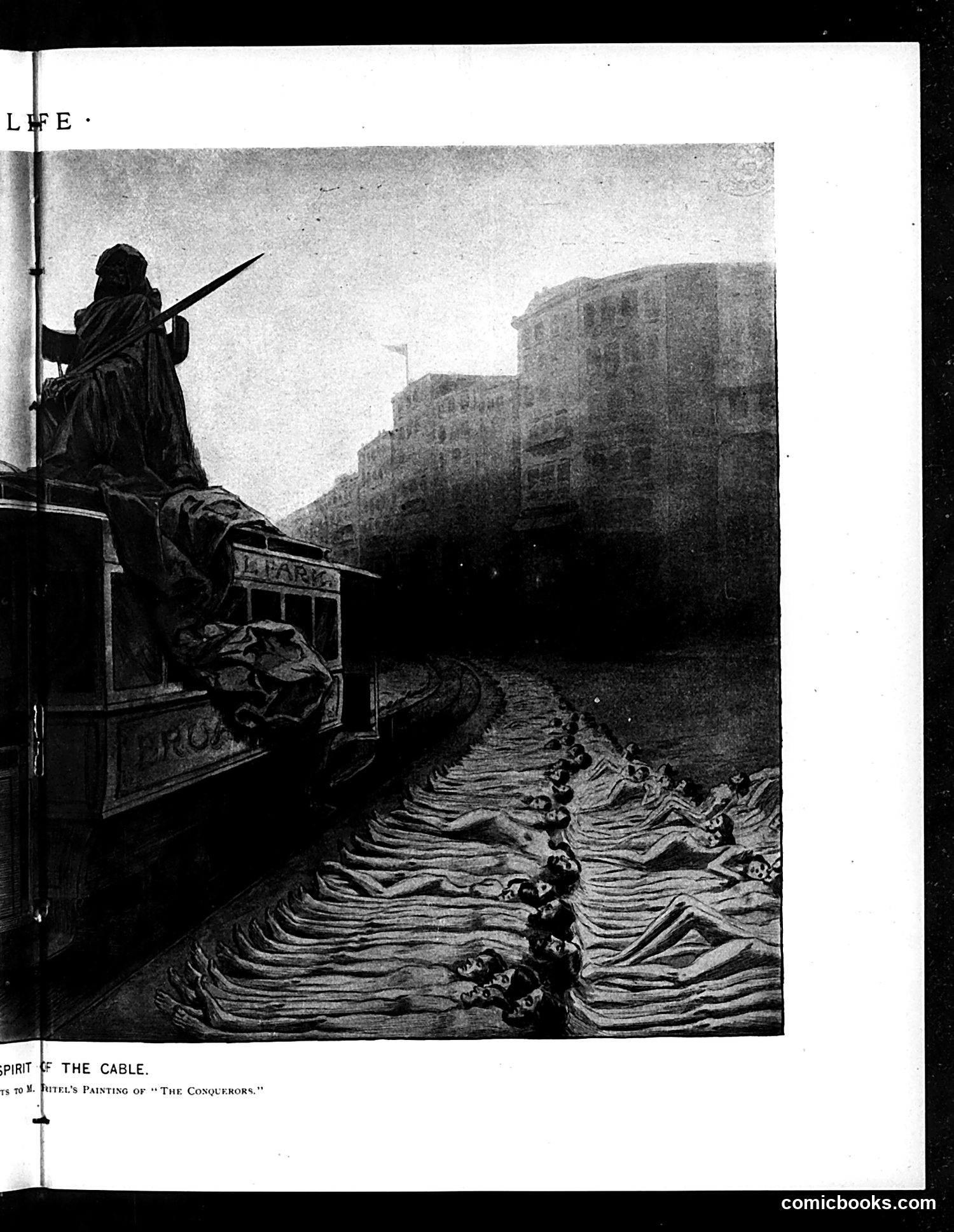
This appears to be a satirical illustration titled "Spirit of the Cable," described as relating to Hitler's painting "The Conquerors." The image shows a robed, skeletal Death figure wielding a spear, standing atop a vehicle marked "PARIS," overlooking rows of corpses in an urban landscape with buildings in the background. The satire equates Hitler's artistic vision of conquest with Death itself, suggesting his imperial ambitions lead only to mass casualties. The "cable" reference likely alludes to contemporary news reports about Nazi aggression. By invoking Hitler's own artwork, the cartoonist mocks the grandiose ideology behind Nazi expansionism, presenting its true consequence: death and destruction rather than glory. The imagery is deliberately grotesque and darkly propagandistic in nature.
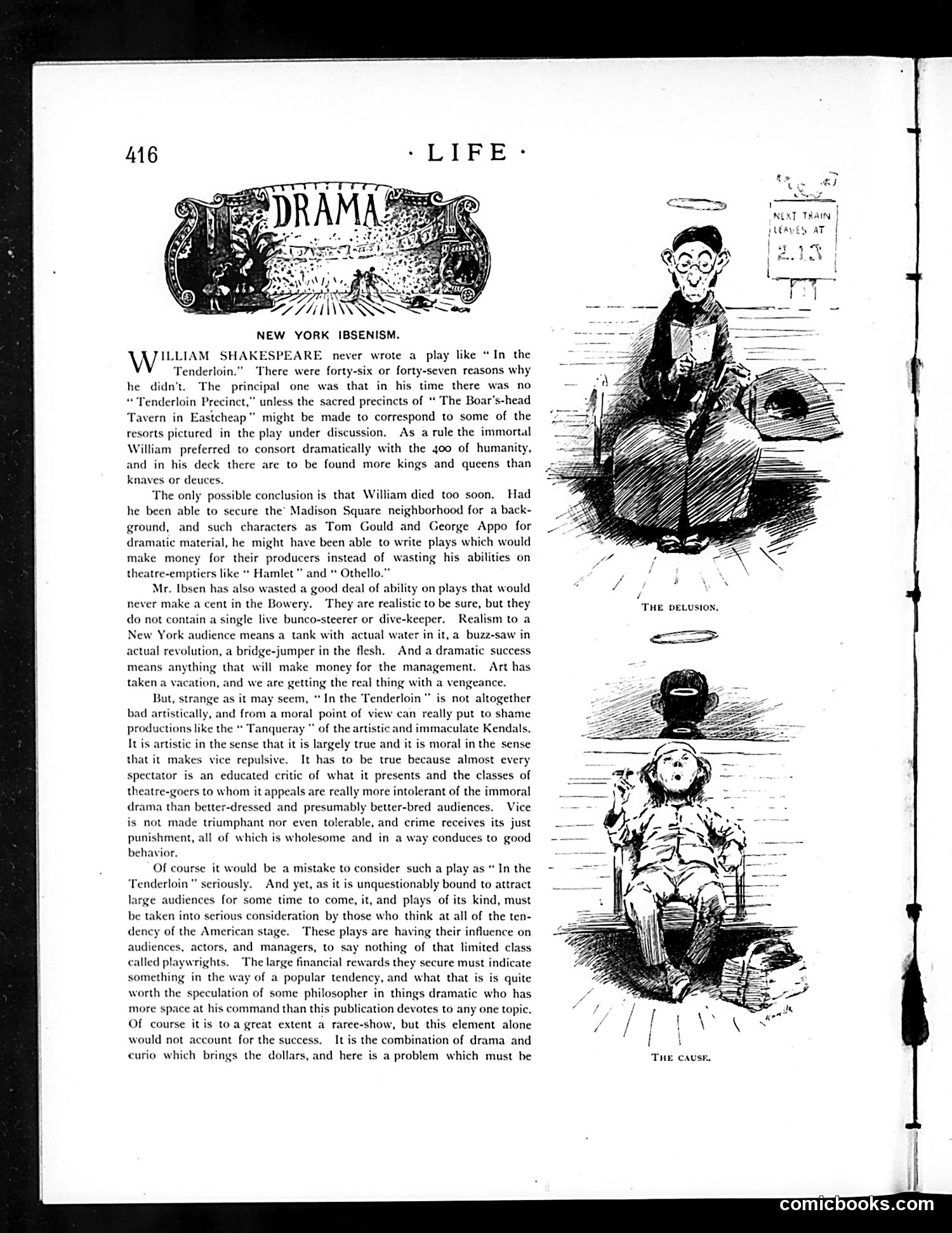
This page discusses William Shakespeare's play "In the Tenderloin," a New York-based dramatic work. The text criticizes Shakespeare for never writing a play set in the Tenderloin neighborhood—a real area of Manhattan known for vice and crime. The three accompanying sketches on the right appear to illustrate scenes from "In the Tenderloin," labeled "The Delusion," "The Cause," depicting what seem to be working-class or street characters typical of that neighborhood. The article argues that realistic New York drama should appeal to audiences seeking authentic depictions of city life rather than artificial theatrical conventions. The satire critiques both the play's artistic merit and its commercial viability, suggesting that realistic urban drama—combining spectacle with moral instruction—represents the future of American theater.
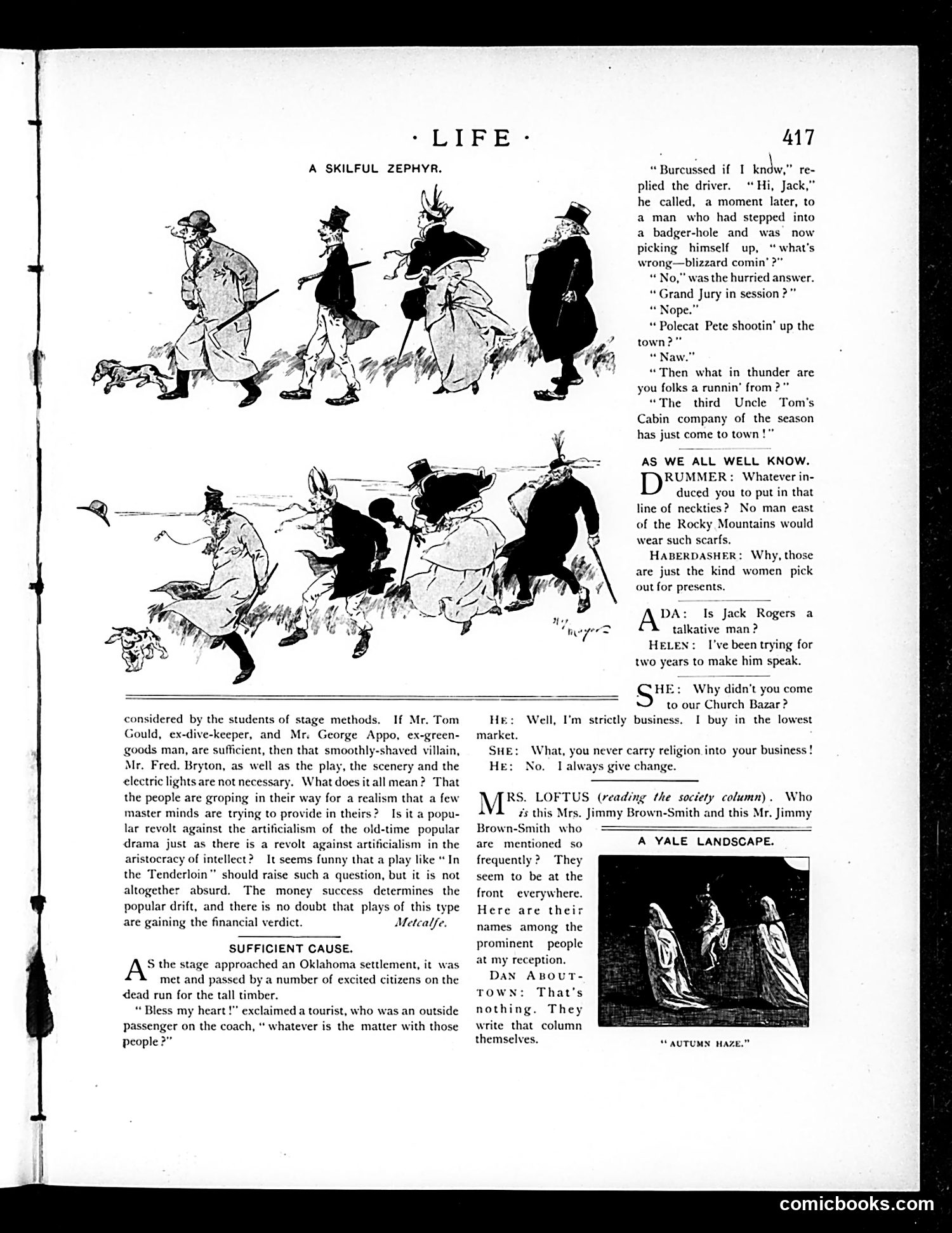
The top cartoon depicts four figures walking together in what appears to be a Western setting. The illustration is titled "A Skilful Zephyr" (zephyr meaning a gentle breeze or wind), suggesting these characters are being swept along or manipulated by some invisible force. The accompanying dialogue discusses various rural matters—a blizzard, grand jury sessions, and "Uncle Tom's Cabin company"—suggesting this satirizes how public opinion or political sentiment moves through small towns. The lower cartoon shows similar characters in animated poses, reinforcing the theme of manipulation or coordinated movement. Without clearer identification of specific historical figures or events referenced, the exact political target remains unclear, though it appears to critique how ideas or political movements spread through communities.
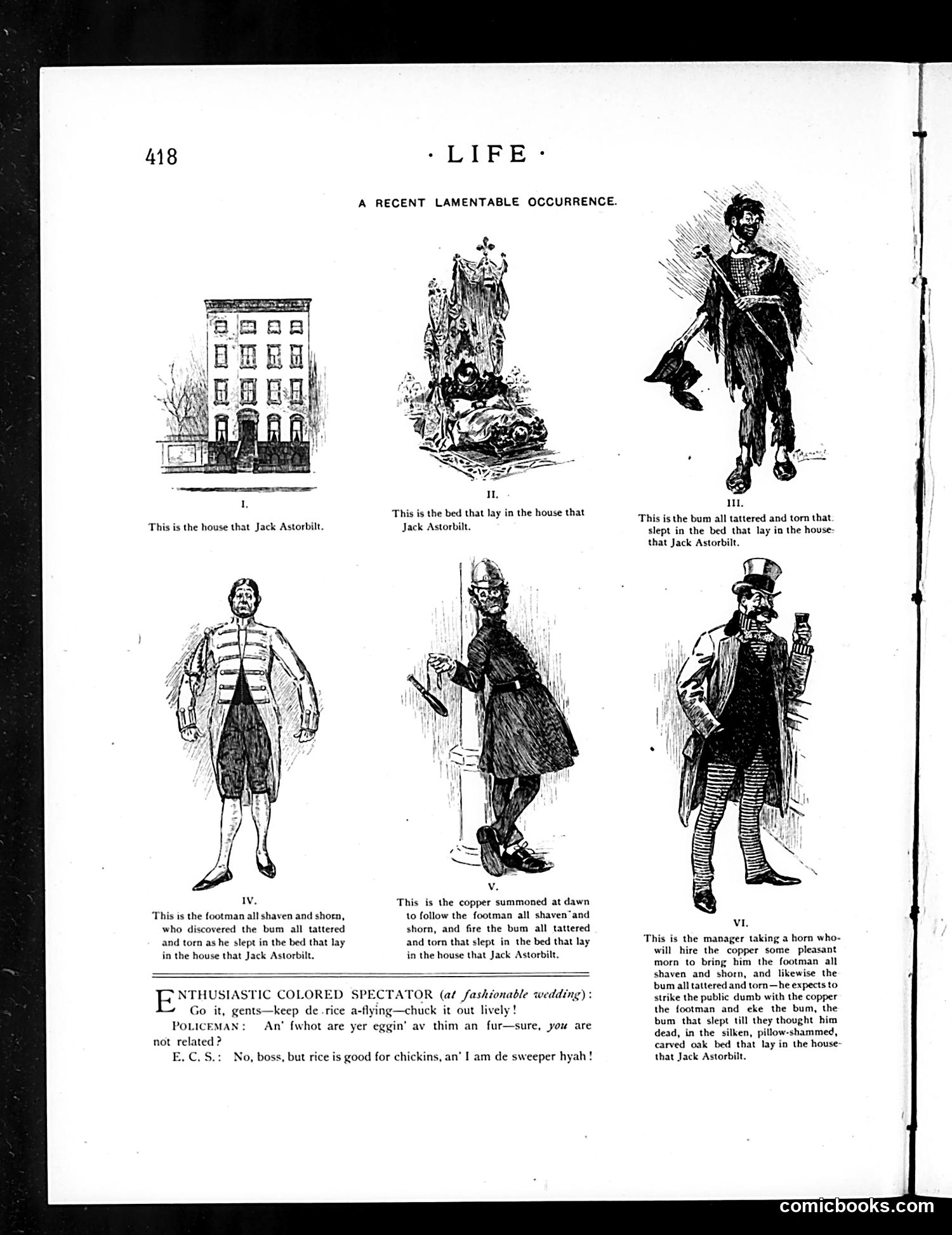
This page satirizes the wealthy Astor family (referenced as "Jack Astorbilt"—a pun on "Astor"). It's a mock-serious takeoff on the nursery rhyme "The House That Jack Built," depicting a comedic chain-of-command scenario involving a vagrant sleeping in a rich man's bed. The six illustrations show: the mansion, the bed, the ragged vagrant, the footman who discovered him, the police officer summoned, and the manager orchestrating a public spectacle from the incident. The satire mocks both the pretensions of wealthy industrialists and the sensationalism of urban news media—suggesting the manager will exploit this minor incident for publicity. The bottom dialogue fragment about a "fashionable wedding" appears to be unrelated content, possibly advertising or a separate piece. The humor targets Gilded Age excess and class divisions in early 1900s America.
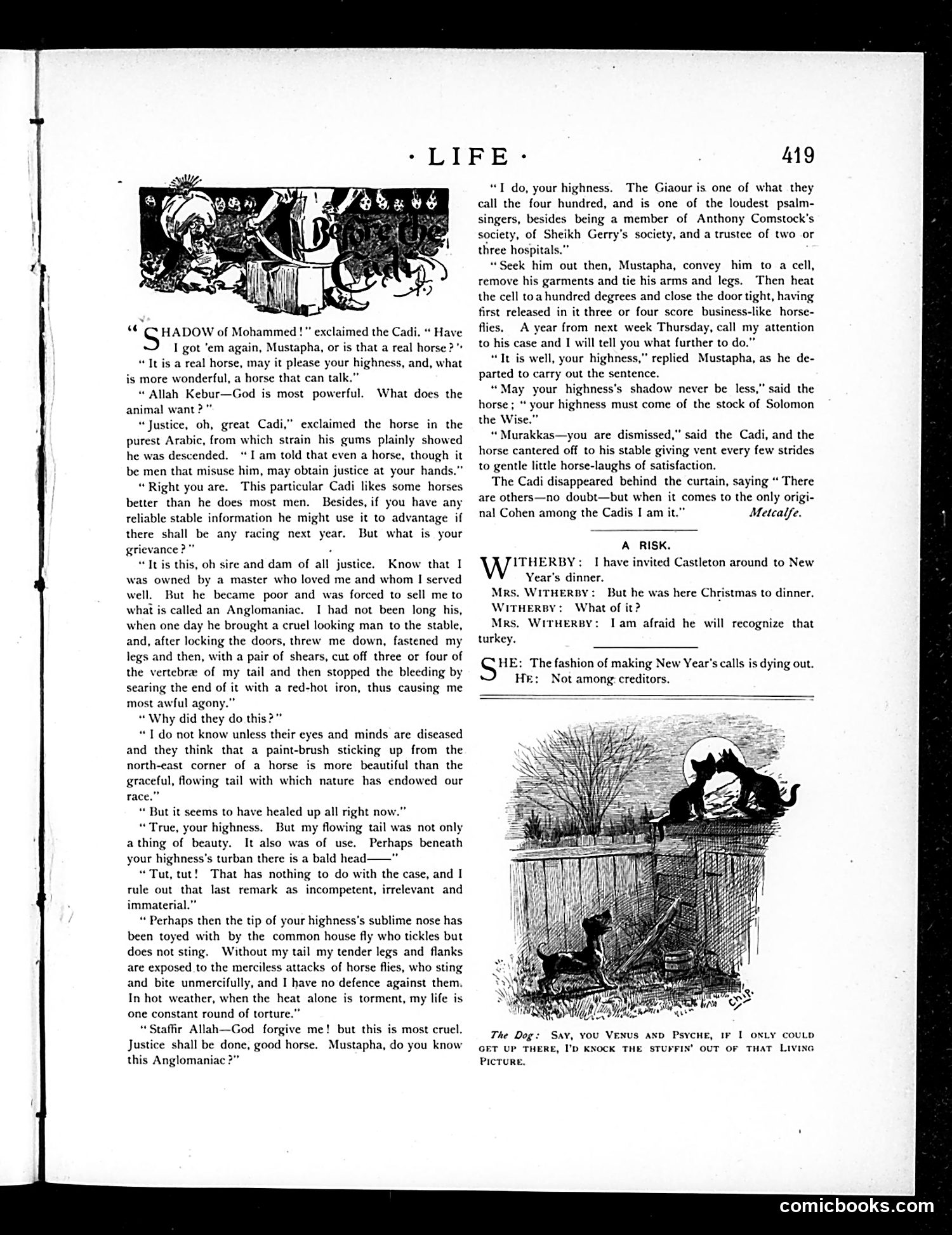
This is a satirical fantasy story where a talking horse brings a complaint to a Muslim judge (Cadi) against his wealthy owner, an "Anglomaniac" who docked the horse's tail for fashion. The satire targets **Victorian upper-class hypocrisy**. The offending owner is described as a member of "the four hundred" (high society), an Anthony Comstock society member (Comstock was a famous moral crusader), and a church trustee—yet he cruelly mutilates animals for aesthetics. The joke exposes the gap between public piety and private cruelty: respectable society condemns immorality while inflicting pointless suffering on animals. The Cadi's absurdly harsh punishment—locking the man in a hot cell with horse-flies—serves poetic justice. The story also pokes fun at fashion trends of docking horses' tails, which was actually practiced in the era but served no practical purpose beyond appearance.
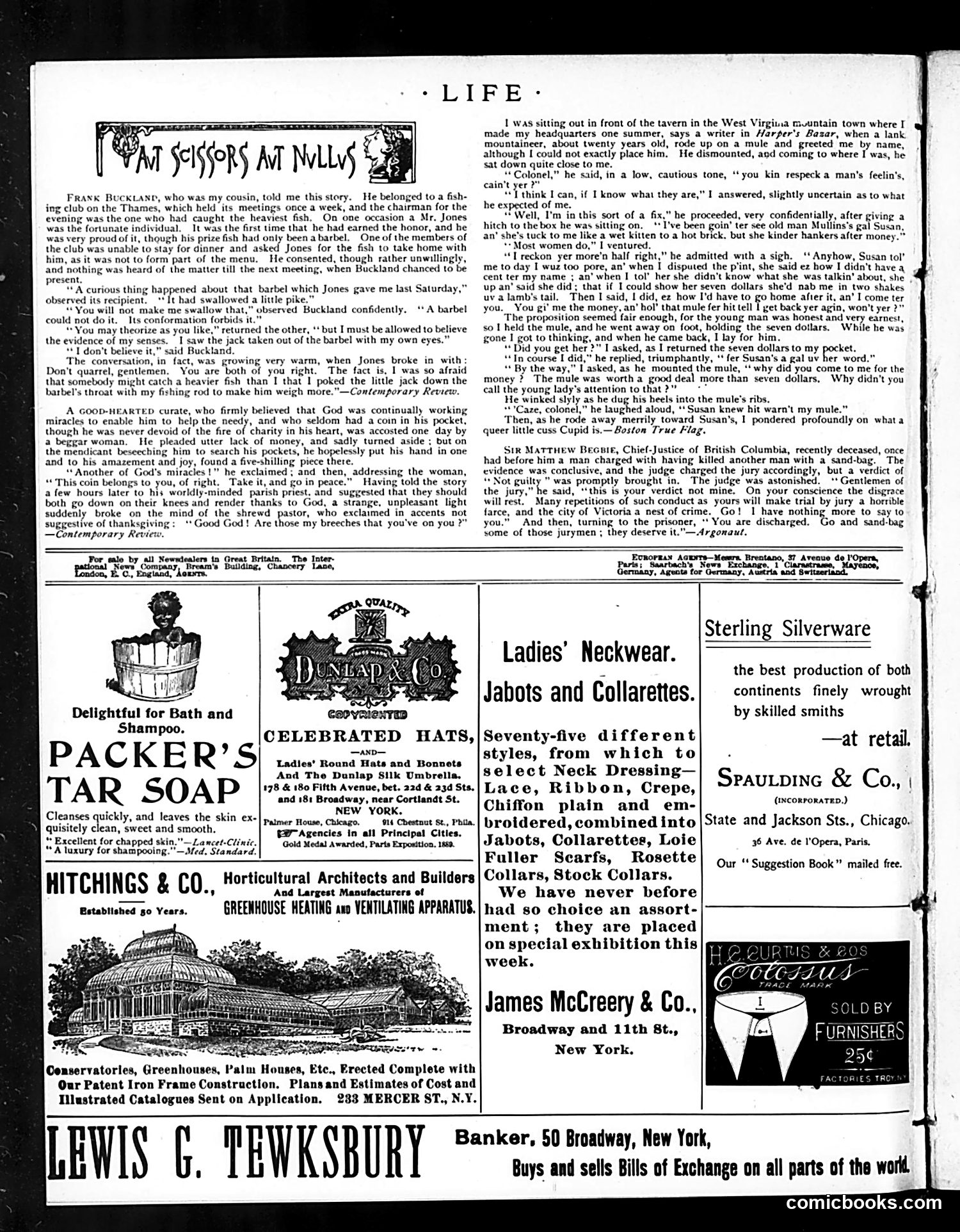
This page contains three humorous anecdotes rather than political cartoons: 1. **The Barbel Story**: A fishing club member cheats to win "heaviest fish" honor by secretly inserting a pike into a smaller barbel, then lies when caught—satirizing vanity and dishonesty masquerading as sportsmanship. 2. **The Curate's Miracle**: A naive, pious clergyman finds money in his pocket and attributes it to divine intervention, while his pragmatic priest realizes the money fell from the clergyman's own borrowed breeches—mocking religious credulity versus worldly skepticism. 3. **The Mountain Romance** (partially visible): A young, poor mountaineer seeks advice about a girl (Susan) who wants money—appearing to set up satire about rural poverty and romance, though the ending is cut off. The page uses these stories to gently mock human nature: self-deception, hypocrisy, and the gap between appearances and reality. The surrounding advertisements are period products (tar soap, hats, silverware).
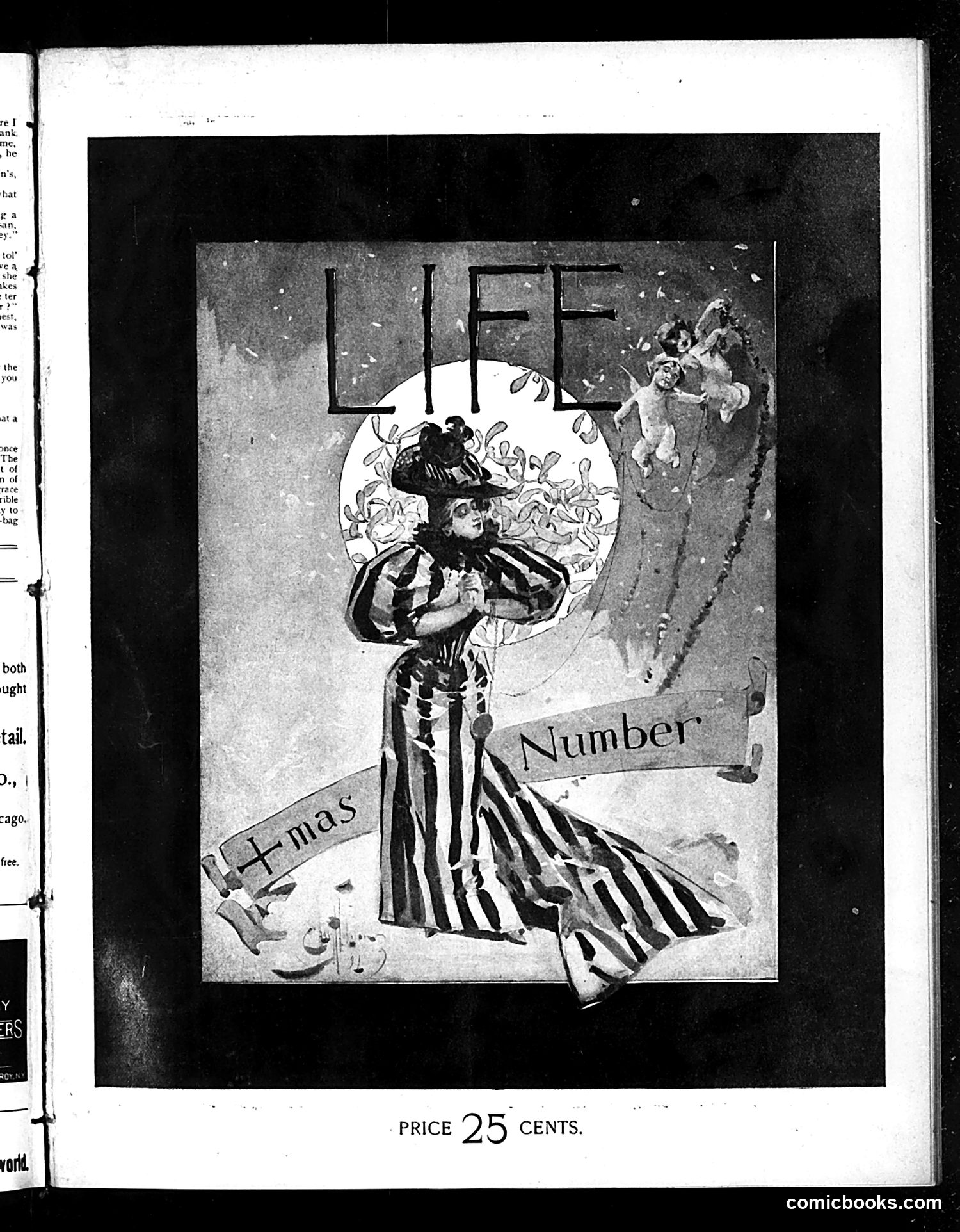
This is a **Life magazine Christmas Number cover** (price 25 cents), featuring a stylized female figure in striped clothing holding what appears to be a large circular object with decorative elements. The word "LIFE" appears prominently at the top, with "Christmas Number" labeled on a banner. The cover uses allegorical imagery typical of early 20th-century satirical magazines. The striped garment and decorative styling suggest this represents either Lady Liberty or a personification of the Christmas season itself. The circular element behind the figure may reference themes of prosperity, commerce, or seasonal celebration. Without additional text or clearer identifying marks, the specific satirical point remains unclear, though the imagery suggests commentary on American consumer culture during the holiday season.

I can see this is a mostly blank page from what appears to be a Life magazine archive (indicated by "comicbooks.com" at the bottom), but the image is too dark and lacks sufficient visible content for me to identify any cartoon figures, text, or satirical commentary. The page appears to be either largely empty, heavily aged/degraded, or improperly scanned. Without clear visual elements or legible OCR text to reference, I cannot reliably explain what political or social satire this page contains. A clearer or higher-contrast image would be needed to provide accurate analysis.
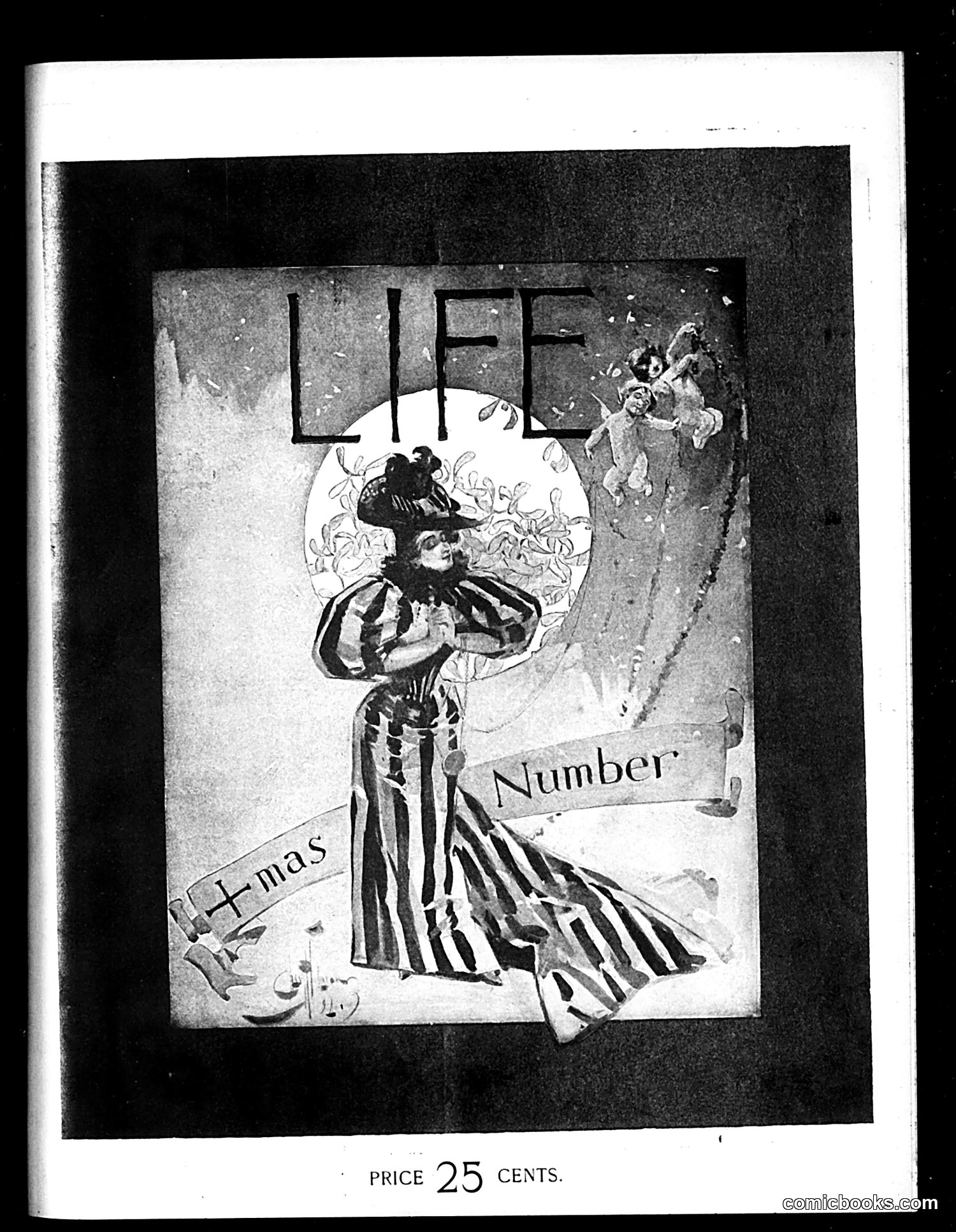
This is a Life magazine cover for a "Christmas Number" issue, priced at 25 cents. The illustration depicts an elegantly dressed woman in an ornate striped gown and feathered hat, posed against a decorative circular backdrop with cherubs. She holds a banner reading "Christmas Number." The satire likely mocks the commercialization of Christmas and high fashion's extravagance during the holiday season. The woman's elaborate, expensive clothing contrasts with Christmas's spiritual themes—a common target of Life's satirical commentary on American consumer culture and social pretension in the early 20th century. The cherubs suggest religious irony: the juxtaposition of sacred imagery with materialistic display.
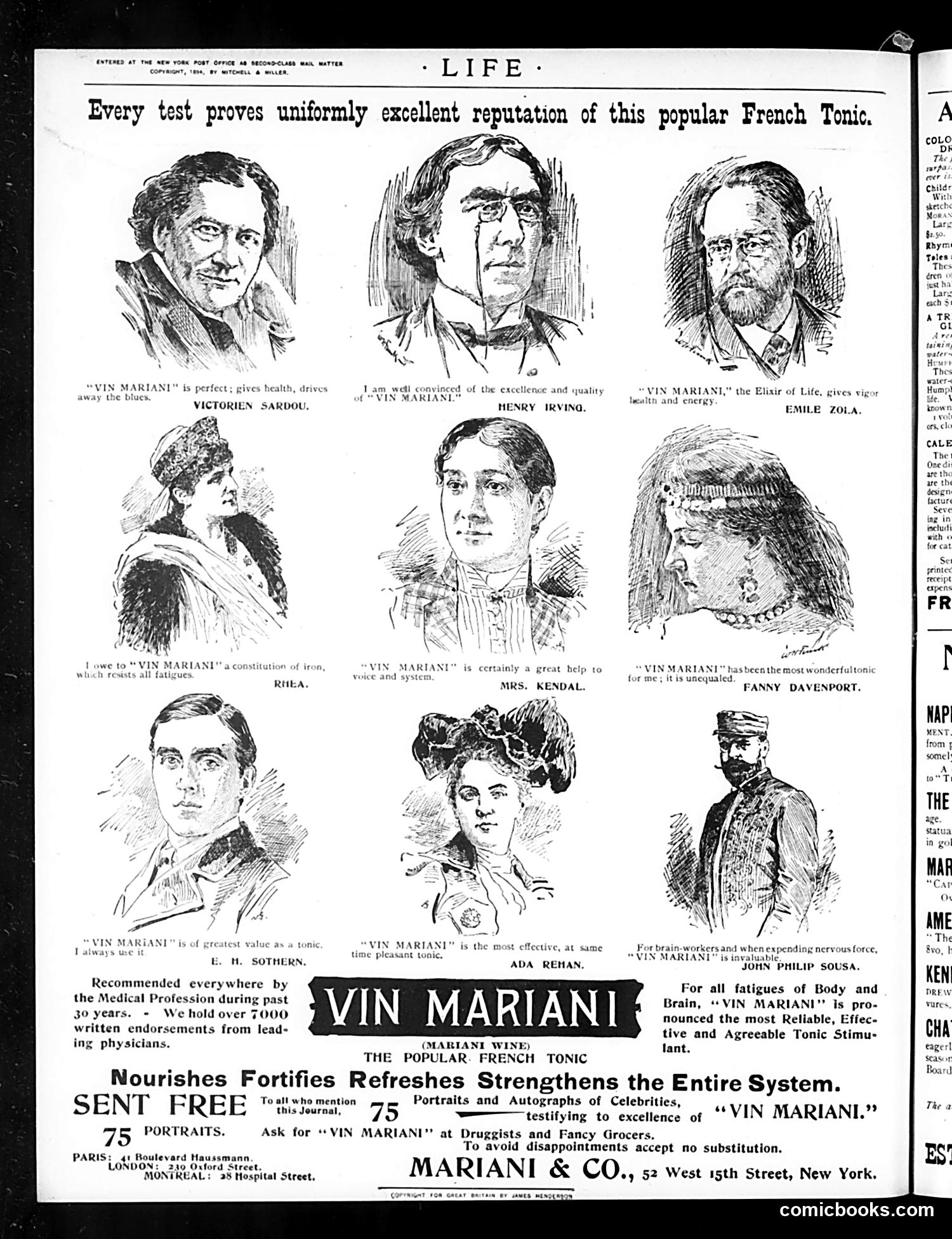
This is not satire—it's a straightforward advertisement for Vin Mariani, a French medicinal wine tonic. The page features nine portrait sketches of celebrated figures (actors Henry Irving and E.H. Sothern, writer Emile Zola, soprano Fanny Davenport, and others) providing testimonials endorsing the product's health benefits. The ad claims the tonic cures fatigue, strengthens the nervous system, and aids digestion. It boasts over 7,000 physician endorsements and offers 75 free celebrity portraits to buyers. While modern readers recognize this as patent medicine marketing (Vin Mariani historically contained cocaine), the ad presents itself as legitimate medical endorsement. The prominent placement in *Life* magazine indicates such advertisements were standard editorial content in early 20th-century publications, before regulatory restrictions on medicinal claims.
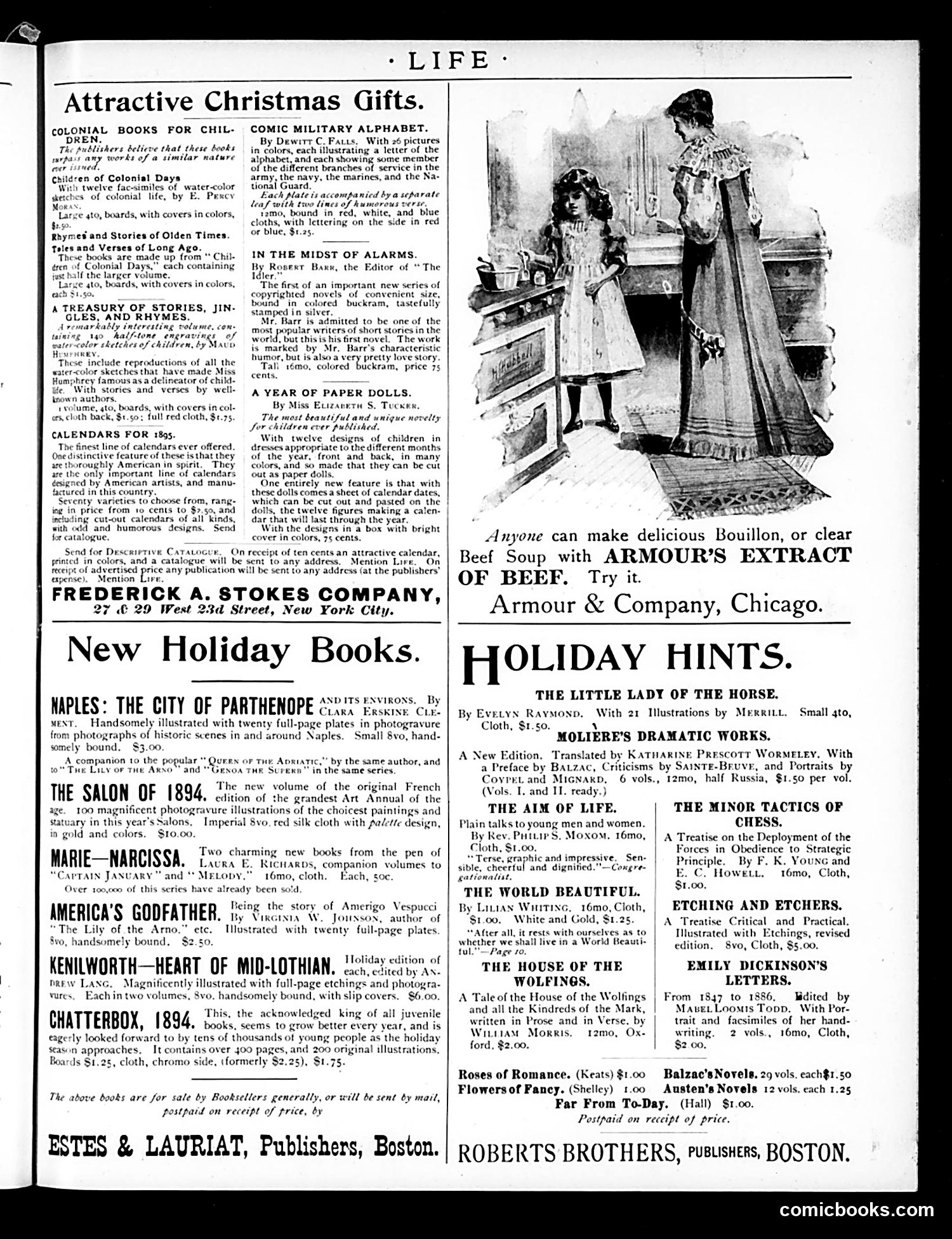
This page is primarily a **book and product advertisement section**, not a political cartoon. The visual content shows a Victorian-era woman displaying what appears to be gift items or merchandise, illustrating the "Attractive Christmas Gifts" heading. This is an ad layout common to *Life* magazine. The text advertises holiday books for 1895, including children's titles (*Colonial Books for Children*, *A Year of Paper Dolls*), military-themed humor (*Comic Military Alphabet*), and adult novels. There's also an **Armour's Extract of Beef** advertisement promising that "Anyone can make delicious Bouillon, or clear Beef Soup" using their product. **No political satire or cartoon commentary is present.** This is a straightforward commercial page—typical of *Life's* mixed content format blending editorial material with advertising. The page reflects 1890s consumer culture and gift-giving traditions rather than social or political commentary.
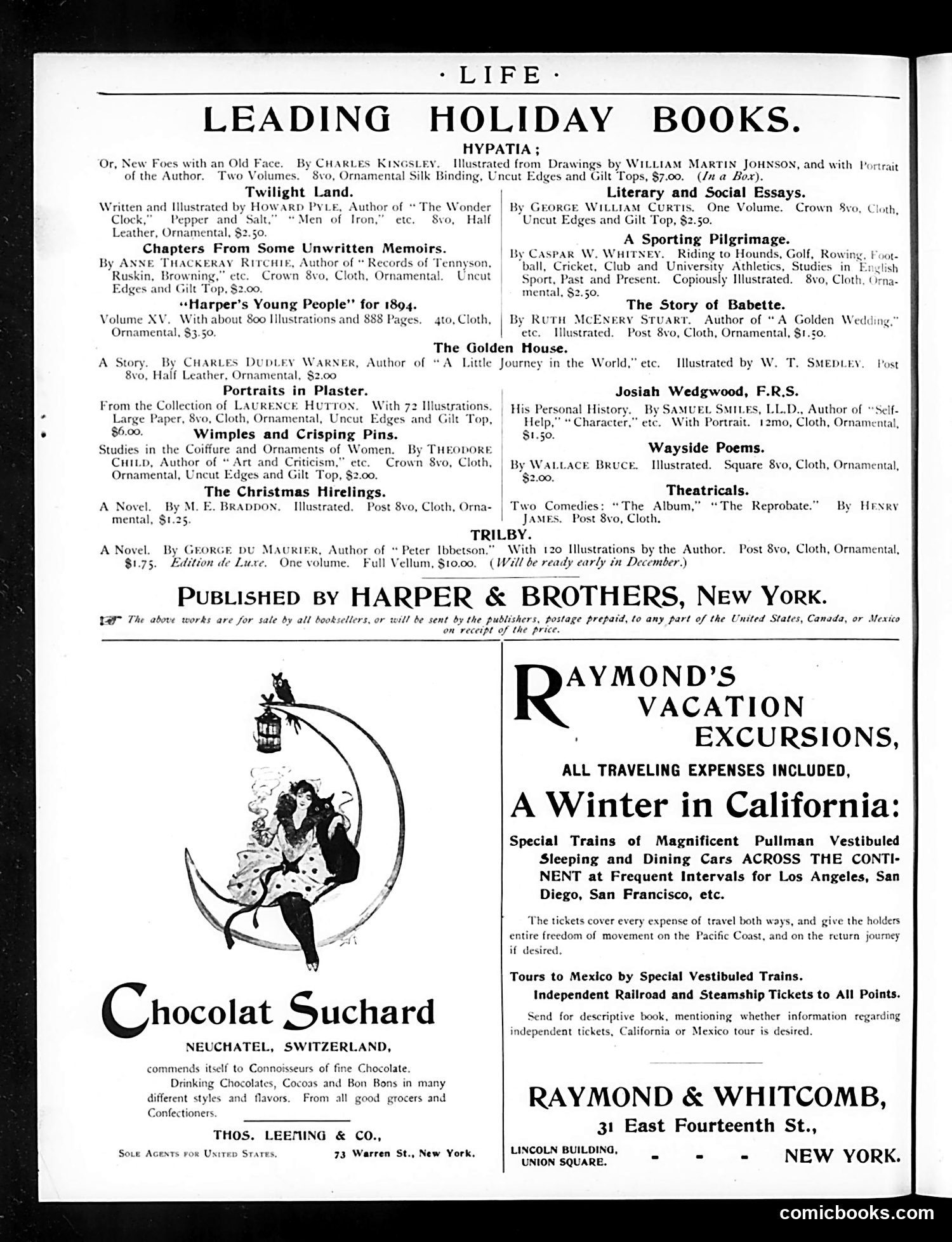
This is primarily an **advertising and book catalog page** from Life magazine, not a satirical cartoon page. The upper section lists holiday books published by Harper & Brothers (1894), featuring literary works by notable authors like Charles Kingsley, Howard Pyle, and George du Maurier. These were premium gift books for the wealthy—expensive, ornately bound volumes priced $1.25–$10.00. The lower half contains advertisements: **Chocolat Suchard** (Swiss chocolate confectionery) and **Raymond's Vacation Excursions** (all-inclusive California winter tours via Pullman trains). The single **illustration** shows a woman on a crescent moon with a lantern—likely decorative holiday imagery unrelated to specific satire. The heading "DUPE" at the very top is unclear without full context; it may be a page marker or section title. This page reflects **Gilded Age consumer culture**: expensive imported goods, leisure travel, and luxury publishing for affluent American readers. No political satire or comic commentary is evident.
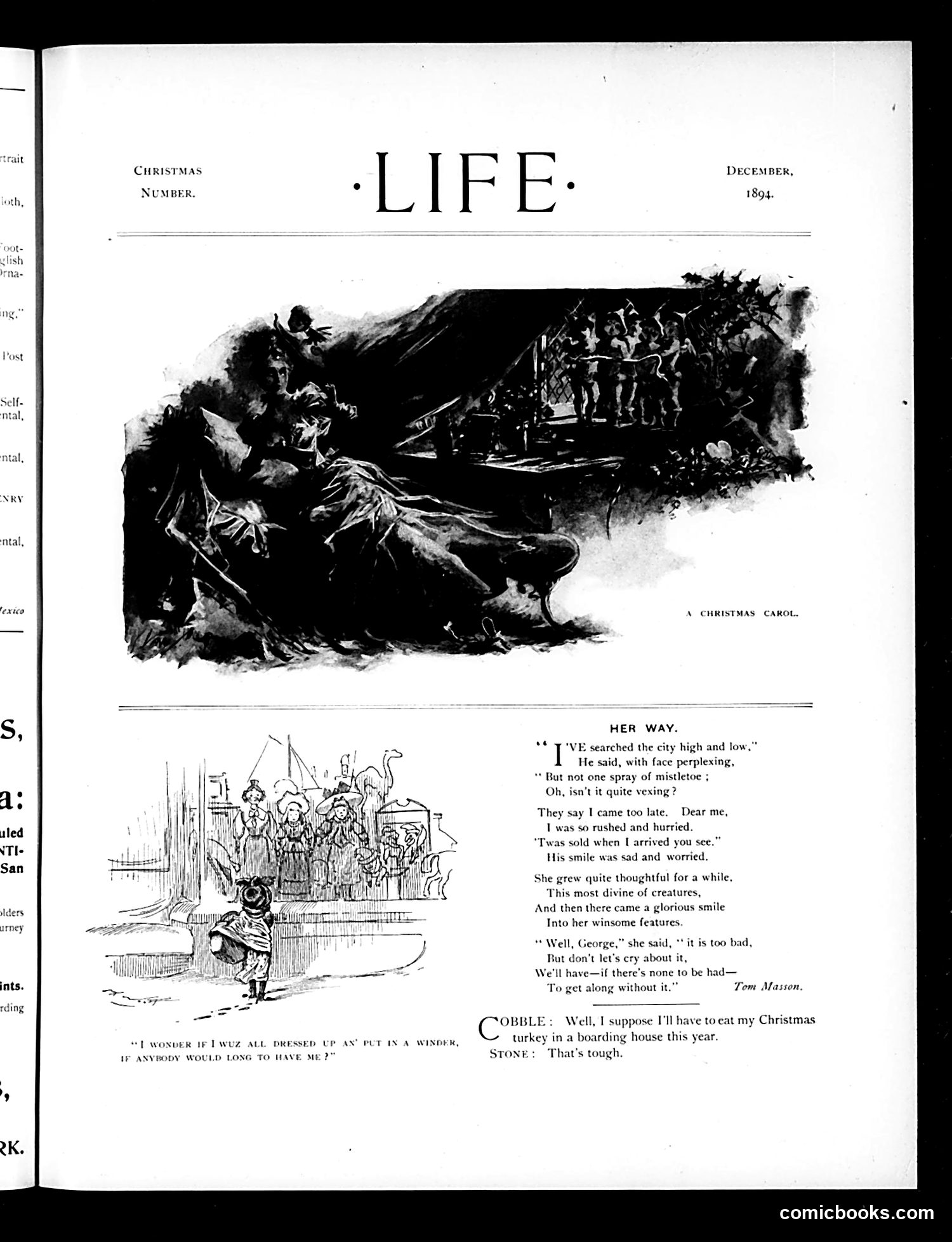
This page contains Christmas-themed humor typical of 1890s satirical magazines. The top illustration appears to reference Dickens's *A Christmas Carol*, showing a ghostly or supernatural scene with figures and a nighttime setting. Below is a poem titled "Her Way" (by Tom Masson) depicting a romantic dialogue between George and a woman. George has searched unsuccessfully for mistletoe to hang—a crucial Christmas tradition for romantic kissing. Rather than expressing disappointment, the woman gracefully suggests they proceed without it, demonstrating good humor and practicality. The bottom dialogue between "Cobble" and "Stone" presents a working-class Christmas scenario: someone must eat turkey in a boarding house rather than at home with family—implying loneliness and economic hardship during the holiday season. The overall theme contrasts genteel romance with working-class struggle, typical of Life's satirical commentary on American society.
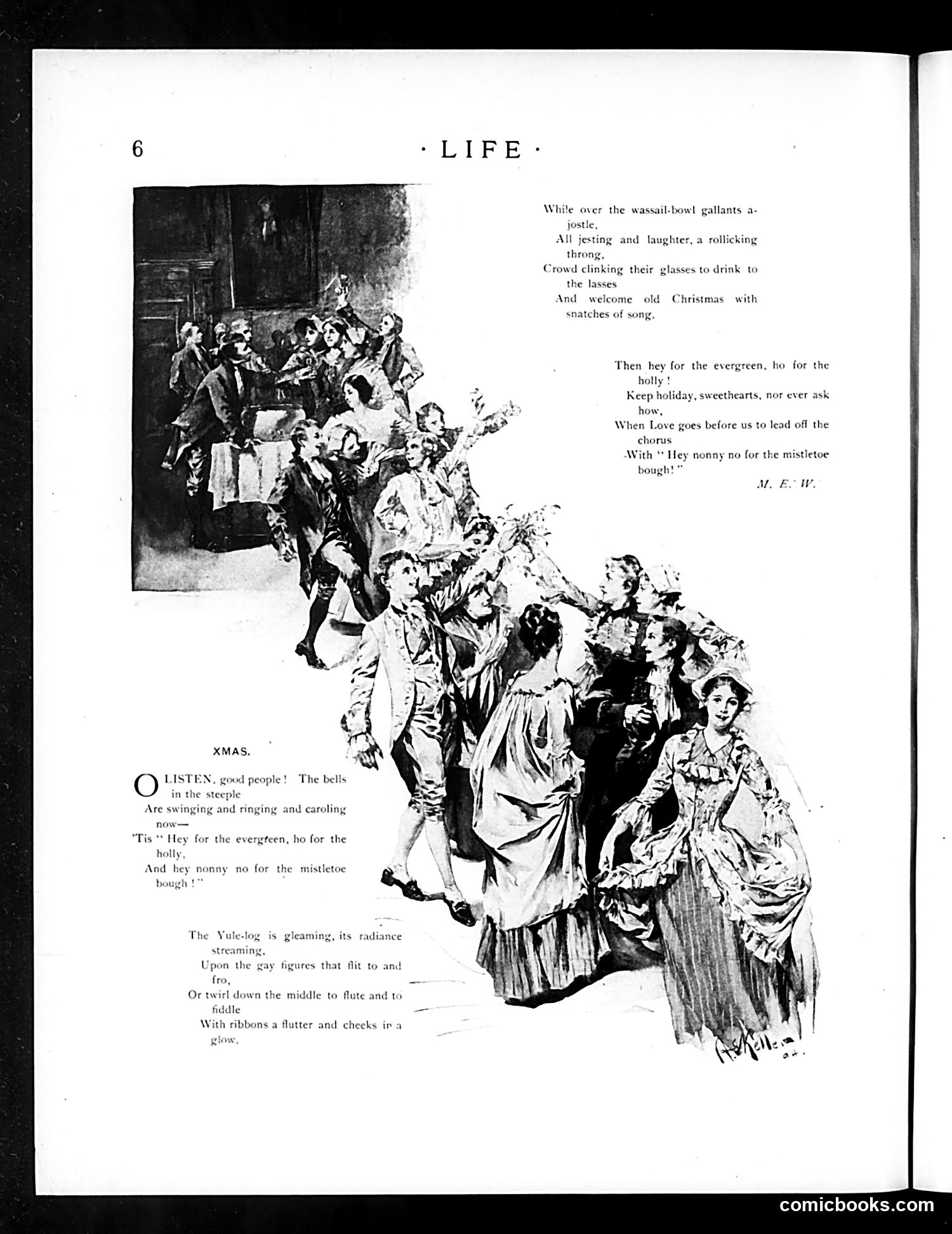
This is a festive Christmas illustration with accompanying poetry rather than political satire. The page depicts Victorian-era holiday celebrations featuring carolers and revelers in period dress. The imagery shows two scenes: an upper vignette of people gathered indoors around a wassail bowl (spiced wine), and a larger illustration below of Christmas carolers outdoors, including women in flowing dresses and men in formal attire, appearing joyful and energetic. The text is purely celebratory verse about Christmas traditions—bells ringing, mistletoe, evergreens, holly, dancing, and caroling. References like "wassail-bowl" and "Yule-log" invoke traditional English Christmas customs. The byline "M.E.W." indicates the author/illustrator. There is no political commentary or social satire present—this is simply sentimental, nostalgic Christmas entertainment typical of Life magazine's lighter editorial content during the holiday season.
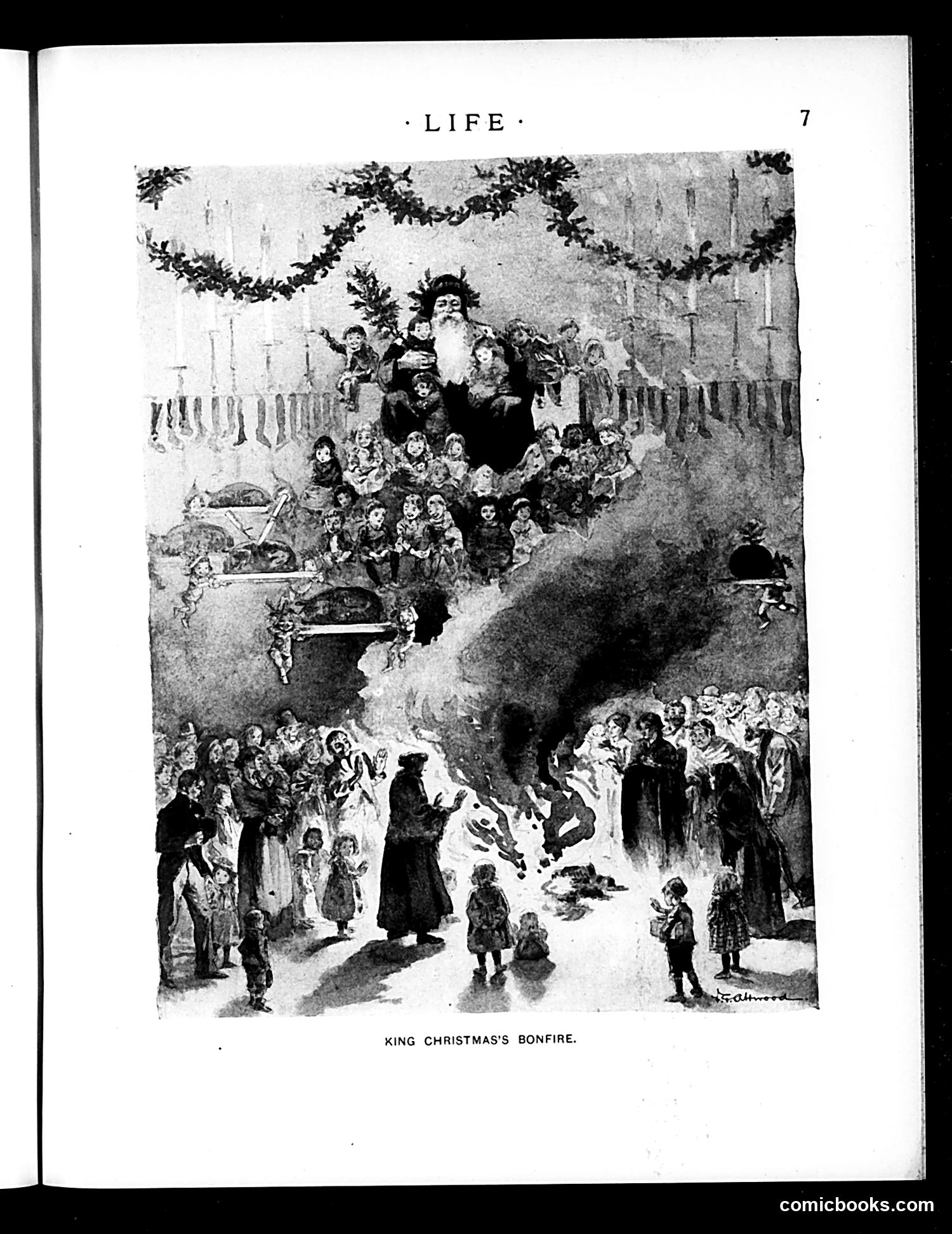
This illustration depicts a fantastical Christmas scene titled "King Christmas's Bonfire." A large, bearded figure resembling Santa Claus or Father Christmas sits enthroned above a bonfire, surrounded by numerous children and spectators. The scene appears celebratory, with evergreen garland decorating the upper portion and candles lining the background walls, suggesting an indoor castle or grand hall setting. The image represents a whimsical, idealized Christmas celebration centered on a paternal, benevolent "King Christmas" figure presiding over children's joy and festive merriment. The bonfire likely symbolizes warmth, gathering, and holiday spirit. Without additional context or OCR text beyond the title, the specific satirical intent remains unclear, though it may reference holiday traditions, charitable giving to children, or contemporary Christmas customs of the era.
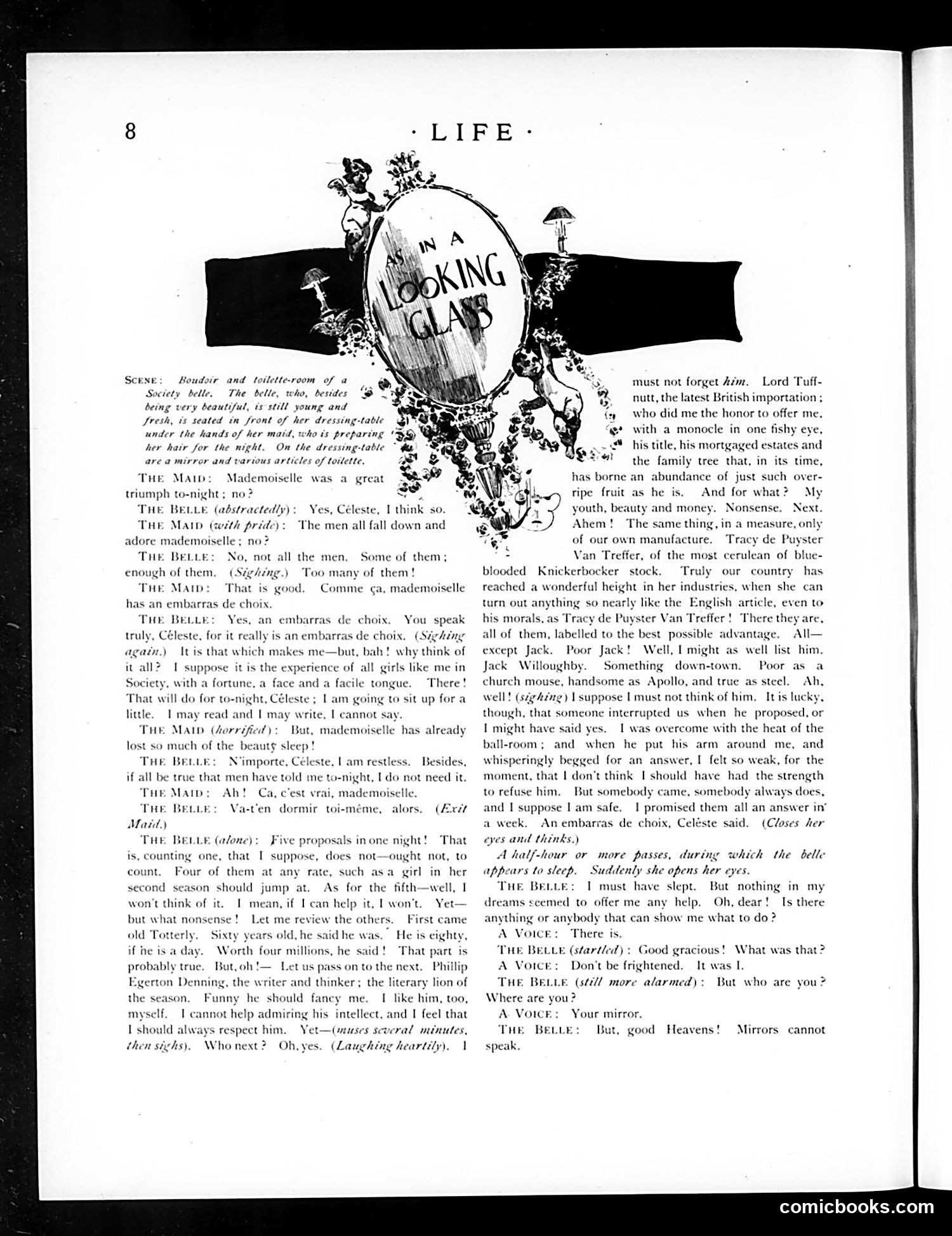
This is a dramatic monologue—not a political cartoon—depicting a wealthy young Society woman reviewing five marriage proposals received in a single evening. The satire targets the mercenary nature of upper-class courtship. The Belle dismisses each suitor's claims: an elderly British lord (Lord Tuffnutt) with a worthless title and mortgaged estates; a wealthy American aristocrat (Tracy de Puyster Van Treffer) who is merely a domestic knockoff of the English import; and Phillip Egerton Denning, a celebrated writer she admires intellectually but rejects. She seriously considers Jack Willoughby—poor, honest, handsome—but avoids committing when interrupted. The satire's point: wealthy young women are courted not for themselves but as prizes, judged by men's titles, money, and appearance. The Belle's "embarrass de choix" (embarrassment of riches) masks a hollow existence where even genuine feeling must be suppressed by social calculation. The mirror in the title suggests vanity and self-reflection, but finds only shallow surfaces.
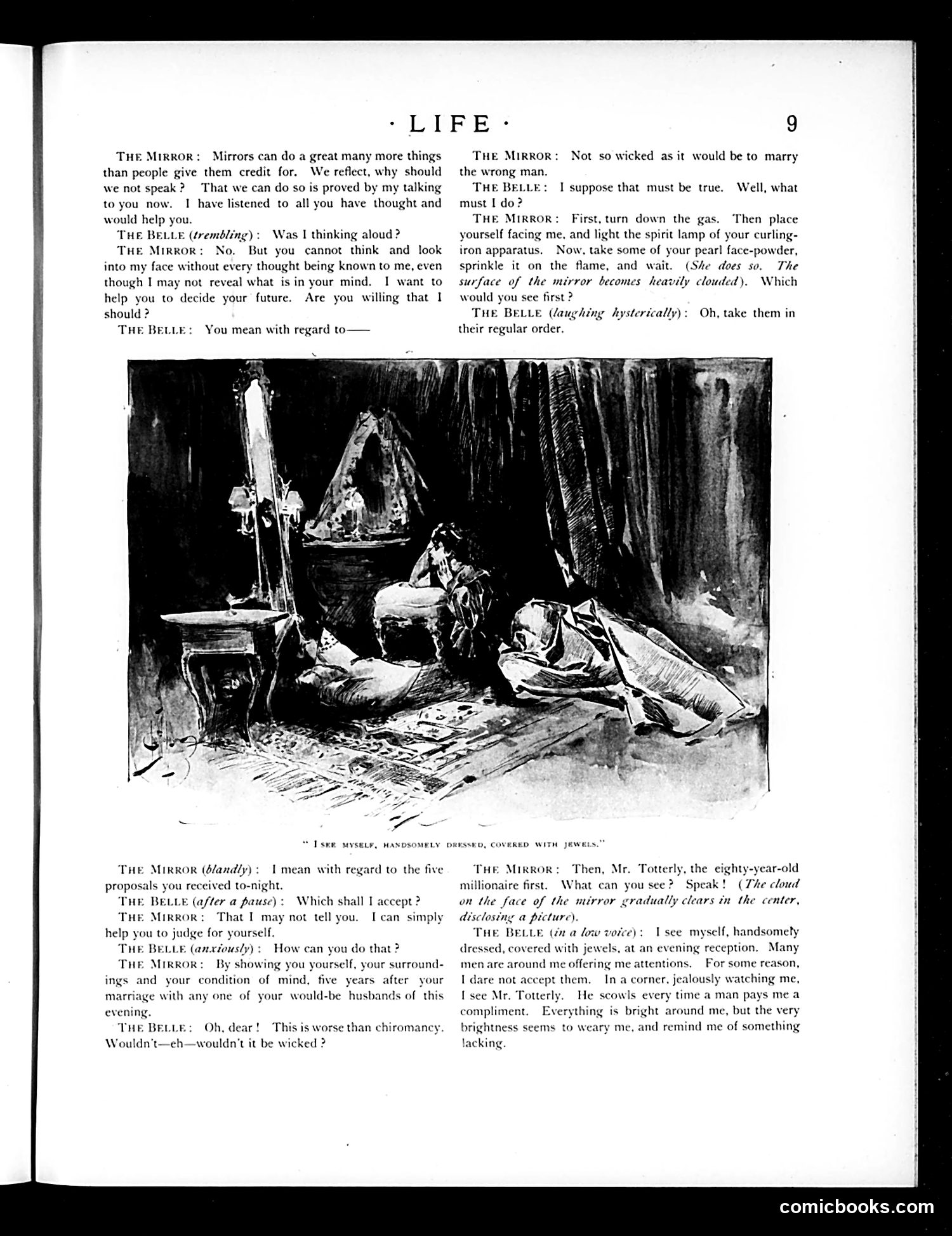
This is a dialogue-driven satirical piece featuring a young woman (identified as "The Belle") consulting a magical mirror about which of five marriage proposals to accept. The mirror claims it can show her future outcomes by using a conjuring trick—turning down gas light, burning powder on a spirit lamp to cloud the mirror's surface, then "revealing" visions. The satire targets romantic delusion and materialism. When the mirror shows her married to "Mr. Totterly, the eighty-year-old millionaire," she imagines herself surrounded by jewels and male admirers—yet feels inexplicably empty and weary despite material abundance. The joke: a wealthy but joyless marriage exposes the hollowness of marrying for money. The mirror itself is a con artist, using stage magic while pretending supernatural insight, mocking both fortune-telling charlatans and women who seek external guidance for intimate decisions. The Belle's willingness to trust this theatrical deception satirizes women's perceived gullibility about romance and finance.
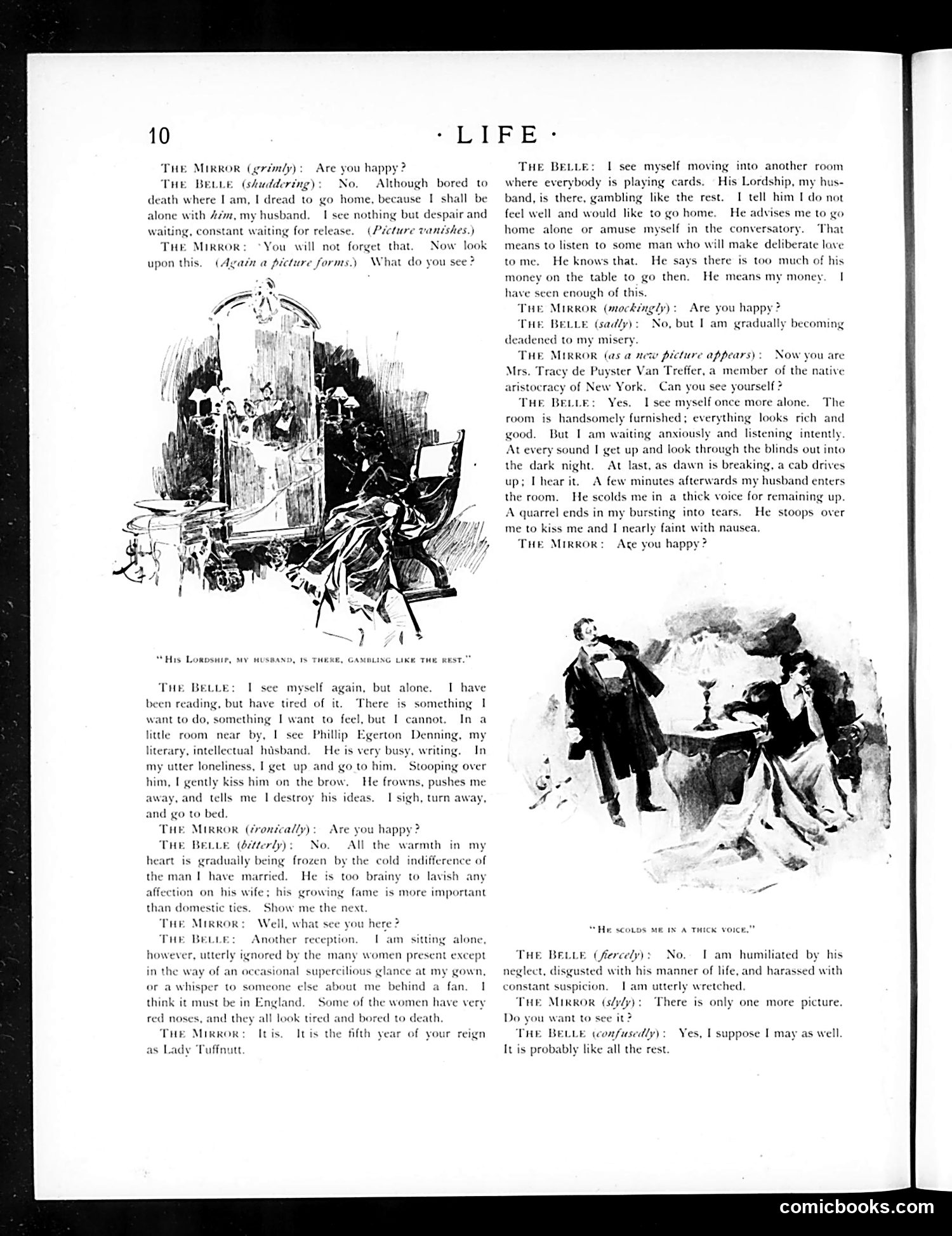
This page presents a dialogue between "The Belle" and "The Mirror"—a magical device showing visions of the woman's married life. The satire depicts the progressive unhappiness of an upper-class woman (identified as Mrs. Tracy de Puyster Van Treffer, "native aristocracy of New York") across five years of marriage. Each vision reveals a different marital complaint: her husband's emotional coldness, his absorption in gambling and his career over domestic affection, her social humiliation at gatherings, and his drunken suspicion. The repeated question "Are you happy?" becomes darkly ironic as she grows progressively more miserable. The satire critiques both the constraints of marriage for women of this era and the indifference of intellectual or ambitious husbands toward their wives' emotional needs. The illustrations emphasize her isolation and despair, making this a commentary on the gap between romantic expectation and marital reality in high society.
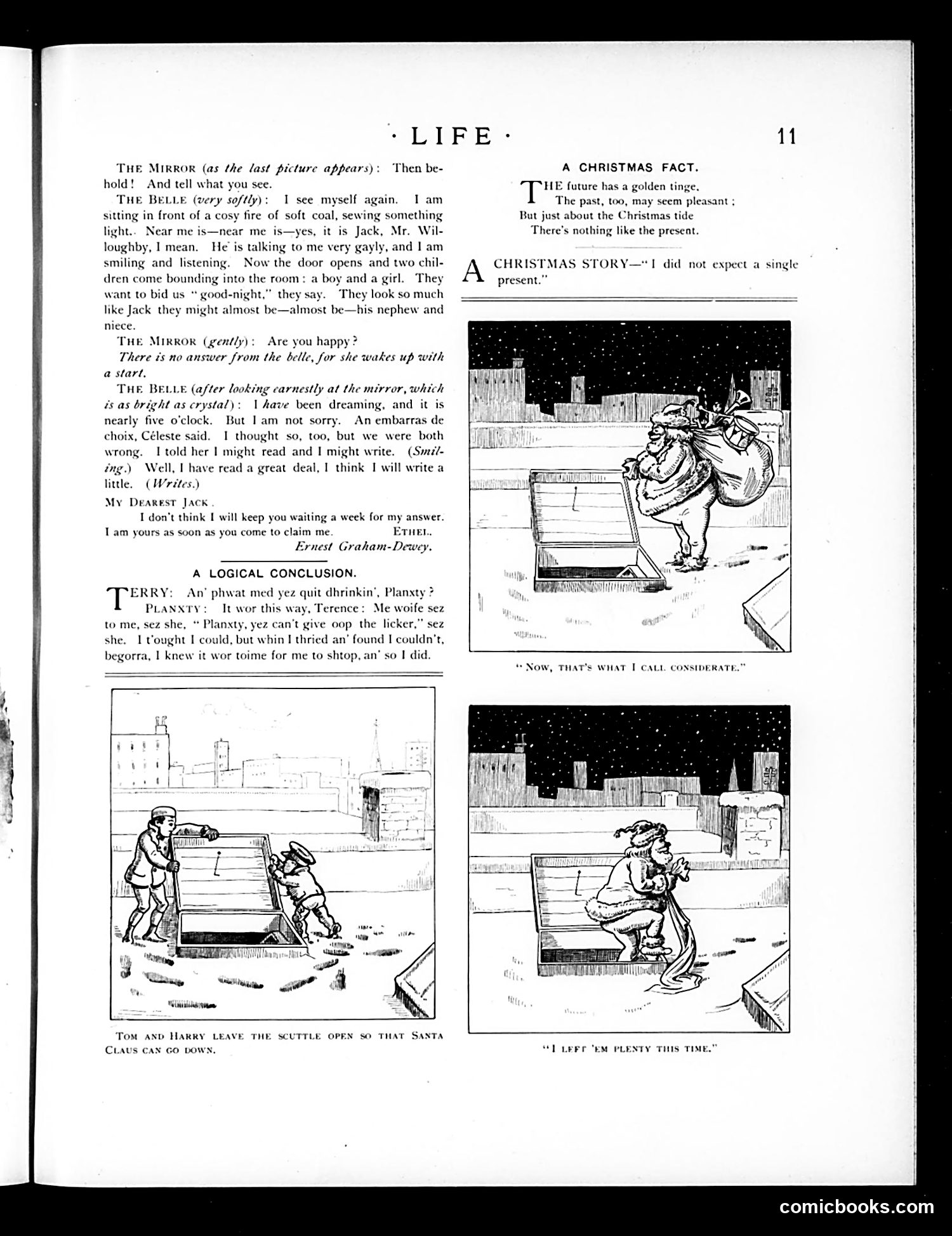
This page contains three distinct satirical pieces: **"The Mirror"** depicts a young woman using a magical mirror to envision her future: domestic contentment with "Jack" (Mr. Willoughby), children, and a cozy fireside. She awakens from this dream and writes to accept his proposal. The satire targets romantic idealization—the gap between fantasy and reality for women of the era. **"A Logical Conclusion"** features two Irish working-class men (rendered in dialect) discussing alcohol abstinence. The humor lies in the circular logic: one man couldn't quit drinking, so he quit trying—presenting this resignation as wisdom. This mocks both Irish stereotypes and the futility of self-improvement efforts. **"A Christmas Story"** shows two children helping Santa by leaving a coal scuttle open (chimney access). The caption's irony suggests their "thoughtfulness" is actually self-interested—they're facilitating gift delivery. This gently satirizes children's motivations during Christmas. All three pieces use gentle humor typical of Life magazine's satirical approach to everyday life, romance, class differences, and holiday customs of the period.
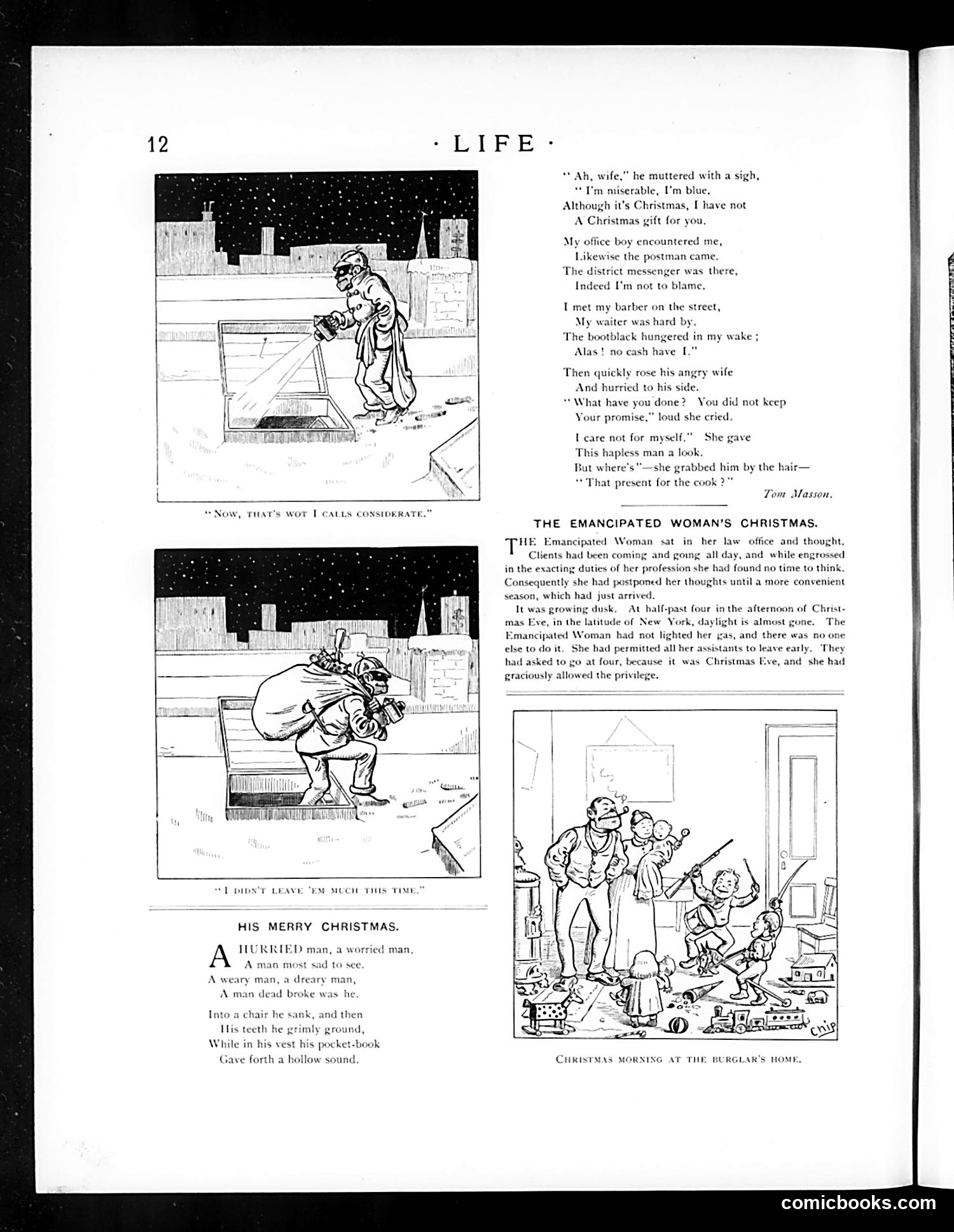
This page contains three Christmas-themed satirical pieces from *Life* magazine: **"His Merry Christmas"** (top): A working-class man, broke and unable to afford gifts for his wife, encounters various service workers (barber, waiter, bootblack, postman) who expect tips. His angry wife's final complaint—demanding he didn't forget the cook's present—satirizes how financial obligations cascade down through household staff. The joke critiques both economic precarity and the servant-dependent class system. **"The Emancipated Woman's Christmas"** (middle): A female lawyer working alone on Christmas Eve represents the "New Woman" of the era—professionally independent but isolated, having sent her staff home early on the holiday. The satire appears to mock both the loneliness of female independence and perhaps the disruption of traditional hierarchies. **"Christmas Morning at the Burglar's Home"** (right): Depicts a burglar surrounded by stolen goods and toys, playing Santa for children. This darkly comic image satirizes criminal life while inverting Christmas virtue narratives. Together, these pieces use Christmas as a lens to examine class anxieties, women's changing roles, and economic inequality in early 20th-century America.
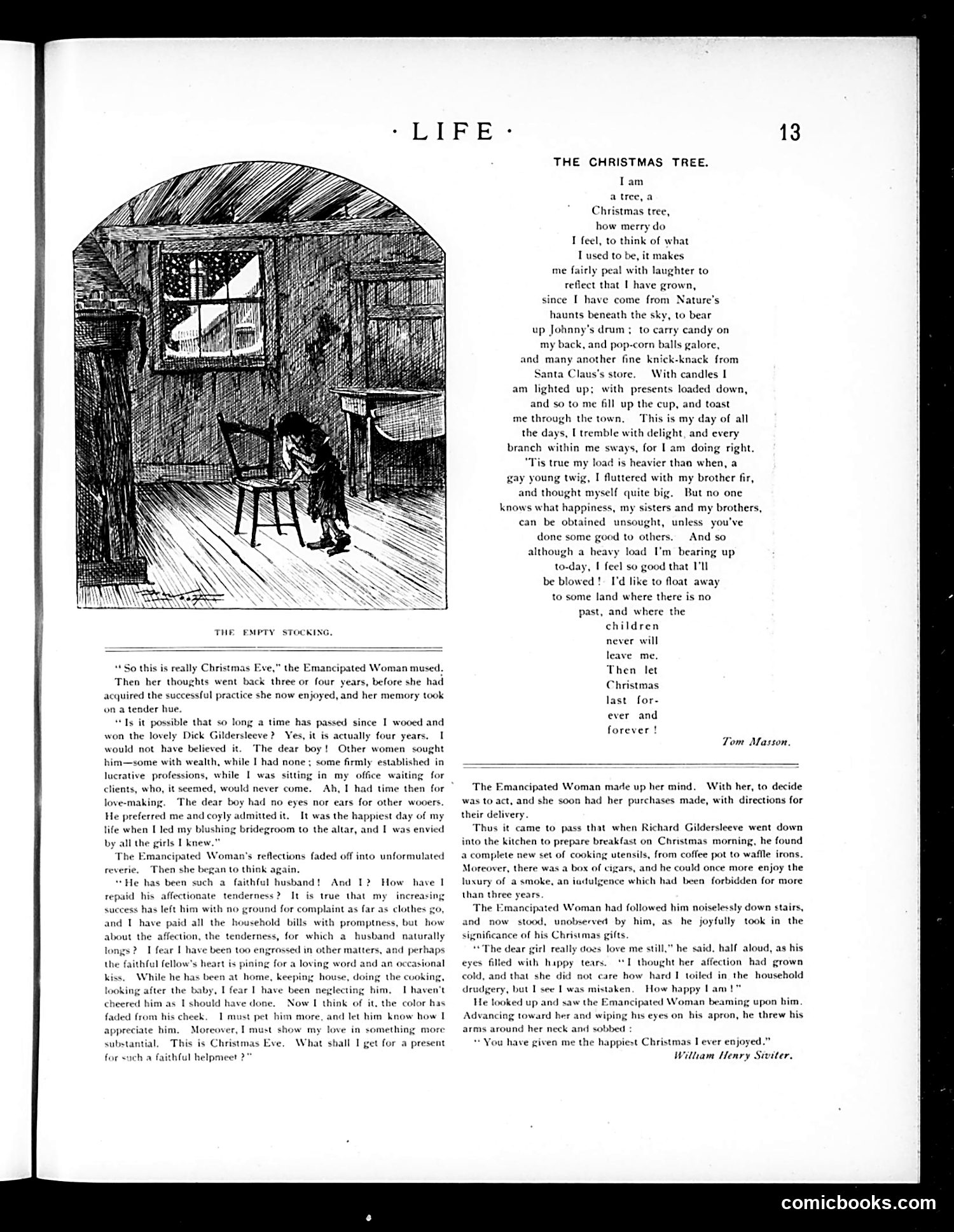
This page contains two related Christmas stories satirizing early 1900s gender roles. **"The Empty Stocking"** depicts an "Emancipated Woman"—a professionally successful female lawyer—who realizes she's neglected her devoted husband while building her career. He's stayed home managing the household and raising their child while she pursued wealth and status. The irony: despite her independence and financial success, she feels guilty for not providing enough emotional support. The satire critiques how even "liberated" women internalized expectations to prioritize male emotional needs. **"The Christmas Tree"** is a sentimental poem personifying a tree grateful for its purpose serving children, despite bearing a "heavy load." It celebrates self-sacrifice and finding meaning through serving others—likely reinforcing traditional domestic virtue. Together, these pieces mock progressive women's aspirations by suggesting that professional success creates guilt and unhappiness, ultimately endorsing traditional gender roles where women's fulfillment comes through supporting others rather than personal achievement.
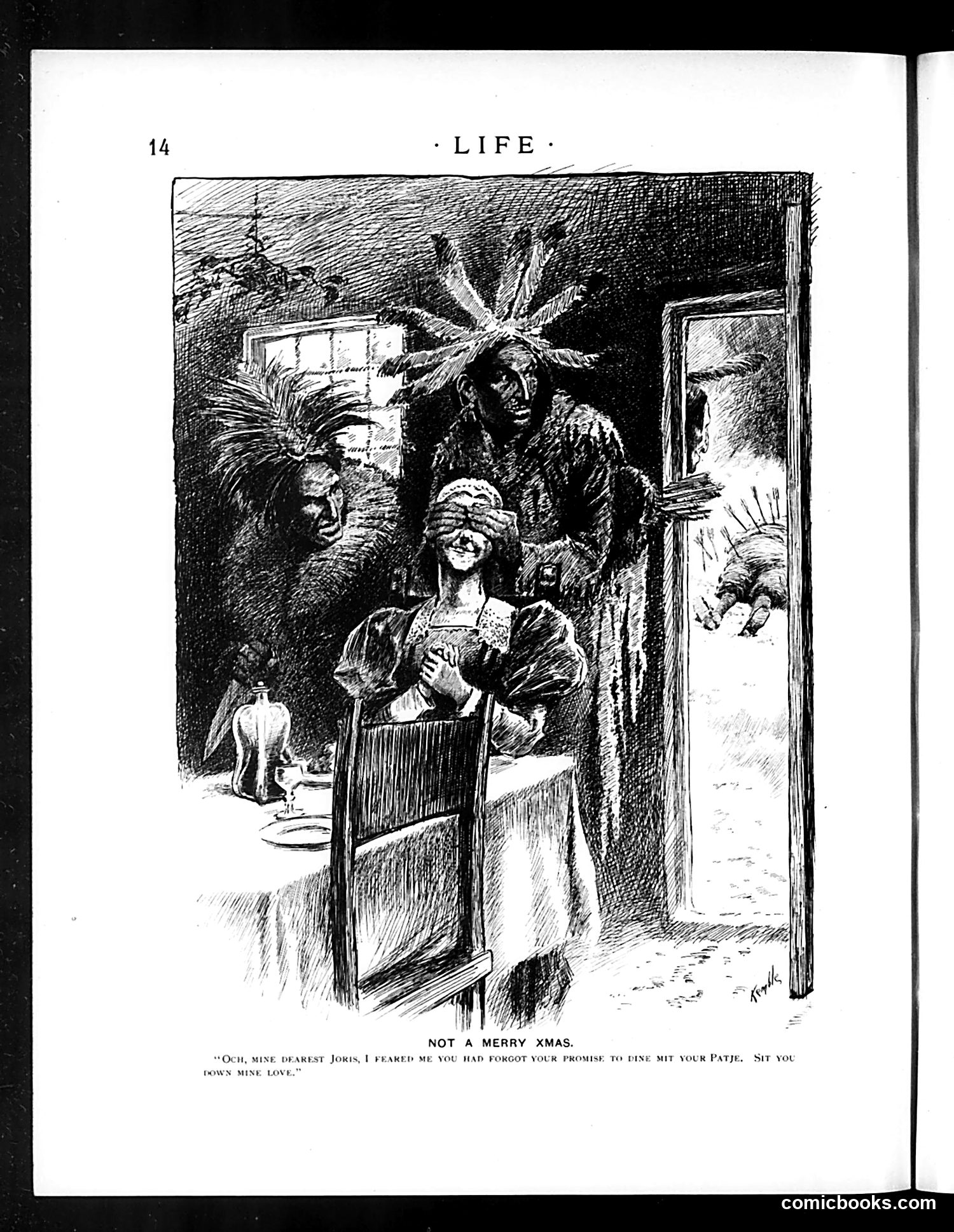
This political cartoon depicts a Christmas scene with a blindfolded woman at a doorway confronted by menacing figures with exaggerated features. The caption shows broken English spoken by what appears to be a German character ("Joris," "mit," "Patje") addressing the woman, referencing a broken dinner promise. The imagery suggests commentary on German-related conflict or tension during a Christmas holiday—likely referencing World War I era anxieties or German-American relations. The blindfold and the woman's apparent distress, combined with the threatening surrounding figures, implies betrayal or broken trust associated with Germany. The satirical point appears to criticize German promises or conduct, using the holiday setting to emphasize the contrast between Christmas goodwill and perceived German aggression or duplicity. The fractured dialect reinforces ethnic stereotyping common to wartime propaganda cartoons.
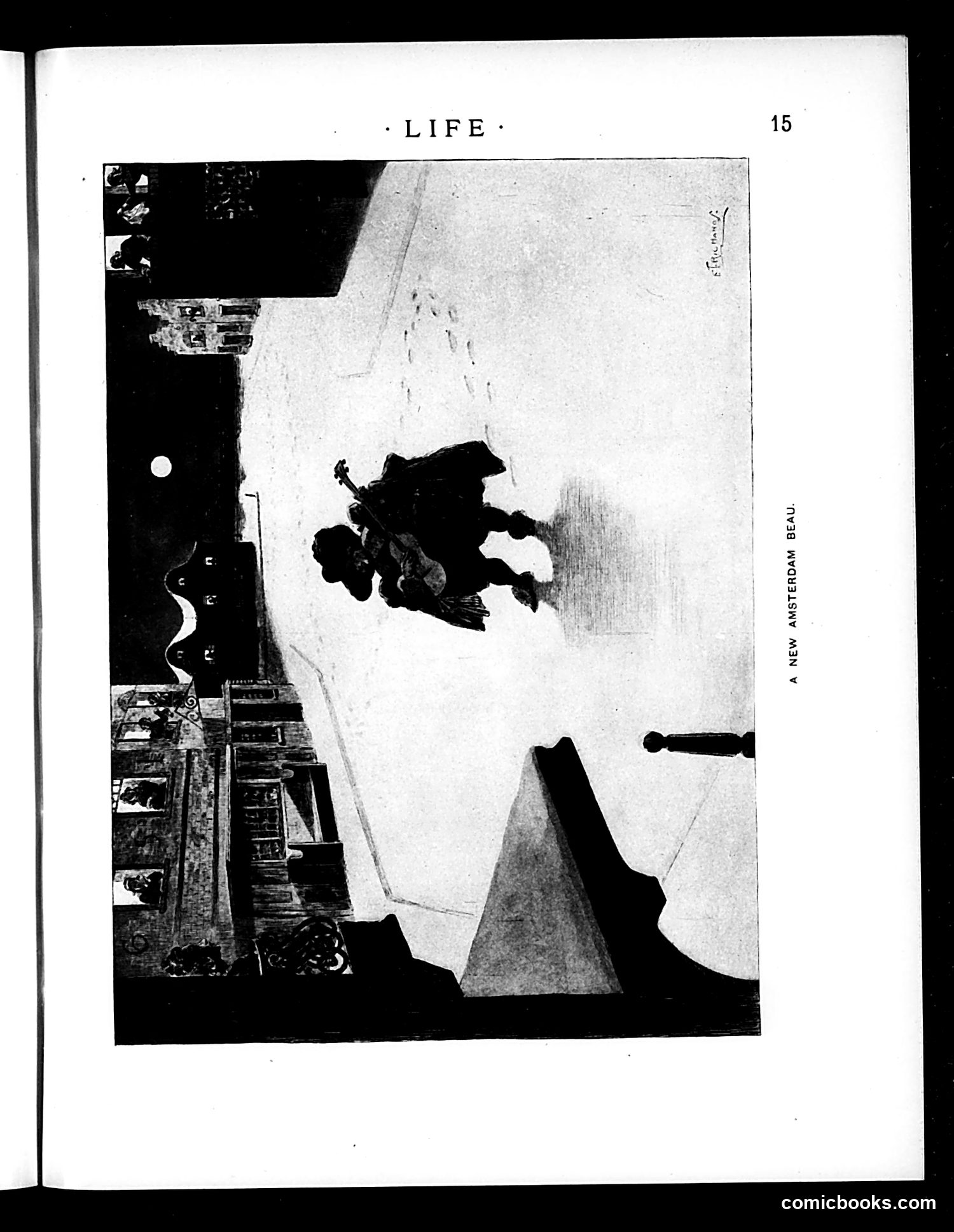
The OCR text is corrupted and unreadable. Based on the image alone: this appears to be a satirical illustration from Life magazine showing a figure in dark clothing positioned against a large white surface (possibly a wall or canvas). The composition is deliberately awkward—the figure appears inverted or at an unusual angle relative to the page orientation. On the left side, there are smaller architectural or industrial elements visible. The artistic style and black-and-white photography suggest early-to-mid 20th century. Without legible caption text, I cannot definitively identify the specific political or social reference intended, though the composition suggests commentary on an artist, public figure, or social absurdity typical of Life's satirical approach.
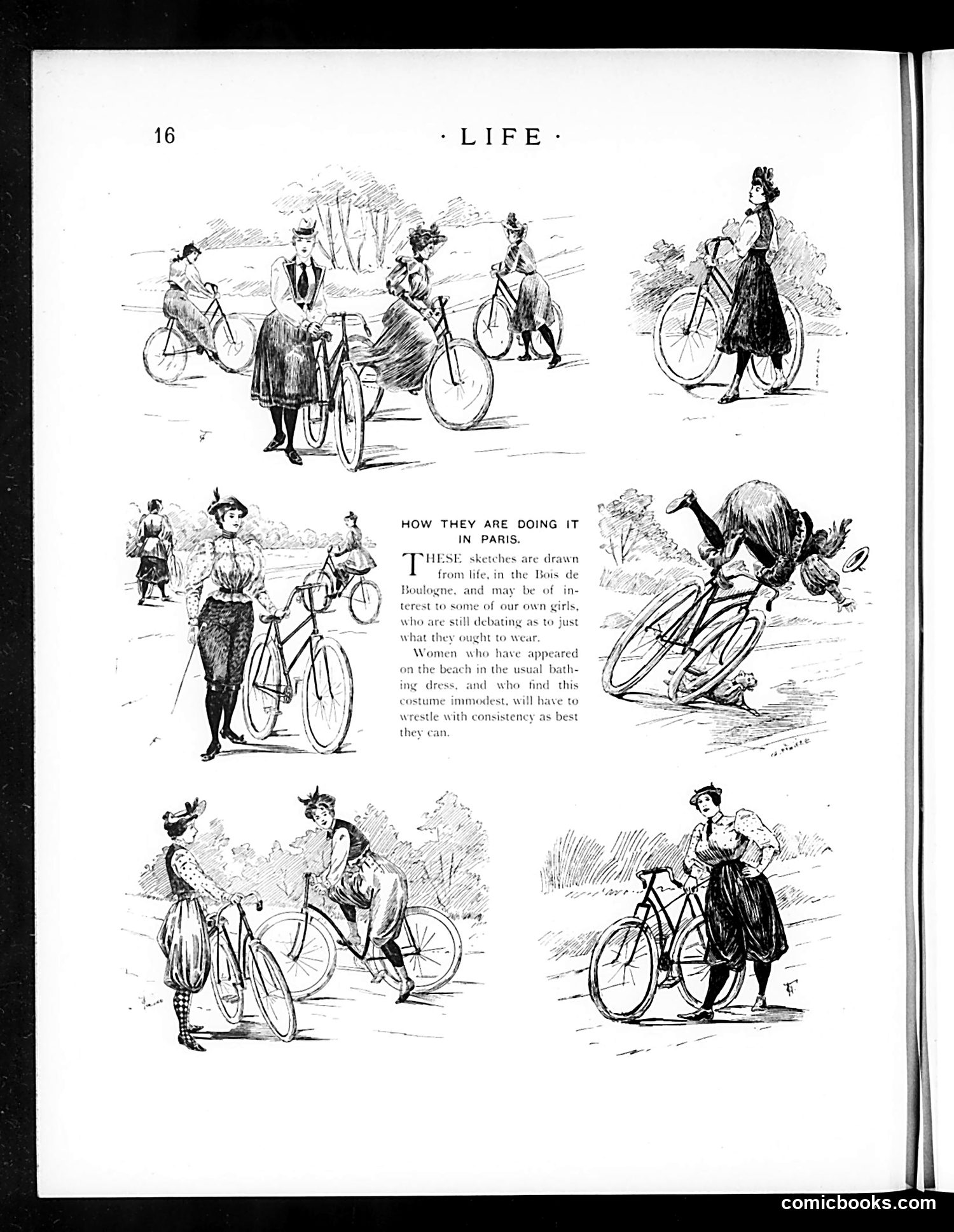
This page satirizes the debate over women's appropriate clothing during the bicycle craze of the 1890s. The sketches depict Parisian women in the Bois de Boulogne (a fashionable park) cycling in various outfits. The satire targets American women "still debating" proper cycling attire. The text humorously notes the contradiction: women who considered standard bathing suits "immodest" must now reconcile this with cycling in practical, often revealing clothing. The sketches show different fashion solutions Parisian women adopted—some modest, others less so. The joke highlights Victorian-era anxieties about women's bodies and "proper" dress codes, while cycling represented newfound female mobility and independence. Parisian women's apparently pragmatic approach to athletic wear contrasts with American prudishness, mocking American hesitation to embrace functional fashion.
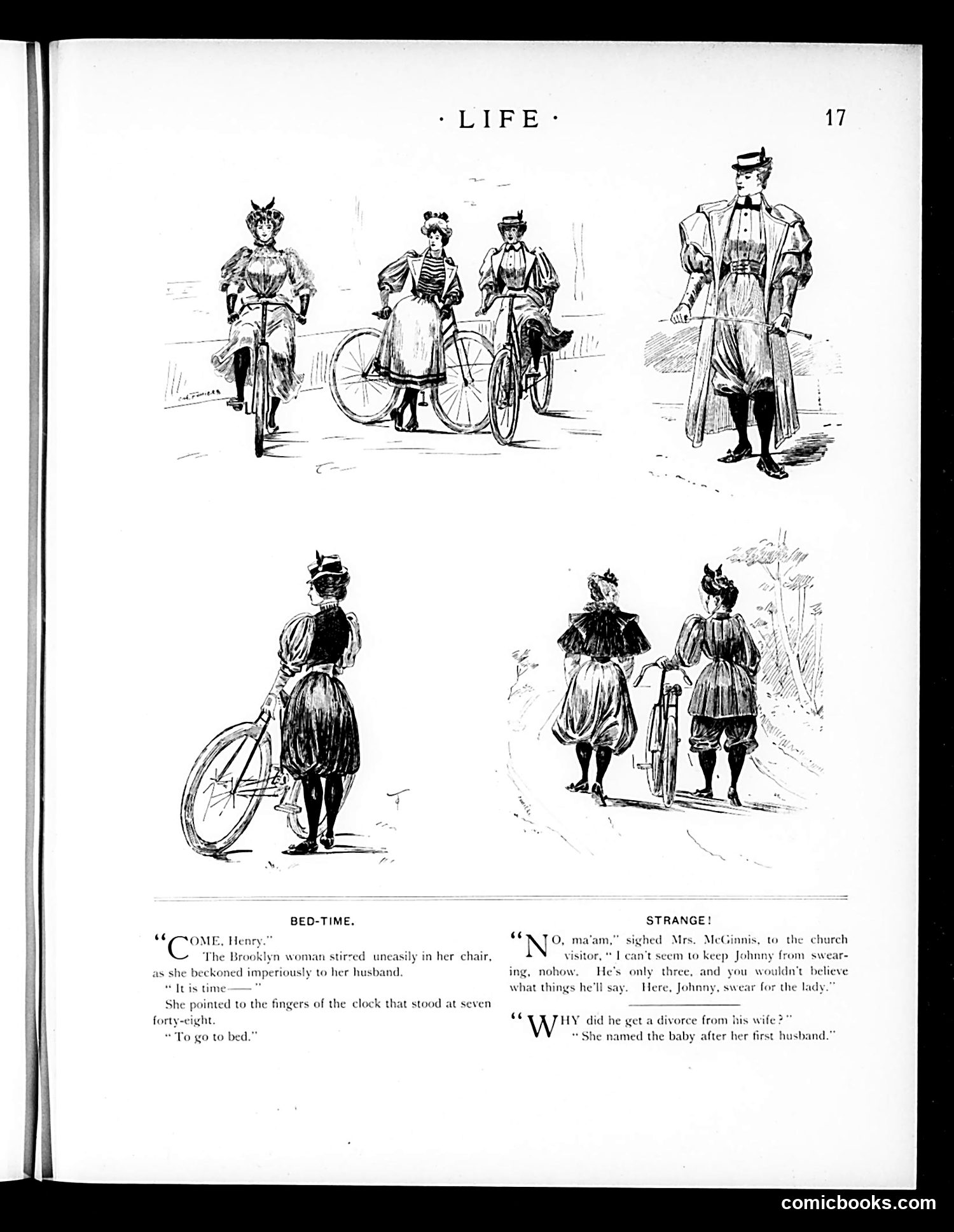
This page contains three separate humor pieces about early 1900s domestic life: **"Bed-Time"**: Satirizes a demanding Brooklyn wife who imperiously orders her husband to bed at 7:48 PM—an unusually early hour, suggesting either her control over him or his exhaustion from work. **"Strange!"**: Jokes about Mrs. McGinnis's frustration that her three-year-old son Johnny swears constantly despite her efforts, yet he'll behave perfectly when asked to swear for a visiting church lady—playing on childhood hypocrisy and the humor of innocent profanity. **"Why did he get a divorce?"**: A punchline joke: a man divorced his wife because she named their baby after her first husband, implying either her lingering attachment to her ex or the awkwardness/insult of such a choice. The satirical target is domestic relationships and child-rearing among ordinary Americans. The bicycle illustrations above represent fashionable cycling culture of the 1890s-1900s era.
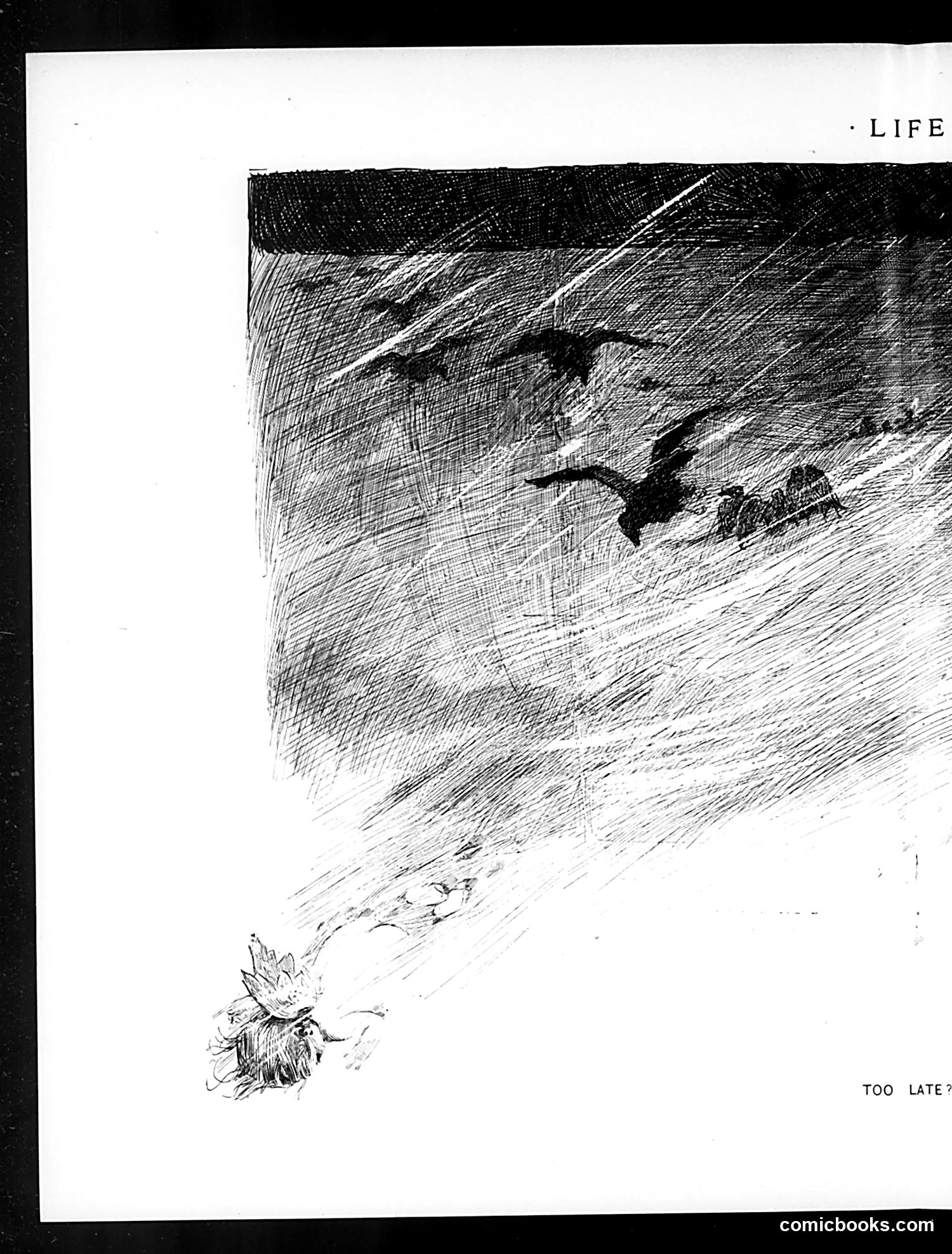
This is a dramatic ink sketch showing a figure at the bottom of a steep, snow-covered slope attempting to warn or reach several dark silhouettes sliding or falling down the mountainside above. The composition suggests an avalanche or disaster in progress that may be unstoppable. The caption "TOO LATE?" indicates the central theme: whether intervention or warning can still prevent catastrophe. Without additional context from the magazine's date and surrounding articles, the specific political or social event referenced remains unclear. However, the imagery suggests commentary on an impending crisis—possibly economic collapse, military threat, or social upheaval—where preventative action may have already become impossible. The artistic style emphasizes urgency and inevitability through the dramatic downward movement.
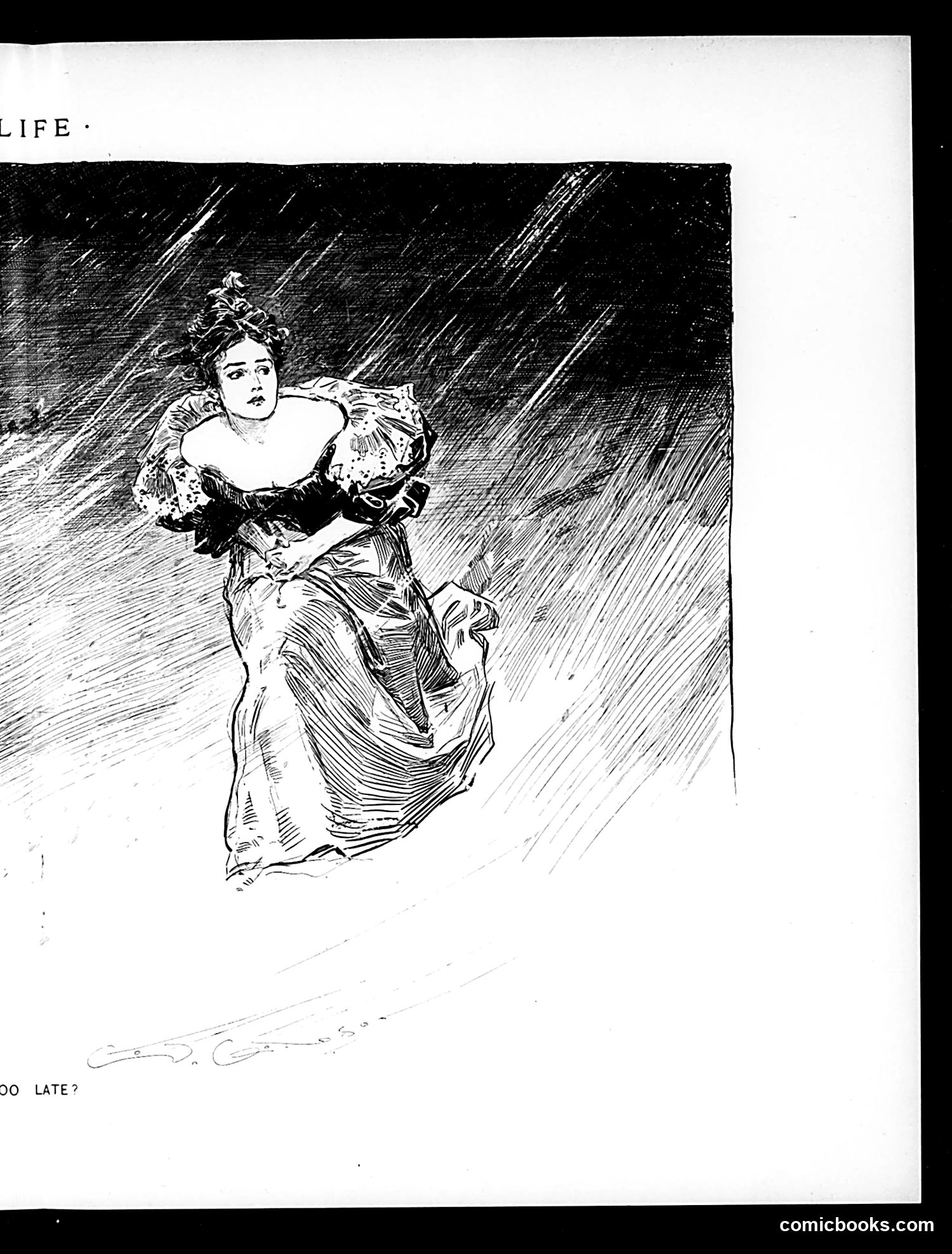
This page appears to be from *Life* magazine and shows an illustration of a fashionably-dressed woman in late 19th or early 1900s attire, with puffy sleeves, an elaborate upswept hairstyle, and a fitted gown. The drawing style uses cross-hatching characteristic of period ink illustrations. The caption reads "TOO LATE?" which likely suggests social commentary about fashion, romance, or social expectations for women. However, without additional context or visible text explaining the cartoon's specific reference, the precise satirical target remains unclear. The illustration may comment on changing women's fashion, dating customs, or social propriety of the era, but the exact joke or political point cannot be confidently determined from the image alone.
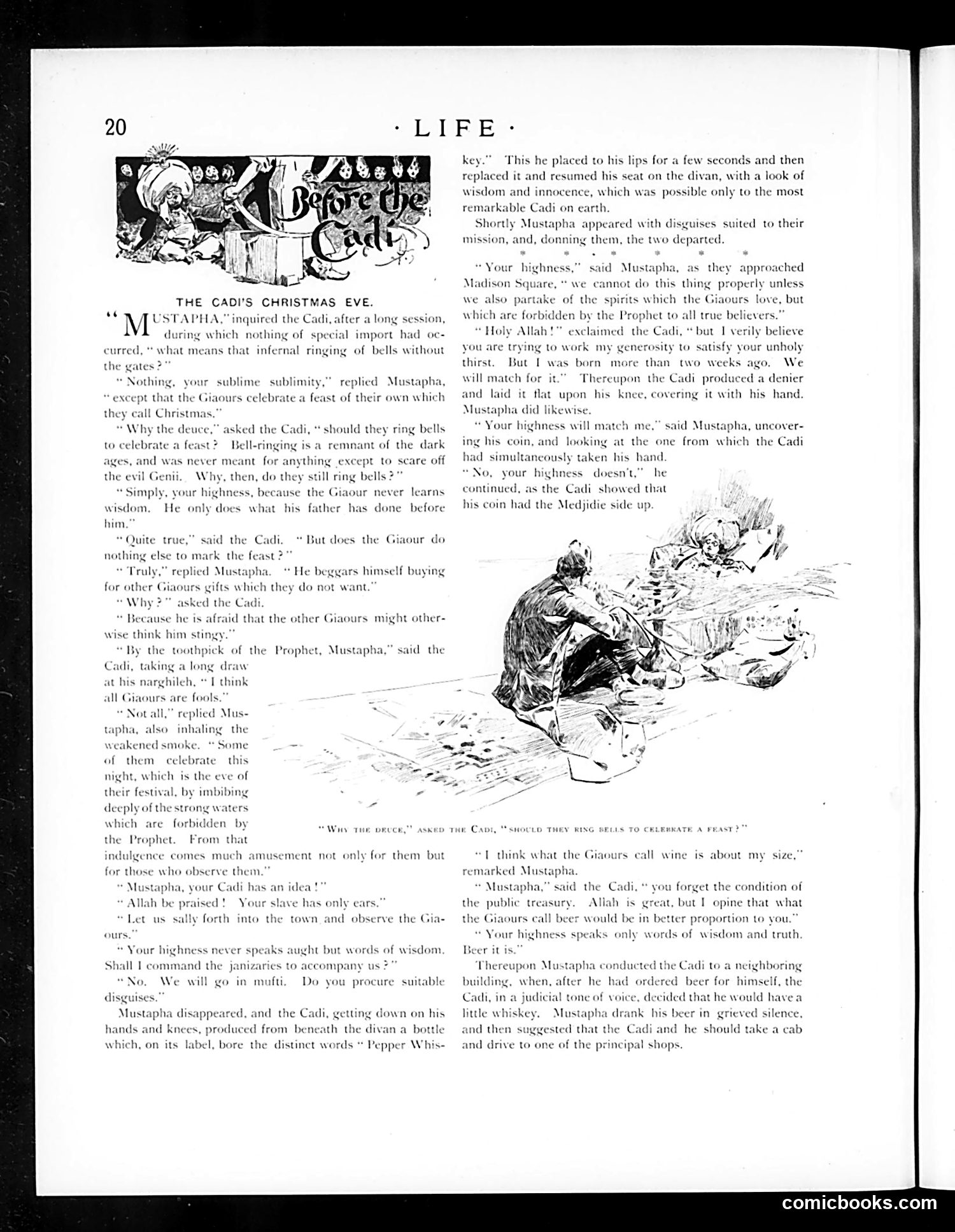
This satirical story mocks Islamic religious hypocrisy and Western customs through a dialogue between a Muslim judge (the Cadi) and his servant Mustapha. The Cadi initially condemns Christian "Giaours" (non-Muslims) for celebrating Christmas with bell-ringing and gift-giving, calling them foolish. Yet when Mustapha notes the Cadi has "an idea," the judge hypocritically disguises himself to observe the festivities—and immediately begins drinking forbidden alcohol and gambling, violating Islamic law far more egregiously than the Christians he criticized. The satire targets the Cadi's sanctimonious condemnation of other religions while indulging his own vices. The illustration shows the Cadi greedily consuming alcohol. The joke exposes double standards: the supposedly wise Muslim authority condemns infidel customs while secretly embracing forbidden pleasures. This reflects 19th-century Western stereotypes about Muslim hypocrisy and moral weakness.
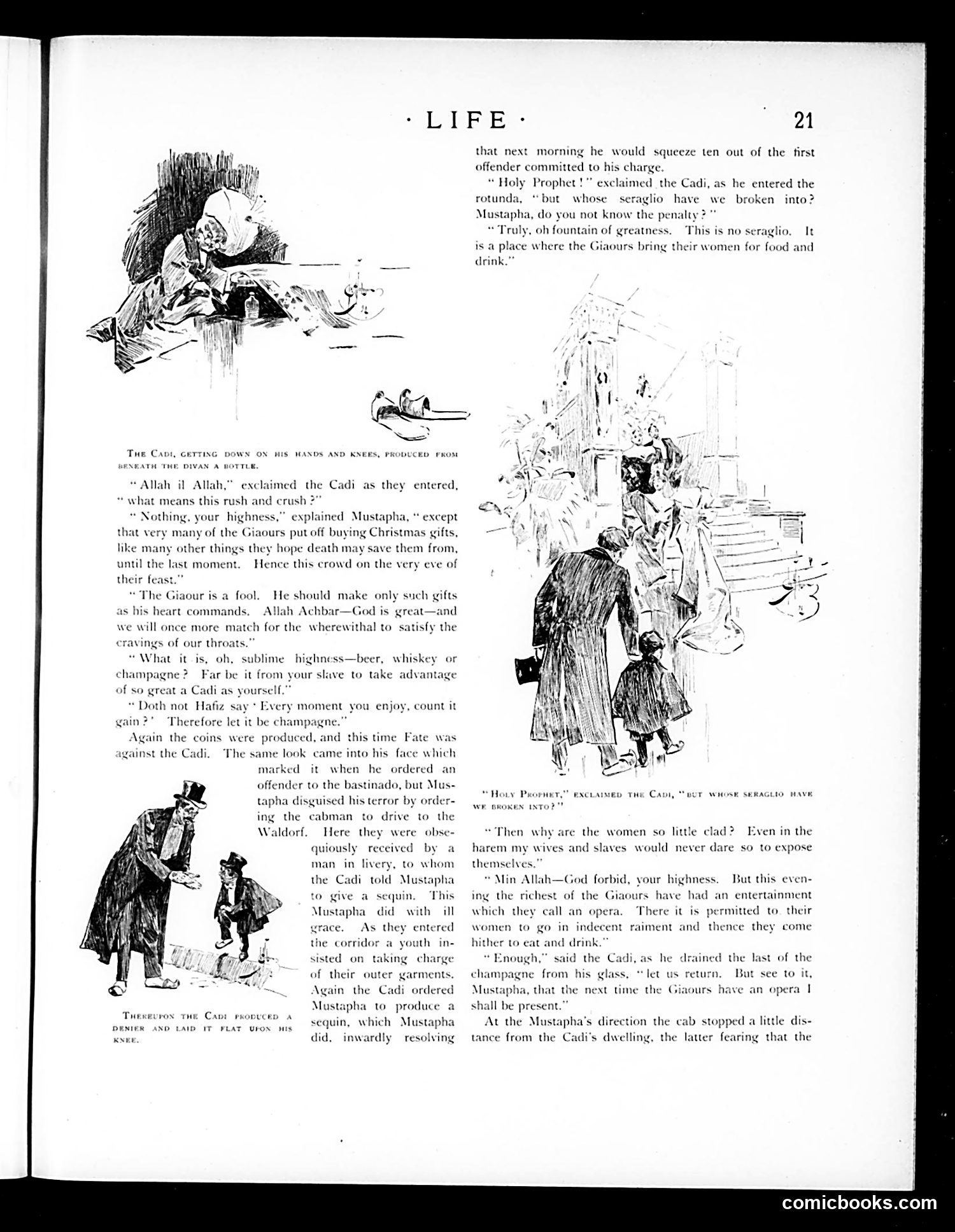
This satirical story mocks cultural clash between a Muslim Ottoman official (a Cadi, or Islamic judge) and American commercialism. The "Cadi" represents conservative Islamic values—he's shocked by women in revealing opera costumes and unfamiliar with Western spending habits. The joke targets American Christmas consumerism: Mustapha explains the crowded streets result from Christians frantically buying last-minute gifts. The Cadi repeatedly must pay gratuities (sequins) for basic services—coat check, cab fare—bewildering him with American tipping culture and commercial expectations. The satire cuts both ways: it mocks the Cadi's rigid prudishness while simultaneously critiquing American materialism and the relentless commercialization of holidays. The illustrations show the befuddled foreign visitor navigating unfamiliar customs, a common satirical device in *Life* magazine for highlighting perceived American excess and mercenary attitudes.
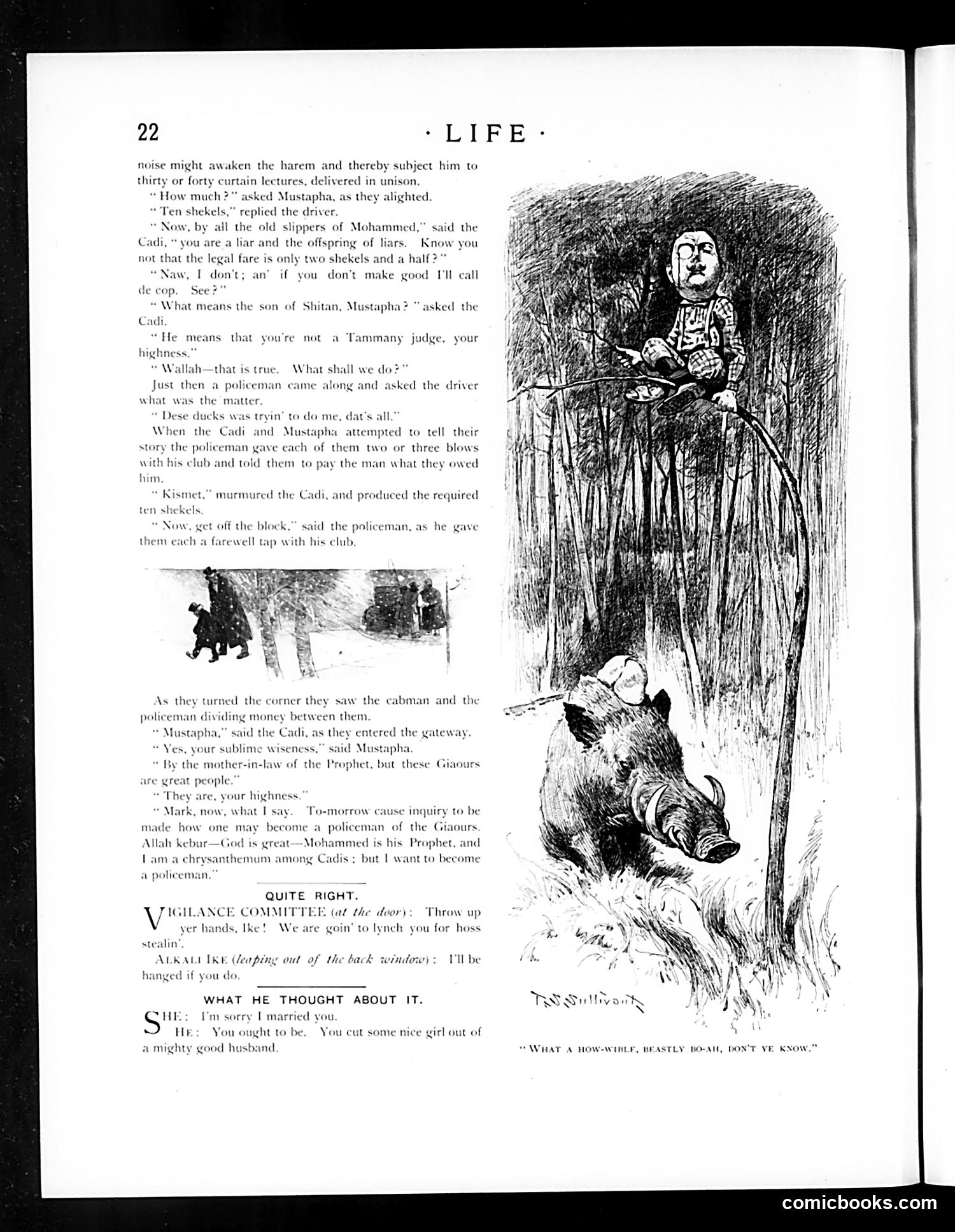
This page satirizes **police corruption and bribery** in early 20th-century America, likely targeting New York's Tammany Hall political machine. The main story depicts a Cadi (Islamic judge) and his servant visiting America. When a cab driver overcharges them, they appeal to a policeman—only to be beaten and forced to pay anyway. They then witness the driver and cop dividing the bribe money. The satire's point: The Cadi remarks that American police are "great people" and decides to become a policeman himself, recognizing corruption as the path to wealth. This mocks how **American law enforcement colluded with criminals and exploited the public**, presenting it as worse than the despotism the foreign visitors know. The joke is that America's "civilized" institutions are actually more corrupt than Ottoman autocracy. The bottom cartoons are unrelated humor about vigilantism and marriage.
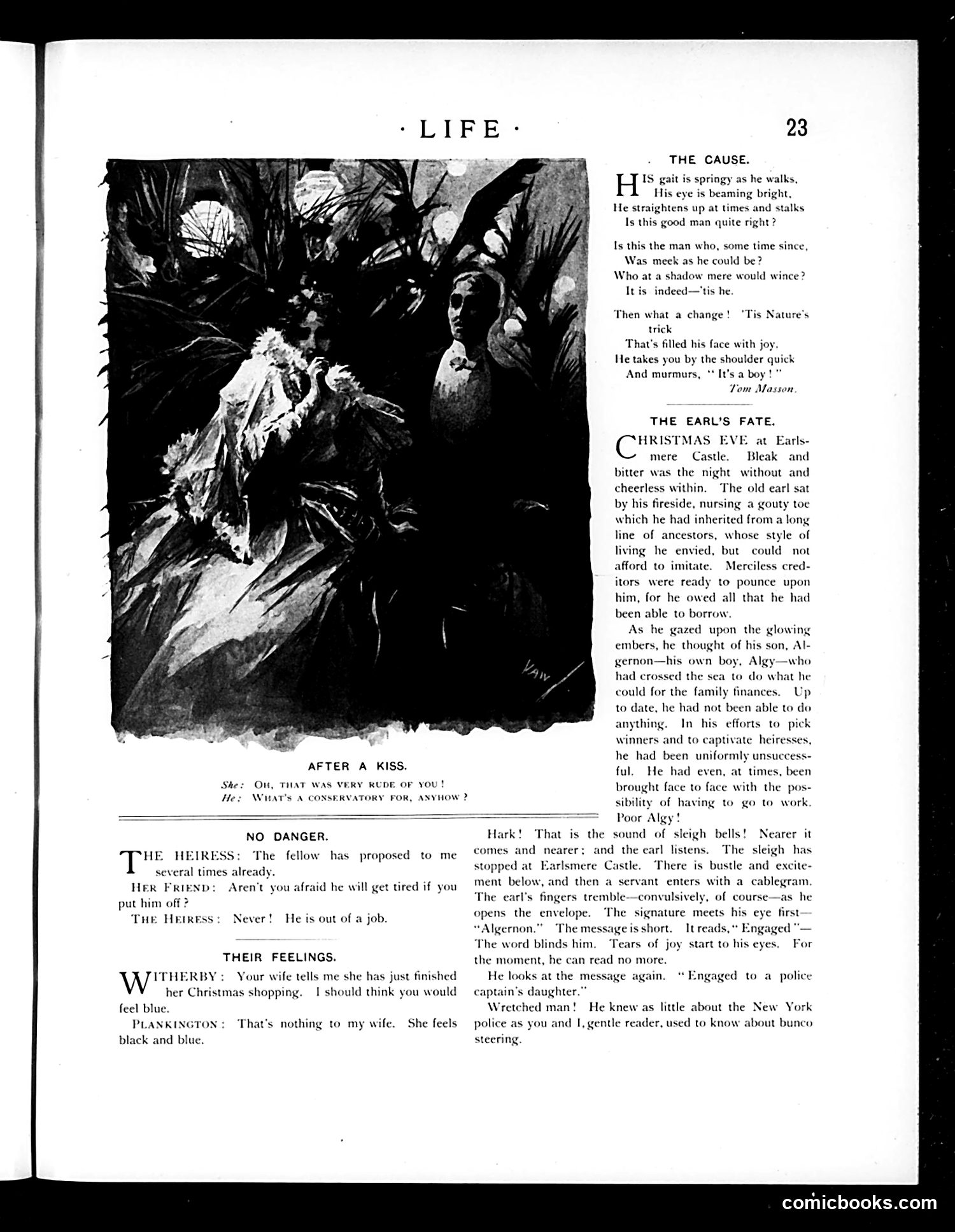
This page contains three separate humorous pieces reflecting early 20th-century concerns: **"The Cause"** mocks how fatherhood transforms men—a lazy or timid man suddenly becomes confident and boastful upon learning he has a son, attributing this to "Nature's trick." **"No Danger"** jokes about marriage and employment: a woman isn't worried her suitor will tire of proposing because he has no job and thus no escape route. **"The Earl's Fate"** is a longer story satirizing Old Money decline. An impoverished British earl anxiously awaits news from his son Algernon, who went to America to restore family finances through marrying an heiress. The punchline: Algernon became engaged to a police captain's daughter—apparently not understanding that American police lack the aristocratic status he needed. The earl's despair suggests marrying a policeman's daughter won't solve their financial crisis, and the reference to "bunco steering" implies distrust of American institutions.
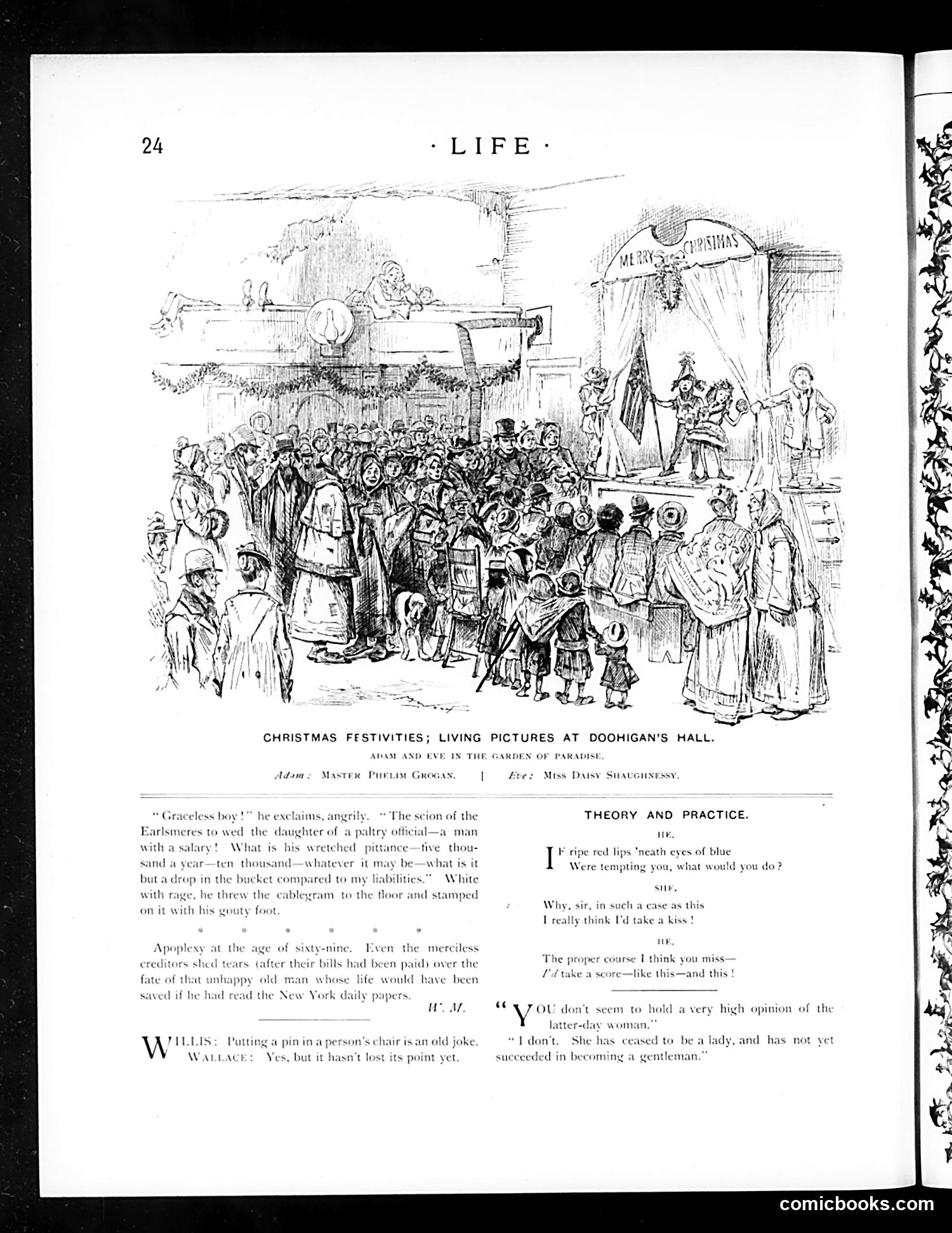
This page contains two satirical pieces from the late 19th/early 20th century: **Top cartoon**: "Christmas Festivities" depicts an aristocratic nobleman furious that his son plans to marry a woman whose father is merely a salaried government official. The satire mocks class pretension—the Earl complains the official's £5,000-10,000 annual salary is "but a drop in the bucket" compared to aristocratic wealth. The irony: the old man dies of apoplexy at 69, suggesting his excessive class consciousness kills him. The dig at "New York daily papers" implies American newspapers would have reported his death, mocking both his irrelevance and tabloid journalism. **Bottom section**: "Theory and Practice" presents two brief exchanges mocking moral inconsistency. The first shows a man claiming he'd "take a kiss" if tempted by a beautiful woman, despite presumably holding strict moral principles. The second ridicules men's attitudes toward women—the speaker dismisses modern women as having "ceased to be a lady" while failing to become gentlemen themselves, exposing male hypocrisy about female behavior. Both pieces satirize upper-class pretension and gendered double standards.
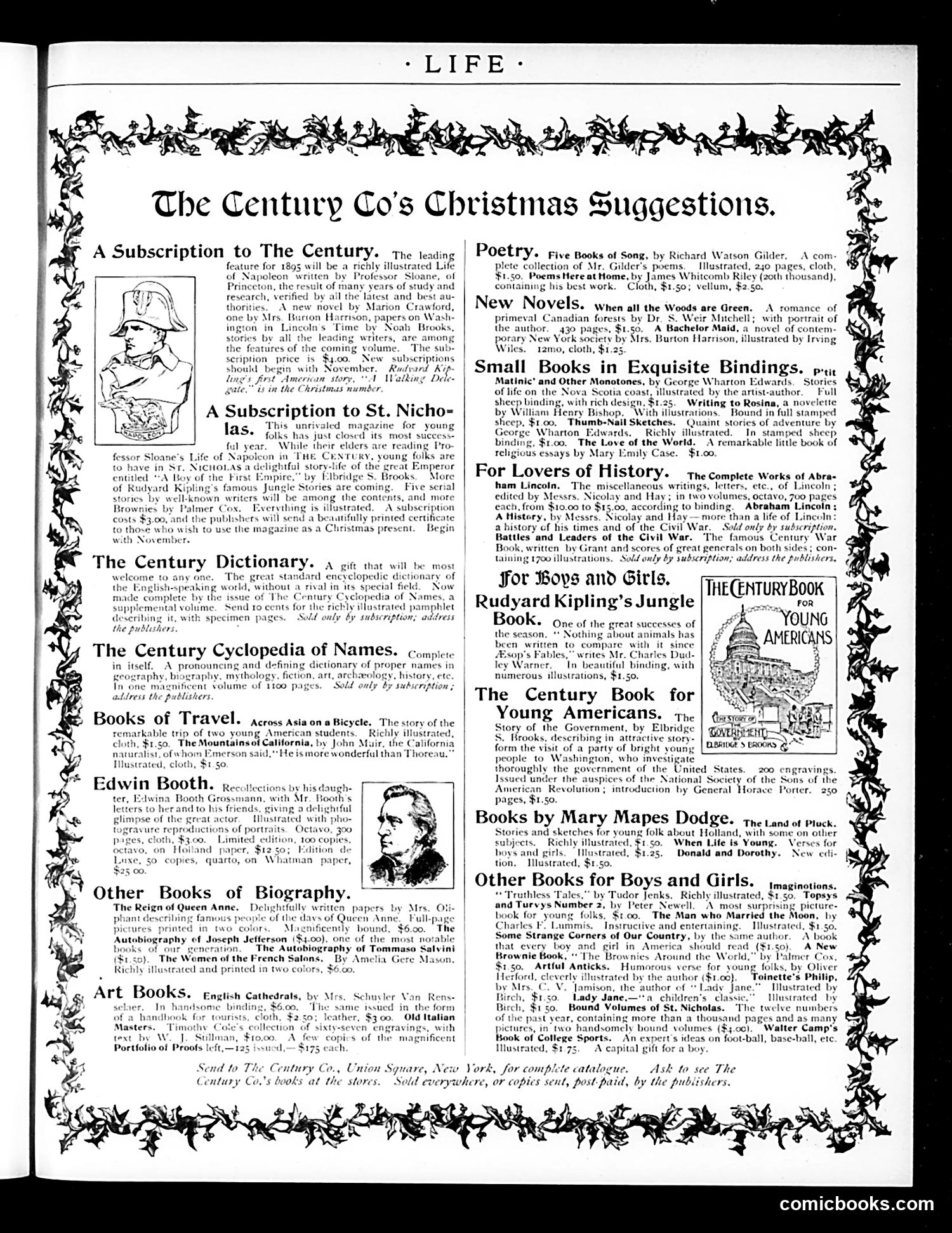
This page is primarily **advertising copy** for The Century Company's Christmas gift suggestions—books published by the company. There are no political cartoons or satirical illustrations requiring historical context. The page features two small portrait engravings: one appears to be a historical figure in 18th-century dress (possibly related to the Napoleon biography advertised), and another shows a bearded man identified as related to Edwin Booth's autobiography. The content is a straightforward catalog of gift recommendations across categories: subscriptions to *The Century* and *St. Nicholas* magazines, reference works (*Century Dictionary*, *Encyclopedia of Names*), travel narratives, biographies, poetry, novels, art books, and children's literature. Prices range from $1.00 to $12.00. This represents typical turn-of-the-century *Life* magazine advertising—*Life* itself was partly sustained by such promotional content for established publishers and cultural institutions.
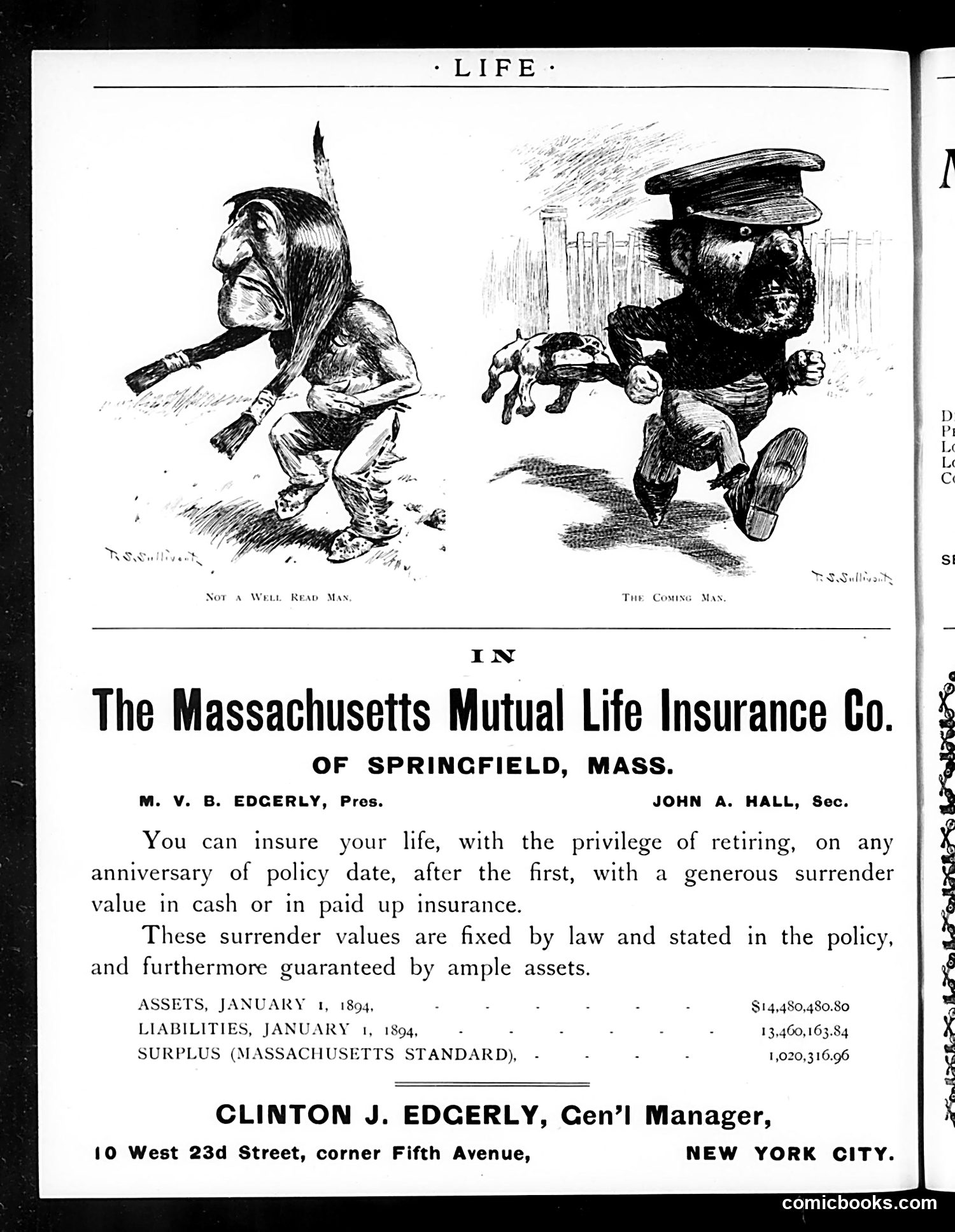
This is a **Life magazine advertisement** for Massachusetts Mutual Life Insurance (circa 1894). The two caricatures above use ethnic/racial stereotyping common to the era: **Left figure** ("Not a Well Read Man"): appears to depict an Indigenous person with exaggerated features, holding a pipe and tomahawk—a crude caricature suggesting ignorance or primitiveness. **Right figure** ("The Coming Man"): depicts a bearded man in formal dress with a captain's cap, appearing prosperous and civilized—suggesting progress or improvement. **The satire's message**: Life insurance represents civilization and advancement. The contrast implies that adopting life insurance policies is part of becoming "modern" and respectable, using offensive racial hierarchy to sell financial products. **Historical context**: This reflects 1890s American attitudes equating European-American civilization with superiority. Such imagery was standard advertising practice, though deeply offensive by today's standards. The actual insurance pitch emphasizes guaranteed surrender values and substantial assets ($14+ million).
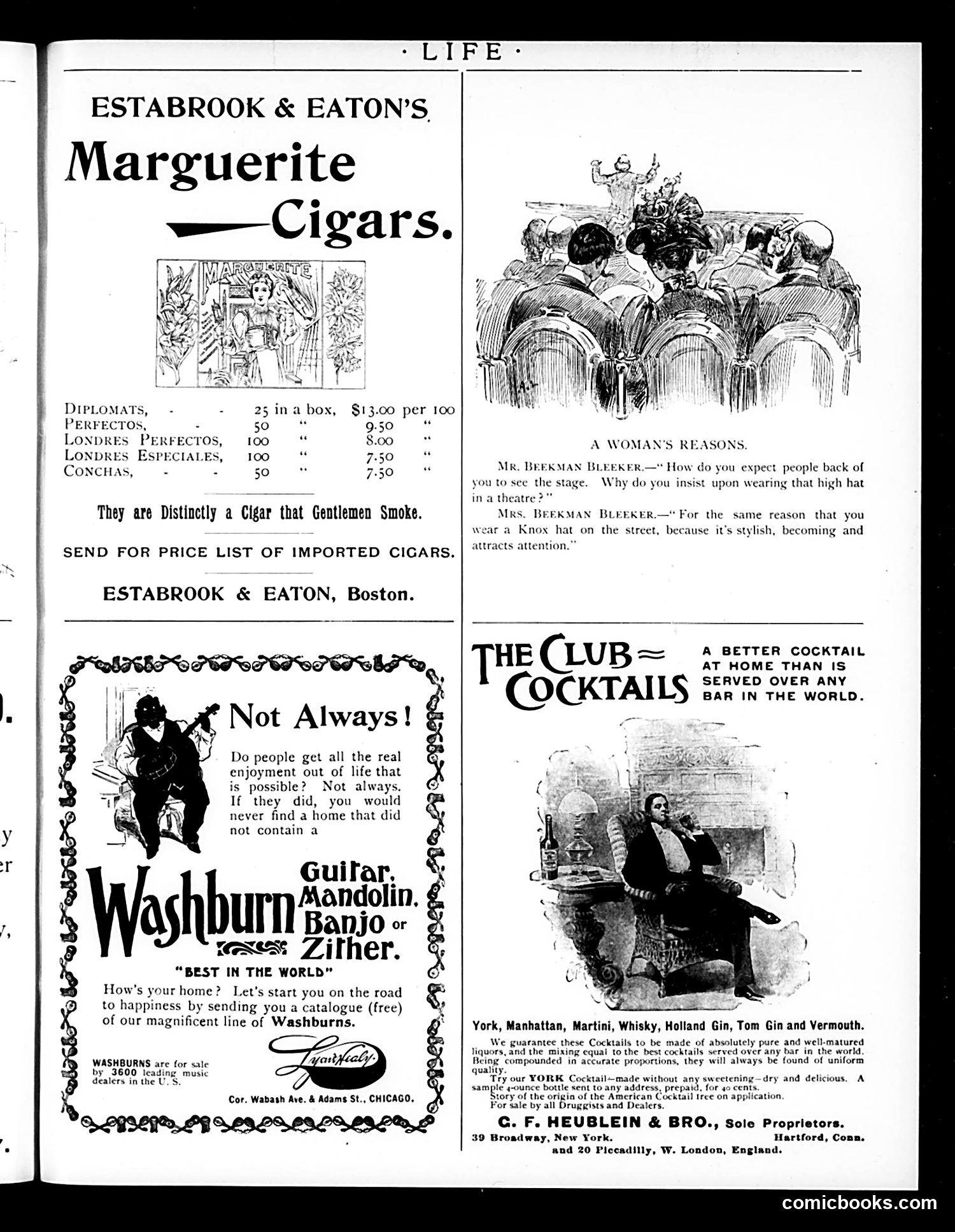
This page is primarily **advertising** with one brief satirical exchange. The main content includes: **"A Woman's Reasons"**: A short dialogue between Mr. and Mrs. Beekman Bleeker about theater etiquette. The husband complains about a woman wearing a high hat blocking the stage view. The wife's retort—that she wears it for the same stylish, attention-getting reasons he wears his Knox hat on the street—is the satirical point: it exposes male hypocrisy about fashion and vanity. Both sexes prioritize appearance over consideration for others. **Advertisements**: The page features cigars (Estabrook & Eaton's Marguerite), musical instruments (Washburn guitars/mandolins/banjos/zithers), and cocktail mixers (The Club Cocktails by Heublein & Bro.). These ads reflect early 1900s consumer culture and leisure activities for the middle and upper classes. The satire is gentle social commentary on gender and propriety rather than political commentary.
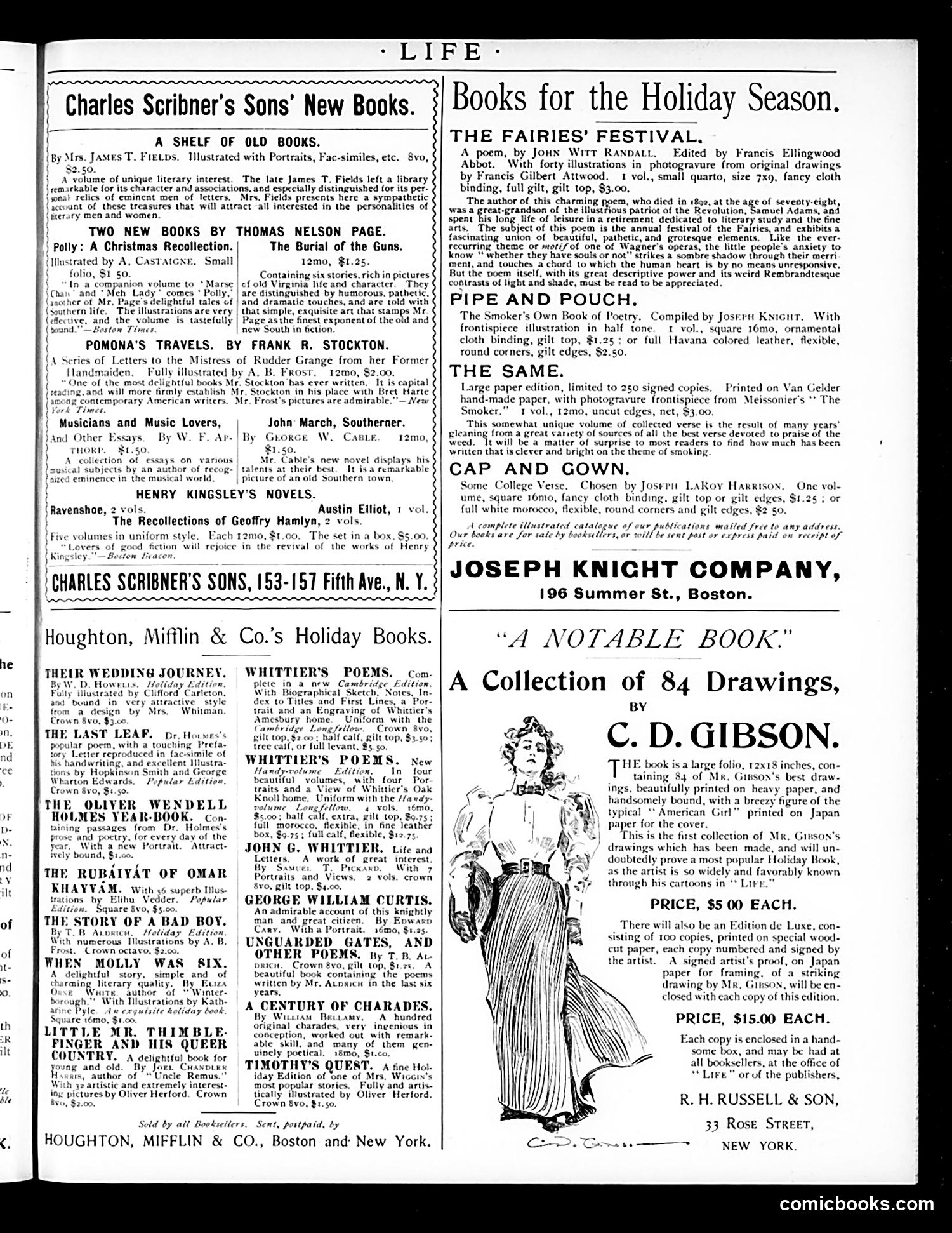
This page is **primarily advertising** for holiday books, not political satire. It consists of book advertisements from major publishers (Charles Scribner's Sons, Houghton Mifflin & Co., and Joseph Knight Company). The only illustrated element is a C.D. Gibson drawing—a fashionable young woman in elegant dress. Gibson was famous for "Gibson Girl" illustrations depicting idealized American femininity. This appears as advertisement for a collection of his 84 drawings, priced at $5.00 (standard edition) or $15.00 (deluxe edition). The book advertisements emphasize Southern literature (Thomas Nelson Page's works), poetry collections, and gift-appropriate volumes—typical holiday-season offerings. There is **no political commentary or social satire** visible on this page; it's a straightforward commercial publication showcase from approximately the 1890s.
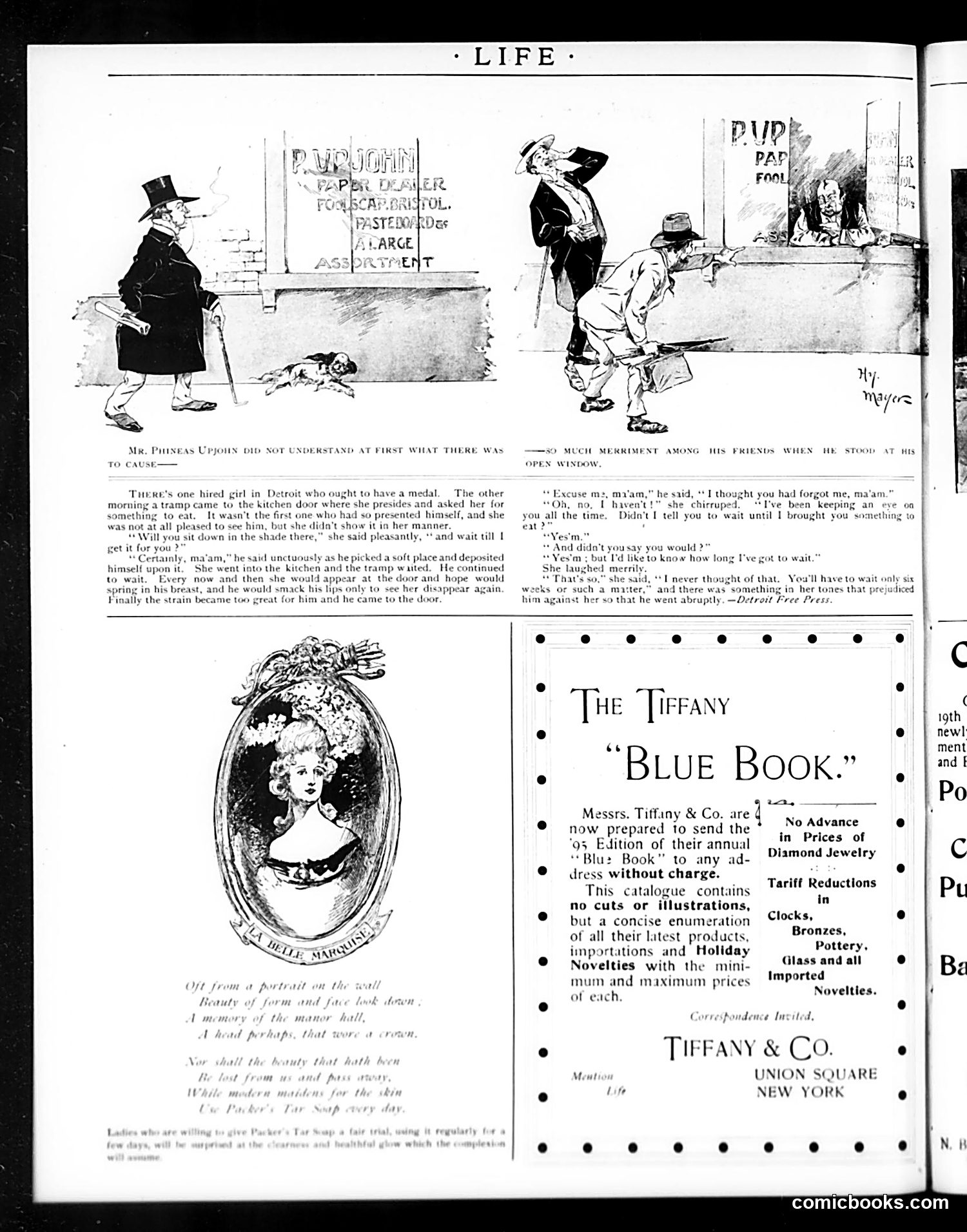
This page contains a humorous short story illustrated with cartoon panels, plus an advertisement. **The Main Story/Cartoon:** The narrative follows Mr. Phineas Upjohn, who apparently stood at an open window while entertaining. His friends found this hilarious, though he didn't understand why initially. The accompanying story explains: a Detroit hired girl (domestic servant) showed unusual kindness to a tramp who came begging for food, repeatedly delaying serving him while she attended to other tasks. When he finally complained about the wait, she revealed she'd been deliberately making him wait as punishment for his impatience—a humorous reversal where the servant gets the upper hand. The joke satirizes class dynamics and the cleverness of working-class people outwitting those they serve. **The Advertisement:** The right side features Tiffany & Co.'s "Blue Book" catalog announcement, promoting their jewelry and luxury goods with no advance payment required. The page reflects early 20th-century American attitudes toward domestic service and class relations.
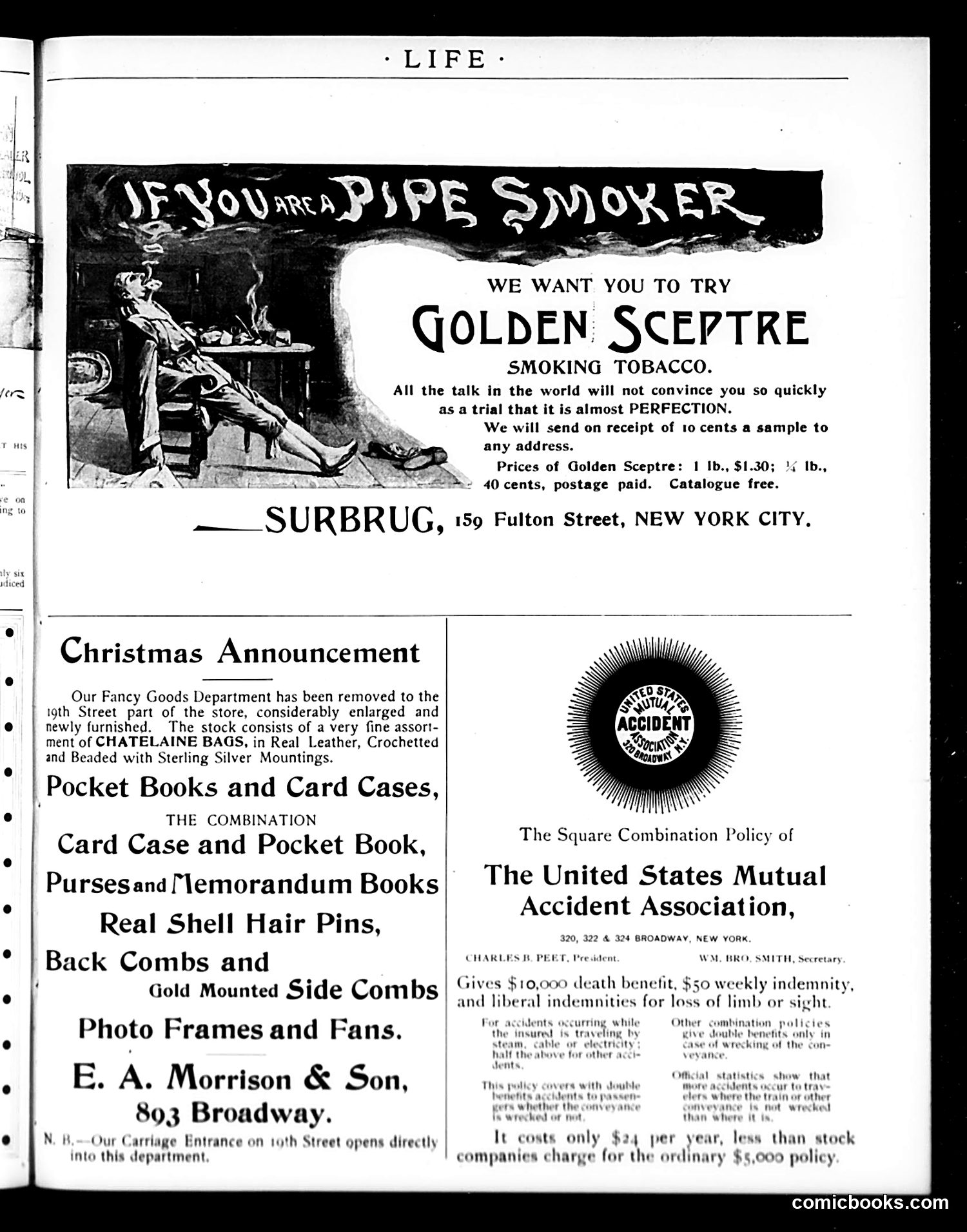
This page is primarily **advertising**, not satirical content. The top features a pipe-smoking advertisement for "Golden Sceptre" tobacco by Surbrug, targeting pipe smokers with claims of near-perfection and sample offers. Below are three distinct advertisements: 1. **E.A. Morrison & Son** announces relocation of their Fancy Goods Department, selling luxury items (leather bags, card cases, combs, photo frames) to upper-class consumers. 2. **United States Mutual Accident Association** promotes affordable accident insurance—$24 yearly for $10,000 death benefit and $50 weekly disability payments. This reflects the era's dangerous industrial conditions and lack of government safety nets; accident insurance was a practical necessity for working people. The page reflects **turn-of-the-century consumer culture**: tobacco marketing to gentlemen, luxury goods for the wealthy, and emerging commercial insurance as ordinary people needed protection against industrial accidents.
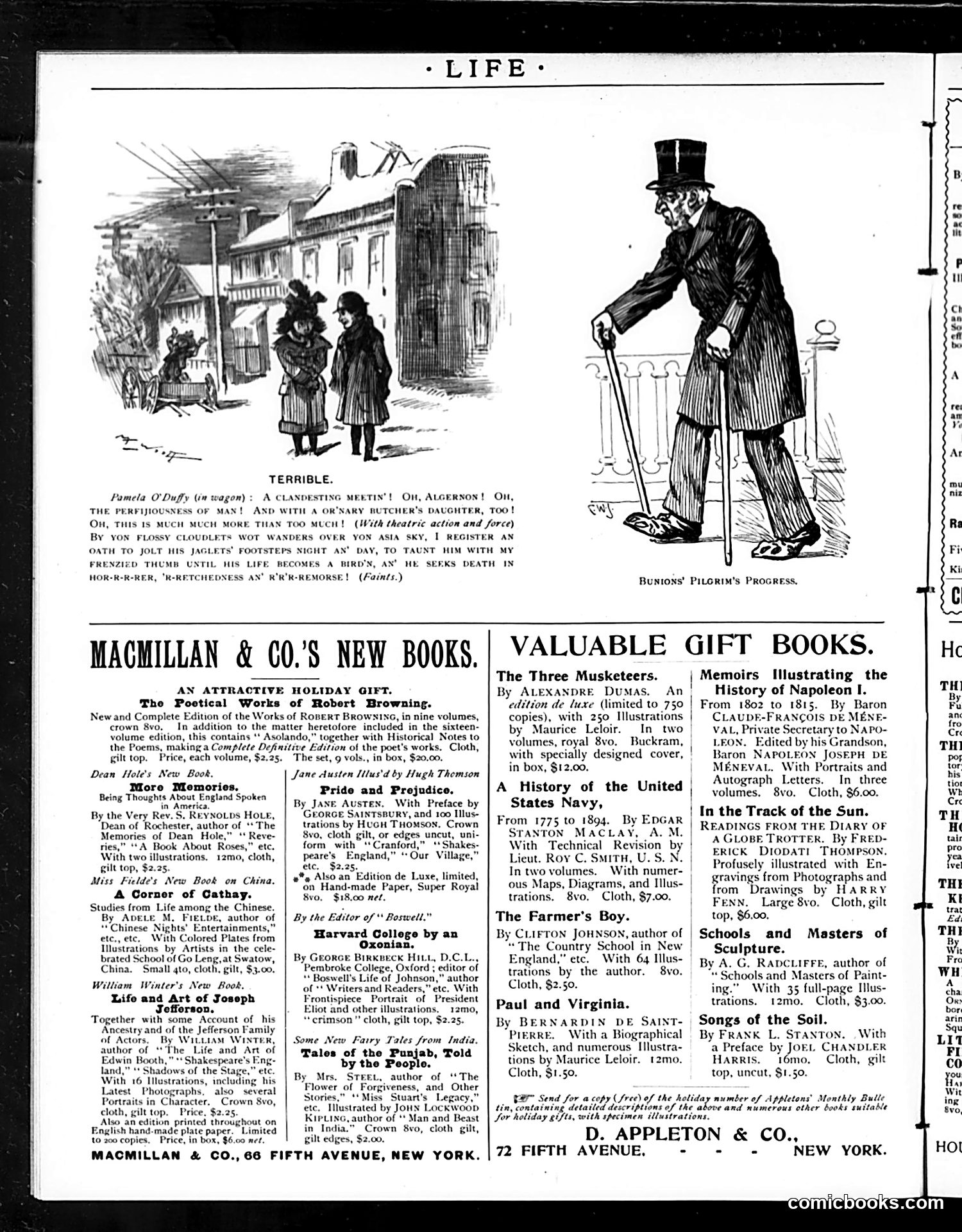
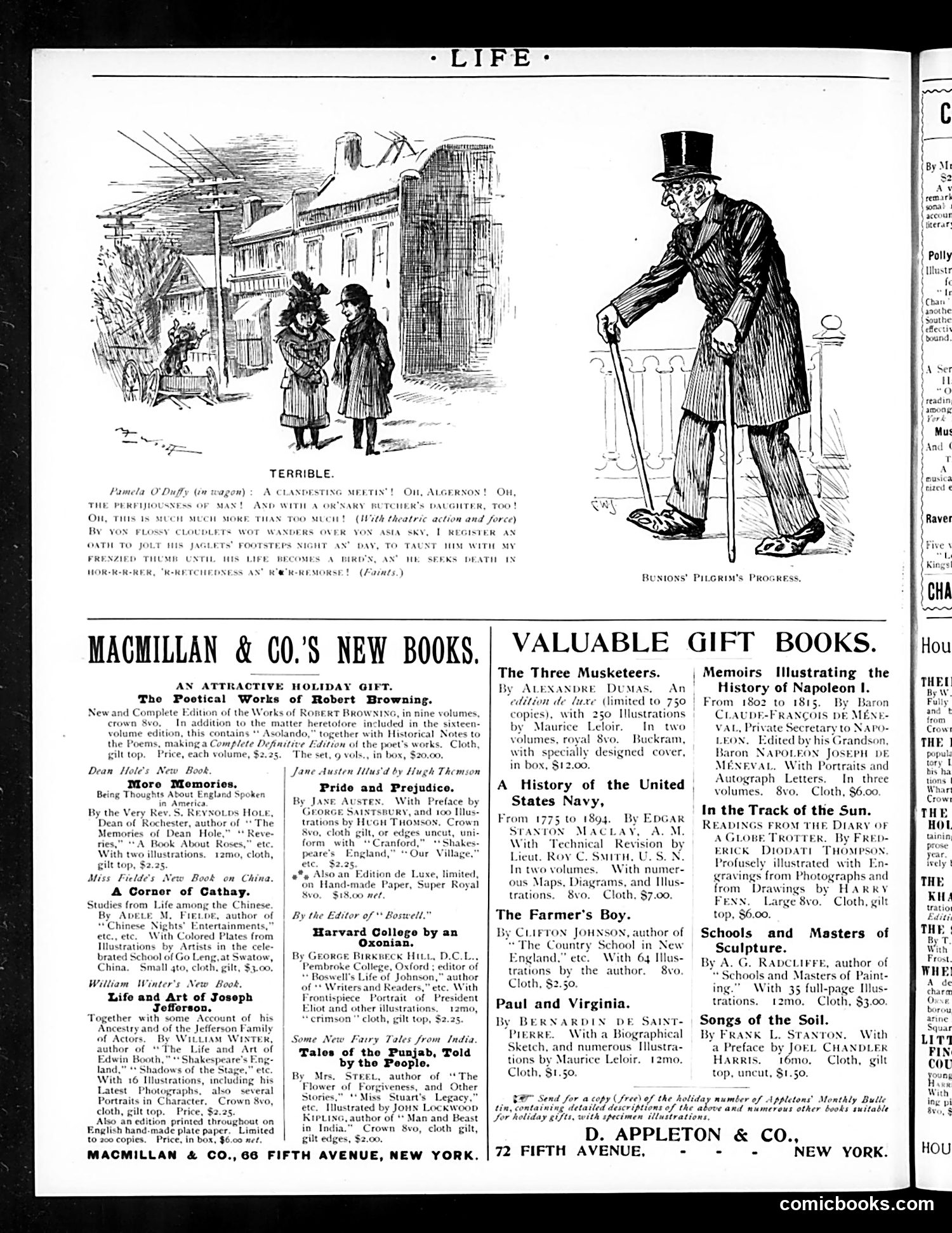
The cartoon depicts a melodramatic social scandal. Pamela O'Duffy, riding in a wagon, has discovered her husband Algernon in a "clandestine meeting" with a butcher's daughter—shocking because she is from the lower working class. This is satire of Victorian upper-class morality and the rigid class system. The humor comes from O'Duffy's absurdly theatrical outrage: she delivers an exaggerated, poetic oath involving "flossy cloudlets" and "jaglets' footsteps," vowing such betrayal should turn her husband into a bird-demon seeking death. Her florid language parodies overwrought dramatic performances and the pretentious moral indignation of aristocrats discovering marital infidelity. The satire targets both class-consciousness (the horror of fraternizing with working people) and the extreme histrionics with which the wealthy express offense to their dignity.
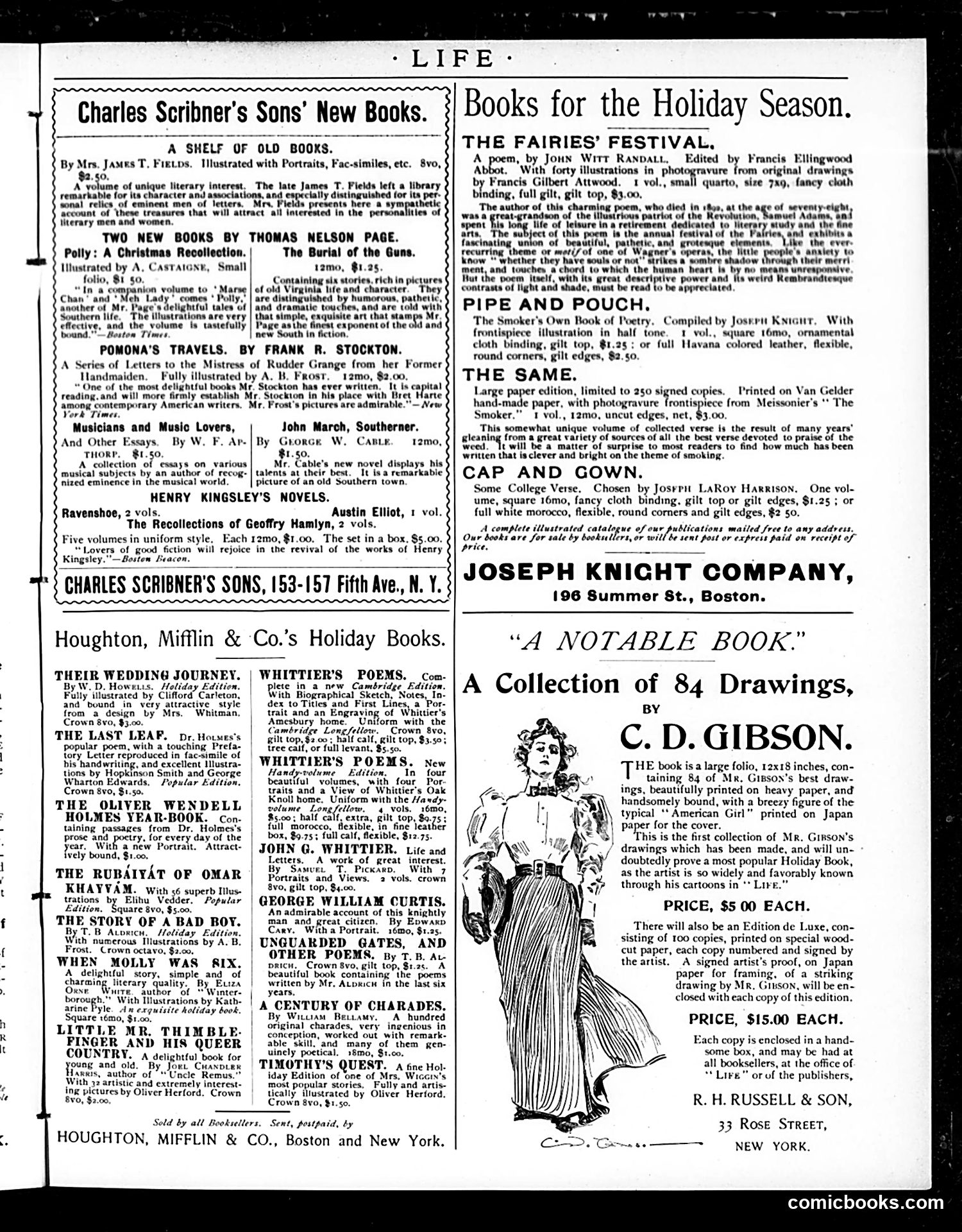
This is primarily a **book advertisement page**, not a satirical cartoon page. It showcases holiday gift books from major publishers (Charles Scribner's Sons and Houghton, Mifflin & Co.) circa late 1800s. The page features literary works by prominent American authors of the period: Thomas Nelson Page (Southern fiction), Frank R. Stockton (humorous tales), George W. Cable (Southern settings), and compilations of work by Oliver Wendell Holmes and John Greenleaf Whittier. One notable item is a **C.D. Gibson drawing collection** — Gibson was famous for illustrating the "Gibson Girl," an idealized American female beauty standard of the era. The advertisement emphasizes the book's artistic prestige and special editions. The content reflects **Victorian-era gift-giving culture**: elaborately bound books with fine illustrations, priced for affluent consumers. For modern readers, this shows how books functioned as luxury status objects and how particular literary figures and artistic styles dominated educated tastes of the period.
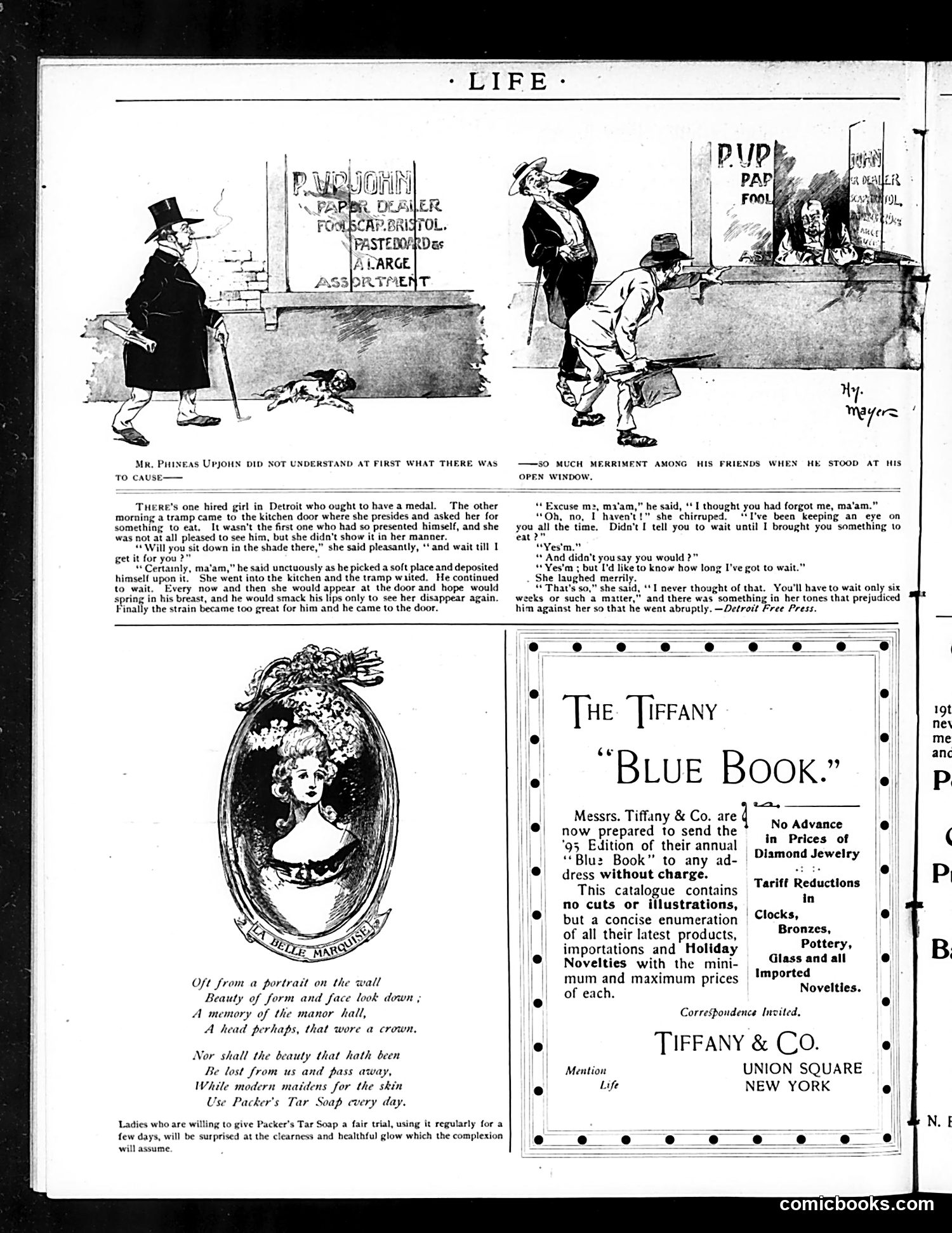
This page contains two unrelated items: **Main Cartoon/Story ("Mr. Phineas Upjohn"):** The top illustration and accompanying text tell a humorous anecdote about a Detroit domestic servant who plays a prolonged prank on a tramp. When he asks for food, she tells him to wait in the shade. She repeatedly appears at the door, raising his hopes, then disappears—torturing him with anticipation. When he finally breaks and asks how long he must wait, she reveals she's been deliberately toying with him the whole time. The joke's point: the servant gets "merriment" (revenge/amusement) at the tramp's expense through psychological manipulation rather than simple refusal. **Advertisement:** The remainder is a Tiffany & Co. advertisement for their "Blue Book" catalog (1895 edition), emphasizing "No Advance in Prices of Diamond Jewelry" and "Tariff Reductions in" imported luxury goods—suggesting contemporary trade policy debate affected jewelry pricing.
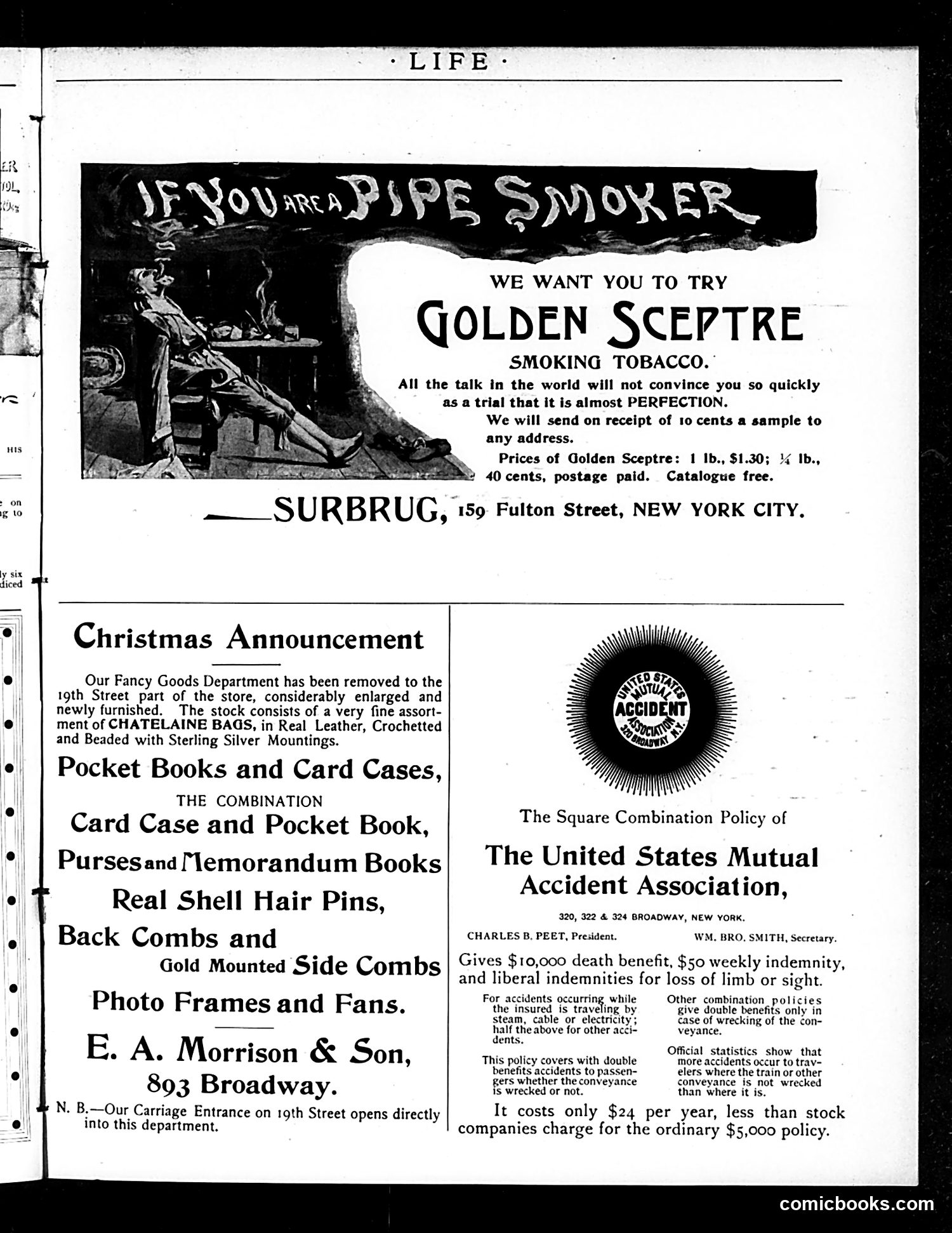
This page is primarily **advertising, not satire or political commentary**. It contains three distinct ads: 1. **Golden Sceptre Smoking Tobacco** (top): A straightforward product advertisement showing a man smoking a pipe, offering a 10-cent sample to potential customers. 2. **E.A. Morrison & Son** (left): A Christmas announcement for fancy goods—leather bags, combs, hair pins, photo frames—relocated to a new department store location on Broadway. 3. **United States Mutual Accident Association** (right): An insurance advertisement highlighting their "Square Combination Policy" offering $10,000 death benefits and weekly indemnity. The ad notably emphasizes that accidents often occur during travel even when conveyances aren't wrecked—a selling point for comprehensive coverage at $24 yearly. The page reflects early 20th-century consumer culture: pipe smoking as respectable leisure, decorative accessories as gift items, and emerging accident insurance as a modern commercial product. There is no apparent satire or caricature present.
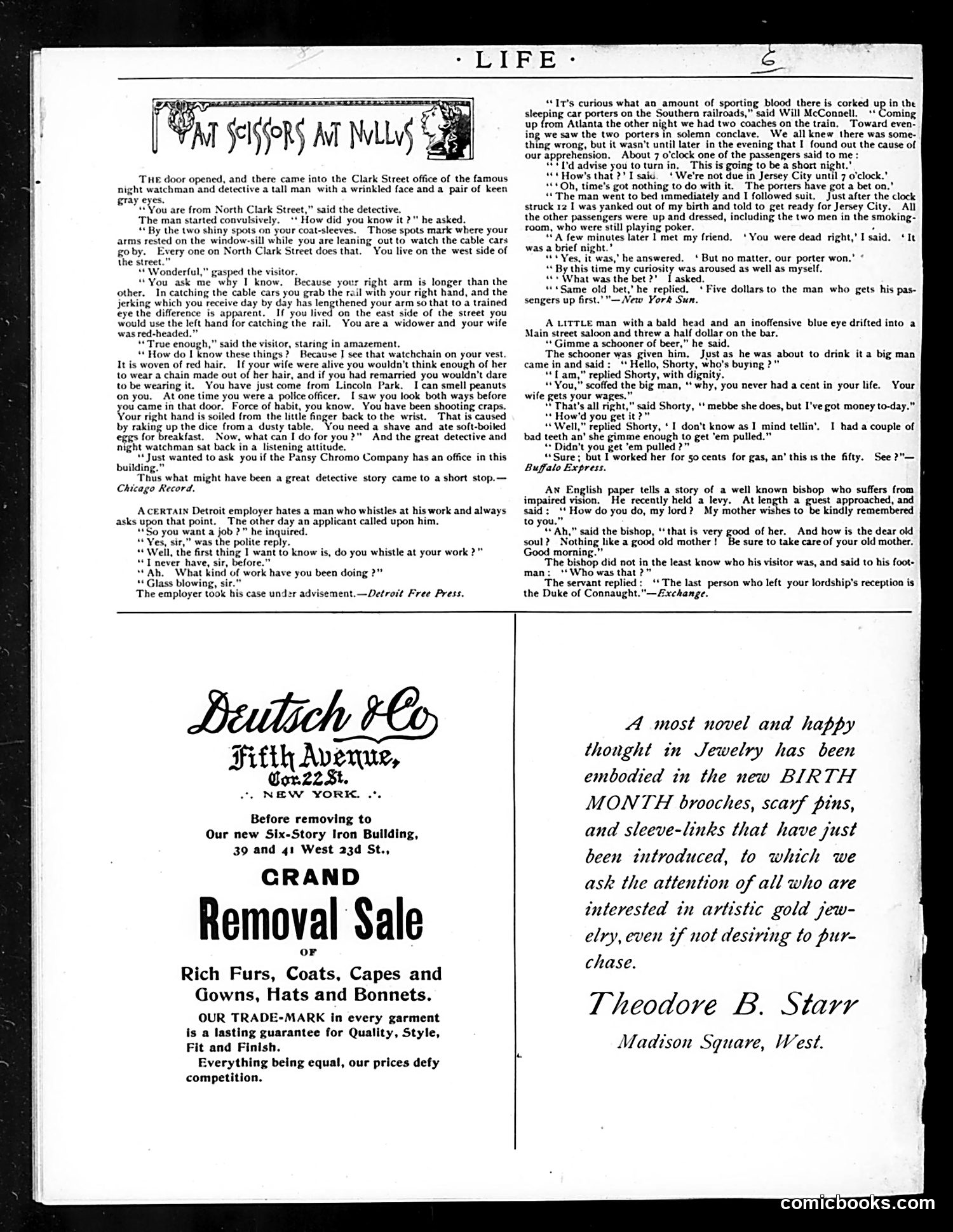
This page contains two humorous short stories mocking detective fiction and job interviews—popular genres of the era. **"Scissors at Nullus"** parodies Sherlock Holmes-style deductive reasoning. A detective makes increasingly absurd deductions about a visitor (cable-car watching, a longer right arm from habit, a red-haired widow based on a watchchain made of hair, peanut smell from Lincoln Park, former policeman status) before the anticlimax: the man merely wants to ask if the Pansy Chromo Company has an office in the building. The satire ridicules overwrought detective fiction's pretension to logic. **"The Employer's Question"** satirizes hiring practices. An employer obsesses over whether applicants whistle while working—a trivial concern presented as grave—until a glass-blower applicant's past work makes the question moot. It mocks arbitrary employer prejudices. The page also contains period advertisements for furs/clothing sales and jewelry, typical of *Life*'s commercial content.

I cannot reliably interpret this page's content. The image is predominantly black with very limited visible text fragments in the margins that appear to be partial OCR errors or corrupted text. The legible portions mention "coming," "looking," "old mother," and a reference to "comicbooks.com," but these fragments are insufficient to identify any cartoon figures, political references, or satirical intent. To accurately explain this Life magazine page's meaning to a modern reader, I would need a clearer image showing the actual cartoon(s) or illustrations, along with more complete OCR text. I cannot responsibly speculate about content I cannot see.