
Life, 1894-12-27 · page 6 of 53
Life — December 27, 1894 — page 6: what you’re looking at
What you’re looking at
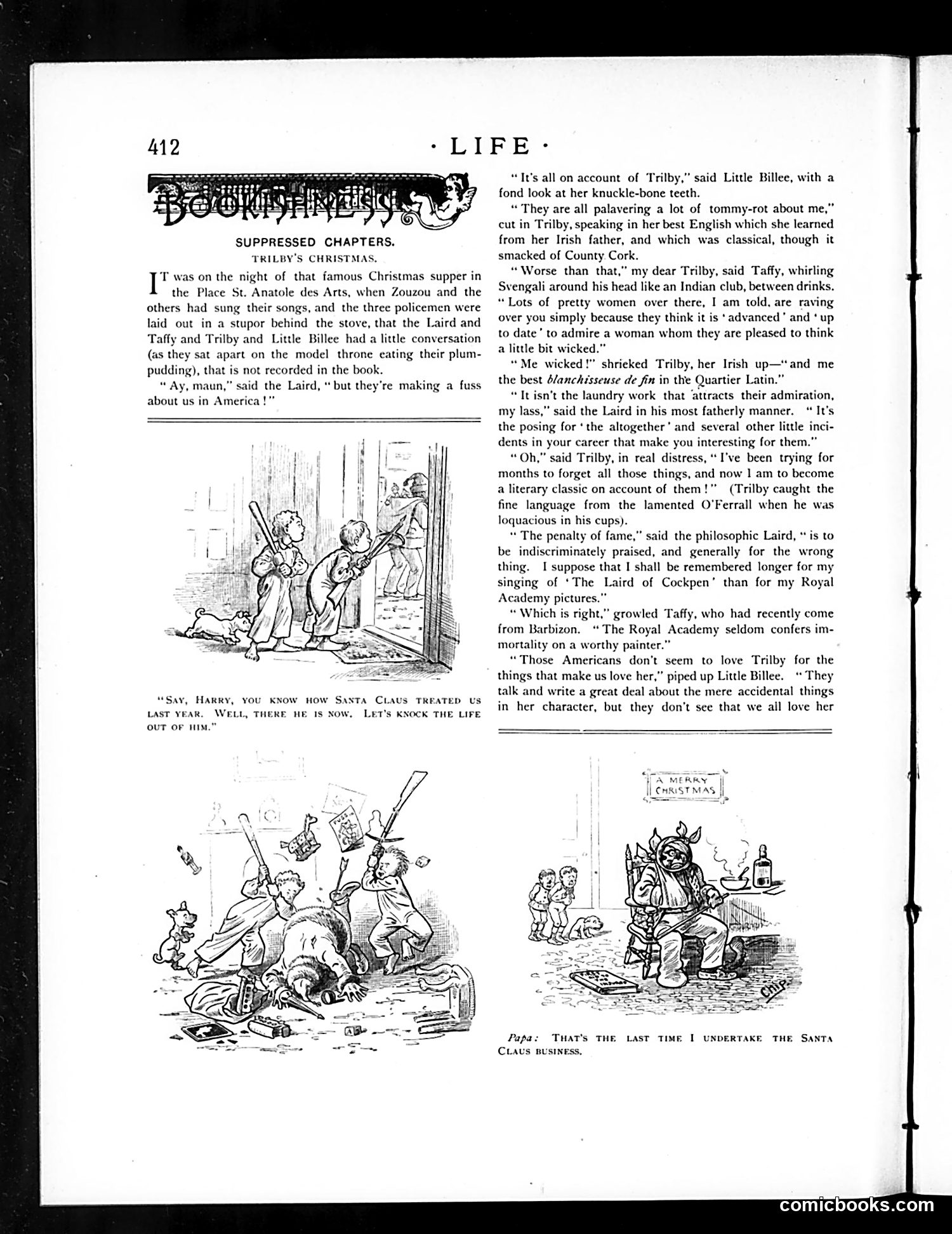
This page presents "Suppressed Chapters: Trilby's Christmas," a satirical story about the character Trilby from George du Maurier's popular novel. The narrative mocks literary pretension and artistic affectation through dialogue between Trilby and other characters (the Laird, Taffy). The satire targets: - **Artistic snobbery**: Characters debate whether being remembered for paintings or literary accomplishments matters more - **Social hypocrisy**: The critique that Americans praise accident-prone characters in fiction while denying such flaws in real people - **Irish stereotypes**: Trilby's Irish father is portrayed in exaggerated dialect The accompanying illustrations show domestic chaos—children wielding weapons, Santa Claus refusing future employment—visualizing the text's humorous critique of pretension versus reality. The joke relies on readers' familiarity with the *Trilby* novel and contemporary literary debates.
📄 Transcribed text from this page (OCR, searchable)
Machine-transcribed from the original scan — historical spelling and the odd misread are preserved.
LIFE: SUPPRESSED CHAPTERS. TRILBY'S CHRISTMAS, T was on the night of that famous Christmas supper in the Place St. Anatole des Arts, when Zouzou and the others had sung their songs, and the three policemen were laid out in a stupor behind the stove, that the Laird and Taffy and Trilby and Little Billee had a little conversation (as they sat apart on the model throne eating their plum- pudding), that is not recorded in the book. “ Ay, maun,” said the Laird, “ but they're about us in America!" making a fuss “Say, HARRY, You KNOW HOW SANTA CLAUS TREATED US LAST YEAR. WELL, THERE HE Is NOW, LET'S KNOCK THE LIFE OUT oF HIM.” “Tr’s all on account of Trilby,” said Little Billee, with a fond look at her knuckle-bone teeth. “ They are all palavering a lot of tommy-rot about me,’ cut in Trilby, speaking in her best English which she learned from her Irish father, and which was classical, though it smacked of County Cork. “Worse than that,” my dear Trilby, said Taffy, whirling Svengali around his head like an Indian club, between drinks. “Lots of pretty women over there, I am told, are raving over you simply because they think it is ‘advanced’ and ‘ up to date’ to admire a woman whom they are pleased to think a little bit wicked.” “Me wicked!" shrieked Trilby, her Irish up—‘tand me the best d/anchésseuse de fin in the Quartier Latin.” “It isn’t the laundry work that ‘attracts their admiration, my lass,” said the Laird in his most fatherly manner.“ It's the posing for ‘the altogether’ and several other little inci- dents in your career that make you interesting for them.” “Oh,” said Trilby, in real distress, “I've been trying for months to forget all those things, and now | am to become a literary classic on account of them!"" (Trilby caught the fine language from the lamented O'Ferrall when he was loquacious in his cups). “ The penalty of fame,” said the philosophic Laird, * is to be indiscriminately praised, and generally for the wrong thing. I suppose that I shall be remembered longer for my singing of ‘The Laird of Cockpen’ than for my Royal Academy pictures.” “ Which is right,” growled Taffy, who had recently come from Barbizon. “The Royal Academy seldom confers im- mortality on a worthy painter.” “Those Americans don't seem to love Trilby for the things that make us love her,” piped up Little Billee. “ They talk and write a great deal about the mere accidental things in her character, but they don’t see that we all love her Papa: TMaT’s THE Last TIME IT UNDERTAKE THE SANTA CLAUS BUSINESS, comicbooks.com