
Life, 1894-12-27 · page 13 of 53
Life — December 27, 1894 — page 13: what you’re looking at
What you’re looking at
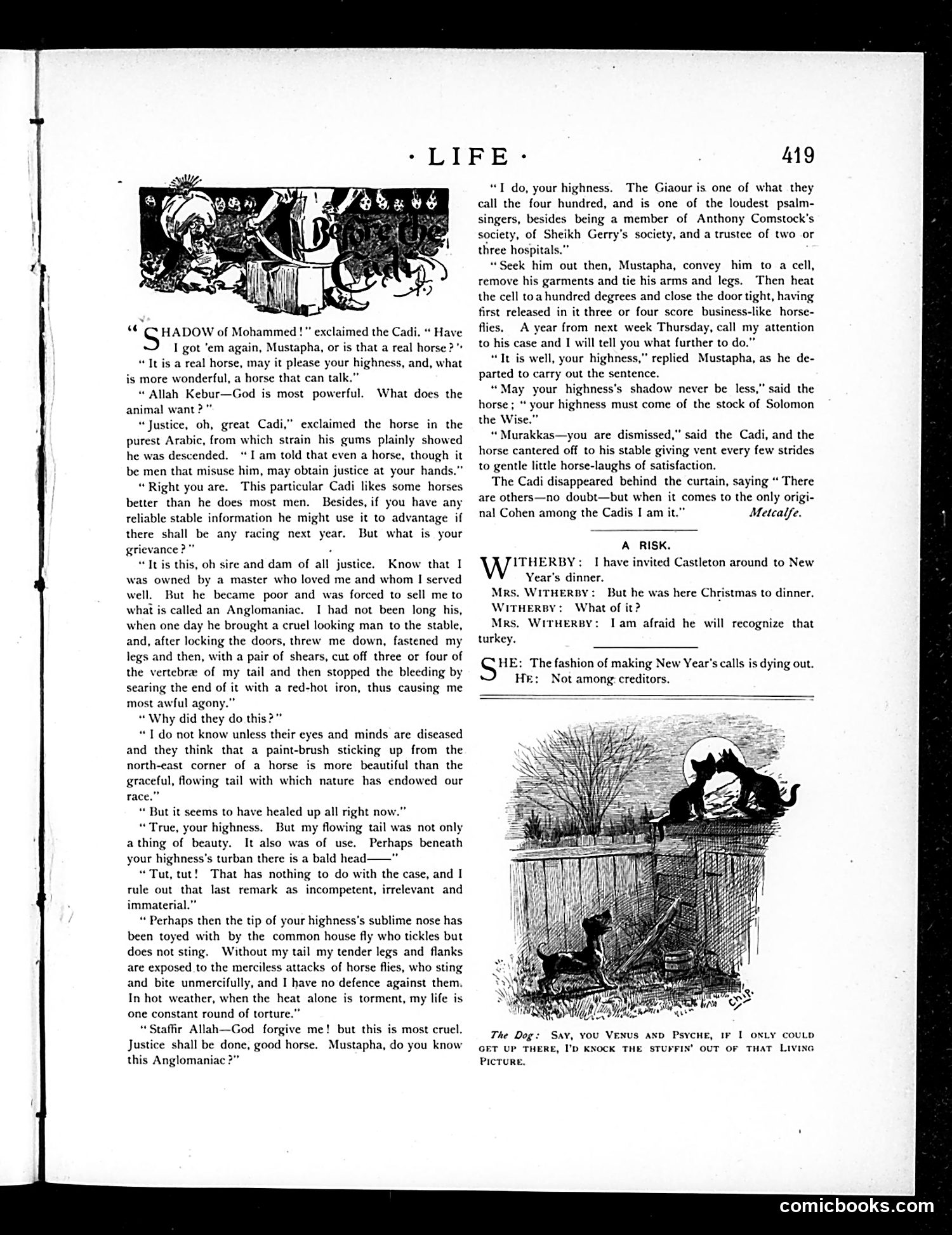
This is a satirical fantasy story where a talking horse brings a complaint to a Muslim judge (Cadi) against his wealthy owner, an "Anglomaniac" who docked the horse's tail for fashion. The satire targets **Victorian upper-class hypocrisy**. The offending owner is described as a member of "the four hundred" (high society), an Anthony Comstock society member (Comstock was a famous moral crusader), and a church trustee—yet he cruelly mutilates animals for aesthetics. The joke exposes the gap between public piety and private cruelty: respectable society condemns immorality while inflicting pointless suffering on animals. The Cadi's absurdly harsh punishment—locking the man in a hot cell with horse-flies—serves poetic justice. The story also pokes fun at fashion trends of docking horses' tails, which was actually practiced in the era but served no practical purpose beyond appearance.
📄 Transcribed text from this page (OCR, searchable)
Machine-transcribed from the original scan — historical spelling and the odd misread are preserved.
* LIFE: se HADOW of Mohammed !” exclaimed the Cadi. “ Have I got ‘em again, Mustapha, or is that a real horse ?” “It is a real horse, may it please your highness, and, what is more wonderful, a horse that can talk.” “ Allah Kebur—God is most powerful. animal want?” “Justice, oh, great Cadi,” exclaimed the horse in the purest Arabic, from which strain his gums plainly showed he was descended, “I am told that even a horse, though it be men that misuse him, may obtain justice at your hands.” “Right you are. This particular Cadi likes some horses better than he does most men. Besides, if you have any reliable stable information he might use it to advantage if there shall be any racing next year. But what is your grievance?” e “Itis this, oh sire and dam of all justice. Know that I was owned by a master who loved me and whom I served well. But he became poor and was forced to sell me to what is called an Anglomaniac. I had not been long his, when one day he brought a cruel looking man to the stable, and, after locking the doors, threw me down, fastened my legs and then, with a pair of shears, cut off three or four of the vertebra of my tail and then stopped the bleeding by searing the end of it with a red-hot iron, thus causing me most awful agony.” “Why did they do this?” “ T do not know unless their eyes and minds are diseased and they think that a paint-brush sticking up from the north-east corner of a horse is more beautiful than the graceful, flowing tail with which nature has endowed our race. But it seems to have healed up all right no’ “ True, your highness. But my flowing tail was not only athing of beauty. It also was of use. Perhaps beneath your highness’s turban there is a bald head—" “Tut, tut! That has nothing to do with the case, and I rule out that last remark as incompetent, irrelevant and immaterial.” “ Perhaps then the tip of your highness’s sublime nose has been toyed with by the common house fly who tickles but does not sting. Without my tail my tender legs and flanks are exposed to the mercile: ies, who sting and bite unmercifully, and I have no defence against them. In hot weather, when the heat alone is torment, my life is one constant round of torture.” “Staffir Allah—God forgive me! but this is most cruel. Justice shall be done, good horse. Mustapha, do you know this Anglomaniac ?” What does the 419 “T do, your highness. The Giaour is one of what they call the four hundred, and is one of the loudest psalm- singers, besides being a member of Anthony Comstock’s society, of Sheikh Gerry's society, and a trustee of two or three hospitals. “Seek him out then, Mustapha, convey him to a cell, remove his garments and tie his arms and legs. Then heat the cell toa hundred degrees and close the door tight, having first released in it three or four score business-like horse- flies. A year from next week Thursday, call my attention to his case and I will tell you what further to do.” “It is well, your highness,” replied Mustapha, as he de- parted to carry out the sentence, “May your highne: shadow never be less,” said the horse ; “ your highness must come of the stock of Solomon the Wise.” “Murakkas—you are dismissed,” said the Cadi, and the horse cantered off to his stable giving vent every few strides to gentle little horse-laughs of satisfaction. The Cadi disappeared behind the curtain, saying “ There are others—no doubt—but when it comes to the only origi- nal Cohen among the Cadis I am it.” Metcalfe. A RISK. WV BERBY: I have invited Castleton around to New Year's dinner. Mrs, WITHERBY: But he was here Christmas to dinner. WITHERB What of it? Mrs. WITHERBY: [am afraid he will recognize that turkey. HE: The fashion of making New Year's calls is dying out. HE: Not among. creditors. The Dog: SAY, You VENUS AND PsycHe, IF I ONLY COULD GET UP THERE, I'D KNOCK THE STUFFIN' OUT OF THAT LIVING Picture. comicbooks.com