
Life, 1894-12-27 · page 10 of 53
Life — December 27, 1894 — page 10: what you’re looking at
What you’re looking at
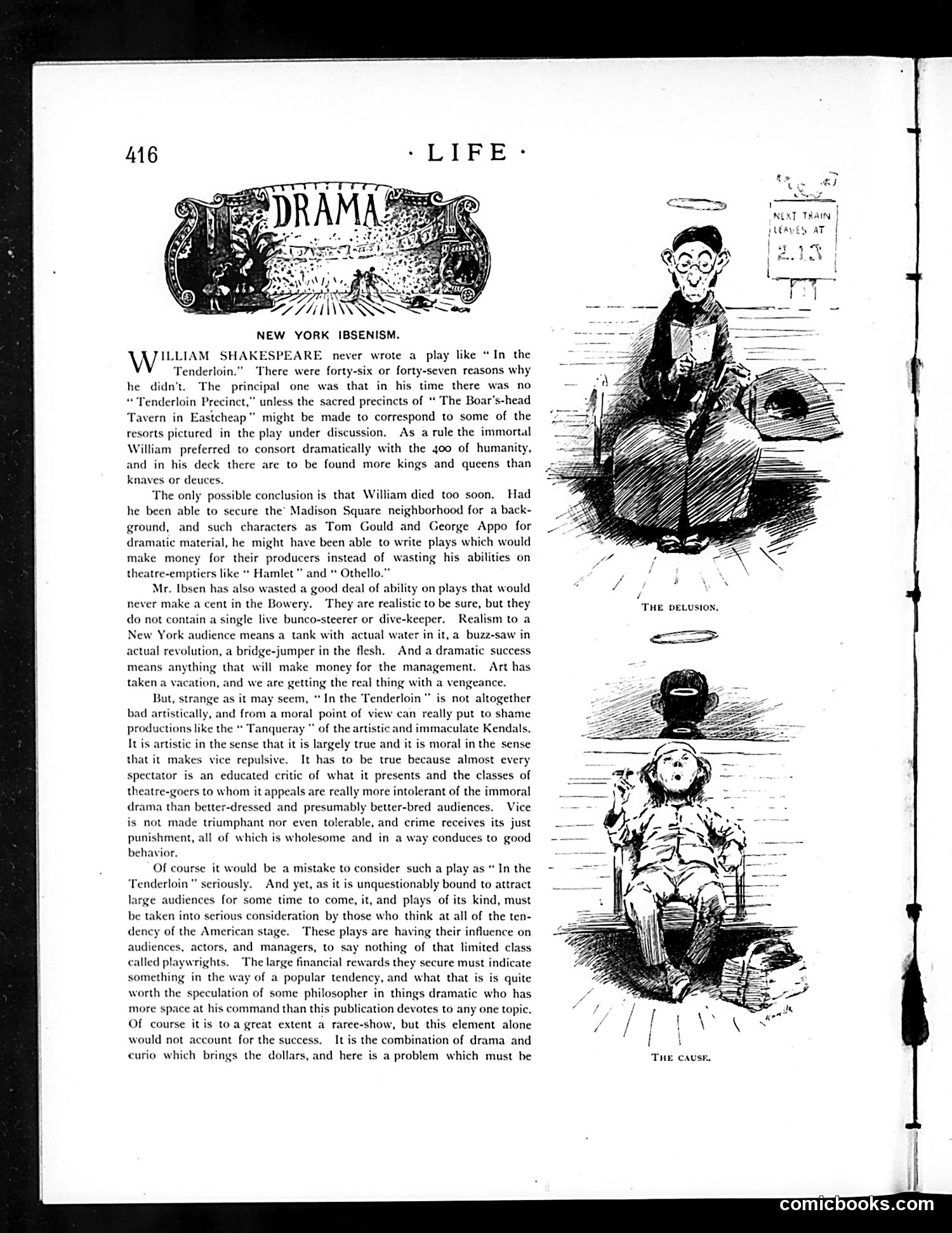
This page discusses William Shakespeare's play "In the Tenderloin," a New York-based dramatic work. The text criticizes Shakespeare for never writing a play set in the Tenderloin neighborhood—a real area of Manhattan known for vice and crime. The three accompanying sketches on the right appear to illustrate scenes from "In the Tenderloin," labeled "The Delusion," "The Cause," depicting what seem to be working-class or street characters typical of that neighborhood. The article argues that realistic New York drama should appeal to audiences seeking authentic depictions of city life rather than artificial theatrical conventions. The satire critiques both the play's artistic merit and its commercial viability, suggesting that realistic urban drama—combining spectacle with moral instruction—represents the future of American theater.
📄 Transcribed text from this page (OCR, searchable)
Machine-transcribed from the original scan — historical spelling and the odd misread are preserved.
NUN Me, 6 77771) \\WWRS NEW YORK IBSENISM. V ILLIAM SHAKESPEARE never wrote a play like “In the Tenderloin.” There were forty-six or forty-seven reasons why he didn’t. The principal one was that in his time there was no “Tenderloin Precinct,” unless the sacred precincts of “ The Boar's-head Tavern in Eastcheap” might be made to correspond to some of the resorts pictured in the play under discussion, As a rule the immortal William preferred to consort dramatically with the 4oo of humanity, and in his deck there are to be found more kings and queens than kna or deuces. The only possible conclusion is that William died too soon. Had he been able to secure the’ Madison Square neighborhood for a back- ground, and such characters as Tom Gould and George Appo for dramatic material, he might have been able to write plays which would make money for their producers instead of wasting his abilities on theatre-emptiers like “ Hamlet" and “ Othello.” Mr. Ibsen has also wasted a good deal of ability on plays that would never make a cent in the Bowery. They are realistic to be sure, but they do not contain a single live bunco-steerer or dive-keeper. Realism to a New York audience means a tank with actual water in it, a buzz-saw in actual revolution, a bridge-jumper in the flesh. And a dramatic success means ything that will make money for the management. Art has taken a vacation, and we are getting the real thing with a vengeance. But, strange as it may seem, “In the Tenderloin” is not altogether bad artistically, and from a moral point of view can really put to shame productions like the * Tanqueray " of the artistic and immaculate Kendals. It is artistic in the sense that it is largely true and it is moral in the sense that it makes vice repulsive. It has to be true because almost every spectator is an educated critic of what it presents and the classes of theatre-goers to whom it appeals are really more intolerant of the immoral drama than better-dressed and presumably better-bred audiences. Vice is not made triumphant nor even tolerable, and crime receives its just punishment, all of which is wholesome and in a way conduces to good behavior. Of course it would be a mistake to consider such a play as * In the Tenderloin” seriously. And yet, as it is unquestionably bound to attract large audiences for some time to come, it, and plays of its kind, must be taken into serious consideration by those who think at all of the ten- dency of the American stage. ‘These plays are having their influence on audiences, actors, and managers, to say nothing of that limited cl called playwrights. The large financial rewards they secure must indicate something in the way of a popular tendency, and what that is is quite worth the speculation of some philosopher in things dramatic who has more space at his command than this publication devotes to any one topic. Of course it is to a great extent a raree-show, but this element alone would not account for the success. It is the combination of drama and curio which brings the dollars, and here is a problem which must be ‘THE caus. comicbooks.com