
A complete issue · 24 pages · 1894
Life — November 22, 1894
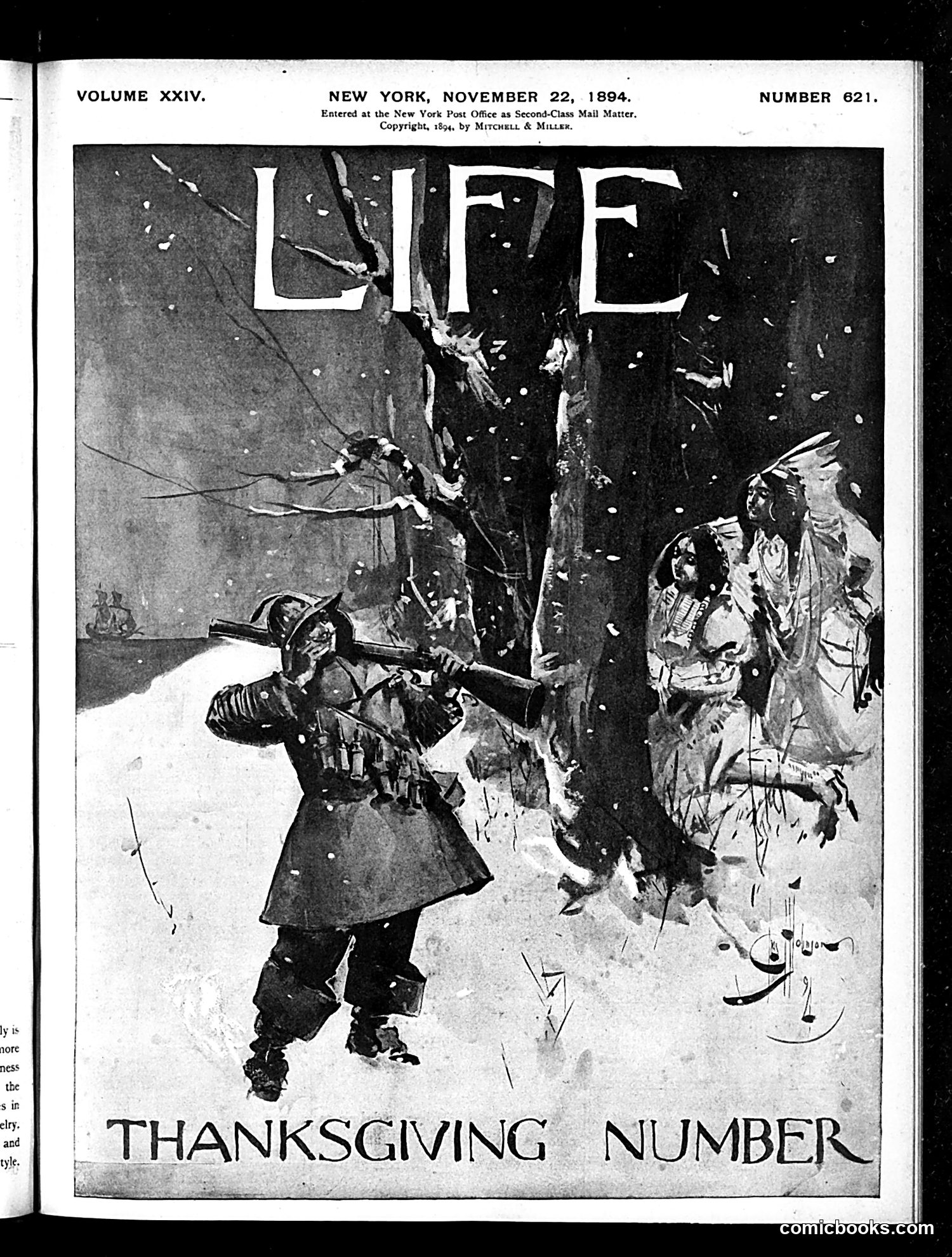
This is the cover of Life's Thanksgiving issue. The illustration depicts a hunter in winter clothing aiming a rifle at what appears to be Native Americans in the snowy landscape. The image draws on historical frontier imagery associated with Thanksgiving narratives. The satirical intent is unclear from the image alone, but the juxtaposition of a hunter with Indigenous peoples during a "Thanksgiving Number" likely critiques or comments on the mythology surrounding the holiday's origins. The 1894 date places this during a period of intense Native American displacement and the final years of frontier conflicts. Without additional text from the issue, the specific political message—whether it mocks settlers, critiques Thanksgiving mythology, or references contemporary events—cannot be determined with certainty.
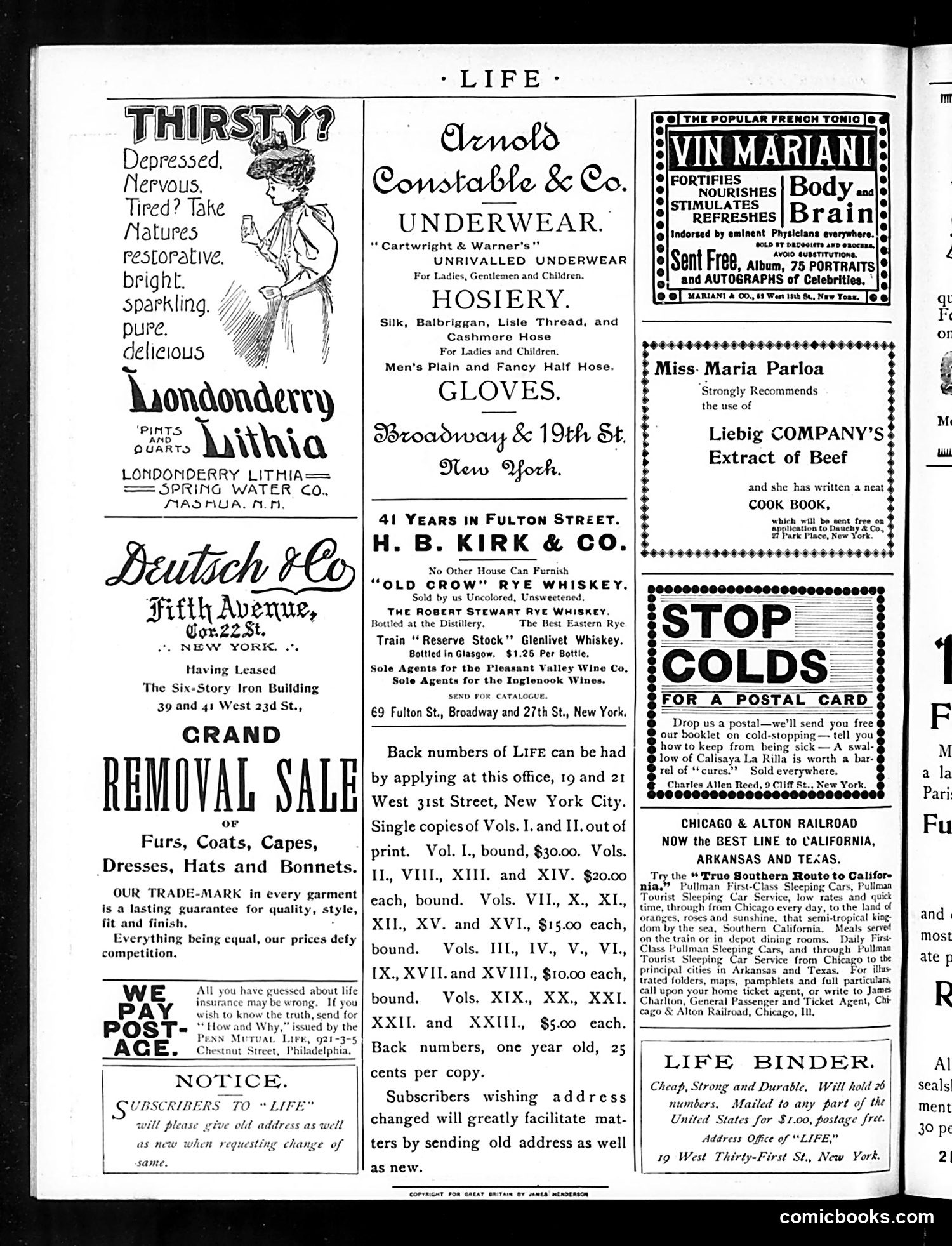
This page is primarily **advertising**, not editorial content or political satire. The dominant elements are commercial notices: - **Londonderry Lithia** (beverage) advertisement claims restorative benefits for those who are "Depressed, Nervous, Tired" - **Arnold Constable & Co.** advertises undergarments, hosiery, and gloves - **H.B. Kirk & Co.** promotes whiskey and wine - **Deutsch & Co.** announces a furniture store removal sale - **Liebig Company** features a celebrity endorsement from Miss Maria Parloa for beef extract - A "Stop Colds" patent medicine advertisement The only illustration—a woman in the Londonderry ad—is a generic marketing image, not political satire. This appears to be a typical **turn-of-the-century Life magazine page** dominated by commercial advertisements rather than editorial cartoons.
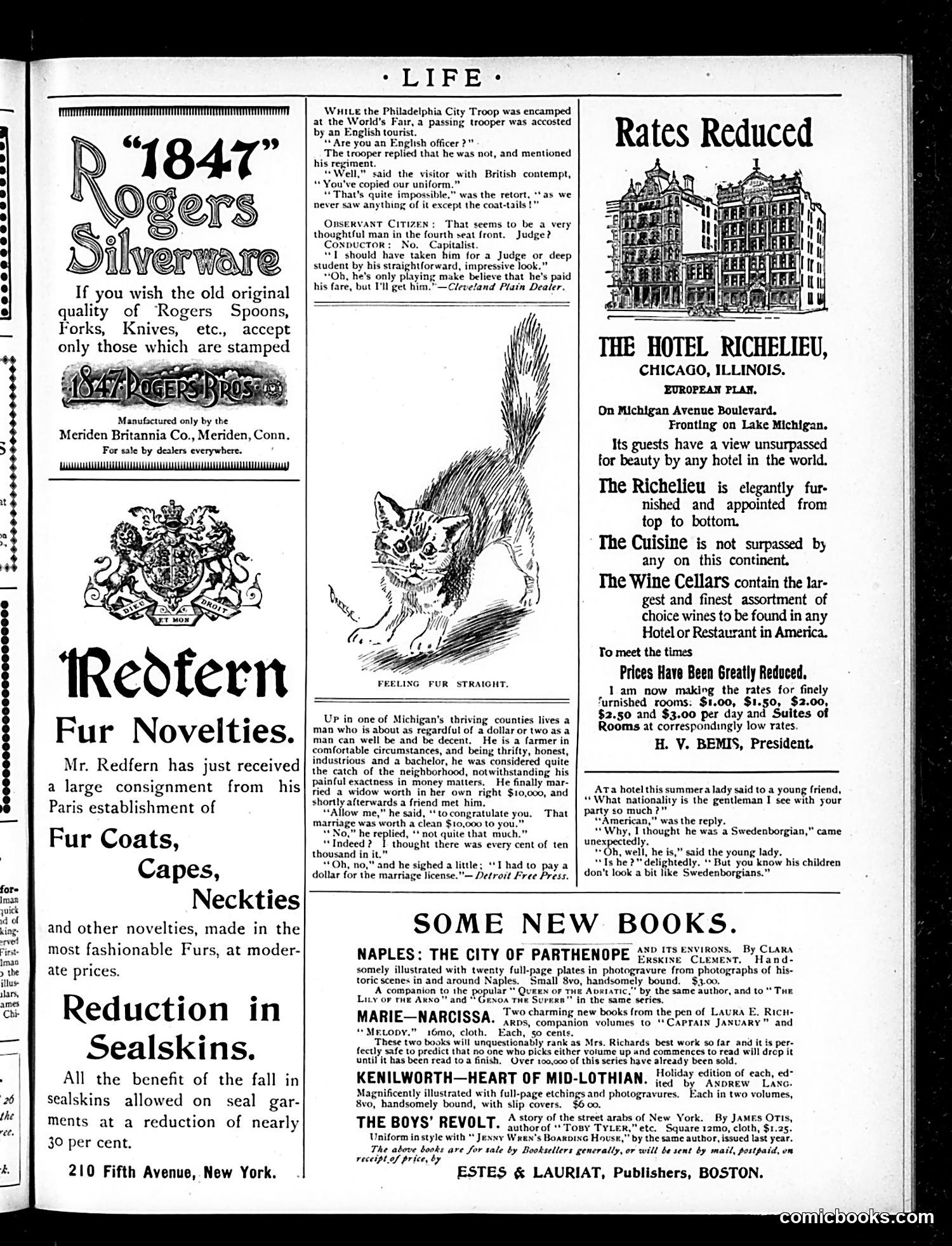
This page is primarily **advertisements** for silverware, fur novelties, and books, with minimal satirical content. The only cartoon depicts a cat with raised fur, captioned "FEELING FUR STRAIGHT." The accompanying text describes a humorous anecdote: a Philadelphia City Troop soldier encounters an English officer at the World's Fair who dismissively claims Americans copied British uniforms. The soldier retorts that they didn't copy uniforms—"we never saw anything of it except the coat-tails!" The joke references Anglo-American tensions and suggests Americans bested the English militarily (likely the Revolutionary War), with the cat's bristling fur humorously illustrating the soldier's indignant reaction. The satire mocks British condescension toward American culture.
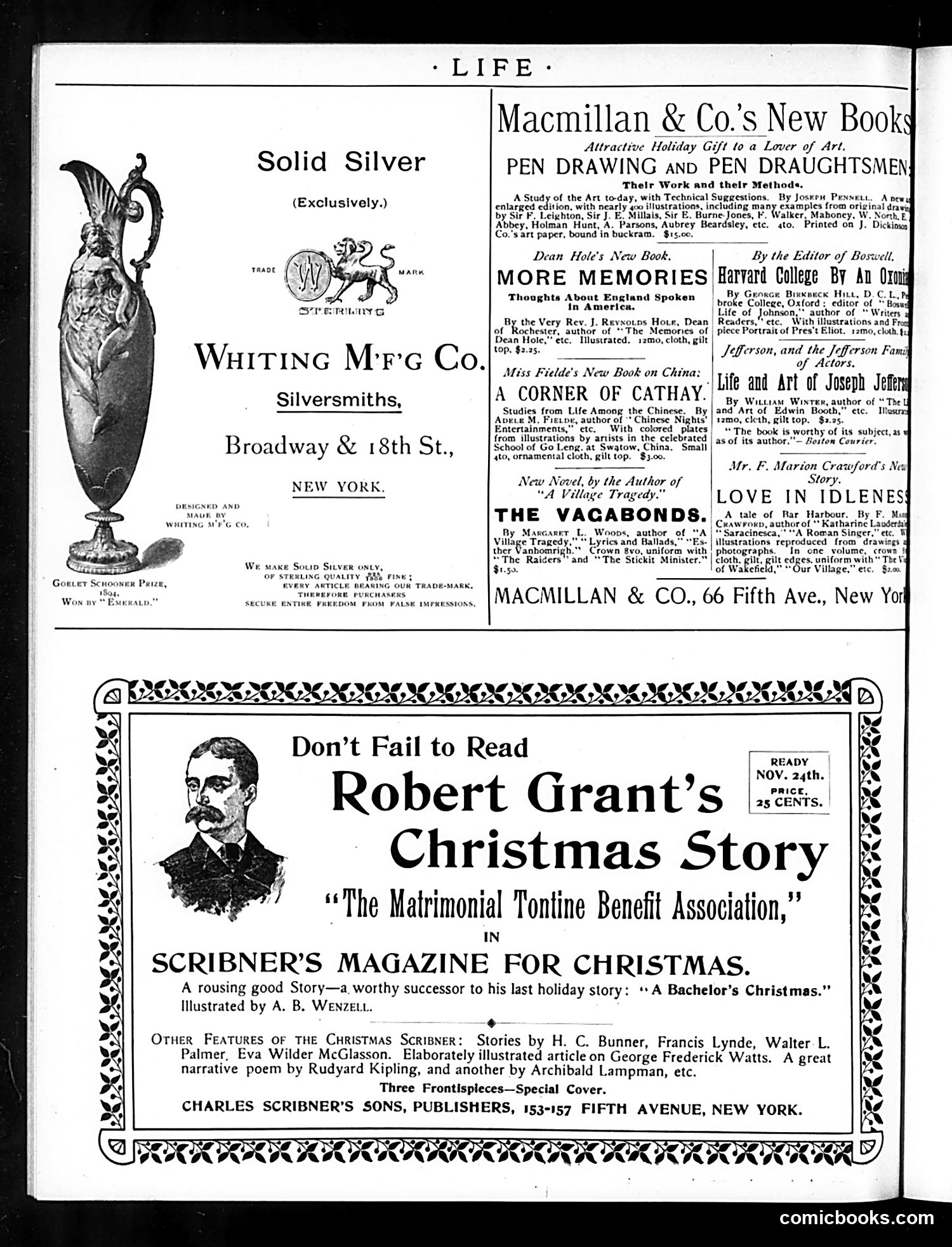
This page contains primarily **advertisements** rather than political cartoons or satire. The content includes: 1. **Whiting Manufacturing Co.** advertisement for solid silver goods (top left) 2. **Macmillan & Co.'s book advertisements** (top right), featuring titles on art, China, and literature 3. **Robert Grant's Christmas Story** advertisement (bottom), promoting his tale "The Matrimonial Tonline Benefit Association" appearing in *Scribner's Magazine for Christmas* The only illustrative element is a portrait of author Robert Grant accompanying his story advertisement. There is **no political satire or cartoon commentary** visible on this page—it functions primarily as a commercial advertising section within *Life* magazine, likely from a November/December issue given the Christmas story promotion.
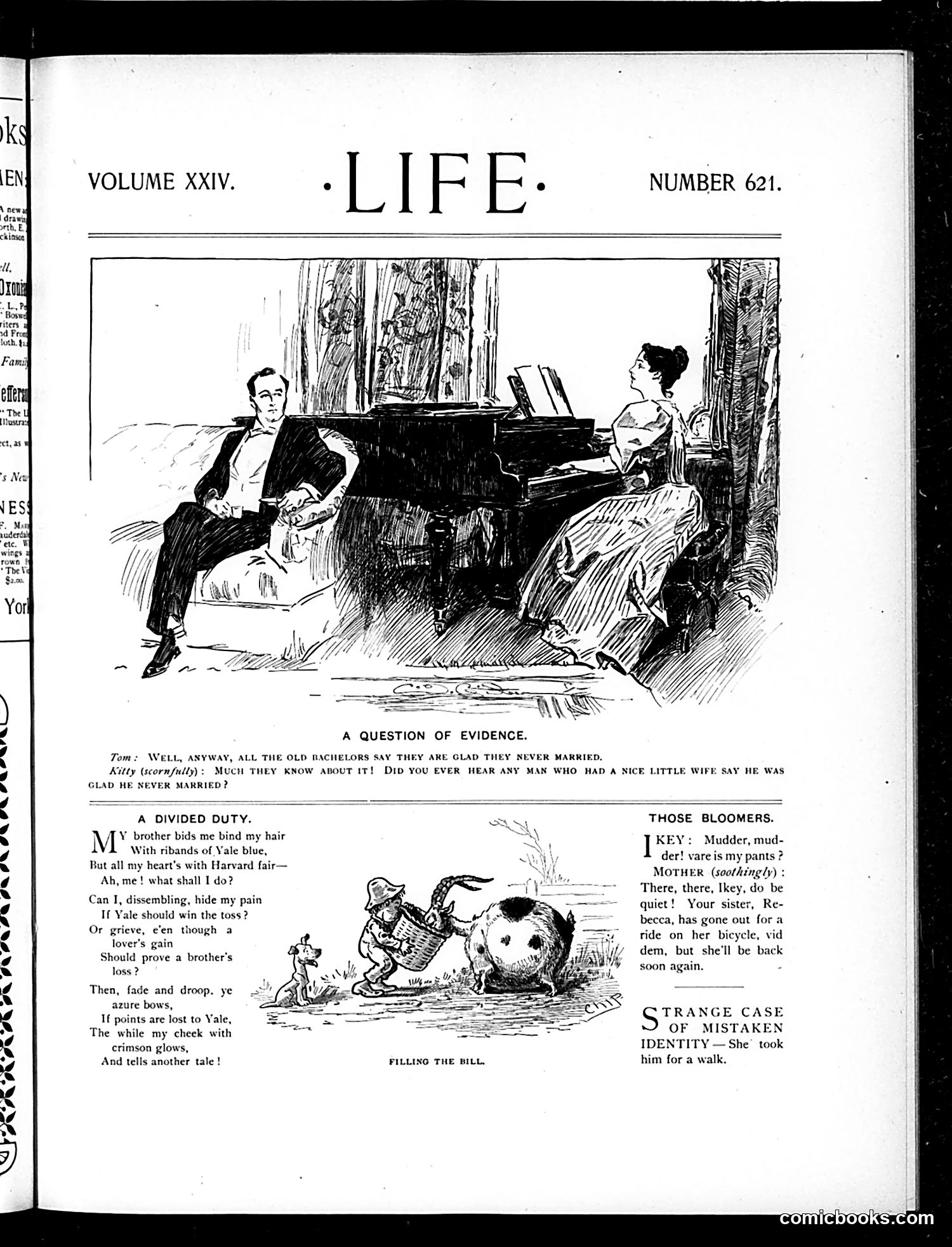
This page contains three separate humor pieces from Life's satirical section: **"A Question of Evidence"** (top): A domestic scene where a man defends unmarried life to a woman. The joke plays on bachelor stereotypes—men claim bachelorhood is preferable, though the woman's skeptical expression suggests she disagrees with this assertion. **"A Divided Duty"** (left): A poem about conflicting loyalties between Harvard and Yale universities, likely referencing the intense rivalry between these institutions. The accompanying illustration shows someone "filling the bill"—unclear exactly what this references without additional context. **"Those Bloomers"** and **"Strange Case of Mistaken Identity"** (right): Brief humor pieces about women's fashions and social situations, typical of the magazine's light domestic satire. These represent Life's standard early-20th-century humor format: domestic situations and social commentary.
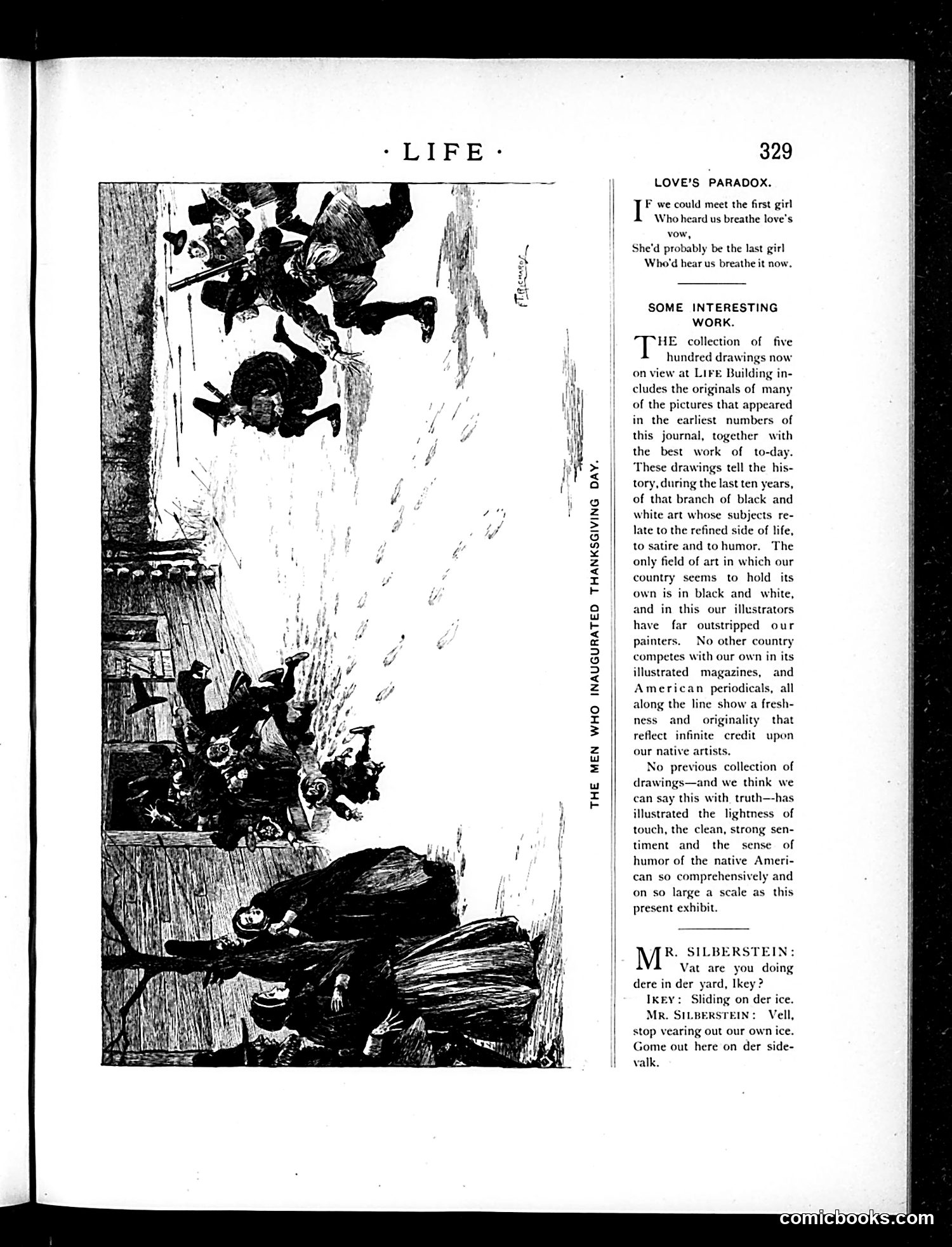
This page contains three distinct sections: a poem titled "Love's Paradox," an article about a collection of drawings, and a brief comedic dialogue. The main illustration is a black and white drawing showing what appears to be a winter scene with figures on ice. The caption reads "The Men Who Inaugurated Thanksgiving Day," suggesting a historical or satirical reference to Thanksgiving's origins. The dialogue at bottom features "Mr. Silberstein" and "Ikey" discussing ice-skating in a yard, employing what appears to be period Yiddish-influenced English dialect humor—a common comedic device in early 20th-century American magazines. The article praises American illustrators' superiority in black-and-white drawing compared to other countries, reflecting contemporary American cultural pride in native artistic achievement.
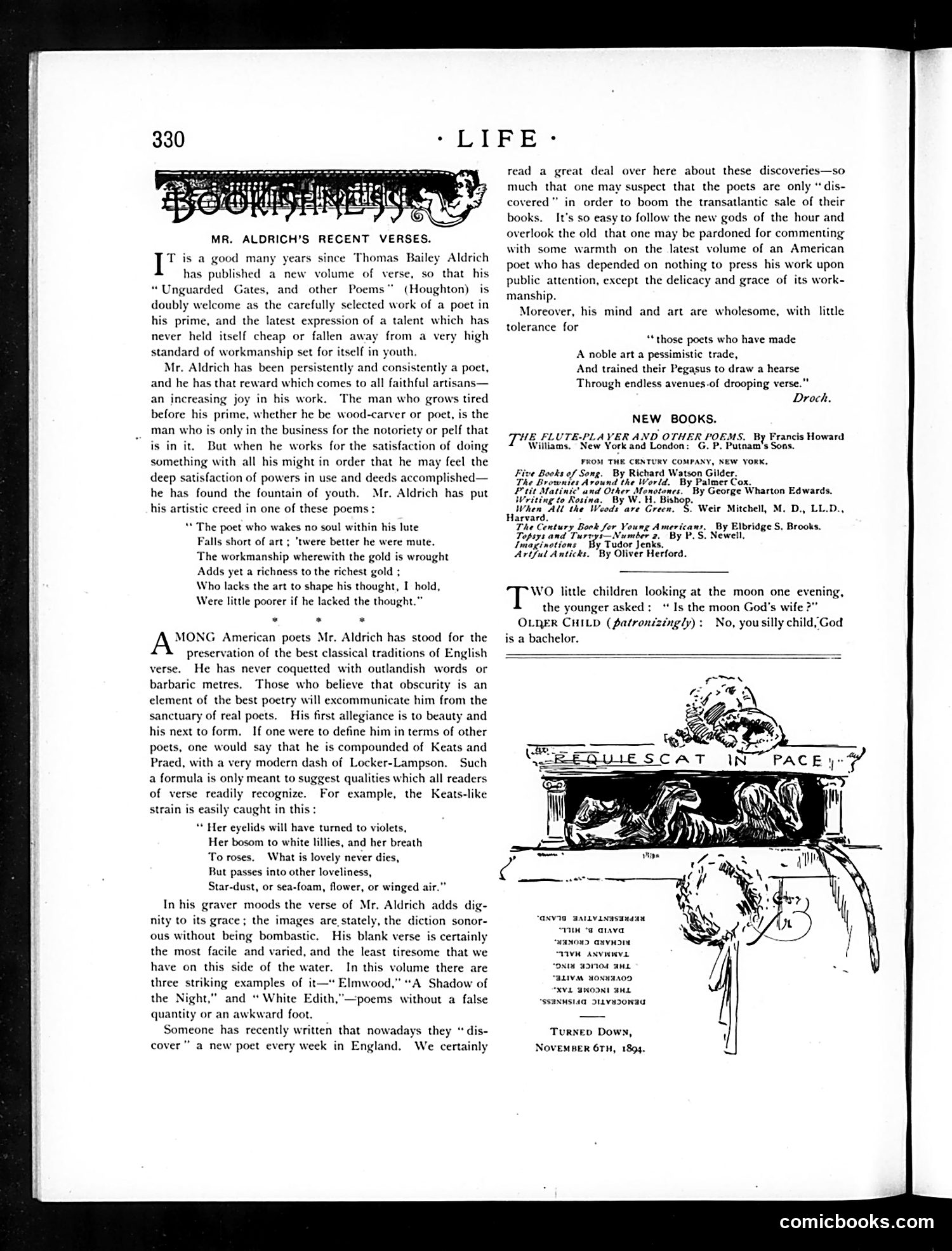
This page is primarily a **book review** of Thomas Bailey Aldrich's poetry collection "Unguarded Gates and Other Poems," not a political cartoon. The left column contains critical commentary praising Aldrich as a careful, classical poet who maintains high standards of craftsmanship. The **only illustration** is a decorative vignette titled "Requiescat in Pace" (Rest in Peace) showing a reclining cat on a classical pediment. Below it is a humorous poem about the cat's death, with text appearing upside-down. This is a lighthearted tribute to a deceased pet, not political satire. The page includes a brief joke about the moon and marriage at the bottom, unrelated to the main content.
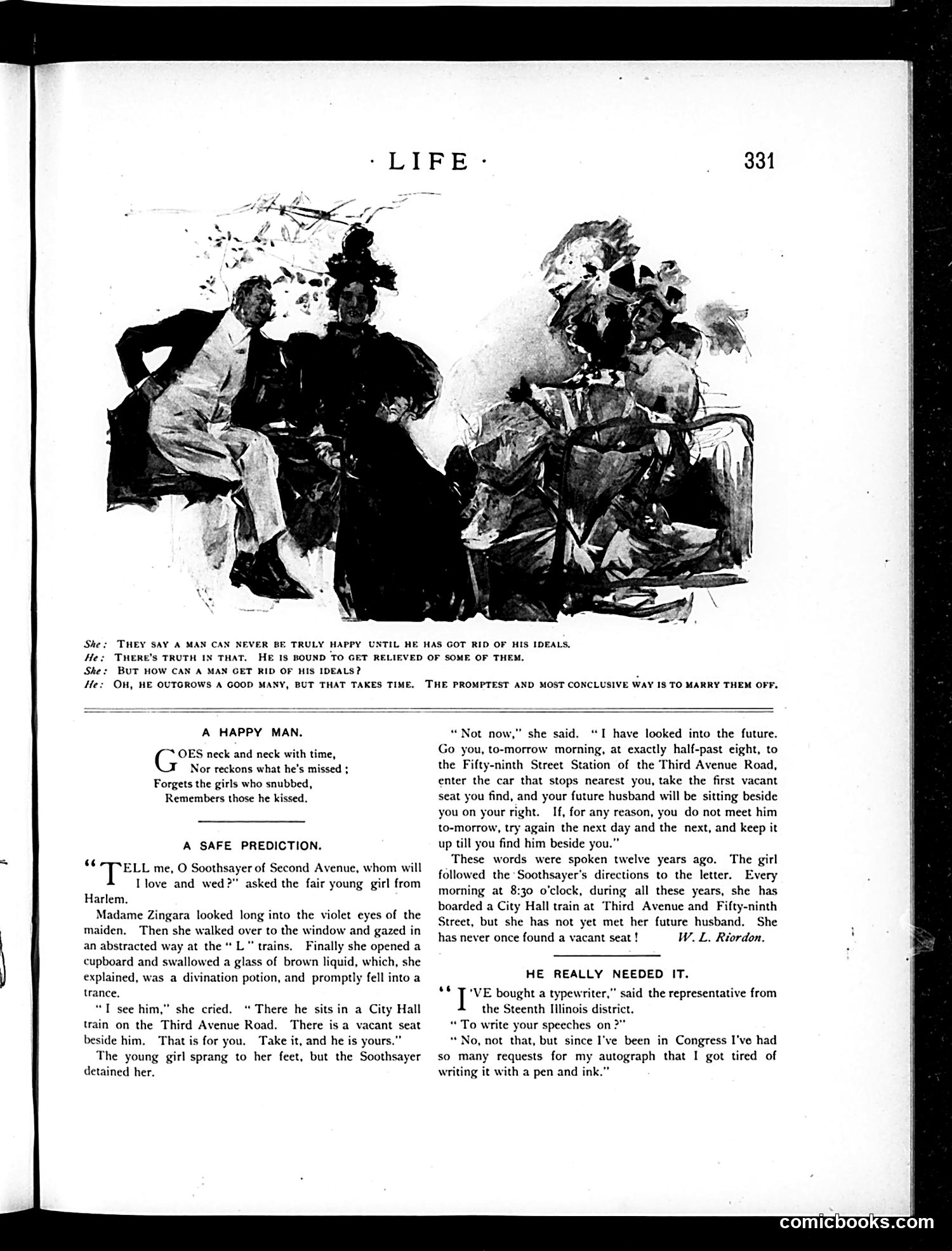
The top illustration shows a social conversation satirizing romantic advice-giving, likely from the early 20th century based on the artistic style. The dialogue contrasts two perspectives: one character argues men can't be happy until rid of ideals, while another counters that marriage is the solution—a cynical joke about matrimony as a cure for romantic restlessness. Below are three brief humorous pieces: 1. **"A Happy Man"** - Mocks a man obsessed with his past conquests 2. **"A Safe Prediction"** - Features Madame Zingara, a fortune-teller character, predicting a woman will meet her future husband on a specific train—a satirical jab at fortune-telling's vagueness 3. **"He Really Needed It"** - A Congressman buys a typewriter instead of using pen and ink, joking about governmental efficiency or changing times The satire targets romantic delusions, fortune-telling charlatans, and bureaucratic modernization.
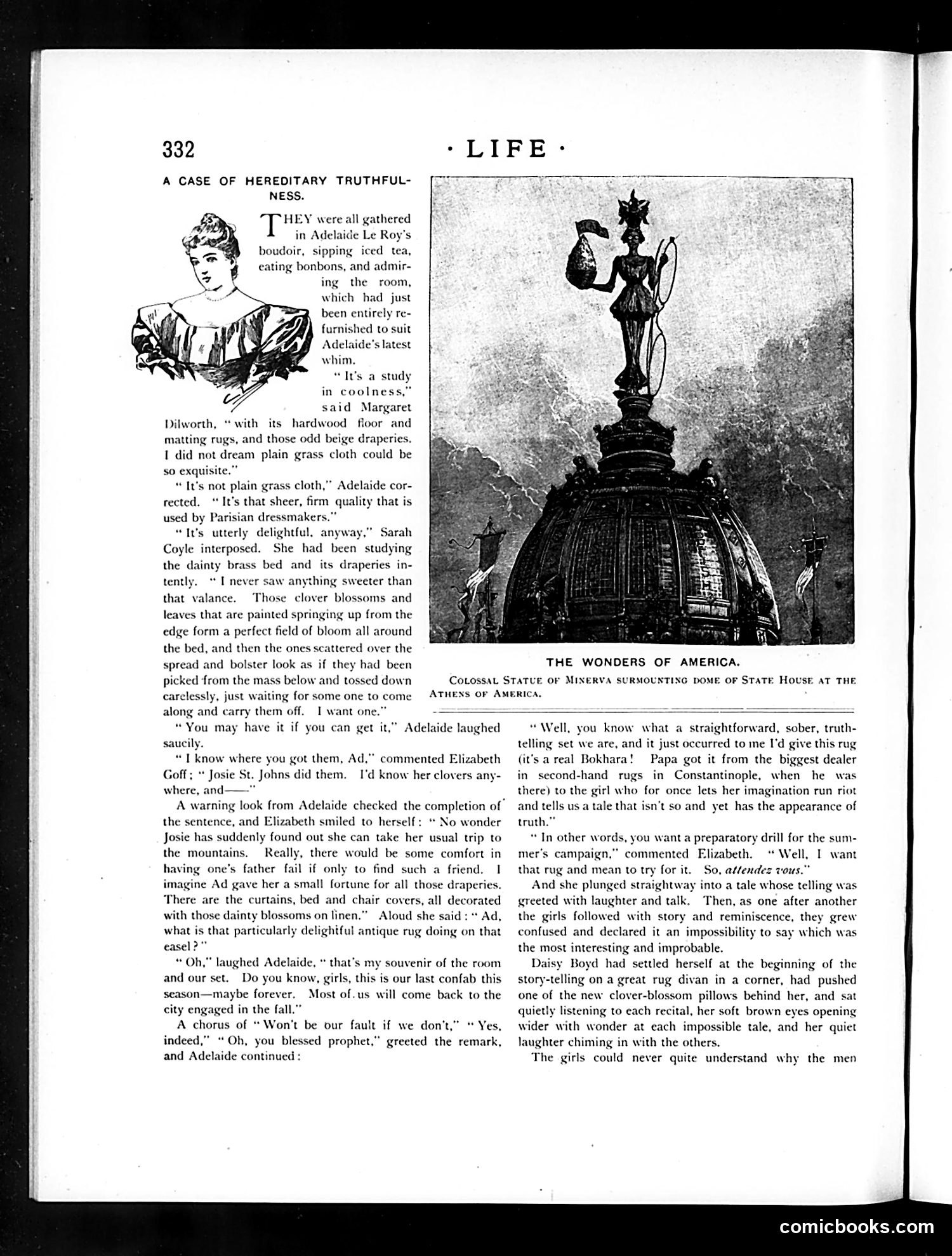
The right-side illustration shows a colossal statue labeled "Statue of Minerva Surmounting Dome of State House at the Athens of America." This appears to be satirical commentary on American civic pride and pretension. The left column contains a fictional dialogue about interior decorating, where characters discuss obtaining fashionable items like "clover-blossom" decorated furniture and rugs. The satire likely mocks upper-class Americans' obsession with acquiring European luxury goods and adopting Continental aesthetic standards. By pairing grandiose claims about American architectural achievement ("Athens of America") with characters focused on imitating Parisian taste, *Life* satirizes American aspirations to cultural sophistication while suggesting the nation remains derivative and status-conscious rather than authentically cultured.
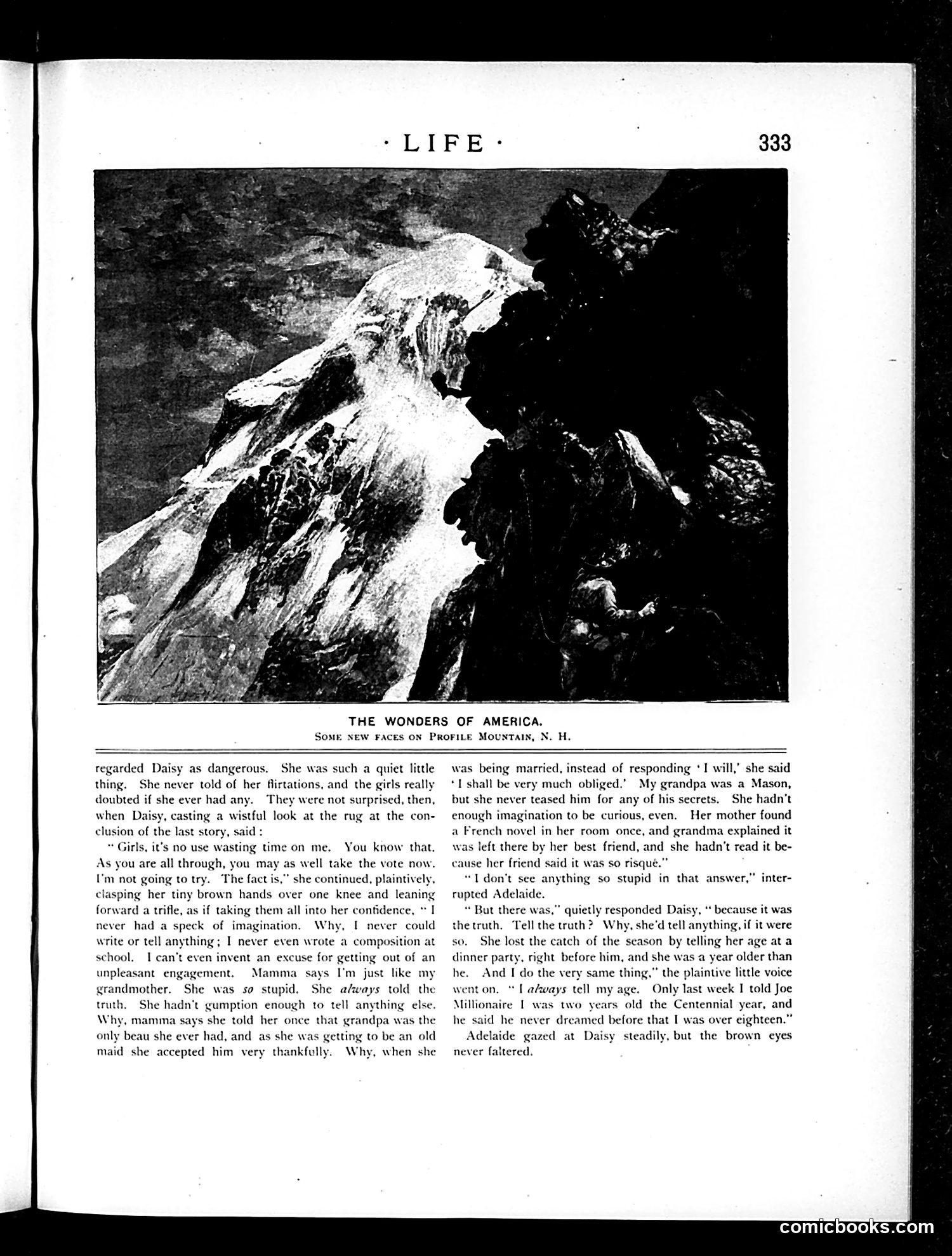
This page from *Life* magazine features a photograph titled "The Wonders of America: Some New Faces on Profile Mountain, N.H." The image shows rock formations on what appears to be a mountainside, with natural features resembling human profiles. The accompanying text is a narrative story about a character named Daisy, discussing her quiet nature, lack of imagination, and family background. The story mentions her grandfather was a Mason and references a French novel her mother left behind. This is **not political satire or social commentary**. Rather, it's a humorous feature combining a landscape photograph with an unrelated fictional narrative—a common *Life* magazine format mixing visual content with short stories or character sketches for entertainment purposes.
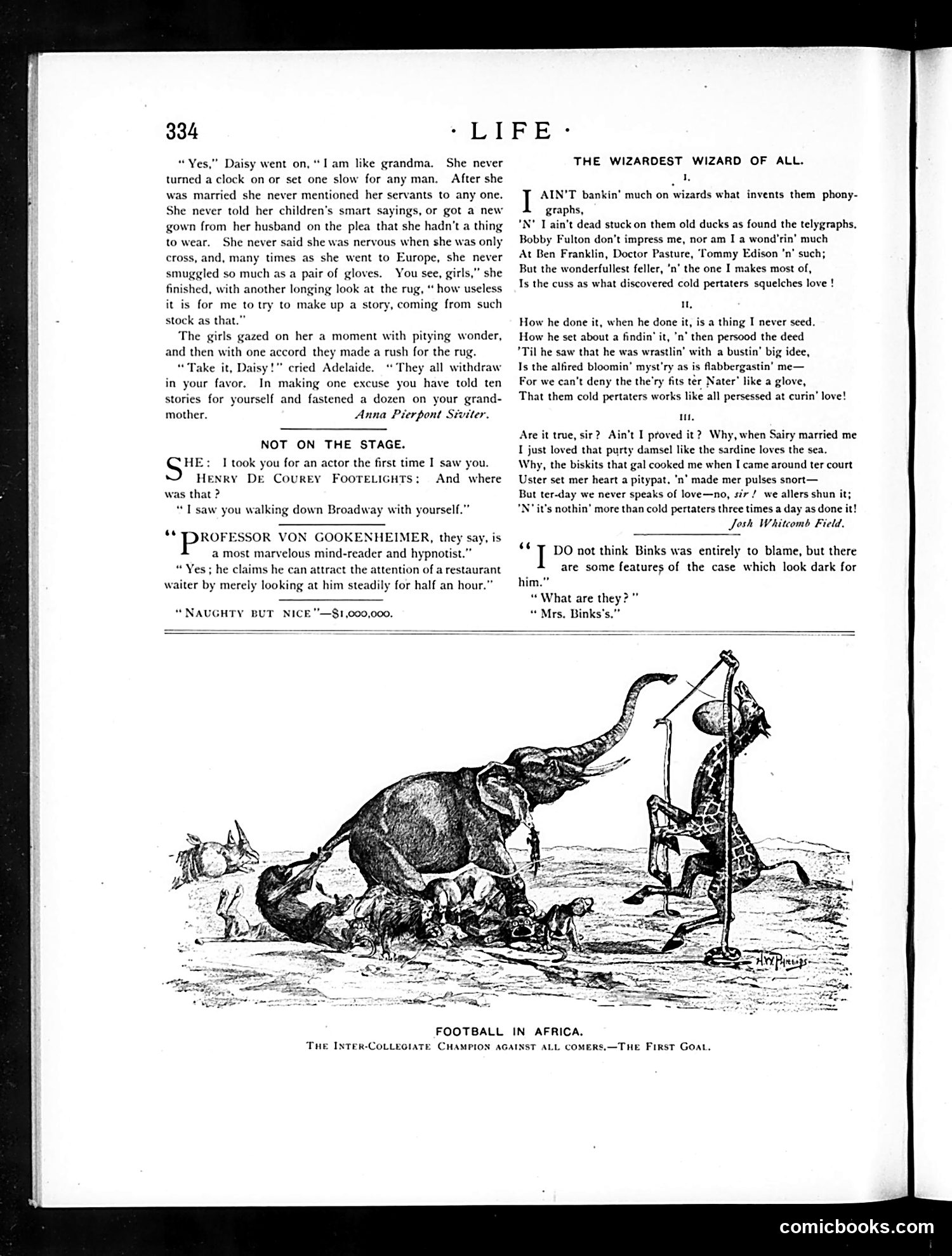
This page contains several short humorous pieces and one satirical cartoon: **Text pieces** include domestic comedies (a woman claiming she can't fabricate stories due to her honest ancestry; a Broadway pickup line) and a Professor Von Gookenheimer joke about mind-reading—humorously defined as the ability to get a restaurant waiter's attention merely by staring. **Main feature**: A dialect poem by Josh Whitcomb Field praising the inventor of cold potatoes as a cure for marital passion. The narrator claims cold potatoes extinguished his ardor after marriage, comparing it favorably to famous inventors like Edison and Franklin. The humor relies on rural dialect and the absurdist premise. **Cartoon**: "Football in Africa" depicts an elephant as the "Inter-Collegiate Champion" kicking a small figure in exotic dress. The joke appears to be about the incongruity of American college football rules applied to African wildlife—treating the elephant as an athletic competitor. This reflects period attitudes about colonialism and racial hierarchy, presenting Africa as comically primitive or animal-like.
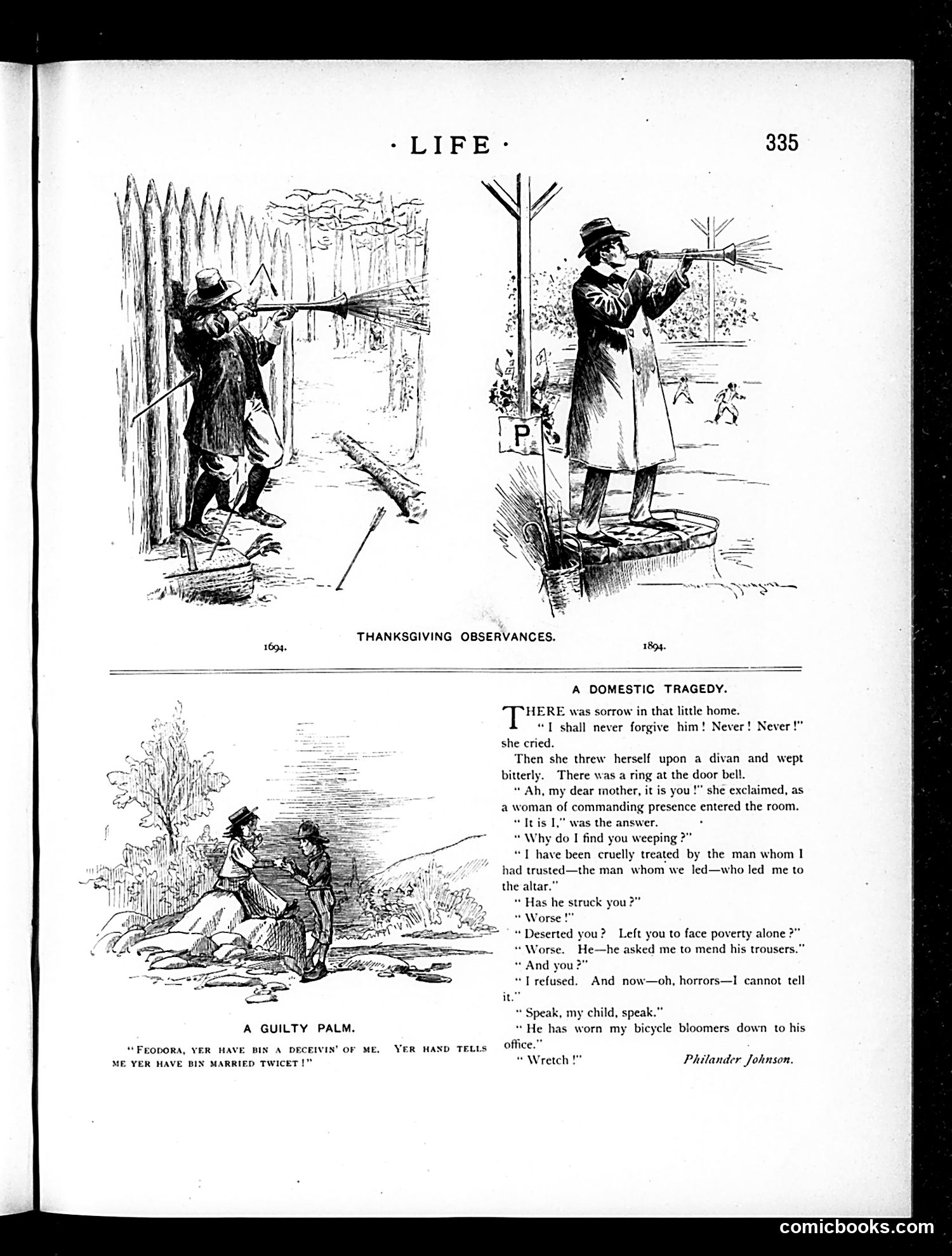
This page contains two distinct satirical pieces mocking social conventions of the era. **"Thanksgiving Observances" (top):** Two 1894 sketches humorously contrast holiday observations—one shows a man hunting/shooting in a forest; the other depicts a man with a telescope, suggesting different ways people "observe" the holiday. **"A Domestic Tragedy":** A melodramatic sketch satirizing women's changing roles and marital expectations. A wife is devastated not by abuse or abandonment, but because her husband asked her to mend his trousers—and she refused. The satire targets the emerging "New Woman" of the 1890s who rejected traditional domestic duties, while also mocking her mother's concern and the husband's expectation. The punchline ridicules both: he's now wearing her "bicycle bloomers" (scandalous athletic wear), suggesting role reversal and social chaos. **"A Guilty Palm":** A fortune-teller reads a woman's hand, revealing she's been married twice—contemporary commentary on remarriage and women's autonomy. The humor assumes readers familiar with 1890s debates about women's rights, fashion, and domestic roles.
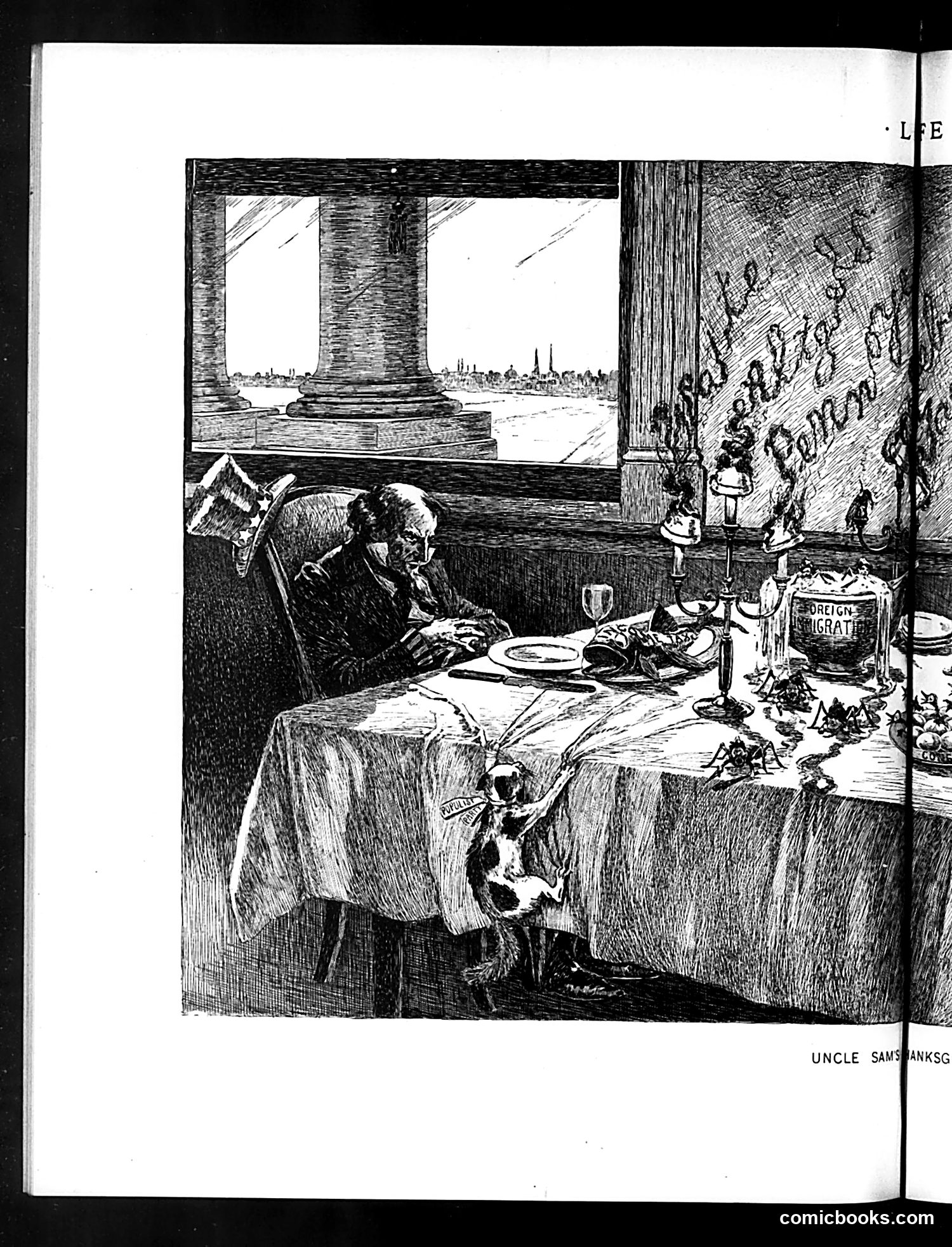
This political cartoon depicts an elderly man (representing Uncle Sam, the personification of the United States) dining alone at a table laden with holiday food and drink. Through the window behind him, a cityscape is visible across water—likely depicting an American industrial city. The satire appears to critique American isolation or self-interest during a period of national plenty. Uncle Sam feasts abundantly while seemingly indifferent to the wider world beyond his window. The title "Uncle Sam's Thanksgiving" suggests irony about American gratitude and prosperity, possibly commentary on American foreign policy, economic inequality, or isolationism during the early-to-mid 20th century. The specific historical context remains unclear without the publication date.
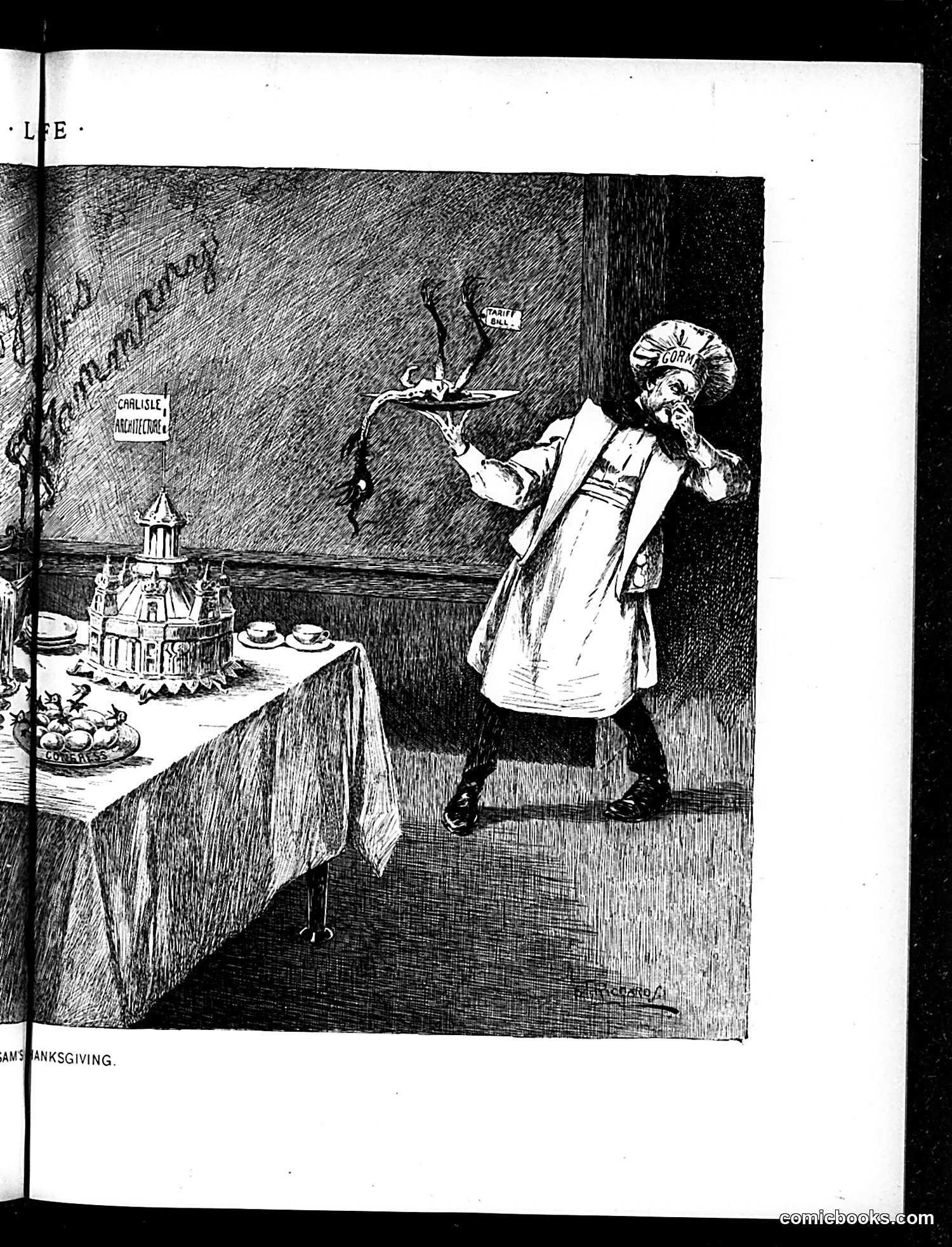
This satirical cartoon depicts a chef or cook presenting an architectural model of Carlisle (Indian) Industrial School as if it were a elaborate Thanksgiving dish. The figure is dressed in chef's whites and hat, proudly displaying the building on a platter like a culinary creation. The satire appears to target the Carlisle Indian Industrial School's assimilationist practices. By presenting the institution as a "dish" being served up, the cartoonist suggests the school was essentially consuming Native American culture and identity. The Thanksgiving context sharpens the critique—what mainstream America celebrated as civilizing progress, the artist portrays as a form of cultural erasure being served as a holiday meal.
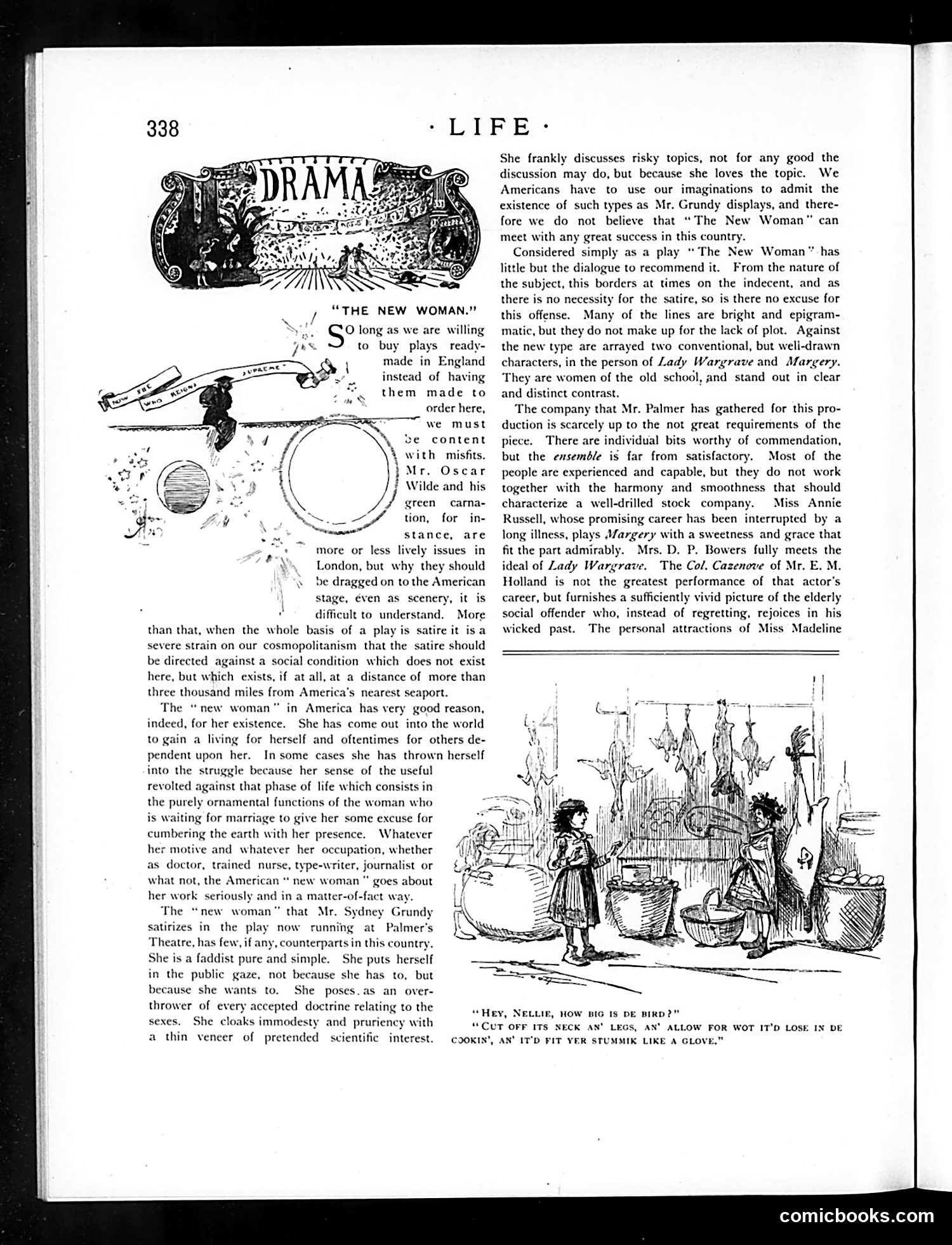
This page reviews a play by English playwright Sydney Grundy called "The New Woman," performed at Palmer's Theatre. The critic argues the satire doesn't translate to America because the "new woman" type it mocks—a frivolous, attention-seeking faddist who poses as a radical while merely cloaking immodesty—doesn't actually exist in America. The American "new woman," the reviewer insists, is fundamentally different: she works seriously as a doctor, nurse, journalist, or typist out of genuine economic necessity, not affectation. The play itself is criticized for weak plotting and indecent dialogue that serves no satirical purpose. The illustration at bottom appears to show a scene involving poultry preparation, its relevance to the review unclear from context.
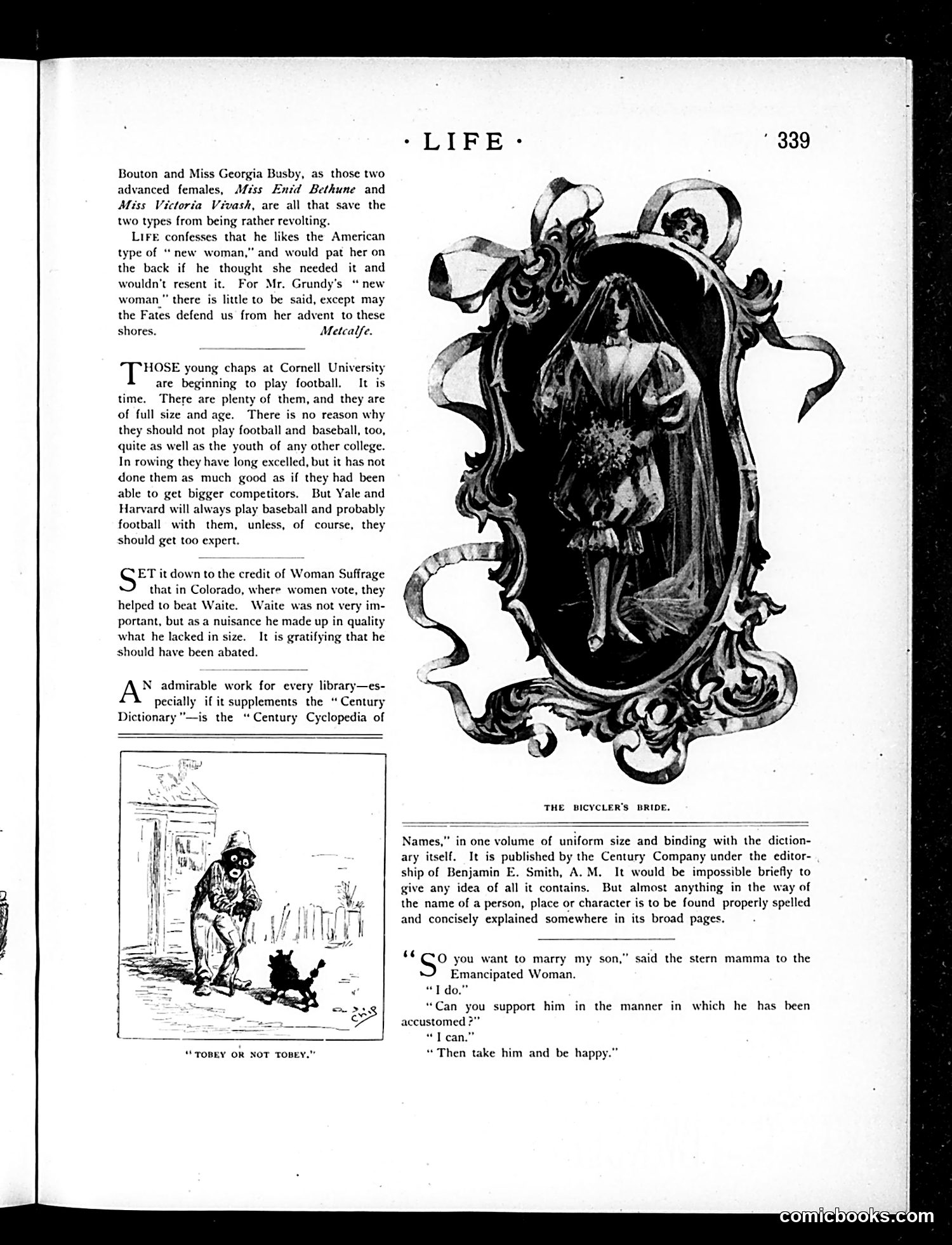
This page contains multiple satirical items typical of Life's editorial commentary: **Upper section:** Discusses theatrical portrayals of "advanced females" and the "new woman" — a contemporary social phenomenon. Life expresses approval of the American "new woman" type but ridicules what it calls "Mr. Grundy's new woman" (a reference to Mrs. Grundy, representing rigid Victorian morality). The satire targets European or overly radical interpretations of female emancipation. **Middle section:** Supports Cornell University's football program, suggesting collegiate athletics are appropriate competition. **Lower left cartoon ("Torrey or Not Torrey"):** Appears to reference a local political figure (unclear from image alone), showing someone confronting another person with a small dog. **Right side:** "The Bicycler's Bride" presents a comedic dialogue where an "Emancipated Woman" seeks to marry a man. The humor derives from the woman's confident claim she can support him—implying financial independence was shocking for women of this era, making the stern mother's easy acceptance ironic. The page satirizes changing gender roles and women's increasing social autonomy.
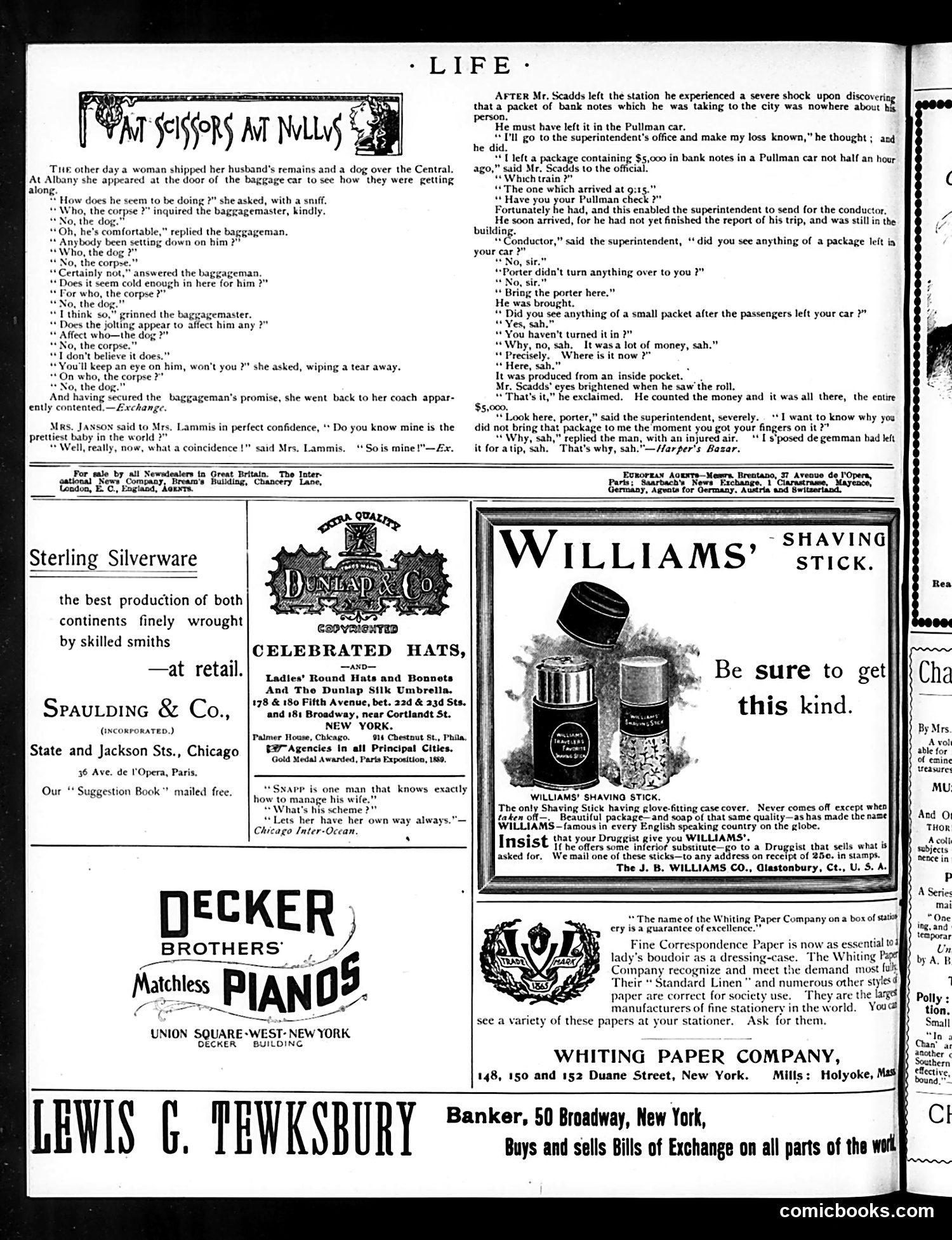
This page from *Life* magazine contains two humorous anecdotes typical of late 19th-century satirical publications. The first cartoon depicts absurdist confusion at a railway baggage car, where a widow inquires about her deceased husband's remains alongside a dog—the humor deriving from the baggageman's deliberately obtuse responses that constantly mistake which subject she's asking about. The second story involves a railway porter who finds $5,000 in bank notes but keeps them, assuming they were left as a tip. The satire targets the porter's misplaced assumptions about gratuities and the superintendent's incredulous reaction to this logic. Both pieces mock railway workers' incompetence and reflect period anxieties about service industry reliability. The remainder of the page consists largely of advertisements for silverware, hats, pianos, and stationery—typical of *Life*'s revenue model. No specific political figures or contemporary events are referenced.
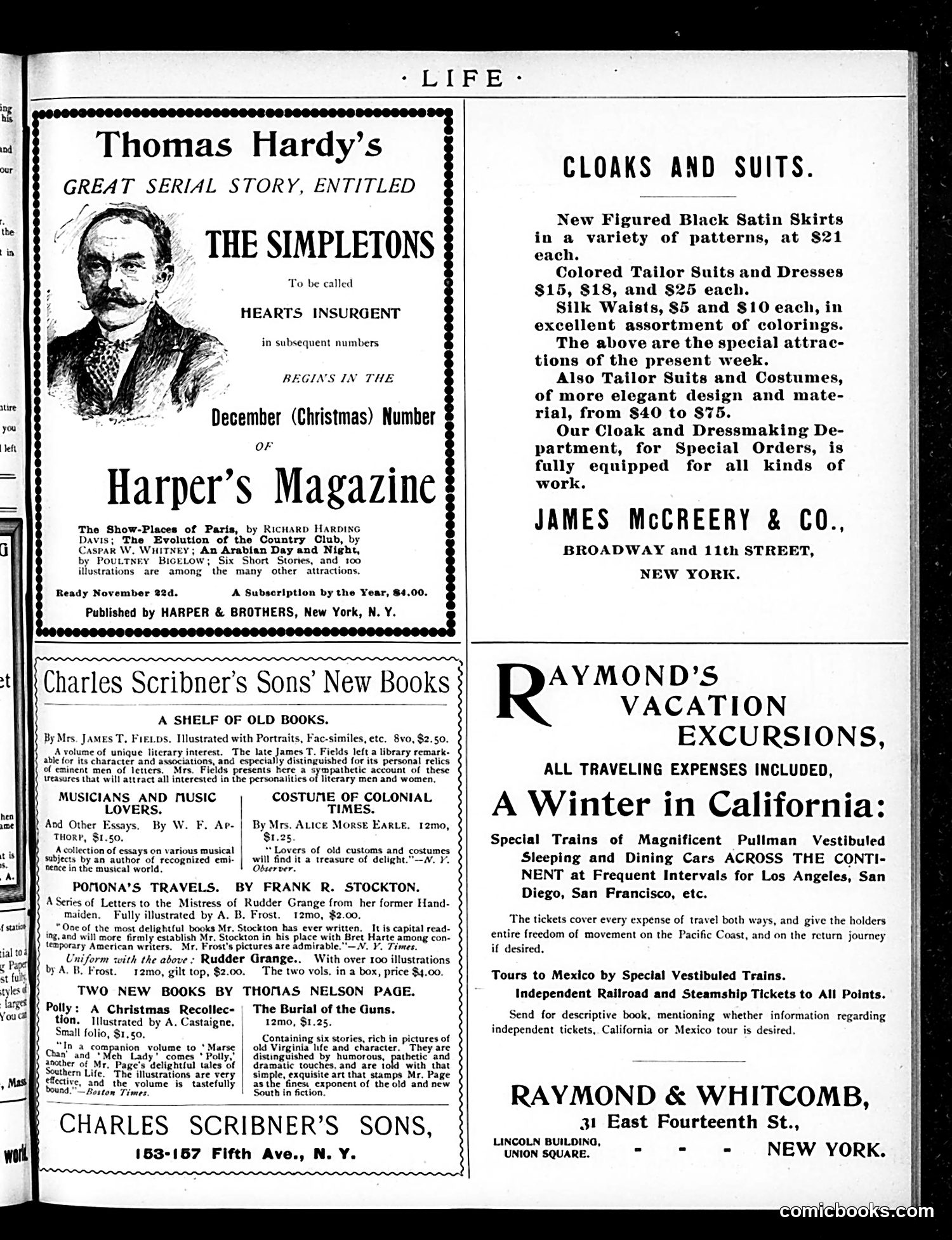
This page is primarily **advertising and announcements** rather than satirical content. It features: **Main Content:** - Advertisement for Thomas Hardy's serialized novel *The Simpletons* (to be retitled *Hearts Insurgent*) appearing in Harper's Magazine's December Christmas issue - Multiple book advertisements from Charles Scribner's Sons, featuring literary and historical titles - Commercial advertisements for women's clothing (James McCreery & Co.) and travel excursions (Raymond's Vacation Excursions to California) **No Political Satire:** The page contains no cartoon, caricature, or satirical commentary. It reflects late-19th-century *Life* magazine's mixed editorial-advertising format. The Thomas Hardy portrait is a straightforward promotional image, not satire. **Historical Note:** The Hardy serial's alternate title reference is notable—the novel was controversial and underwent title changes during serialization.
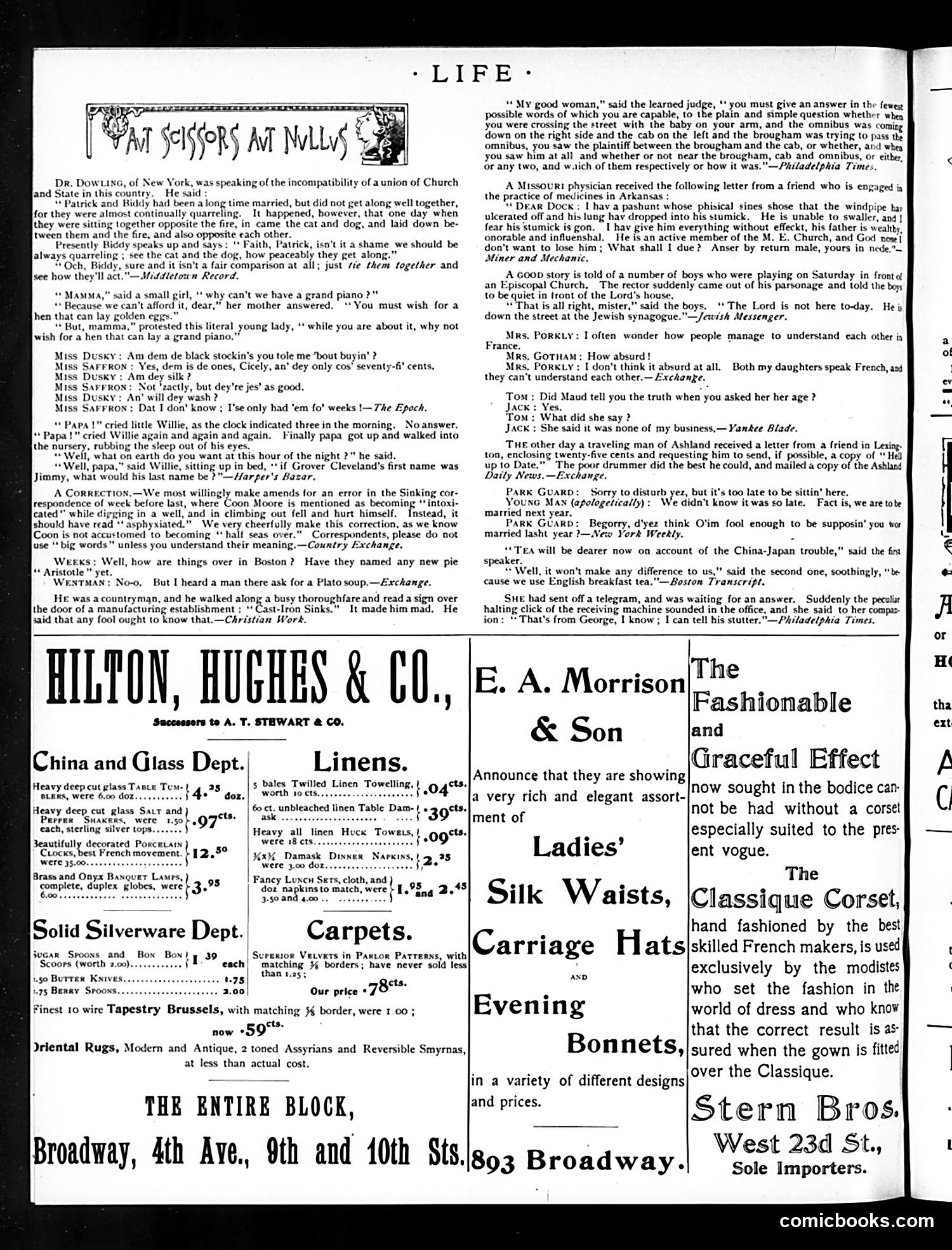
This is primarily a **humor and anecdote page** rather than political satire. The title references Dr. Dowling's speech comparing Church-State separation to a quarreling Irish couple (Patrick and Biddy) who stop fighting only when a cat and dog lie between them—the joke being that incompatible things don't peacefully coexist just by proximity. The page contains various short jokes and anecdotes typical of period humor magazines: - A child's literal-minded response to wishing for a piano - Dialect humor featuring African American characters discussing cheap stockings - A child's wordplay about President Cleveland's name - A countryman misreading "Cast-Iron Sinks" as an insult The advertisements for department stores (Hilton, Hughes & Co.) and fashion (Stern Bros. corsets, E.A. Morrison) occupy the lower half, typical of Life's revenue model. The humor reflects **late 19th-century sensibilities**: puns, malapropisms, ethnic/racial caricature, and domestic anecdotes rather than pointed political commentary.
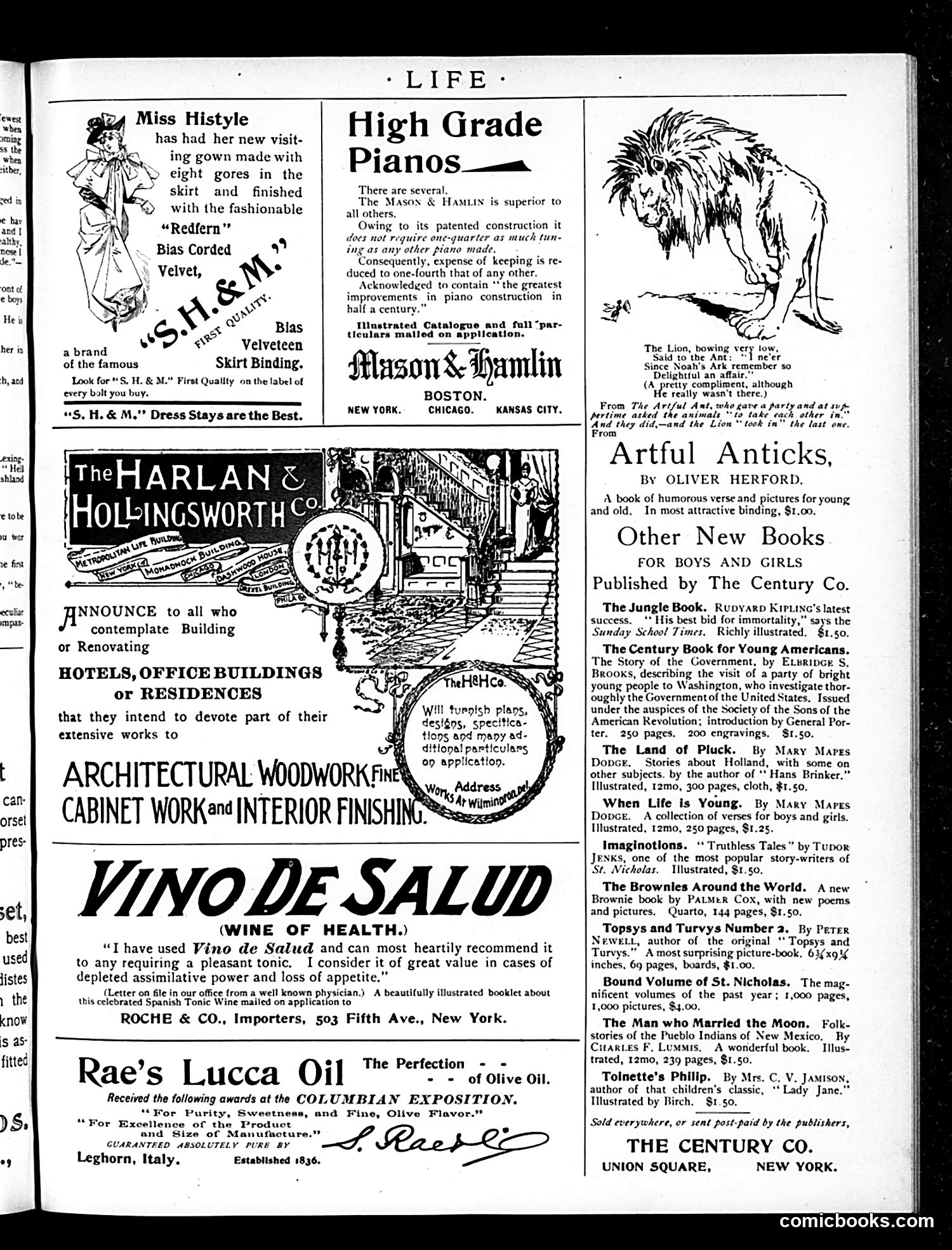
This is primarily an **advertising page** from Life magazine, with one small illustrated joke. The main cartoon appears in the upper right: Oliver Herford's "Artful Anticks" depicts a lion bowing to an ant who hosted a dinner party. The joke plays on social etiquette—the lion compliments the ant's gathering as delightful, though "he really wasn't there" (during Noah's Ark). It's gentle satirical humor about politeness and flattery in high society. The page otherwise consists of period advertisements for luxury goods: fashionable women's clothing ("S.H. & M." skirt bindings), Mason & Hamlin pianos (marketed as requiring less tuning), architectural woodwork services, wines and tonics (Vino de Salud), and olive oil. There's also a book announcement section promoting children's literature including Kipling's *Jungle Book*. The overall content reflects **turn-of-the-century consumer culture** and genteel advertising aimed at upper-middle-class readers.
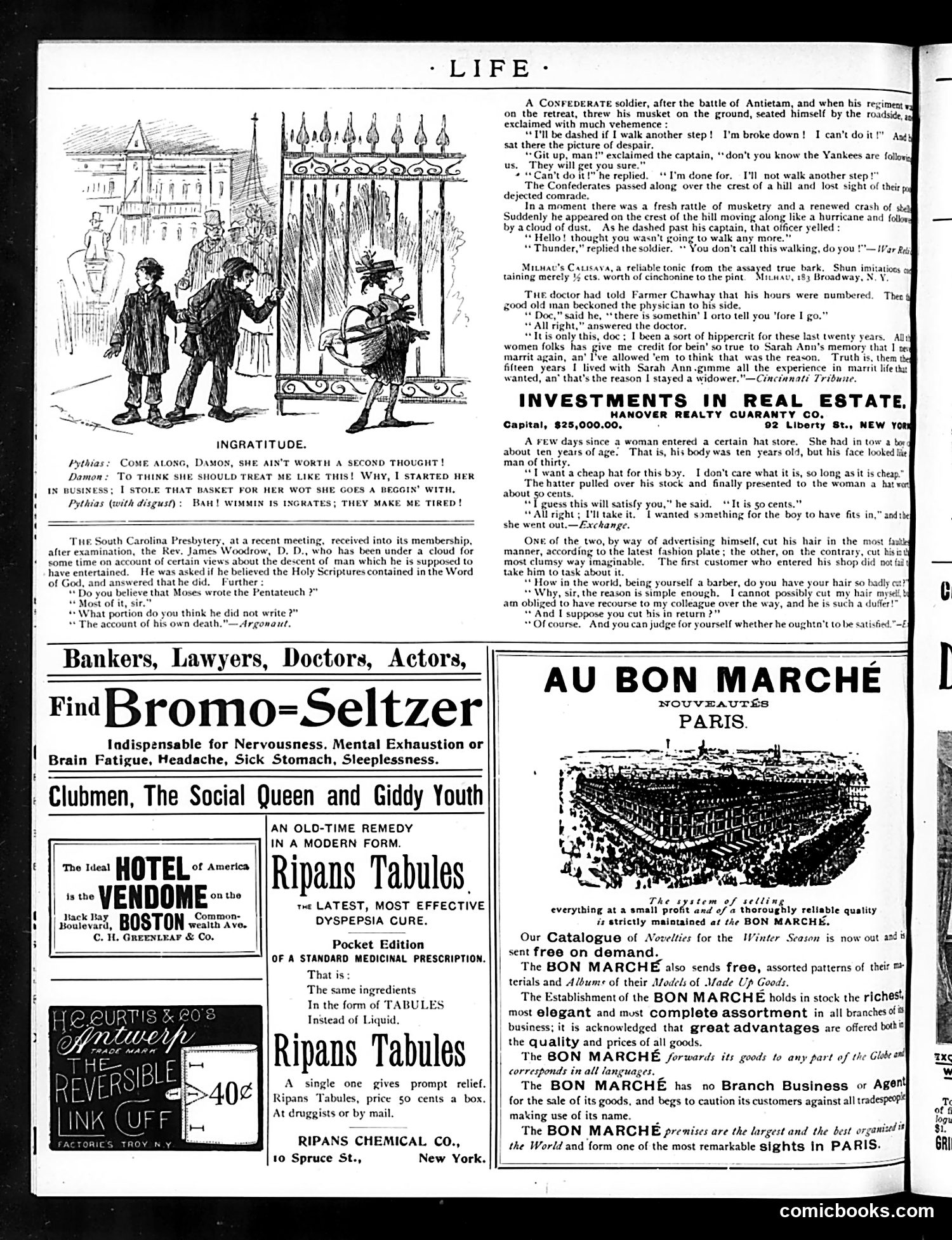
This satirical cartoon depicts two male figures (labeled Pythias and Damon, referencing the classical friendship legend) commiserating about an ungrateful woman. The joke relies on the men's complaint that despite their assistance—one claiming he "started her in business" and "stole that basket for her"—she shows no appreciation. The humor targets both male entitlement and stereotypical misogyny of the era, with Pythias concluding "women is ingrates." The accompanying anecdote about a clergyman being asked whether Moses wrote the Pentateuch, answering "most of it, sir" but excluding "the account of his own death," demonstrates the magazine's satirical approach to religion and biblical scholarship—a contemporary debate during this period. The page is primarily anecdotal humor combined with period advertising, representing *Life* magazine's typical mix of social satire and commercial content.
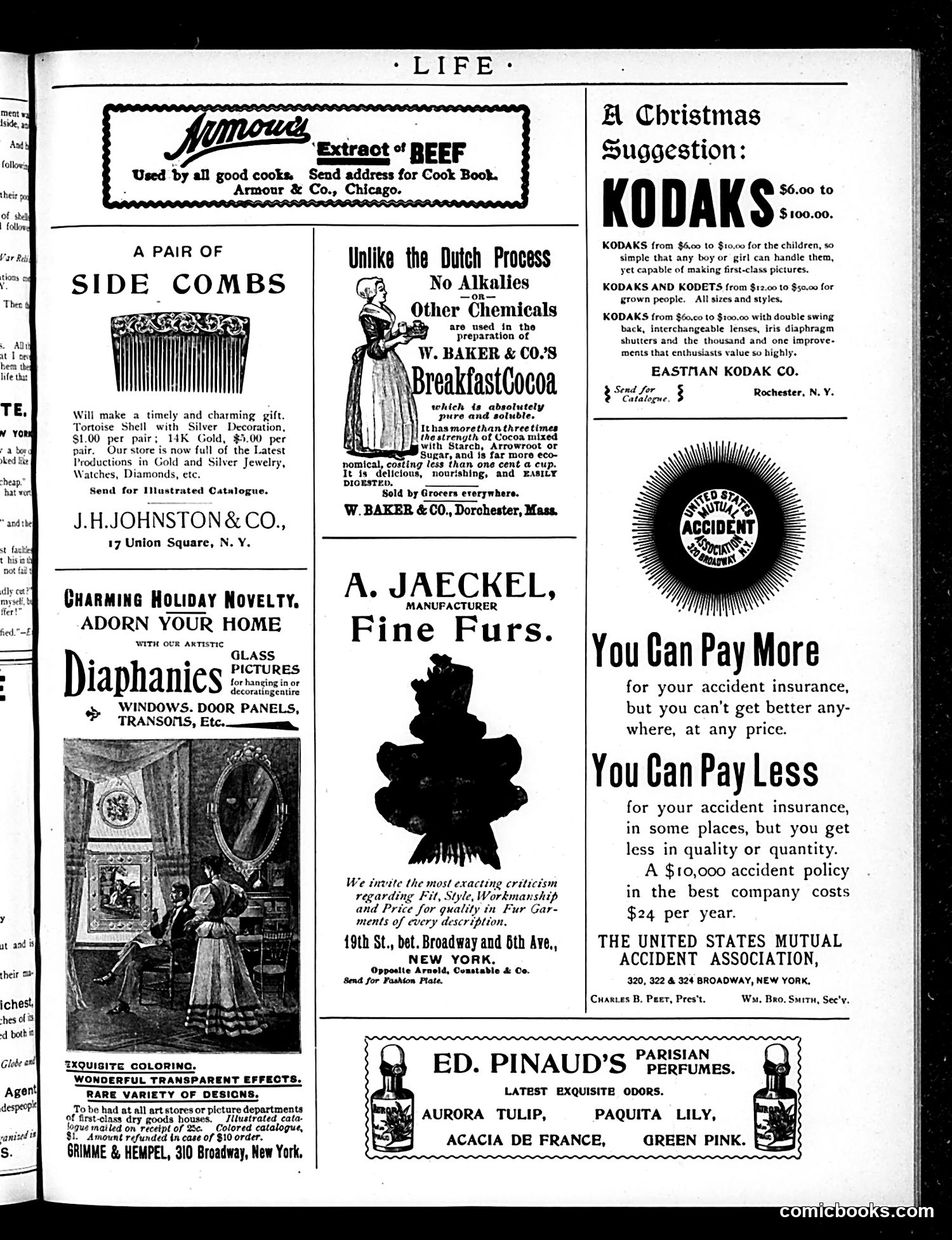
This is primarily a **Christmas shopping advertisement page** from an early Life magazine (likely 1880s-1890s based on styling). There is no political cartoon or satire present. The page features luxury gift suggestions for wealthy readers: jewelry (side combs from J.H. Johnston), decorative glass panels (Diaphanies), cocoa products, cameras (Kodak—positioned as novel gift technology), fine furs, perfumes, and accident insurance. The only potentially humorous element is the accident insurance ads, which use mild persuasive rhetoric ("You Can Pay More... but you can't get better") rather than satire. This reflects period advertising conventions. The page primarily documents **consumer culture and gift-giving practices** of the Gilded Age, targeting affluent urban audiences in New York. Notable is the prominent placement of Kodak cameras as desirable gifts, indicating photography's emerging status as a middle-class leisure activity. The overall content serves commercial rather than satirical purposes.
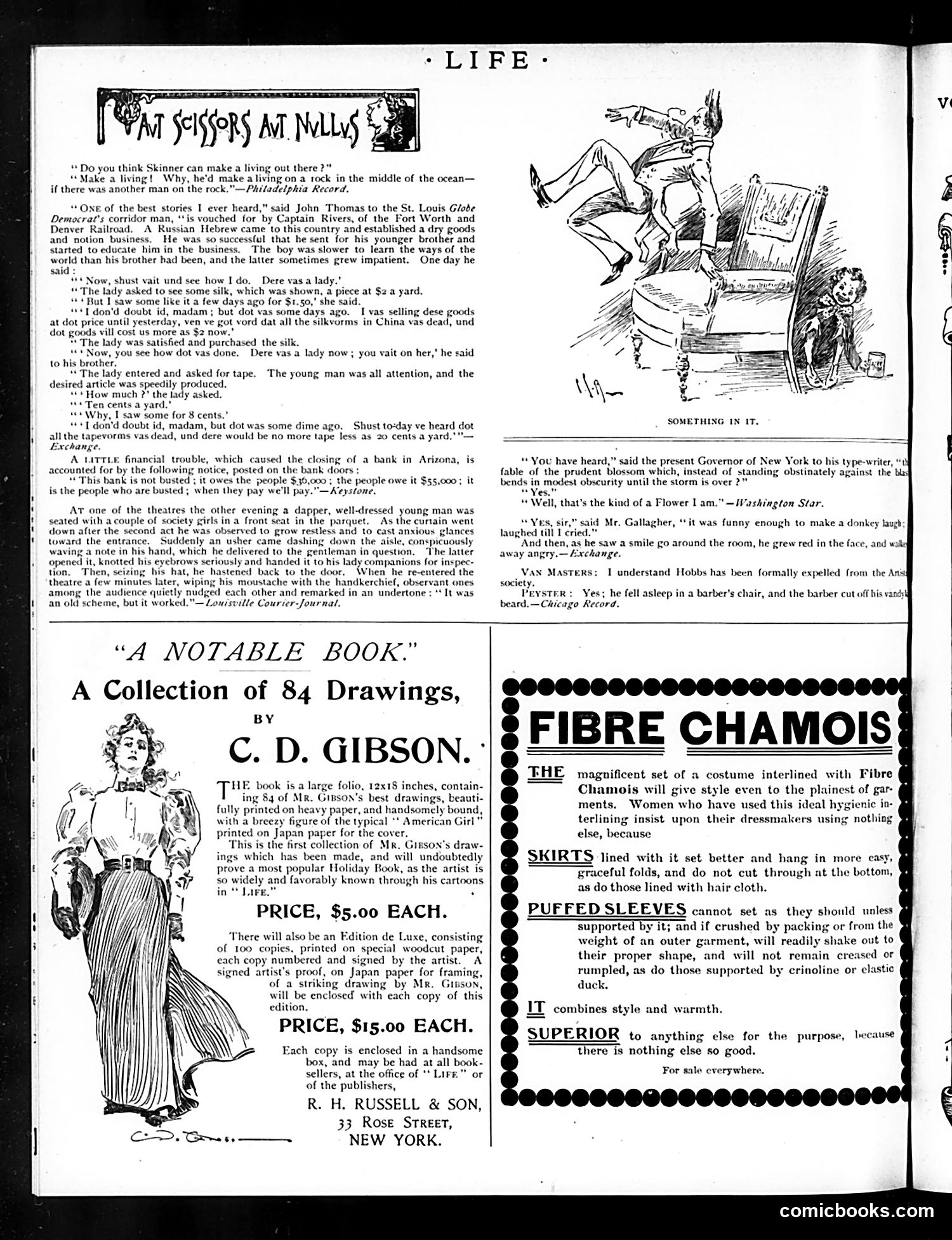
This page contains humorous anecdotes rather than political cartoons. The main content satirizes **immigrant business acumen**, particularly through a story about a Russian Jewish merchant teaching his slower brother sales tactics. The brother uses fabricated scarcity claims ("all silkworms in China are dead") to justify price increases, successfully manipulating customers. The satire targets two things: immigrant success in American business (presented as clever but ethically questionable) and gullible consumers easily convinced by invented explanations. The exaggerated Yiddish dialect ("dere vasa lady," "don'd doubt id") reflects period attitudes toward Eastern European immigrants. Other brief anecdotes mock Arizona banking failures and theatrical schemes. The page also advertises C.D. Gibson's drawing collection and Fibre Chamois fabric—typical of Life's mixed content format combining satire, humor, and advertisements for a middle-class audience.