
Life, 1894-11-22 · page 8 of 24
Life — November 22, 1894 — page 8: what you’re looking at
What you’re looking at
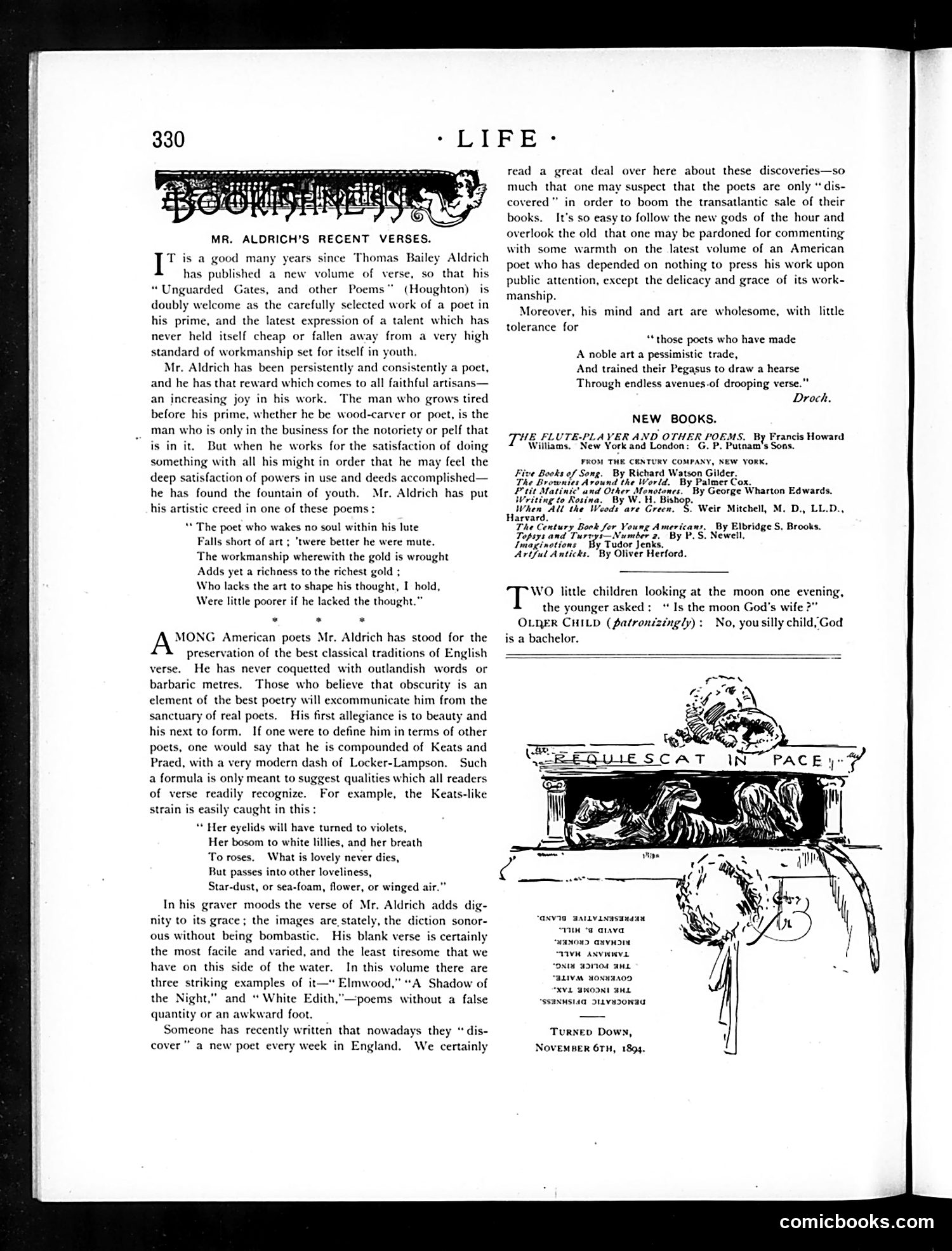
This page is primarily a **book review** of Thomas Bailey Aldrich's poetry collection "Unguarded Gates and Other Poems," not a political cartoon. The left column contains critical commentary praising Aldrich as a careful, classical poet who maintains high standards of craftsmanship. The **only illustration** is a decorative vignette titled "Requiescat in Pace" (Rest in Peace) showing a reclining cat on a classical pediment. Below it is a humorous poem about the cat's death, with text appearing upside-down. This is a lighthearted tribute to a deceased pet, not political satire. The page includes a brief joke about the moon and marriage at the bottom, unrelated to the main content.
📄 Transcribed text from this page (OCR, searchable)
Machine-transcribed from the original scan — historical spelling and the odd misread are preserved.
“LIFE * MR. ALDRICH’S RECENT VERSES. I T is a good many years since Thomas Bailey has published a new volume of verse, so that his “Unguarded Gates, and other Poems” (Houghton) is doubly welcome as the carefully selected work of a poet in his prime, and the latest expression of a talent which has never held itself cheap or fallen away from a very high standard of workmanship set for itself in youth. Mr. Aldrich has been persistently and consistently a poct, and he has that reward which comes to all faithful artisans— an increasing joy in his work. The man who grows tired before his prime, whether he be wood-carver or poet, is the man who is only in the business for the notoriety or pelf that is in it. But when he works for the satisfaction of doing something with all his might in order that he may feel the deep satisfaction of powers in use and deeds accomplished— he has found the fountain of youth. Mr. Aldrich has put his artistic creed in one of these poem: “The poet who wakes no soul within his lute Falls short of art; "twere better he were mute. The workmanship wherewith the gold is wrought Adds yet a richness to the richest gold ; Who lacks the art to shape his thought, I hold, Were little poorer if he lacked the thought.” * . * MONG American poets Mr. Aldrich has stood for the preservation of the best classical traditions of English verse. He has never coquetted with outlandish words or barbaric metres, Those who believe that obscurity is an element of the best poetry will excommunicate him from the sanctuary of real poets. His first allegiance is to beauty and his next to form. If one were to define him in terms of other poets, one would say that he is compounded of Keats and Praed, with a very modern dash of Locker-Lampson. Such a formula is only meant to suggest qualities which all readers of verse readily recognize. For mple, the Keats-like strain is easily caught in this : * Her eyelids will have turned to violets, Her bosom to white lillies, and her breath To roses, What is lovely never dies, But passes into other loveliness, Star-dust, or sea-foam, flower, or winged air.” In his graver moods the verse of Mr, Aldrich adds dig- nity to its grace; the images are stately, the diction sonor- ous without being bombastic. His blank verse is certainly the most facile and varied, and the least tiresome that we have on this side of the water. In this volume there are three striking examples of it—* Elmwood,” *A Shadow of the Night,” and * White Edith,”"—poems without a false quantity or an awkward foot. Someone has recently written that nowada’ cover” a new poet every week in England. they “ dis- We certainly read a great deal over here about these discoveries—so much that one may suspect that the poets are only “di: covered” in order to boom the transatlantic sale of their books. It's so easy to follow the new gods of the hour and overlook the old that one may be pardoned for commenting with some warmth on the latest volume of an American poet who has depended on nothing to press his work upon public attention, except the delicacy and grace of its work- manship. Moreover, his mind and art are wholesome, with little tolerance for “*those poets who have made A noble art a pessimistic trade, And trained their Pegasus to draw a hearse Through endless avenues-of drooping verse. Droch. NEW BOOKS. THE FLUTE-PLAYER AND OTHER POEMS. By Francis Howard Williams, New York and London: G. P, Putnam's Sons. FROM THE CENTURY COMPANY, NEW YORK, Books of Song. By Richard Watson Gilder. ‘he Brownies Around the World. By Palmer Cox. P'tit Matinic’ and Other Monotoncs. By George Wharton Edwards, Writing to Kosina. By W. H. Bishop. When All the Weods are Green, §. Weir Mitchell, M. D., LL.D., Harvard, The Century Book for Young Americans. Bi ridge S. Brooks. Topsys and Turtyi—Number 2, By P.S. Newell, Imaginotions By Tudor Jenks. Artful Anticks, By Oliver Herford. WO little children looking at the moon one evening, the younger asked: * Is the moon God's wife ? OLQER CHILD (fatronizingly): No, yousilly child,God is a bachelor. "ANV19 BALLVANHSUMSAH “TK “a aiava “waNOND aNYHONL “TWH ANVIL “ONIA HDNIOd ANE “BLIVMN YONNAAOD “XV BOONE HHL “SSENNSIAG DILVNDONTG Turnev Down, NOVEMBER 6TH, 1894. comicbooks.com