
Life, 1894-11-22 · page 16 of 24
Life — November 22, 1894 — page 16: what you’re looking at
What you’re looking at
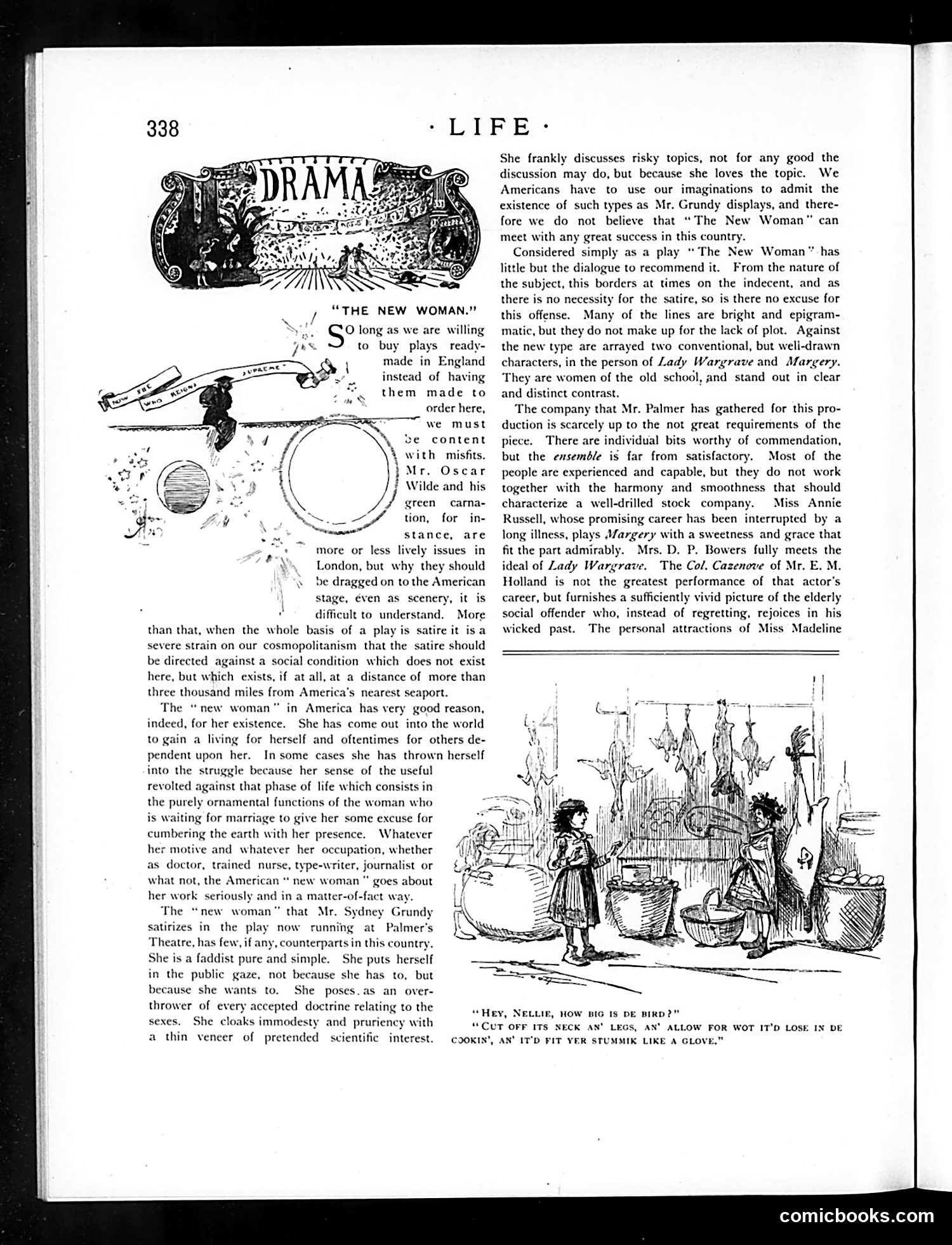
This page reviews a play by English playwright Sydney Grundy called "The New Woman," performed at Palmer's Theatre. The critic argues the satire doesn't translate to America because the "new woman" type it mocks—a frivolous, attention-seeking faddist who poses as a radical while merely cloaking immodesty—doesn't actually exist in America. The American "new woman," the reviewer insists, is fundamentally different: she works seriously as a doctor, nurse, journalist, or typist out of genuine economic necessity, not affectation. The play itself is criticized for weak plotting and indecent dialogue that serves no satirical purpose. The illustration at bottom appears to show a scene involving poultry preparation, its relevance to the review unclear from context.
📄 Transcribed text from this page (OCR, searchable)
Machine-transcribed from the original scan — historical spelling and the odd misread are preserved.
- LIFE: “THE NEW WOMAN.” O long as we are willing to buy plays ready- made in England ad of having them made to order here, we must be content \ with misfits. }Mr. Oscar j Wilde and his green carna- tion, for in- stan are more or less lively issues in London, but why they should be dragged on to the American stage, even as scenery, it is difficult to understand. More than that, when the whole basis of a play is satire it is a severe strain on our cosmopolitanism that the satire should be directed against a social condition which does not exist here, but which exists, if at all, at a distance of more than three thousand miles from America’s nearest seaport. The “new woman” in America has very good reason, indeed, for her existence. She has come out into the world to gain a living for herself and oftentimes for others de- pendent upon her. In some cases she has thrown herself into the struggle b se her sense of the useful revolted against that phase of life which consists in the purely ornamental functions of the woman who is waiting for marriage to give her some excuse for cumbering the earth with her presence. Whatever her motive and whatever her occupation, whether as doctor, trained nurse, type-writer, journalist or what not, the America goes about her work seriously and in a matter-of-fact way. The “new woman” that Mr. Sydney Grundy satirizes in the play now running at Palmer's Theatre, . if any, counterparts in this country. She is a faddist pure and simple. She puts herself in the public gaze, not because she has to, but because she wants to. She poses.as an over- thrower of every accepted doctrine relating to the sexes. She cloaks immodesty and pruriency with a thin veneer of pretended n “new woman has fe; scientific interest. “Hey; “CUT OFF ITS NECK AN’ LE COOKIN’, AN’ IT'D FIT YER STUMME She frankly discusses risky topics, not for any good the discussion may do, but because she loves the topic. We Americans have to use our imaginations to admit the existence of such type: Mr. Grundy displays, and there- fore we do not believe that he New Woman” can meet with any great success in this country. Considered simply as a play “The New Woman” has little but the dialogue to recommend it. From the nature of the subject, this borders at times on the indecent, and as there is no necessity for the satire, so is there no excuse for this offense. Many of the lines are bright and epigram- matic, but they do not make up for the lack of plot. Against the new type are arrayed two conventional, but weli-drawn characters, in the person of Lady Wargrave and Margery. They are women of the old school, and stand out in clear and distinct contrast. ‘The company that Mr. Palmer has gathered for this pro- duction is scarcely up to the not great requirements of the piece. There are individual bits worthy of commendation, but the exsemé/e is far from satisfactory. Most of the people are experienced and capable, but they do not work together with the harmony and smoothness that should characterize a well-drilled stock company. Miss Annie Russell, whose promising career has been interrupted by a long illness, plays Margery with a sweetness and grace that fit the part admirably. Mrs. D. P. Bowers fully meets the ideal of Lady Wargrave. The Col. Cazenove of Mr. E. M. Holland is not the greatest performance of that actor's career, but furnishes a sufficiently vivid picture of the elderly social offender who, instead of regretting, rejoices in his wicked past. The personal attractions of Miss Madeline , HOW BIG IS DE BIRD?” AN’ ALLOW FOR WOT IT'D LOSE IN DE LIKE A GLOVE.” comicbooks.com