
A complete issue · 14 pages · 1894
Life — October 25, 1894
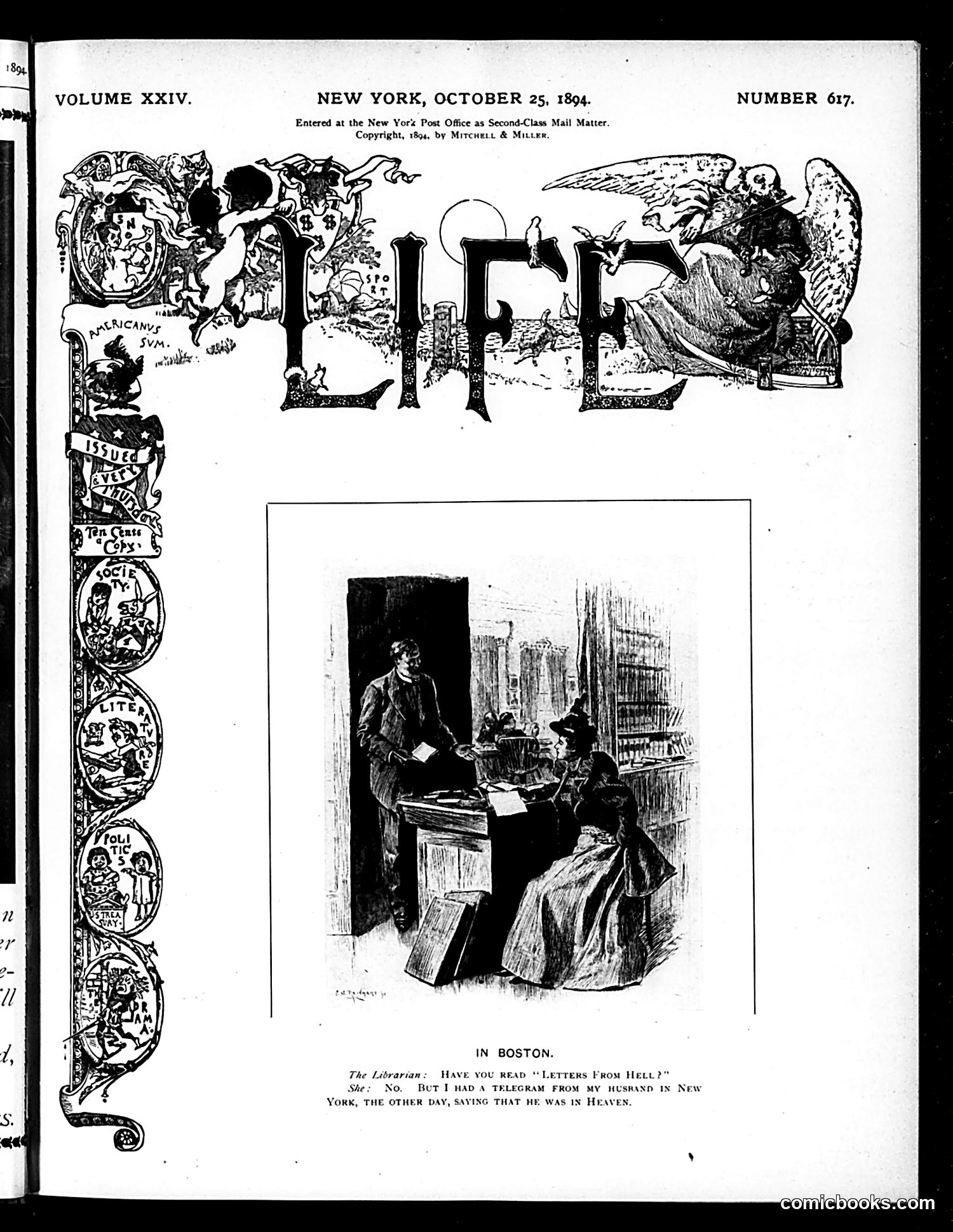
The cartoon titled "In Boston" depicts a librarian conversing with a woman patron. The joke plays on a telegram the woman received from her husband in New York stating he was in Heaven, while she had simultaneously received a telegram saying he was in Heaven. The humor derives from the implication that the husband's claim to be in Heaven while actually being in New York (a place associated with sin and worldliness in Victorian moral discourse) is absurd or ironic. This reflects late 19th-century American attitudes about urban vice—New York representing temptation and moral danger, contrasted with claims of virtue. The satire mocks both the husband's obvious dishonesty and perhaps the wife's naive acceptance of the telegram's claim.
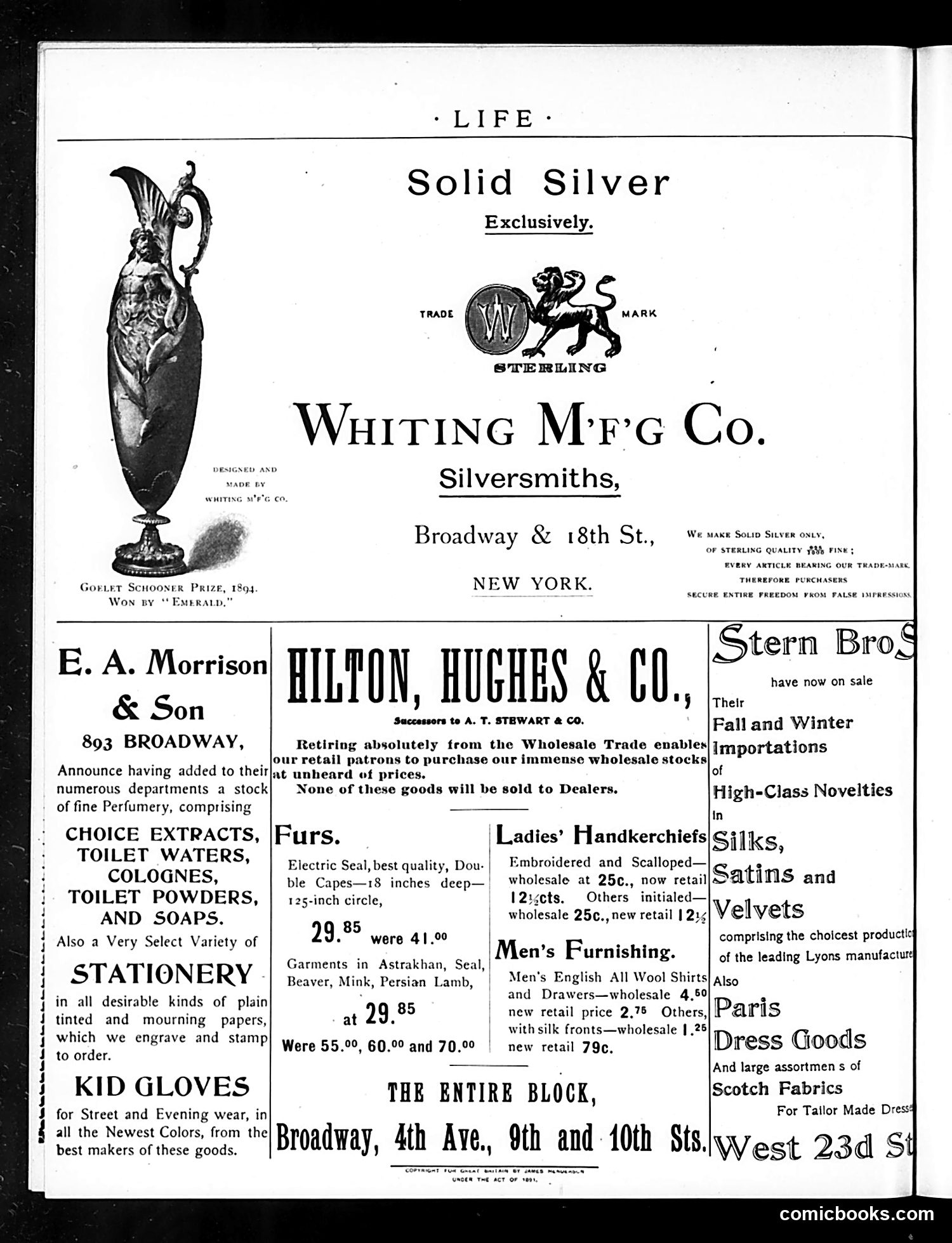
This page is **primarily advertising**, not satire or political commentary. It contains commercial advertisements from late 19th-century New York retailers: - **Whiting M'fg Co.**: A silversmith advertising solid silver goods, with an ornamental pitcher trophy image - **E.A. Morrison & Son**: Perfumery, stationery, and kid gloves at 893 Broadway - **Hilton, Hughes & Co.**: Wholesale goods clearance, furs, and men's furnishings - **Stern Bros**: Department store advertising imported silks, satins, velvets, and dress goods The only potentially notable item is the "Goblet Schooner Prize, 1894. Won by 'Emerald'"—likely referencing a yacht race, a popular sporting event of the era. The page reflects **turn-of-the-century Manhattan retail culture** rather than containing satirical or political content.
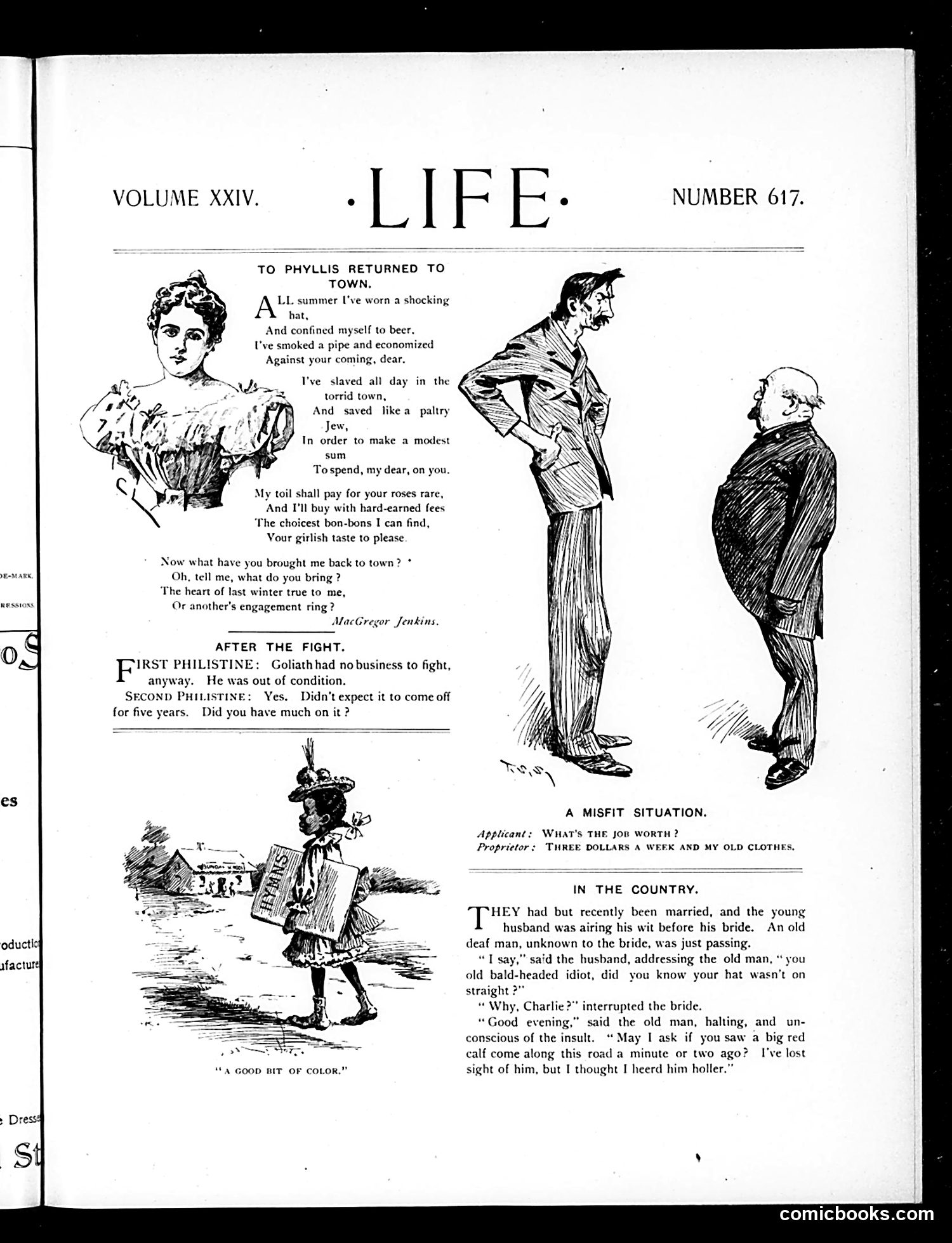
This page contains three humor pieces typical of early 20th-century Life magazine: 1. **"To Phyllis Returned to Town"** (top): A poem by MacGregor Jenkins about a man boasting of his summer sacrifices—wearing shabby clothing, drinking beer, smoking—to afford luxuries for his female companion upon her return. It satirizes the financial burden of courting wealthy or fashion-conscious women. 2. **"After the Fight"**: A brief joke about a boxer named Goliath returning to fighting after five years out of condition, mocking both comeback attempts and physical decline. 3. **"In the Country"** (bottom): A humorous anecdote about a newlywed husband insulting his bride by asking an old man about a "big red calf," misheard as a crude insult. The joke relies on mishearing and social embarrassment. The illustrations are period pen-and-ink sketches.
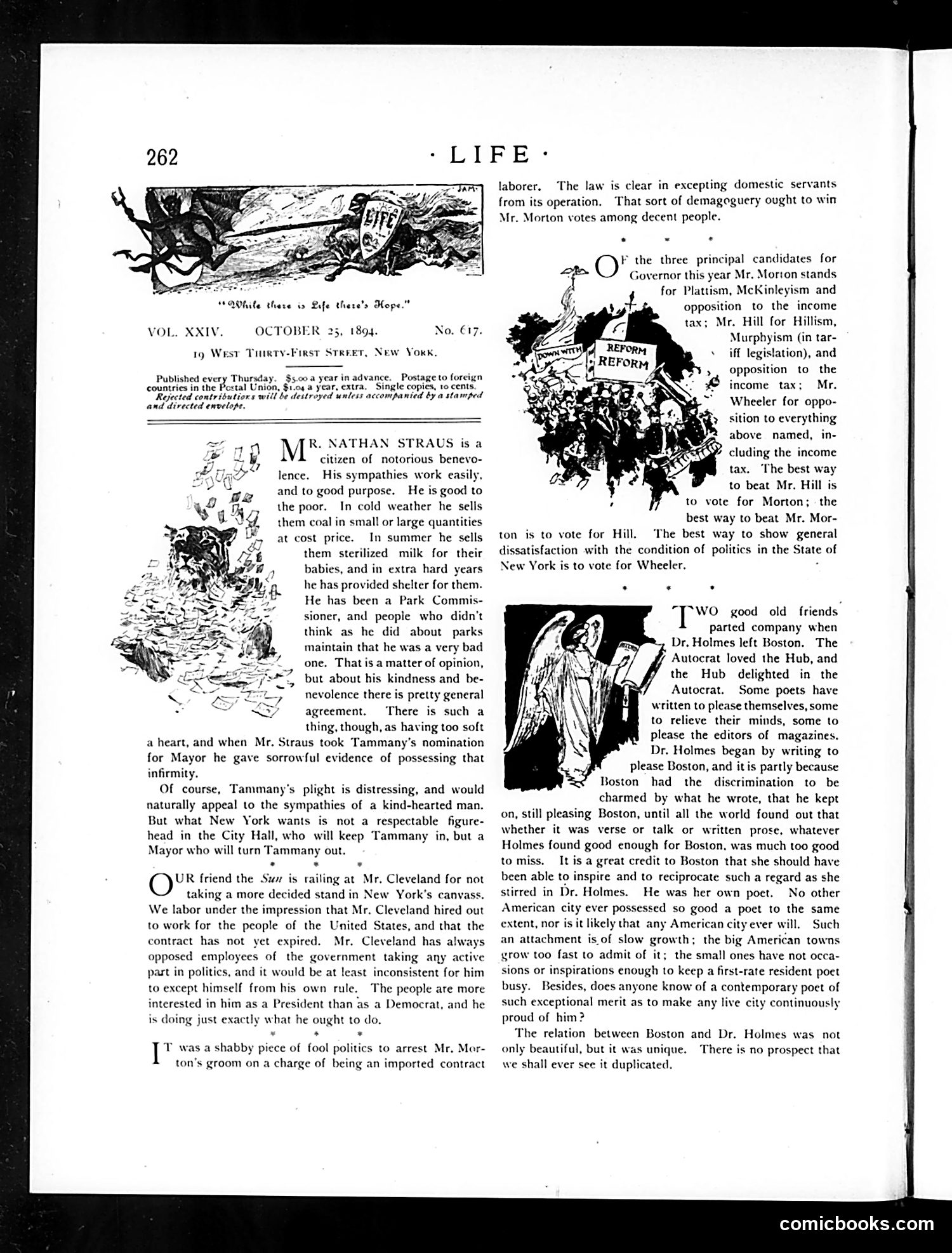
This page contains political commentary about New York gubernatorial candidates. The text discusses **Mr. Morton** (appears to be a reform-minded candidate), critiquing his sympathies as too soft and questioning his fitness for mayor. The article contrasts three principal candidates: Morton (Platism and income tax opposition), Hill (Hillism and Murphy-ism), and Wheeler (opposition to everything). The satirical point seems to be that all three candidates have significant flaws—the article suggests voting strategically against the worst option rather than for anyone preferable. There's also commentary about Dr. Holmes leaving Boston, praising his relationship with that city as uniquely exceptional. The cartoons appear to be decorative/illustrative rather than directly tied to specific political figures.
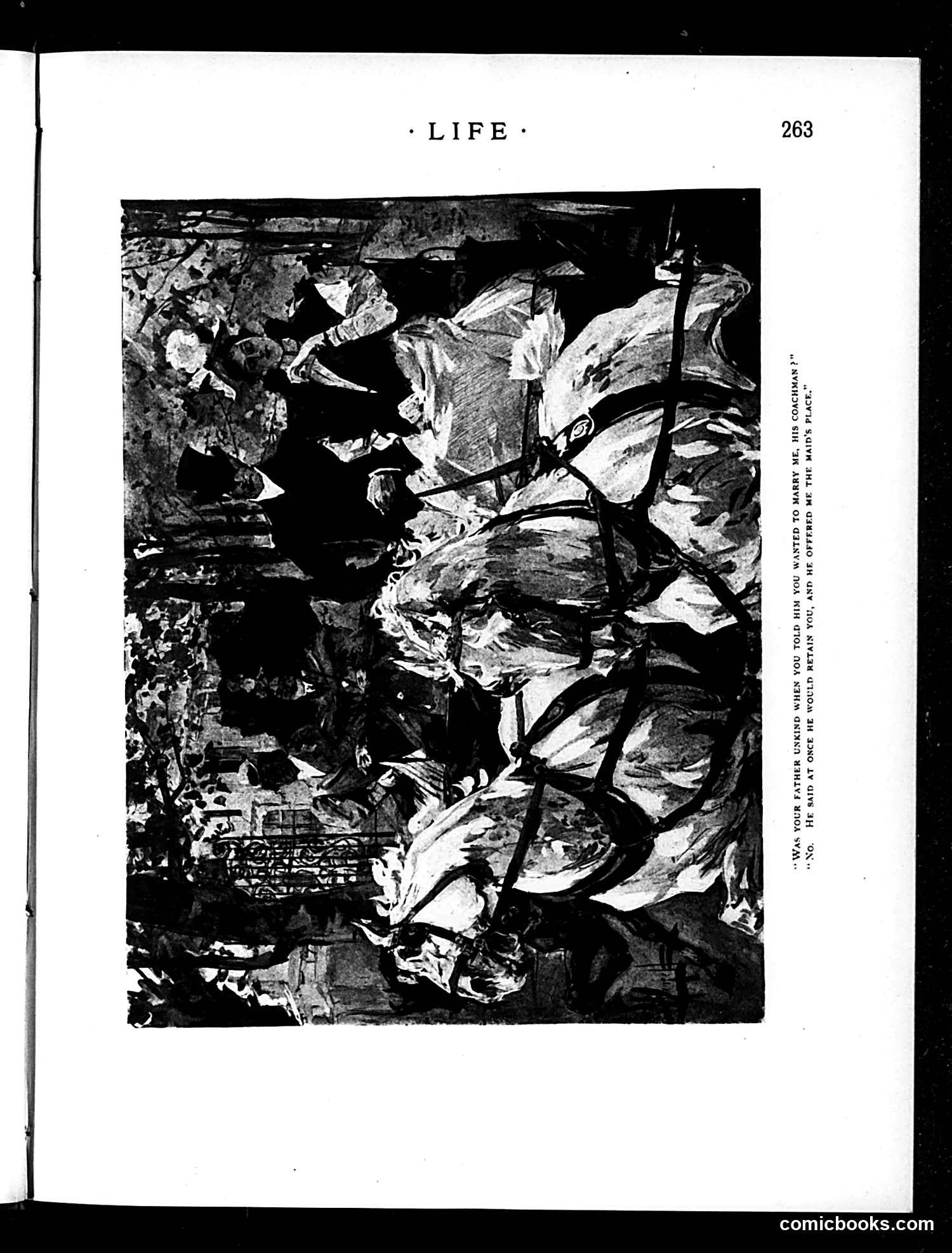
I can see this is page 263 from Life magazine, but the image quality and reproduction make it difficult to discern specific details clearly. The photograph appears to be a chaotic scene with multiple figures and overlapping elements rendered in stark black and white, possibly depicting a crowded or tumultuous situation. The caption on the right side is partially visible but not fully legible in this reproduction. Without being able to read the caption clearly or identify specific figures with confidence, I cannot reliably explain what political or social satire this cartoon represents or which contemporary figures or events it references. To provide accurate historical context, I would need a clearer reproduction of both the image and its accompanying text.
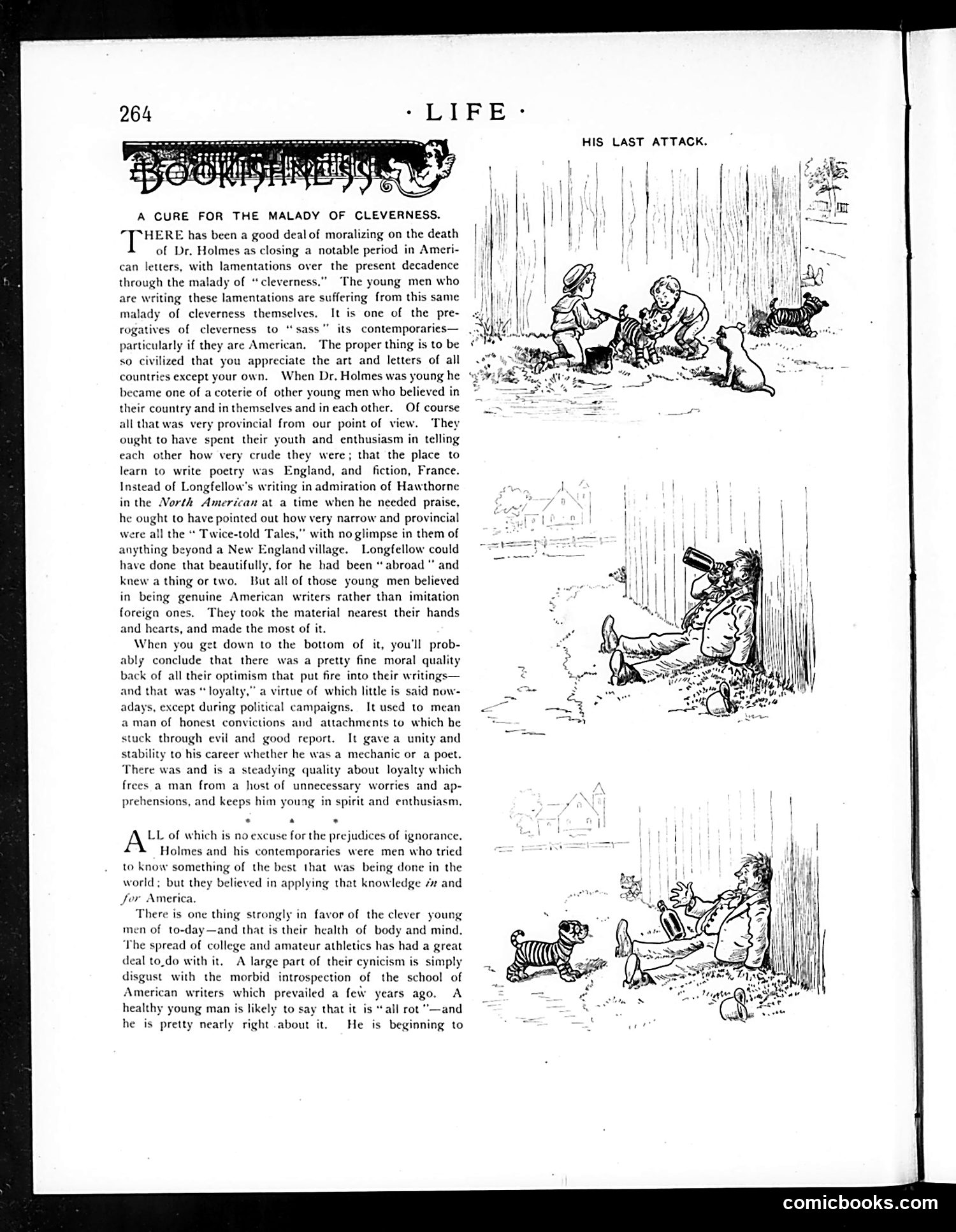
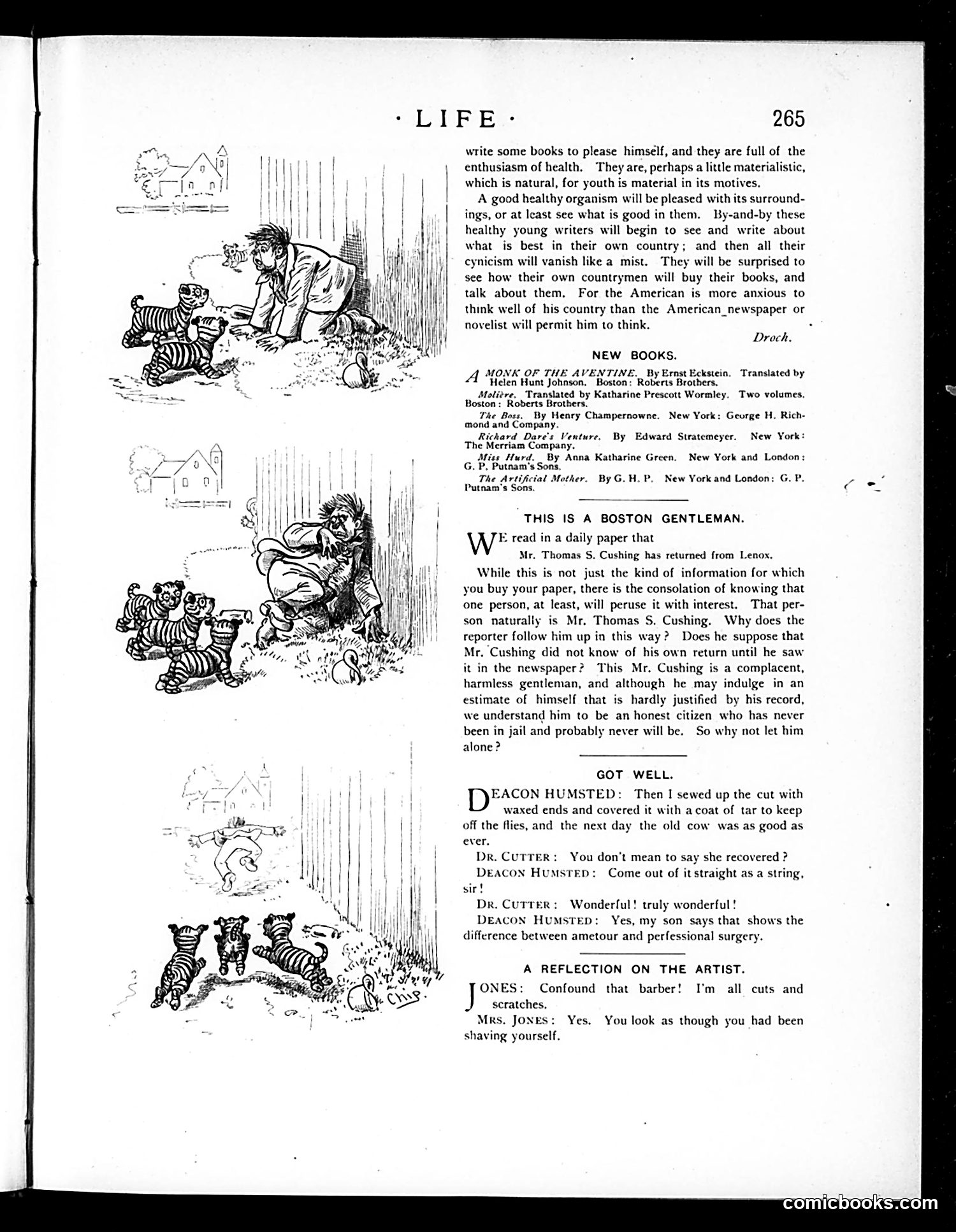
This page contains three separate humorous anecdotes rather than political cartoons: 1. **"This is a Boston Gentleman"**: A joke about Thomas S. Cushing returning from Lenox. The humor relies on the irony that a newspaper reporter follows up on his mundane trip—treating trivial local news as if it were significant. 2. **"Got Well"**: A dialogue between Deacon Humsted and Dr. Cutter about amateur versus professional surgery. The deacon has crudely repaired a cow's wound with tar; the doctor praises the result as superior to his own professional work—satirizing the gap between training and actual outcomes. 3. **"A Reflection on the Artist"**: A barber (Mr. Jones) has cut a customer so badly the man looks self-inflicted. The joke mocks artistic incompetence through physical damage. All three mock American social pretension and professional incompetence.
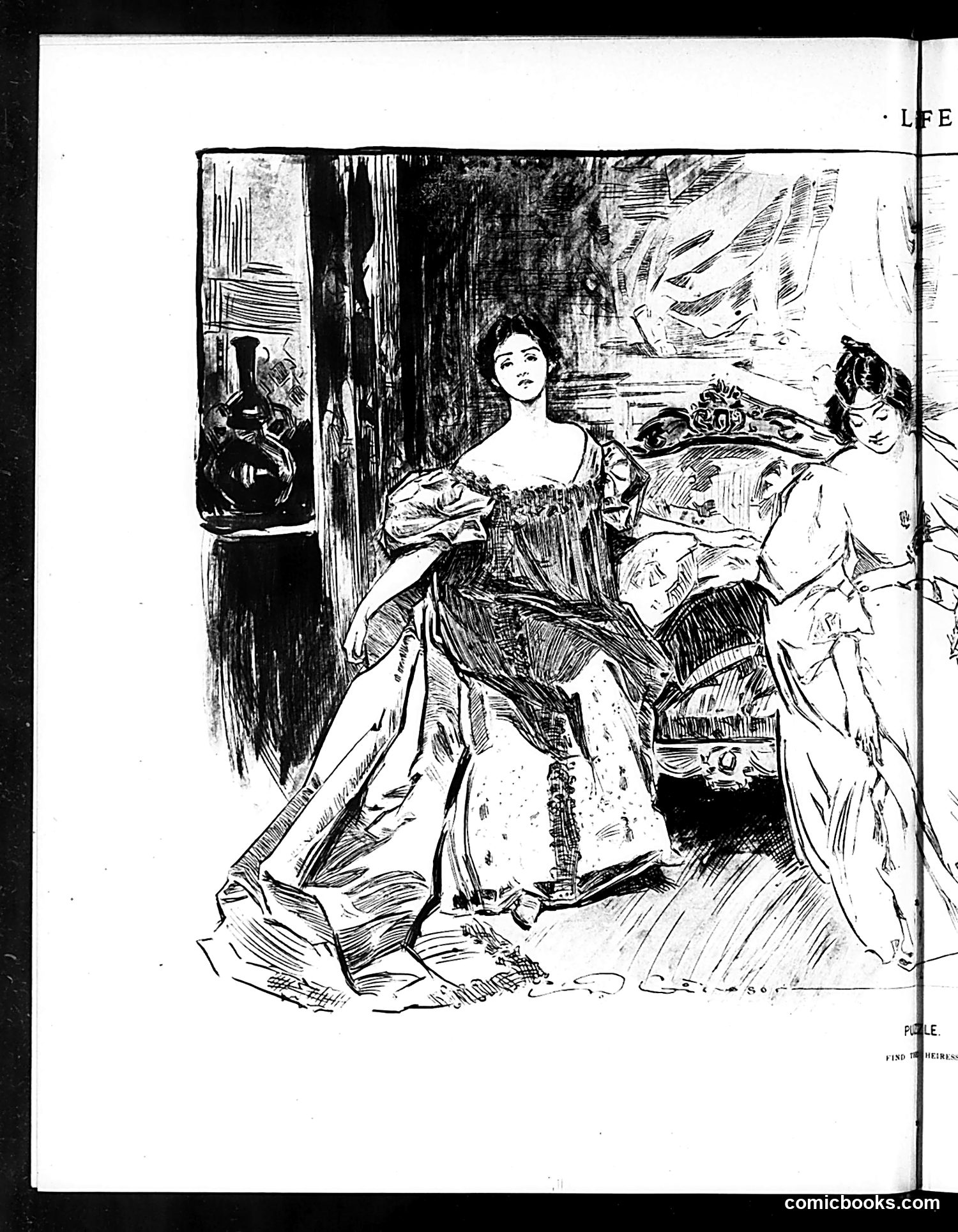
This appears to be an illustration from *Life* magazine depicting an elegant interior scene. A central woman in an ornate dress sits prominently, attended by another figure on the right. A servant or attendant stands in the background left near a doorway. The scene suggests domestic leisure among the wealthy. Without visible caption text or clear satirical elements, the specific social critique is unclear. However, the detailed rendering of luxurious fabrics, furnishings, and the hierarchy of figures (wealthy woman attended to by servants) likely comments on Gilded Age class distinctions and women's decorative role in society. The precise satirical point—whether mocking excess, idle affluence, or social pretension—cannot be determined from the image alone.
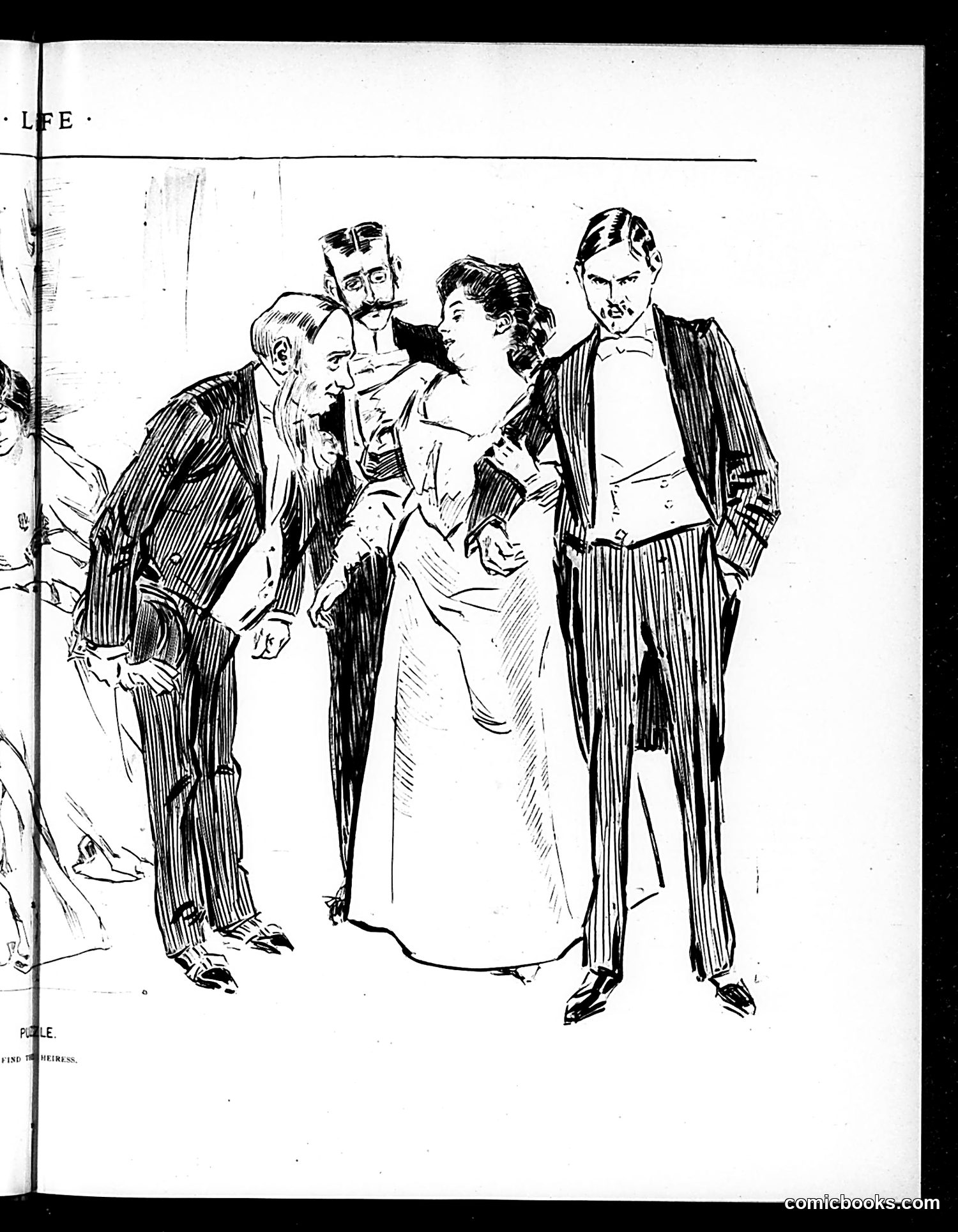
This page from *Life* magazine depicts a social scene with four elegantly dressed figures in formal attire. A woman in a light dress stands centrally, surrounded by three men in pinstriped suits. The illustration style and composition suggest this is satirizing high society or upper-class social dynamics, likely from the early 20th century based on the artistic technique. However, without visible caption text or clearer identifying details in the image itself, I cannot confidently identify the specific individuals being caricatured or pinpoint the exact social/political commentary intended. The page header reads "LIFE" and there appears to be credit text at the bottom, but it's not legible enough to determine the artist or provide more specific context about what particular event or trend this cartoon satirizes.
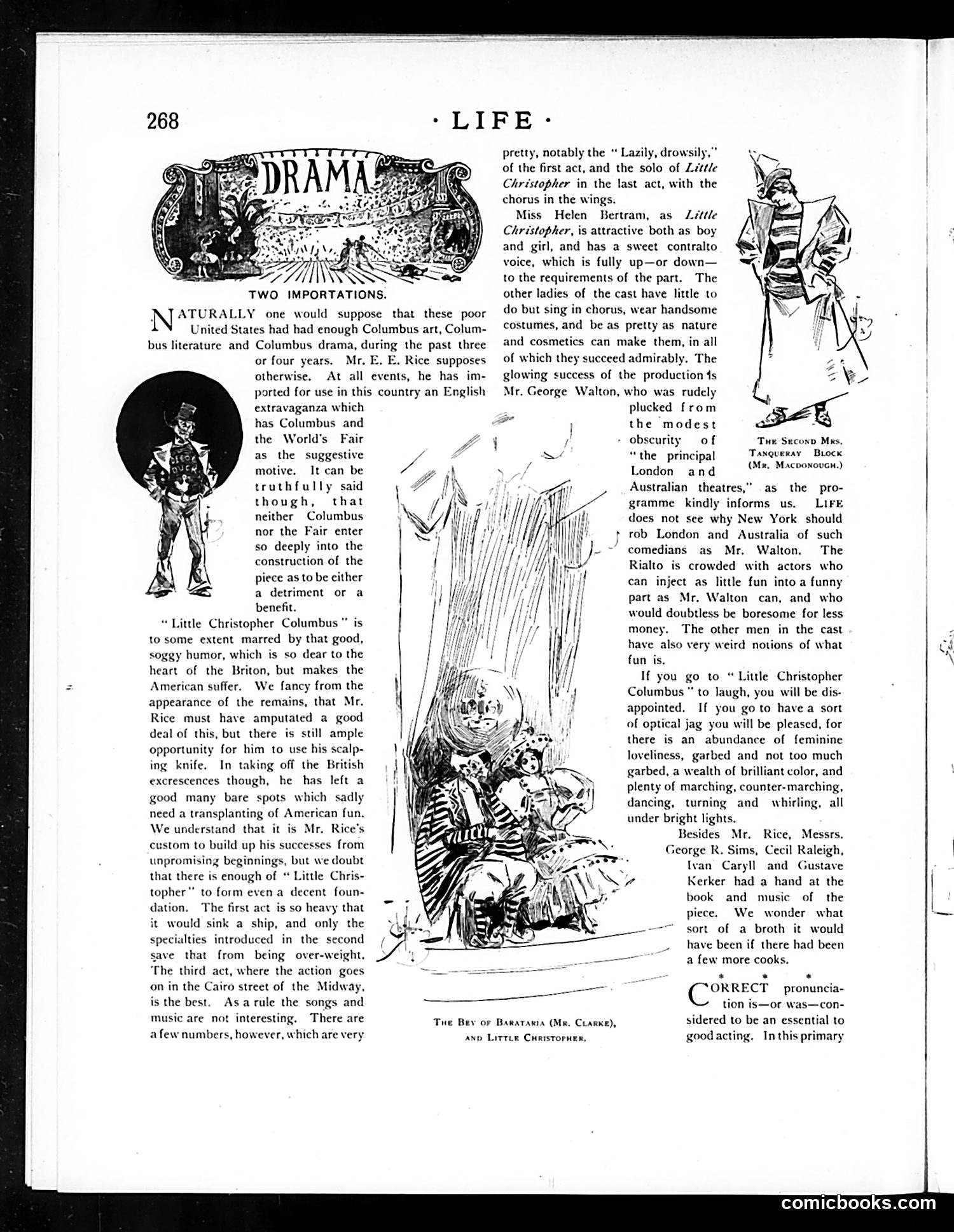
This is a theater review in *Life* magazine (page 268) discussing a production of "Little Christopher Columbus," a comedic play featuring Mr. E. E. Rice's work. The illustrations show characters in costume from the show. The text criticizes the production's attempt to transplant British theatrical humor for American audiences, noting that while the piece has merit, it requires "American fun" to succeed. The reviewer discusses specific cast members and their performances, particularly praising Miss Helen Hertram as "Little Christopher" and critiquing George Walton's direction as being drawn from "the principal London and Australian theatres." The satire targets the play's derivative nature and the challenge of adapting British comedy for American tastes, suggesting the production needed more distinctly American comedic sensibility to fully succeed.
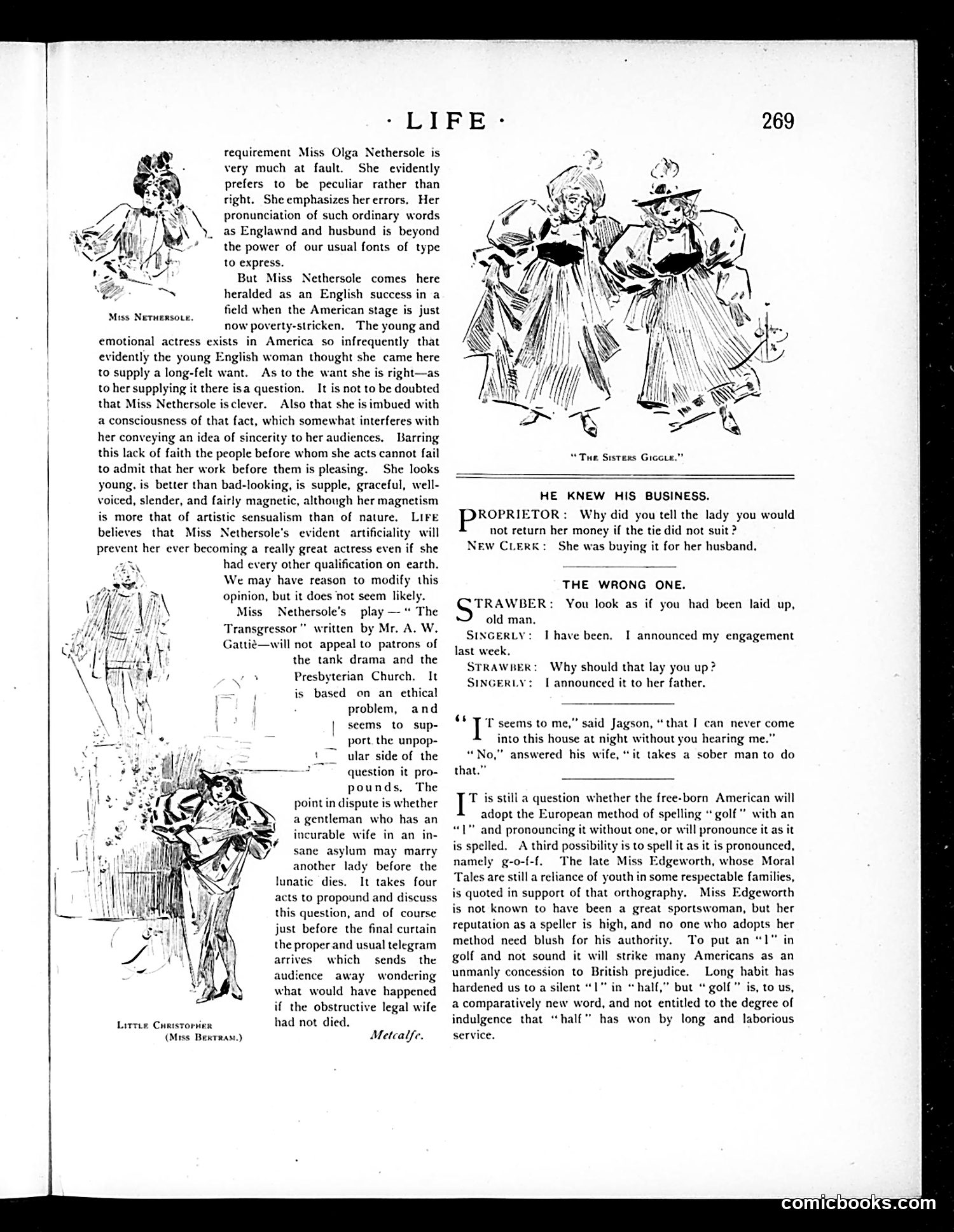
This page contains theatrical criticism and humorous anecdotes rather than political cartoons. The main review discusses actress **Miss Olga Nethersole**, praising her as embodying "English success" on the American stage—rare for young English actresses. The critic notes she's emotionally expressive, physically graceful, and magnetic, though somewhat artificial. Her play "The Transgressor" (by A. W. Gattie) addresses ethical questions about whether a gentleman can remarry before his first wife's death, a scandalous premise for the era's Presbyterian audiences. The sketches illustrate theatrical scenes and characters. Below are brief comedic dialogues ("He Knew His Business," "The Wrong One") featuring everyday workplace and domestic situations with wordplay humor typical of early-20th-century Life magazine's style.
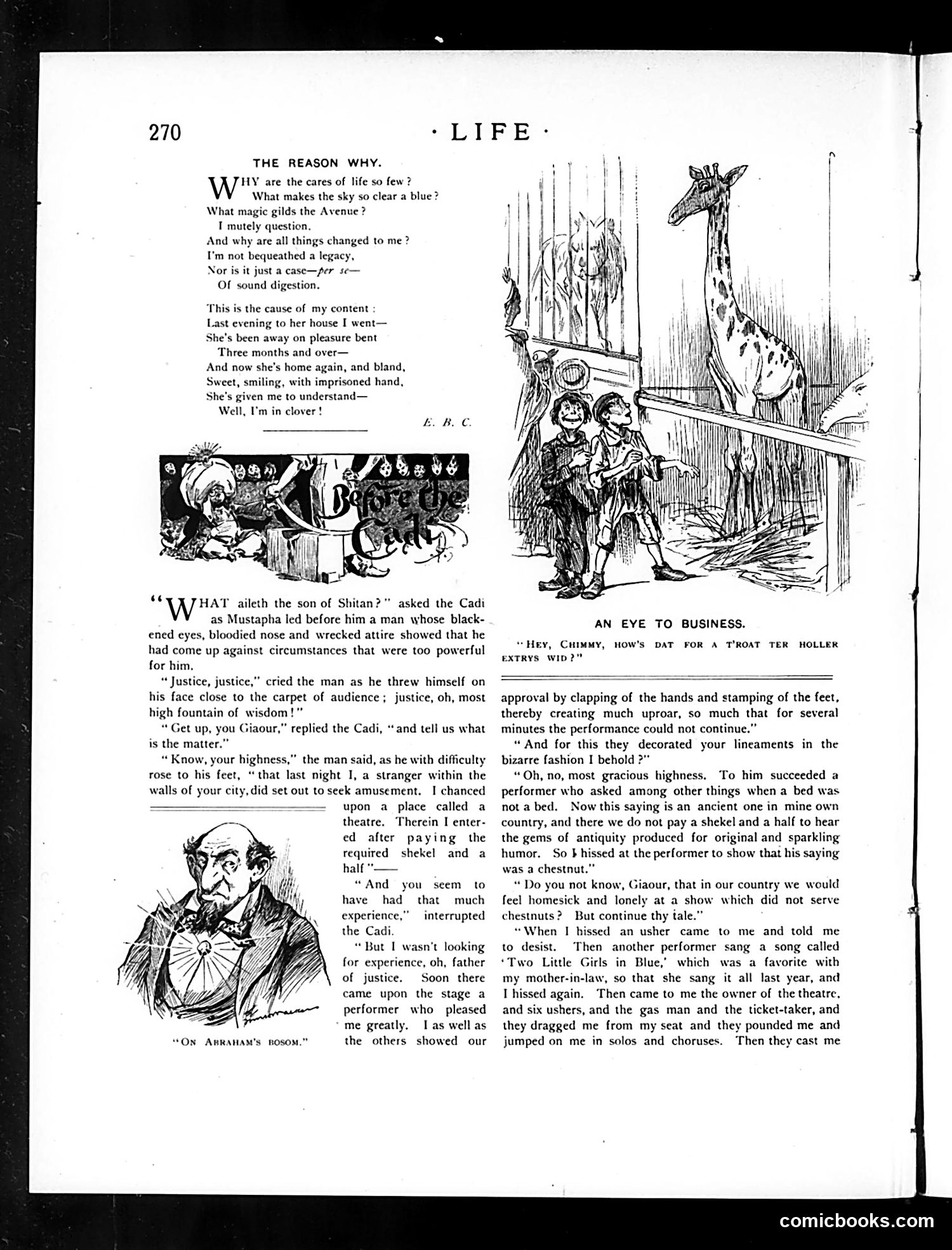
This page contains two distinct satirical pieces: **"The Reason Why"** (top left): A sentimental poem about a man's contentment—his lover has returned from a three-month absence. The satire is gentle, poking fun at romantic sentimentality and how love makes life seem perfect. **"An Eye to Business"** (main story): A frame-narrative satire set in an Oriental court. A foreign theater-goer complains to a Cadi (Islamic judge) about being brutally beaten by theater staff. His offense: he hissed at performers—once to discourage bad jokes ("chestnuts"), and once during a sentimental song. The satire mocks American theater audiences and performers. It suggests that theaters prioritize profit and crowd-pleasing sentiment over quality, and that audiences who dare criticize (hiss) face violent retaliation from theater management protecting their investment. The "Eastern" setting was a common literary device for social commentary in this era, allowing criticism of American society under a fictional guise.
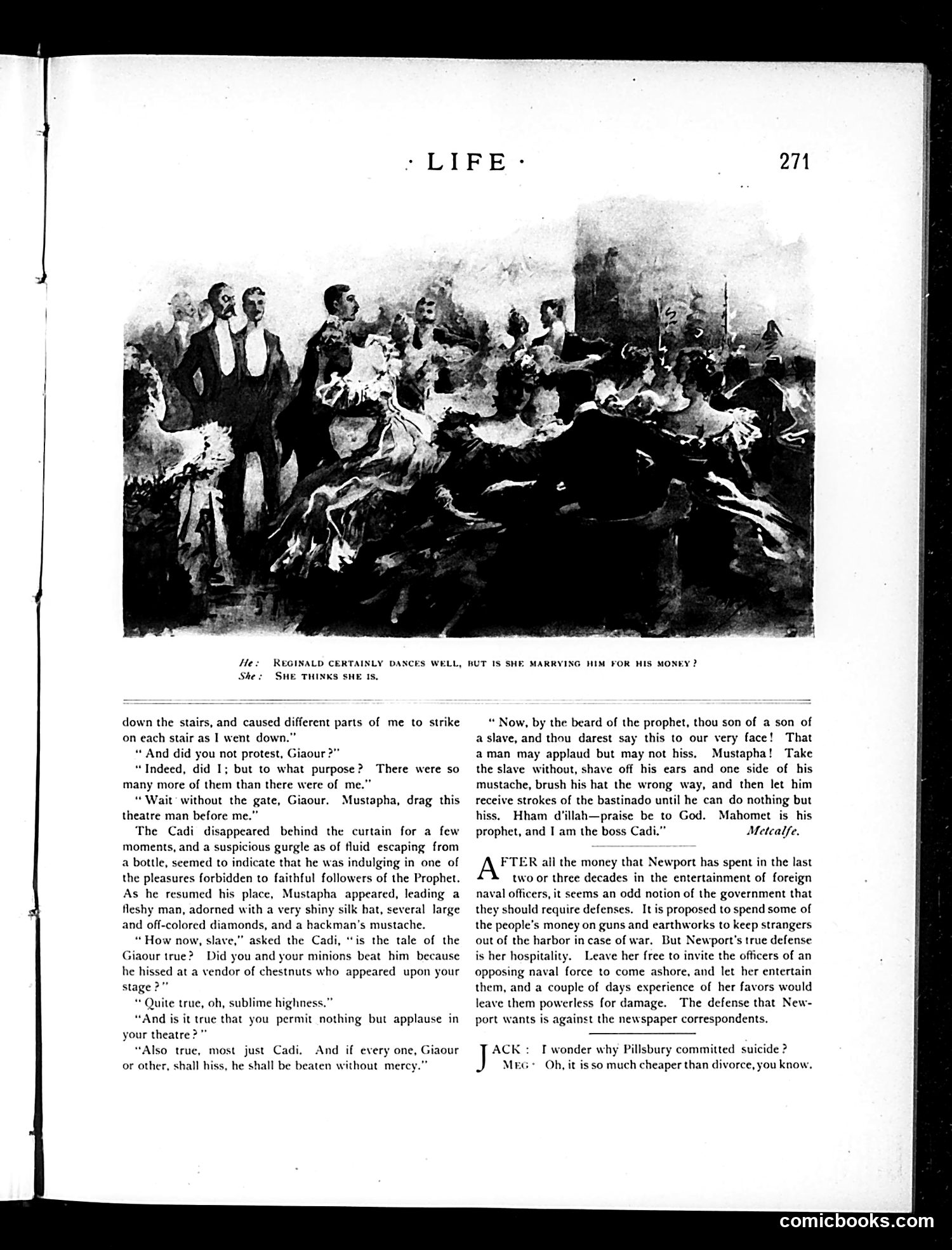
The page contains two separate satirical pieces: **Upper Illustration & Text:** A theatrical sketch mocking censorship and theatrical management. A theater manager defends beating audience members who hiss (express disapproval), claiming he permits only applause. The absurdist humor escalates when a Turkish Cadi (judge) character sentences him to severe punishment—shaving his ears and mustache, then beatings—for this authoritarian policy. The satire targets theater owners who suppress legitimate audience criticism. **Lower Section:** A brief commentary mocking Newport, Rhode Island's defensive military spending. Life sarcastically argues Newport's "true defense" is entertaining foreign naval officers with hospitality rather than building fortifications. The joke: wealthy Newport's genuine threat comes from newspaper reporters exposing scandal, not war. **Final Joke:** A dark one-liner about a suicide being cheaper than divorce—typical of Life's caustic social commentary on marriage and class. The page reflects turn-of-century American satirical humor targeting theatrical tyranny, military policy, and marital discord.
This page contains **three humorous anecdotes** rather than a single political cartoon, all playing on cases of mistaken identity and misunderstanding: 1. **The ship cabin mix-up**: A shy Australian major discovers his cabin-mate "Capt. Higginson" is actually a woman. The joke relies on the assumption that "Higginson" sounds masculine—a name-based gender deception that causes embarrassment. 2. **The elderly Black soldier**: An ex-slave discusses his wartime conduct, prioritizing survival over courage or reputation—a comedic commentary on practical priorities versus social expectations. 3. **The rural visitor to the eye doctor**: A country man, told that seeing double is an "advantage," leaves a ten-dollar tip instead of the required five-dollar fee, outsmarting the clever city doctor through literal interpretation. These represent typical **turn-of-century American humor**: plays on rural/urban divides, gender assumptions, and linguistic misunderstandings that were considered witty to contemporary readers.