
Life, 1894-10-25 · page 11 of 14
Life — October 25, 1894 — page 11: what you’re looking at
What you’re looking at
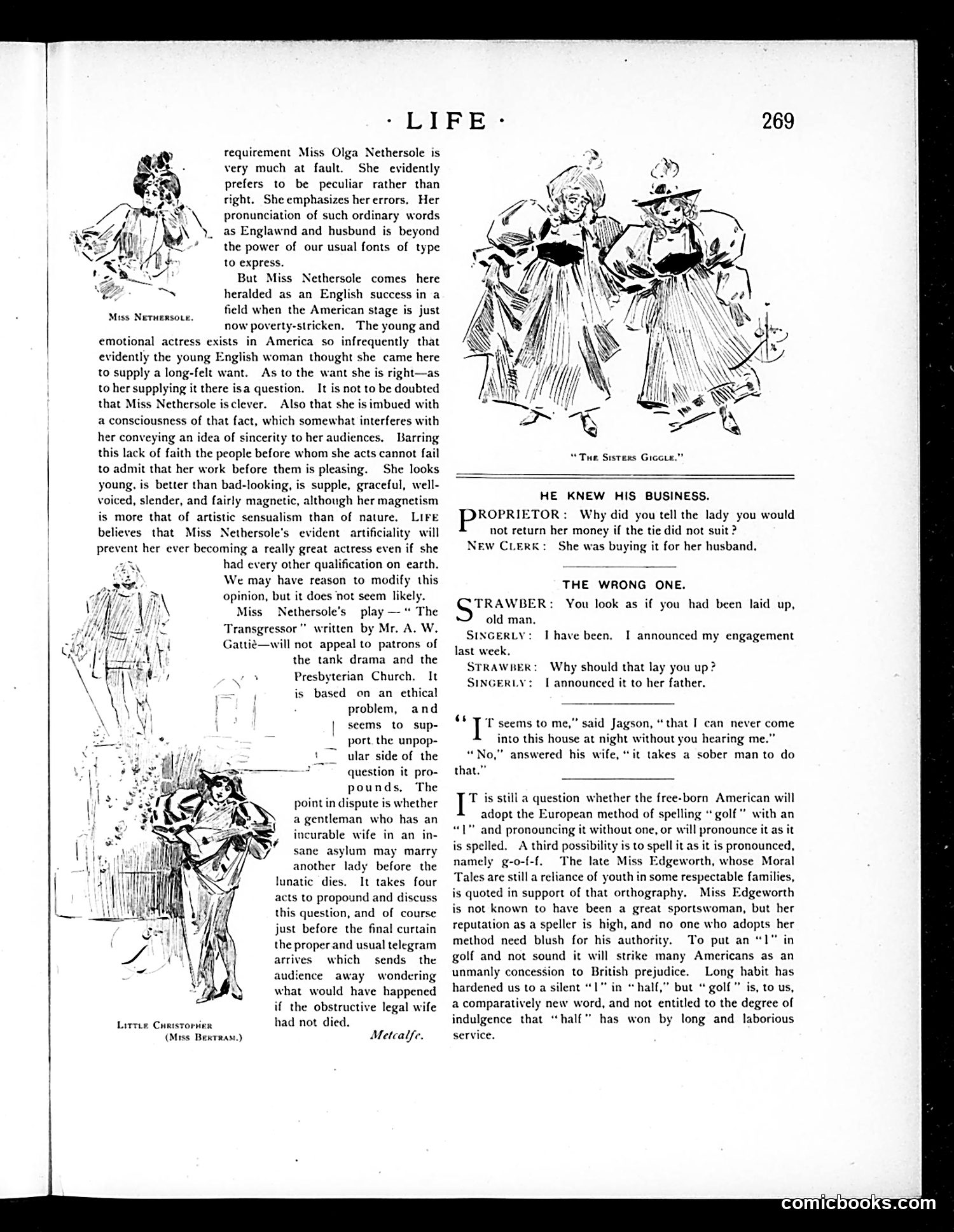
This page contains theatrical criticism and humorous anecdotes rather than political cartoons. The main review discusses actress **Miss Olga Nethersole**, praising her as embodying "English success" on the American stage—rare for young English actresses. The critic notes she's emotionally expressive, physically graceful, and magnetic, though somewhat artificial. Her play "The Transgressor" (by A. W. Gattie) addresses ethical questions about whether a gentleman can remarry before his first wife's death, a scandalous premise for the era's Presbyterian audiences. The sketches illustrate theatrical scenes and characters. Below are brief comedic dialogues ("He Knew His Business," "The Wrong One") featuring everyday workplace and domestic situations with wordplay humor typical of early-20th-century Life magazine's style.
📄 Transcribed text from this page (OCR, searchable)
Machine-transcribed from the original scan — historical spelling and the odd misread are preserved.
- LIFE: requirement Miss Olga Nethersole is very much at fault. She evidently prefers to be peculiar rather than right. She emphasizes hererrors. Her pronunciation of such ordinary words as Englawnd and husbund is beyond the power of our usual fonts of type to express. But Miss Nethersole comes here heralded as an English success in a field when the American stage is just now poverty-stricken. The young and emotional actress exists in America so infrequently that evidently the young English woman thought she came here to supply a long-felt want. As to the want she is right—as to her supplying it there isa question. It is not to be doubted that Miss Nethersole isclever. Also that she is imbued with a consciousness of that fact, which somewhat interferes with her conveying an idea of sincerity to her audiences. Barring this lack of faith the people before whom she acts cannot fail to admit that her work before them is pleasing. She looks young, is better than bad-looking, is supple, graceful, well- voiced, slender, and fairly magnetic, although her magnetism is more that of artistic sensualism than of nature, LIFE believes that Miss Nethersole’s evident artificiality will prevent her ever becoming a really great actress even if she had every other qualification on earth, We may have reason to modify this opinion, but it does not seem likely. Miss Nethersole’s play — “ The Transgressor" written by Mr. A. W. Gattit—will not appeal to patrons of the tank drama and the Presbyterian Church. It is based on an ethical problem, and | seems to sup- port. the unpop- ‘ ular side of the a question it pro- pounds, The point in dispute is whether a gentleman who has an incurable wife in an in- sane asylum may marry another lady before the lunatic dies, It takes four acts to propound and discuss this question, and of course just before the final curtain the proper and usual telegram arrives which sends the audience away wondering what would have happened if the obstructive legal wife had not died. Miss Netwersote. Littie Curistorvier (Miss Bexrras.) Metcalfe. 269 “Tue Sisters Giccur.”” HE KNEW HIS BUSINESS. ROPRIETOR: Why did you tell the lady you would not return her money if the tie did not suit ? New CLERK: She was buying it for her husband. THE WRONG ONE. TRAWBER: You look as if you had been laid up, old man. SINGERLY: Ihave been. I announced my engagement last week, STRAWB Why should that lay you up? SINGERL- I announced it to her father. “ T seems to me,” said Jagson, “that I can never come into this house at night without you hearing me.” “No,” answered his wife, “it takes a sober man to do that. T is still a question whether the free-born American will adopt the European method of spelling “ golf” with an and pronouncing it without one, or will pronounce it as it is spelled. A third possibility is to spell it as it is pronounced, namely g-o-f-f, The late Miss Edgeworth, whose Moral Tales are still a reliance of youth in some respectable families, is quoted in support of that orthography. Miss Edgeworth is not known to have been a great sportswoman, but her reputation as a speller is high, and no one who adopts her method need blush for his authority. To put an “1" in golf and not sound it will strike many Americans as an unmanly concession to British prejudice. Long habit has hardened us to a silent “1" in “half,” but “ golf” is, to us, a comparatively new word, and not entitled to the degree of indulgence that ‘half has won by long and laborious service.