
Life, 1894-10-25 · page 4 of 14
Life — October 25, 1894 — page 4: what you’re looking at
What you’re looking at
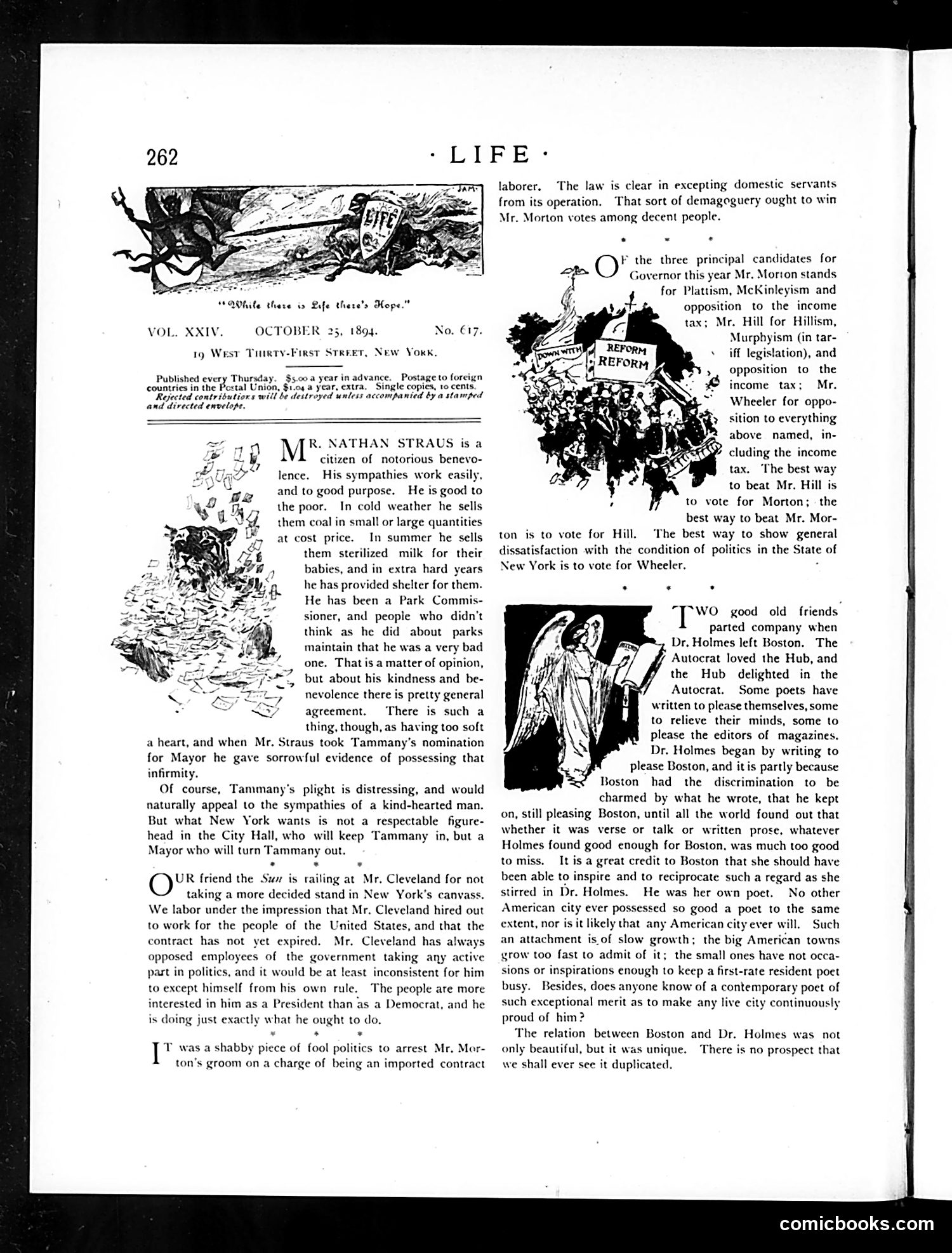
This page contains political commentary about New York gubernatorial candidates. The text discusses **Mr. Morton** (appears to be a reform-minded candidate), critiquing his sympathies as too soft and questioning his fitness for mayor. The article contrasts three principal candidates: Morton (Platism and income tax opposition), Hill (Hillism and Murphy-ism), and Wheeler (opposition to everything). The satirical point seems to be that all three candidates have significant flaws—the article suggests voting strategically against the worst option rather than for anyone preferable. There's also commentary about Dr. Holmes leaving Boston, praising his relationship with that city as uniquely exceptional. The cartoons appear to be decorative/illustrative rather than directly tied to specific political figures.
📄 Transcribed text from this page (OCR, searchable)
Machine-transcribed from the original scan — historical spelling and the odd misread are preserved.
LIFE “While there is Life there’s Hope.” VOL. XXIV. 1g West Tiirty-First STREET, OCTOBER 25, 1894. No. €17. New York. Published every Thursday. $5.00 a year in advance, | Postage to foreign countries in the Pestal Union, $1.04 a year, extra, Single copies, to cents. Rejected contributions will be destroyed unless accompanied by a stamped and directed envelope. M R. NATHAN STRAUS is a AVL citizen of notorious benevo- lence. His sympathies work easily, and to good purpose. He is good to the poor. In cold weather he sells them coal in small or large quantities at cost price. In summer he sells them sterilized milk for their babies, and in extra hard years he has provided shelter for them. He has been a Park Commis- sioner, and people who didn't think as he did about parks maintain that he was a very bad one. Thatis a matter of opinion, but about his kindness and be- nevolence there is pretty general agreement. There is such a thing, though, as having too soft a heart, and when Mr. Straus took Tammany's nomination for Mayor he gave sorrowful evidence of possessing that infirmity. Of course, Tammany’s plight is distressing, and would naturally appeal to the sympathies of a kind-hearted man. But what New York wants is not a respectable figure- head in the City Hall, who will keep Tammany in, but a Mayor who will turn Tammany out. UR friend the Sw is railing at Mr. Cleveland for not taking a more decided stand in New York's canvass. We labor under the impression that Mr. Cleveland hired out to work for the people of the United States, and that the contract has not yet expired. Mr. Cleveland has always opposed employees of the government taking any active part in politics, and it would be at least inconsistent for him to except himself from his own rule. The people are more interested in him as a President than as a Democrat, and he is doing just exactly what he ought to do, I" was a shabby piece of fool politics to arrest Mr. Mor- ton’s groom on a charge of being an imported contract laborer, from its operation. The law is clear in excepting domestic servants That sort of demagoguery ought to win Mr. Morton votes among decent people. ae three principal candidates for wernor this year Mr. Morton stands for Plattism, McKinleyism and opposition to the income tax; Mr. Hill for Hillism, Murphyism (in tar- iff legislation), and opposition to the income tax; Mr. Wheeler for oppo- sition to everything above named, in- cluding the income tax. The best way to beat Mr. Hill is to vote for Morton; the best way to beat Mr. Mor- ton is to vote for Hill. The best way to show general dissatisfaction with the condition of politics in the State e of New York is to vote for Wheeler. Ot ate good old friends parted company when Dr. Holmes left Boston. The Autocrat loved the Hub, and the Hub delighted in the Autocrat. Some poets have written to please themselves, some to relieve their minds, some to please the editors of magazines. Dr. Holmes began by writing to please Boston, and itis partly because Boston had the discrimination to be charmed by what he wrote, that he kept on, still pleasing Boston, until all the world found out that whether it was verse or talk or written prose, whatever Holmes found good enough for Boston, was much too good to miss. It is a great credit to Boston that she should have been able to inspire and to reciprocate such a regard as she stirred in Dr. Holmes. He was her own poet. No other American city ever possessed so good a poet to the same extent, nor is it likely that any American city ever will. Such an attachment is.of slow growth; the big American towns grow too fast to admit of it; the small ones have not occa- sions or inspirations enough to keep a first-rate resident poet busy. Besides, does anyone know of a contemporary poet of such exceptional merit as to make any live city continuously proud of him? The relation between Boston and Dr. only beautiful, but it was unique. we shall ever see it dupl Holmes was not There is no prospect that comicbooks.com