
Life, 1894-10-25 · page 7 of 14
Life — October 25, 1894 — page 7: what you’re looking at
What you’re looking at
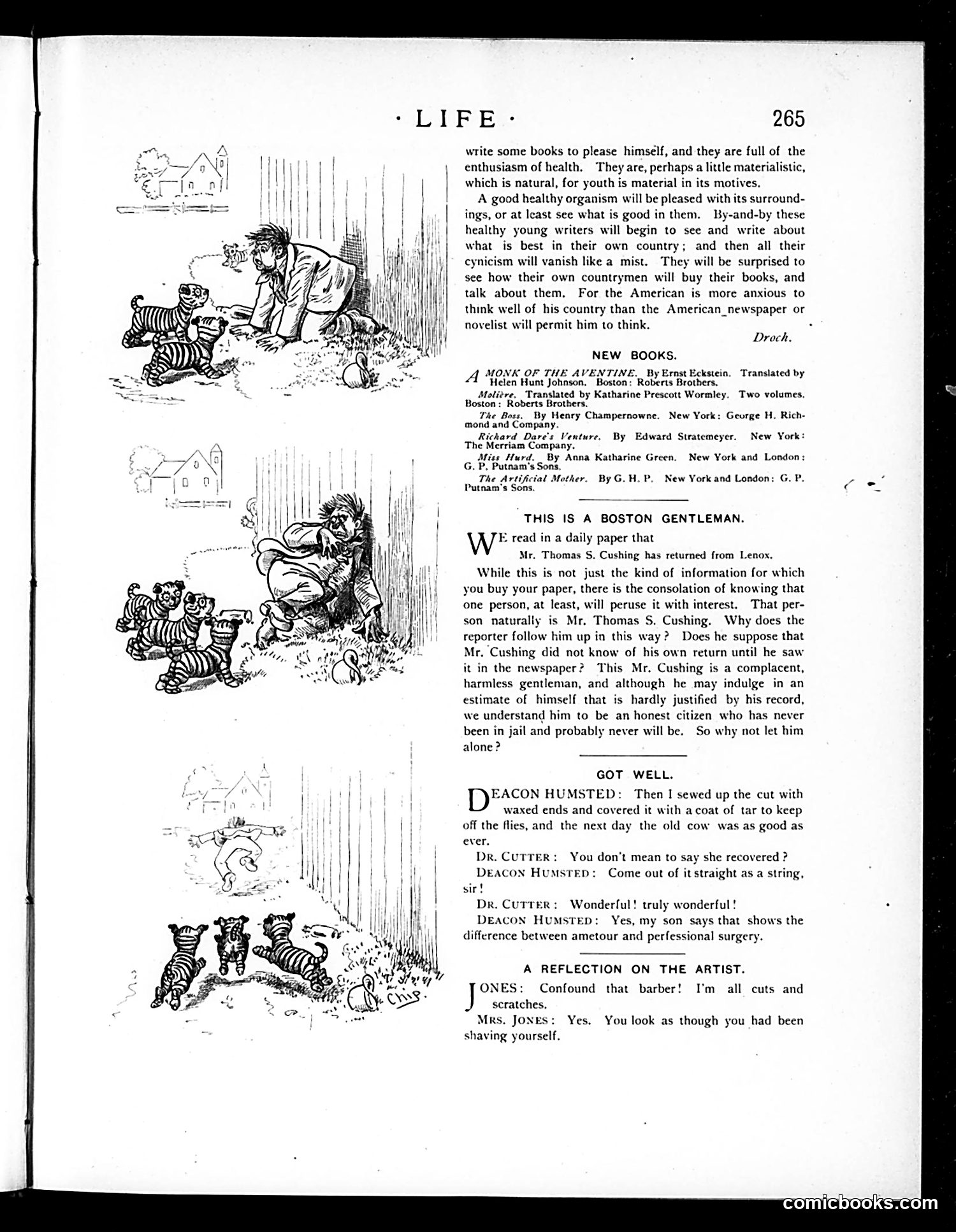
This page contains three separate humorous anecdotes rather than political cartoons: 1. **"This is a Boston Gentleman"**: A joke about Thomas S. Cushing returning from Lenox. The humor relies on the irony that a newspaper reporter follows up on his mundane trip—treating trivial local news as if it were significant. 2. **"Got Well"**: A dialogue between Deacon Humsted and Dr. Cutter about amateur versus professional surgery. The deacon has crudely repaired a cow's wound with tar; the doctor praises the result as superior to his own professional work—satirizing the gap between training and actual outcomes. 3. **"A Reflection on the Artist"**: A barber (Mr. Jones) has cut a customer so badly the man looks self-inflicted. The joke mocks artistic incompetence through physical damage. All three mock American social pretension and professional incompetence.
📄 Transcribed text from this page (OCR, searchable)
Machine-transcribed from the original scan — historical spelling and the odd misread are preserved.
> LIFE.- 265 write some books to please himself, and they are full of the enthusiasm of health, They are, perhaps a little materialistic, which is natural, for youth is material in its motives. A good healthy organism will be pleased with its surround- ings, or at least see what is good in them. By-and-by these healthy young writers will begin to see and write about what is best in their own country; and then all their cynicism will vanish like a mist. They will be surprised to see how their own countrymen will buy their books, and talk about them, For the American is more anxious to think well of his country than the American_newspaper or novelist will permit him to think. Droch. NEW BOOKS. MONK OF THE AVENTINE. By Ernst Eckstein, Translated by Helen Hunt Johnson, Boston: Roberts Brothers. Motitre. ‘Translated by Katharine Prescott Wormley. Two volumes. Boston: Roberts Brothers. The Boss. By Henry Champernowne. New York: Geurge H. Rich- mond and Company. Richard Dare's Venture. By Edward Stratemeyer. New York: The Merriam Company, Miss Hurd. By Anna Katharine Green. New York and London: G. P, Putnam's Sons, The Artificial Mother. By G.H.P. New York and London: G. P. Putnam's Sons. THIS IS A BOSTON GENTLEMAN. E read in a daily paper that Mr. Thomas S, Cushing has returned from Lenox, While this is not just the kind of information for which you buy your paper, there is the consolation of knowing that one person, at least, will peruse it with interest. That per- son naturally is Mr. Thomas S. Cushing. Why does the reporter follow him up in this way? Does he suppose that Mr. Cushing did not know of his own return until he saw it in the newspaper? This Mr. Cushing is a complacent, harmless gentleman, and although he may indulge in an estimate of himself that is hardly justified by his record, we understand him to be an honest citizen who has never been in jail and probably never will be. So why not let him alone ? GOT WELL. EACON HUMSTED: Then I sewed up the cut with waxed ends and covered it with a coat of tar to keep off the flies, and the next day the old cow was as good as ever, Dr. CUTTER: You don’t mean to say she recovered ? DEACON HuMSTED: Come out of it straight as a string, UTTER: Wonderful! truly wonderful! rED: Yes, my son says that shows the difference between ametour and perfessional surgery. A REFLECTION ON THE ARTIST. ONES: Confound that barber! I'm all cuts and scratches, Mrs. Jones: Yes. You look as though you had been shaving yourself.