
A complete issue · 16 pages · 1894
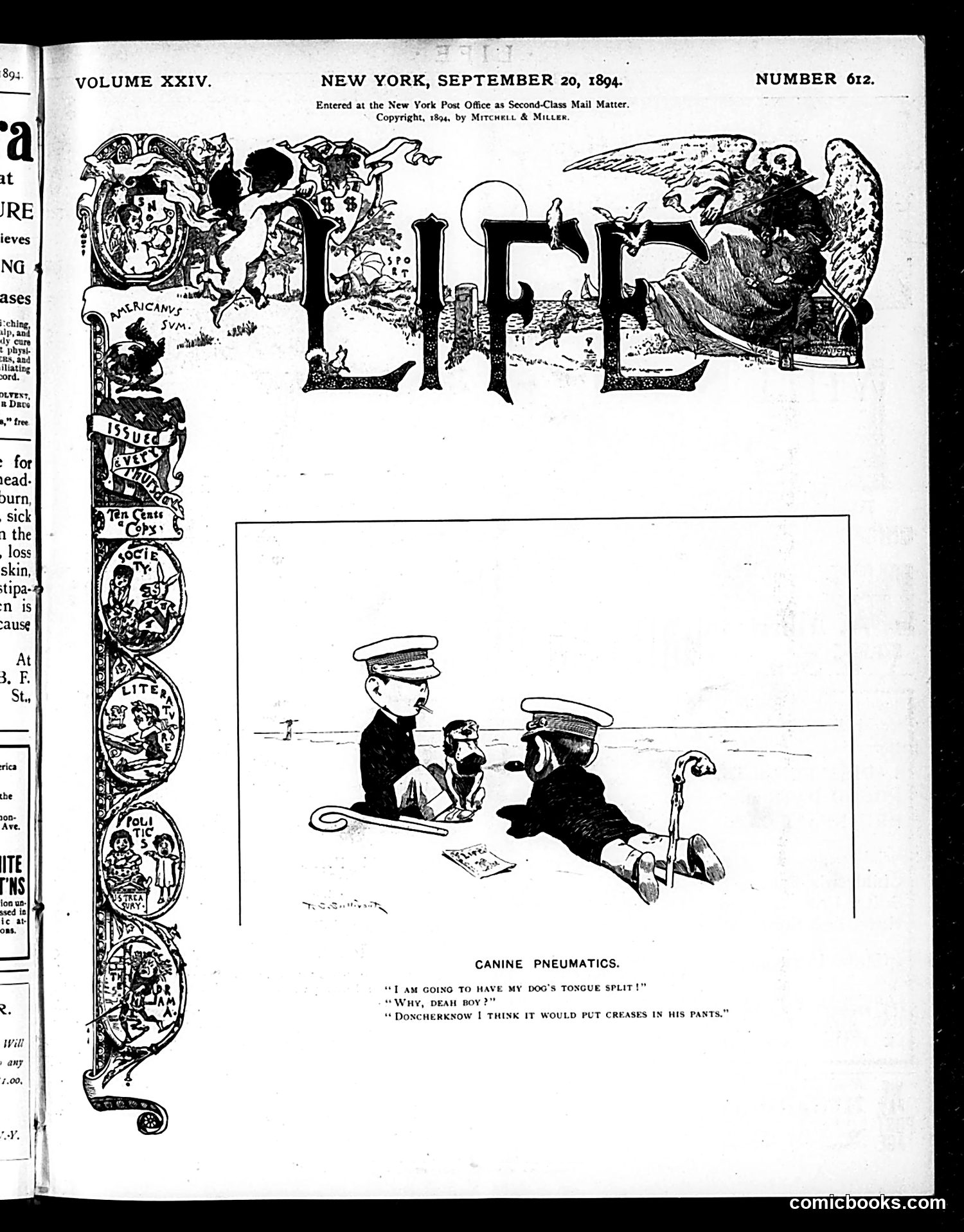
Life — September 20, 1894
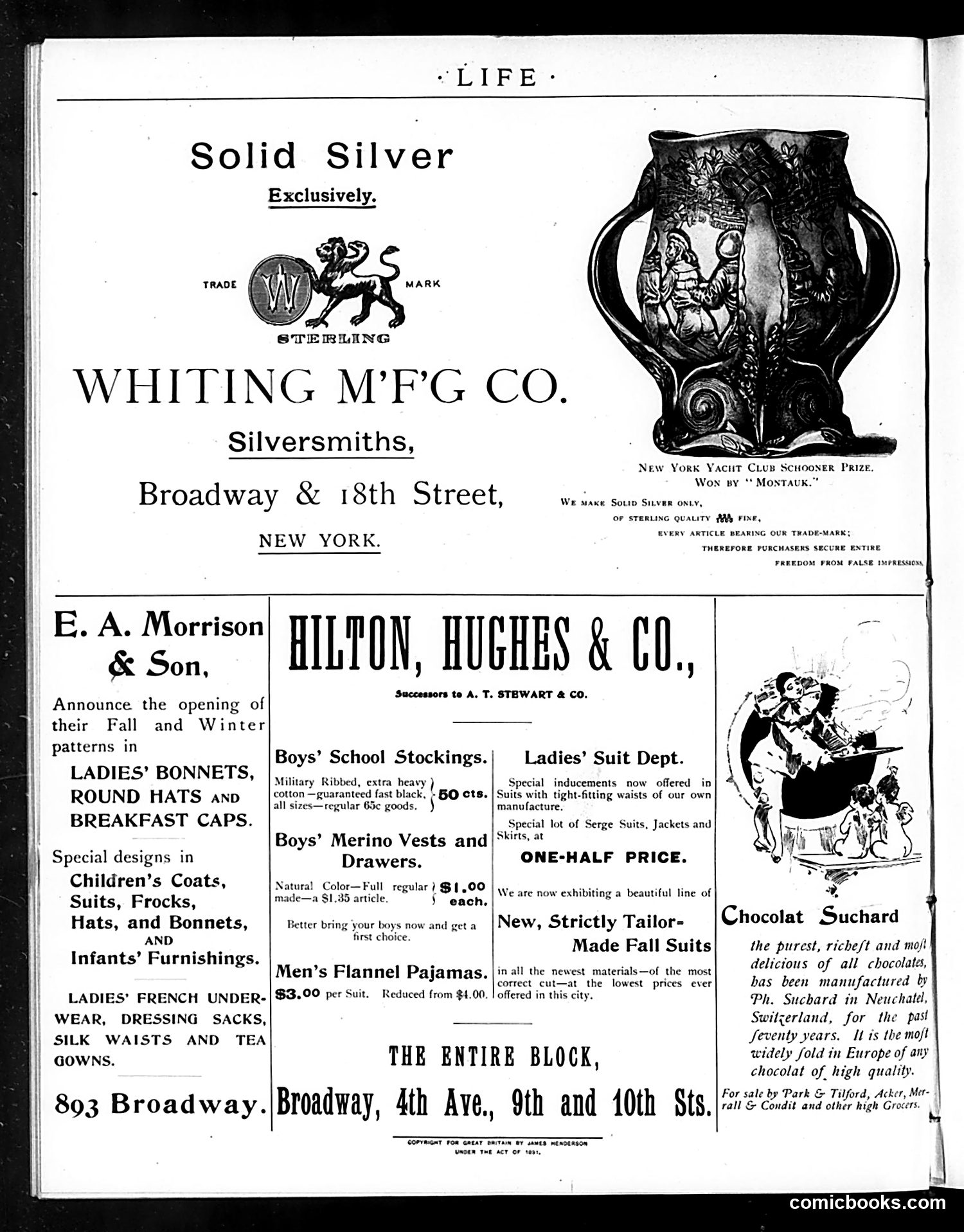
This page is primarily **advertising**, not satirical content. It contains three commercial advertisements: 1. **Whiting M'FG Co.** — A New York silversmith promoting solid sterling silver goods, featuring an ornate vase that won a New York Yacht Club prize. 2. **E.A. Morrison & Son** — Clothing retailer advertising ladies' bonnets, hats, children's coats, and undergarments at 803 Broadway. 3. **Hilton, Hughes & Co.** — Department store (successor to A.T. Stewart & Co.) advertising boys' stockings, men's pajamas, ladies' suits, and other merchandise across an entire block on Broadway. A **Chocolate Suchard** advertisement appears on the right, promoting Swiss chocolate. The small cartoon illustration accompanies the chocolate ad but contains no political or social satire—it's decorative commercial artwork typical of period magazine advertising.
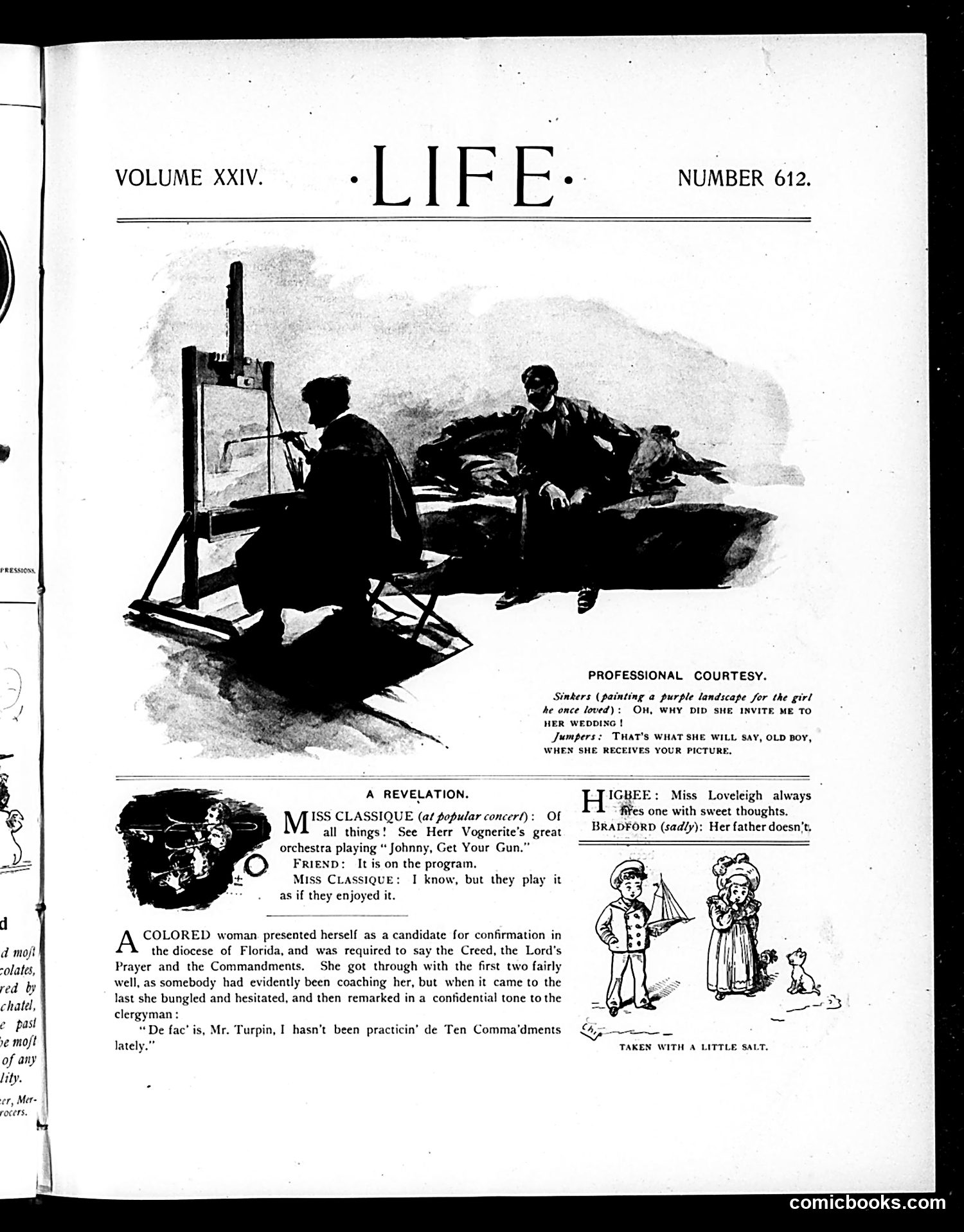
**Top Cartoon - "Professional Courtesy":** Shows an artist painting a portrait while a man lounges nearby. The joke hinges on the man's comment about the artist inviting a woman to her wedding—he cynically predicts she'll criticize the portrait when she receives it. This satirizes both artistic vanity and the social awkwardness of unsolicited criticism from recipients of art. **"A Revelation":** Mocks concert-goers' pretense. Miss Classique attends an orchestra playing "Johnny, Get Your Gun" (a popular wartime song) but claims ignorance, while admitting they play it as if they enjoyed it—poking fun at affected cultural snobbery. **"A Colored Woman" anecdote:** Humorous account of a woman struggling to recite religious commandments during confirmation, bungling the recitation badly.
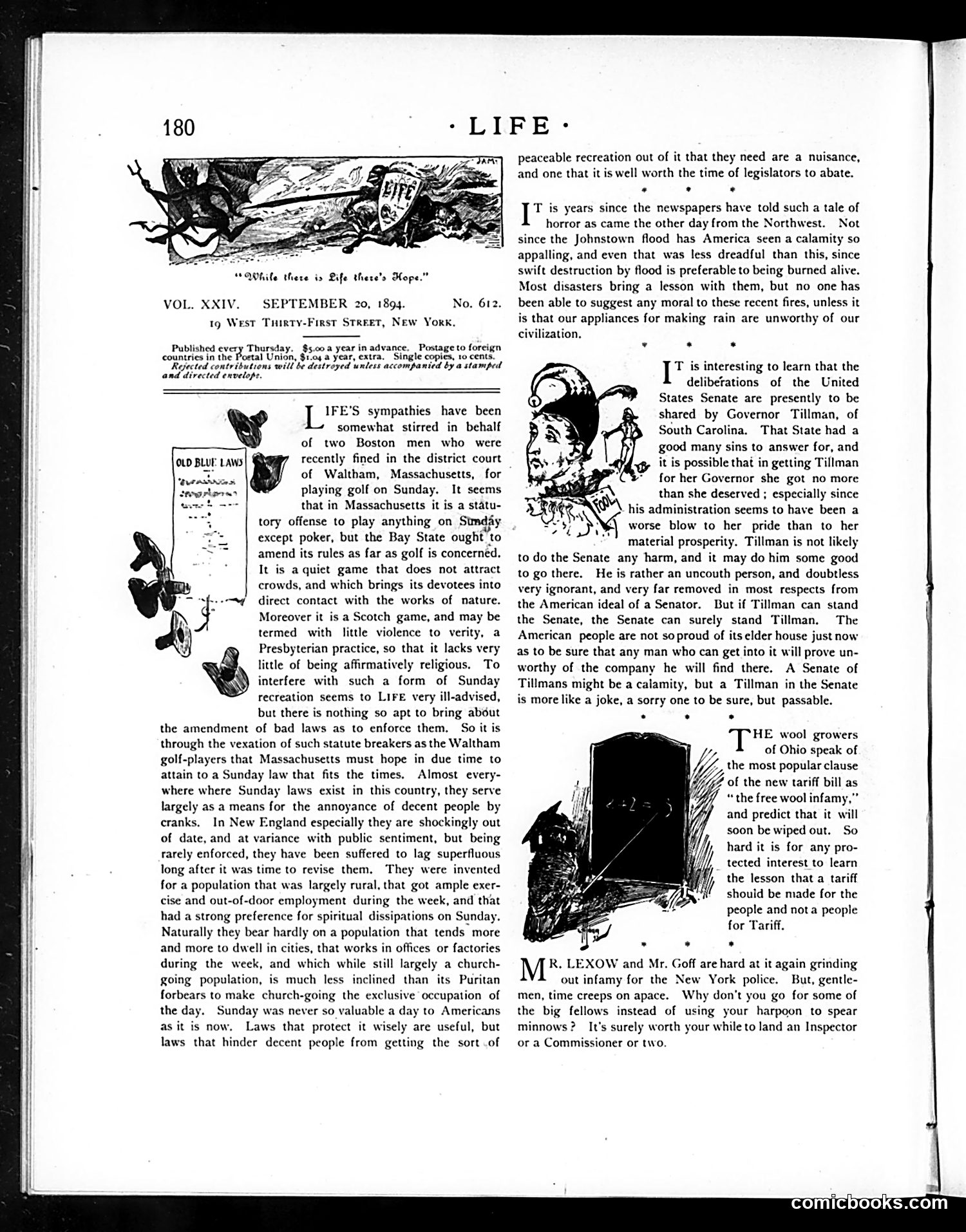
**"Behold How to Rife Haste's Nope"** This satirical cartoon critiques Massachusetts' enforcement of Sunday blue laws prohibiting golf and other recreation. The image shows a golfer mid-swing, illustrating the absurdity of criminalizing peaceful Sunday activities. The accompanying text argues that such laws are outdated relics of Puritanism, poorly enforced, and contrary to public sentiment. Life contends these restrictions serve no purpose except needlessly harassing citizens seeking innocent recreation. The magazine advocates for legal reform, noting that Sunday laws were originally intended to protect workers' rest but now mainly annoy the public and undermine respect for actual legislation. The cartoon mockingly asks: why criminalize harmless golf when real crimes go unpunished?
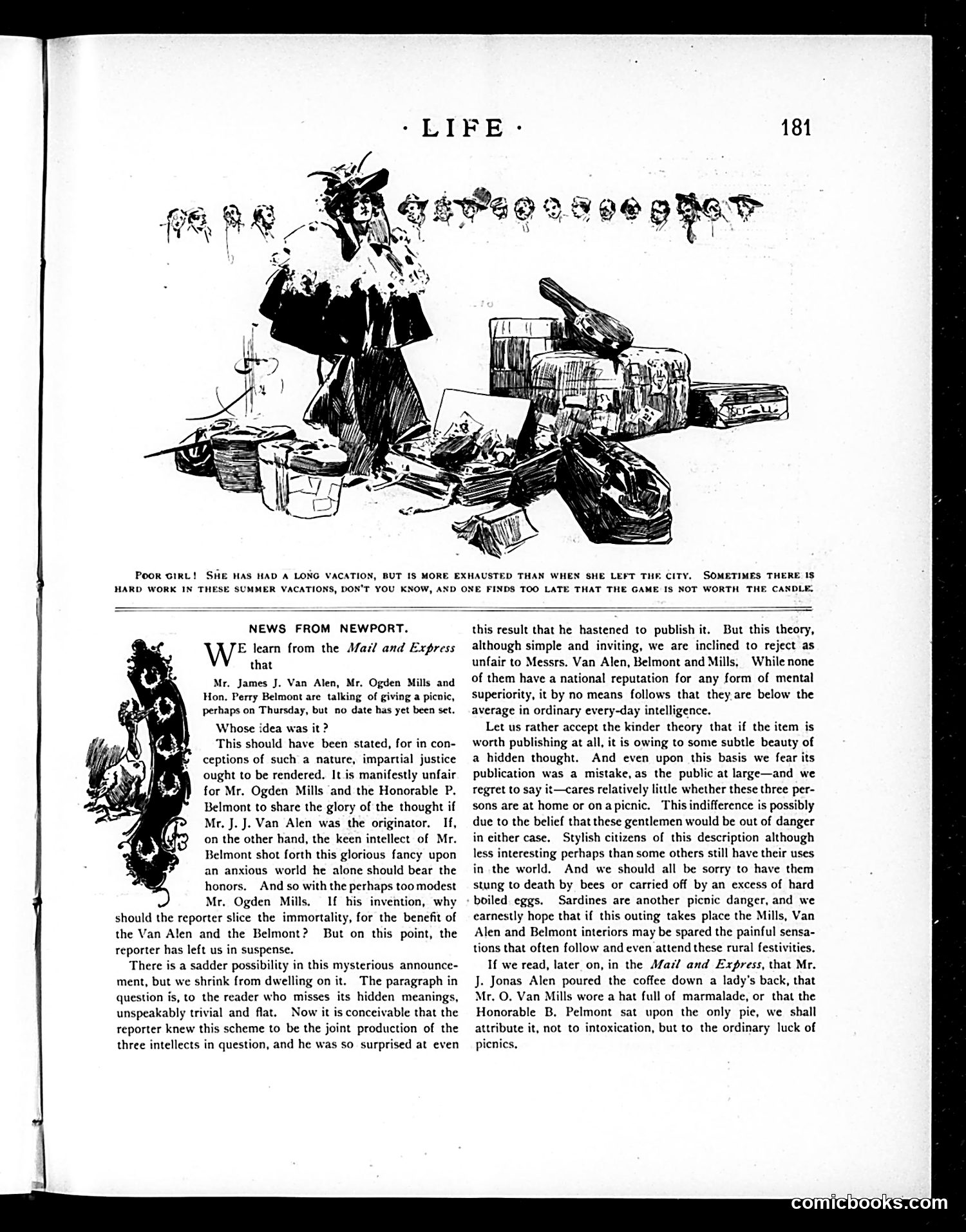
**Top Cartoon:** A fashionable woman returns from summer vacation utterly exhausted, surrounded by scattered luggage and picnic debris. The caption ironically notes that vacations involve "hard work" and questions whether "the game is worth the candle"—satirizing the supposed leisure of wealthy women's summer retreats, which apparently proves more taxing than city life. **Bottom Section ("News from Newport"):** Commentary on a reported picnic incident involving society figures James J. Van Alen, Ogden Mills, and the Honorable P. Belmont. The text humorously discusses competing claims about whose idea the picnic was, mentioning mishaps like spilled coffee and marmalade. It mocks both the trivial nature of high-society gossip and the social pretensions of Newport's elite.
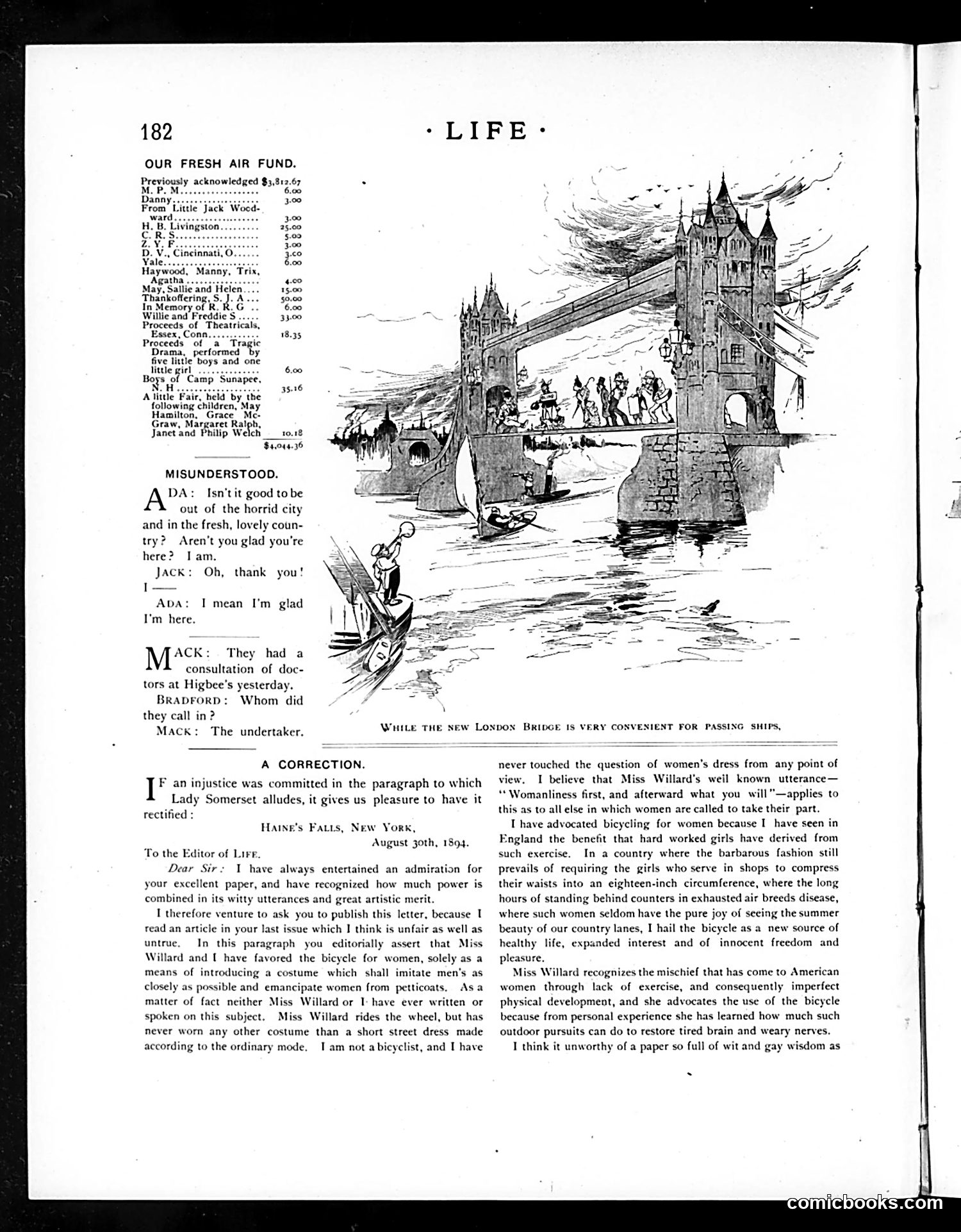
This page contains **no political cartoon**. Instead, it features: 1. **"Our Fresh Air Fund"** — a fundraising list for a charitable program providing city children country outings 2. **"Misunderstood"** — a brief comedic dialogue between characters named Ada, Jack, Mack, and Bradford, appearing to be a humorous domestic or social scene (the joke's specifics are unclear from text alone) 3. **A large illustrated scene** showing London Bridge with ships and pedestrians — captioned "While the New London Bridge is very convenient for passing ships" 4. **"A Correction"** — a letter to the editor defending women's bicycling and Miss Willard's advocacy, countering criticism about women's dress and exercise The page is primarily **civic charity announcements and correspondence**, with illustrative material, rather than satirical political commentary.
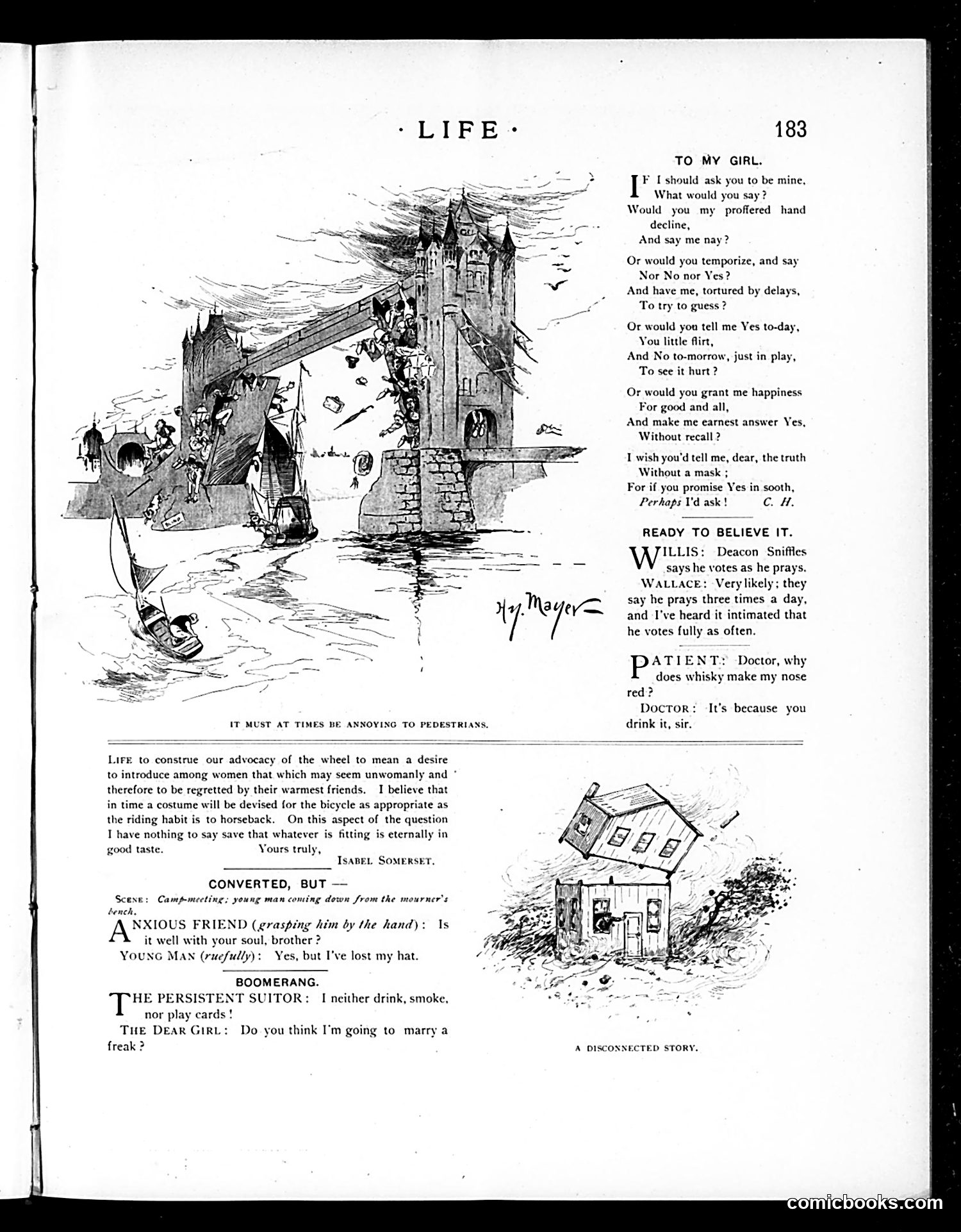
This page contains satirical poems and short humor pieces typical of Life's format. "To My Girl" is a romantic poem humorously listing contingencies—asking if she'd refuse, delay, or accept a proposal. The signature "C.H." appears at the end. Below, "Ready to Believe It" mocks a character (Deacon Sniffles) for voting as he prays—three times daily. The humor suggests hypocrisy or mechanical piety. "Converted, But—" jokes about a young man who lost his hat while coming down from a mourner's bench (a religious conversion site), and a "Dear Girl" asks a persistent suitor if he thinks she'll marry "a freak." "Boomerang" presents a brief exchange about the suitor's claims of not drinking, smoking, or playing cards. The illustrated cartoons show period-appropriate scenes supporting these textual jokes.
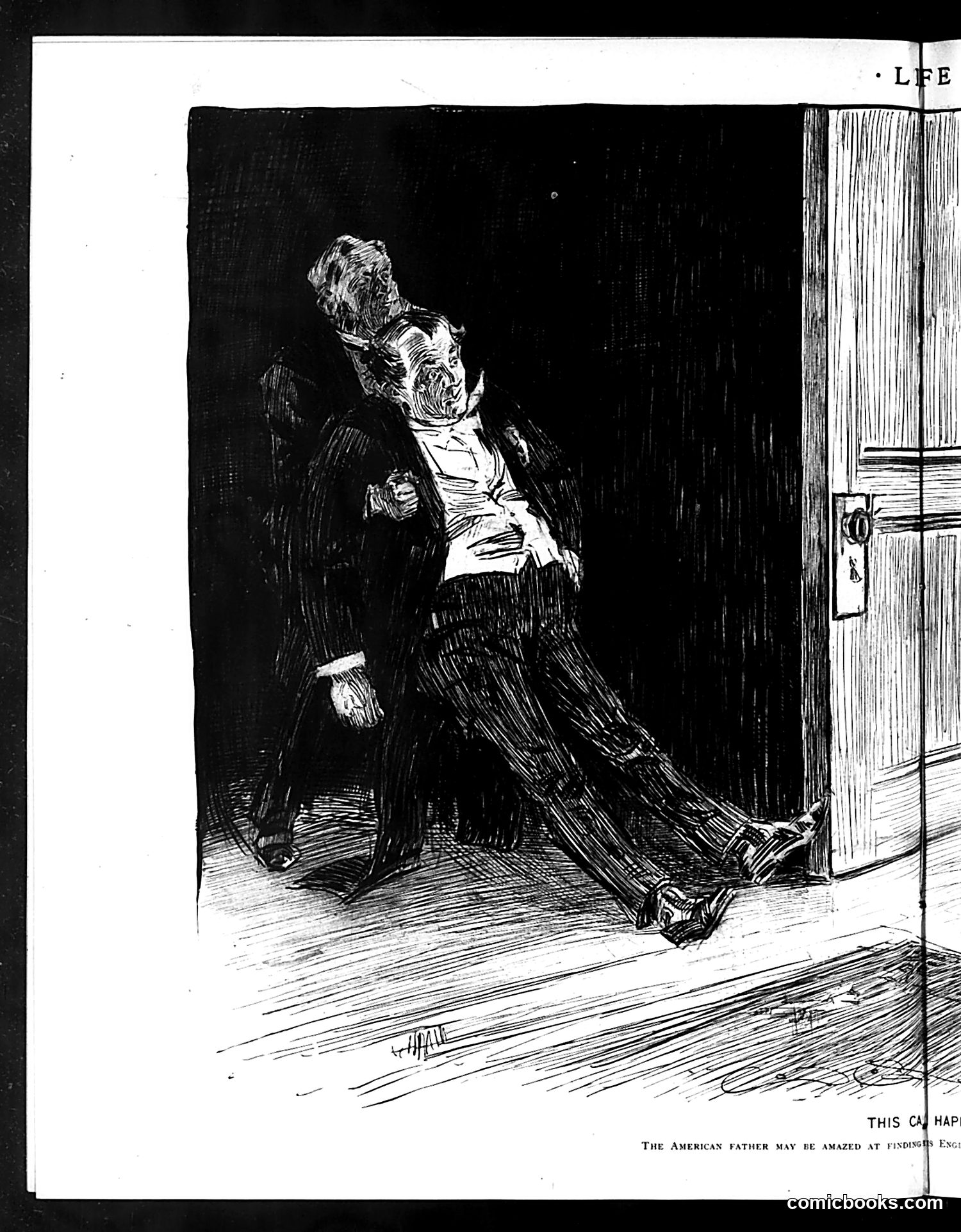
This appears to be a political cartoon from *Life* magazine showing a well-dressed man in formal attire (tuxedo with tails) standing in a doorway, looking startled or concerned. The figure has exaggerated facial features typical of period caricature. The partially visible caption reads: "THE AMERICAN FATHER MAY BE AMAZED AT FINDING HIS..." (text is cut off). **What's unclear:** The complete caption is not fully legible, making the specific satirical target difficult to identify with certainty. The cartoon likely critiques American fathers discovering something unexpected about their families or society, possibly relating to social behavior or moral standards of the era. The formal dress and domestic setting suggest commentary on upper-class respectability or hypocrisy. Without the full caption, the precise subject of satire cannot be definitively stated.
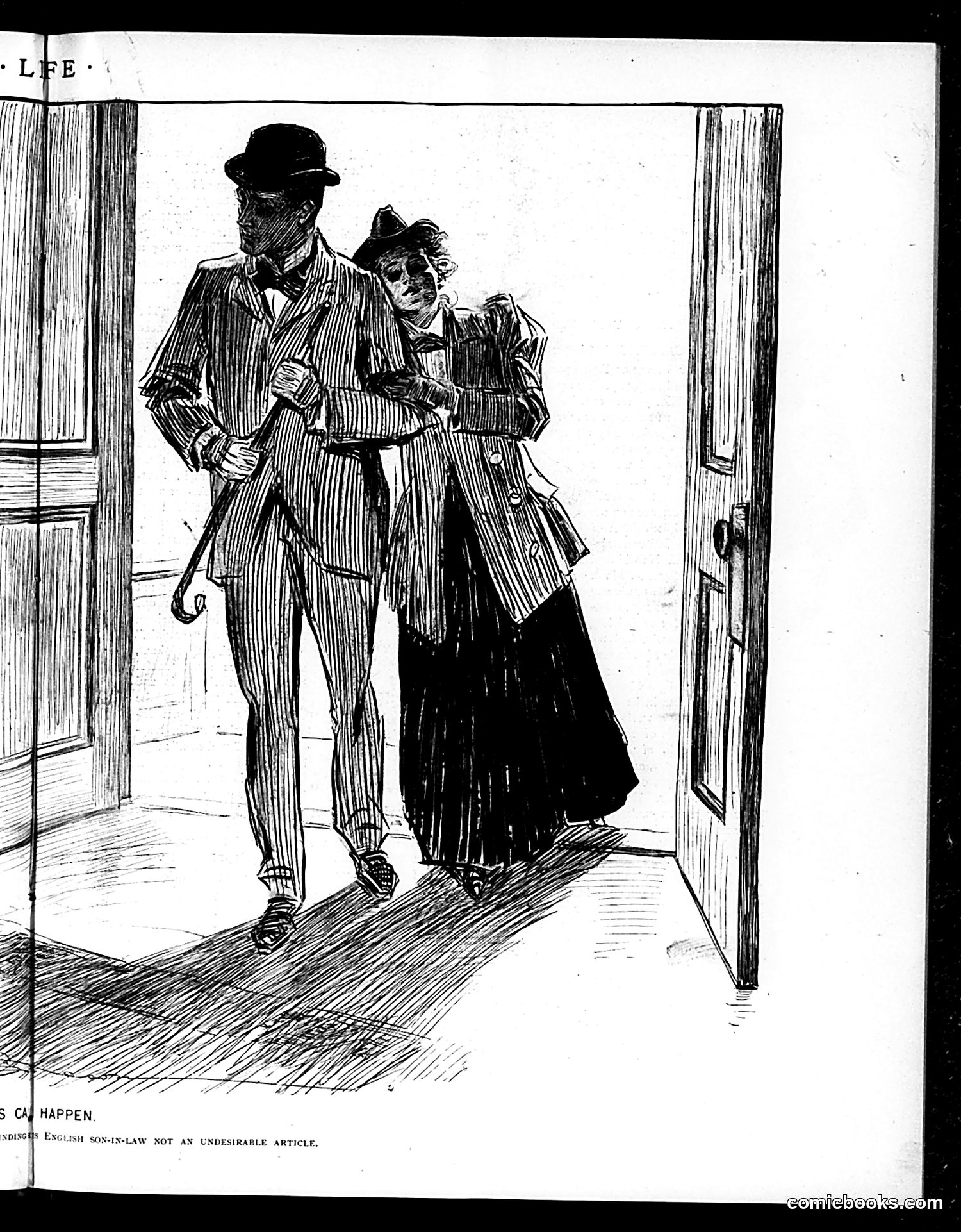
This sketch from *Life* magazine depicts a domestic scene with the caption "THINGS CAN HAPPEN" and a subtitle referencing "ENGLISH SON-IN-LAW NOT AN UNDESIRABLE ARTICLE." The cartoon shows a man in a pinstriped suit and bowler hat standing with a woman at a doorway. The British styling (hat, suit, cane) and the caption's focus on "English son-in-law" suggests this satirizes attitudes toward English relatives marrying into American families. The phrase "not an undesirable article" employs ironic understatement—a common *Life* magazine technique—to comment on social anxieties about foreign husbands or international marriages. The "things can happen" heading implies unexpected or surprising developments in such relationships. The exact historical context remains unclear without additional publication details.
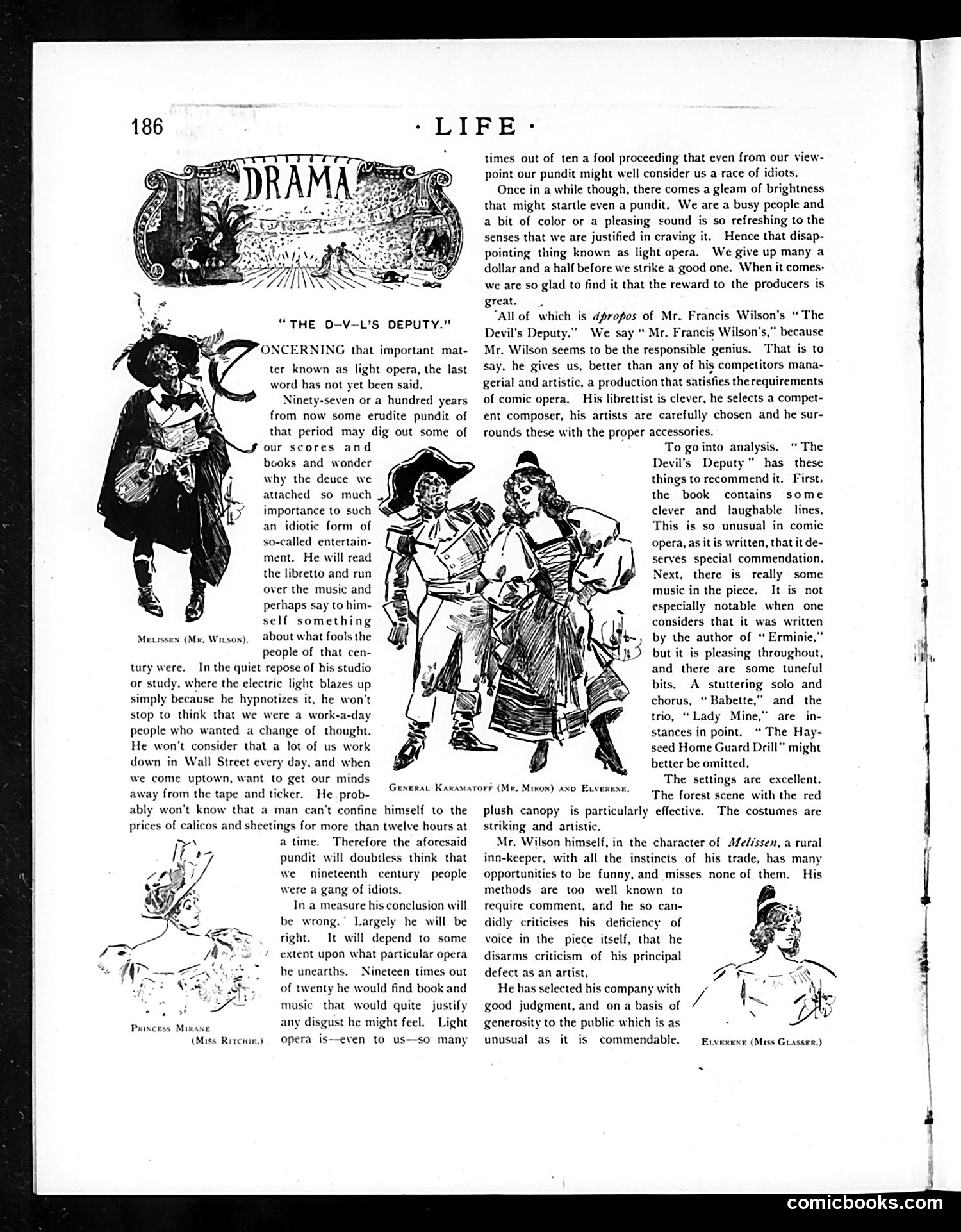
This page reviews Francis Wilson's comic opera production "The Devil's Deputy." The illustrated characters shown are: - **Mephistopheles** (Mr. Wilson) — the devil character, depicted in classical theatrical costume - **General Karamazoff** (Mr. Miron) and **Evariste** (Miss Glasser) — supporting characters shown in period military/aristocratic dress - **Princess Mimace** (Miss Ritchie) — a female character The review praises Wilson's production as unusually clever for comic opera, particularly noting the book's "laughable lines" and commending the scenic design. The critic suggests that light opera deserves serious consideration despite its entertainment reputation, using the quality of this particular production as evidence that the form can be artistically respectable.
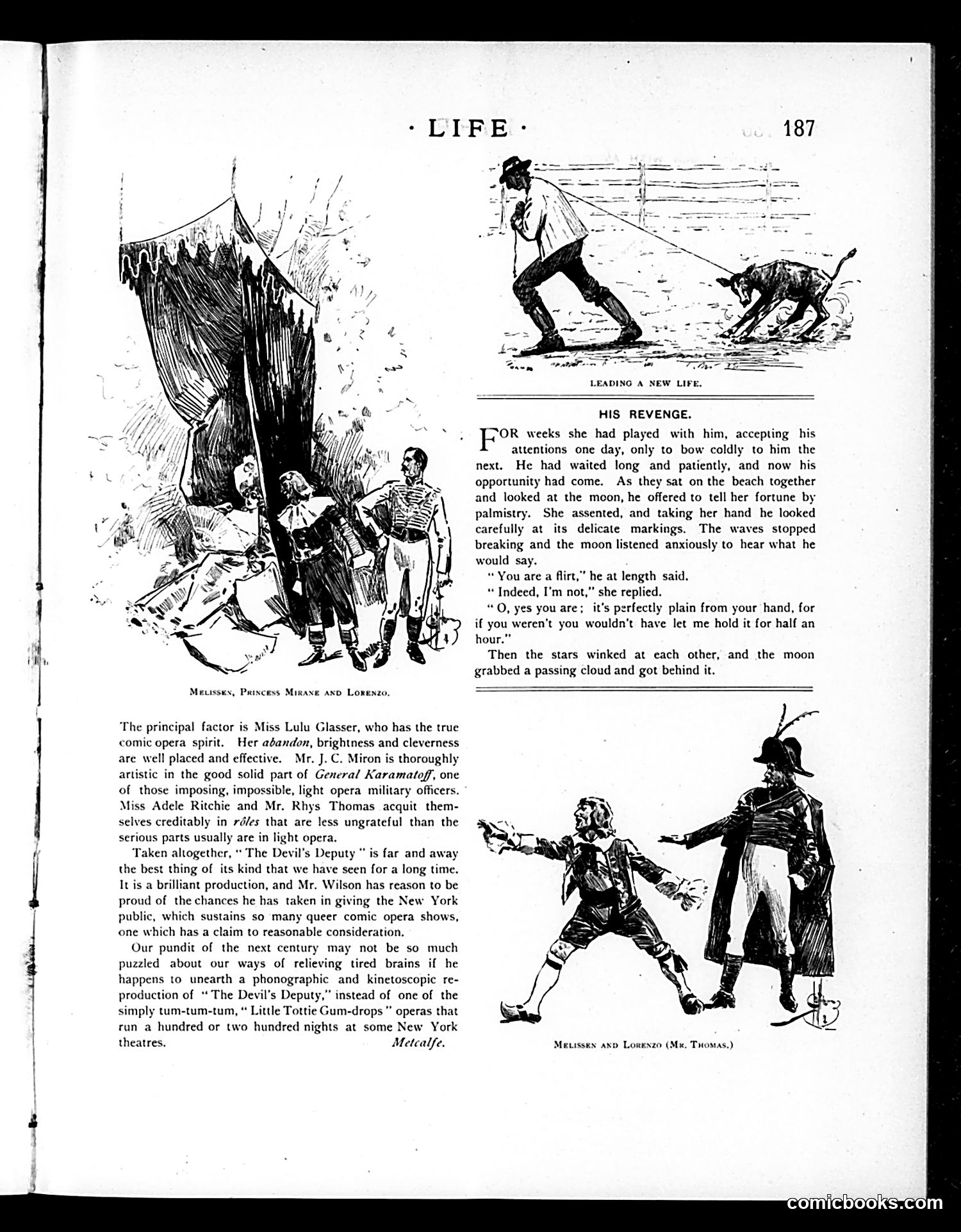
This page reviews "The Devil's Deputy," a comic opera production. The illustrations depict characters from the show: "Mélisses, Princess Mirabé and Lorenzo" and "Mélisses and Lorenzo (Mr. Thomas)." The review's satire targets the proliferation of light opera in New York theaters. The critic, writing as "Metcalfe," praises the lead performer Miss Lulu Glasser's comedic talent but expresses weary skepticism about the genre itself. The humor lies in the backhanded compliment—acknowledging that while this show is competent, New York audiences are oversaturated with similar productions. The reviewer sardonically suggests audiences might prefer "phonographic and kinetoscopic" reproductions or "Little Lottie Gum-drops" opera over yet another comic opera variant.
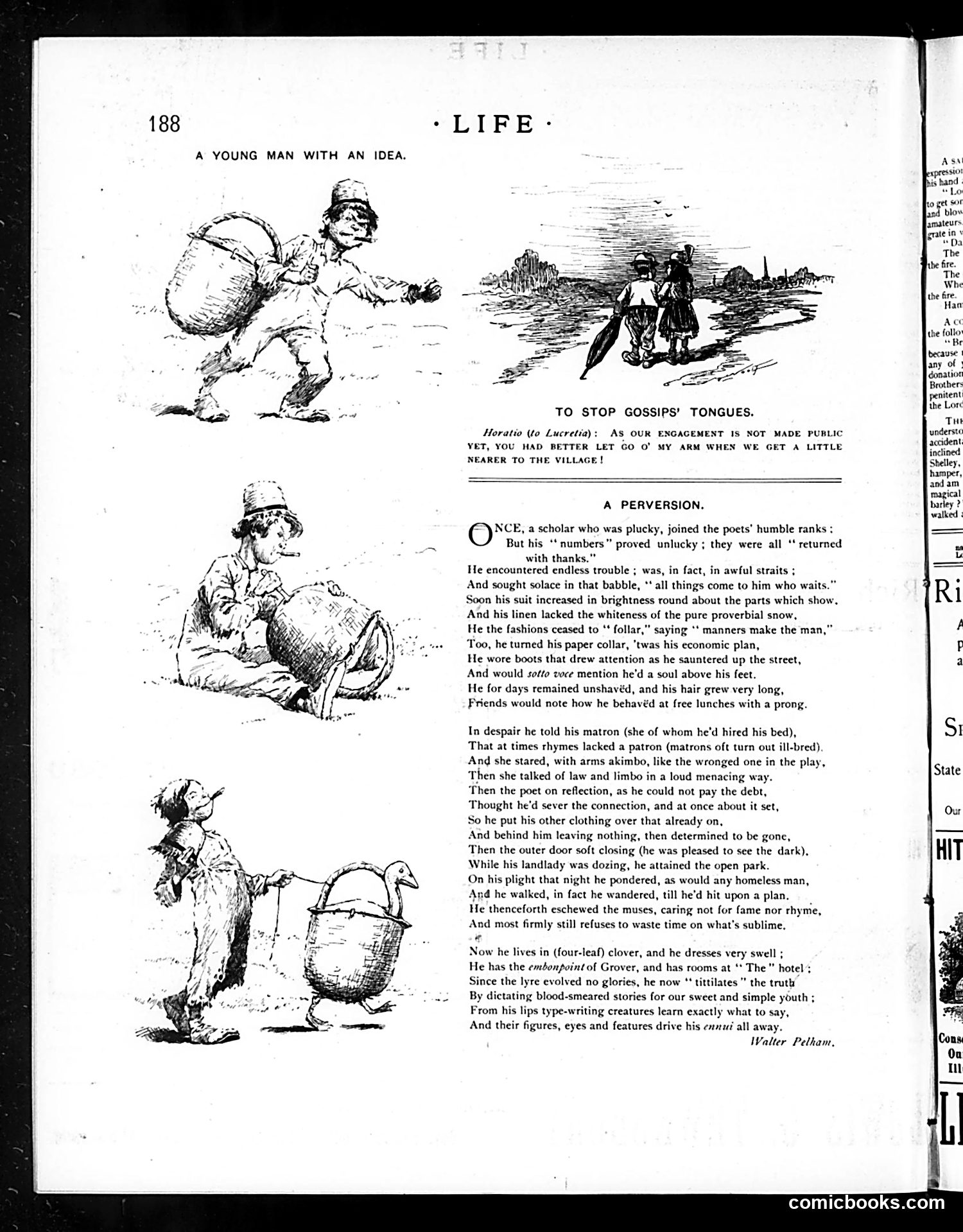
This page contains two separate satirical pieces: **"A Young Man with an Idea"** (top): A brief comedic sketch about a couple, Horatio and Lucretia, whose secret engagement risks exposure. The humor lies in the social propriety of the era—appearing arm-in-arm in public before engagement announcement would fuel village gossip. **"A Perversion"** (bottom): A longer narrative poem by Walter Pelham mocking a failed poet who embraces bohemian poverty while chasing artistic success, then abandons poetry entirely. The satire targets the romantic notion of the starving artist: the scholar adopts affectations (long hair, philosophical air, freeloading), eventually abandons his landlady without paying rent, and achieves financial success by becoming a sensationalist journalist writing "blood-smeared stories" for mass audiences—a complete betrayal of artistic ideals. The message: artistic integrity is abandoned the moment money appears.
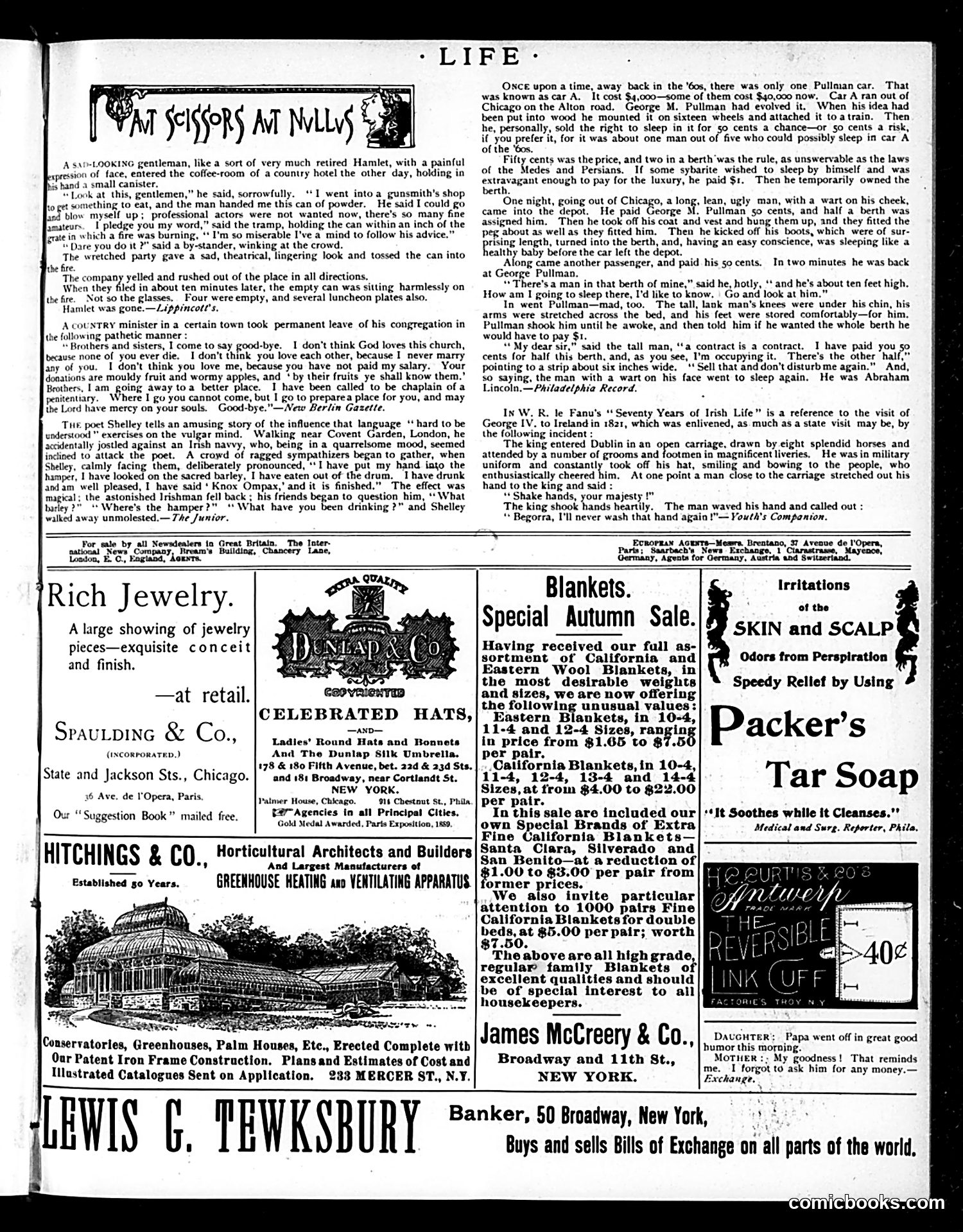
This page contains three humorous anecdotes mocking social pretension and incompetence: **The Main Cartoon Story** features a melancholy, Hamlet-like man carrying gunpowder into a country hotel, claiming he's so miserable he'll blow himself up. He dramatically threatens suicide with the powder near a fire, then tosses the can in—but it merely sits there harmlessly while he escapes with free food and drinks he's consumed. The joke satirizes theatrical posturing and fake desperation: the man's elaborate suicide threat is revealed as an act designed to manipulate sympathy and steal refreshments. The satire targets unemployed actors reduced to con artistry, referencing how "professional actors were not wanted now" due to an abundance of "fine amateurs." It mocks both theatrical affectation and the economic desperation of performers in that era. The page also includes unrelated humorous anecdotes about a stingy minister and Shelley confusing an Irish laborer with nonsense words—all illustrating how language and performance manipulate the gullible.
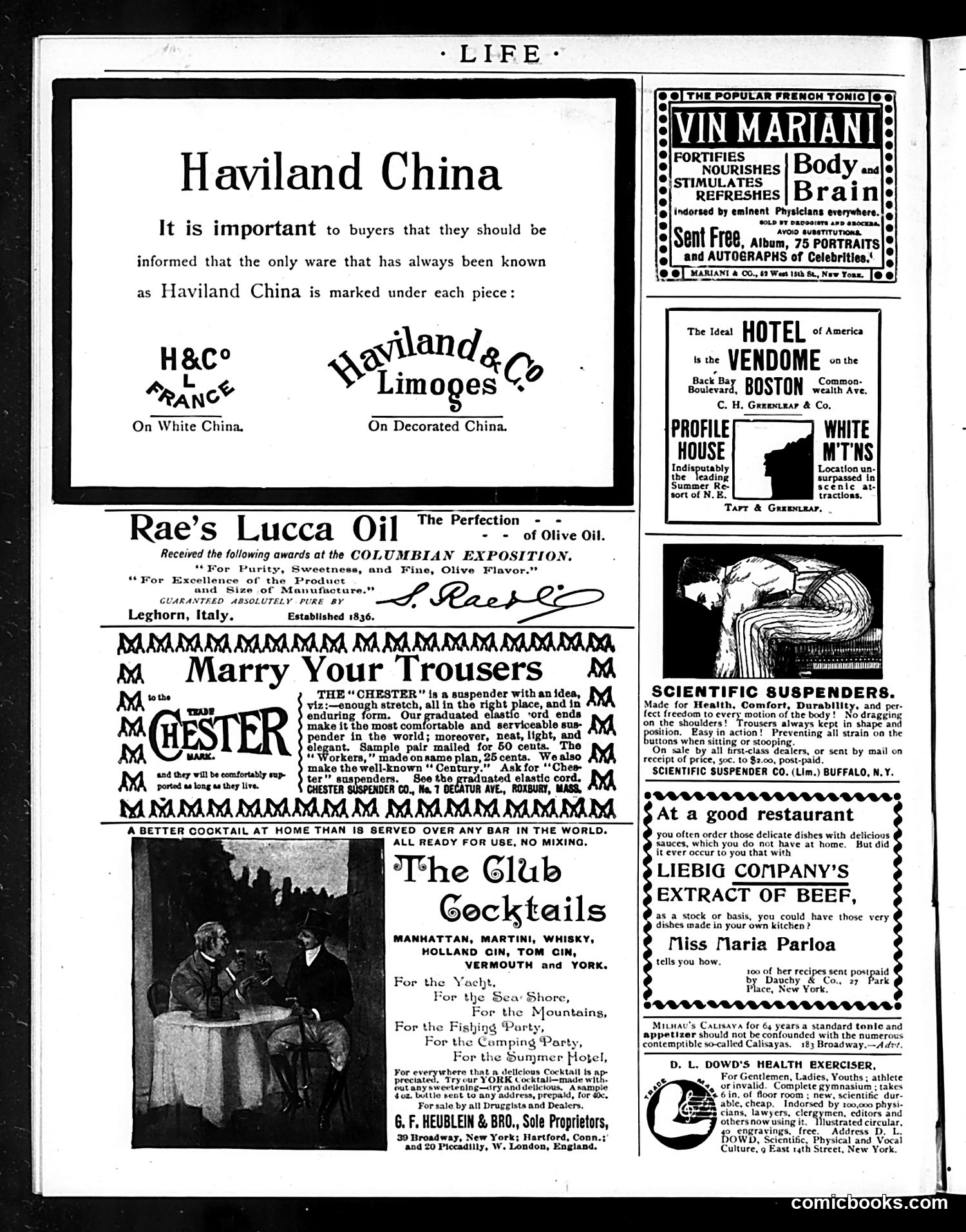
This is a Life magazine page dominated by **product advertisements** rather than editorial content or satire. The only substantive article is about **Haviland China**, explaining that authentic pieces bear the H&C° mark (for white china made in France) or "Haviland & Co. Limoges" (for decorated china). The remaining content consists of ads for luxury goods and services typical of the era: Rae's olive oil, Chester suspenders, pre-mixed cocktails, Liebig's beef extract, health tonics, and exercise equipment. The Hotel Vendome and Profile House promote themselves as elite American resorts. **No satire or political commentary is evident.** The page reflects early 20th-century consumer culture and advertising conventions—brands emphasizing quality, celebrity endorsements (Liebig's mentions "Miss Maria Parloa"), and pseudo-scientific health claims (the "Scientific Suspenders" and "Health Exerciser"). There are no identifiable caricatures or editorial cartoons present.
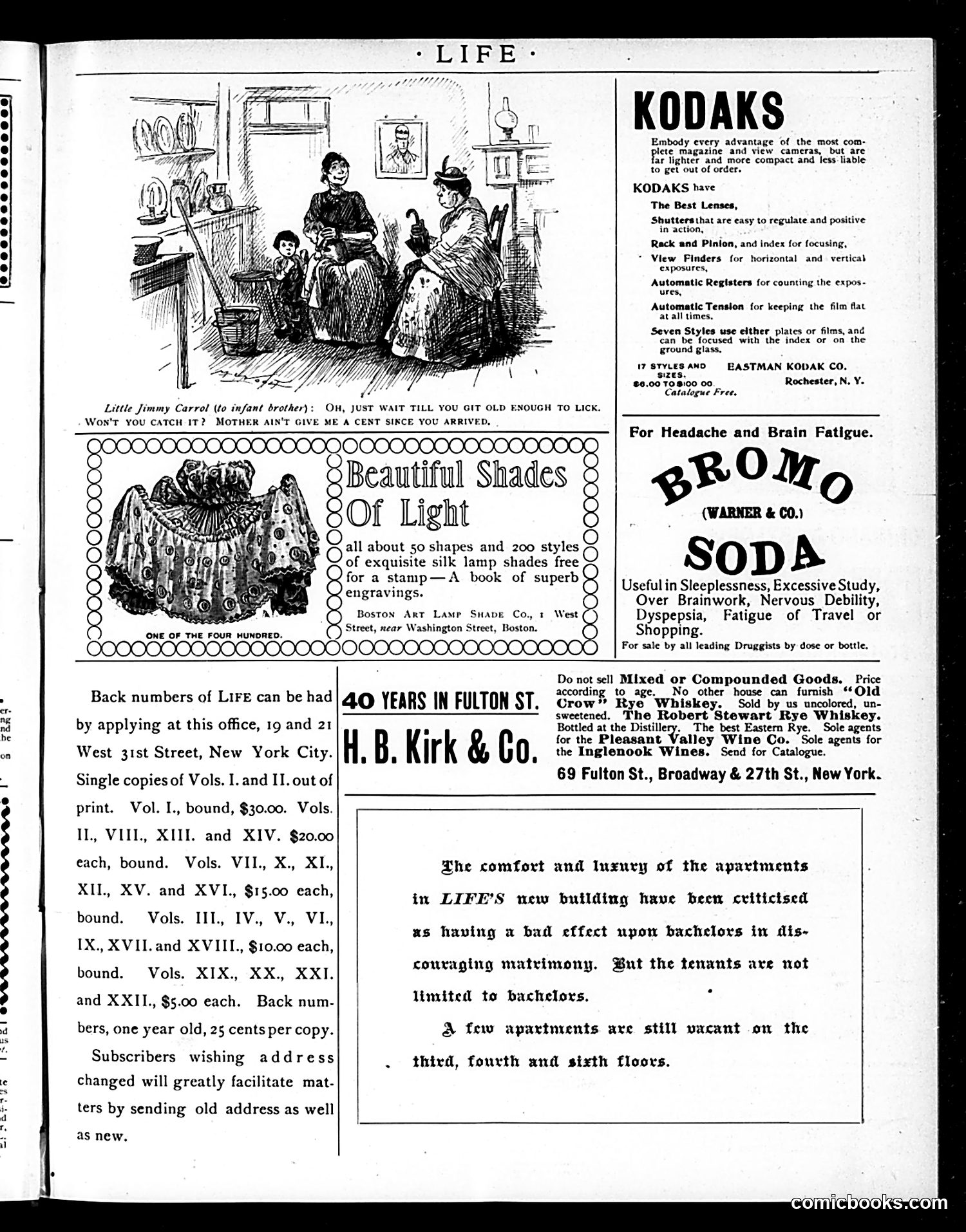
This page is primarily **advertising**, with one small cartoon joke. **The Cartoon:** "Little Jimmy Carroll" depicts a child warning his infant brother that once he's old enough to "lick" (eat solid food), their mother won't give him money anymore—she hasn't given Jimmy a cent since the baby arrived. The joke reflects early-20th-century domestic economics: children were financial burdens, and parents resented supporting multiple kids. **Notable Context:** The advertisements reveal period concerns. Bromo Soda promises relief for "Sleeplessness, Excessive Study, Over Brainwork"—suggesting anxiety about modern life's pace. Kodak ads emphasize cameras as accessible consumer products. Whiskey is marketed openly. A lengthy notice about Life magazine's new bachelor apartments jokingly worries these comfortable dwellings might discourage men from marrying—reflecting anxieties about changing social patterns and bachelorhood as a lifestyle choice rather than necessity.
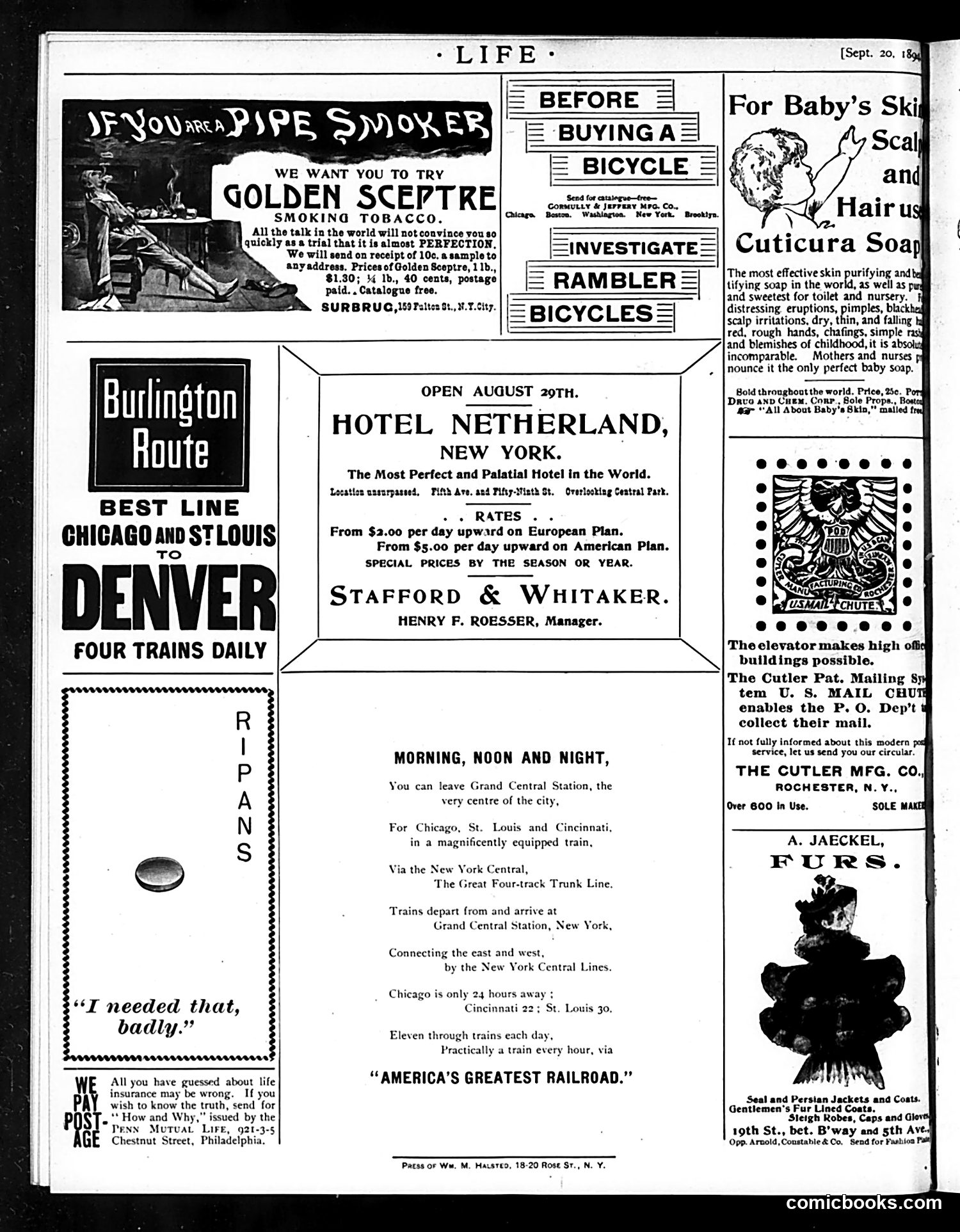
This page is primarily **advertising**, not editorial content or political satire. It contains commercial advertisements typical of the 1890s: **Notable ads include:** - **Golden Sceptre Smoking Tobacco** — a product pitch claiming near-perfection - **Rambler and other bicycles** — the 1890s bicycle craze was booming - **Hotel Netherland** opening in New York on Fifth Avenue - **Burlington Route railroad** — emphasizing speed (Chicago in 24 hours) - **Cuticura Soap** — marketed specifically for babies and skin conditions - **Various service patents** (Cutler mailing system, elevator technology) - **A. Jaeckel Furs** — luxury outerwear The page reflects the commercial interests and consumer goods of the Gilded Age. The only humorous element is a small cartoon labeled "RIPANS" showing someone saying "I needed that, badly"—likely advertising a digestive remedy. No significant political or social satire is evident on this page.