
Life, 1894-09-20 · page 10 of 16
Life — September 20, 1894 — page 10: what you’re looking at
What you’re looking at
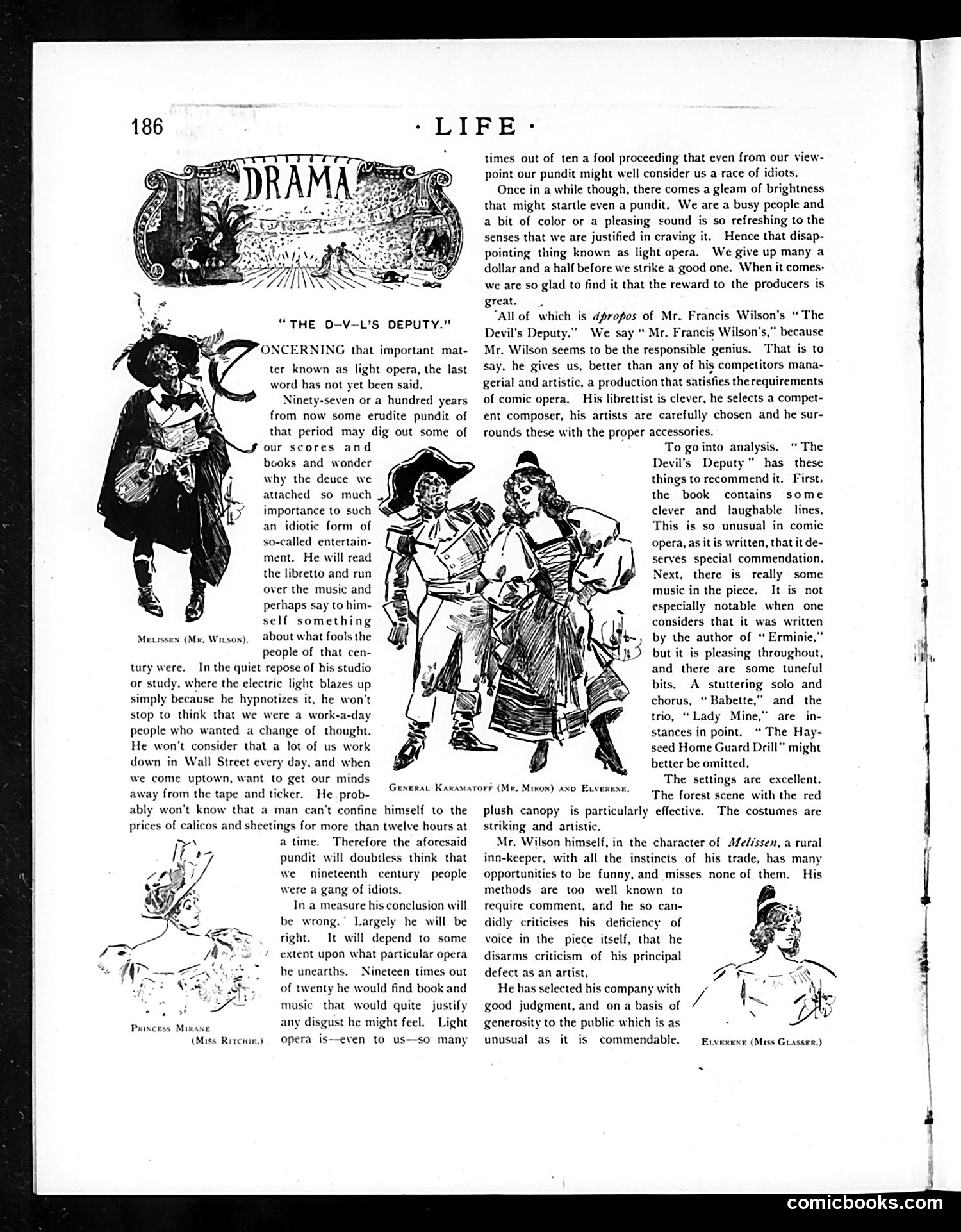
This page reviews Francis Wilson's comic opera production "The Devil's Deputy." The illustrated characters shown are: - **Mephistopheles** (Mr. Wilson) — the devil character, depicted in classical theatrical costume - **General Karamazoff** (Mr. Miron) and **Evariste** (Miss Glasser) — supporting characters shown in period military/aristocratic dress - **Princess Mimace** (Miss Ritchie) — a female character The review praises Wilson's production as unusually clever for comic opera, particularly noting the book's "laughable lines" and commending the scenic design. The critic suggests that light opera deserves serious consideration despite its entertainment reputation, using the quality of this particular production as evidence that the form can be artistically respectable.
📄 Transcribed text from this page (OCR, searchable)
Machine-transcribed from the original scan — historical spelling and the odd misread are preserved.
4 “THE O-V-L’S DEPUTY.” ONCERNING that important mat- ter known as light opera, the last word has not yet been said. Ninety-seven or a hundred years from now some erudite pundit of that period may dig out some of our scores and books and wonder why the deuce we attached so much importance to such an idiotic form of so-called entertain- ment. He will read the libretto and run over the music and perhaps say to him- self something Meuissey (Mx, Witsox), about what fools the people of that cen- tury were. In the quiet repose of his studio or study, where the electric light blazes up simply because he hypnotizes it, he won't stop to think that we were a work-a-day people who wanted a change of thought. He won't consider that a lot of us work down in Wall Street every day, and when we come uptown, want to get our minds away from the tape and ticker. He prob- ably won't know that a man can’t confine himself to the prices of calicos and sheetings for more than twelve hours at >. atime. Therefore the aforesaid lis pundit will doubtless think that nei we nineteenth century people be wrong.” Largely he will be beat 4 were a gang of idiots. & (ei In a measure his conclusion will 7 ae Ze right. i Ny ght. It will depend to some 74 » extent upon what particular opera Zo.) he unearths. Nineteen times out St te Gh of twenty he would find book and = sf Pe music that would quite justify Princess Mieane any disgust he might feel. Light (Miss Rercue.) Opera is—even to us--so many - LIFE: Generar Kanastator? (Mr. Mixox) axo Exvernse times out of ten a fool proceeding that even from our view- point our pundit might well consider us a race of idiots. Once in a while though, there comes a gleam of brightness that might startle even a pundit. We are a busy people and a bit of color or a pleasing sound is so refreshing to the senses that we are justified in craving it. Hence that disap- pointing thing known as light opera. We give up many a dollar and a half before we strike a good one. When it comes: we are so glad to find it that the reward to the producers is great. “All of which is dpropos of Mr. Francis Wilson's “ The Devil's Deputy.” We say “ Mr. Francis Wilson's,” because Mr. Wilson seems to be the responsible genius. That is to say, he gives us, better than any of his competitors mana- gerial and artistic, a production that satisfies the requirements of comic opera. His librettist is clever, he selects a compet- ent composer, his artists are carefully chosen and he sur- rounds these with the proper accessories. , To gointo analysis. “ The Devil’s Deputy” has these things to recommend it. First, the book contains some clever and laughable lines. This is so unusual in comic opera, as it is written, that it de- serves special commendation. Next, there is really some music in the piece. It is not especially notable when one considers that it was written by the author of “ Ermini but it is pleasing throughout, and there are some tuneful bits. A stuttering solo and chorus, “Babette,” and the trio, “Lady Mine,” are in- stances in point. “ The Hay- seed Home Guard Drill” might better be omitted. The settings are excellent. The forest scene with the red plush canopy is particularly effective. The costumes are striking and artistic. Mr. Wilson himself, in the character of Afe/éssen, a rural inn-keeper, with all the instincts of his trade, has many opportunities to be funny, and misses none of them. His methods are too well known to require comment, and he so can- didly criticises his deficiency of voice in the piece itself, that he disarms criticism of his principal defect as an artist. He has selected his company with good judgment, and ona basis of generosity to the public which is as unusual as it is commendable. Evvenene (Miss GLasser.) eee ee ee comicbooks.com