
Life, 1894-09-20 · page 12 of 16
Life — September 20, 1894 — page 12: what you’re looking at
What you’re looking at
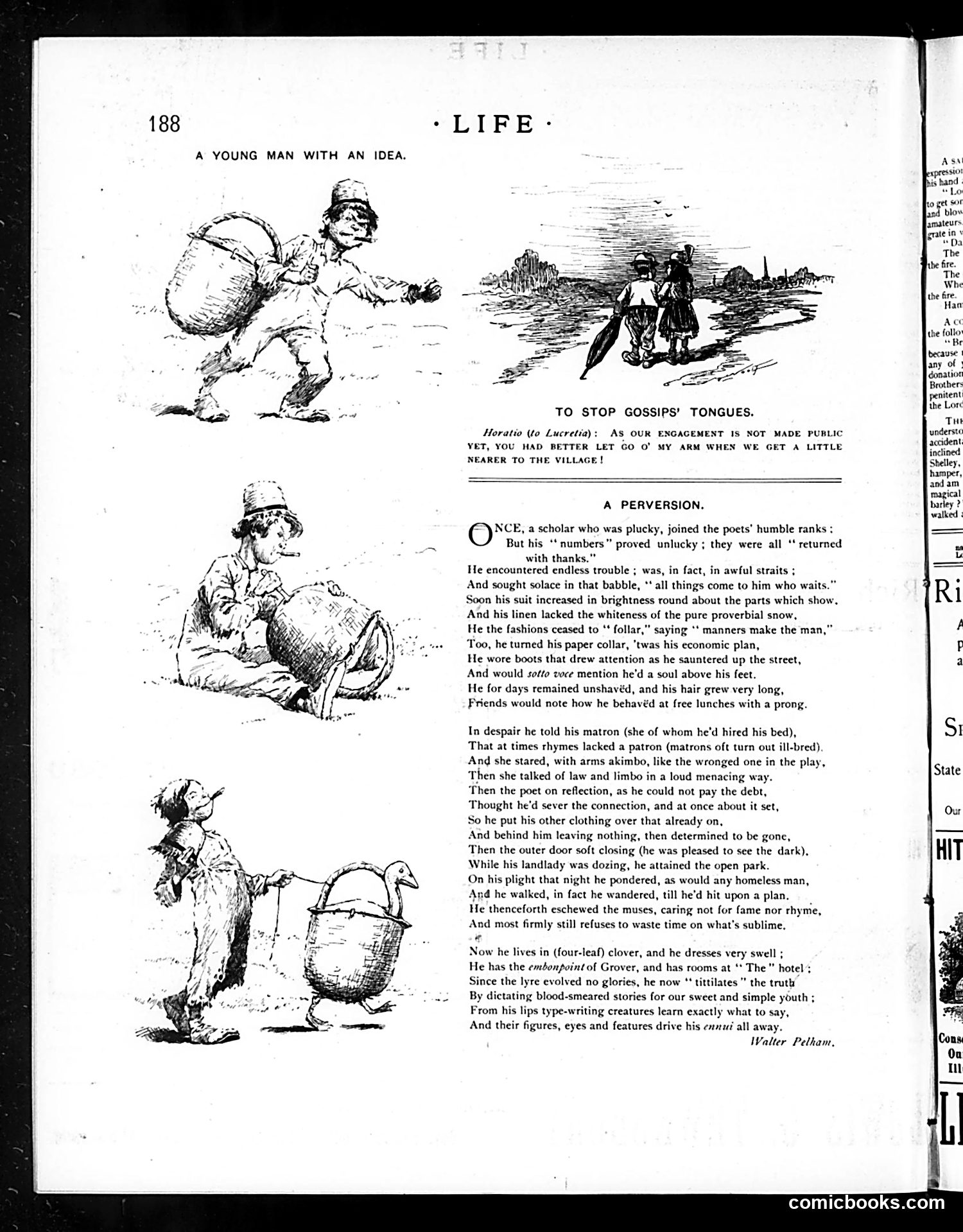
This page contains two separate satirical pieces: **"A Young Man with an Idea"** (top): A brief comedic sketch about a couple, Horatio and Lucretia, whose secret engagement risks exposure. The humor lies in the social propriety of the era—appearing arm-in-arm in public before engagement announcement would fuel village gossip. **"A Perversion"** (bottom): A longer narrative poem by Walter Pelham mocking a failed poet who embraces bohemian poverty while chasing artistic success, then abandons poetry entirely. The satire targets the romantic notion of the starving artist: the scholar adopts affectations (long hair, philosophical air, freeloading), eventually abandons his landlady without paying rent, and achieves financial success by becoming a sensationalist journalist writing "blood-smeared stories" for mass audiences—a complete betrayal of artistic ideals. The message: artistic integrity is abandoned the moment money appears.
📄 Transcribed text from this page (OCR, searchable)
Machine-transcribed from the original scan — historical spelling and the odd misread are preserved.
188 A YOUNG MAN WITH AN IDEA. ho get sot blow [amateurs penitent the Lore TO STOP GOSSIPS’ TONGUES. ae Horatio (to Lucretia): AS OUR ENGAGEMENT 15 NOT MADE PUBLIC YET, YOU HAD BETTER LET GO O' MY ARM WHEN WE GET A LITTLE NEARER TO THE VILLAGE! A PERVERSION. NCE, a scholar who was plucky, joined the poets’ humble ranks : But his ‘‘ numbers” proved unlucky ; they were all “* returned with thanks,” He encountered endless trouble ; was, in fact, in awful straits ; And sought solace in that babble, ‘‘ all things come to him who waits.” Soon his suit increased in brightness round about the parts which show, And his linen lacked the whiteness of the pure proverbial snow, He the fashions ceased to ‘* follar,” saying “‘ manners make the man,” Too, he tumed his paper collar, ‘twas his economic plan, He wore boots that drew attention as he sauntered up the street, And would sotto voce mention he'd a soul above his feet. He for days remained unshavétd, and his hair grew very long, Friends would note how he behavéd at free lunches with a prong. In despair he told his matron (she of whom he'd hired his bed), That at times rhymes lacked a patron (matrons oft turn out ill-bred) And she stared, with arms akimbo, like the wronged one in the play, Then she talked of law and limbo in a loud menacing way. ‘Then the poet on reflection, as he could not pay the debt, Thought he'd sever the connection, and at once about it set, So he put his other clothing over that already on, And behind him leaving nothing, then determined to be gone, Then the outer door soft closing (he was pleased to see the dark), While his landlady was dozing, he attained the open park. On his plight that night he pondered, as would any homeless man, And he walked, in fact he wandered, till he'd hit upon a plan. He thenceforth eschewed the muses, caring not for fame nor rhyme, And most firmly still refuses to waste time on what's sublime. « Now he lives in (four-leaf) clover, and he dresses very swell ; He has the embonpoint of Grover, and has rooms at “ The" hotel ; Since the lyre evolved no glories, he now ** tittilates " the truth By dictating blood-smeared stories for our sweet and simple youth ; From his lips type-writing creatures learn exactly what to say, And their figures, eyes and features drive his ennui all away. Walter Pelham, comicbooks.com