
Life, 1894-09-20 · page 4 of 16
Life — September 20, 1894 — page 4: what you’re looking at
What you’re looking at
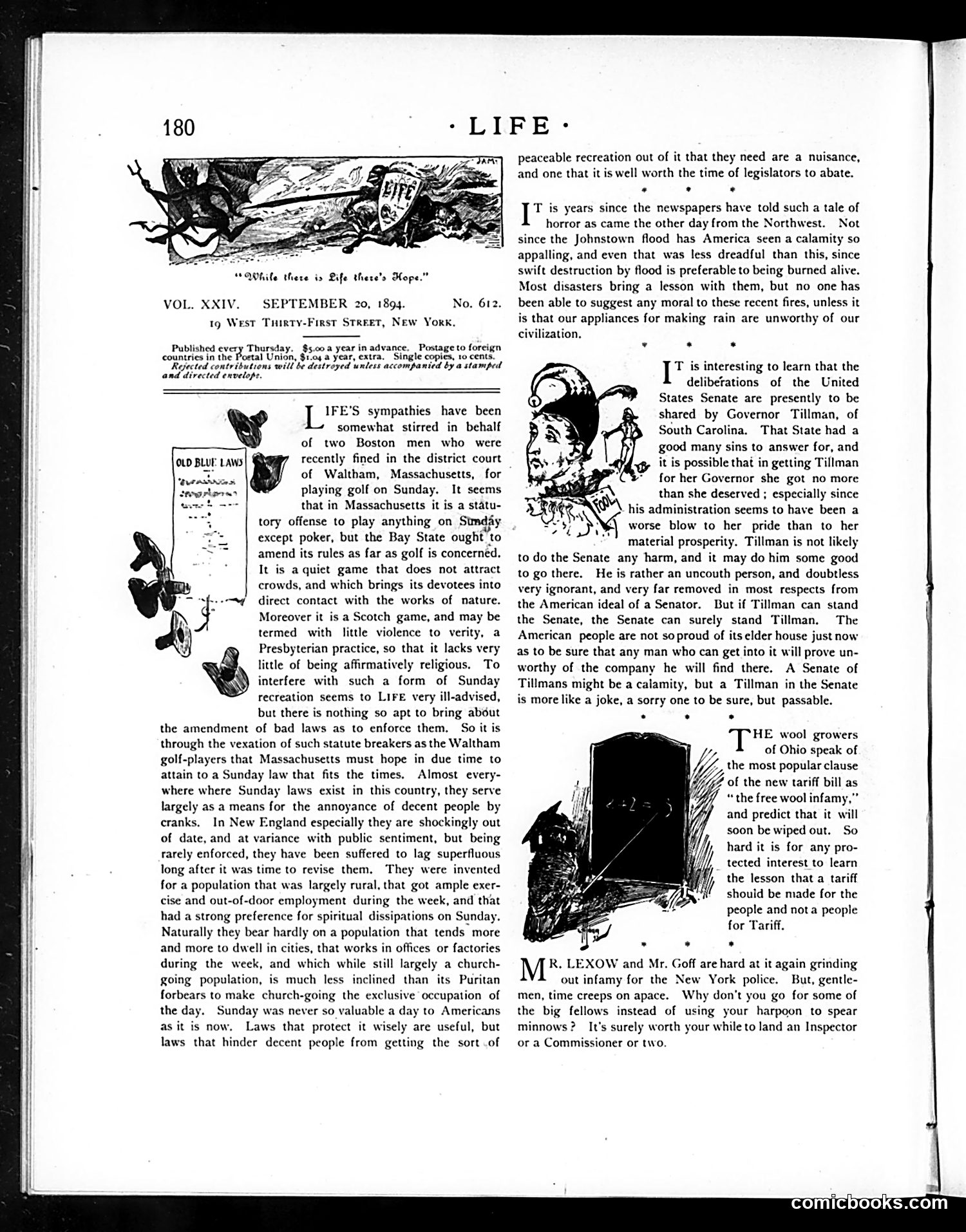
**"Behold How to Rife Haste's Nope"** This satirical cartoon critiques Massachusetts' enforcement of Sunday blue laws prohibiting golf and other recreation. The image shows a golfer mid-swing, illustrating the absurdity of criminalizing peaceful Sunday activities. The accompanying text argues that such laws are outdated relics of Puritanism, poorly enforced, and contrary to public sentiment. Life contends these restrictions serve no purpose except needlessly harassing citizens seeking innocent recreation. The magazine advocates for legal reform, noting that Sunday laws were originally intended to protect workers' rest but now mainly annoy the public and undermine respect for actual legislation. The cartoon mockingly asks: why criminalize harmless golf when real crimes go unpunished?
📄 Transcribed text from this page (OCR, searchable)
Machine-transcribed from the original scan — historical spelling and the odd misread are preserved.
- LIFE: “While there is Life there’s Hope.” VOL. XXIV. SEPTEMBER 20, 1894. Ig West Tirty-First STREET, New York, Published every Thursday. $5.00 a year in advance. Postage to foreign countries in the Portal Union, $1.04 a year, extra. Single copies, ro cents. Rejected contributions will be destroyed unless accompanied by a stamped and directed envelope. IFE'S sympathies have been somewhat stirred in behalf of two Boston men who were recently fined in the district court of Waltham, Massachusetts, for playing golf on Sunday. It seems that in Massachusetts it is a statu- tory offense to play anything on Sundfy except poker, but the Bay State ought to amend its rules as far as golf is concerned. It is aquict game that does not attract crowds, and which brings its devotees into direct contact with the works of nature. Moreover it is a Scotch game, and may be termed with little violence to verity, a Presbyterian practice, so that it lacks very little of being affirmatively religious. To interfere with such a form of Sunday recreation seems to LIFE very ill-advised, but there is nothing so apt to bring about the amendment of bad laws as to enforce them, So it is through the vexation of such statute breakers as the Waltham golf-players that Massachusetts must hope in due time to attain to a Sunday law that fits the times. Almost every- where where Sunday laws exist in this country, they serve largely as a means for the annoyance of decent people by cranks. In New England especially they are shockingly out of date, and at variance with public sentiment, but being rarely enforced, they have been suffered to lag superfluous long after it was time to revise them, They were invented for a population that was largely rural, that got ample exer- cise and out-of-door employment during the week, and that had a strong preference for spiritual dissipations on Sunday. Naturally they bear hardly on a population that tends more and more to dwell in cities, that works in offices or factories during the week, and which while still largely a church- going population, is much less inclined than its Puritan forbears to make church-going the exclusive occupation of the day. Sunday was never so valuable a day to Americans as it is now. Laws that protect it wisely are useful, but laws that hinder decent people from getting the sort .of peaceable recreation out of it that they need are a nuisance, and one that it is well worth the time of legislators to abate. * . * 12 is years since the newspapers have told such a tale of horror as came the other day from the Northwest. Not since the Johnstown flood has America seen a calamity so appalling, and even that was less dreadful than this, since swift destruction by flood is preferable to being burned alive. Most disasters bring a lesson with them, but no one has been able to suggest any moral to these recent fires, unless it is that our appliances for making rain are unworthy of our civilization, . . . ’ is interesting to learn that the deliberations of the United States Senate are presently to be shared by Governor Tillman, of South Carolina. That State had a good many sins to answer for, and it is possible that in getting Tillman for her Governor she got no more than she deserved ; especially since his administration seems to have been a worse blow to her pride than to her material prosperity. Tillman is not likely to do the Senate any harm, and it may do him some good to go there. He is rather an uncouth person, and doubtless very ignorant, and very far removed in most respects from the American ideal of a Senator. But if Tillman can stand the Senate, the Senate can surely stand Tillman, The American people are not so proud of its elder house just now as to be sure that any man who can get into it will prove un- worthy of the company he will find there. A Senate of Tillmans might be a calamity, but a Tillman in the Senate is more like a joke, a sorry one to be sure, but passable. . HE wool growers of Ohio speak of Z, the most popular clause Y of the new tariff bill as “the free wool infamy,” and predict that it will soon be wiped out. So hard it is for any pro- tected interest to learn the lesson that a tariff should be made for the people and nota people for Tariff. . R, LEXOW and Mr. Goff are hard at it again grinding out infamy for the New York police. But, gentle- men, time creeps on apace. Why don’t you go for some of the big fellows instead of using your harpoon to spear minnows ? It’s surely worth your while to land an Inspector or a Commissioner or two.