
A complete issue · 16 pages · 1894
Life — July 5, 1894
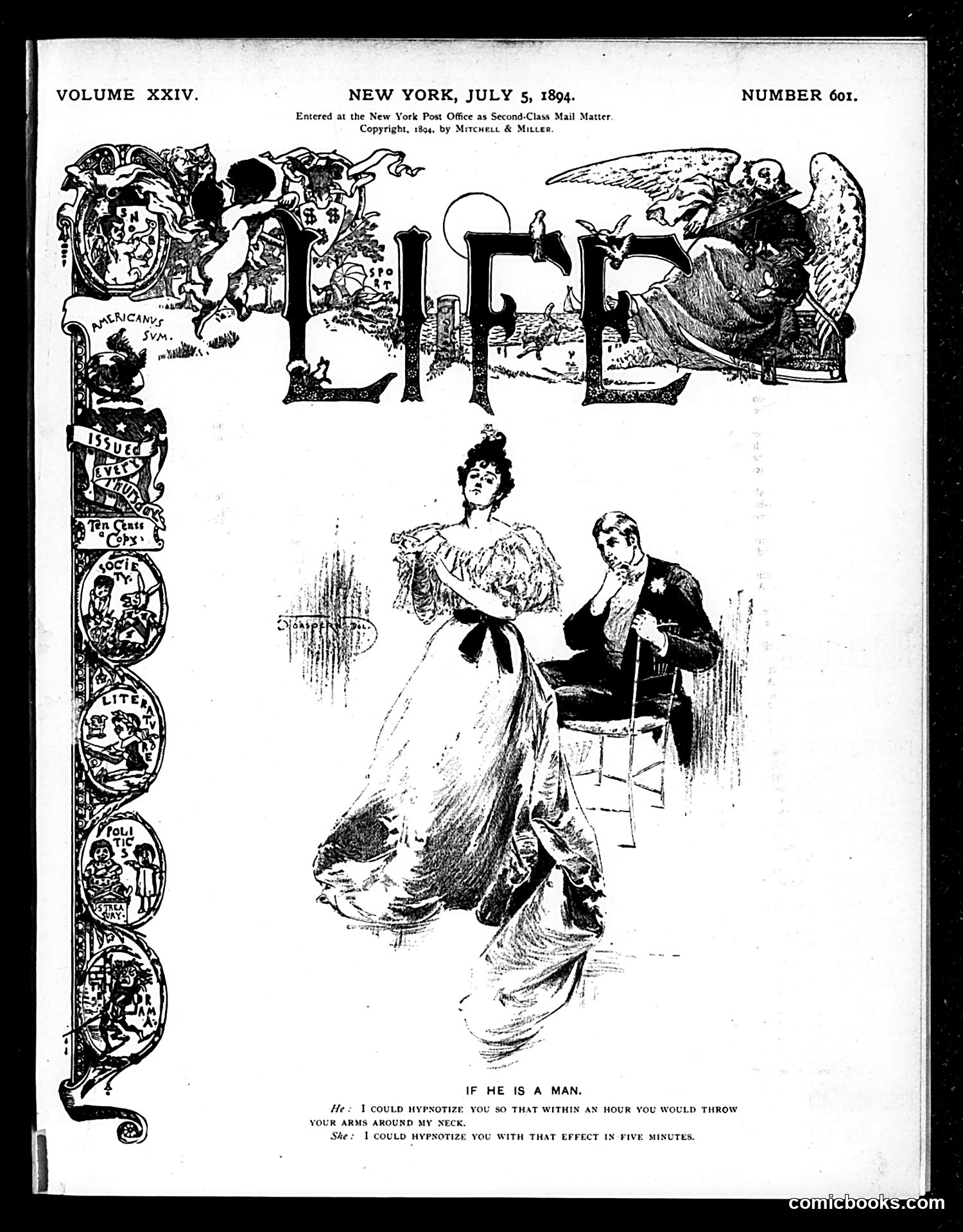
This satirical cartoon depicts a woman in an elegant gown confronting a seated man, likely mocking the emerging "New Woman" movement of the 1890s. The caption presents a hypnotic challenge: the woman claims she could hypnotize the man so completely that within an hour he'd embrace her neck, and accomplish this hypnotic effect in five minutes. The satire targets anxieties about shifting gender dynamics. The man's passive, seated position contrasts with the woman's dominant stance and elaborate dress, suggesting feminist concerns about women's independence and social power. The hypnosis theme implies women possess dangerous, almost supernatural influence over men—a common anxiety during this era of women's suffrage activism and changing social roles.
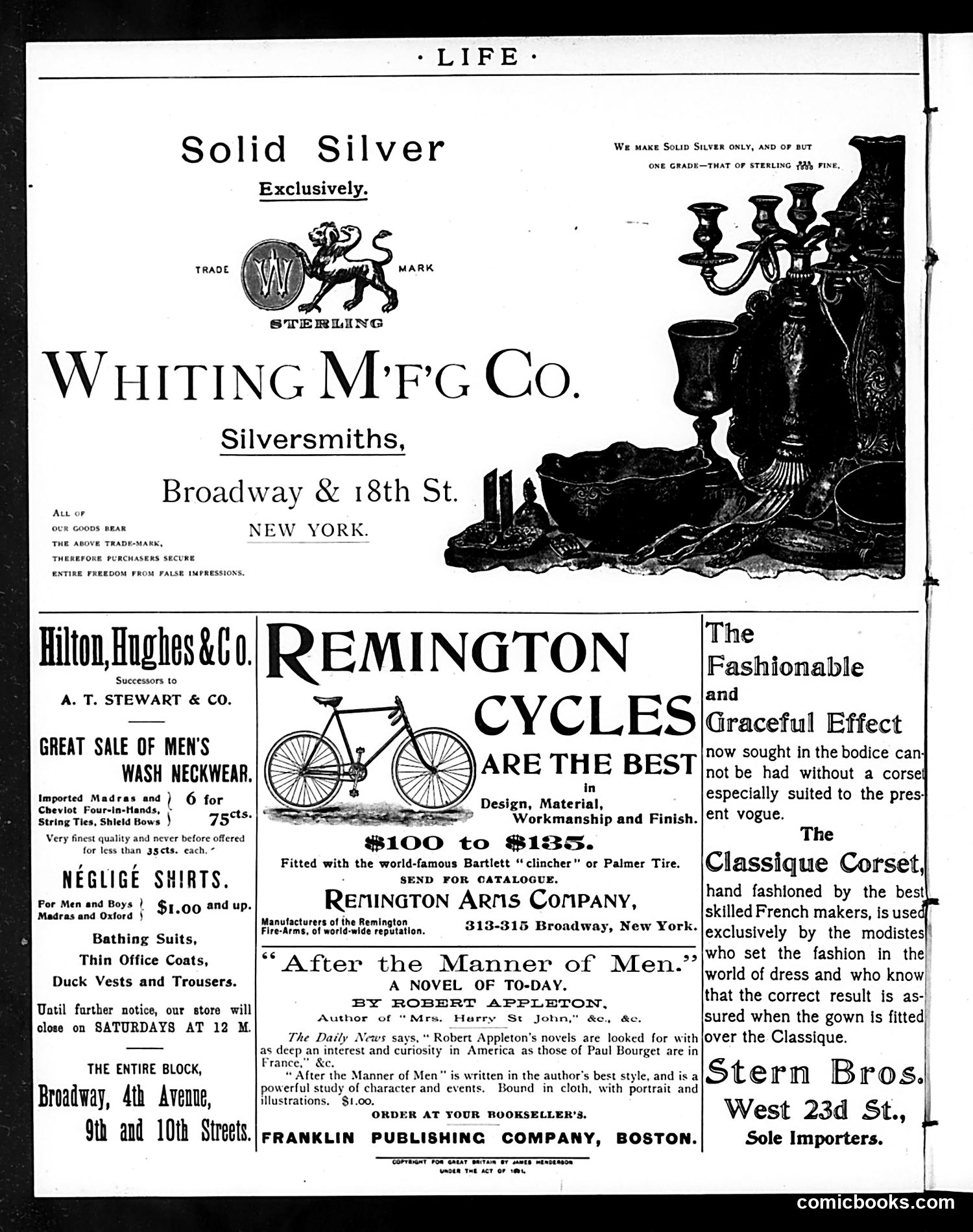
This page is **primarily advertising**, not political satire or editorial cartoons. It contains commercial advertisements for: - **Whiting M'fg Co.** (sterling silver goods, New York) - **Hilton, Hughes & Co.** (men's neckwear and shirts) - **Remington Cycles** (bicycles, $100-$185) - **The Classique Corset** (women's fashion) - **Stern Bros.** (corset importers) - **Franklin Publishing Company** (advertising a novel, "After the Manner of Men") The only illustrative content shows product images: ornate silver vessels, a bicycle, and corset advertisements. There are no political cartoons, caricatures, or satirical commentary visible on this page. It represents typical turn-of-the-century magazine advertising aimed at middle and upper-class consumers.
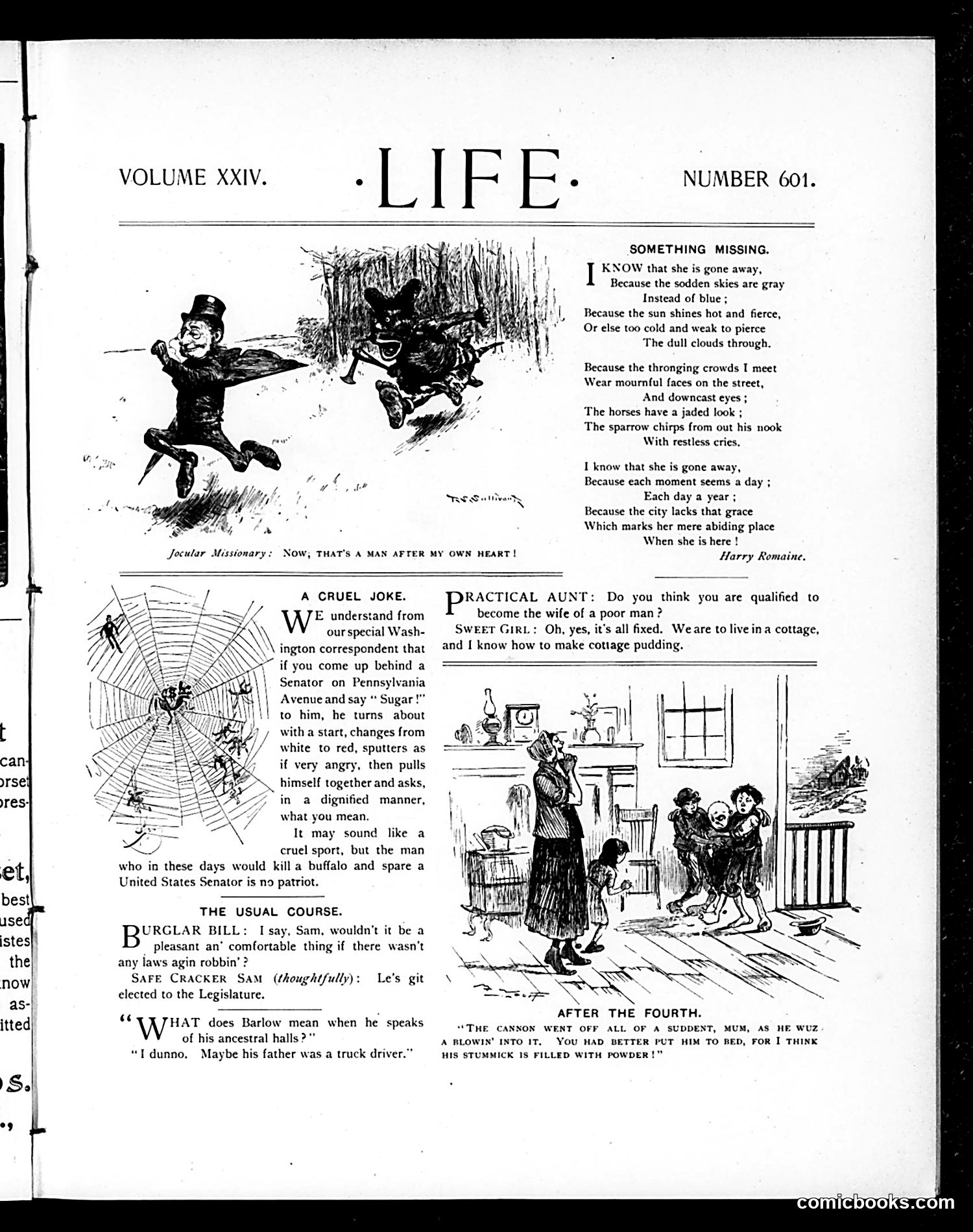
This page contains several humorous sketches typical of early 20th-century American satire: **"A Cruel Joke"** depicts a spider web trap, mocking a senator from Pennsylvania Avenue who supposedly becomes angry when called "Sugar," changing colors like an angry chameleon before asking questions "in a dignified manner." The satire targets the senator's thin-skinned vanity. **"The Usual Course"** presents a brief exchange mocking politicians' family pretensions—suggesting a legislator's ancestor was merely a truck driver. **"Practical Aunt"** jokes about a woman's qualifications for marrying a poor man, bragging about making cottage pudding. The poem "Something Missing" laments an absent woman's presence in the city. These sketches reflect turn-of-the-century American humor focusing on social pretension, political pomposity, and domestic comedy.
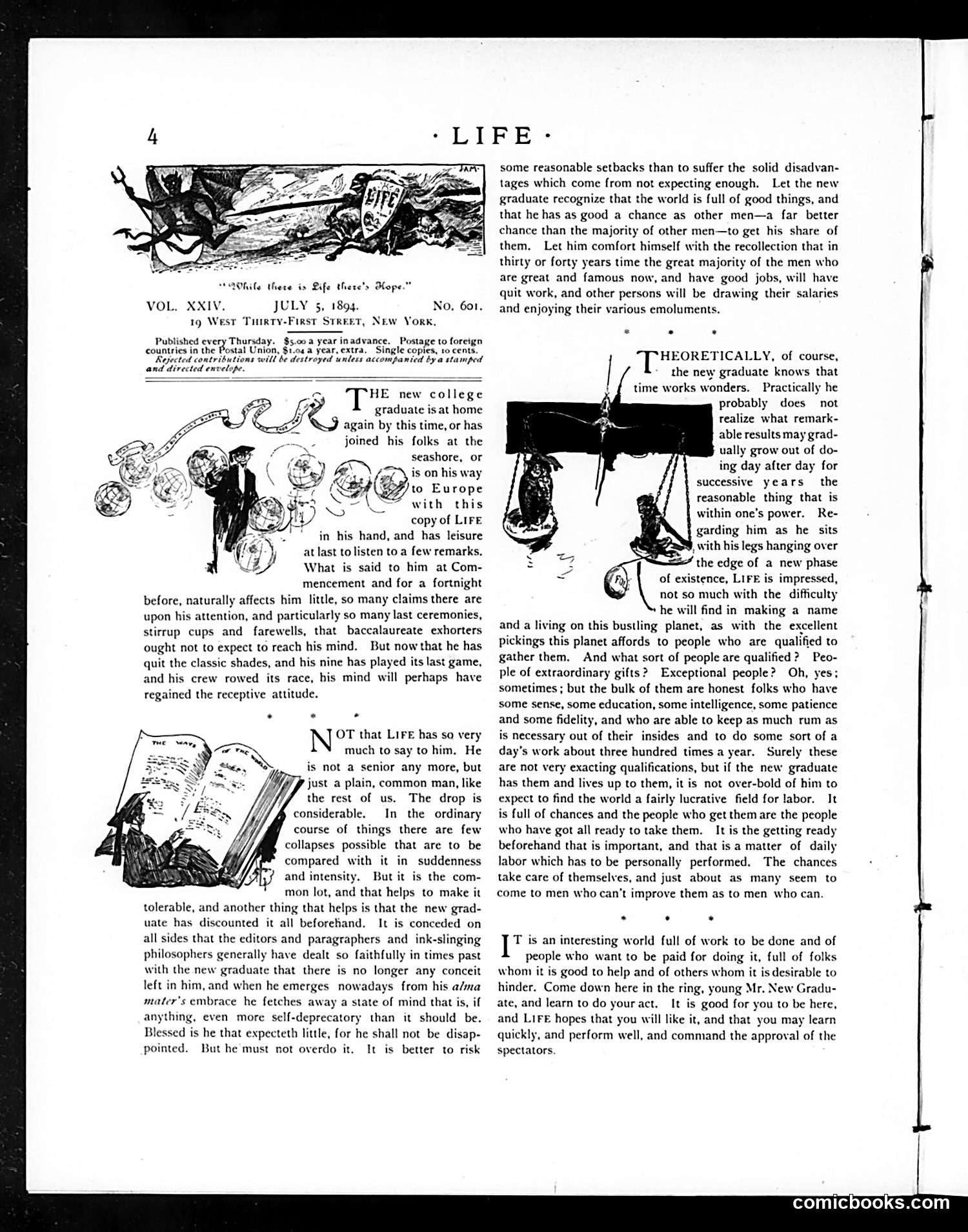
This page offers satirical advice to recent college graduates entering the workforce. The central cartoon depicts a young man on a swing or trapeze, symbolizing the precarious position of starting adult life. The accompanying text argues that while graduates theoretically understand work's value, they often underestimate its practical demands and the unremarkable nature of entry-level positions. The satire targets graduates' inflated expectations. The text suggests most new workers possess only basic qualifications—"some sense, some education, some intelligence"—hardly exceptional. The piece mockingly notes that finding meaningful work is difficult, and many graduates will eventually accept ordinary jobs alongside ordinary people. The overall message: realistic expectations and humility are necessary virtues for young professionals.
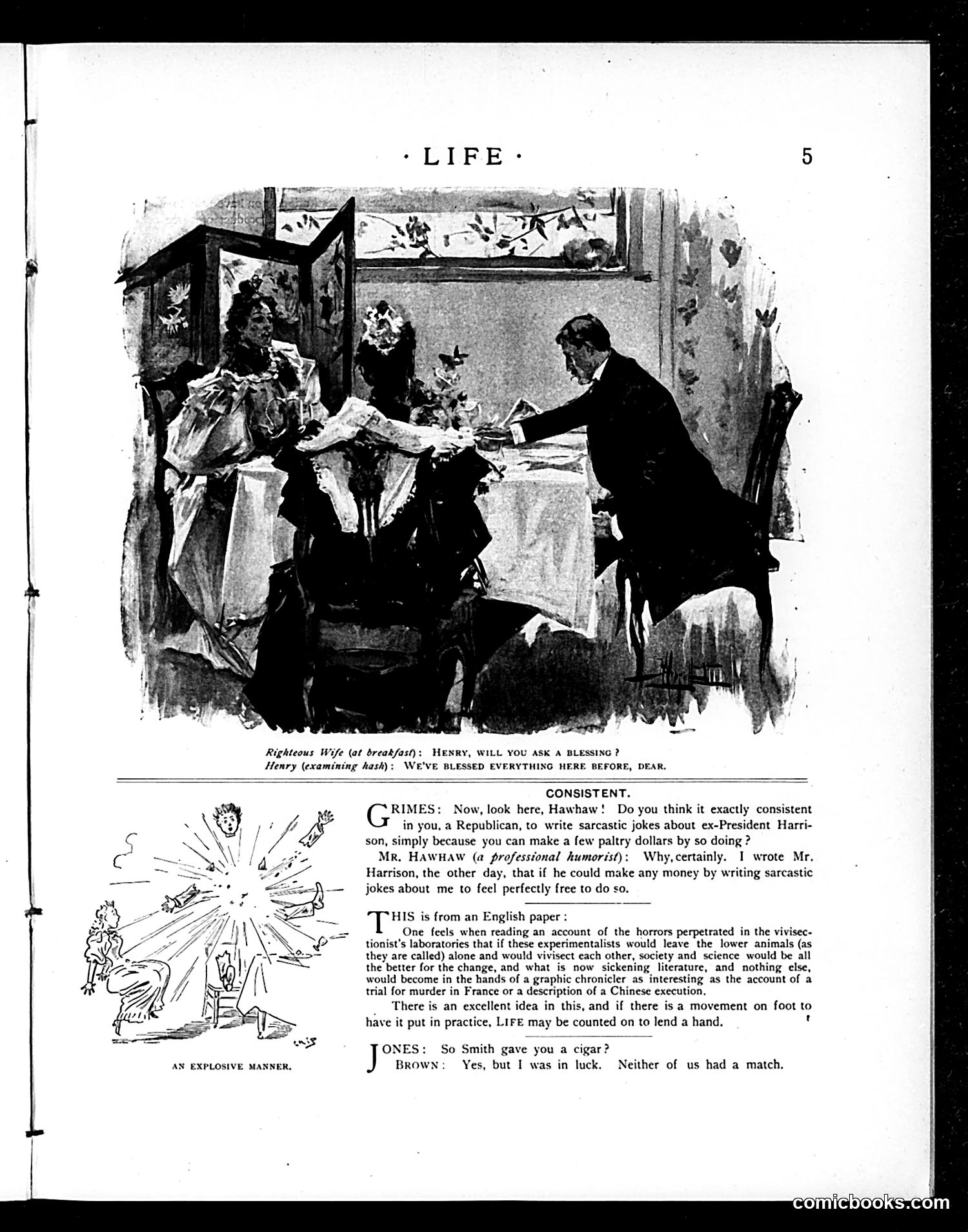
The top cartoon depicts a domestic scene where a man presents papers to his wife, with the caption referencing "blessing" and examining a "hash." This appears to be satirizing marital financial discussions. The main article "CONSISTENT" criticizes Republican politician **Hawbaw** (or similar name) for writing sarcastic jokes about ex-President **Harrison** to earn money, calling this hypocritical. The piece argues that sarcastic political commentary—while potentially profitable—is inconsistent with serious Republican principles. The "EXPLOSIVE MANNER" cartoon below shows a figure amid chaotic imagery, likely illustrating the disruptive nature of such partisan satire. The final brief dialogue jokes about someone named Smith refusing to lend a cigar, playing on the theme of self-interest. The page satirizes American political hypocrisy and mercenary motivations in political writing during what appears to be the late 19th or early 20th century.
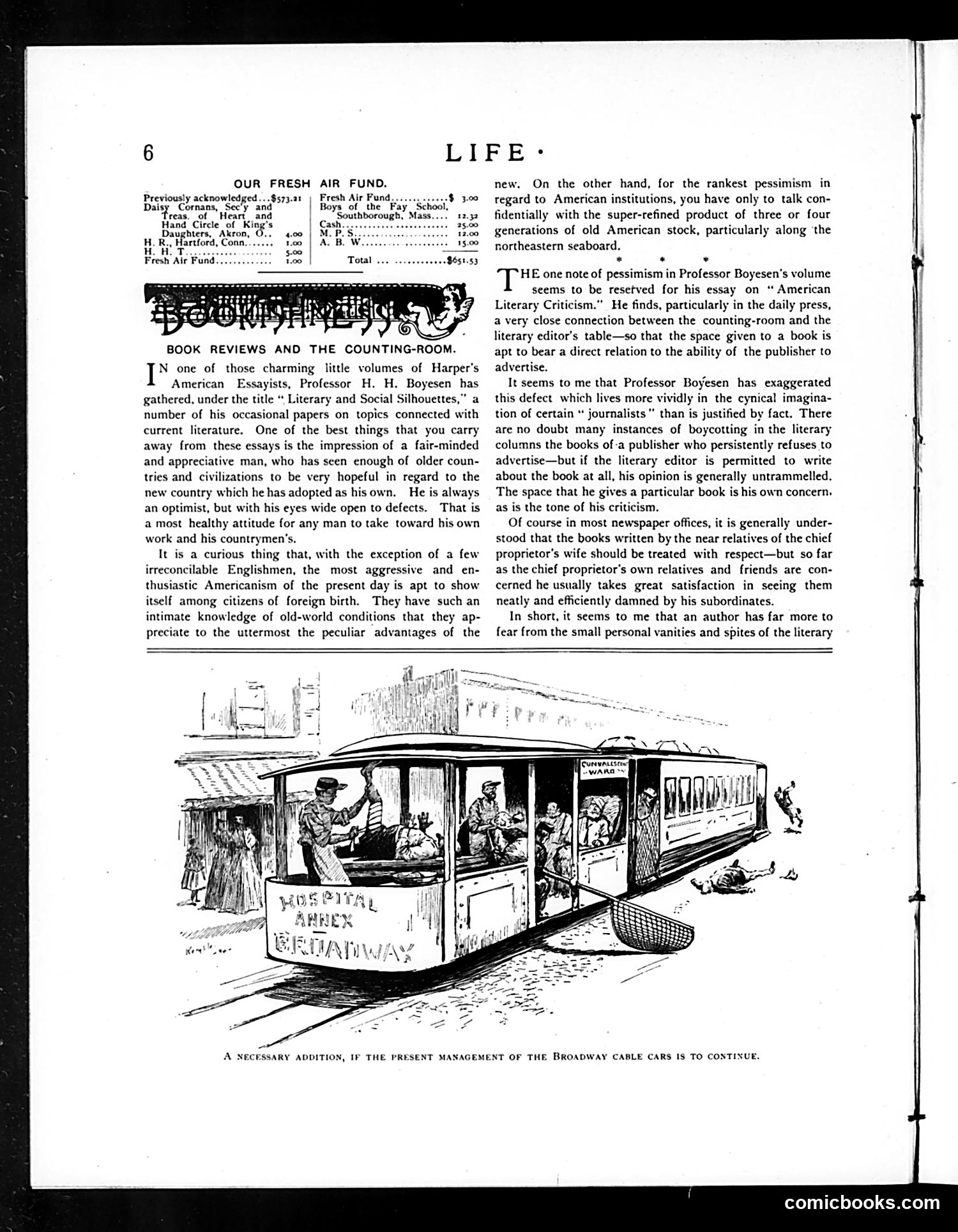
This page contains a satirical cartoon about New York City's Broadway cable cars. The illustration shows an overcrowded streetcar labeled "HOSPITAL ANNEX" and "BROADWAY," packed with passengers in what appears to be dangerous conditions. The caption reads: "A NECESSARY ADDITION, IF THE PRESENT MANAGEMENT OF THE BROADWAY CABLE CARS IS TO CONTINUE." The satire criticizes the cable car system's management for overcrowding and poor safety conditions, suggesting that at the current rate of mismanagement, a hospital car would become a necessary accompaniment to regular service. This is a commentary on public transportation inadequacy and operator negligence in what appears to be late 19th or early 20th-century New York City. The page also discusses literary criticism and book reviews above the cartoon.
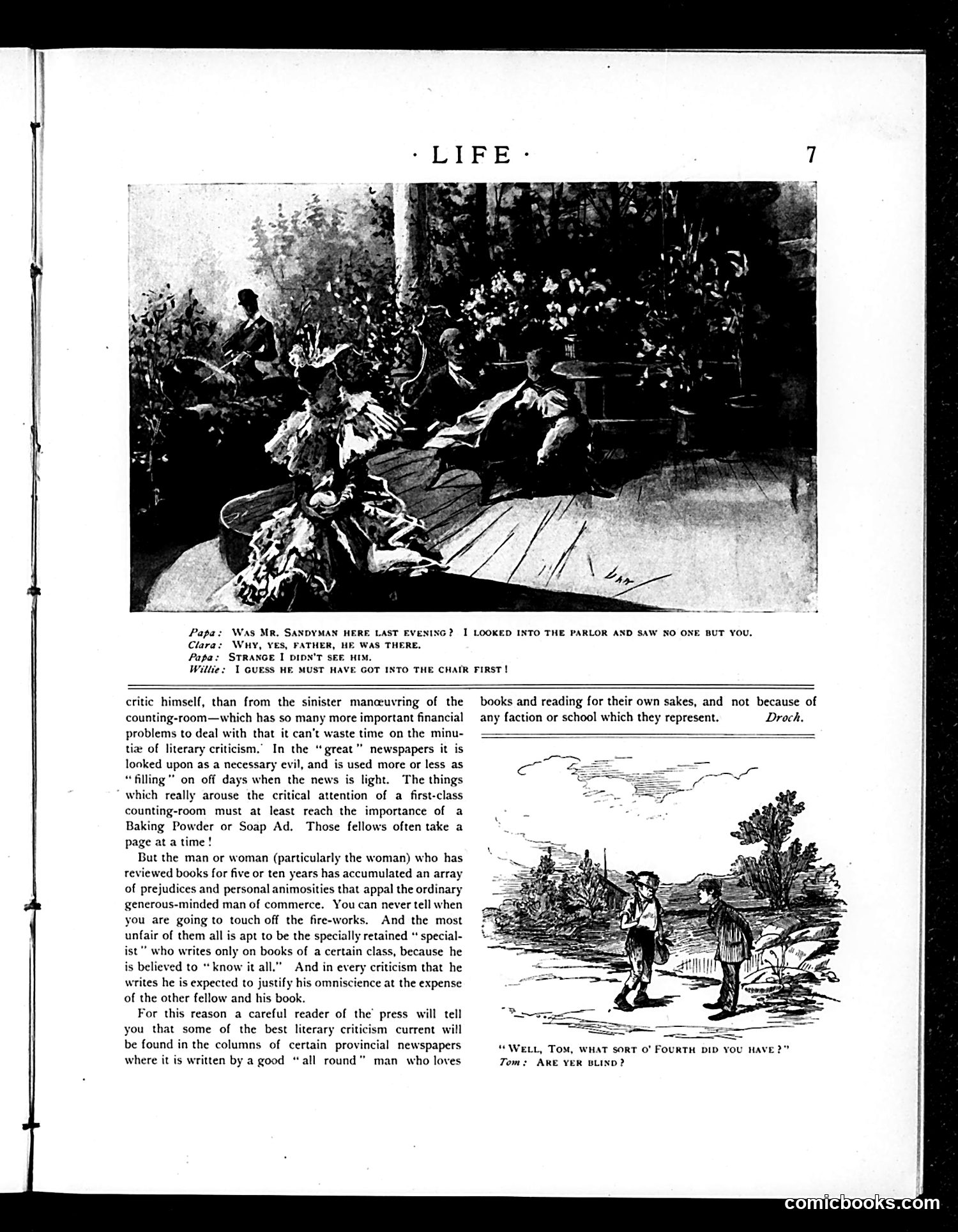
This page contains two distinct elements: **Top photograph/illustration:** A parlor scene showing people in what appears to be early 20th-century dress. The dialogue suggests a domestic comedy: Papa asks if Mr. Sandyman visited ("I looked into the parlor and saw no one but you"), Clara confirms he was there, Papa claims not seeing him, and Willy jokes that "he must have got into the chain first!" This appears to be a humorous visual gag about a guest disappearing or hiding, likely from a serialized story or comic sequence. **Bottom illustration:** Two figures outdoors. The caption reads "Well, Tom, what sort of Fourth did you have?" with Tom's response "Are yer blind?" This references Independence Day celebrations and suggests Tom experienced some mishap—possibly fireworks-related injury—making the question sarcastically inappropriate. Both are light domestic humor typical of Life's satirical content.
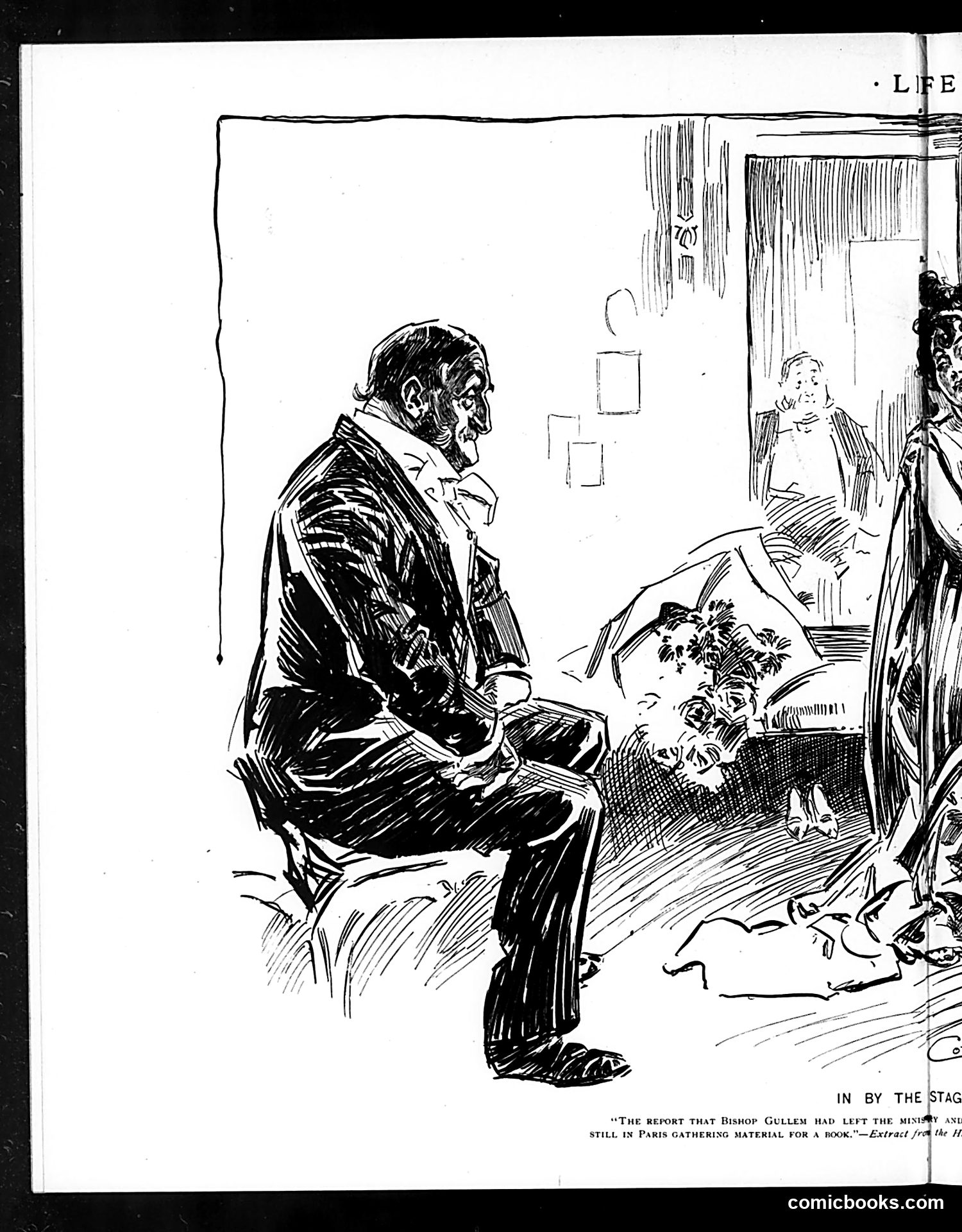
This is a sketch titled "In by the Stag" with a caption referencing Bishop Gullen leaving "the mishap" and still gathering material for a book in Paris. The image shows an older man in a dark suit seated and observing a domestic scene where a woman with a child sits near a fireplace. A second man stands in the background. The satire appears to target Bishop Gullen (identity unclear to modern readers—likely a public figure of the era) for opportunistically gathering material for a book while in Paris, despite some unspecified "mishap" occurring. The title "In by the Stag" suggests he's entered a situation somewhat by accident or through indirect means. The humor lies in depicting him as an observer exploiting others' circumstances for literary purposes—a critique of exploitative authorship or journalism.
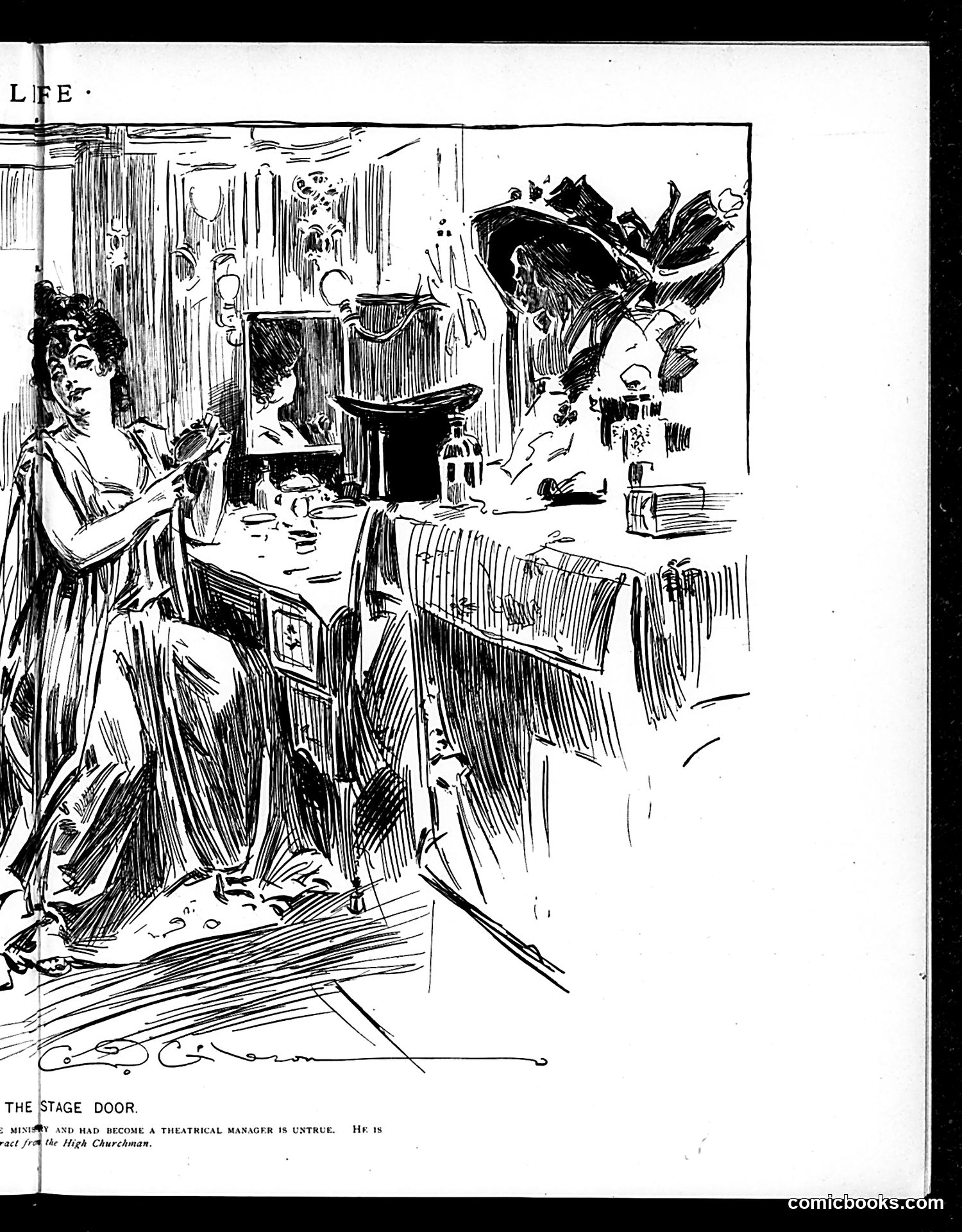
This satirical illustration depicts a backstage dressing room scene, labeled "The Stage Door." The visible caption fragment mentions "ministry and had become a theatrical manager is untrue. He is [part of] the High Churchman." The sketch shows three fashionably dressed women at a vanity mirror in what appears to be theatrical attire. The satire appears to target someone—likely a public figure or politician—who has taken on a theatrical management role, with the caption suggesting this appointment is being mocked as incongruous or absurd. The reference to "High Churchman" suggests religious or social-class commentary. The exact political target remains unclear from this page fragment, but the overall joke concerns the incongruity between someone's previous position and their new theatrical venture.
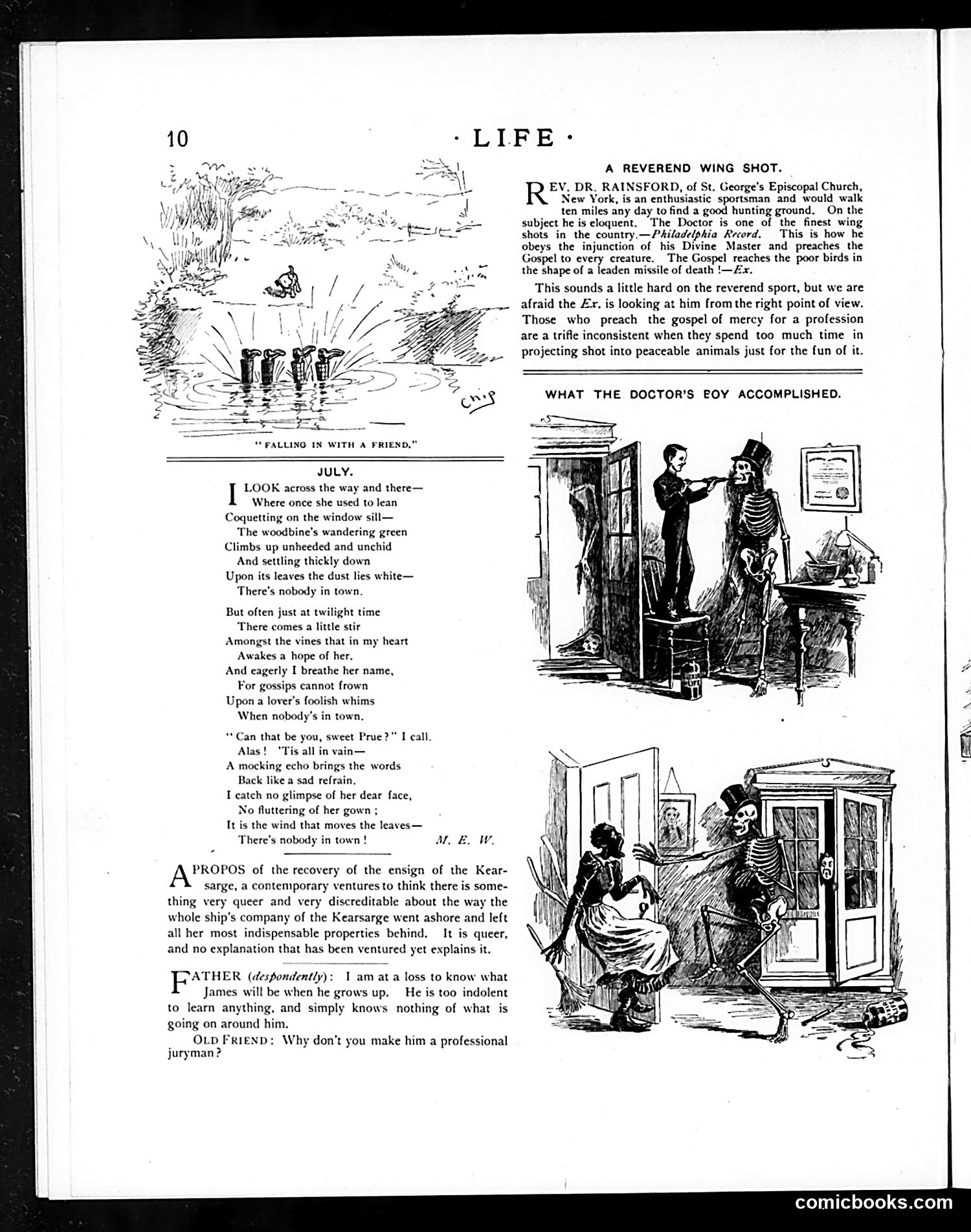
This page contains three separate pieces of satirical content: 1. **"A Reverend Wing Shot"**: A brief article mocking Reverend Dr. Rainsford of St. George's Episcopal Church in New York for his apparent contradiction—he preaches gospel mercy but enthusiastically hunts birds for sport. The satire highlights the hypocrisy of a religious figure who advocates compassion yet kills animals recreationally. 2. **"July" Poem**: A sentimental verse about missing an absent beloved, attributed to M.E.W. 3. **"What the Doctor's Boy Accomplished"**: Two cartoon panels showing a boy apparently using a skeleton (possibly from a doctor's office) to frighten or prank people. The humor derives from mischievous youth misusing professional medical equipment. The page exemplifies Life's satirical approach to social hypocrisy and human folly.
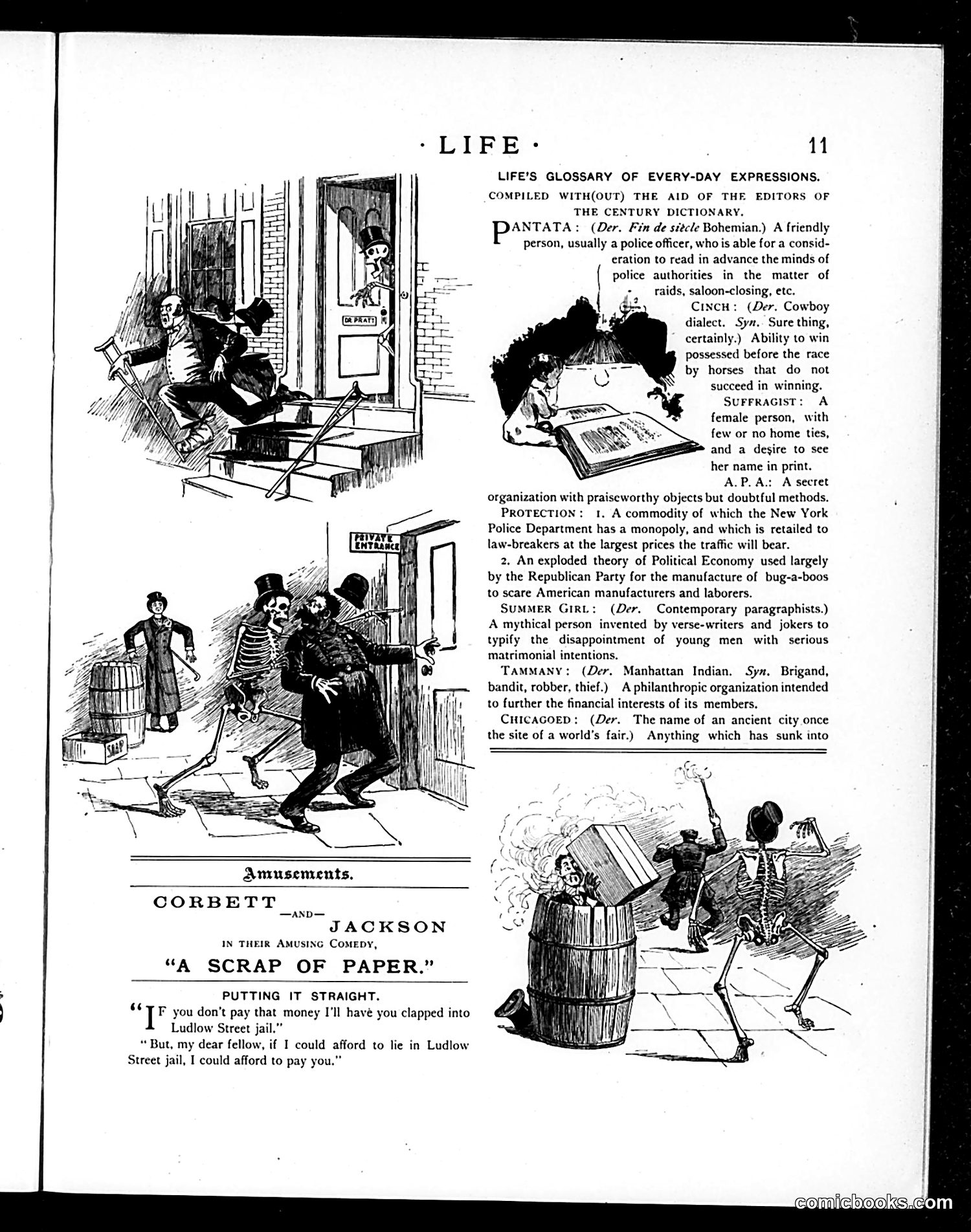
This page contains satirical "glossary" definitions of contemporary social types and a comedic sketch by Corbett and Jackson titled "A Scrap of Paper." The glossary mocks various figures: a **Pantata** (friendly police informant), a **Cinch** (sure thing in horse racing), a **Suffragist** (woman seeking publication and recognition), and others including references to the **A.P.A.** (a secretive anti-Catholic organization), **Protection** (Republican scaremongering tactics), and **Tammany** (corrupt Manhattan political machine). The sketch below shows two men in financial dispute, with one threatening jail and the other sarcastically responding that if he could afford Ludlow Street jail, he could pay his debt. This appears to reference debtor's prisons, suggesting commentary on working-class poverty and the legal system's treatment of the poor.
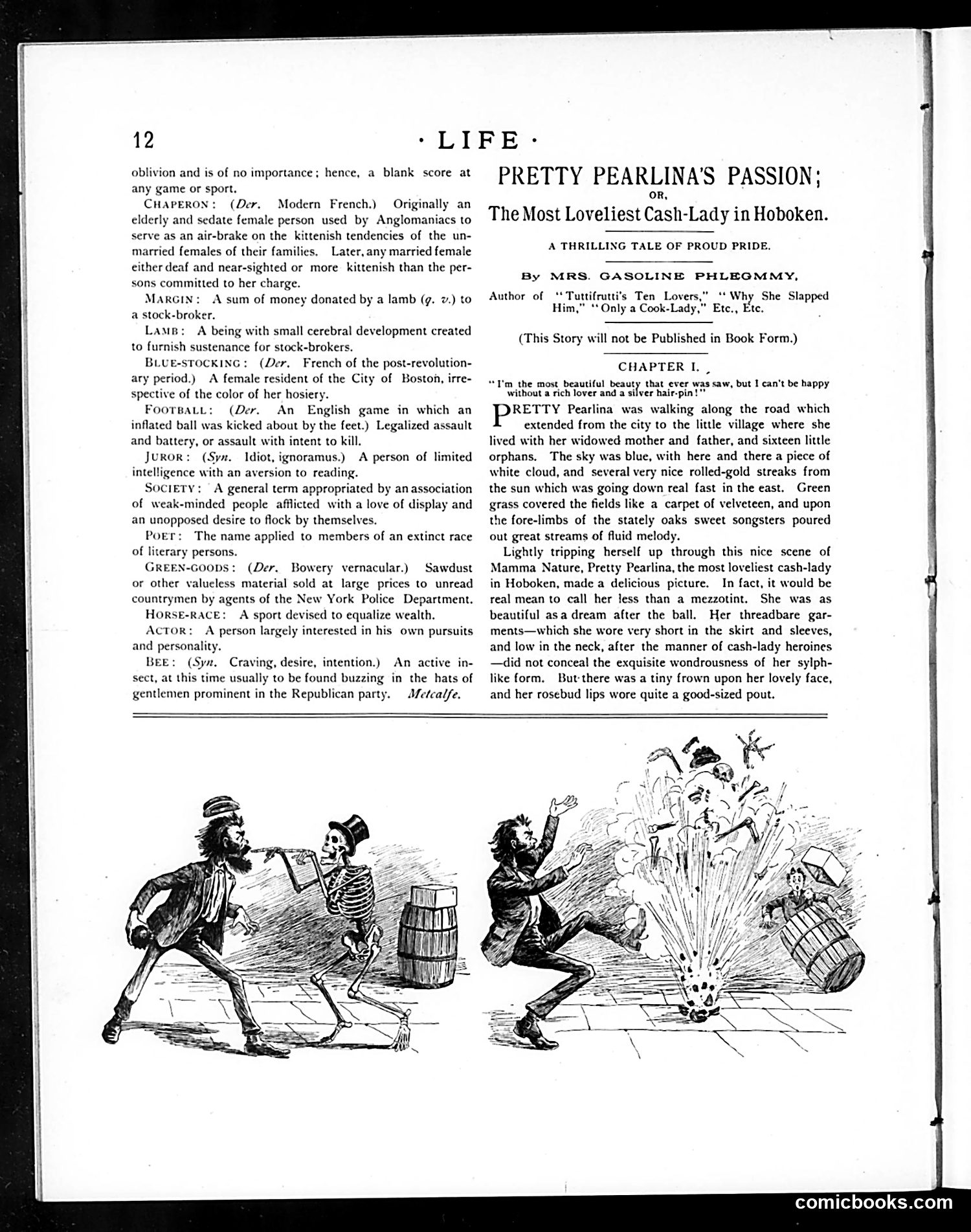
This page contains **satirical definitions** (left column) mocking 1890s American society and politics, followed by the **opening of a parody serial story** (right). The definitions ridicule: - **Chaperons** as ineffectual guardians of unmarried women - **Stock brokers** as parasites exploiting naive investors ("lambs") - **Blue-stockings** as pretentious Boston intellectuals - **Football** as legalized violence - **High society** as shallow and status-obsessed - **The Republican party** (referenced via "Metcalfe," likely a political figure) The story parody mocks contemporary **dime-novel melodrama**: "Pretty Pearlina's Passion" exaggerates sentimental prose ("fluid melody," "sylph-like form") and absurd plot devices (beautiful poor heroine, orphans, dramatic poverty amid overwrought description). The cartoon below shows **slapstick violence**—figures engaged in physical comedy with explosives—typical of Life's comedic illustrations. Together, the page satirizes both **gilded-age social hypocrisy** and **popular culture's emotional excess**.
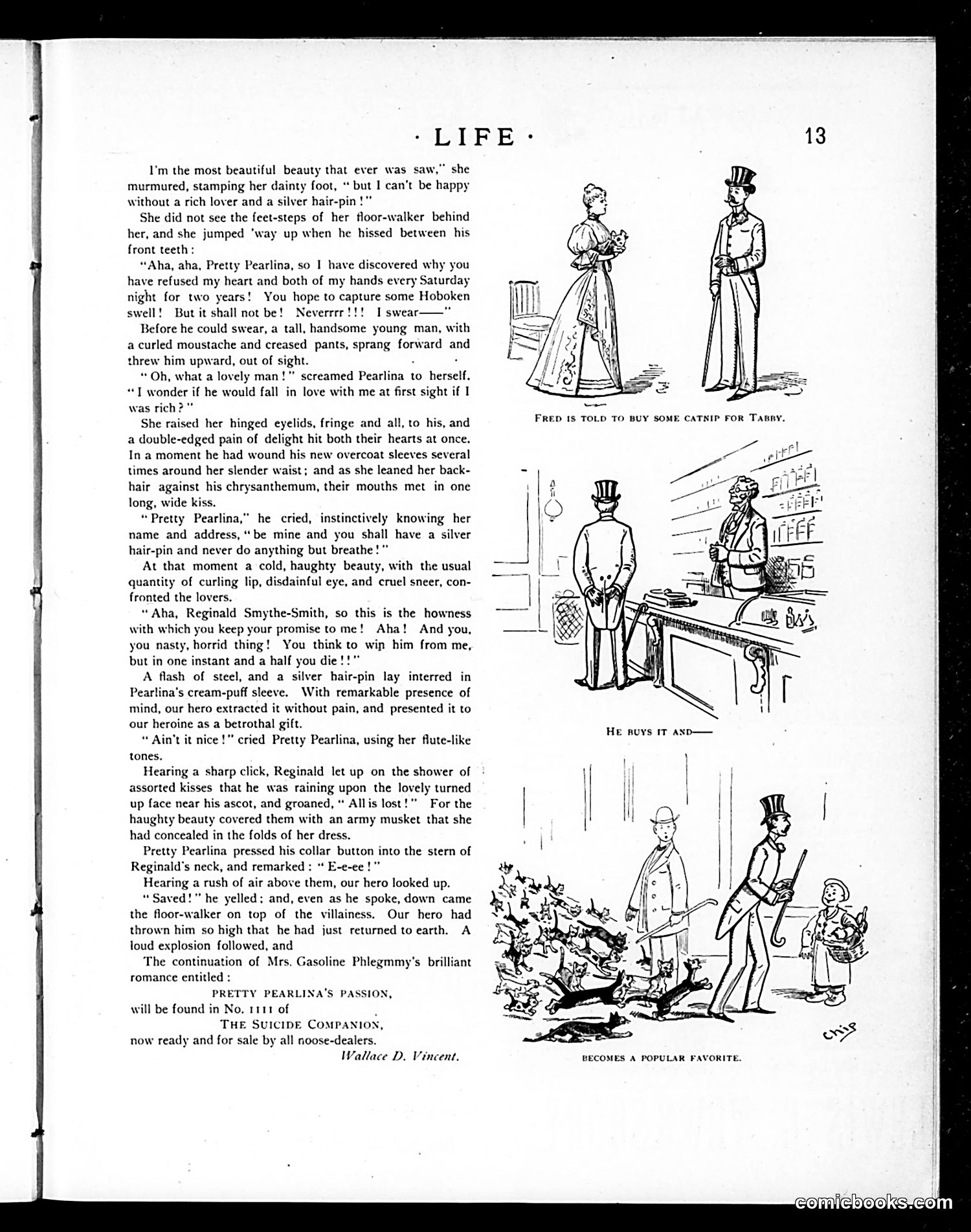
This page satirizes cheap serialized romance fiction and melodrama popular in early 20th-century magazines. "Pretty Pearlina's Passion" is a mock serial story featuring deliberately overwrought tropes: the beautiful shop girl, the persistent admirer, the dashing mysterious rescuer, the vengeful rival with a hidden weapon, and absurd coincidences (the thrown floor-walker returning at the perfect moment). The cartoons illustrate the story's ridiculous plot. The satire targets both the hackneyed narratives themselves and readers' appetite for such melodrama. The final advertisements are fake—"The Suicide Companion" sold by "noose-dealers"—darkly mocking the formula's formulaic desperation. The byline "Wallace D. Vincent" and the promised continuation in a fictional "No. 1111" underscore Life's mockery of serialized pulp fiction's endless repetition and commercial exploitation.
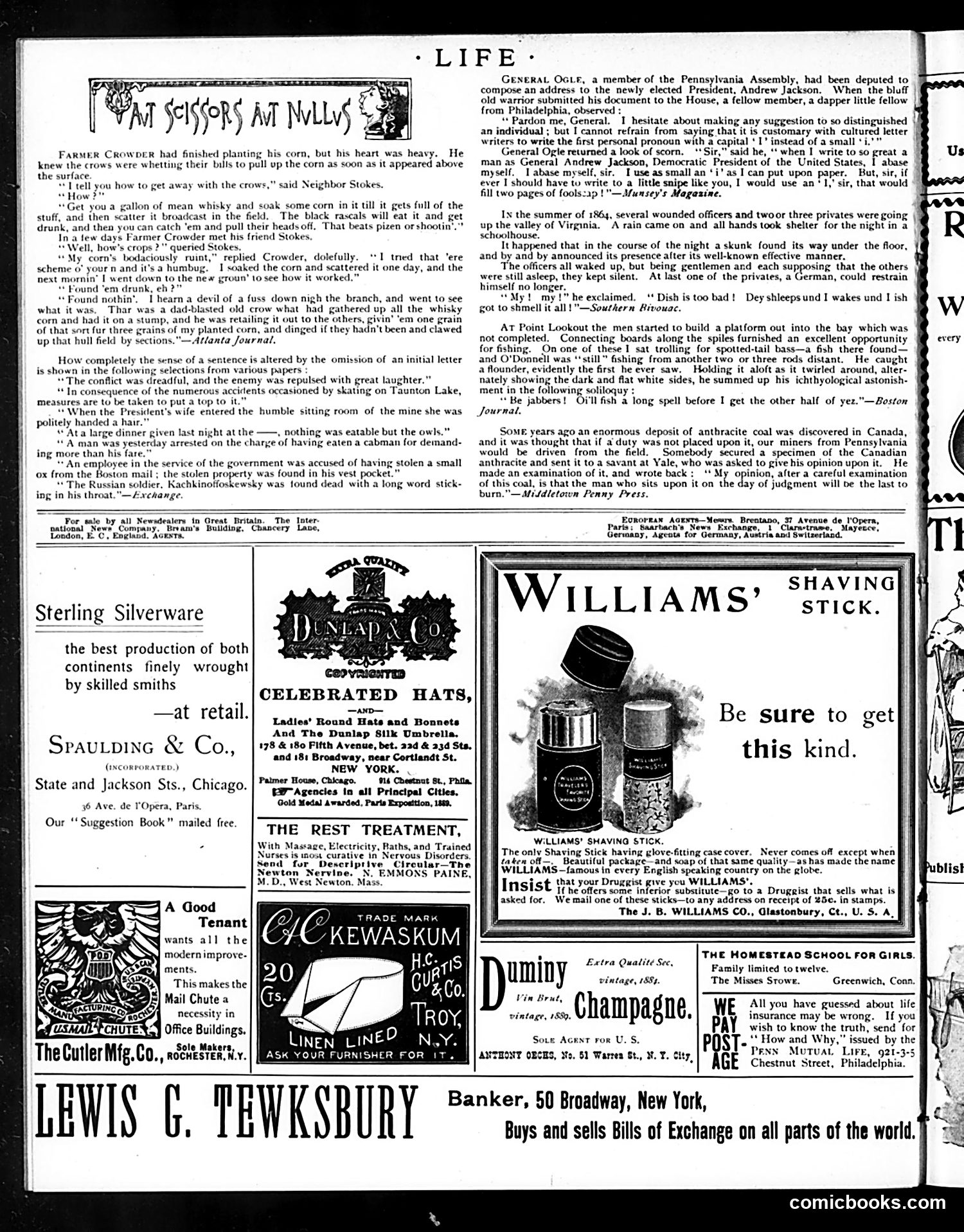
This page from *Life* contains three humorous anecdotes typical of 19th-century American satirical magazines: **"Farmer Crowder and the Crows"**: A rural comedy where a farmer attempts to poison crows with whiskey-soaked corn. The joke: the crows get drunk and establish their own "business," reselling the farmer's planted corn at inflated rates, then destroy his field anyway—satirizing both rural simplicity and corrupt commerce. **The Omitted Letters**: A compilation of absurd sentences where missing initial letters create unintended meanings (e.g., "haur" instead of "hair"). This wordplay mockingly demonstrates how careless printing or writing produces ridiculous results. **General Ogle's Letter**: An anecdote where a Pennsylvania assemblyman defiantly refuses to capitalize the pronoun "I" when writing to President Andrew Jackson, claiming humility before greatness—satirizing both excessive formality and political deference. The remaining content is primarily period advertisements for silverware, hats, champagne, and banking services, typical of *Life*'s revenue model.
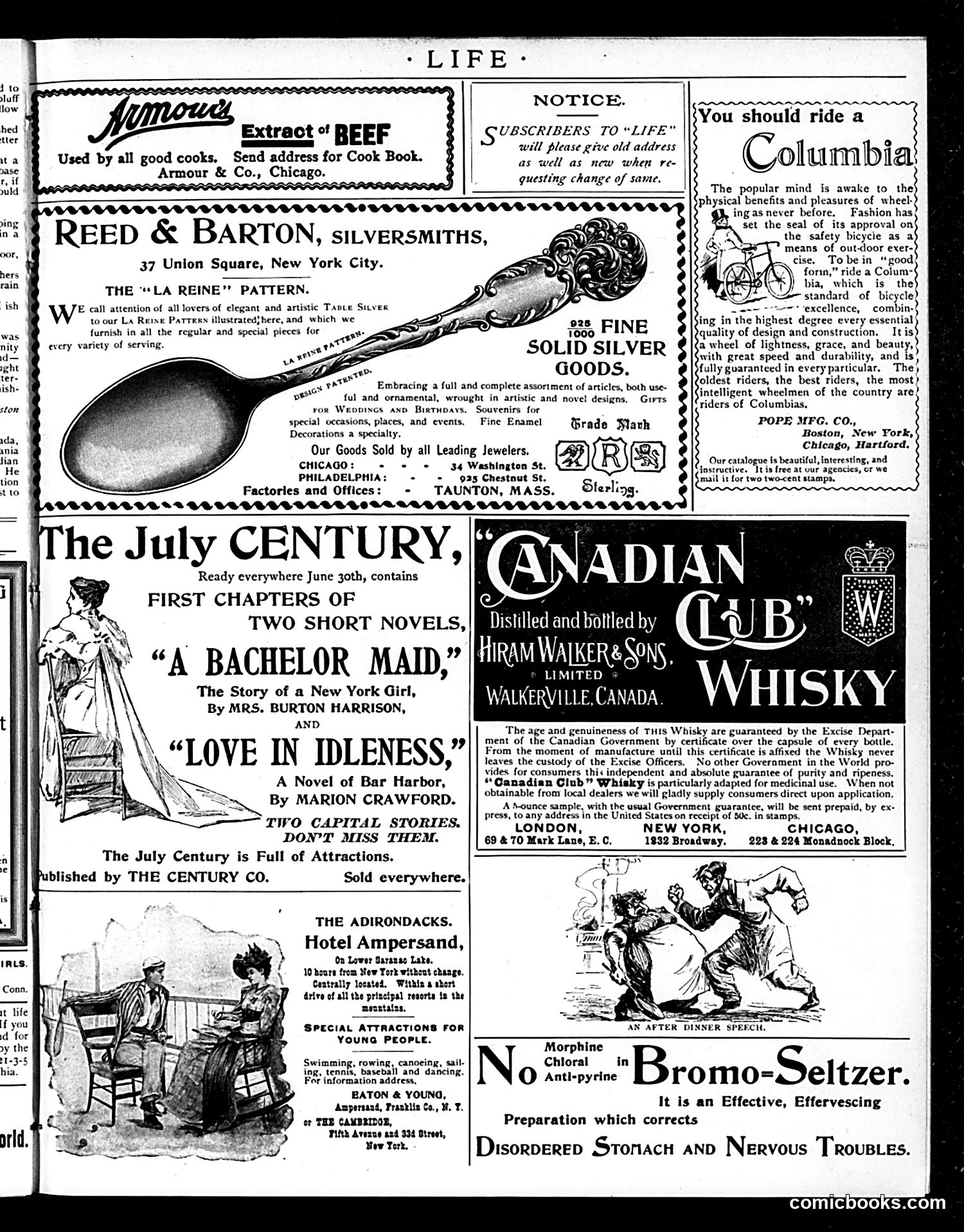
This page is **primarily advertisements and notices** rather than political satire or comics. It contains: **Main Content:** - A subscriber notice requesting address changes - Multiple product advertisements: Armour's beef extract, Reed & Barton silverware (the "La Reine" pattern), Columbia bicycles, Canadian Club whisky, and Bromo-Seltzer **Editorial Matter:** - Announcements for *The July Century* magazine's upcoming issue, featuring two serialized novels: "A Bachelor Maid" by Mrs. Burton Harrison and "Love in Idleness" by Marion Crawford - Hotel and resort advertisements (Hotel Ampersand in the Adirondacks) **The Single Cartoon:** Near the bottom right, there's a small illustration labeled "After Dinner Speech" showing what appears to be a social scene, but lacks sufficient detail or context to identify specific figures or satirical intent. **Overall:** This appears to be a typical late-19th century magazine page mixing advertisements with literary announcements—no discernible political satire or recognizable caricatures are present.
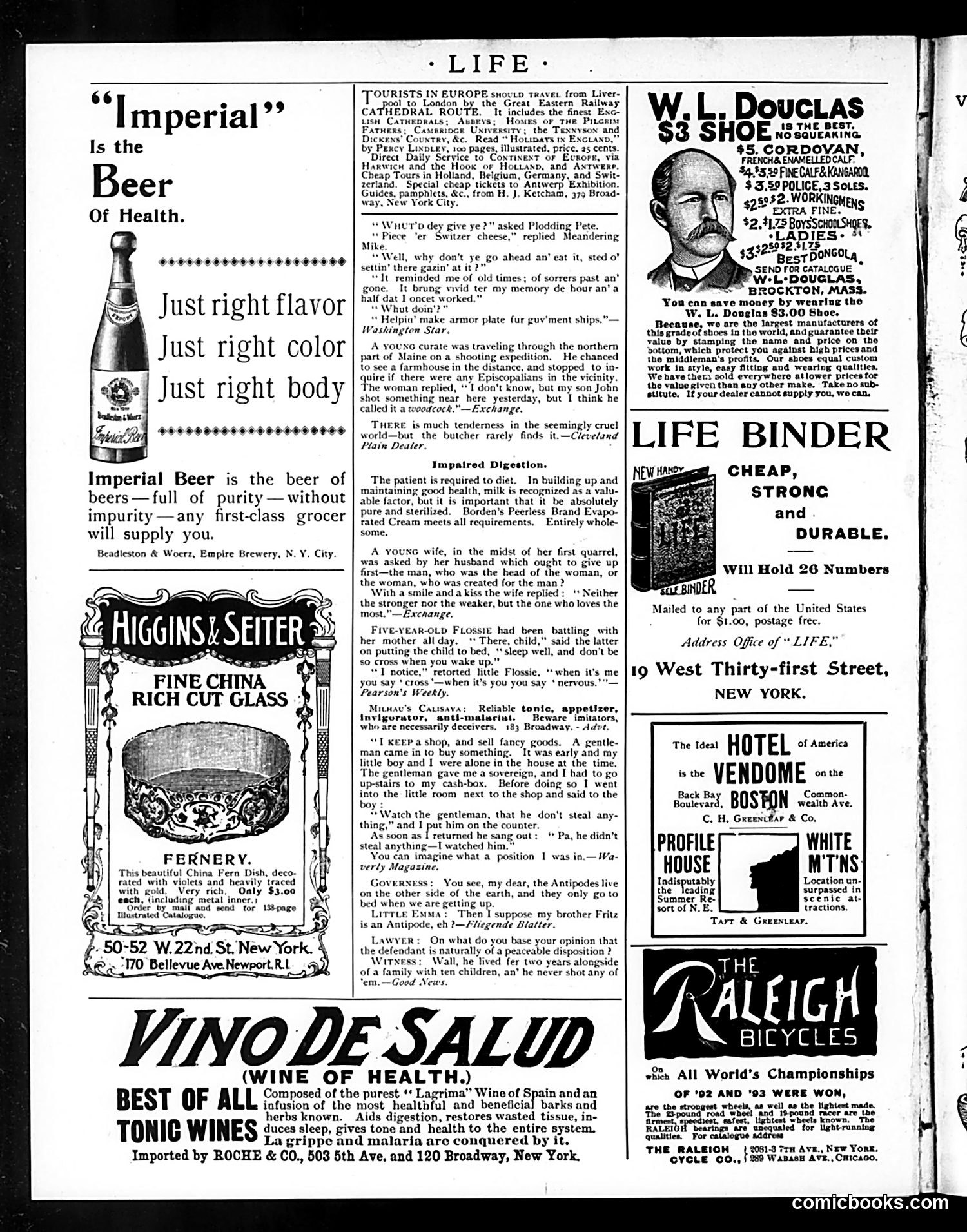
This page is primarily **advertising and filler content**, not political satire. The main elements are: **Advertisements:** - Imperial Beer ("Beer of Health") promoting health benefits - W.L. Douglas shoes ($3 price point) - Higgins & Seiter fine china - Life Binder - Vino de Salud (wine tonic) - Raleigh Bicycles - Hotel Vendome and other services **Humorous anecdotes** (filler content typical of Life magazine): - Short jokes about vagrants, clergy, and marital quarrels - These use period-appropriate dialect and gentle domestic humor rather than sharp satire **Travel advertisement** for Great Eastern Railway tours through England and Europe The page reflects **turn-of-century consumer culture and marketing**—products marketed with dubious health claims (beer and wine as tonics), mass manufacturing pride (shoes stamped with maker's name), and leisure tourism. There's no identifiable political cartoon or sharp social commentary—just the everyday advertisements and light humor that filled Life's pages.