
Life, 1894-07-05 · page 6 of 16
Life — July 5, 1894 — page 6: what you’re looking at
What you’re looking at
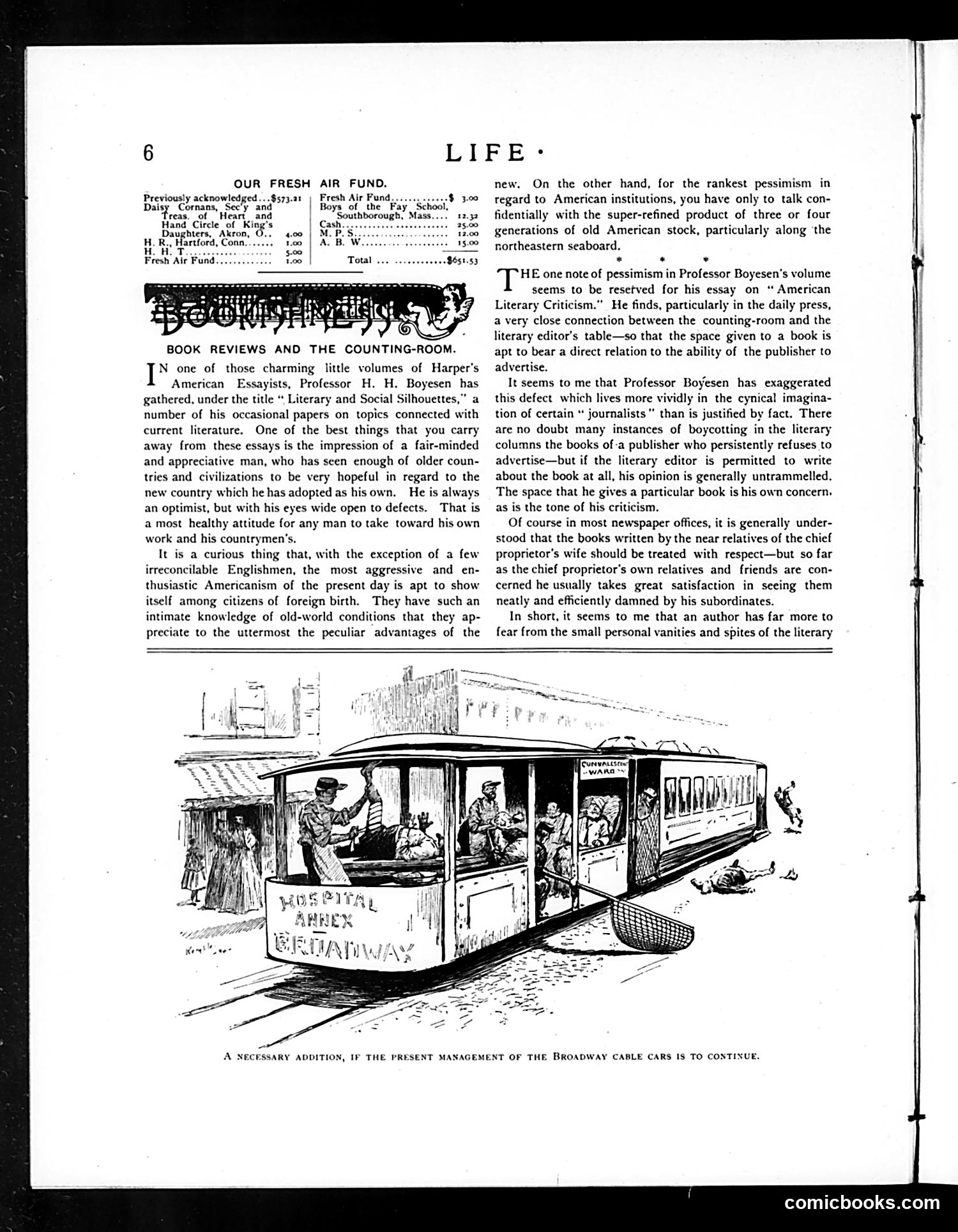
This page contains a satirical cartoon about New York City's Broadway cable cars. The illustration shows an overcrowded streetcar labeled "HOSPITAL ANNEX" and "BROADWAY," packed with passengers in what appears to be dangerous conditions. The caption reads: "A NECESSARY ADDITION, IF THE PRESENT MANAGEMENT OF THE BROADWAY CABLE CARS IS TO CONTINUE." The satire criticizes the cable car system's management for overcrowding and poor safety conditions, suggesting that at the current rate of mismanagement, a hospital car would become a necessary accompaniment to regular service. This is a commentary on public transportation inadequacy and operator negligence in what appears to be late 19th or early 20th-century New York City. The page also discusses literary criticism and book reviews above the cartoon.
📄 Transcribed text from this page (OCR, searchable)
Machine-transcribed from the original scan — historical spelling and the odd misread are preserved.
6 LIFE: OUR FRESH AIR FUND. Fresh Air Fund Boys of the Southborough, BOOK REVIEWS AND THE COUNTING-ROOM. N one of those charming little volumes of Harper's American Essayists, Professor H. H. Boyesen has gathered, under the title “ Literary and Social Silhouettes,” a number of his occasional papers on topics connected with current literature, One of the best things that you carry away from these essays is the impression of a fair-minded and appreciative man, who has seen enough of older coun- tries and c ations to be very hopeful in regard to the new country which he has adopted as his own. He is always an optimist, but with his eyes wide open to defects. That is a most healthy attitude for any man to take toward his own work and his countrymen’s. It is a curious thing that, with the exception of a few irreconcilable Englishmen, the most aggressive and en- thusiastic Americanism of the present day is apt to show itself among citizens of foreign birth. They have such an intimate knowledge of old-world conditions that they ap- preciate to the uttermost the peculiar advantages of the new. On the other hand, for the rankest pessimism in regard to American institutions, you have only to talk con- fidentially with the super-refined product of three or four generations of old American stock, particularly along ‘the northeastern seaboard. * . . HE one note of pessimism in Professor Boyesen's volume seems to be resetved for his essay on “ American Literary Criticism.” He finds, particularly in the daily press, a very close connection between the counting-room and the literary editor's table—so that the space given to a book is apt to bear a direct relation to the ability of the publisher to advertise. It seems to me that Professor Boyesen has exaggerated this defect which lives more vividly in the cynical imagina- tion of certain “ journalists” than is justified by fact. There are no doubt many instances of boycotting in the literary columns the books of-a publisher who persistently refuses to advertise—but if the literary editor is permitted to write about the book at all, his opinion is generally untrammelled. The space that he gives a particular book is his own concern, as is the tone of his criticism. Of course in most newspaper offices, it is generally under- stood that the books written by the near relatives of the chief proprietor’s wife should be treated with respect—but so far as the chief proprietor’s own relatives and friends are con- cerned he usually takes great satisfaction in seeing them neatly and efficiently damned by his subordinates. In short, it seems to me that an author has far more to fear from the small personal vanities and spites of the literary A NECESSARY ADDITION, IF THE PRESENT MANAGEMENT OF THE BROADWAY CABLE CARS IS TO CONTINUE. comicbooks.com