
A complete issue · 16 pages · 1894
Life — May 3, 1894
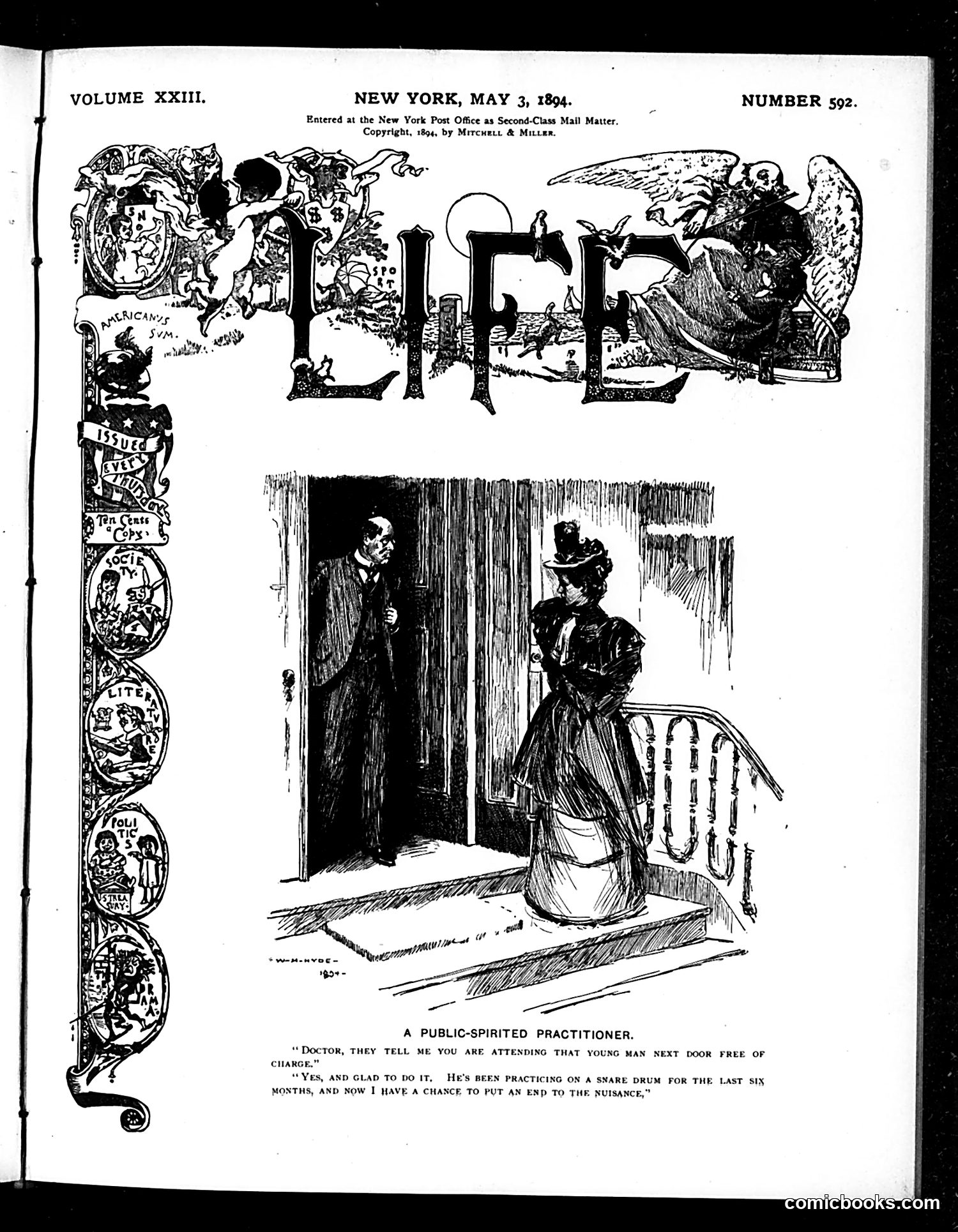
This cartoon satirizes a doctor who offers free medical services to a neighbor, but with a self-interested motive. The caption reveals his true agenda: he's been practicing on a "snare drum" (likely a euphphemism for percussion or noise-making) for six months at the neighbor's expense, causing a nuisance. Now the doctor cynically offers free treatment for the young man next door—not out of generosity, but to eliminate the source of the annoying sound. The satire targets hypocrisy: the doctor presents himself as "public-spirited" when actually pursuing personal benefit. The joke exposes how people sometimes disguise selfish motives as charitable acts, a common theme in satirical commentary on professional ethics and urban neighborly relations.
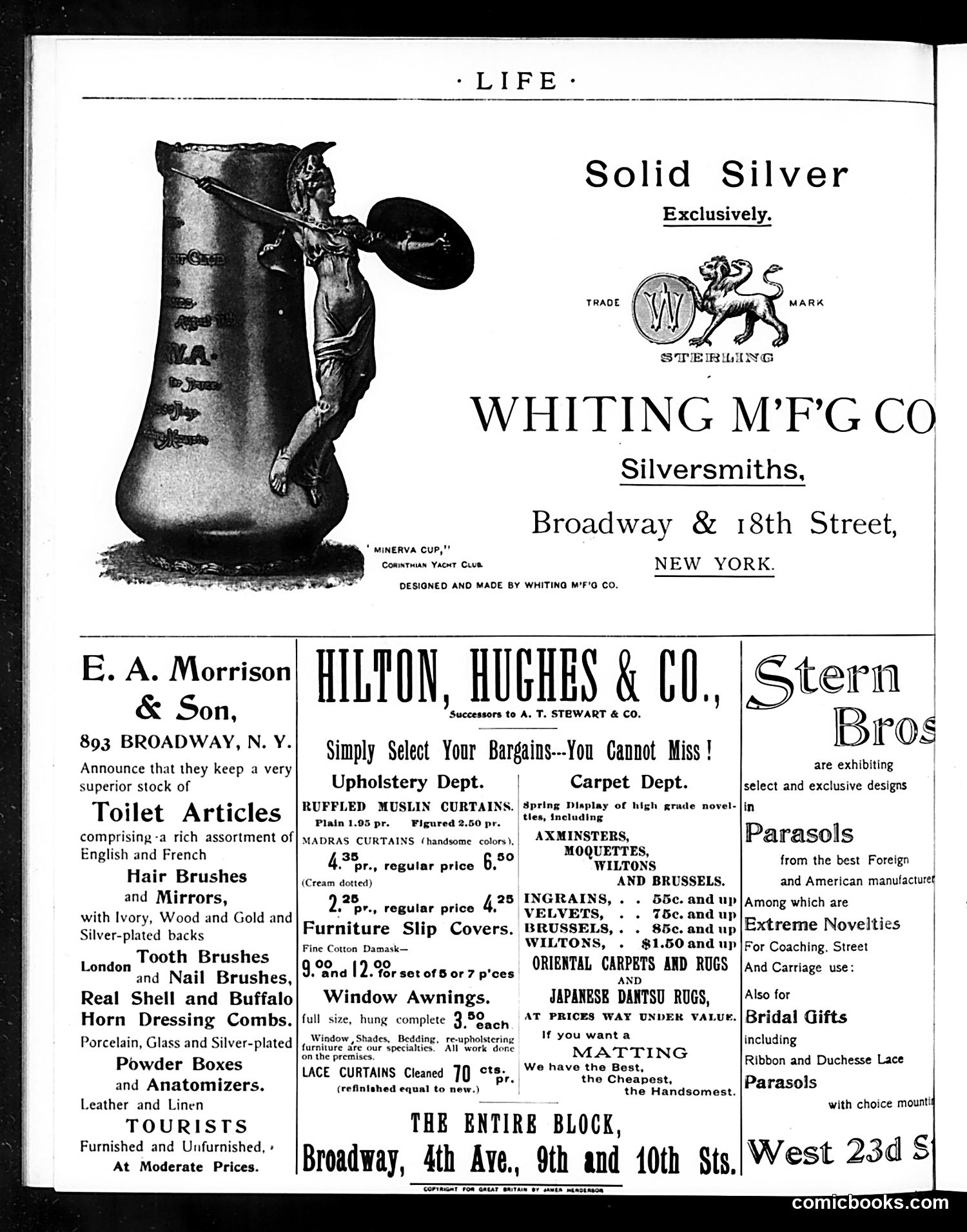
This page is **primarily advertisements** rather than satirical content. The main image shows the "Minerva Cup," a solid silver vessel designed and made by Whiting Manufacturing Company, a New York silversmith. The cup features a classical female figure (Minerva, the Roman goddess of wisdom) as a decorative handle. The surrounding ads promote luxury goods typical of early 20th-century New York retail: furniture, carpets, toiletries, and parasols. The text emphasizes quality materials—solid silver, fine fabrics, exclusive designs—targeting affluent consumers. **No political satire is evident.** This is essentially a commercial page showcasing high-end merchandise and silverware design rather than commentary on current events or social issues.
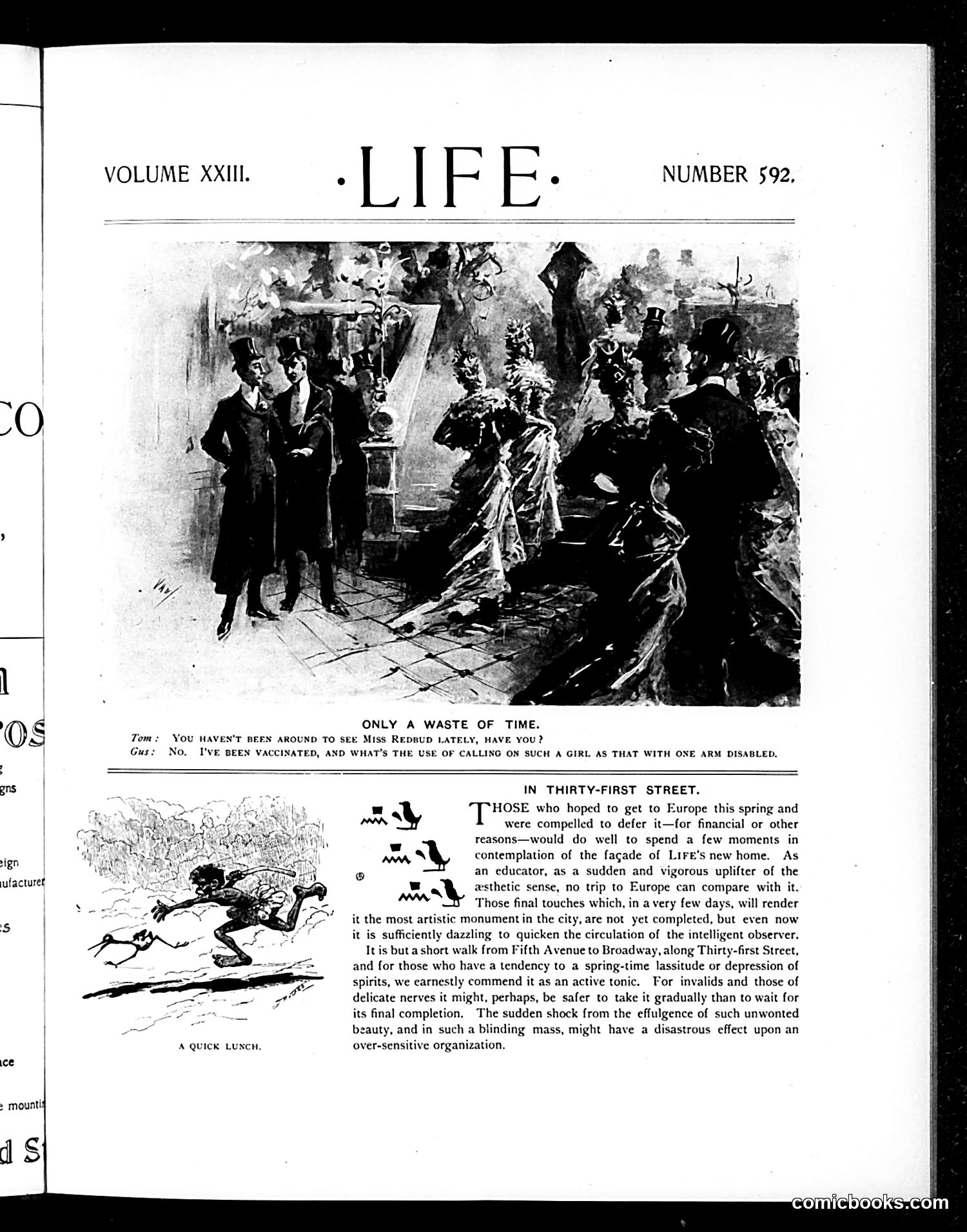
The page contains two satirical pieces about early 20th-century social issues: **Top cartoon ("Only a Waste of Time"):** Shows a conversation between Tom and Gerty about a disabled woman named Miss Rebuked. Tom criticizes calling on a girl with "one arm disabled," implying she's not worth visiting. The satire targets social callousness toward disabled individuals and the superficiality of social conventions. **Bottom section ("In Thirty-First Street"):** Discusses a newly completed architectural facade on Manhattan's Thirty-first Street. The text recommends it as a tonic for those with depression, praising its sudden aesthetic impact. The accompanying sketch ("A Quick Lunch") appears to show people in motion, possibly commenting on urban rushing or casual dining culture. Both pieces critique social attitudes and urban life in the period.
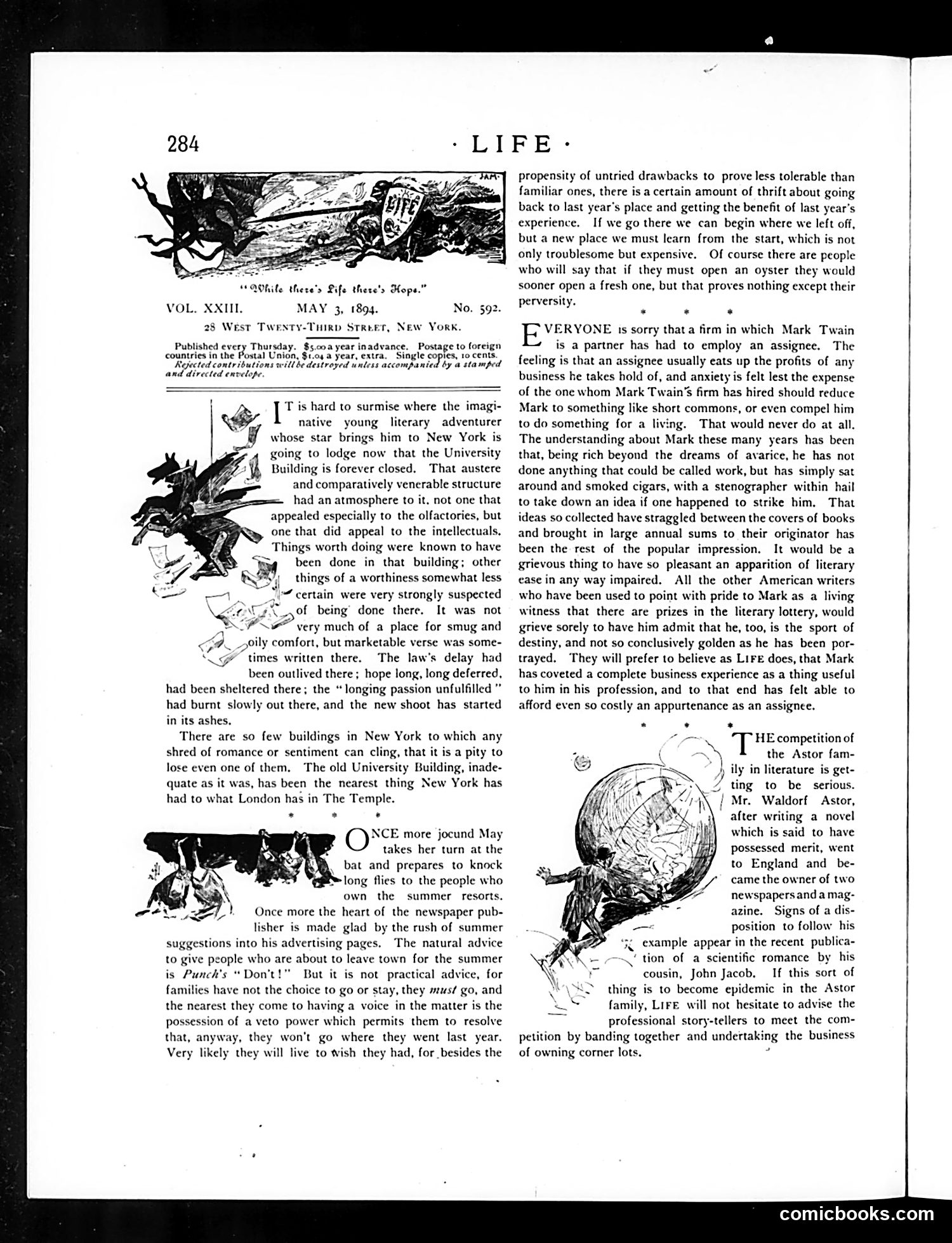
This page contains editorial commentary rather than political cartoons. The primary content discusses **Mark Twain's employment of a business assignee**—apparently someone managing his financial affairs, likely due to business difficulties. The writer expresses sympathy for Twain's situation, noting that despite his literary success and wealth, he lacks practical business experience. The second section discusses **competition among the Astor family regarding newspaper and magazine ownership**, mentioning Mr. Waldorf Astor's recent business ventures in publishing. This appears to satirize the wealthy Astor family's competitive aspirations in the literary marketplace. The decorative illustrations are generic satirical ornaments rather than depicting specific individuals. The overall tone critiques wealthy writers' lack of business acumen and wealthy industrialists' attempts to dominate publishing.
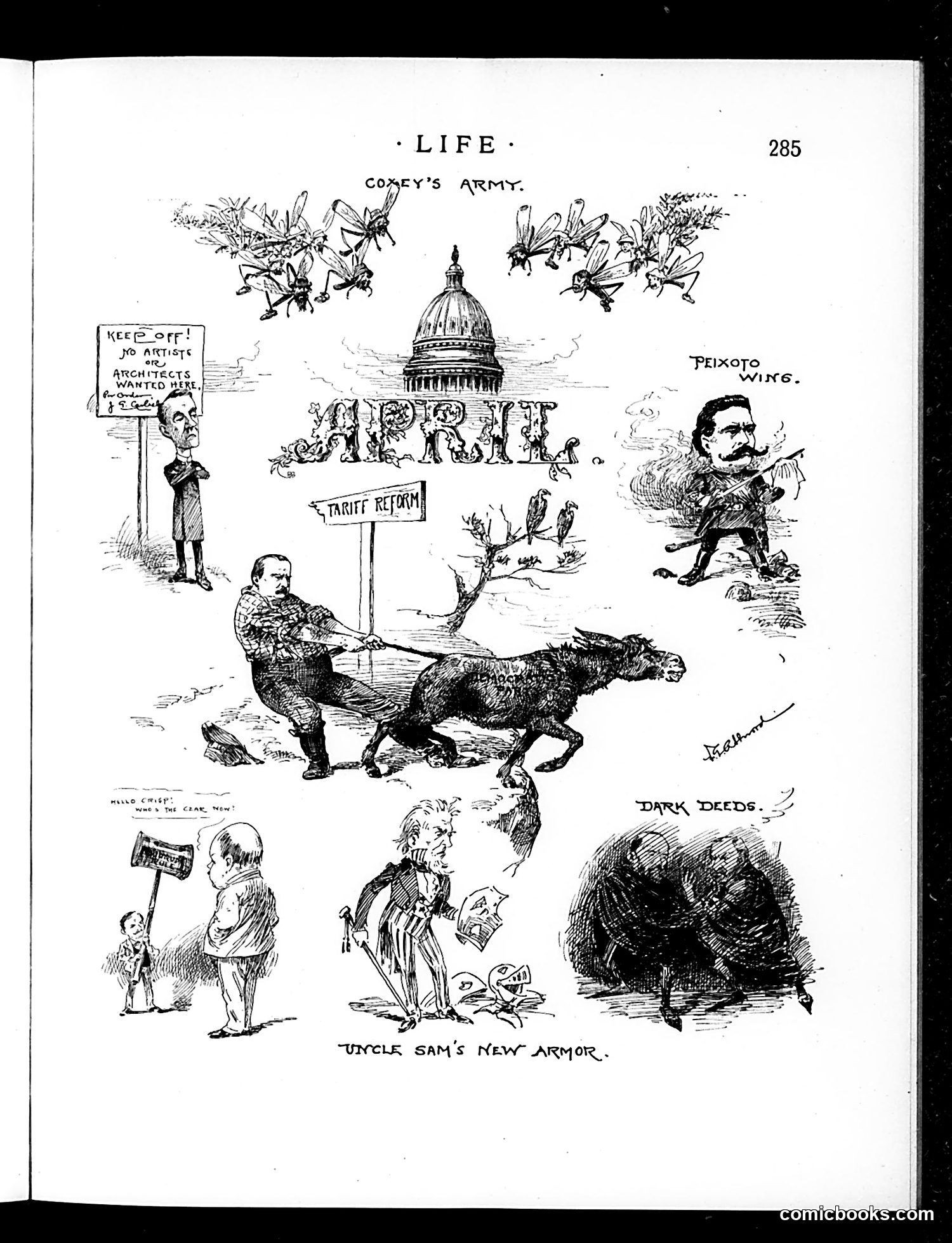
This satirical page depicts early 1900s American political conflicts through multiple vignettes: **"Coxey's Army"** (top): References Jacob Coxey's 1894 march of unemployed workers to Washington, shown here as locusts descending on the Capitol—mocking the protest movement as a plague. **"Tariff Reform"** (center): A man struggles to control a bull labeled with this issue, suggesting tariff debates were chaotic and uncontrollable political forces. **"Peixoto Wing"** and **"Keep Off"** (sides): Appear to reference Latin American political figures or diplomatic tensions, with architects barred from construction—possibly critiquing foreign policy or interference. **"Uncle Sam's New Armor"** and **"Dark Deeds"** (bottom): Comment on American military preparations and murky political dealings, respectively. The overall theme satirizes contemporary political instability and reform movements.
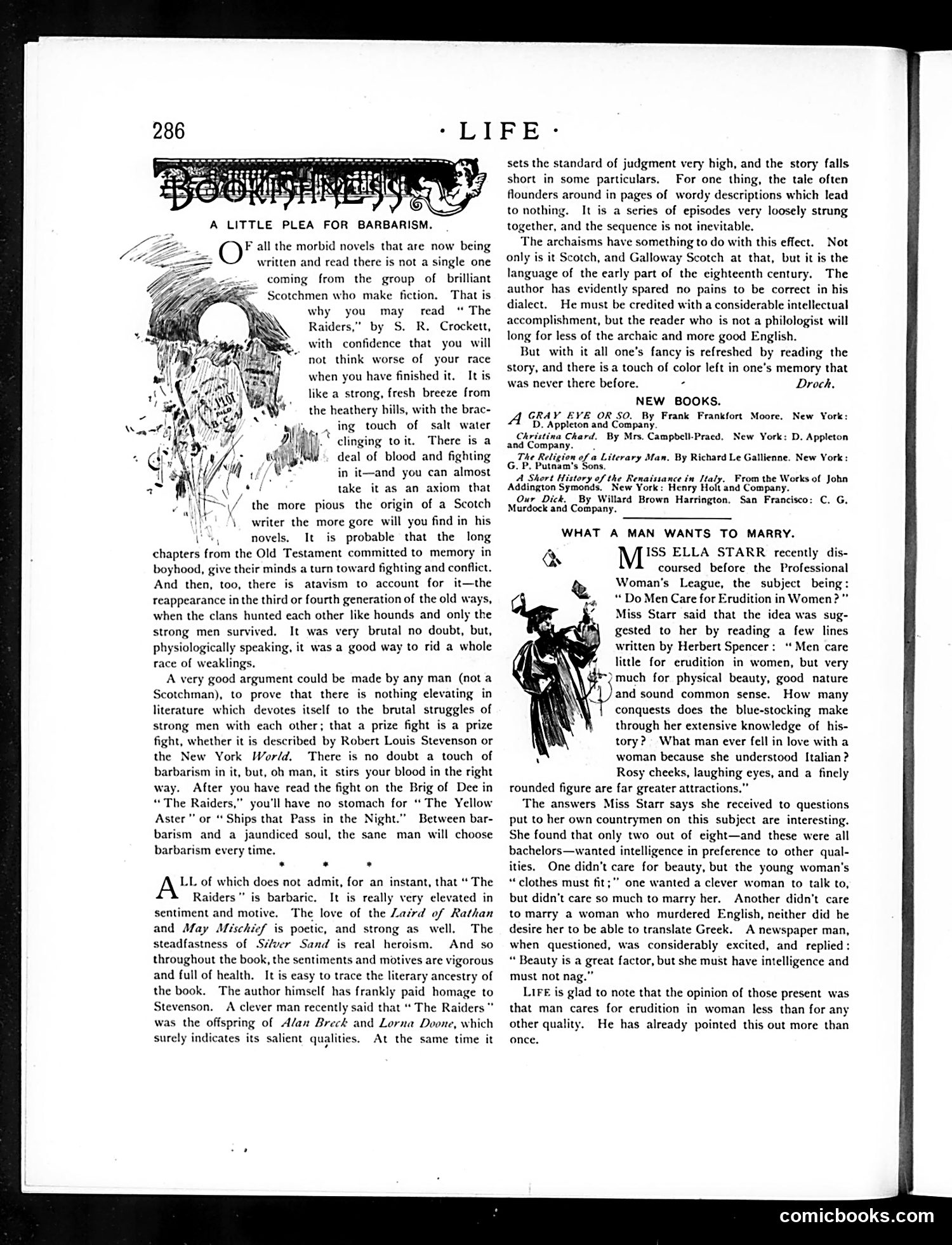
The left side features "A Little Plea for Barbarism," a satirical article defending Scottish literature—particularly works by S.R. Crockett. The accompanying illustration shows a bearded Scottish figure, likely representing Crockett himself or Scottish literary tradition generally. The article argues that Scottish dialect writing shouldn't be dismissed as barbaric, despite its archaic language. It defends the "blood and fighting" in Scottish novels as legitimate literary subjects, comparing them favorably to works like *The Raiders* by Robert Louis Stevenson. The right side contains an unrelated article titled "What a Man Wants to Marry," discussing Miss Ella Starr's views on women's education and attractiveness. The satirical point appears to be examining contemporary attitudes about marriage preferences and female accomplishments.
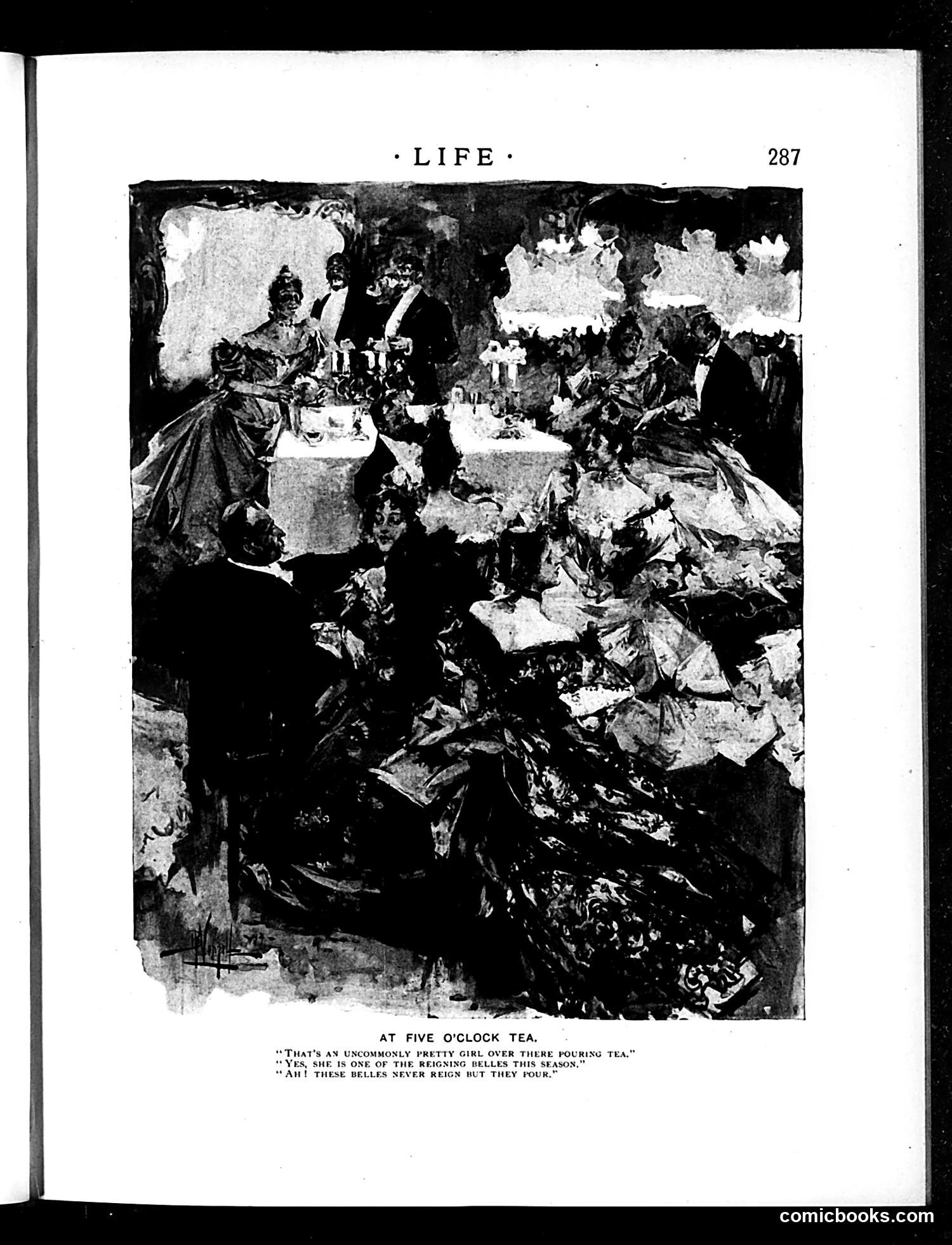
This illustration depicts a fashionable tea party scene from the Gilded Age era. The caption quotes three women discussing a young woman pouring tea, calling her "uncommonly pretty" and "one of the reigning belles this season," before concluding sarcastically: "Ah! these belles never reign but they pour." The satire targets wealthy society women and their limited social roles. Despite being celebrated as "belles" (desirable young women in high society), their primary function remains domestic service—literally pouring tea. The joke mocks how elite women, despite their status and beauty, were confined to traditional domestic duties with no real power or agency, hence the wordplay on "reign" versus "pour."
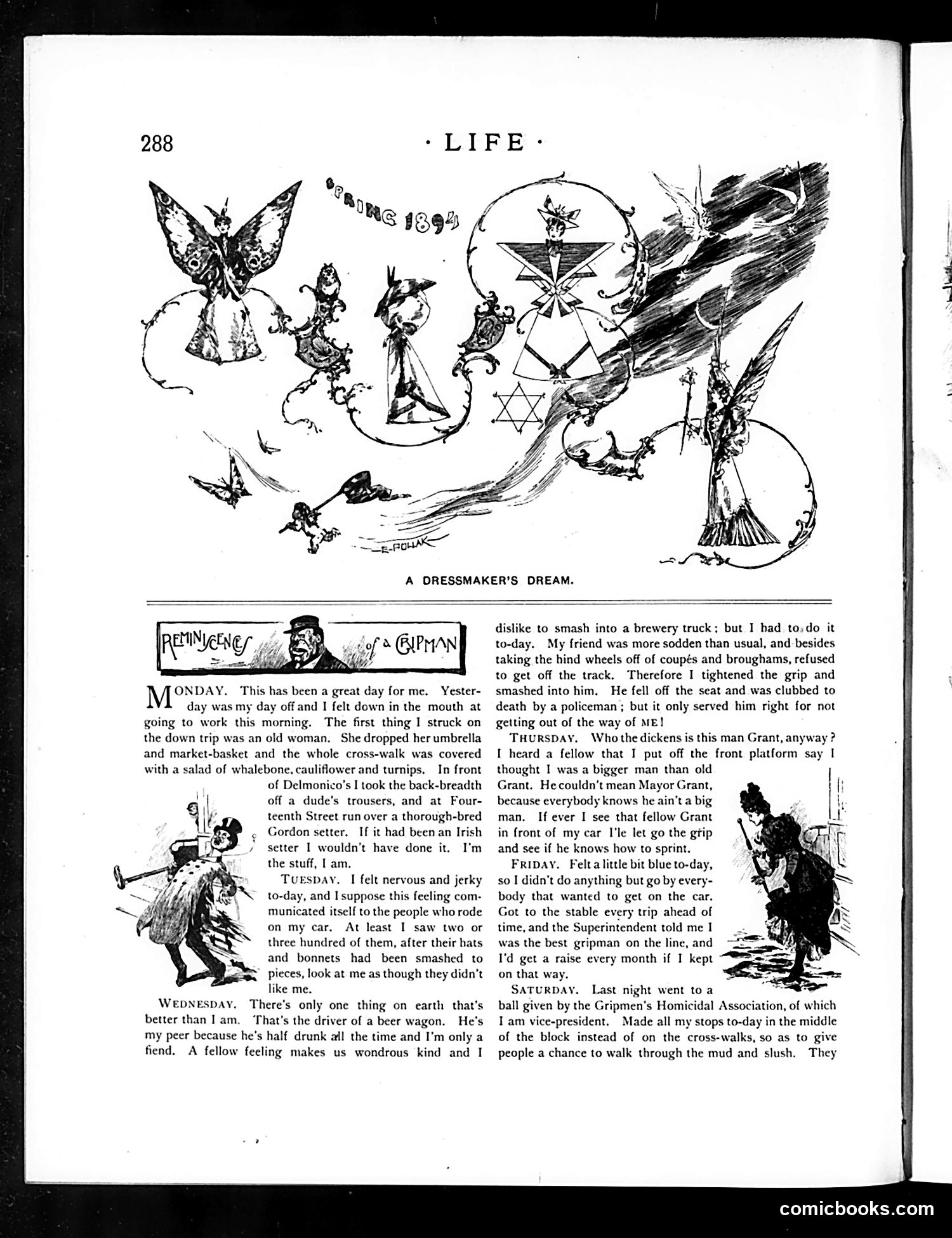
This illustrated satirical piece depicts a fantastical vision titled "A Dressmaker's Dream" from June 1894. The whimsical drawing shows exaggerated, elaborate fashion designs floating surreally—oversized bonnets, theatrical garments, and ornamental headpieces rendered as dreamlike, almost grotesque forms with tiny figures beneath them. The accompanying text, "Reflections of a Gripman," humorously chronicles a streetcar gripman's week of observations. The satire mocks social hierarchies and workplace dynamics—his nervous observations about passengers, anxiety over fellow worker "Grant," and complaints about elite behaviors reflect working-class frustrations with class distinctions and job precarity in 1890s urban America. The fashion illustration likely satirizes the absurdity of contemporary high fashion and women's elaborate dress conventions of that era.
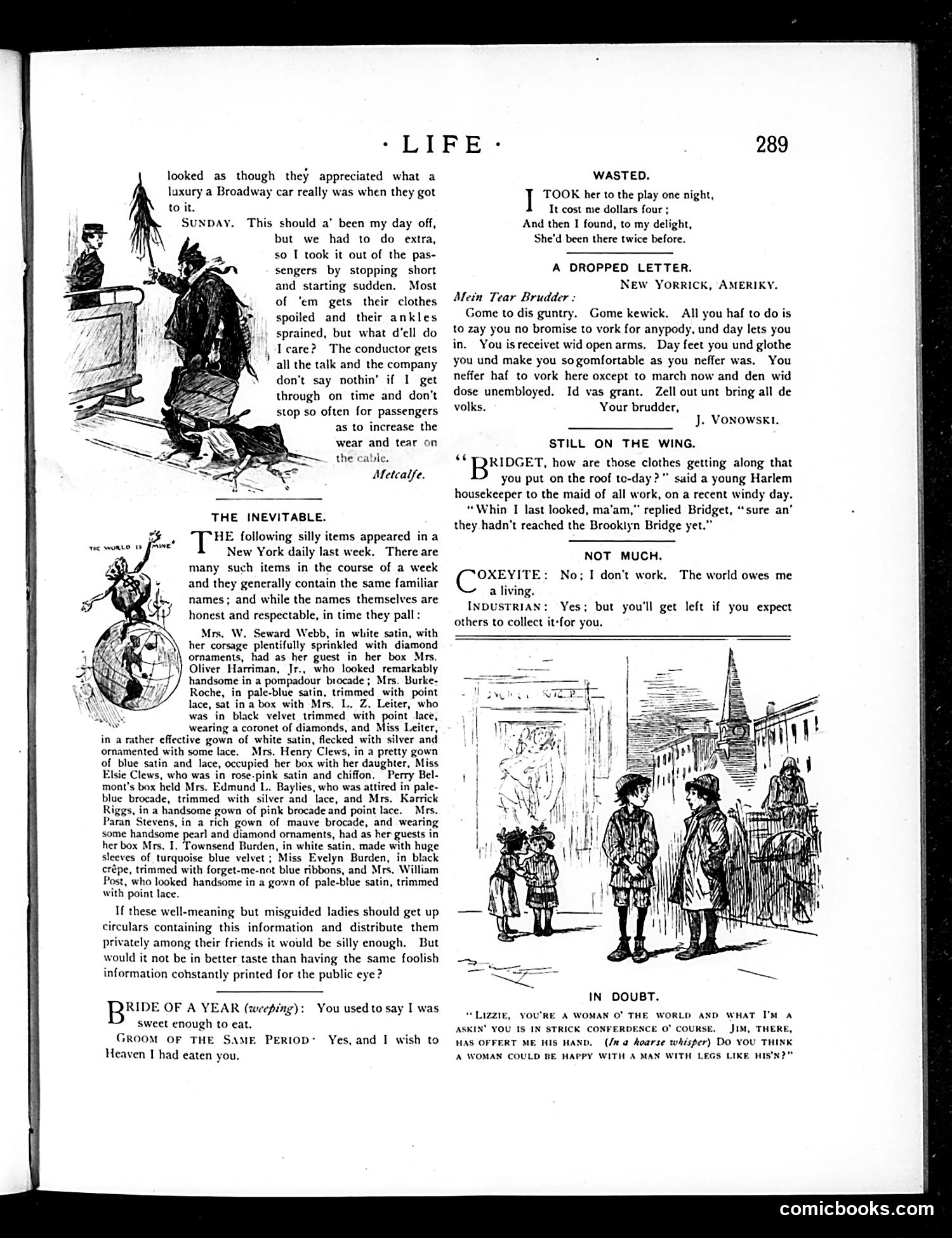
This satirical page contains several distinct pieces mocking social pretension and gender relations in early 20th-century America. **"THE INEVITABLE"** cartoon depicts working-class passengers on a trolley with damaged clothing and sprained ankles, satirizing how luxury Broadway cars break down despite their expense. **"A DROPPED LETTER"** presents a German immigrant's humorous malapropisms advising someone to emigrate to America, mocking both broken English and immigrant stereotypes. **"STILL ON THE WING"** jokes about a housemaid's excuses for poorly maintained clothes left on a roof. **"NOT MUCH"** exchanges cynical dialogue between a jobless man and an industrialist about earning a living. The page concludes with a dialogue between "Bride of a Year" and "Groom," satirizing marriage's disenchantment through their bitter repartee about initial attraction versus present reality.
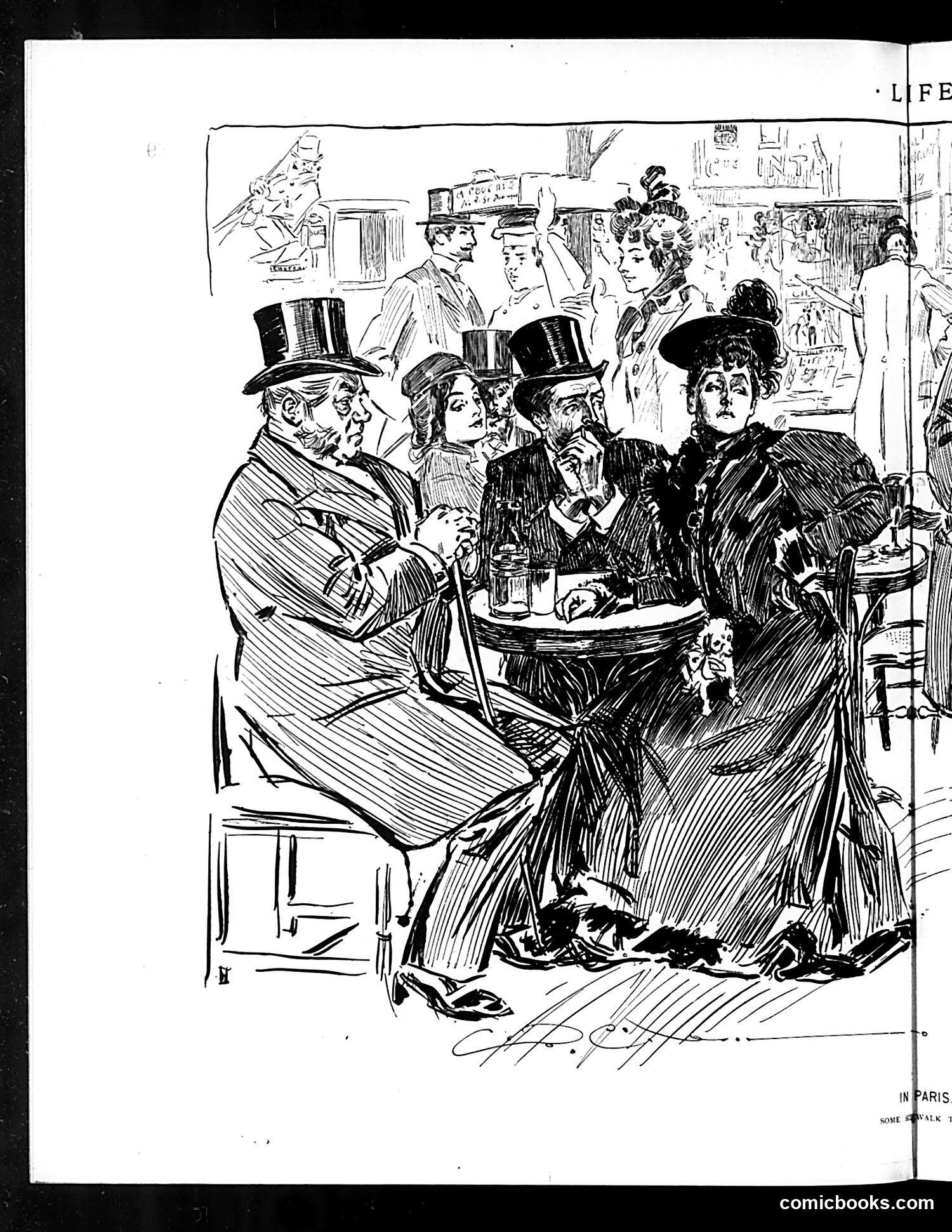
This is a satirical sketch titled "IN PARIS" depicting four men in top hats and formal wear seated at what appears to be a Parisian café or restaurant, with well-dressed patrons visible in the background. The drawing style and composition suggest social commentary on wealthy leisure culture. The four figures in the foreground appear to be caricatured types—likely representing stereotypical wealthy gentlemen or specific public figures of the era engaged in idle conversation at a fashionable establishment. The detail of their formal attire and the Paris setting indicate satire directed at upper-class social pretension and the affectations of European high society. However, without visible text identifying the specific individuals or clearer historical context, I cannot definitively state which particular figures or events are being mocked.
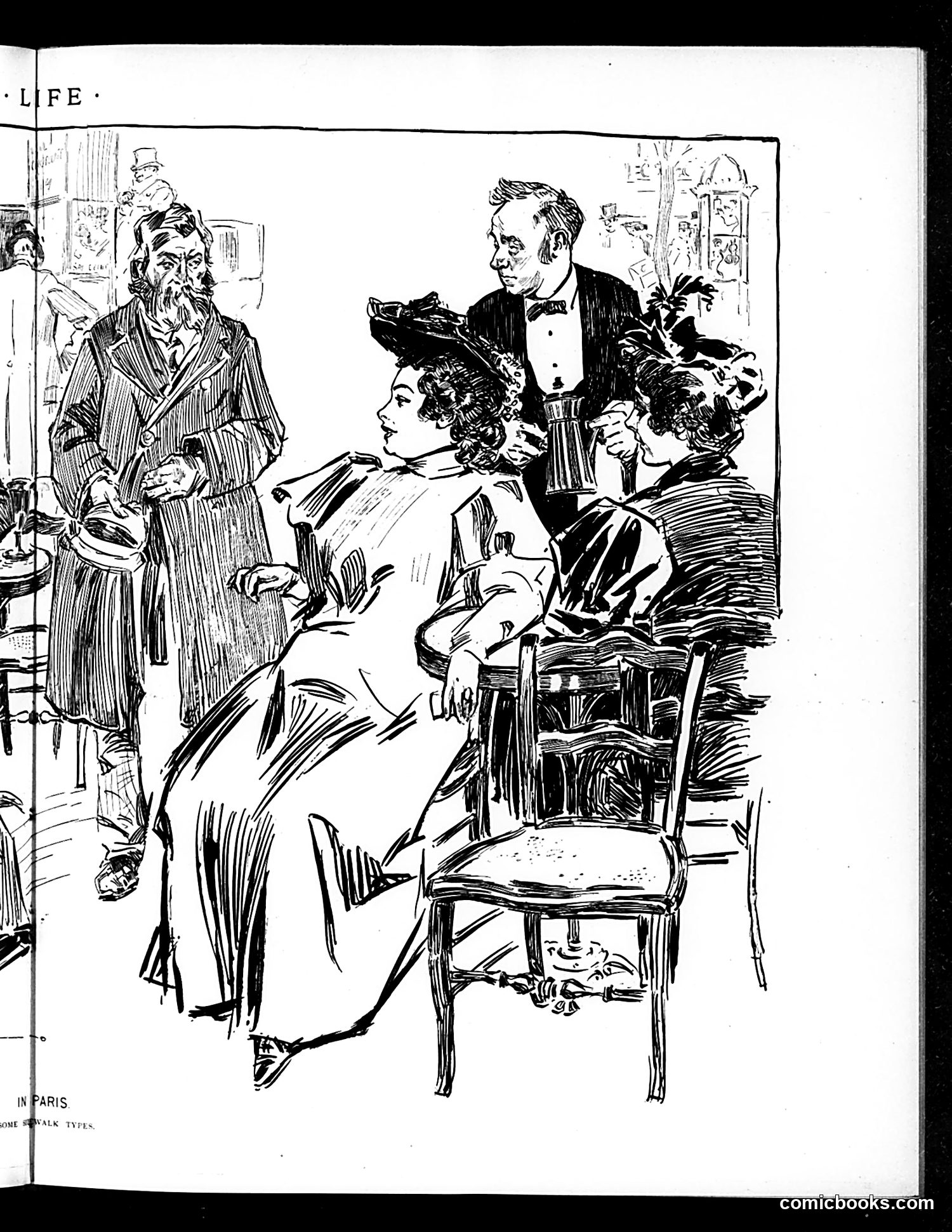
This appears to be a satirical illustration from *Life* magazine titled "In Paris" (visible at bottom left). The cartoon depicts a social scene featuring three main figures: a bearded man on the left in a pinstriped suit, a well-dressed woman seated centrally in an elaborate white gown, and a man in formal evening wear (tuxedo) standing behind her. A fourth figure sits partially visible on the right. The satire likely targets French or Parisian social pretension and upper-class behavior. The exaggerated clothing, formal poses, and stylized rendering suggest mockery of elite social conventions or possibly specific Parisian "types." Without clearer OCR text or additional context, the specific political or social critique remains unclear, though the drawing style is characteristic of early 20th-century American satirical commentary on European society.
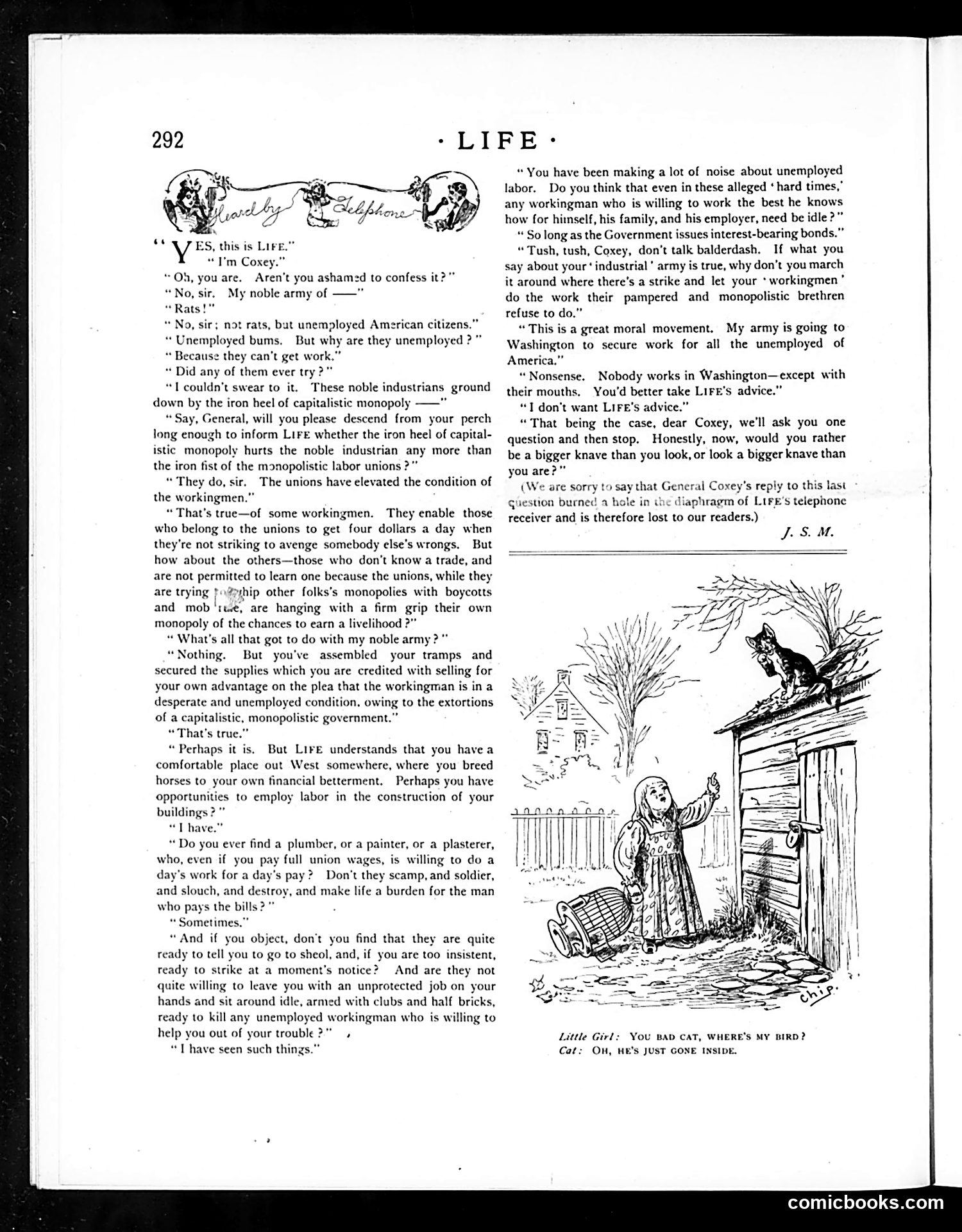
This page satirizes **Coxey's Army**, an 1894 unemployed workers' protest march to Washington led by businessman Jacob Coxey. The dialogue features "General Coxey" defending his movement to a Life magazine representative. **The satire targets Coxey's hypocrisy**: Life attacks him for championing unemployed workers while allegedly: - Profiting from selling supplies to his own "army" - Operating a profitable horse-breeding business out West - Refusing to employ union workers at fair wages on his own property **Life's broader critique** extends beyond Coxey to blame *both* capitalistic monopolies *and* labor unions for unemployment—suggesting unions protect only their members while excluding non-unionized workers from earning livelihoods. **The closing joke** hints Coxey's angry response was so profane it damaged the telephone line. The small illustration shows a girl losing her cat—unrelated filler content.
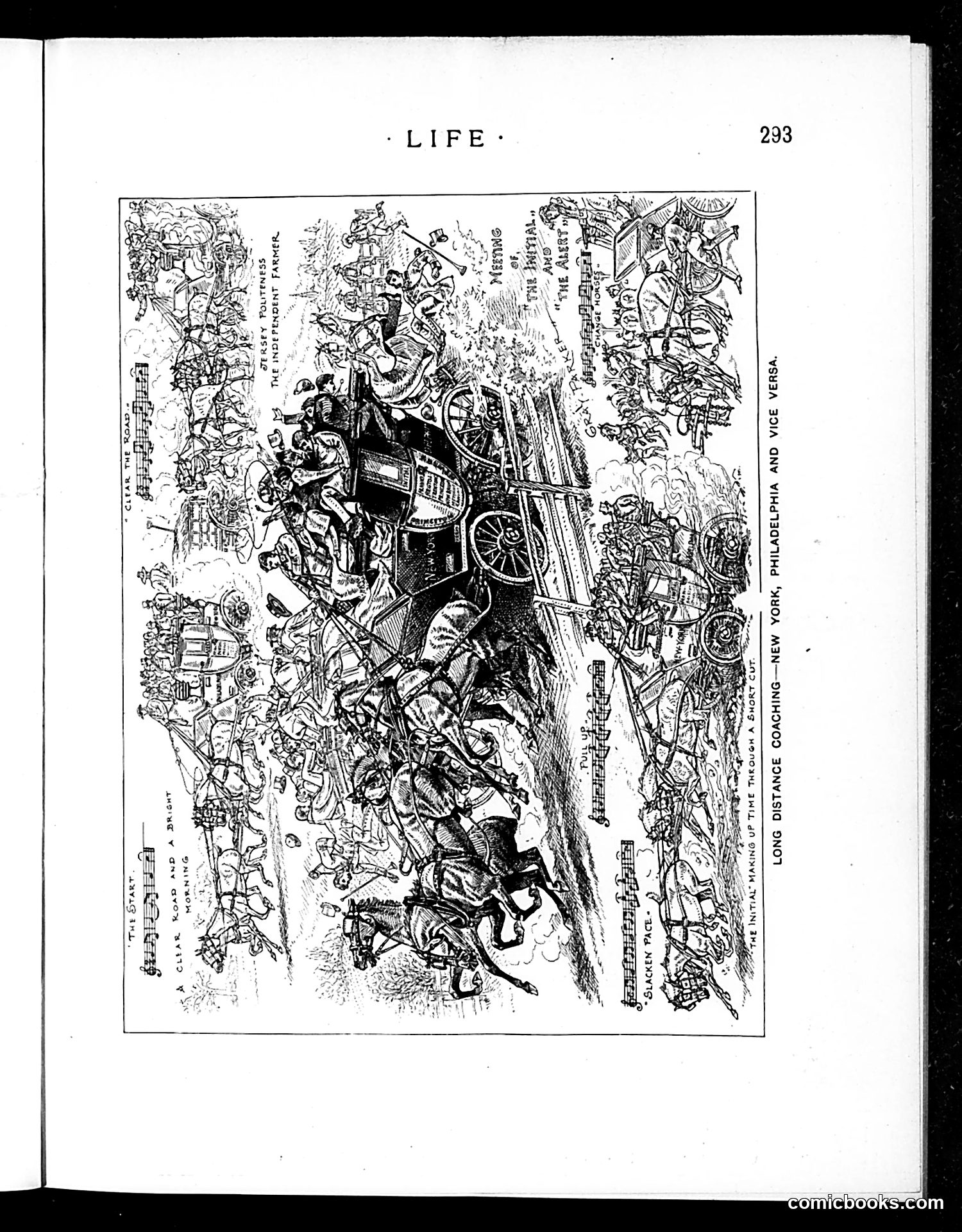
I cannot reliably read the OCR text on this page—it appears corrupted or reversed. The image itself shows an elaborate satirical cartoon depicting what appears to be a chaotic coaching or transportation scene with horses, carriages, and multiple figures in period dress. The central focus seems to be a stagecoach or similar vehicle surrounded by numerous people and animals in comedic disarray. Without legible text identifying the specific figures, events, or political references, I cannot accurately explain the satire's targets or meaning to a modern reader. The style and printing suggest late 19th or early 20th-century Life magazine, but the specific subject requires readable captions or text to interpret correctly.
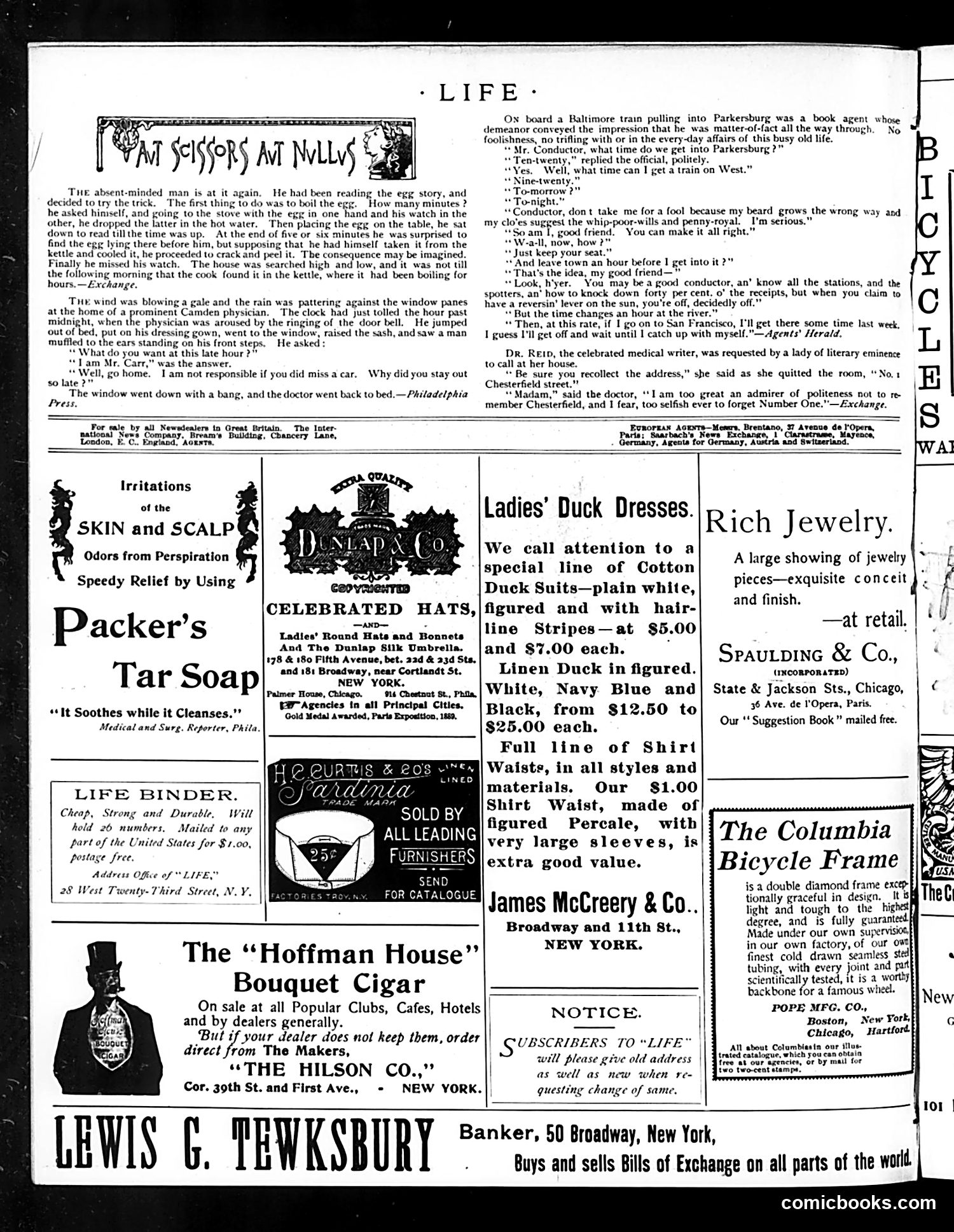
This Life magazine page contains three humorous anecdotes satirizing absent-mindedness and miscommunication: 1. **"Scissors at Nullus"**: A distracted man, after reading a story about boiling eggs, accidentally boils his pocket watch instead, then discovers it the next morning—mocking intellectual men so absorbed in reading they lose practical sense. 2. **The Conductor and Time Zones**: A bearded man argues with a train conductor about arrival times, frustrated that the conductor claims the sun has a "reversing lever" at the state border—satire on the confusion caused by America's newly-implemented time zones (standardized nationally in 1883), which genuinely confused travelers. 3. **Dr. Reid's Visit**: A doctor claims he'll remember "No. 1 Chesterfield Street" by his admiration for politeness and selfishness—a pun playing on "Chesterfield" (the polite earl) and "Number One" (self-interest). The page is primarily **advertisements** (tar soap, bicycles, jewelry, cigars), typical of Life's format. The cartoons mock human foolishness rather than political targets.
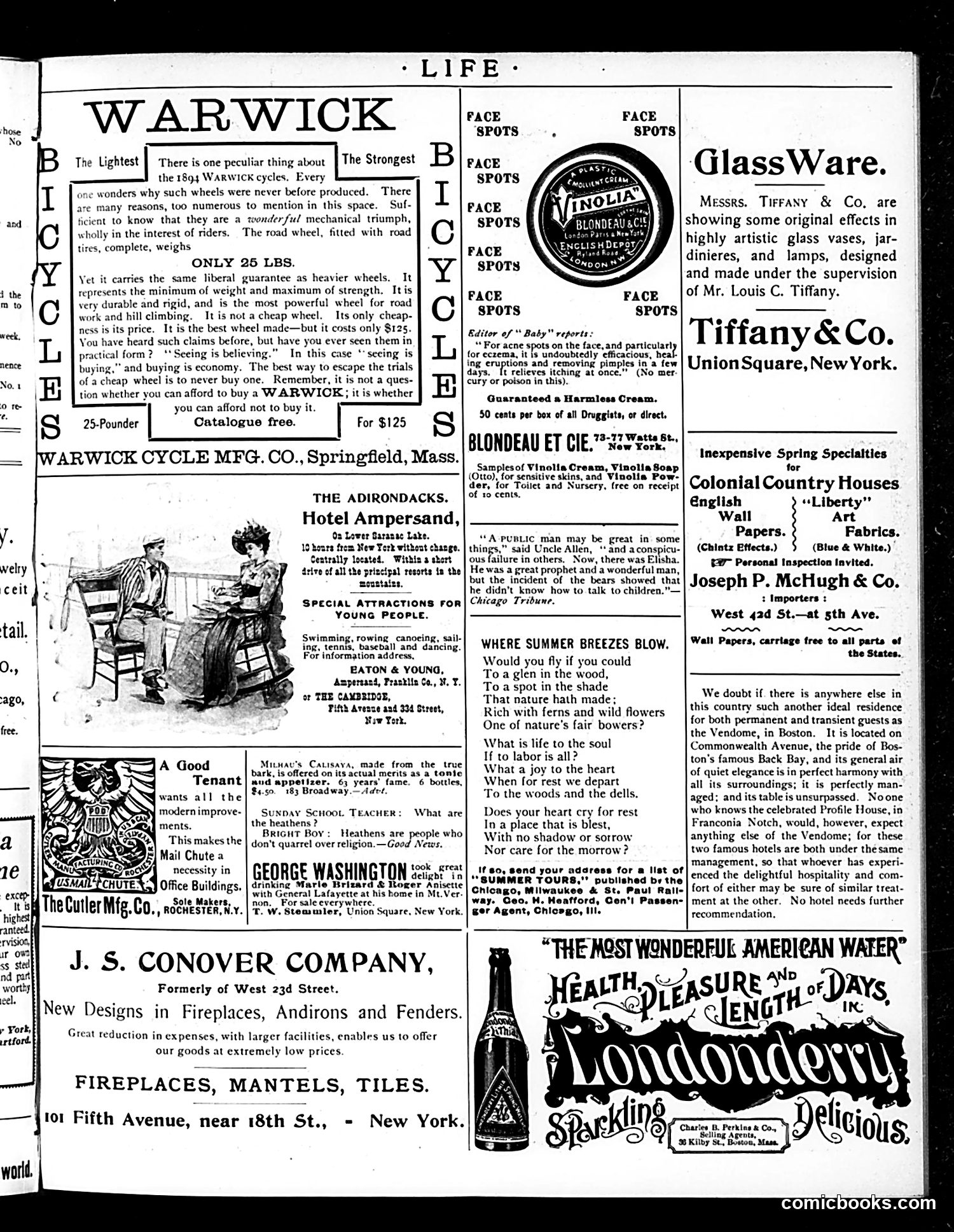
This page is primarily **advertising** with minimal satirical content. The main items are: **Advertisements:** - Warwick bicycles (prominent), emphasizing lightweight design (25 lbs) at $125 - Tiffany & Co. glassware and artistic pieces - Hotel Ampersand in the Adirondacks - Blondeau skin cream for acne and eczema - Minard's Cataplasm tonic - Conover Company fireplaces and mantels - Londonderry sparkling water **Satirical Content:** A brief dialogue between a Sunday School Teacher and a "Bright Boy" jokes that heathens are "people who don't quarrel over religion"—a lighthearted jab at religious sectarianism. A snippet attributes a quote to George Washington about drinking Brizard & Roger Anisette, likely a humorous anachronism or advertisement disguised as historical anecdote. The page reflects 1890s consumer culture and advertising practices rather than political satire.
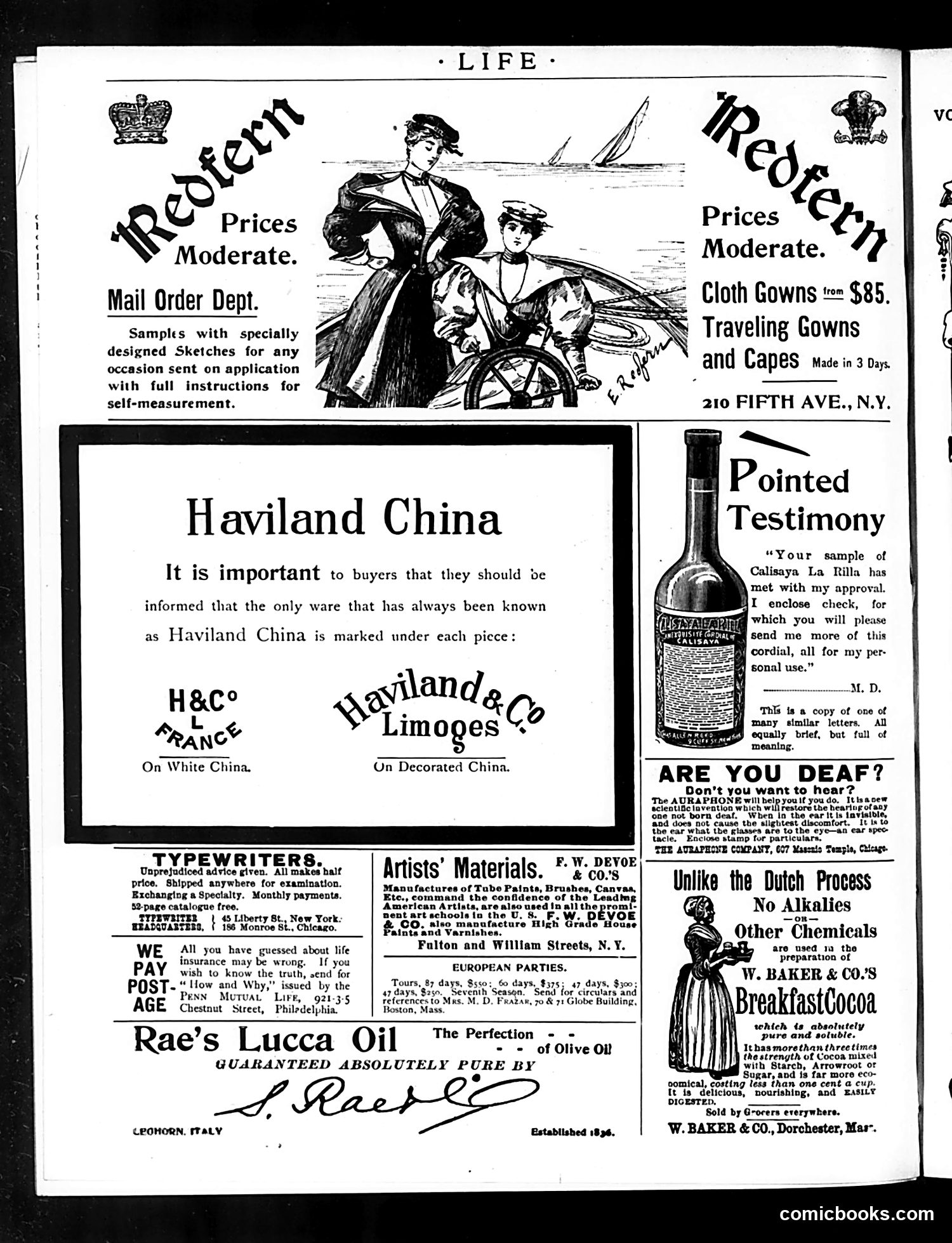
This page is primarily **advertising**, not editorial content or satire. It features multiple commercial advertisements from early 20th-century businesses: **Key advertisements include:** - **Iroderm and Redtern**: Dress shops offering mail-order clothing with moderate prices - **Haviland China**: Tableware with marks identifying authentic pieces - **Typewriters**: Office equipment with exchange options - **Artists' Materials**: Paint and brush suppliers - **Rae's Lucca Oil**: Italian olive oil marketed as "absolutely pure" - **W. Baker & Co.'s Breakfast Cocoa**: Cocoa powder without alkalies - **Auraphone**: A hearing device (notable as period technology) - **European travel packages** and insurance offerings The only element approaching satire is a small section titled **"Are You Deaf?"** advertising the Auraphone hearing aid—using mild humor about deafness to market the device. The page reflects early 1900s consumer culture, with emphasis on mail-order shopping, luxury goods, and emerging technologies. No political content is evident.