
Life, 1894-05-03 · page 6 of 16
Life — May 3, 1894 — page 6: what you’re looking at
What you’re looking at
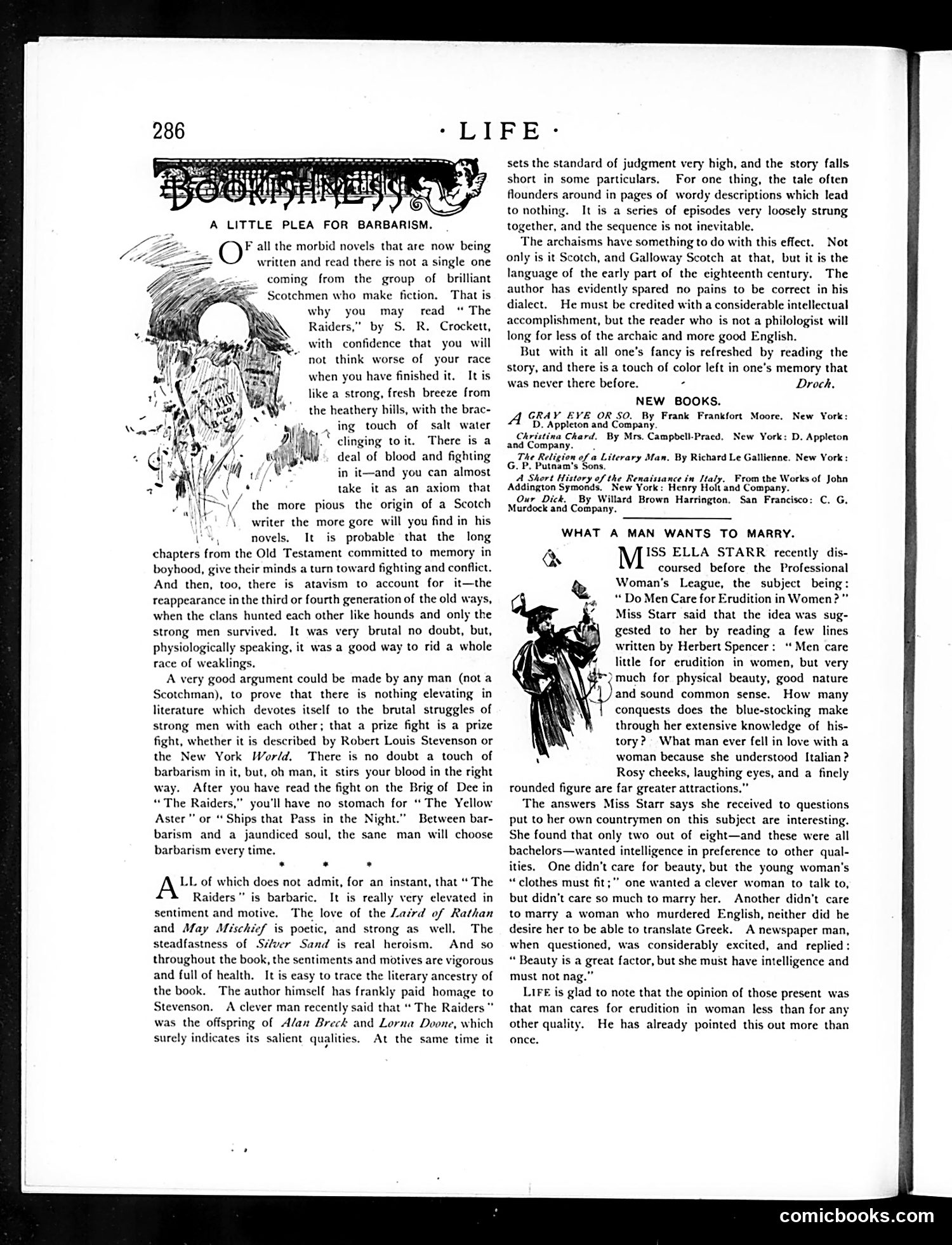
The left side features "A Little Plea for Barbarism," a satirical article defending Scottish literature—particularly works by S.R. Crockett. The accompanying illustration shows a bearded Scottish figure, likely representing Crockett himself or Scottish literary tradition generally. The article argues that Scottish dialect writing shouldn't be dismissed as barbaric, despite its archaic language. It defends the "blood and fighting" in Scottish novels as legitimate literary subjects, comparing them favorably to works like *The Raiders* by Robert Louis Stevenson. The right side contains an unrelated article titled "What a Man Wants to Marry," discussing Miss Ella Starr's views on women's education and attractiveness. The satirical point appears to be examining contemporary attitudes about marriage preferences and female accomplishments.
📄 Transcribed text from this page (OCR, searchable)
Machine-transcribed from the original scan — historical spelling and the odd misread are preserved.
‘LIFE: A LITTLE PLEA FOR BARBARISM. written and read there is not a single one coming from the group of brilliant Scotchmen who make fiction, That is why you may read “ The Raiders,” by S. R. Crockett, with confidence that you will not think worse of your race when you have finished it. It is like a strong, fresh breeze from "the heathery hills, with the brac- ». . ing touch of salt water y. * clinging toit. There is a deal of blood and fighting in it—and you can almost i take it as an axiom that the more pious the origin of a Scotch \\ writer the more gore will you find in his novels. It is probable that the long 7 OF all the morbid novels that are now being > chapters from the Old Testament committed to memory in boyhood, give their minds a turn toward fighting and conflict. And then, too, there is atavism to account for it—the reappearance in the third or fourth generation of the old ways, when the clans hunted each other like hounds and only the strong men survived. It was very brutal no doubt, but, physiologically speaking, it was a good way to rid a whole race of weaklings, A very good argument could be made by any man (nota Scotchman), to prove that there is nothing elevating in literature which devotes itself to the brutal struggles of strong men with each other; that a prize fight is a prize fight, whether it is described by Robert Louis Stevenson or the New York World. There is no doubt a touch of barbarism in it, but, oh man, it stirs your blood in the right way. After you have read the fight on the Brig of Dee in “ The Raiders,” you'll have no stomach for “ The Yellow Aster" or “ Ships that Pass in the Night.” Between bar- barism and a jaundiced soul, the sane man will choose barbarism every time. . . . LL of which does not admit, for an instant, that “ The Raiders” is barbaric. It is really very elevated in sentiment and motive. The love of the Laérd of Rathan and May Mischief is poetic, and strong as well. The steadfastness of Sfver Sand is real heroism. And so throughout the book, the sentiments and motives are vigorous and full of health. It is easy to trace the literary ancestry of the book. The author himself has frankly paid homage to Stevenson. A clever man recently said that “ The Raiders ” was the offspring of Alan Breck and Lorna Doone, which surely indicates its salient qual At the same time it sets the standard of judgment very high, and the story falls short in some particulars. For one thing, the tale often flounders around in pages of wordy descriptions which lead to nothing. It is a series of episodes very loosely strung together, and the sequence is not inevitable. The archaisms have something to do with this effect. Not only is it Scotch, and Galloway Scotch at that, but it is the language of the early part of the cighteenth century. The author has evidently spared no pains to be correct in his dialect. He must be credited with a considerable intellectual accomplishment, but the reader who is not a philologist will long for less of the archaic and more good English. But with it all one’s fancy is refreshed by reading the story, and there is a touch of color left in one’s memory that was never there before. - Drock. NEW BOOKS. A GRAY EYE OR SO. By Frank Frankfort Moore. D. Appleton and Company. Christina Chard. By Mrs. Campbell-Pracd, New York: D. Appleton and Company. The Religion of a Literary Man. By Richard Le Gallienne. New York: G. P. Putnam's Sons. A Short History of the Renaissance in Italy, From the Works of John Addington Symonds. New York: Henry Holt and Company. Our Dick. By Willard Brown Harrington. San Francisco: C. G. Murdock and Company. New York: WHAT A MAN WANTS TO MARRY. M*s ELLA STARR recently dis- coursed before the Professional Woman's League, the subject being: “Do Men Care for Erudition in Women?” Miss Starr said that the idea was sug- gested to her by reading a few lines written by Herbert Spencer: ‘ Men care little for erudition in women, but very much for physical beauty, good nature and sound common sense. How many conquests does the blue-stocking make through her extensive knowledge of his- tory? What man ever fell in love with a woman because she understood Italian? Rosy cheeks, laughing eyes, and a finely rounded figure are far greater attractions.” The answers Miss Starr says she received to questions put to her own countrymen on this subject are interesting. She found that only two out of eight—and these were all bachelors—wanted intelligence in preference to other qual- ities. One didn’t care for beauty, but the young woman's “clothes must fit;"” one wanted a clever woman to talk to, but didn’t care so much to marry her. Another didn’t care to marry a woman who murdered English, neither did he desire her to be able to translate Greek. A newspaper man, when questioned, was considerably excited, and replied: “ Beauty is a great factor, but she must have intelligence and must not nag.” LiFe is glad to note that the opinion of those present was that man cares for erudition in woman less than for any other quality. He has already pointed this out more than once. comicbooks.com