
Life, 1894-05-03 · page 4 of 16
Life — May 3, 1894 — page 4: what you’re looking at
What you’re looking at
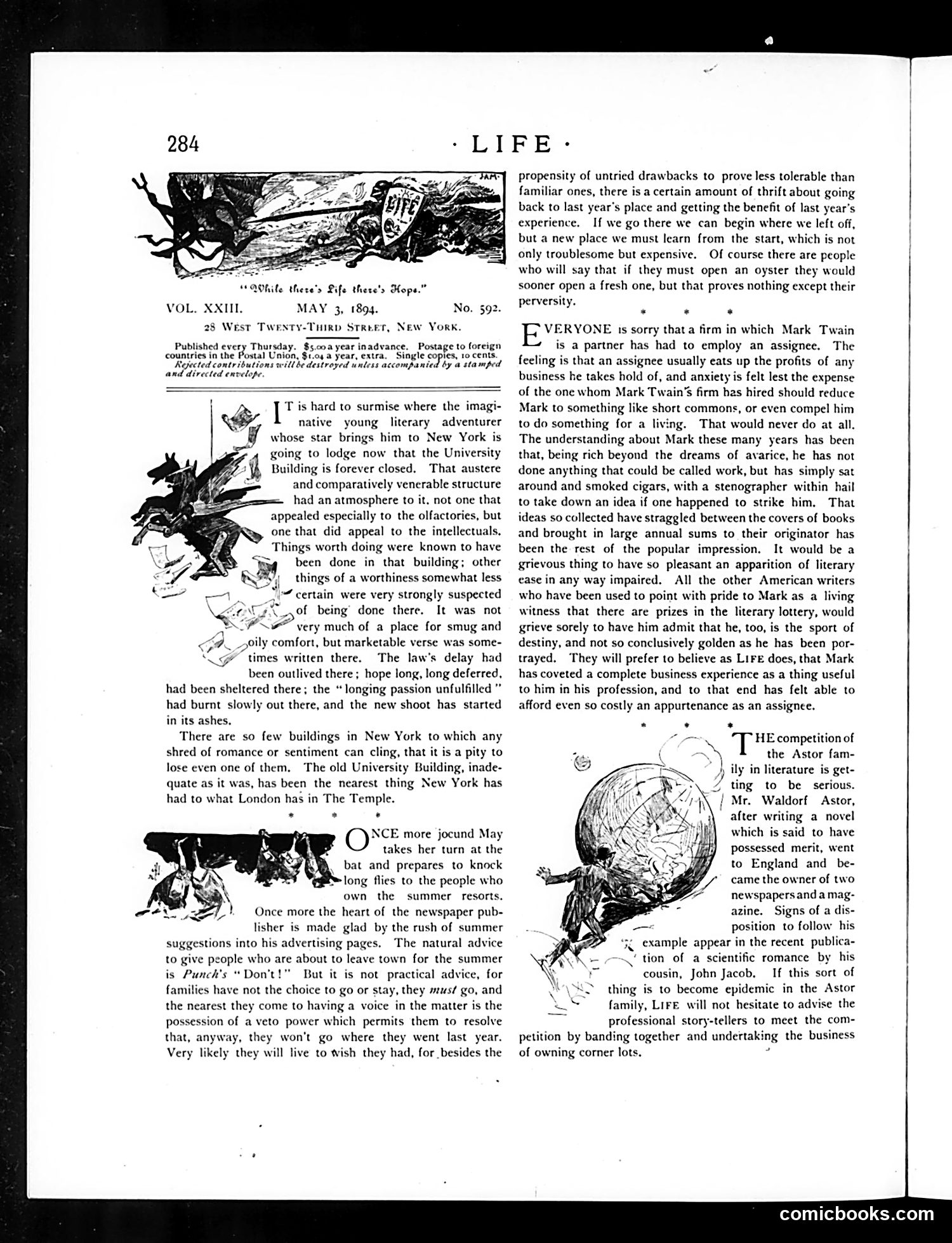
This page contains editorial commentary rather than political cartoons. The primary content discusses **Mark Twain's employment of a business assignee**—apparently someone managing his financial affairs, likely due to business difficulties. The writer expresses sympathy for Twain's situation, noting that despite his literary success and wealth, he lacks practical business experience. The second section discusses **competition among the Astor family regarding newspaper and magazine ownership**, mentioning Mr. Waldorf Astor's recent business ventures in publishing. This appears to satirize the wealthy Astor family's competitive aspirations in the literary marketplace. The decorative illustrations are generic satirical ornaments rather than depicting specific individuals. The overall tone critiques wealthy writers' lack of business acumen and wealthy industrialists' attempts to dominate publishing.
📄 Transcribed text from this page (OCR, searchable)
Machine-transcribed from the original scan — historical spelling and the odd misread are preserved.
“Qhile there's Life there's Hope.” VOL. XXIII. MAY 3, 1894. 28 West Twesty-Thirp Street, New Vork. No. 592. Published every Thursday. $s.0oa year inadvance. countries in the Postal Union, $1.04 a year, extra. Single copies, 10 cents, Rejected contributions willbe destroyed unless accompanied by a stamped and directed envelope. Postage to foreign native young literary adventurer ¥ vhose star brings him to New York is 5% 4 going to lodge now that the University Building is forever closed. That austere and comparatively venerable structure had an atmosphere to it, not one that appealed especially to the olfactories, but one that did appeal to the intellectuals, Things worth doing were known to have been done in that building; other i things of a worthiness somewhat less “\ certain were very strongly suspected \< , ¢_,of being’ done there. It was not {Se very much of a place for smug and <¢A_Deily comfort, but marketable verse was some- ‘py times written there. The law's delay had been outlived there; hope long, long deferred, had been sheltered there; the “longing passion unfulfilled ” had burnt slowly out there, and the new shoot has started in its ashes, There are so few buildings in New York to which any shred of romance or sentiment can cling, that it is a pity to lose one of them, The old University Building, inade- quate as it was, has been the nearest thing New York has had to what London has in The Temple. . . . NCE more jocund May takes her turn at the bat and prepares to knock long flies to the people who own the summer resorts. Once more the heart of the newspaper pub- lisher is made glad by the rush of summer tions into his advertising pages. The natural advice to give people who are about to leave town for the summer is Punch's “Don't!” But it is not practical advice, for families have not the choice to go or stay, they mus? go, and the nearest they come to having a voice in the matter is the possession of a veto power which permits them to resolve that, anyway, they won't go where they went last year. Very likely they will live to wish they had, for besides the - LIFE: propensity of untried drawbacks to prove less tolerable than familiar ones, there is a certain amount of thrift about going back to last year’s place and getting the benefit of last year’s experience. If we go there we can begin where we left off, but a new place we must learn from the start, which is not only troublesome but expensive. Of course there are people who will say that if they must open an oyster they would sooner open a fresh one, but that proves nothing except their perversity. . * . VERYONE 1s sorry that a firm in which Mark Twain is a partner has had to employ an assignee. The feeling is that an assignee usually eats up the profits of any business he takes hold of, and anxiety is felt lest the expense of the one whom Mark Twain’s firm has hired should reduce Mark to something like short commons, or even compel him to do something for a living. That would never do at all. The understanding about Mark these many years has been that, being rich beyond the dreams of avarice, he has not done anything that could be called work, but has simply sat around and smoked cigars, with a stenographer within hail to take down an idea if one happened to strike him, That ideas so collected have straggled between the covers of books and brought in large annual sums to their originator has been the rest of the popular impression. It would be a grievous thing to have so pleasant an apparition of literary ease in any way impaired. All the other American writers who have been used to point with pride to Mark as a living witness that there are prizes in the literary lottery, would grieve sorely to have him admit that he, too, is the sport of destiny, and not so conclusively golden as he has been por- trayed. They will prefer to believe as LiFe does, that Mark has coveted a complete business experience as a thing useful to him in his profession, and to that end has felt able to afford even so costly an appurtenance as an assignee. * . * Sam “HEE competition ef ke i A the Astor fam- \ )} ily in literature is get- _Z ting to be serious. / Mr. Waldorf Astor, after writing a novel which is said to have possessed merit, went to England and be- came the owner of two newspapers and a mag- azine. Signs of a dis- position to follow his ‘x example appear in the recent public: ~/ tion of a scientific romance by his cousin, John Jacob, If this sort of ; thing is to become epidemic in the Astor ae family, LIFE will not hesitate to advise the professional story-tellers to meet the com- petition by banding together and undertaking the business of owning corner lots. , comicbooks.com