
A complete issue · 16 pages · 1893
Life — February 9, 1893
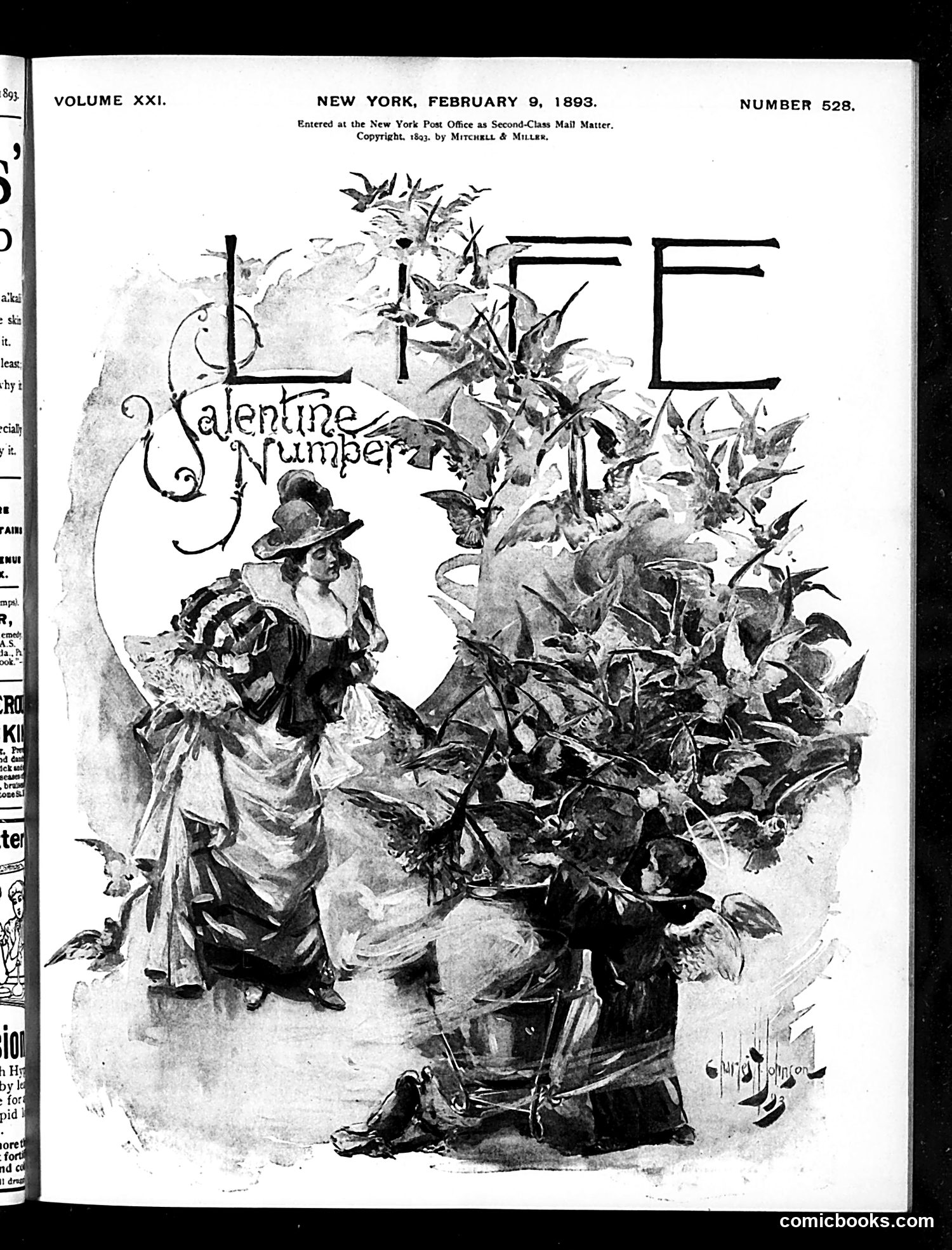
This is a Valentine's Day-themed cover featuring a woman in Victorian dress presenting a large potted flowering plant. The illustration is titled "Life Valentine Number" with decorative text. The artistic style and composition suggest this is a romantic or sentimental cover typical of Life's Valentine issues from this era. The woman appears elegantly dressed in period clothing with a hat, presenting the flowers in a gesture of affection—fitting the Valentine's Day theme. Without additional context or identifying captions in the visible text, the specific satirical or political meaning isn't entirely clear from this image alone. This appears to be primarily a festive, romantic cover rather than sharp political satire, though Life often embedded social commentary even in seemingly light-hearted issues.
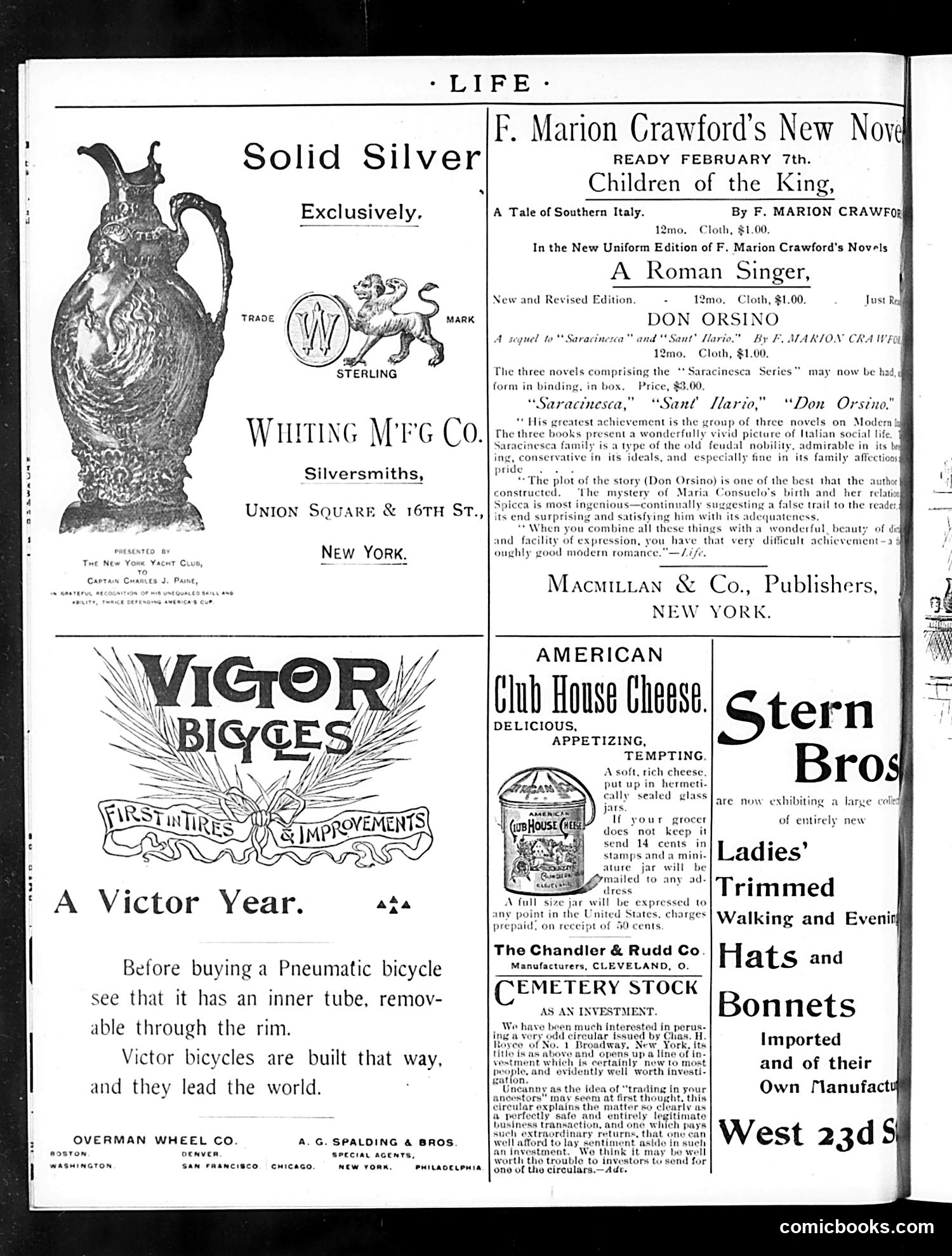
This page is **primarily advertising**, not satirical content. The layout contains four distinct advertisements: 1. **Whiting Mfg Co.** - A silverware pitcher advertisement 2. **Victor Bicycles** - Promoting pneumatic bicycles with removable inner tubes as a technical innovation 3. **American Club House Cheese** - A food product ad 4. **Stern Bros.** - A department store advertising ladies' hats and bonnets The Victor Bicycles ad makes a competitive claim ("they lead the world"), typical of early 1900s marketing. The other ads target consumer goods—silverware, cheese, and fashion—reflecting Life magazine's mixed advertising-editorial model. There is no political cartoon or satire visible on this page. It represents standard turn-of-the-century magazine advertising and product promotion.
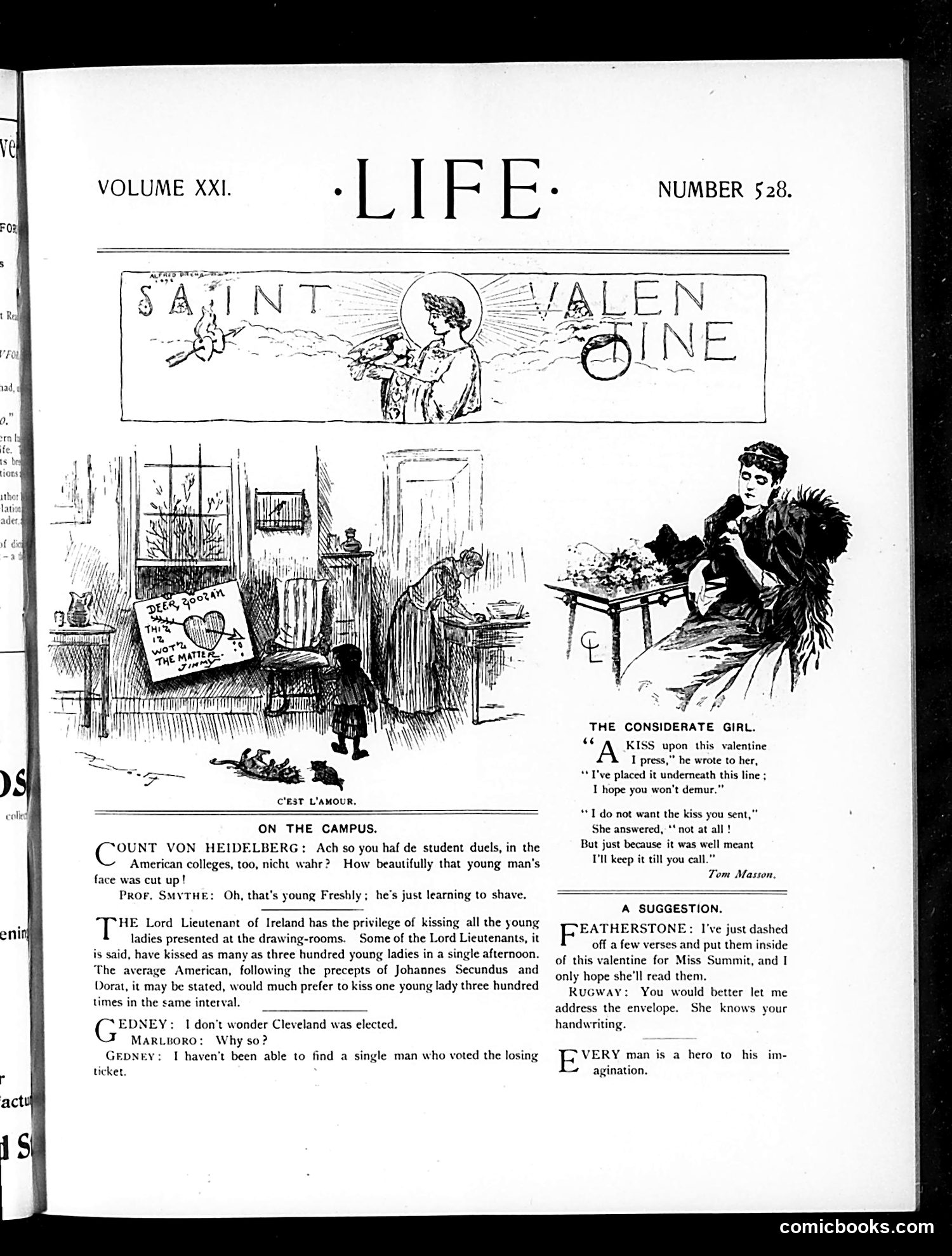
This page contains light satirical humor rather than political commentary. "Saint Valentine" is the header, indicating Valentine's Day content. **"C'est L'Amour"** (left cartoon): Shows a young man posting a notice about student duels in American colleges, prompting a professor's quip about a student learning to shave—suggesting the "dueler" is inexperienced. **"On the Campus"** (center dialogue): A joke about the Lord Lieutenant of Ireland's privilege of kissing young ladies at drawing-room events, contrasting European aristocratic customs with American practices. **"The Considerate Girl"** (right): A poem about a woman refusing a Valentine kiss but keeping it "till you call"—playful romance humor. **"A Suggestion"** and **"Every man is a hero..."**: Brief witty observations about Valentine etiquette and masculine pride. The content reflects early-1900s courtship customs and social comedy.
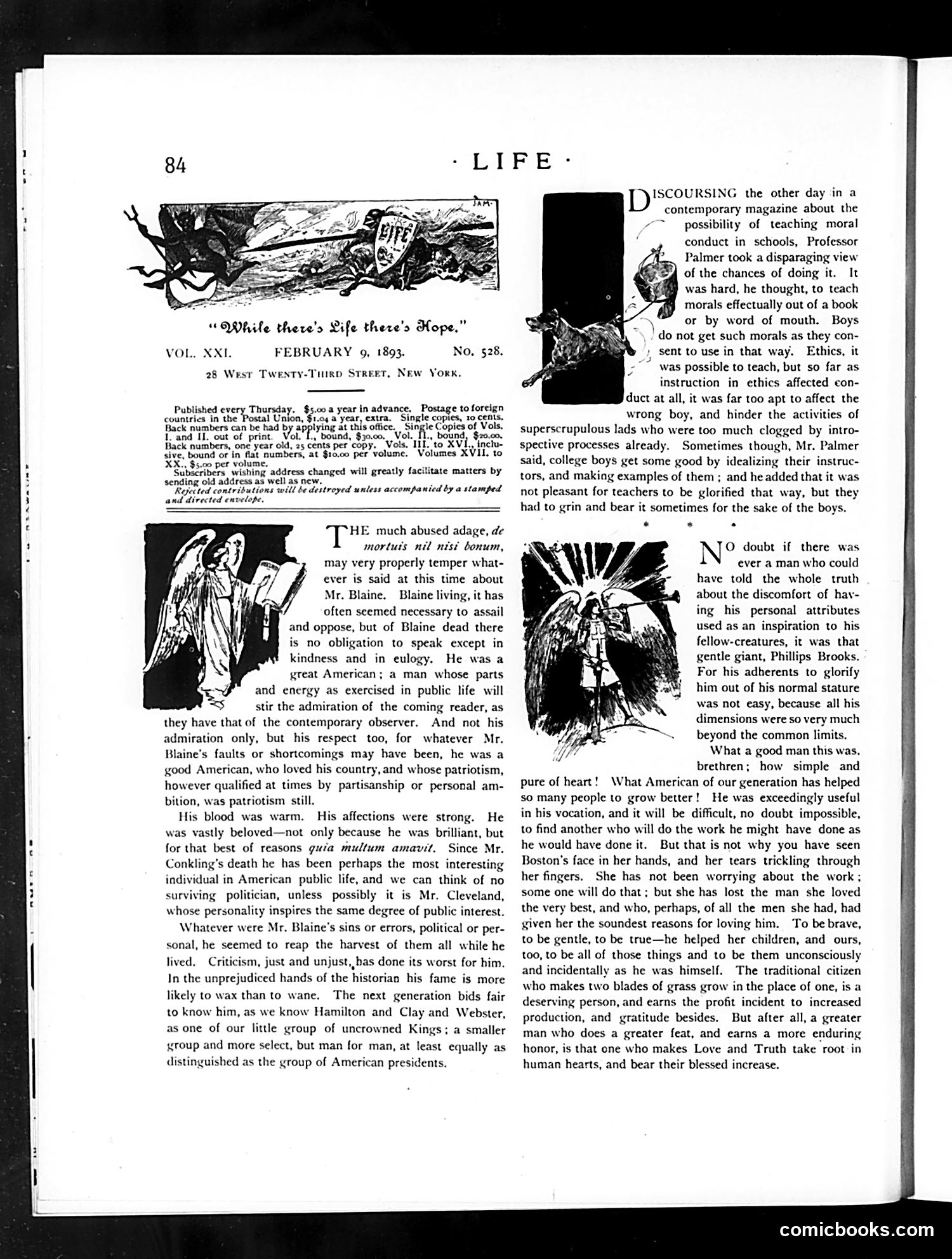
**The Main Cartoon** (top left): Shows a figure labeled "PITT" emerging from or associated with a coffin or tomb, beneath the caption "While there's Life there's Hope." This appears to be political commentary, likely referencing William Pitt (the younger British Prime Minister), though the exact satirical point is unclear without additional historical context about 1893 events. **The Article's Focus**: The lengthy text discusses James G. Blaine, a prominent American politician. It defends Blaine against critics, praising his patriotism and character while acknowledging past controversies. The piece emphasizes his contributions to American public life and compares him favorably to other national leaders like Hamilton, Clay, and Webster. The cartoon's connection to the Blaine article remains unclear from the image alone.
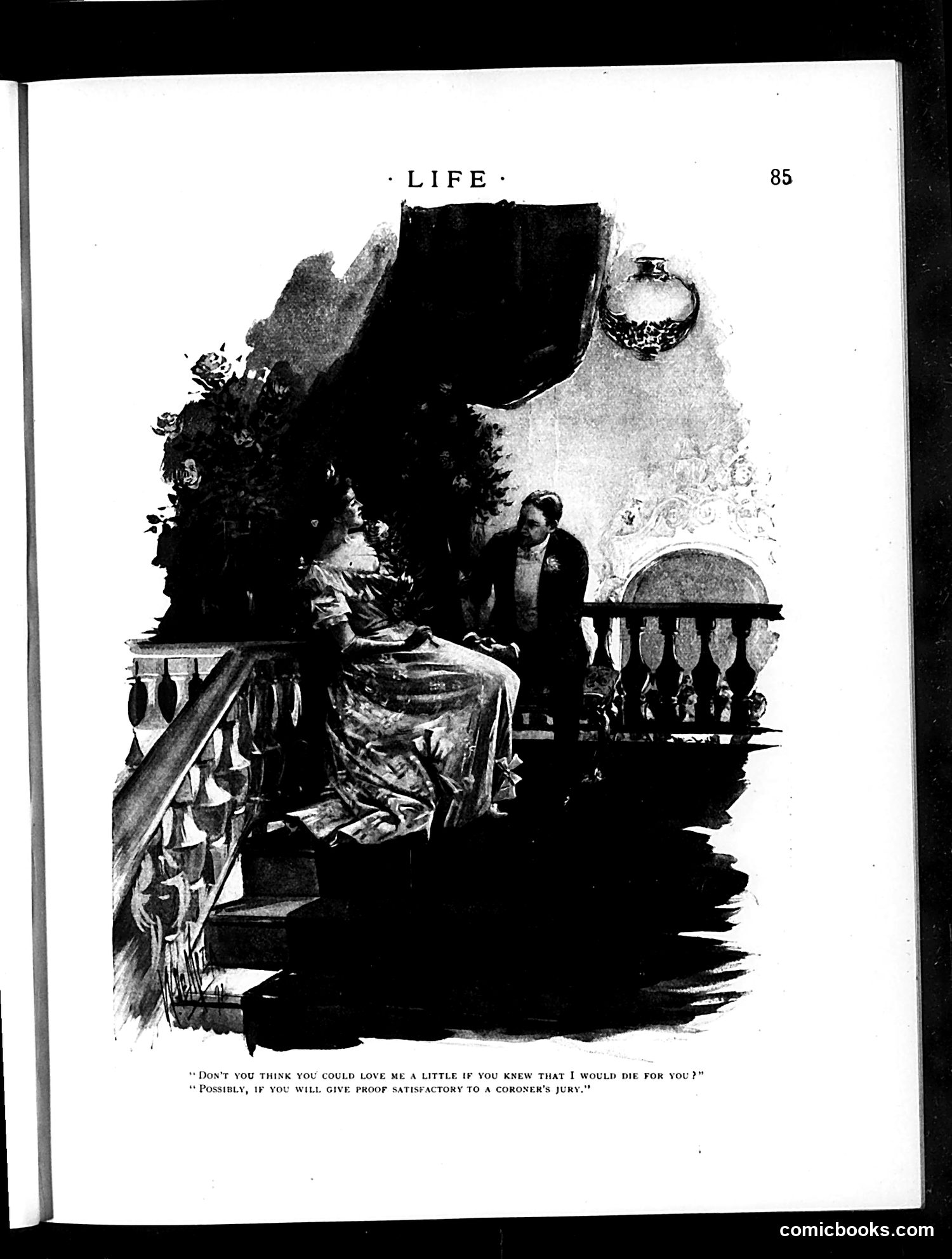
This is a romantic/comedic illustration showing a couple on a moonlit balcony. The woman reclines luxuriously while a man stands nearby. The caption reads: "Don't you think you could love me a little if you knew that I would die for you?" followed by "Possibly, if you will give proof satisfactory to a coroner's jury." The satire mocks romantic melodrama and male declarations of devotion. The punchline suggests the woman won't believe his profession of love unless he literally dies—and even then, she'd need official verification from a coroner's jury. It's a cynical joke about both overwrought romantic rhetoric and skepticism about male sincerity. The illustration style and sentiment suggest this is early-to-mid 20th century satire of courtship conventions.
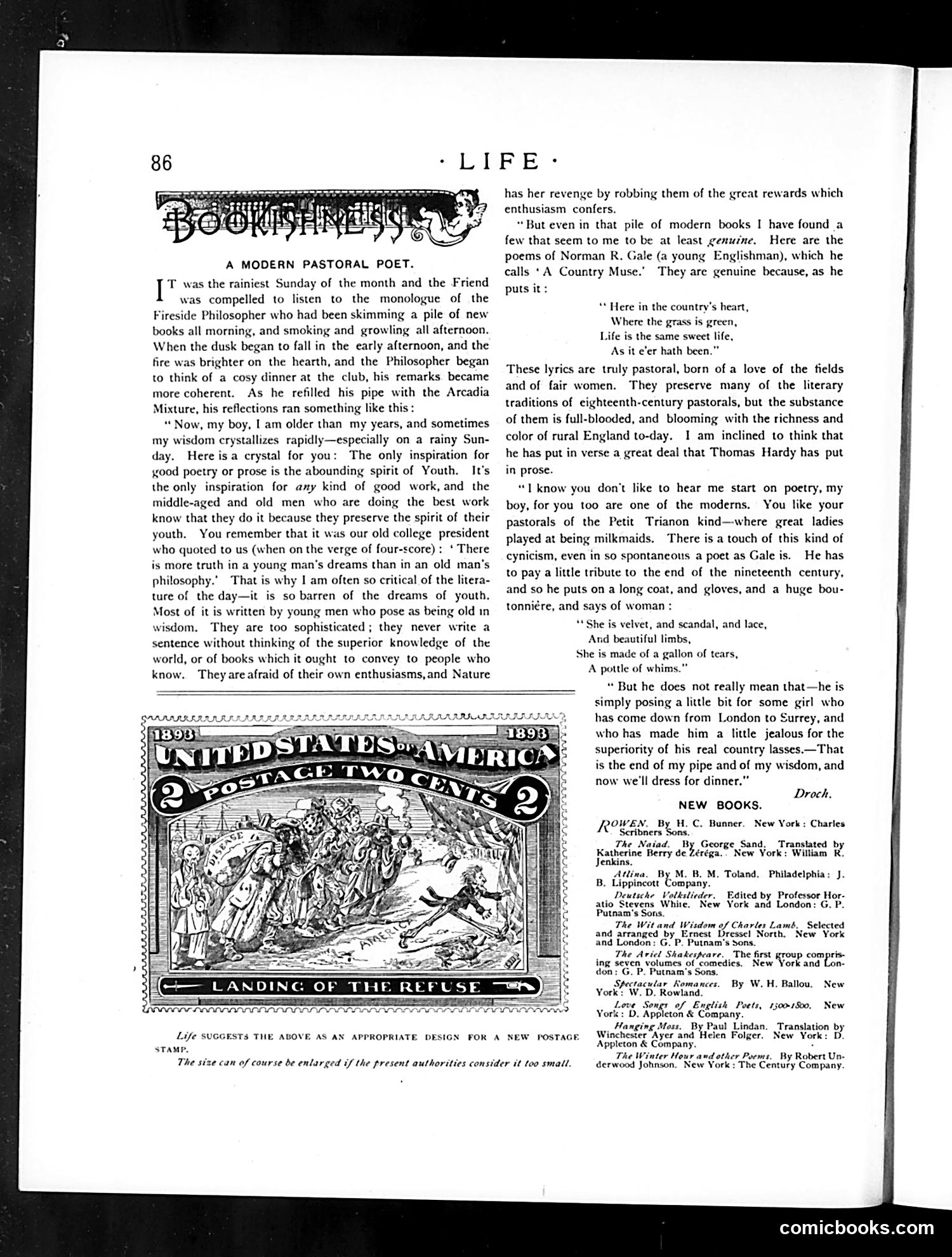
This page discusses "A Modern Pastoral Poet" and features Norman K. Gale, a young English writer. The text critiques modern poetry's lack of enthusiasm, contrasting it with Gale's genuine pastoral verses celebrating rural English life and "fair women." The accompanying **postage stamp design** (labeled "Landing of the Refuge") appears to be a satirical proposal for a new U.S. stamp. It depicts a crowded, chaotic historical scene with many figures—likely referencing immigration or colonial settlement themes. The satire seems to mock either contemporary immigration debates or the romanticized nature of official commemorative imagery. The page also lists "New Books," providing contemporary literary recommendations. The overall tone blends literary criticism with visual satire about American cultural values.
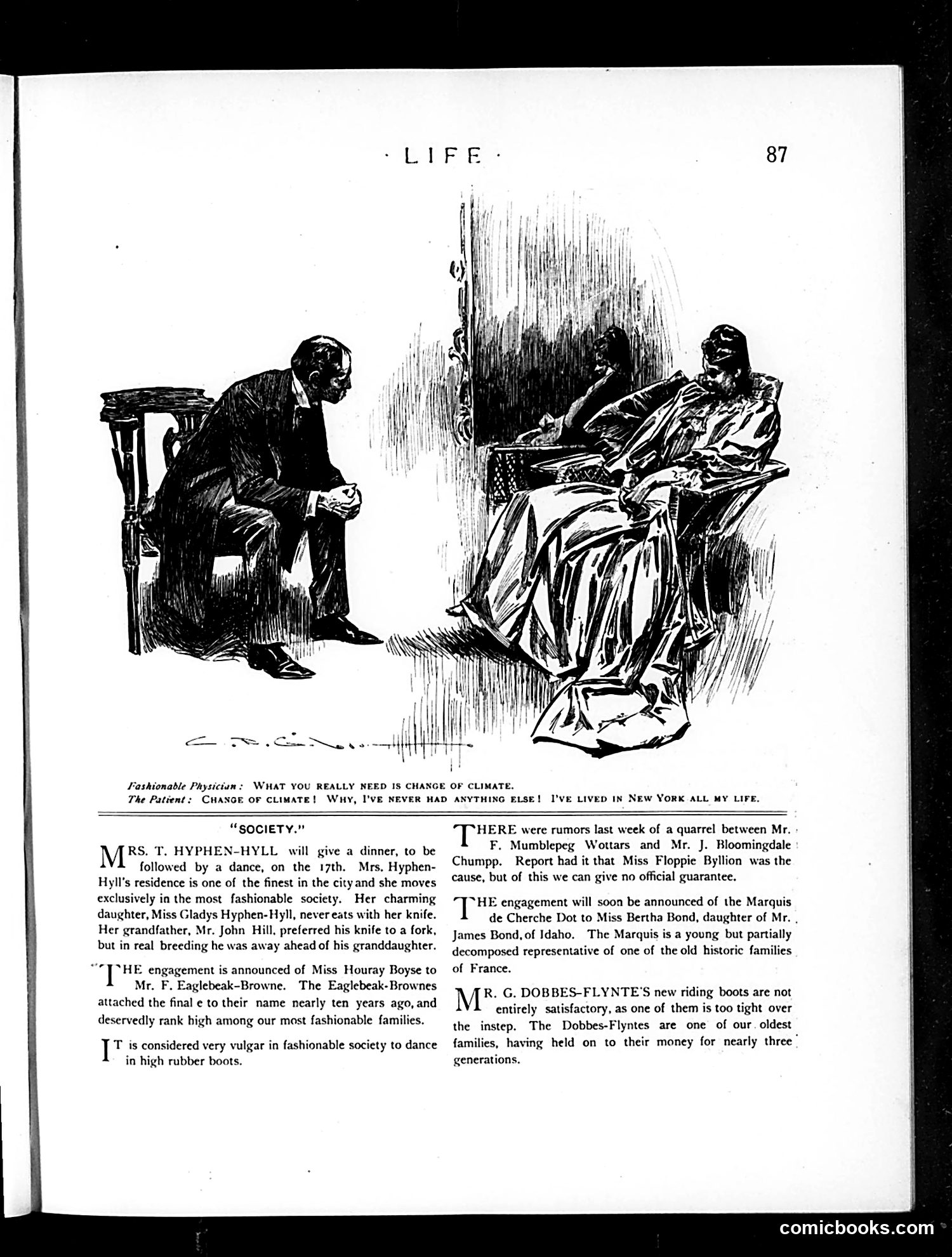
**The Cartoon:** The top illustration depicts a doctor (left, in formal attire) advising a patient (right, reclining). The caption reads: "Fashionable Physician: WHAT YOU REALLY NEED IS CHANGE OF CLIMATE. / The Patient: CHANGE OF CLIMATE! Why, I've never had anything else! I'VE LIVED IN NEW YORK ALL MY LIFE." **The Joke:** This satirizes both overused medical advice and New York City's notoriously variable weather. The humor lies in the patient's deadpan response: he's *already* experienced constant climate change simply by living in New York, where weather shifts dramatically. The doctor's generic, fashionable prescription—"change of climate"—is rendered absurd when the patient points out he's lived his entire life experiencing exactly that. **Social Context:** The cartoon mocks trendy physicians who prescribe expensive climate retreats as panaceas, while simultaneously poking fun at New York's unpredictable weather patterns.
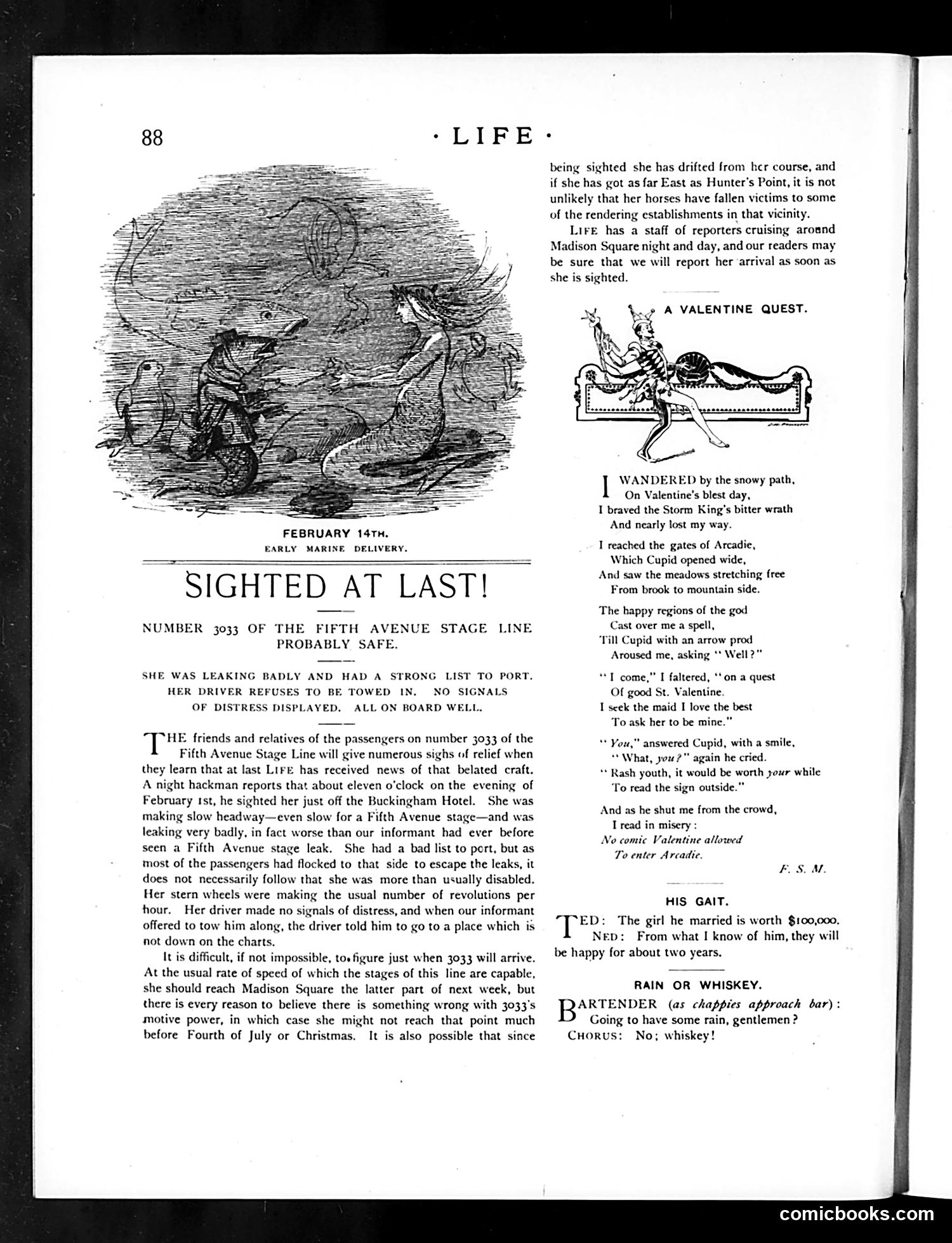
This page satirizes the delayed arrival of a Fifth Avenue Stage Line bus (vehicle #3033). The main article "Sighted at Last!" reports the coach was spotted "leaking badly" with engine trouble, making slow headway—so slow that its arrival time is uncertain, possibly delayed until summer or beyond Fourth of July. The humor relies on treating a simple bus breakdown as a major news event worthy of breathless reporting, with concerned relatives checking for updates. The exaggerated tone mocks both the bus line's unreliability and New Yorkers' dependence on public transit. The page also contains unrelated items: a poem "A Valentine Quest" and brief jokes about marriage and bartending—typical Life magazine miscellany. The date appears to be February 14th (Valentine's Day), referenced in the poem.
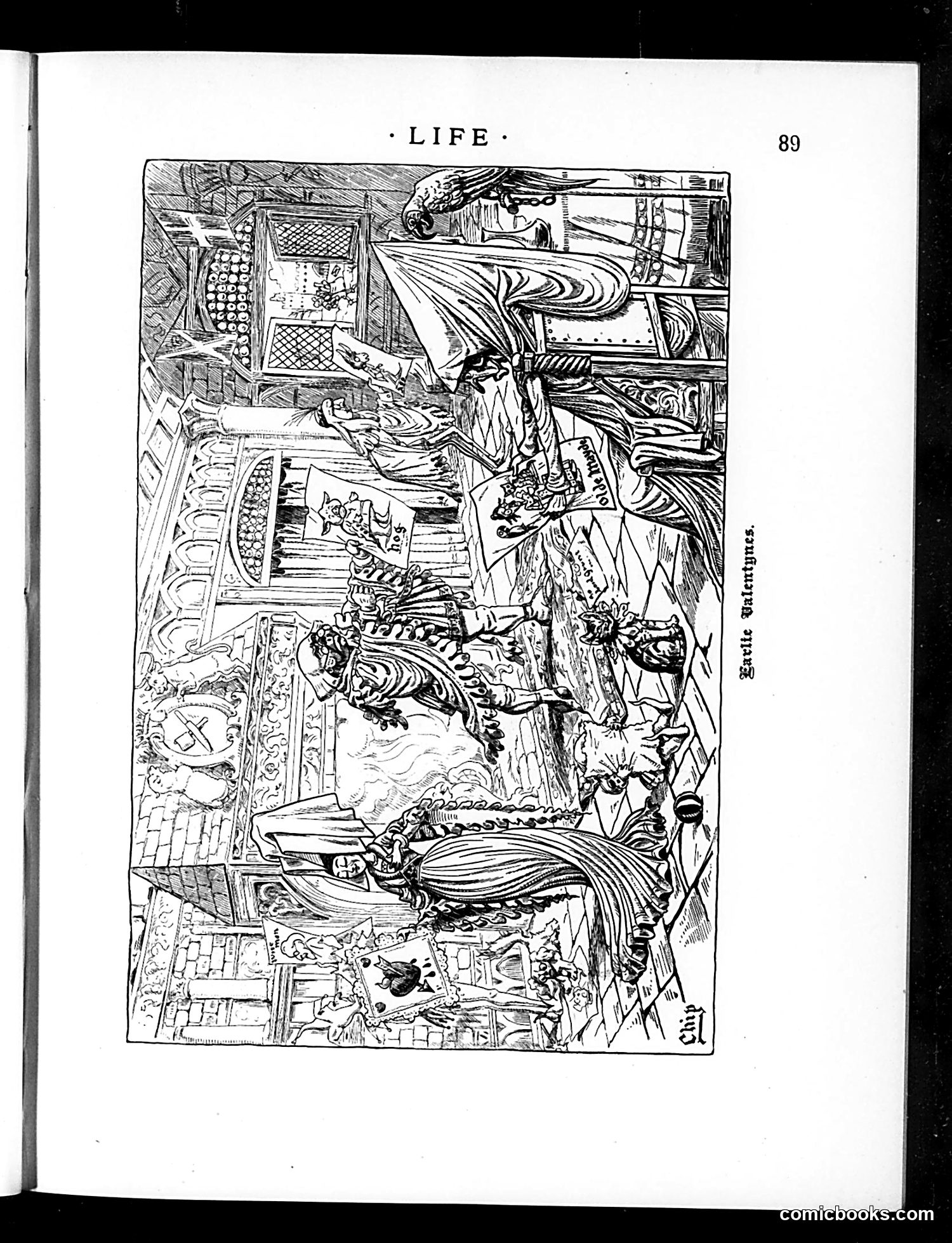
This page from *Life* magazine (page 89) contains a single large satirical illustration titled "Gentle Earthquakes" (visible on the right margin). The image depicts what appears to be an ornate interior—possibly a wealthy home or palace—shown at a tilted angle, suggesting an earthquake or tremor. Multiple figures are depicted in various states of alarm or disruption among elaborate furnishings and architectural details. Without additional context about the publication date or specific historical event referenced, I cannot definitively identify the particular political or social commentary intended. The "gentle earthquakes" title suggests the cartoon satirizes some kind of social or political upheaval presented as minor disturbance, but the specific targets remain unclear from the image alone.
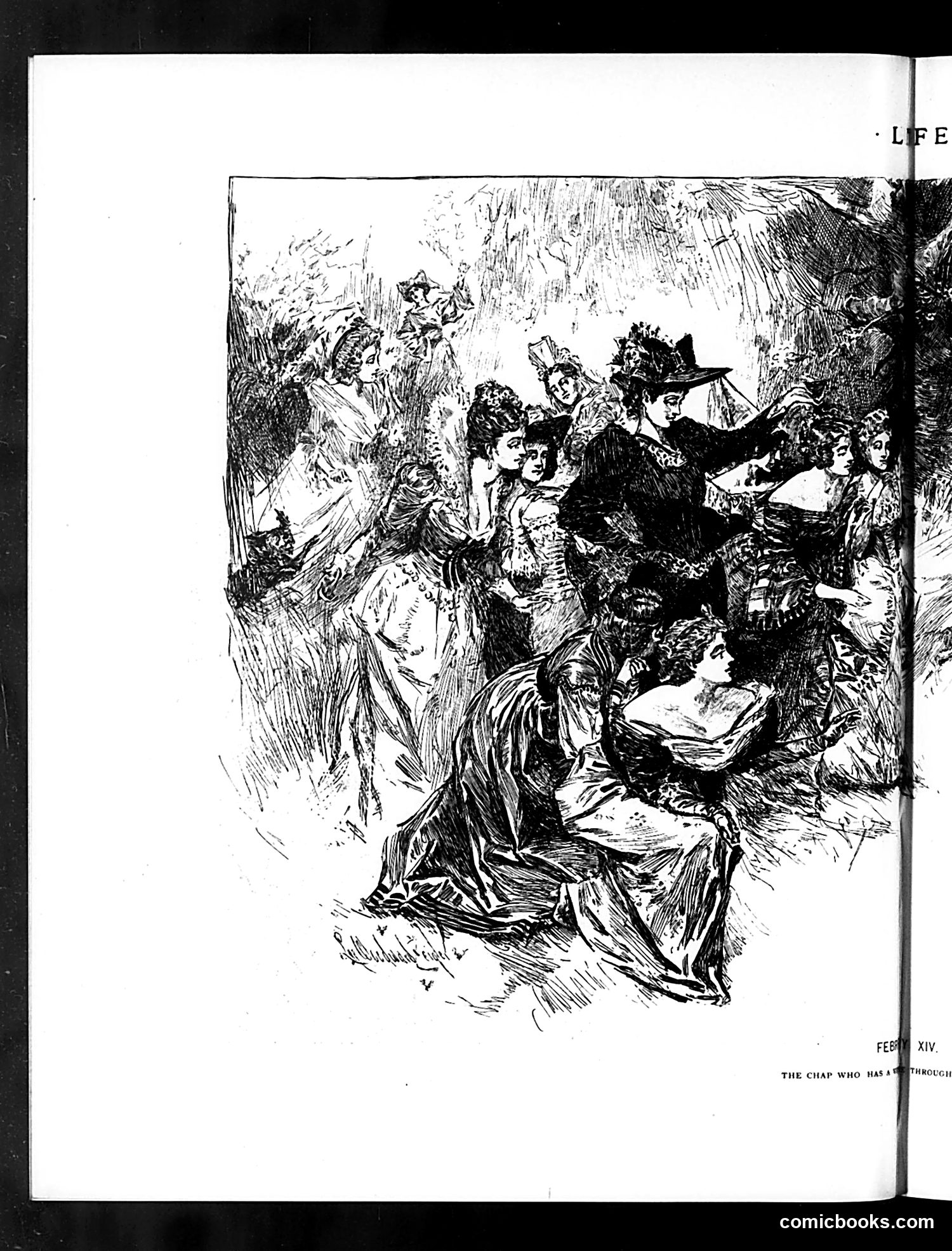
This is a satirical illustration depicting a fashionable social gathering, likely from the late 19th or early 20th century based on the clothing styles and artistic technique. The caption reads "THE CHAP WHO HAS A [text cut off]" suggesting the cartoon critiques a particular social type. The sketch shows well-dressed men and women in an indoor social setting, with elaborate period clothing including hats and formal attire. The style of caricature and line work suggests satire aimed at upper-class society manners or pretensions. However, the partial caption makes the specific target unclear. The image may mock social climbing, fashion obsession, or a particular character type recognizable to Life's 1890s-1900s readership, but without the complete text, the precise satirical point cannot be determined with certainty.
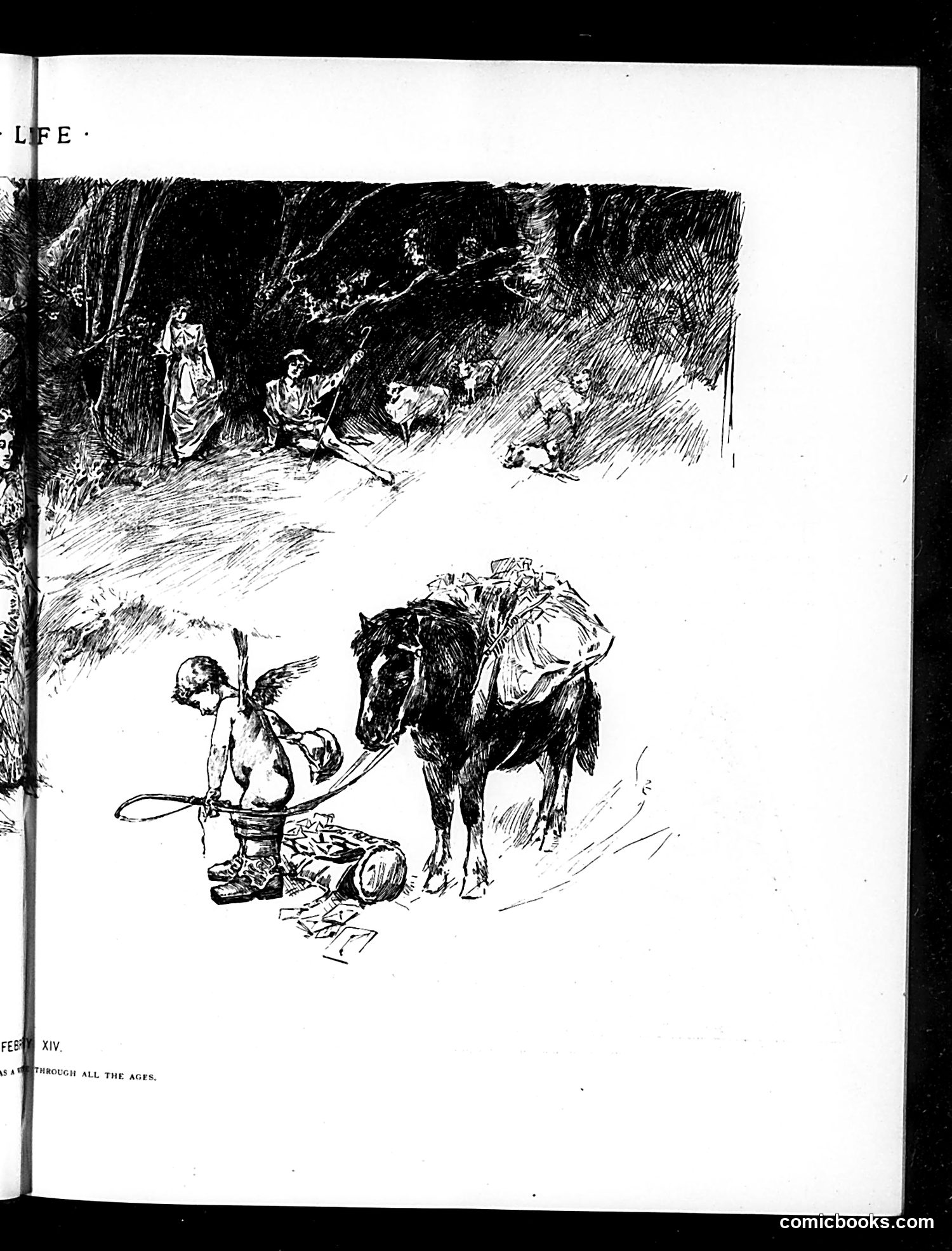
This appears to be an illustration titled "Through All the Ages" (visible at bottom). The sketch depicts a mythological or allegorical winged figure (possibly Cupid or similar) beside a laden donkey or pack animal, with scattered goods at their feet. In the background, figures gather near trees, suggesting a classical or timeless scene. The artistic style uses heavy cross-hatching typical of late 19th/early 20th century satirical illustration. The title suggests the image comments on something eternal or recurring throughout human history. Without additional context or caption text, the specific satirical target remains unclear—it may reference timeless human folly, commerce, love, or burden-bearing across ages. The exact point of satire cannot be determined from the image alone.
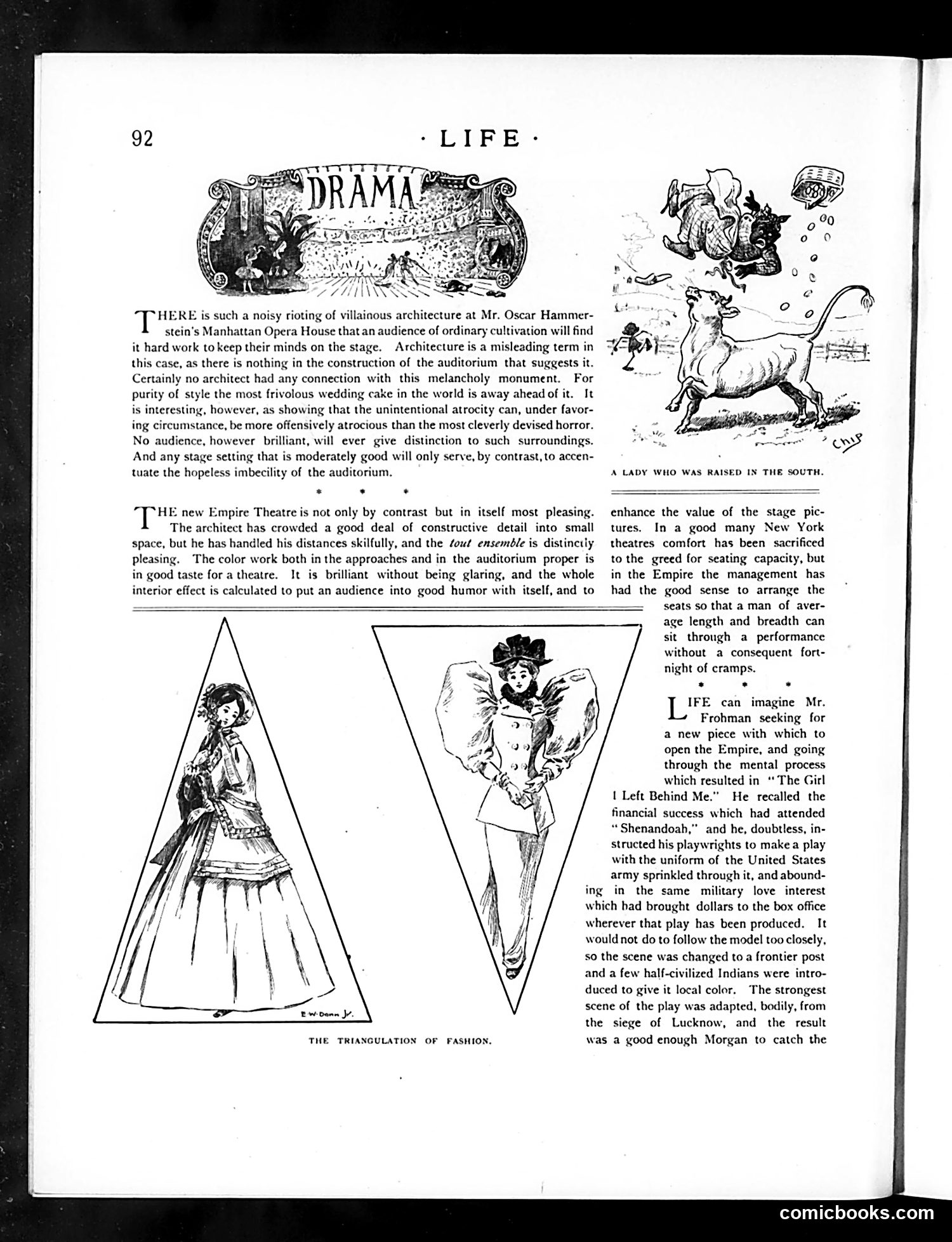
This page critiques New York theater architecture and management. The main text attacks Oscar Hammerstein's Manhattan Opera House as architecturally hideous—comparing it unfavorably to a wedding cake—yet praises the rival Empire Theatre for its elegant design and audience comfort. The fashion cartoon labeled "The Triangulation of Fashion" (lower left) satirizes women's clothing silhouettes by showing how fashion reduces the female form to geometric shapes—triangles representing the exaggerated skirts and bustles of the era. The upper right sketch "A Lady Who Was Raised in the South" appears to be a comedic illustration, likely depicting regional characteristics through caricature (common in this era's satire). The text also discusses theater impresario Charles Frohman's strategy of copying the successful play "Shenandoah" by adding military uniforms and borrowing scenes from other works to create "The Girl I Left Behind Me"—mocking theatrical formula-writing as cynical commercialism aimed purely at box-office returns.
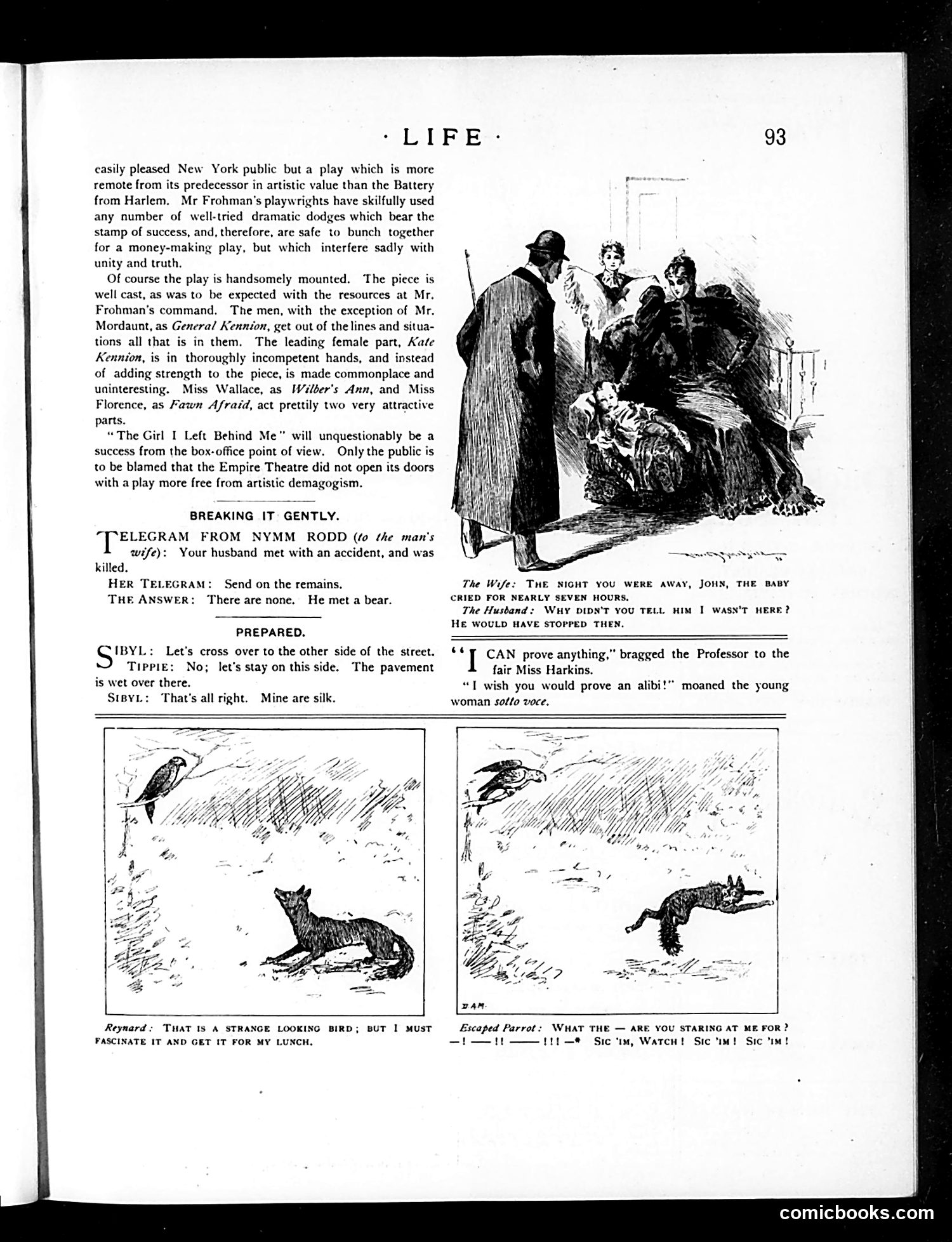
This page contains several unrelated short humorous pieces typical of early Life magazine's satirical format. The top section reviews a theatrical production ("The Girl I Left Behind Me"), criticizing it as commercially successful but artistically mediocre—pandering to "easily pleased" audiences with tired dramatic formulas rather than genuine artistic merit. Below are brief comic sketches: **"Breaking It Gently"** jokes about delivering bad news—a man's death is rendered darkly funny by the punchline that he "met a bear" (implying the bear caused his death). **"Prepared"** is a dialogue joke about two women crossing a wet street; one reveals her shoes are silk, implying she's wealthy enough not to worry about ruining them. The remaining items are brief gags about a professor claiming to prove anything (a woman wishes he'd prove an alibi—implying infidelity), and two animal cartoons featuring a fox eyeing a bird and a dog chasing an escaped parrot. These are lighthearted, non-political humor pieces typical of Life's miscellaneous content.
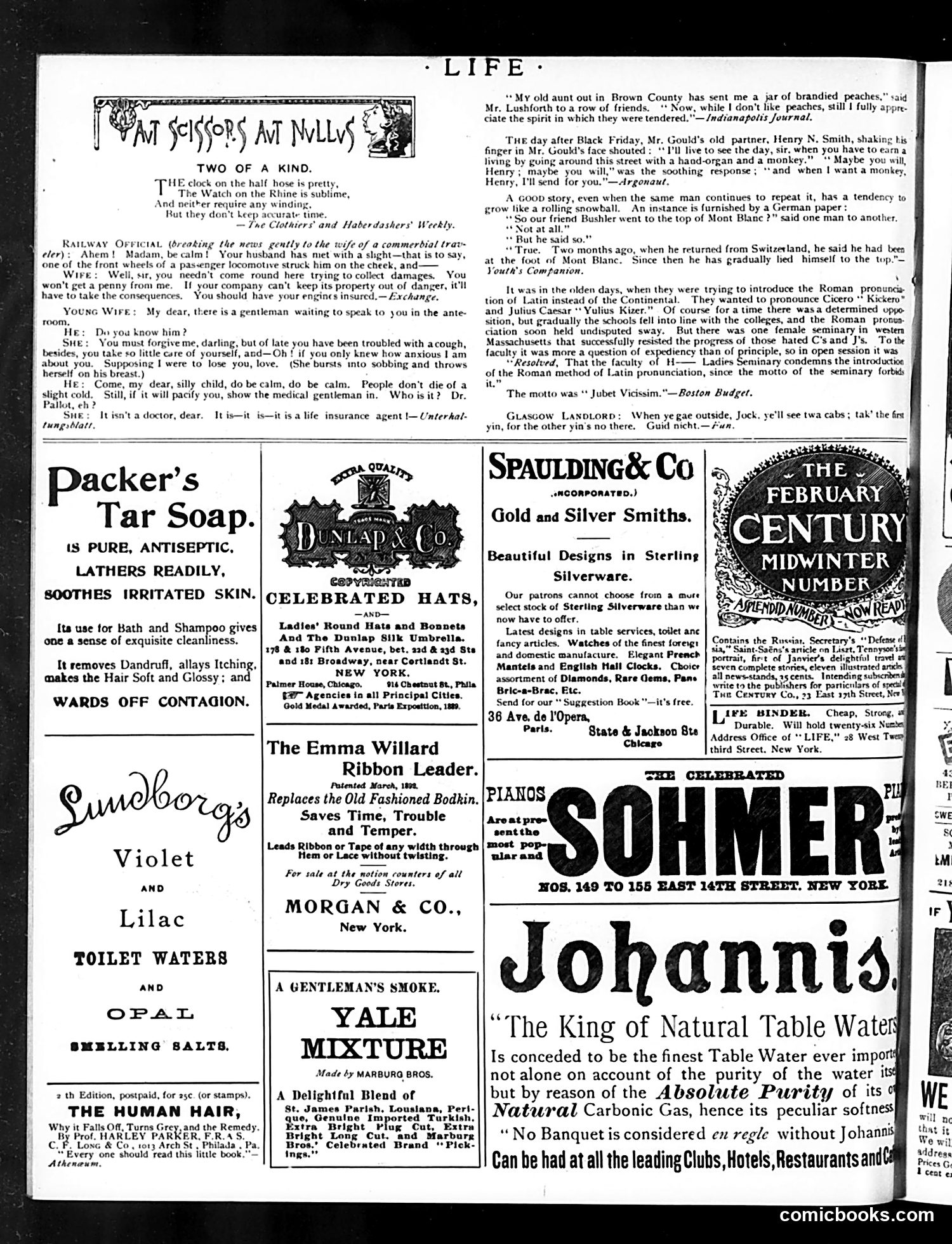
This page contains three brief satirical sketches rather than visual cartoons: 1. **"The Clock on the Half House"**: A play on words mocking German precision. It references "The Watch on the Rhine" (a famous German patriotic song) and "The Clothiers' and Haberdashers' Weekly," suggesting irony about German reliability—the clocks are pretty but don't keep accurate time. 2. **Railway Official**: Dark humor about a locomotive accident. A railway official awkwardly informs a traveler's wife that a train wheel struck her husband's face. She responds by threatening to sue the railway for negligence rather than showing concern for him—satirizing litigious attitudes. 3. **The Life Insurance Agent**: A wife's anxiety about her husband's cough culminates in the shocking reveal that the gentleman caller is actually a life insurance salesman. The joke plays on her panic about losing him and the commercial opportunism of insurance agents preying on family fears. All three mock social anxieties, human nature, and commercial practices of the era.
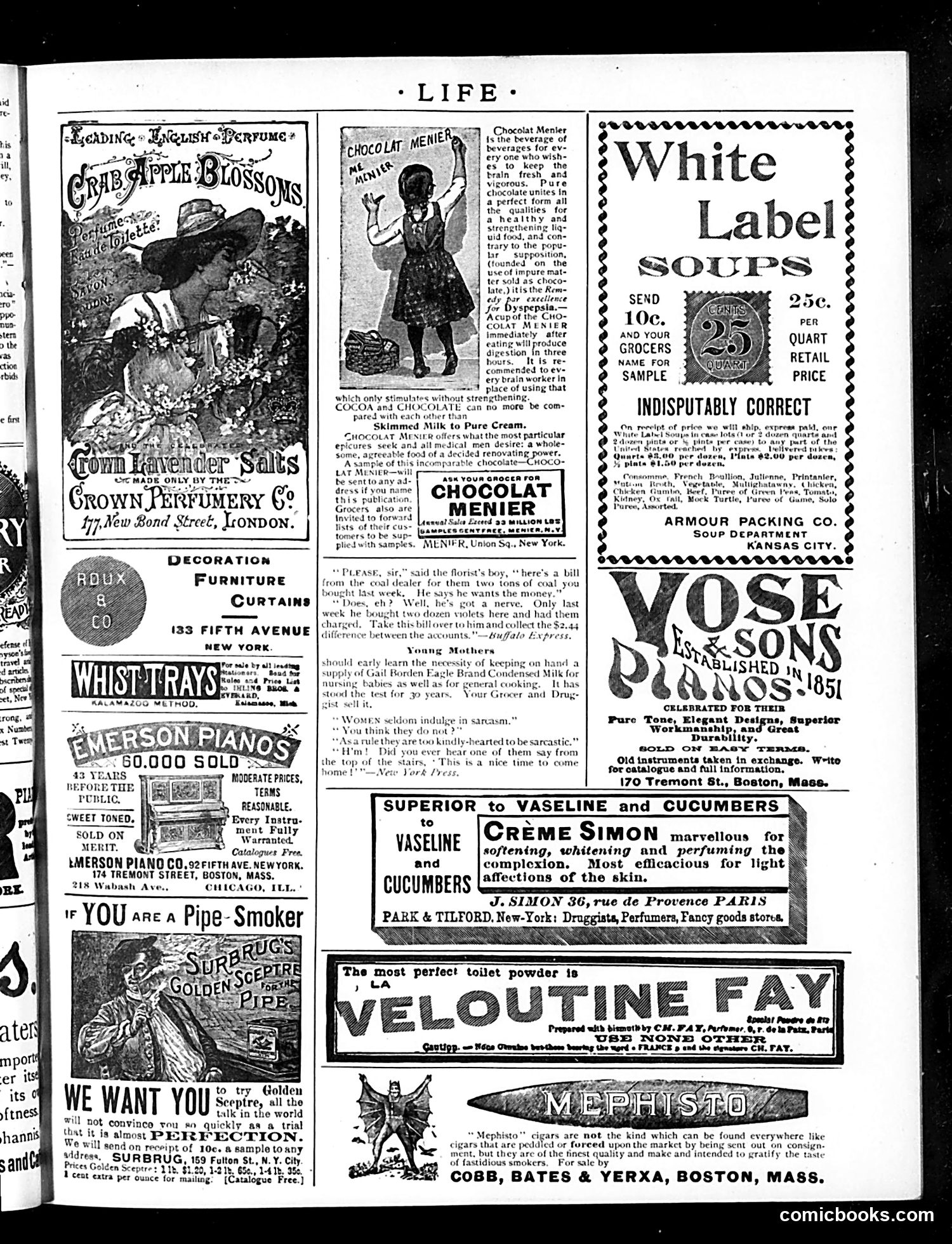
This is primarily an **advertisement page** with no political cartoons or satire. It contains commercial ads typical of early 20th-century Life magazine, including: **Products advertised:** - Perfumes and cosmetics (Crown Lavender Salts, Crème Simon, Veloutine powder) - Food/beverages (Chocolat Menier, White Label Soups, Mephisto cigars) - Pianos (Emerson) - Furniture and home goods - Tobacco products **One humorous anecdote** appears mid-page: a florist's boy demands payment for coal delivered, claiming the florist owes money. The florist's sarcastic response suggests the boy is too "kindly-hearted" to genuinely demand payment—a mild joke about youthful naivety. The page reflects contemporary consumer culture and advertising practices, with product endorsements emphasizing purity, quality, and health benefits—claims common in ads of this era before modern consumer protection laws.

This page is primarily **advertising, not satire or political commentary**. It's a full-page advertisement for the Jacksonville, St. Augustine & Indian River Railway, published in *Life* magazine on February 9, 1893. The image shows a scenic landscape photograph of the Indian River in Florida—featuring palm trees, calm water, and a distant pier—meant to attract tourists to Florida's east coast. The text is a straightforward promotional pitch emphasizing Florida's climate and the railway's service, with a practical note that ticket-holders could make multiple stops along the route. Joseph Richardson, listed as General Passenger Agent in St. Augustine, is the advertiser. The only potentially tongue-in-cheek element is the quote calling Florida's climate "nearer perfection than any other one thing of earth"—hyperbolic marketing language typical of the era's tourism promotion. This reflects the late-19th-century boom in Florida tourism and railroad expansion.