
Life, 1893-02-09 · page 6 of 16
Life — February 9, 1893 — page 6: what you’re looking at
What you’re looking at
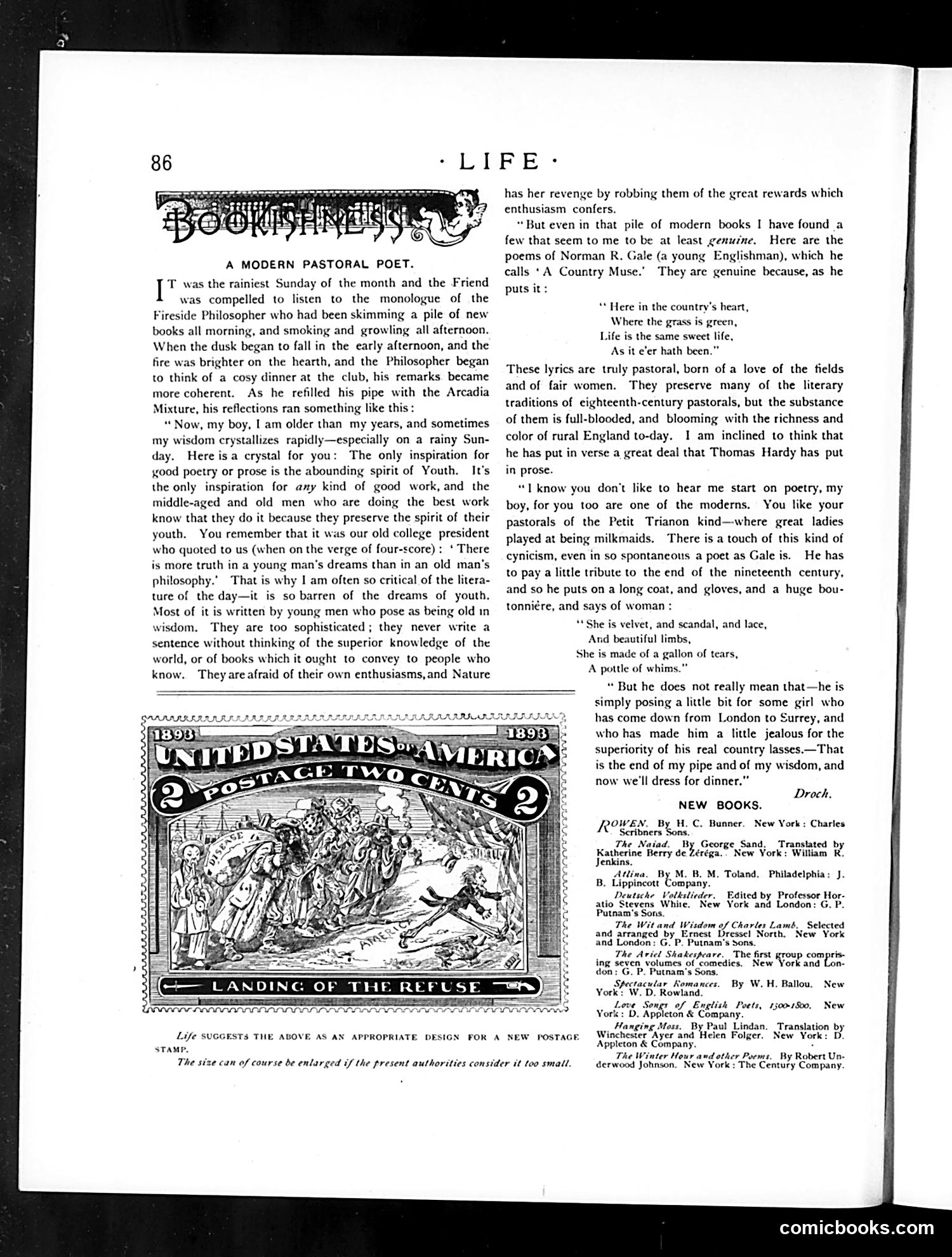
This page discusses "A Modern Pastoral Poet" and features Norman K. Gale, a young English writer. The text critiques modern poetry's lack of enthusiasm, contrasting it with Gale's genuine pastoral verses celebrating rural English life and "fair women." The accompanying **postage stamp design** (labeled "Landing of the Refuge") appears to be a satirical proposal for a new U.S. stamp. It depicts a crowded, chaotic historical scene with many figures—likely referencing immigration or colonial settlement themes. The satire seems to mock either contemporary immigration debates or the romanticized nature of official commemorative imagery. The page also lists "New Books," providing contemporary literary recommendations. The overall tone blends literary criticism with visual satire about American cultural values.
📄 Transcribed text from this page (OCR, searchable)
Machine-transcribed from the original scan — historical spelling and the odd misread are preserved.
-LIFE: A MODERN PASTORAL POET. the rainiest Sunday of the month and the Friend was compelled to listen to the monologue of the Fireside Philosopher who had been skimming a pile of new books all morning, and smoking and growling all afternoon. When the dusk began to fall in the early afternoon, and the fire was brighter on the hearth, and the Philosopher began to think of a cosy dinner at the club, his remarks became more coherent. As he refilled his pipe with the Arcadia Mixture, his reflections ran something like this : “Now, my boy, I am older than my years, and sometimes my wisdom crystallizes rapidly—especially on a rainy Sun- day. Here isa crystal for you: The only inspiration for good poetry or prose is the abounding spirit of Youth. It’s the only inspiration for any kind of good work, and the middle-aged and old men who are doing the best work know that they do it because they preserve the spirit of their youth. You remember that it was our old college president who quoted to us (when on the verge of four-score) : ‘ There is more truth in a young man’s dreams than in an old man’s philosophy.’ That is why I am often so critical of the litera- ture of the day—it is so barren of the dreams of youth, Most of it is written by young men who pose as being old in wisdom. They are too sophisticated ; they never write a sentence without thinking of the superior knowledge of the world, or of books which it ought to convey to people who know. They are afraid of their own enthusiasms, and Nature has her revenge by robbing them of the great rewards which enthusiasm confers. “But even in that pile of modern books I have found a few that seem to me to be at least genuine. Here are the poems of Norman R, Gale (a young Englishman), which he calls ‘A Country Muse.’ They are genuine because, as he puts it: ‘* Here in the country’s heart, Where the grass is green, Life is the same sweet life, As it e’er hath been.” These lyrics are truly pastoral, born of a love of the fields and of fair women. They preserve many of the literary traditions of cighteenth-century pastorals, but the substance of them is full-blooded, and blooming with the richness and color of rural England to-day. I am inclined to think that he has put in verse a great deal that Thomas Hardy has put in prose. “know you don’t like to hear me start on poetry, my boy, for you too are one of the moderns. You like your pastorals of the Petit Trianon kind—where great ladies played at being milkmaids. There is a touch of this kind of cynicism, even in so spontaneous a poet as Gale is. He has to pay a little tribute to the end of the nineteenth century, and so he puts on a long coat, and gloves, and a huge bou- tonniére, and says of woman : “She is velvet, and scandal, and lace, nd beautiful limbs, She is made of a gallon of tears, A pottle of whims.” “ But he does not really mean that—he is SUSI. Life SUGGESTS THE ABOVE AS AN APPROPRIATE DESIGN FOR A NEW POSTAGE STAMP. The size can of course be enlarged if the present authorities consider it too small. simply posing a little bit for some girl who has come down from London to Surrey, and who has made him a little jealous for the superiority of his real country lasses.—That is the end of my pipe and of my wisdom, and now we'll dress for dinner.” Droch. NEW BOOKS. ROWEN. By H.C. Bunner. New Vork : Charles Scribners Sons, ‘Translated by New York: William R. The Neiad. By George Sand. Les Katherine Berry de Jenkins. Atlina, By M. B. M. Toland. Philadelphia: J. B. Lippincott Company. Deutsche Volkstieder. atio Stevens White. Putnam's Sons. The Wit and Wisdom of Charles Lamb. Selected and arranged by Ernest Dressel North, New York and London: G. P. Putnam's dons. The Arict Shakespeare. ‘The first group compris- ing seven volumes of comedies. New Vork and Lon- don: G. P. Putnam's Sons. Spectacular Romances York: W. D. Rowland, , Love Songs of English Poets, 1500-180, New York: D, Appleton & Company. Hanging Moss. By Paul Lindan, Winchester Ayer and Helen Folger. Appleton & Company. The Winter Hour and other Poems. By Robert Un- derwood Johnson. New York: The Century Company. réga. Edited by Professor Hor- New York and London: G. P. By W.H. Ballou. New Translation by New York: D. comicbooks.com