
Life, 1893-02-09 · page 12 of 16
Life — February 9, 1893 — page 12: what you’re looking at
What you’re looking at
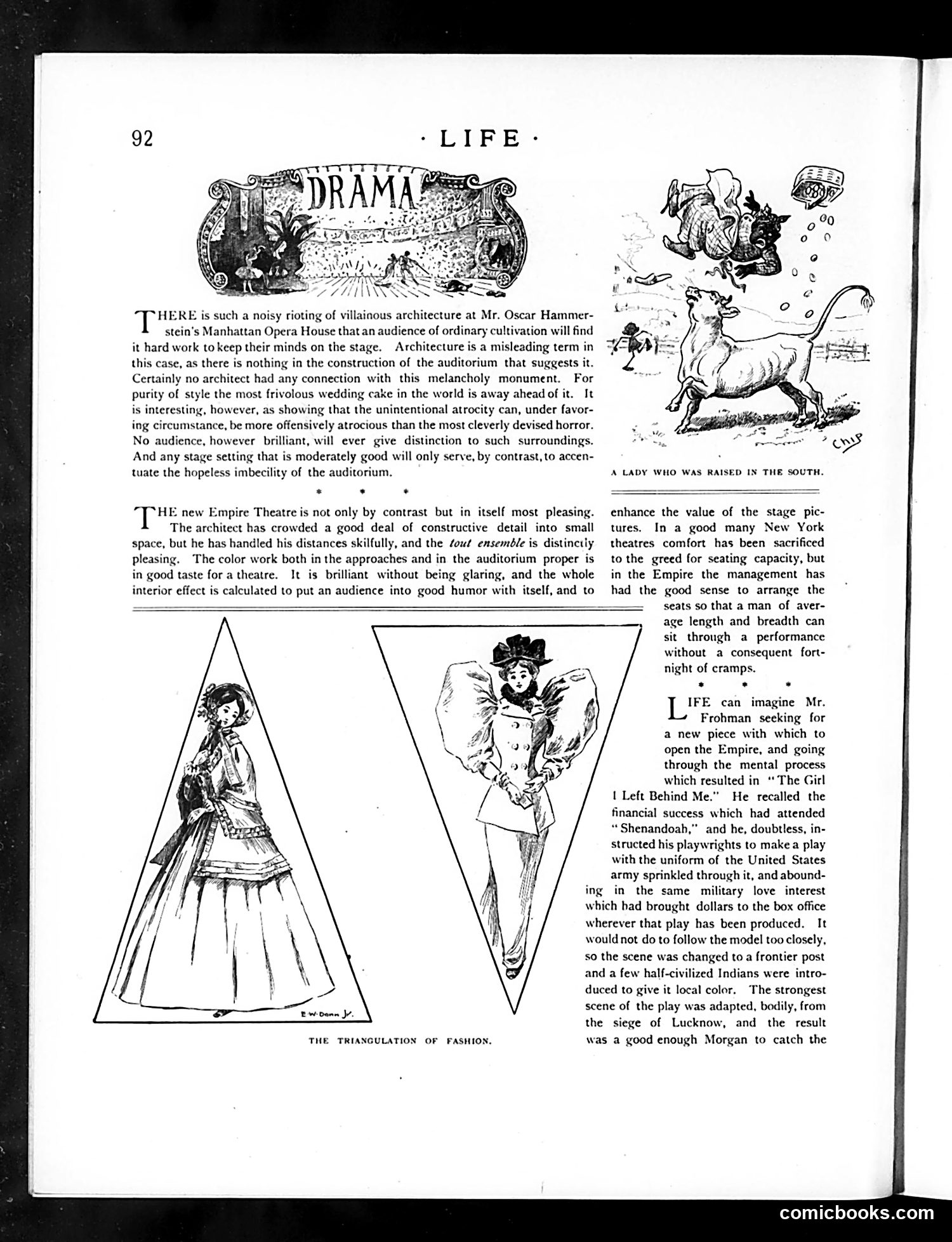
This page critiques New York theater architecture and management. The main text attacks Oscar Hammerstein's Manhattan Opera House as architecturally hideous—comparing it unfavorably to a wedding cake—yet praises the rival Empire Theatre for its elegant design and audience comfort. The fashion cartoon labeled "The Triangulation of Fashion" (lower left) satirizes women's clothing silhouettes by showing how fashion reduces the female form to geometric shapes—triangles representing the exaggerated skirts and bustles of the era. The upper right sketch "A Lady Who Was Raised in the South" appears to be a comedic illustration, likely depicting regional characteristics through caricature (common in this era's satire). The text also discusses theater impresario Charles Frohman's strategy of copying the successful play "Shenandoah" by adding military uniforms and borrowing scenes from other works to create "The Girl I Left Behind Me"—mocking theatrical formula-writing as cynical commercialism aimed purely at box-office returns.
📄 Transcribed text from this page (OCR, searchable)
Machine-transcribed from the original scan — historical spelling and the odd misread are preserved.
HERE is such a noisy rioting of villainous architecture at Mr. Oscar Hammer- stein’s Manhattan Opera House that an audience of ordinary cultivation will find it hard work to keep their minds on the stage. Architecture is a misleading term in this case, as there is nothing in the construction of the auditorium that suggests it. Certainly no architect had any connection with this melancholy monument. For purity of style the most frivolous wedding cake in the world is away ahead of it. It is interesting, however, as showing that the unintentional atrocity can, under favor- ing circumstance, be more offensively atrocious than the most cleverly devised horror. No audience, however brilliant, will ever give distinction to such surroundings. And any stage setting that is moderately good will only serve, by contrast, to accen- tuate the hopeless imbecility of the auditorium. A LADY WHO WAS RAISED IN THE SOUTH. . . . ——_———— —— = *T CHE new Empire Theatre is not only by contrast but in itself most pleasing. enhance the value of the stage pic- The architect has crowded a good deal of constructive detail into small tures. In a good many New York space, but he has handled his distances skilfully, and the fout ensemble is distinctly theatres comfort has been sacrificed pleasing. The color work both in the approaches and in the auditorium proper is to the greed for seating capacity, but in good taste for a theatre. It is brilliant without being glaring, and the whole in the Empire the management has interior effect is calculated to put an audience into good humor with itself, and to had the good sense to arrange the — ———— seats so that a man of aver- age length and breadth can sit through a performance without a consequent fort- night of cramps. IFE can imagine Mr. Frohman seeking for a new piece with which to open the Empire, and going through the mental process which resulted in ** The Girl | Left Behind Me.” He recalled the financial success which had attended “Shenandoah,” and he, doubtless, in- structed his playwrights to makea play with the uniform of the United States army sprinkled through it, and abound- ing in the same military love interest which had brought dollars to the box office wherever that play has been produced. It would not do to follow the model too closely, so the scene was changed to a frontier post and a few half-civilized Indians were intro- duced to give it local color. The strongest scene of the play was adapted, bodily, from the siege of Lucknow, and the result THE TRIANGULATION OF FASHION. was a good enough Morgan to catch the comicbooks.com