
Life, 1893-02-09 · page 4 of 16
Life — February 9, 1893 — page 4: what you’re looking at
What you’re looking at
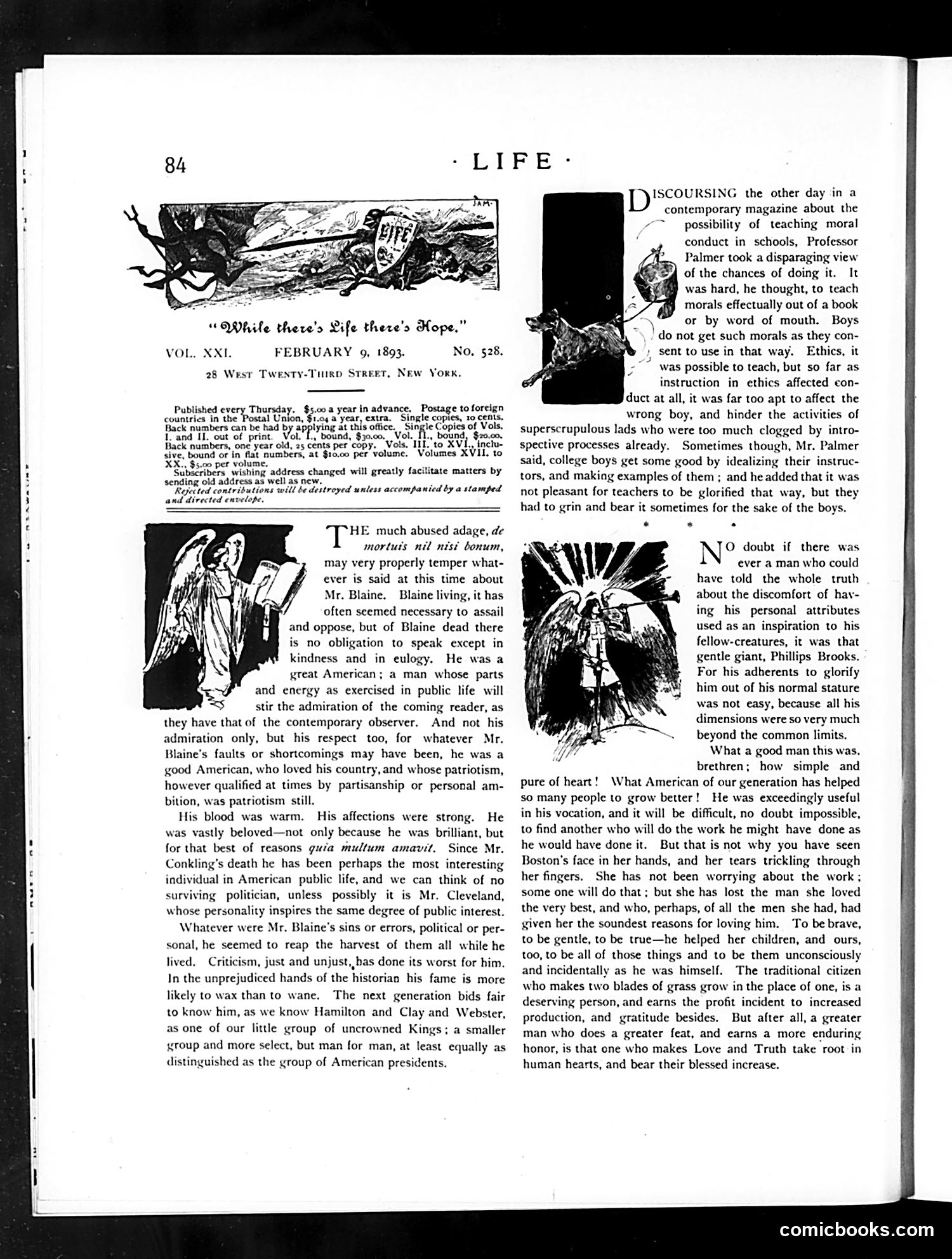
**The Main Cartoon** (top left): Shows a figure labeled "PITT" emerging from or associated with a coffin or tomb, beneath the caption "While there's Life there's Hope." This appears to be political commentary, likely referencing William Pitt (the younger British Prime Minister), though the exact satirical point is unclear without additional historical context about 1893 events. **The Article's Focus**: The lengthy text discusses James G. Blaine, a prominent American politician. It defends Blaine against critics, praising his patriotism and character while acknowledging past controversies. The piece emphasizes his contributions to American public life and compares him favorably to other national leaders like Hamilton, Clay, and Webster. The cartoon's connection to the Blaine article remains unclear from the image alone.
📄 Transcribed text from this page (OCR, searchable)
Machine-transcribed from the original scan — historical spelling and the odd misread are preserved.
VOL. XXL. FEBRUARY 9, 1893. 28 West Twenty-Tuirp Street, New York. No, 528. Published every Thursday. $5.00 a year in advance. Postage to foreign countries in the Postal Union, $1.04 a year, extra. Single copies, 10 cents. plying at this ofce, le Copies of Vols. id, $: Back numbers can be had by ie Vol. bound, $20.00, Vols, HI.'to XV1..'inclu- i Volumes XVII. to XX, $5.00 per volume. hesribes" wishing: address changed will greatly facilitate matters by sending old address as well as new. ; Rejected contributions will be destroyed unless accompanied by a stamped and directed envelope, HE much abused adage, de mortuts nil nist bonum, may very properly temper what- ever is said at this time about Mr. Blaine, Blaine living, it has often seemed necessary to assail and oppose, but of Blaine dead there is no obligation to speak except in kindness and in eulogy. He was a great American; a man whose parts and energy as exercised in public life will stir the admiration of the coming reader, as ve that of the contemporary observer. And not his admiration only, but his respect too, for whatever Mr. Blaine’s faults or shortcomings may have been, he was a good American, who loved his country, and whose patriotism, however qualified at times by partisanship or personal am- bition, was patriotism still. His blood was warm. His affections were strong. He was vastly beloved—not only because he brilliant, but for that best of reasons guéa multum amavit. Since Mr. Conkling's death he has been perhaps the most interesting individual in American public life, and we can think of no surviving politician, unless possibly it is Mr. Cleveland, whose personality inspires the same degree of public interest. Whatever were Mr. Blaine’s sins or errors, political or per- sonal, he seemed to reap the harvest of them all while he lived. Criticism, just and unjust, has done its worst for him. In the unprejudiced hands of the historian his fame is more likely to wax than to wane. The next generation bids fair to know him, as we know Hamilton and Clay and Webster, as one of our little group of uncrowned Kings; a smaller sroup and more select, but man for man, at least equally as distinguished as the group of American presidents. ISCOURSING the other day in a contemporary magazine about the possibility of teaching moral conduct in schools, Professor Palmer took a disparaging v of the chances of doing it. It was hard, he thought, to teach morals effectually out of a book or by word of mouth. Boys do not get such morals as they con- sent to use in that way. Ethics, it ~ was possible to teach, but so far as instruction in ethics affected con- duct at all, it was far too apt to affect the wrong boy, and hinder the activities of superscrupulous lads who were too much clogged by intro- spective processes already. Sometimes though, Mr. Palmer said, college boys get some good by idealizing their instruc- tors, and making examples of them ; and he added that it was not pleasant for teachers to be glorified that way, but they had to grin and bear it sometimes for the sake of the boys. . . A] O doubt if there was ever a man who could have told the whole truth about the discomfort of hav- ing his personal attributes used as an inspiration to his fellow-creatures, it was that gentle giant, Phillips Brooks. For his adherents to glorify him out of his normal stature was not easy, because all his dimensions were so very much beyond the common limits. What a good man this was, brethren; how simple and pure of heart! What American of our generation has helped so many people to grow better! He was exceedingly useful in his vocation, and it will be difficult, no doubt impossible, to find another who will do the work he might have done as he would have done it, But that is not why you have seen Boston's face in her hands, and her tears trickling through her fingers. She has not been worrying about the work ; some one will do that; but she has lost the man she loved the very best, and who, perhaps, of all the men she had, had given her the soundest reasons for loving him. To be brave, to be gentle, to be true—he helped her children, and ours, too, to be all of those things and to be them unconsciously and incidentally as he was himself, The traditional citizen who makes two blades of grass grow in the place of one, is a deserving person, and earns the profit incident to increased production, and gratitude besides. But after all, a greater man who does a greater feat, and earns a more enduring honor, is that one who makes Love and Truth take root in human hearts, and bear their blessed increase. comicbooks.com