
A complete issue · 16 pages · 1893
Life — February 2, 1893
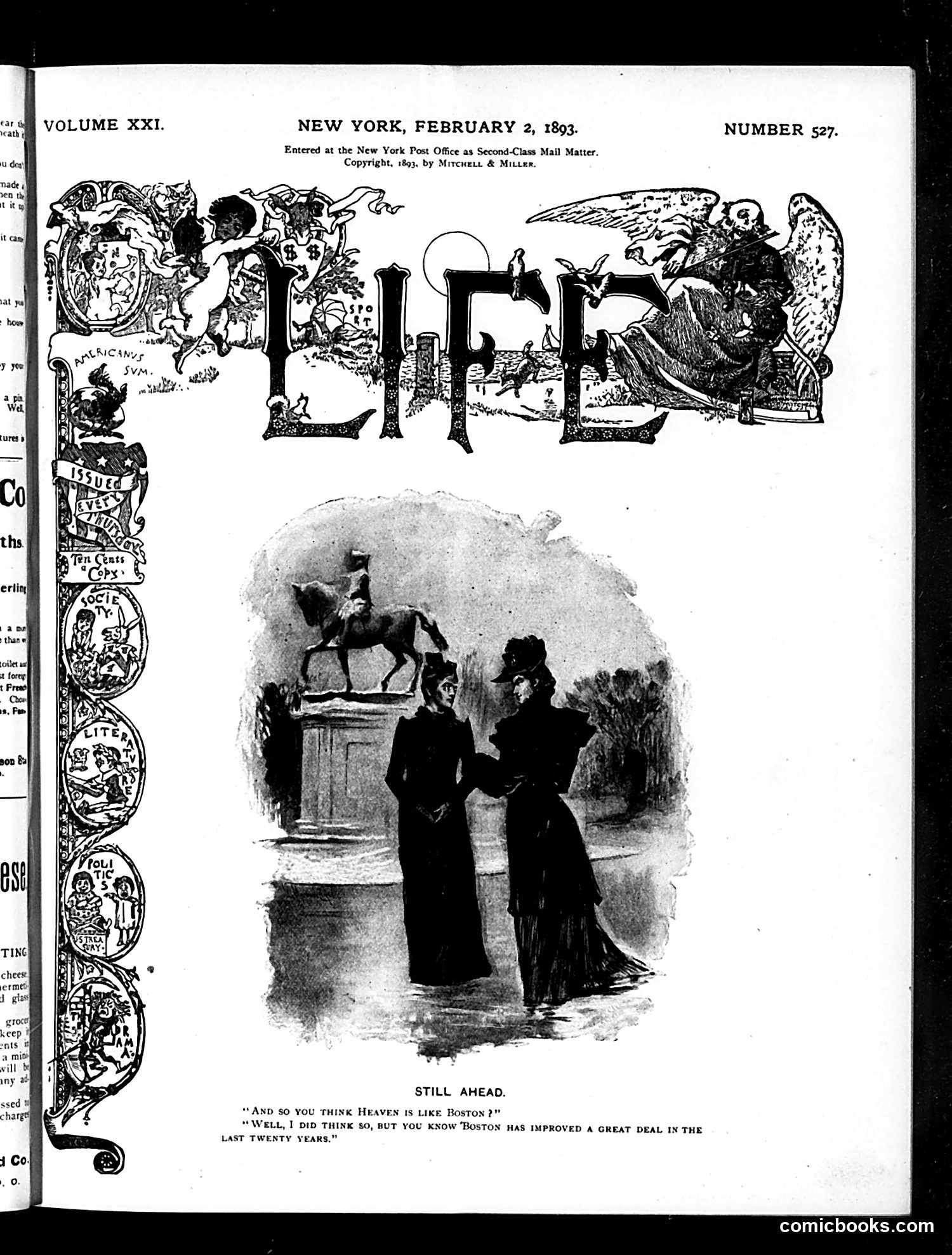
The cartoon titled "Still Ahead" depicts two figures in Victorian dress viewing an equestrian statue. The dialogue references Heaven and Boston, with one character noting that Boston "has improved a great deal in the last twenty years." This is satirical commentary on Boston's civic pride and development in the late 19th century. The statue likely represents a prominent Boston figure or achievement. The joke appears to mock Bostonians' self-congratulatory attitude about urban improvements, suggesting they consider their city almost heavenly in quality. The ornate left-margin decoration with zodiac signs indicates this is a standard Life magazine format from the 1890s. Without additional context about specific 1893 Boston developments, the exact reference remains somewhat unclear, though the general satire targets local boosterism.
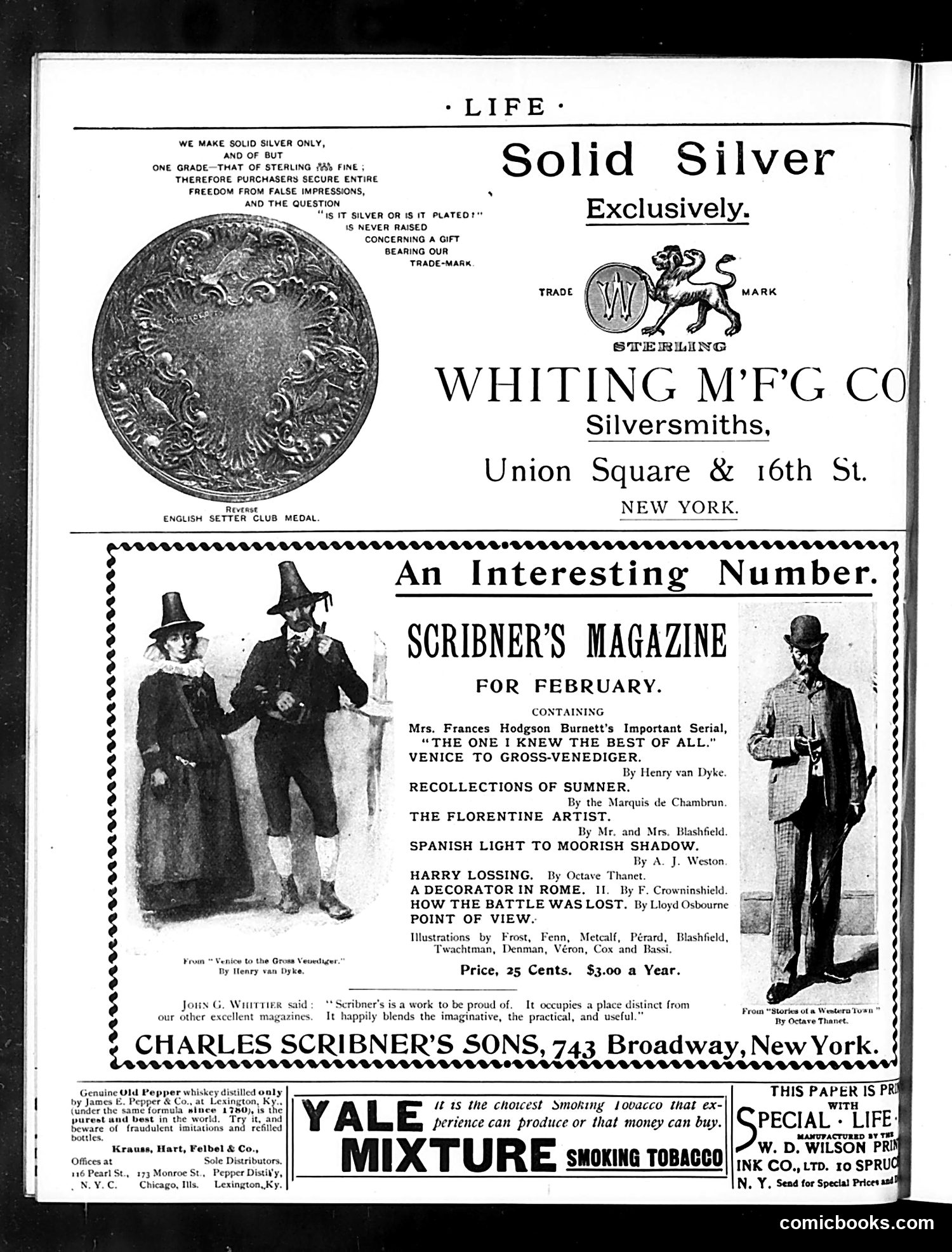
This page is primarily **advertising**, not satirical content. The top advertisement for Whiting Manufacturing Company promotes solid silver flatware and tableware, featuring an ornate medal design and the company's lion trademark. The larger boxed advertisement promotes **Scribner's Magazine** for February, listing literary content by notable authors including Frances Hodgson Burnett and Octave Thanet. The illustration shows two figures in period dress—likely representing characters from serialized fiction rather than political figures. Below that is an advertisement for **Yale Mixture Smoking Tobacco**, emphasizing it as "the choicest Smoking Tobacco." There is **no political satire** visible on this page. This appears to be a standard advertising section from Life magazine's commercial pages.
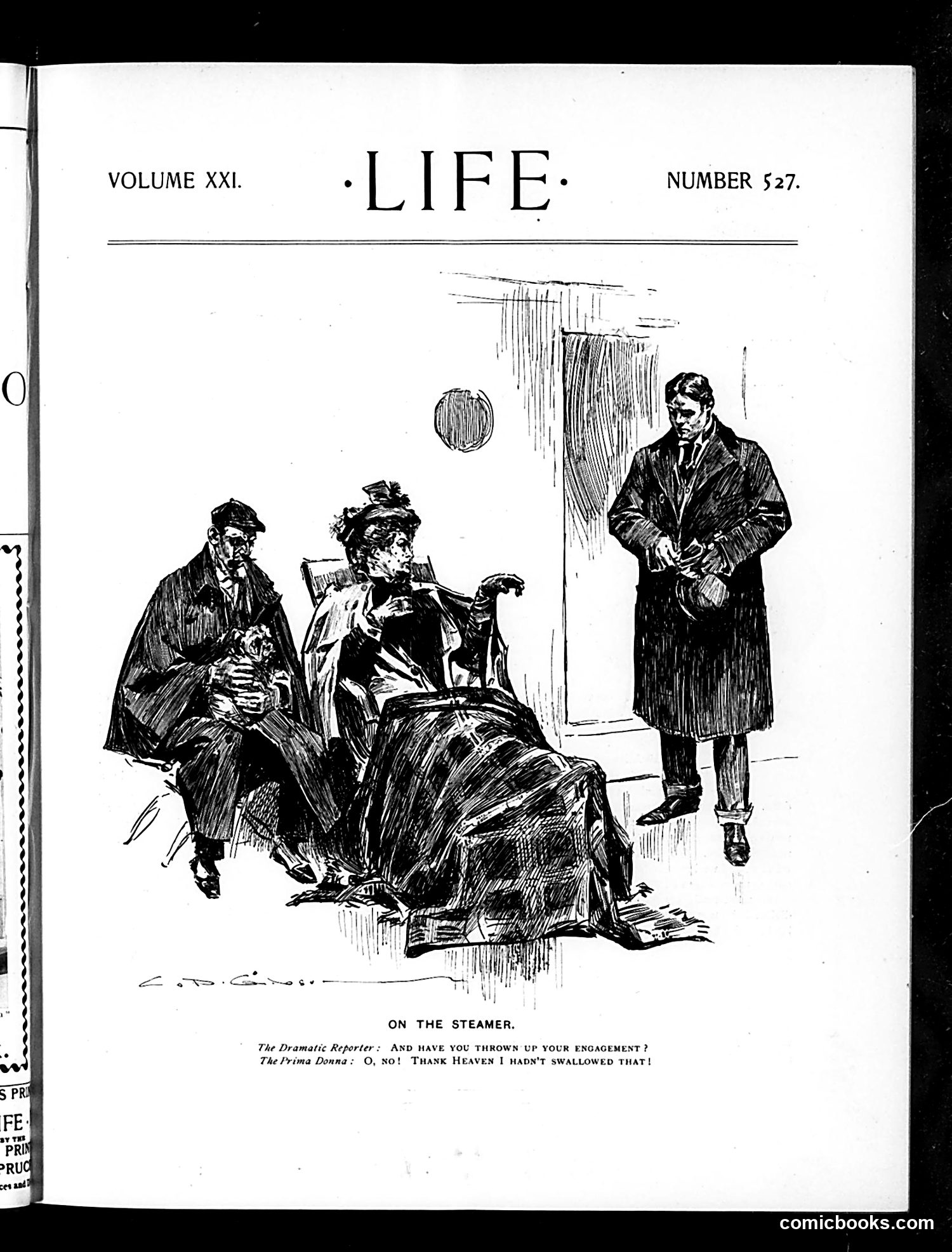
This satirical cartoon depicts a domestic scene aboard a ship. A woman lies dramatically on the floor or a bunk while a dramatic reporter asks: "And have you thrown up your engagement?" The Prima Donna responds: "O, no! Thank Heaven I hadn't swallowed that!" The joke relies on double meaning: "throwing up" an engagement (breaking an engagement) versus the literal act of vomiting, which seasickness would cause. The woman's exaggerated theatrical posture and the reporter's presence suggest this involves a performer or public figure. The humor mocks both the melodramatic behavior of theatrical people and the discomforts of sea travel. The "dramatic reporter" character indicates this satirizes how entertainment press sensationalizes minor incidents involving celebrities.
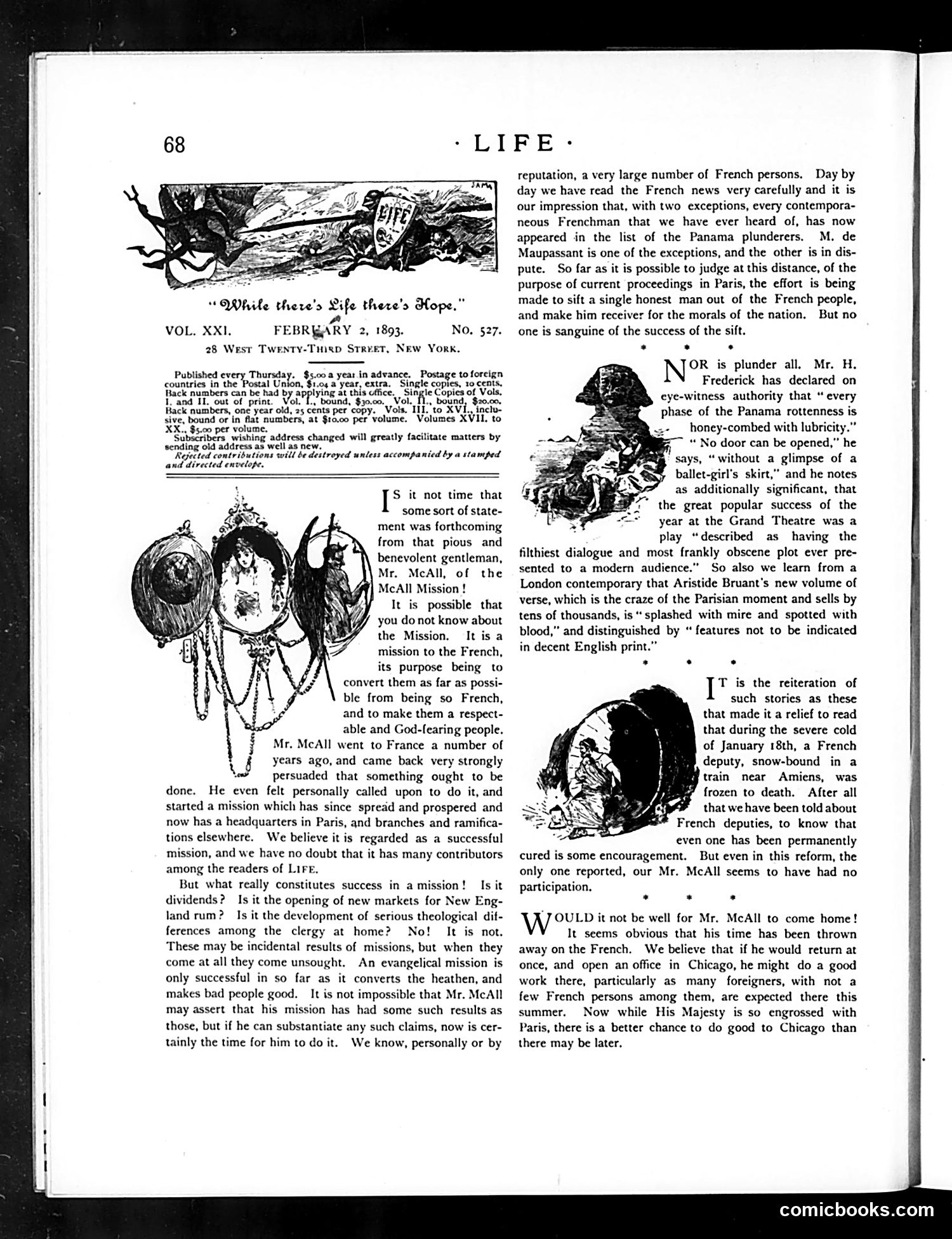
This page critiques **Mr. McAll's missionary work in France**. The text expresses skepticism about converting French citizens to Protestant Christianity, questioning whether such missions actually produce meaningful religious conversion versus merely spreading Anglo-American influence. The **three decorative illustrations** (ornamental vignettes) appear to be period artistic flourishes rather than political cartoons with specific identifiable figures. The article's satire targets the assumption that missionary work equals genuine spiritual success. It suggests McAll's Paris-based mission diverts resources from more practical domestic needs (like Chicago) and questions whether converting "the French" to "respectable and God-fearing people" is either achievable or desirable—a tongue-in-cheek dig at American Protestant cultural imperialism and French secularism.
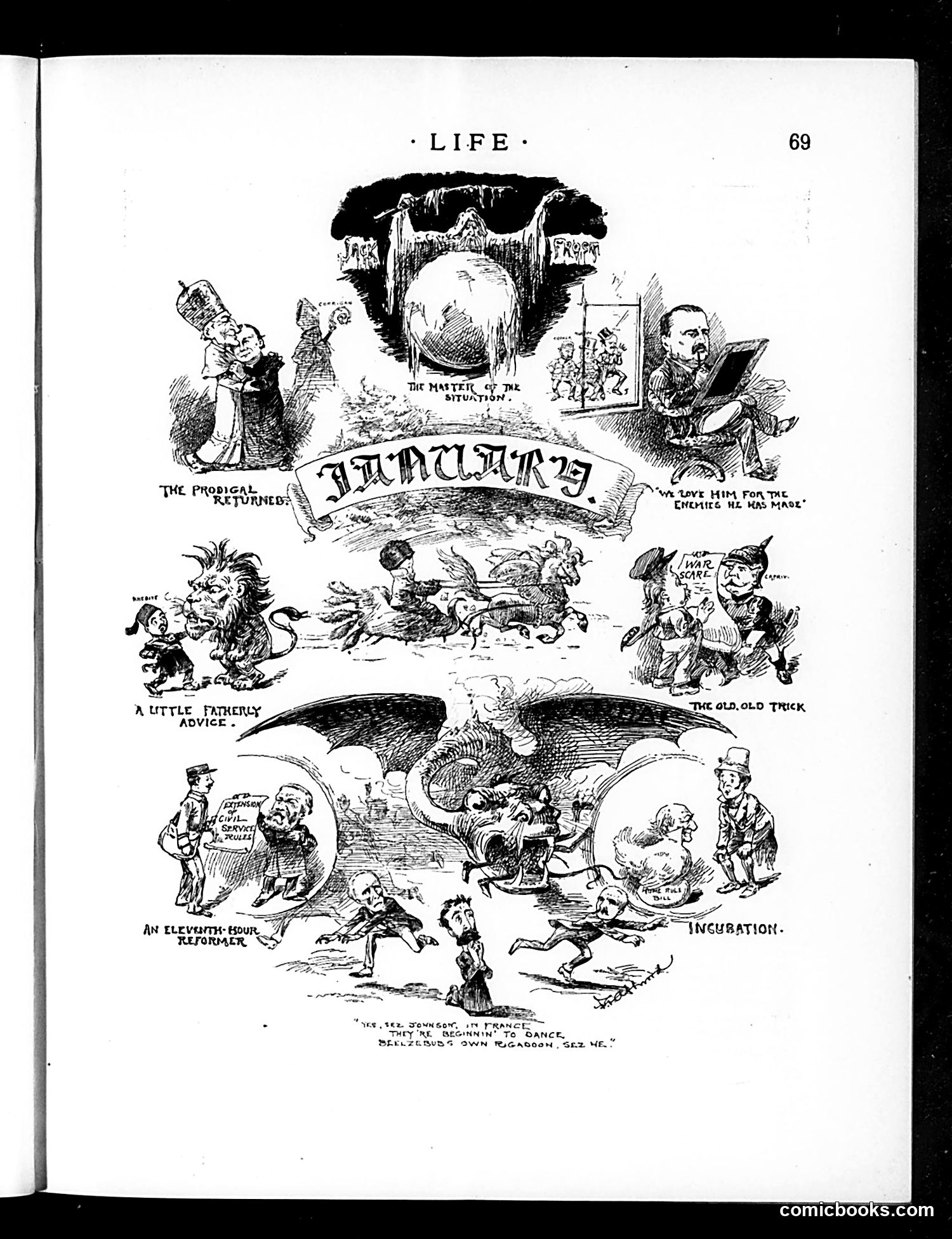
This page presents a central figure labeled "McCarthy" surrounded by satirical vignettes critiquing various aspects of his conduct or political impact. The surrounding scenes include: - "The Prodigal Returnees" (left) - "The Master of the Situation" (top center) - "We Love Him for the Enemies He Has Made" (right) - "A Little Fatherly Advice" and "The Old, Old Trick" (middle) - "An Eleventh-Hour Reformer" and "Incubation" (bottom) The cartoon appears to satirize Senator Joseph McCarthy's investigations and their consequences, likely referencing the 1950s McCarthy hearings. The various scenes mock both McCarthy's methods and those who supported or opposed him. The central winged demon figure suggests the cartoonist views McCarthy's influence as malevolent, corrupting American politics through accusation and fear-mongering.
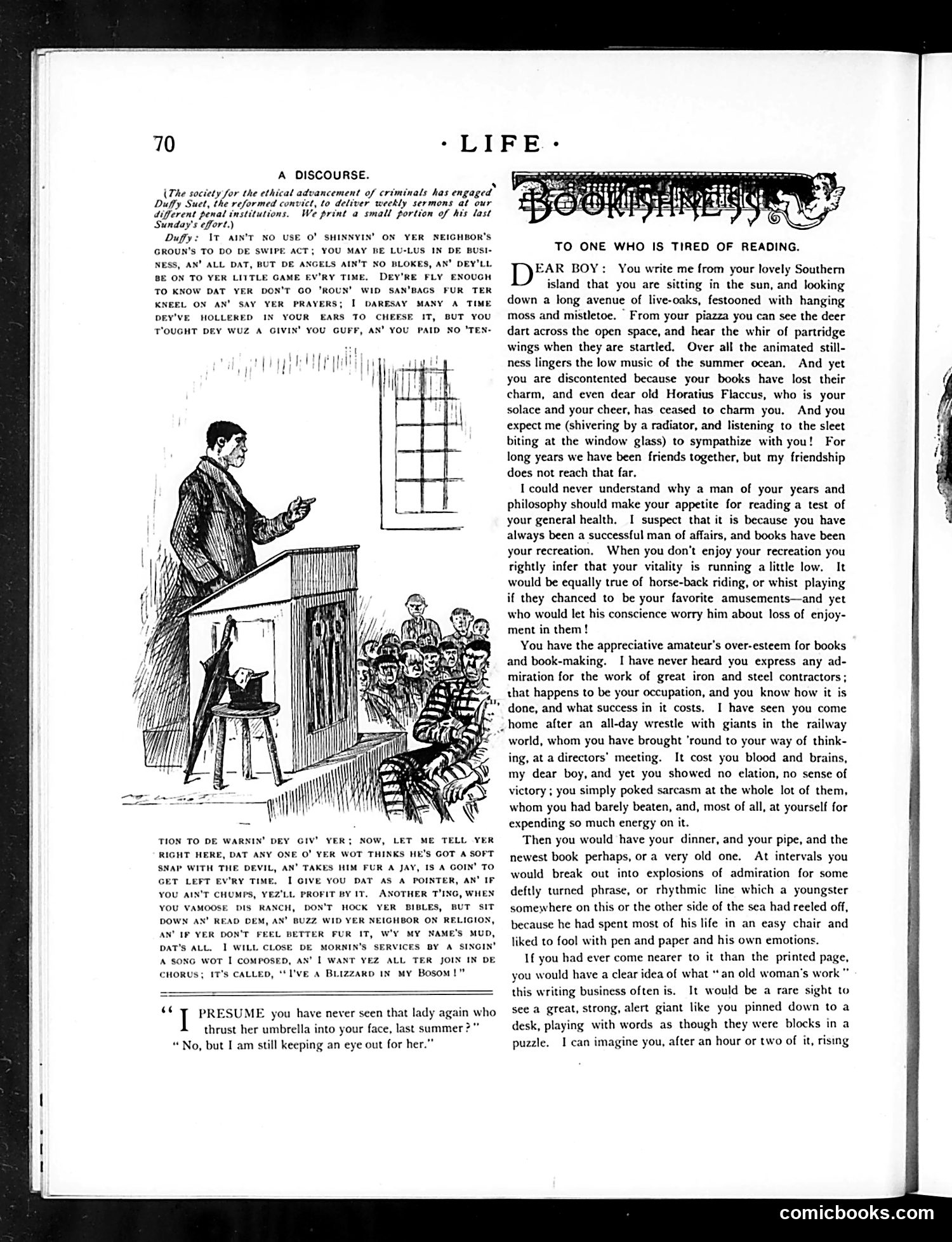
This page contains "A Discourse: To One Who Is Tired of Reading," a satirical letter addressing a reader complaining that books have lost their charm. The left side features two illustrations: the upper shows a man gesturing while speaking to an audience in what appears to be a lecture hall; the lower contains dialogue between two figures. The satire targets a specific type of person—someone successful in business who dismisses reading as recreation. The author mocks this attitude, suggesting the reader's tiredness reflects depleted vitality rather than any fault of books. The piece appears to be social commentary on early 20th-century American materialism and the tension between intellectual pursuits and commercial success. The humor derives from the author's pointed, knowing criticism of this character type.
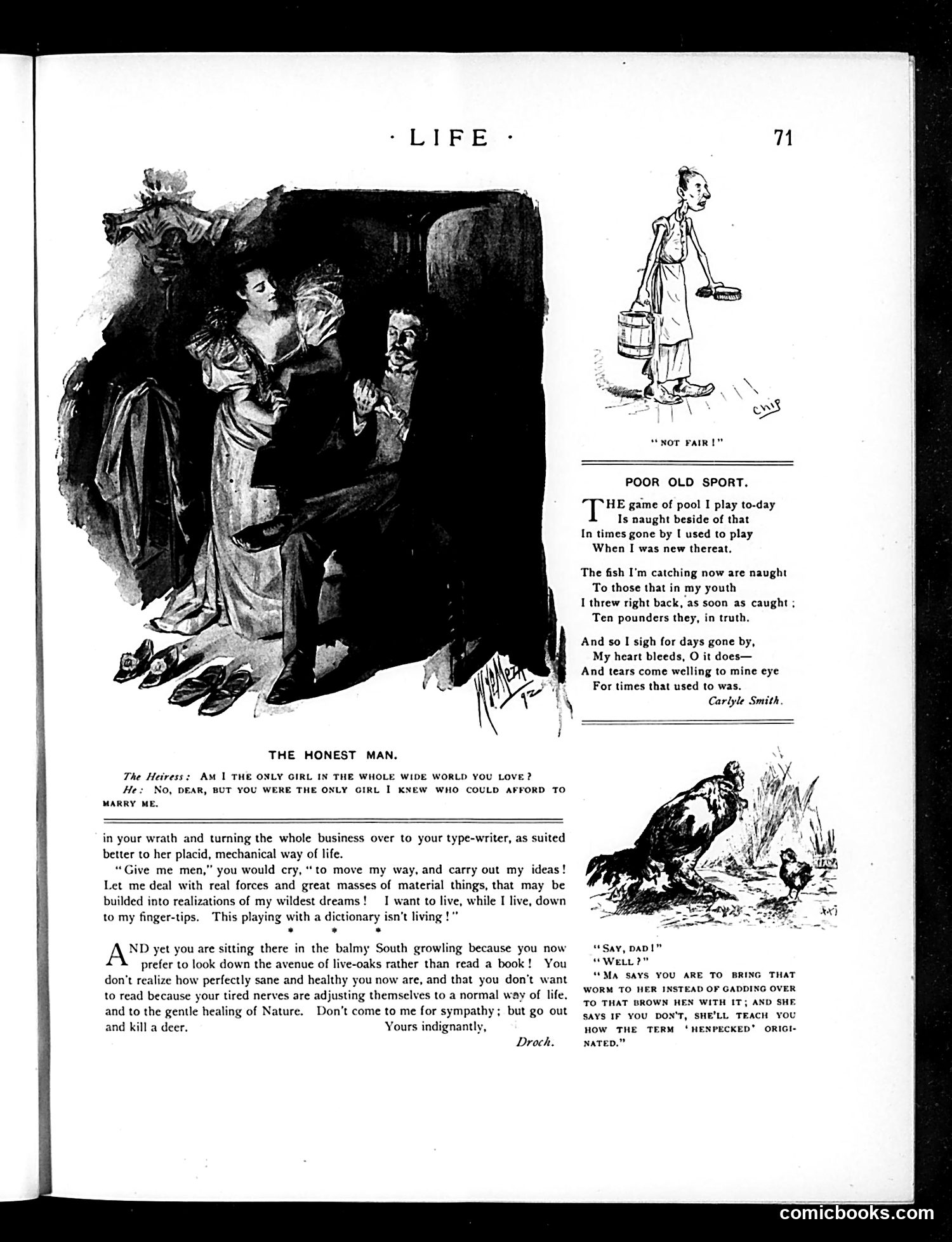
**"The Honest Man"** cartoon depicts a dialogue between a woman and man about marriage. She asks if he loves her, and he responds honestly that she was "the only girl I knew who could afford to marry me"—satirizing the mercenary nature of courtship and marriage among the wealthy. The irony is that brutal honesty about marrying for money is presented as virtuous. **"Poor Old Sport"** is a nostalgic poem by Carlyle Smith lamenting lost youth—specifically the decline from catching large fish as a young man to catching small ones now. It's sentimental commentary on aging and diminished physical prowess. The small sketch "Say, Dad!" and "Not Fair!" depict parent-child interactions, likely satirizing generational differences or parenting approaches of the era.
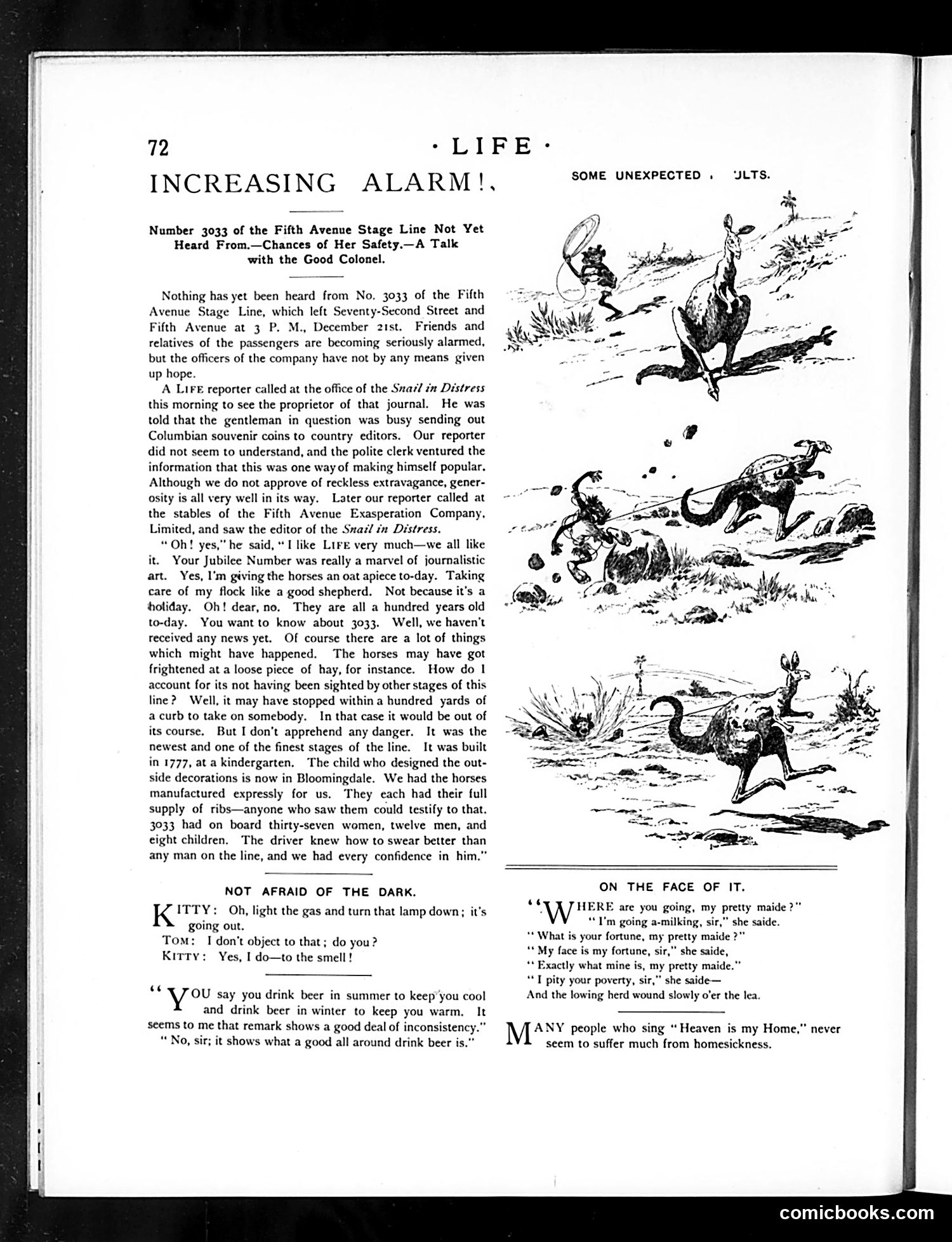
This page contains two distinct sections: **"Increasing Alarm!"** reports on a missing Fifth Avenue Stage Line coach (No. 3033) that departed December 1st and hasn't been found. The article humorously speculates about possible explanations—loose hay spooking horses, mechanical failure—while praising the coach's quality (built 1777, carries 37 women, 12 men, and 8 children). It's a tongue-in-cheek story about a lost transportation vehicle. **"Some Unexpected Jolts"** features cartoon illustrations of people being thrown from or startled by horses and carriages—depicting everyday hazards of horse-drawn transportation in early 20th-century America. **Lower sections** include brief humorous dialogues about drinking beer and homesickness, representing typical Life magazine humor content of the period.
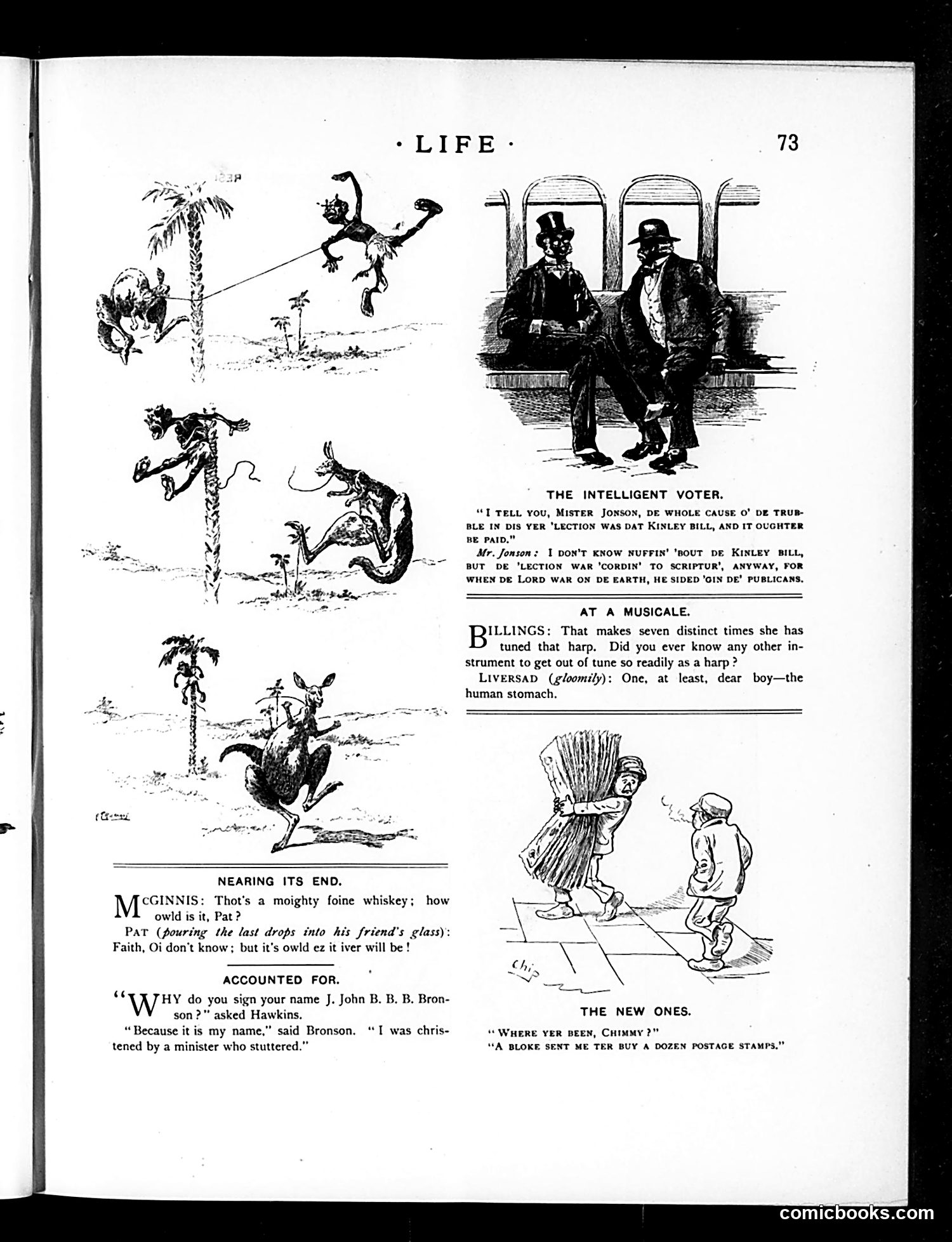
**"The Intelligent Voter"** depicts two well-dressed men discussing political corruption. One references the "Kinley Bill" and mentions "Election War" and scriptural language ("'dis' de publicians"), suggesting a satirical commentary on politicians using religious rhetoric to justify questionable legislation while extracting bribes. **"Nearing Its End"** shows monkeys swinging from palm trees in escalating desperation, titled as commentary on whiskey consumption—likely a temperance-era joke about alcohol's degrading effects. **"At a Musicale"** mocks a concert-goer for tuning a harp seven times, with the punchline that only the "human stomach" achieves such ready adjustment—social satire on amateur musicians. The remaining sketches are brief humorous quips with minimal context visible.
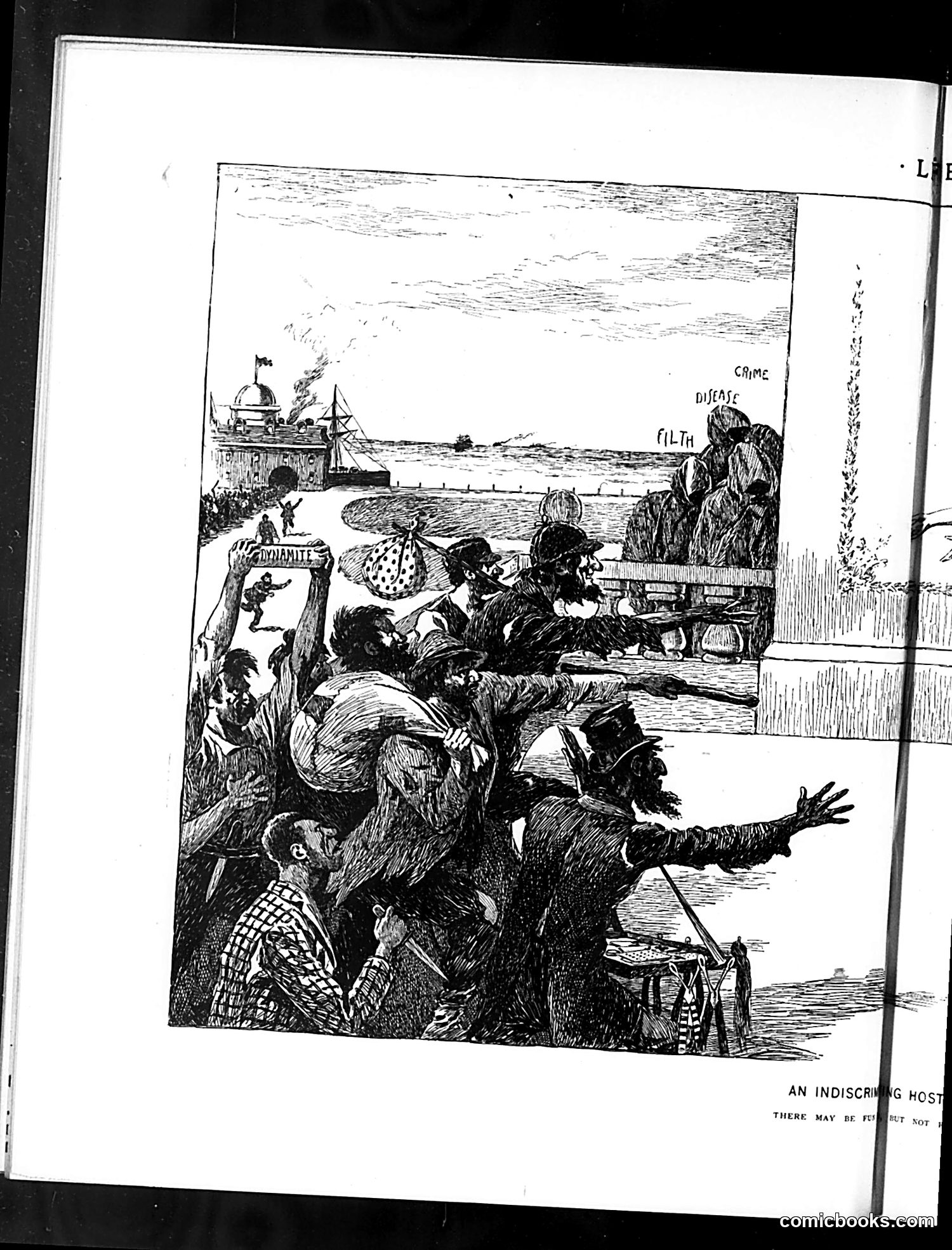
This satirical illustration depicts a crowded waterfront scene with multiple labeled social ills: "CRIME," "DISEASE," and "FILTH." The composition shows what appears to be immigrants or working-class people at a harbor or dock, with ships visible in the background. The labels suggest this cartoon critiques urban conditions in American port cities—likely commentary on 19th-century immigration concerns and poor sanitation. The title "AN INDISCRIMINATING HOST" (partially visible) implies the cartoon addresses America's immigration policy or reception of newcomers. The crowded, chaotic composition visually reinforces the satirist's message about urban overcrowding and associated social problems blamed on immigration. This reflects common nativist sentiment of the era, expressing anxiety about new arrivals and their perceived association with urban decay.
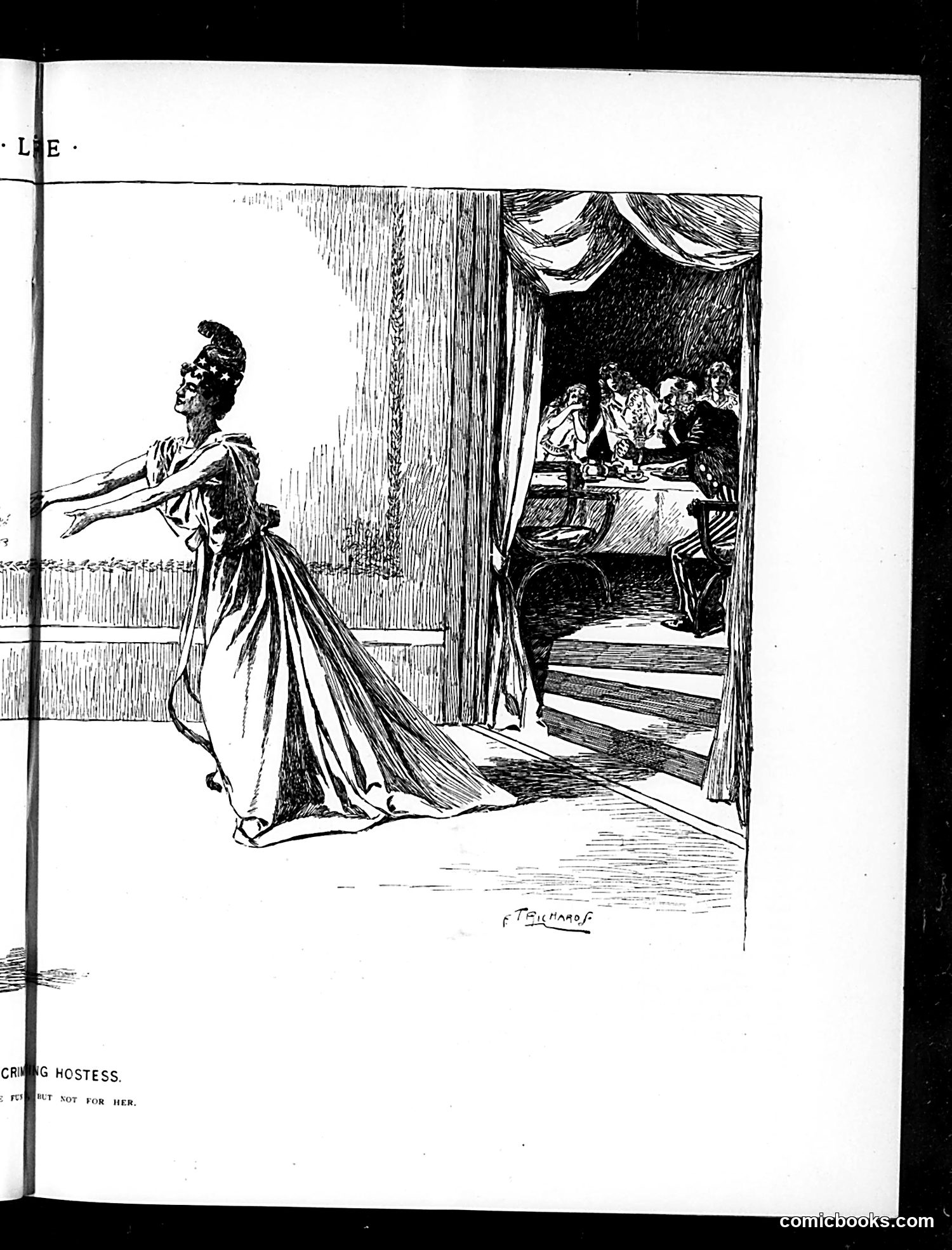
This satirical illustration depicts a woman in an elegant gown gesturing toward a formal dinner party visible through an open doorway. The caption reads "PRESIDING HOSTESS" with the subtitle "A JEST NOT FOR HER." The cartoon appears to satirize upper-class social pretension. The elegantly dressed woman, positioned prominently in the foreground, is literally "presiding" over the dinner—yet the jest suggests her role as hostess is merely performative or ironic. The humor likely mocks the artificiality of society hostessing, where elaborate appearances and formal positioning matter more than genuine hospitality or meaningful contribution. The artist's signature (appears to read "Trigunaert") is visible at bottom. The image critiques shallow social conventions of the period among wealthy Americans.
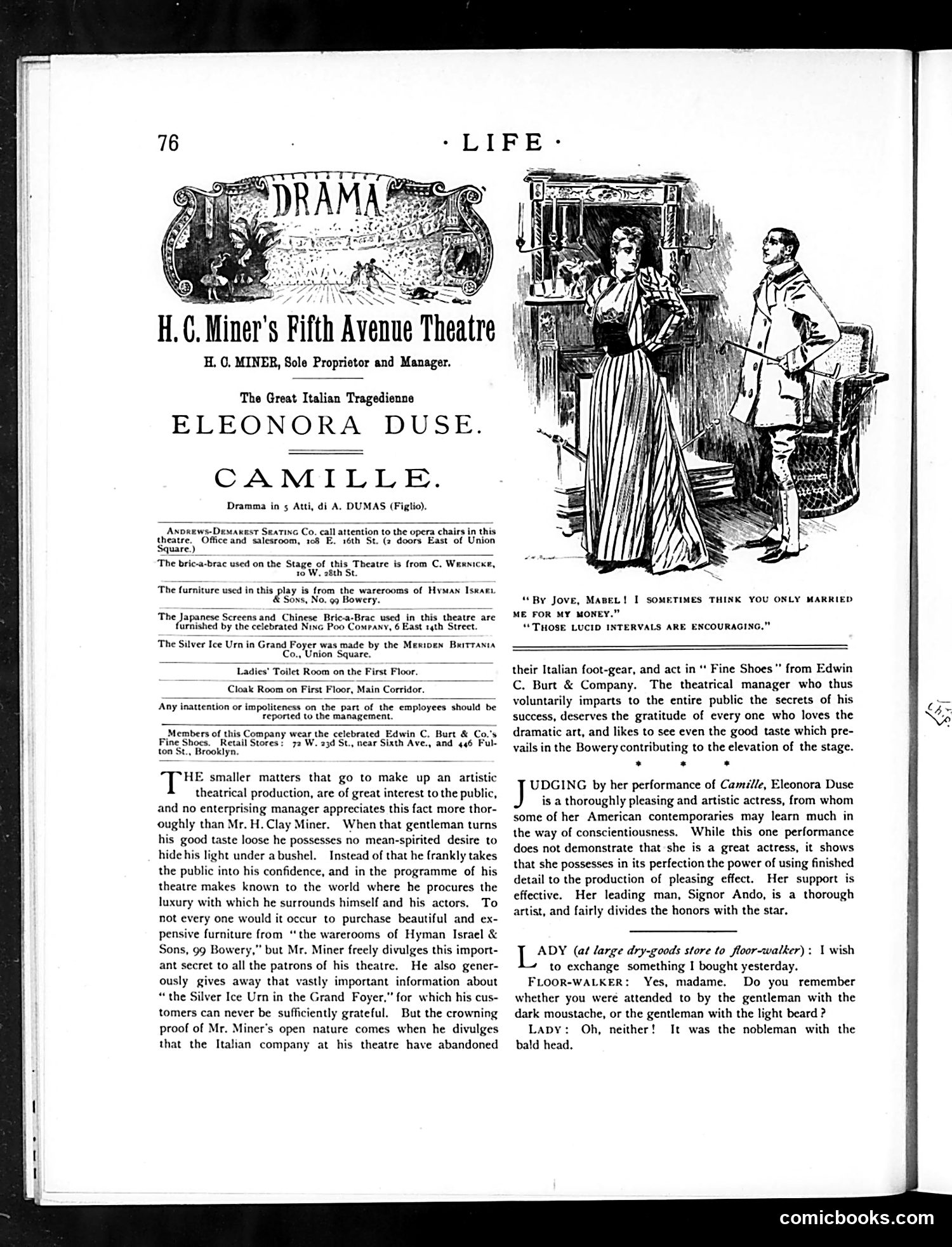
This page is primarily **theatrical advertising and review**, not political satire. It announces Italian actress Eleonora Duse performing in "Camille" at H.C. Miner's Fifth Avenue Theatre. The **main satirical content** is the lengthy middle article mocking theater manager Miner's excessive product placement in his program. Life ridicules how Miner shamelessly advertises every supplier (furniture from Hyman Israel & Sons, shoes from Edwin C. Burt & Company, etc.), treating the program like a commercial catalog. The satire suggests Miner prioritizes sponsors' credit over artistic integrity. The **cartoon** (upper right) and **two comic exchanges** below it are separate humor pieces unrelated to the theater review—typical filler for the magazine. The implication: a mid-19th-century theater manager so eager to please advertisers that he turns his program into a walking advertisement, betraying artistic pretensions for commercial gain.
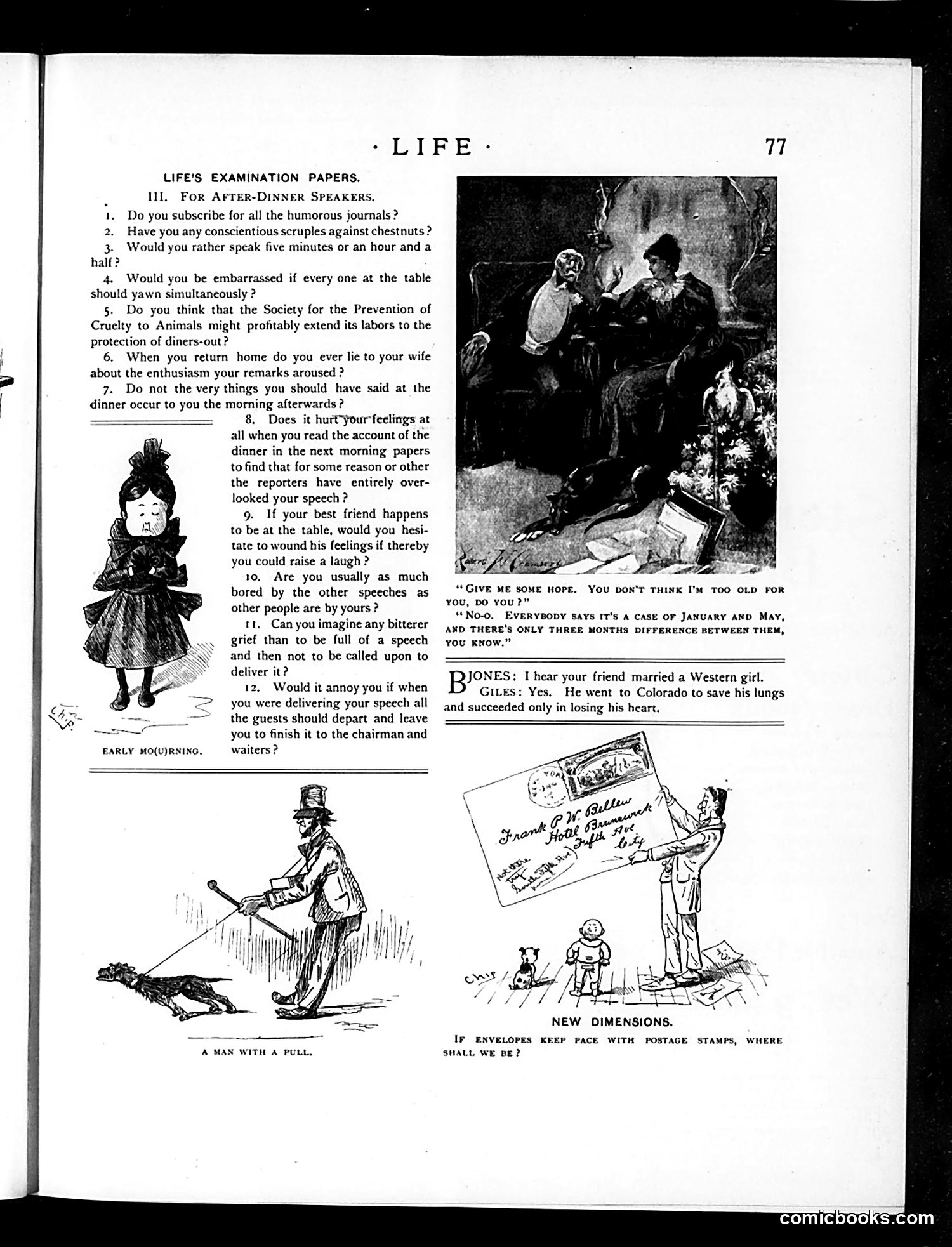
This page satirizes the tedious convention of after-dinner speeches in early 20th-century social gatherings. The "examination paper" format humorously interrogates speakers' vanity and obliviousness—questioning whether they subscribe to humor magazines, lie about their speech's reception, feel wounded when newspapers omit coverage of their remarks, or would annoy guests by continuing after everyone leaves. The accompanying illustrations reinforce the mockery: "Early Morning" shows a woman's dismay (presumably regretting witty remarks she failed to deliver), while "A Man with a Full" depicts someone dragging a reluctant dog, paralleling the forced captive audience enduring a dinner speech. The dialogue snippets mock romantic conventions (age-gap relationships) and common platitudes. "New Dimensions" jokes about inflation: if postage stamps keep growing proportionally with envelope sizes, spatial absurdity results. The page's humor targets bourgeois social pretension and the universal boredom of obligatory public speaking.
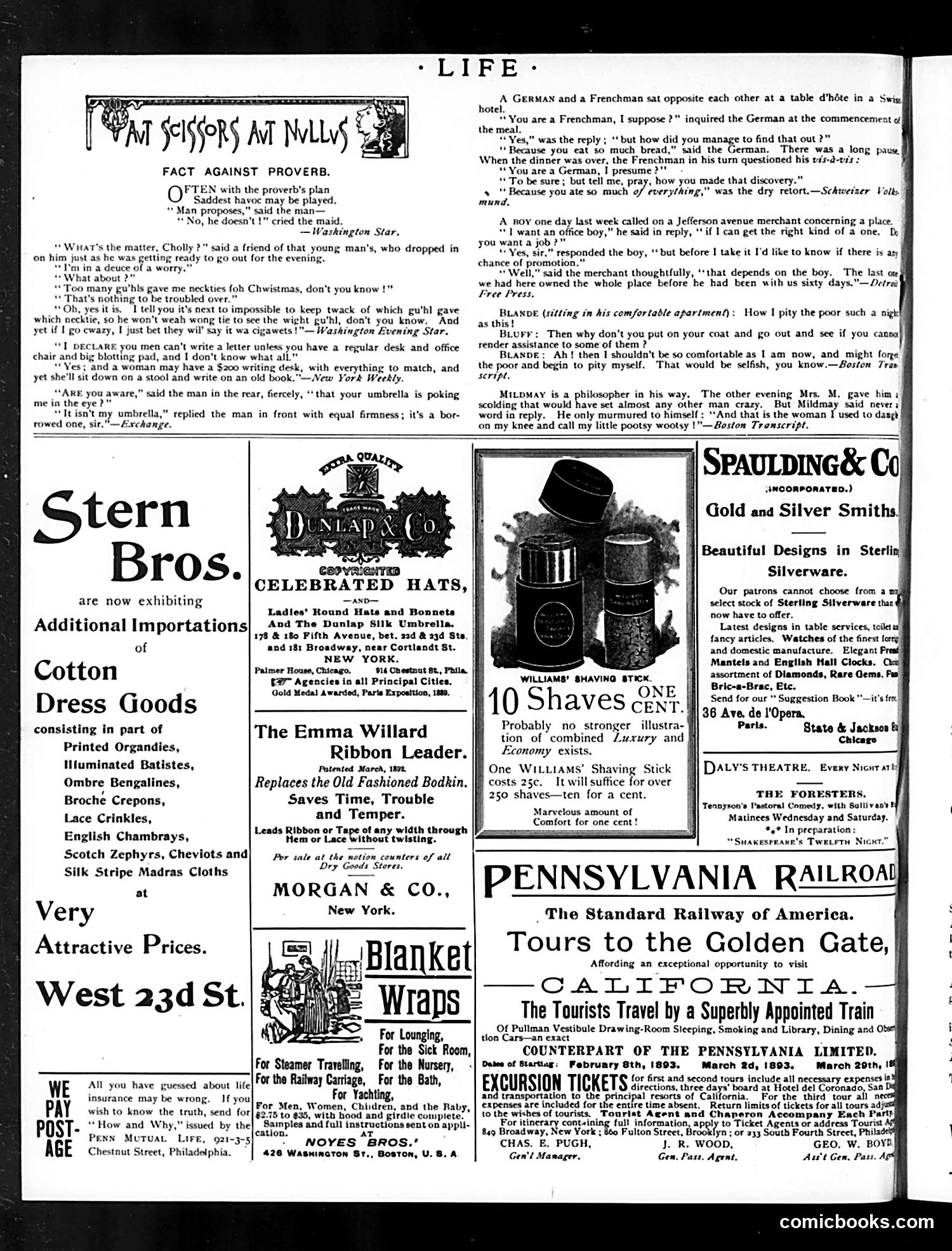
This page contains several short humorous anecdotes mocking social conventions and human nature, typical of *Life* magazine's satirical format. **"Fact Against Proverb"** jokes about the saying "Man proposes, God disposes"—a woman contradicts the man's proposal, inverting the proverb. **The main cartoons** satirize genteel upper-class anxieties: a young man fretting over multiple girlfriends' Christmas neckties (worried about wearing the "wrong" tie to each girl); complaints about needing proper desks to write letters; umbrella disputes on public transport. **"The German and Frenchman"** is a national stereotype joke playing on food consumption—Germans supposedly eat everything, Frenchmen eat lots of bread—both equally gluttonous. **"Blande" and "Bluff"** satirize performative charity: a comfortable man pities the poor from his apartment but won't actually help, afraid of discomfort. These pieces mock bourgeois pretension, romantic entanglements, and hypocritical sympathy—common *Life* targets of the era.
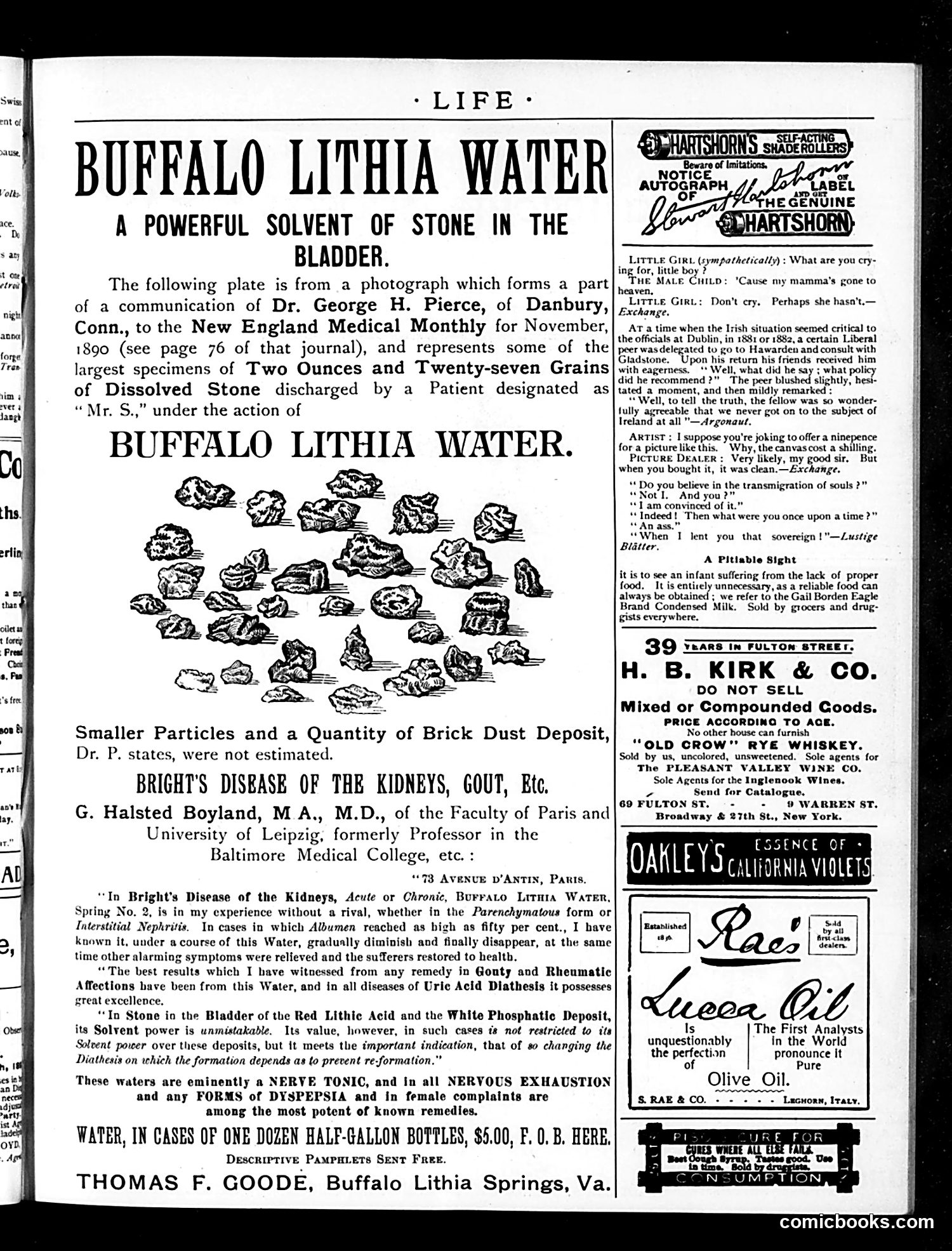
This page is primarily **pharmaceutical advertising** for Buffalo Lithia Water, a patent medicine marketed to dissolve kidney stones. The dramatic image shows actual stone specimens allegedly expelled by a patient, presented as medical evidence. Accompanying testimonials from European doctors claim the water cures Bright's Disease, gout, and nervous exhaustion—typical claims for mineral spring remedies of this era. The page also contains **brief humorous anecdotes** in the margins: children's jokes about death and heaven, an Irish political reference mocking Gladstone's pleasantness, and witticisms about art and philosophy. **For modern readers**: This reflects the pre-FDA era when unregulated patent medicines made dramatic medical claims without scientific proof. The stone specimens represent the kind of visual "evidence" manufacturers used to convince desperate patients.
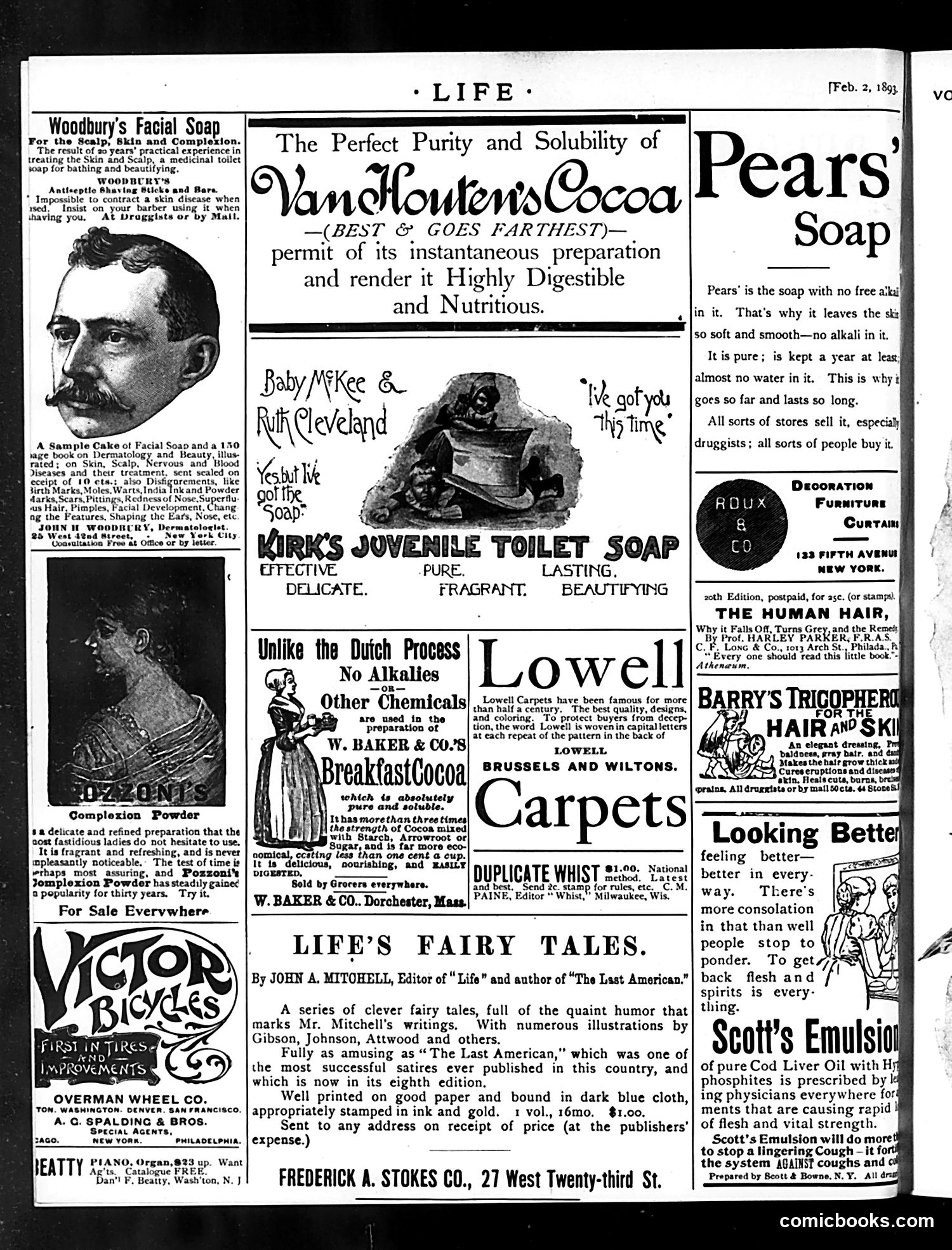
This page is primarily **advertising**, not political satire. It contains product advertisements typical of 1890s American magazines: soaps (Woodbury's, Pears', Kirk's), cocoa (Van Houten's, Baker's), carpets (Lowell), and patent medicines (Scott's Emulsion, Barry's Tricopherous). The only editorial content is an announcement for **"Life's Fairy Tales"** by John A. Mitchell, the magazine's editor, described as humorous satirical tales "as amusing as 'The Last American.'" The ad notes this was a successful earlier satire published in eight editions. There are **no political cartoons** visible. Two portraits appear—likely of Baby McKee and Ruth Cleveland (identifiable by the caption), possibly referencing contemporary public figures—but they lack satirical commentary. The page reflects Gilded Age consumer culture and the magazine's reliance on advertising revenue rather than offering social/political commentary.