
Life, 1893-02-02 · page 4 of 16
Life — February 2, 1893 — page 4: what you’re looking at
What you’re looking at
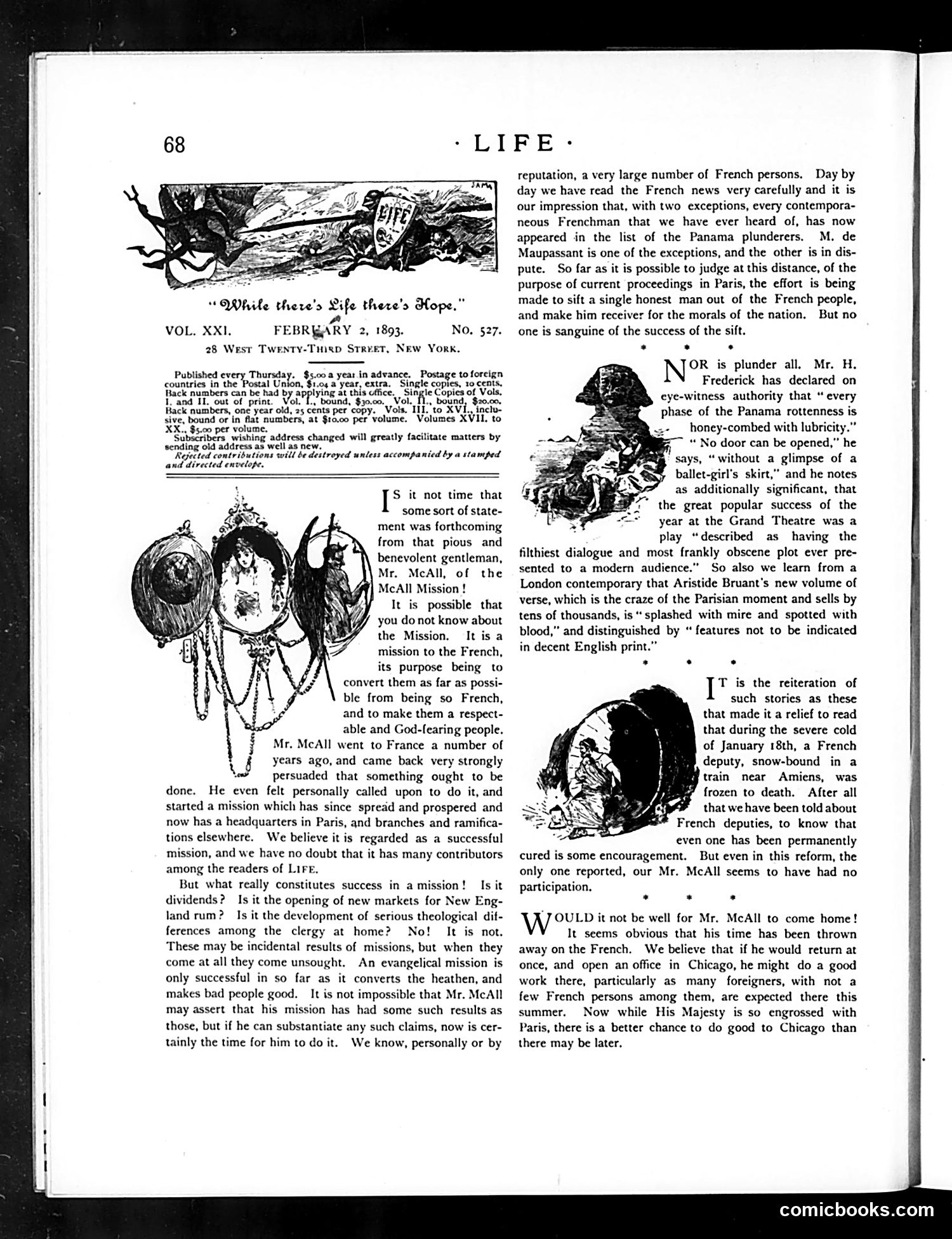
This page critiques **Mr. McAll's missionary work in France**. The text expresses skepticism about converting French citizens to Protestant Christianity, questioning whether such missions actually produce meaningful religious conversion versus merely spreading Anglo-American influence. The **three decorative illustrations** (ornamental vignettes) appear to be period artistic flourishes rather than political cartoons with specific identifiable figures. The article's satire targets the assumption that missionary work equals genuine spiritual success. It suggests McAll's Paris-based mission diverts resources from more practical domestic needs (like Chicago) and questions whether converting "the French" to "respectable and God-fearing people" is either achievable or desirable—a tongue-in-cheek dig at American Protestant cultural imperialism and French secularism.
📄 Transcribed text from this page (OCR, searchable)
Machine-transcribed from the original scan — historical spelling and the odd misread are preserved.
- LIFE: A VOL. XXI. FEBRKARY 2, 1893. No. 527. 28 West Twenty-Tinep Street, New York. Published every Thursday. $5.00 a year in advance. Postage toforeign countries in the Postal Union, $1.04 a year, extra. Single copies, 10 cents, Back numbers can be had by applying at this office. ingle Copies of Vols. J. and IL. out of print fol. I., bound, $30.00. Vol. fl., bound, $20. Back numbers, one year old, 25 cents per copy. Vols. III. to XVI. inclu- sive, bound or in flat numbers, at $10.00 per volume. Volumes XVII. to XX. X., $5.00 per volume. ; Subscribers wishing address changed will greatly facilitate matters by sending old address as well as new. " Rejected contributions will be destroyed untess accompanied by a stamped and directed envelope, S it not time that some sort of state- ment was forthcoming from that pious and benevolent gentleman, Mr. McAll, of the McAll Mission ! It is possible that you do not know about the Mission. It is a mission to the French, its purpose being to convert them as far as possi- ble from being so French, and to make them a respect- able and God-fearing people. Mr. McAll went to France a number of % § years ago, and came back very strongly ‘= persuaded that something ought to be done. He even felt personally called upon to do it, and started a mission which has since spread and prospered and now has a headquarters in Paris, and branches and ramifica- tions elsewhere. We believe it is regarded as a successful mission, and we have no doubt that it has many contributors among the readers of LIFE. But what really constitutes success in a mission! dividends? Is it the opening of new markets for New Eng- land rum? Is it the development of serious theological dif- ferences among the clergy at home? No! It is not. These may be incidental results of missions, but when they come at all they come unsought. An evangelical mission is only successful in so far as it converts the heathen, and makes bad people good. It is not impossible that Mr. McAll may assert that his mission has had some such results as those, but if he can substantiate any such claims, now is cer- tainly the time for him to do it. We know, personally or by Is it reputation, a very large number of French persons. Day by day we have read the French news very carefully and it is our impression that, with two exceptions, every contempora- neous Frenchman that we have ever heard of, has now appeared in the list of the Panama plunderers. M. de Maupassant is one of the exceptions, and the other is in dis- pute. So far as it is possible to judge at this distance, of the purpose of current proceedings in Paris, the effort is being made to sift a single honest man out of the French people, and make him receiver for the morals of the nation, But no one is sanguine of the success of the sift. . . . OR is plunder all, Mr. H. Frederick has declared on eye-witness authority that “every phase of the Panama rottenness is honey-combed with lubricity.” No door can be opened,” he says, “without a glimpse of a ballet-girl’s skirt,” and he notes as additionally significant, that the great popular success of the year at the Grand Theatre was a play “described as having the filthiest dialogue and most frankly obscene plot ever pre- sented to a modern audience.” So also we learn from a London contemporary that Aristide Bruant’s new volume of verse, which is the craze of the Parisian moment and sells by tens of thousands, is “ splashed with mire and spotted with blood,” and distinguished by “features not to be indicated in decent English print.” . . T is the reiteration of such stories as these that made it a relief to read that during the severe cold of January 18th, a French deputy, snow-bound in a train near Amiens, was frozen to death. After all that we have been told about French deputies, to know that even one has been permanently cured is some encouragement. But even in this reform, the only one reported, our Mr. McAll seems to have had no participation. * . . J OULD it not be well for Mr. McAll to come home! It seems obvious that his time has been thrown away on the French. We believe that if he would return at once, and open an office in Chicago, he might do a good work there, particularly as many foreigners, with not a few French persons among them, are expected there this summer. Now while His Majesty is so engrossed with Paris, there is a better chance to do good to Chicago than there may be later. comicbooks.com