
A complete issue · 60 pages · 1893
Life — January 5, 1893
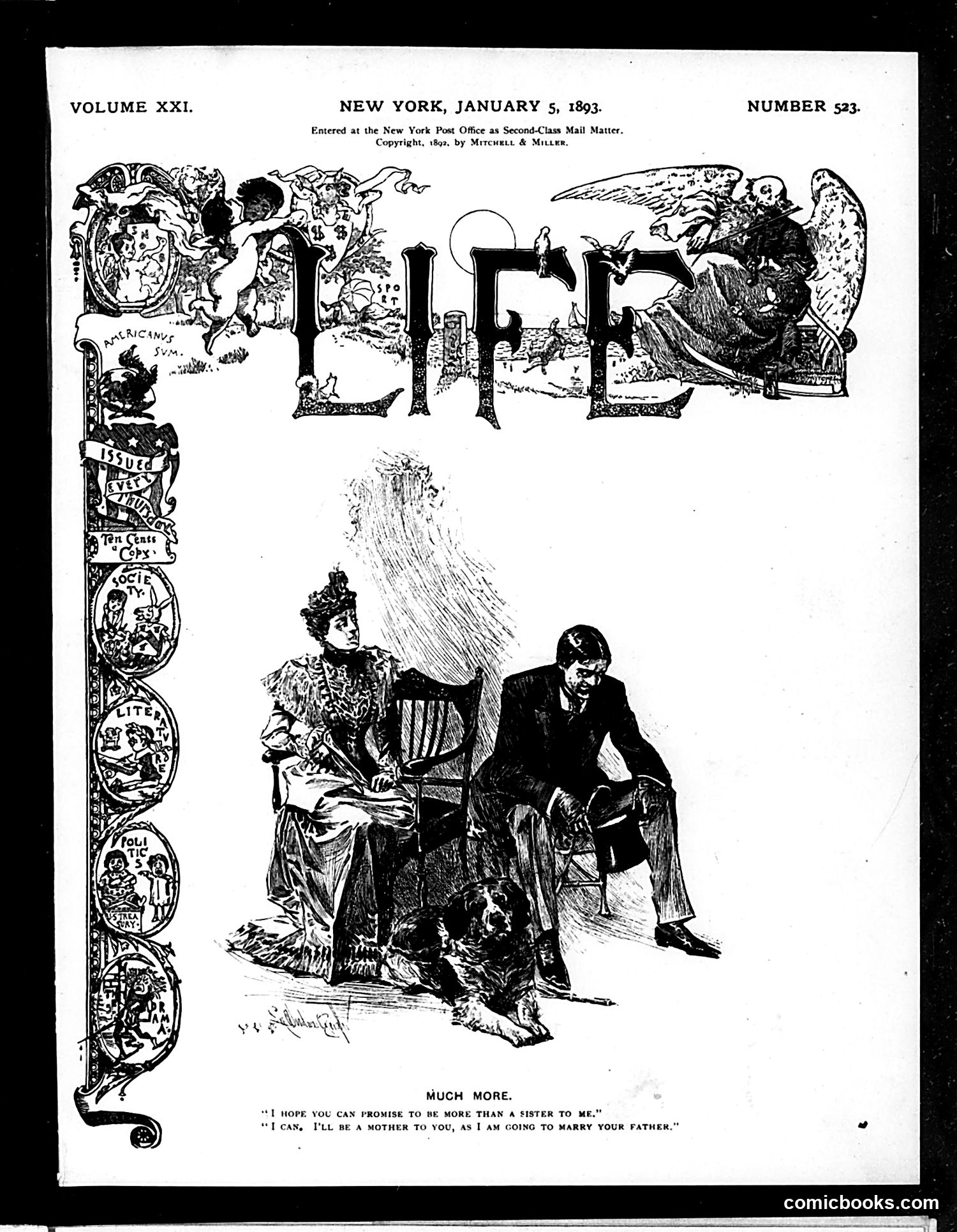
This satirical cartoon depicts a domestic scene with dialogue at the bottom: "I hope you can promise to be more than a sister to me." / "I can, I'll be a mother to you, as I am going to marry your father." The joke centers on a woman's promise to become more than a sister-figure to a man—she'll actually become his stepmother by marrying his father. This is a play on the Victorian-era romantic phrase "more than a sister," which typically implied romantic devotion. The humor lies in the literal, practical interpretation: she's offering an actual familial relationship that supersedes the suggested romantic one. The ornamental left border contains circular vignettes typical of Life's decorative style.
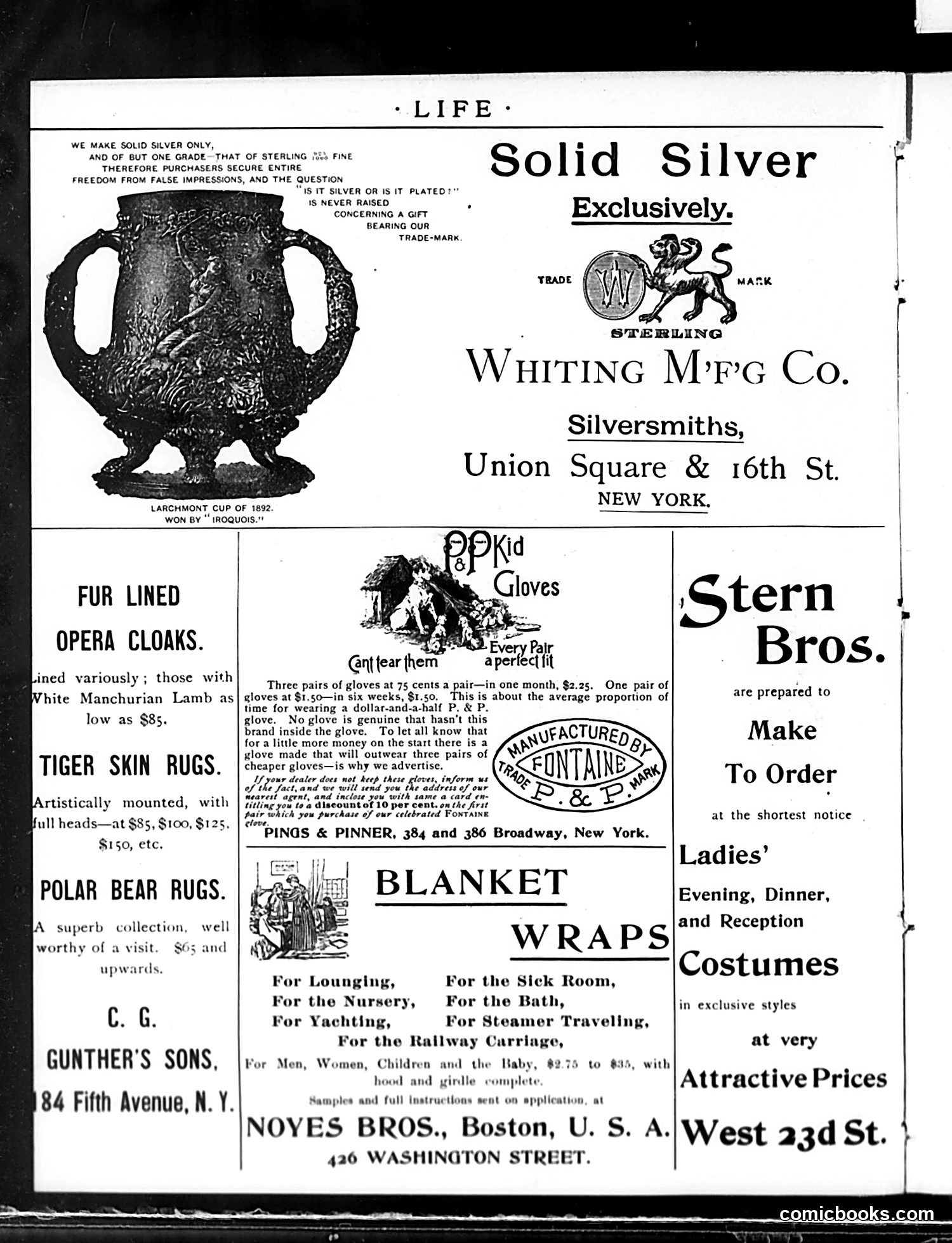
This page is primarily **advertising**, not satire or political commentary. It contains luxury product advertisements from late 19th/early 20th century New York businesses: - **Whiting MFG Co.**: Sterling silver goods (showing the "Larchmont Cup of 1892") - **Stern Bros.**: Custom ladies' evening wear - **Noyes Bros.**: Blanket wraps for various purposes - **Gunther's Sons**: Fur rugs (tiger skin, polar bear) - **Fontaine**: Kid gloves The only illustration with narrative content is a small sketch accompanying the glove advertisement, showing what appears to be a domestic scene, though its specific meaning is unclear from this context. The page reflects **Gilded Age consumer culture**: luxury goods marketed to wealthy New Yorkers, emphasizing exclusivity and quality craftsmanship. No political satire is evident.
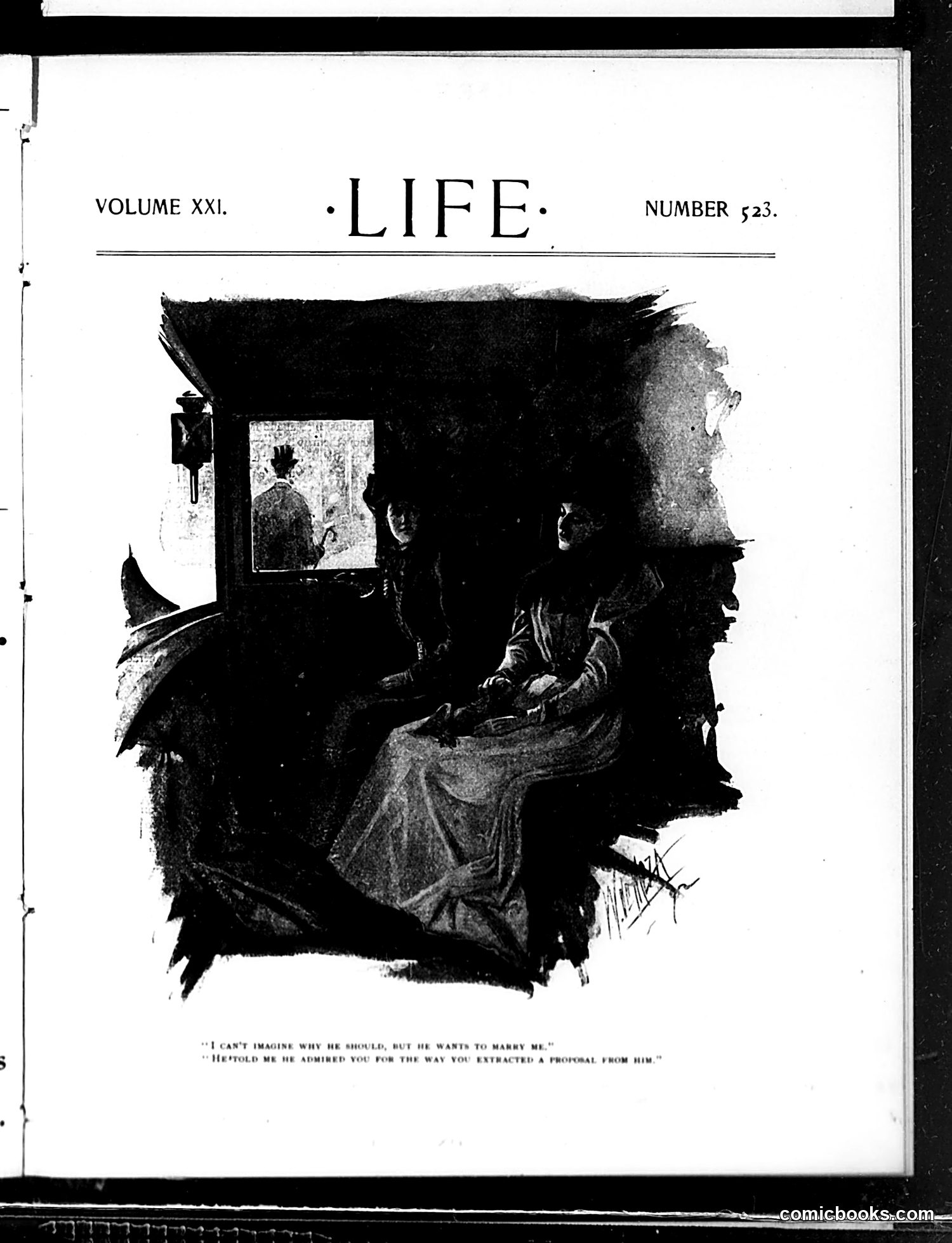
This cover presents a silhouette composition showing a woman's profile containing a domestic scene. The caption reads: "I can't imagine why he should, but he wants to marry me. He told me he admired you for the way you extracted a proposal from him." The satire critiques early 20th-century courtship dynamics and female manipulation. The joke suggests the woman being addressed successfully manipulated a man into proposing, and now another woman is copying her tactics—implying women deliberately "extract" marriage proposals through calculated behavior rather than genuine romantic connection. The silhouette technique cleverly visualizes how women's interior thoughts and schemes were perceived during this era. The humor reflects contemporary anxieties about female agency and marriage negotiations in the pre-WWI period.
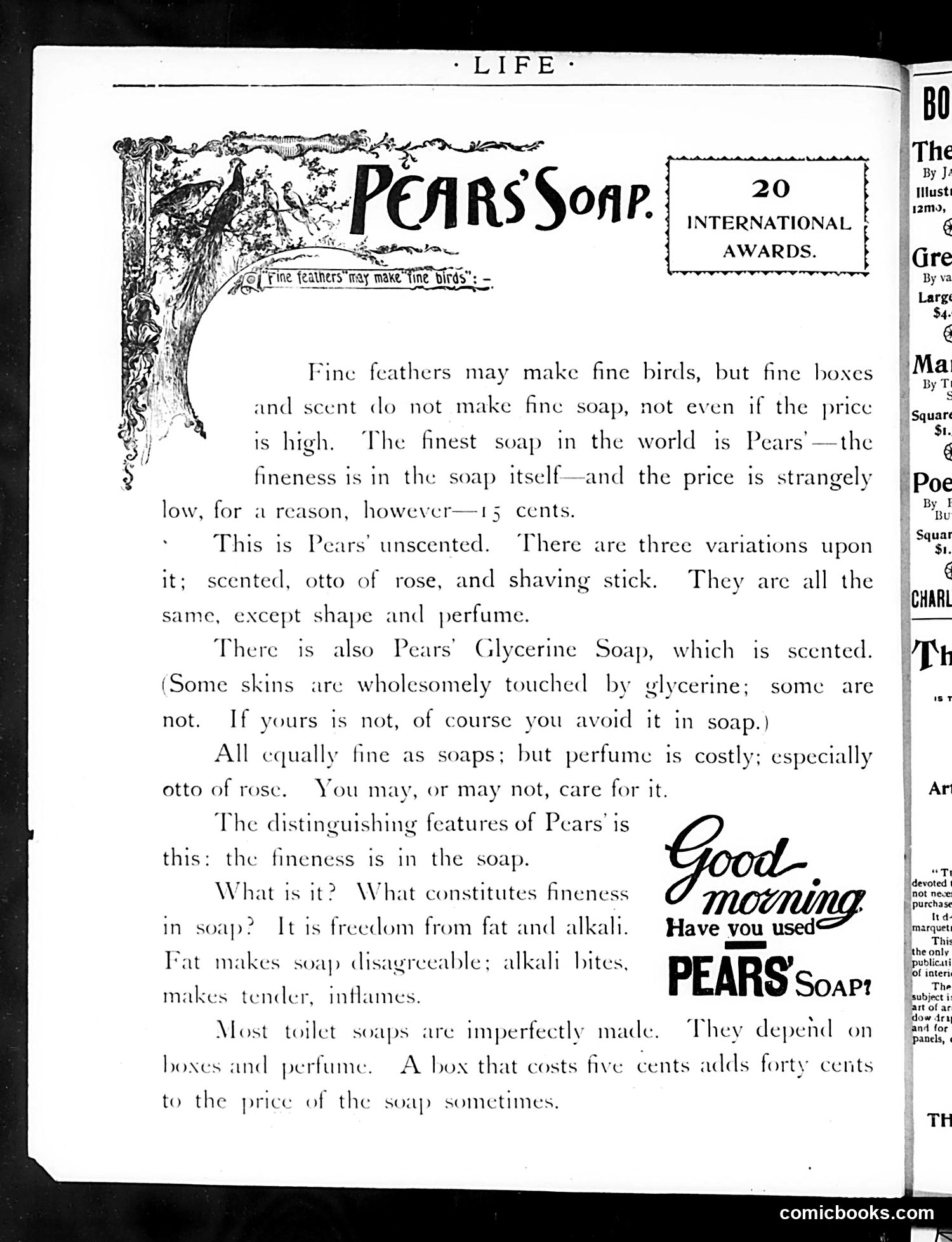
This is primarily a **product advertisement** rather than political satire. The page promotes Pears' Soap, which had won "20 International Awards" (noted in the box). The accompanying illustration shows a tree branch with birds, accompanying the slogan "Fine feathers may make fine birds." The ad uses this to argue that superior quality lies in the soap itself, not packaging or perfume—unlike competitors who charge extra for boxes and scent. The text emphasizes that Pears' costs only 15 cents because its "fineness is in the soap itself," and boasts freedom from fat and alkali that make other soaps disagreeable. This appears designed to position Pears as an honest, value-focused alternative to fancier competitors relying on marketing gimmicks.
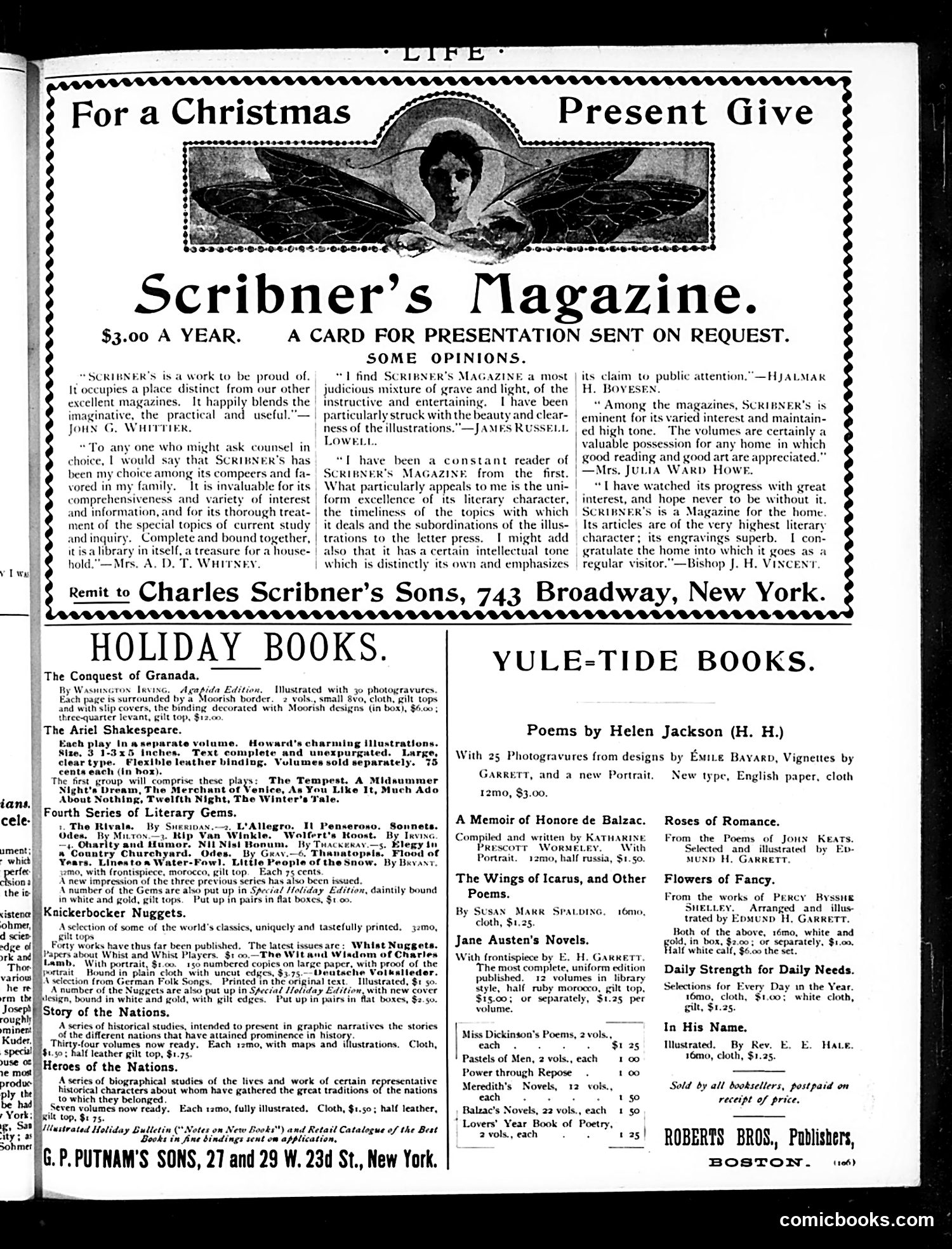
This page is primarily **advertising content**, not satirical cartoons. It consists entirely of book advertisements and promotional material for publications and services, including: - Holiday gift book recommendations (children's literature, poetry collections) - F. Marion Crawford's novel "Don Orsino" - "The Decorator and Furnisher" magazine subscription promotion - Frederick A. Stokes Company publishing advertisements There are **no political cartoons or caricatures** visible on this page. The layout and typography reflect a typical early-20th-century magazine advertisement section, mixing literary promotions with home furnishing and art journal advertisements. This appears to be a straightforward commercial page rather than satirical editorial content.
This page is primarily **advertising for Harper's periodicals** (Magazine, Bazaar, Young People, and Weekly) for 1893. The text lists upcoming content including serialized novels, articles on fashion and cooking, coverage of the Columbian Exposition in Chicago, and illustrations of Shakespeare's comedies. There are **no visible political cartoons or satirical illustrations** on this page that I can discern from the image. The page functions as a promotional catalog describing Harper Brothers' publications' features and subscription rates ($4.00 per year for most titles). The only potentially notable content is mention of coverage of "Political Events of the year," suggesting Harper's Weekly would document contemporary political news, but no specific satire or cartoon commentary is visible here.
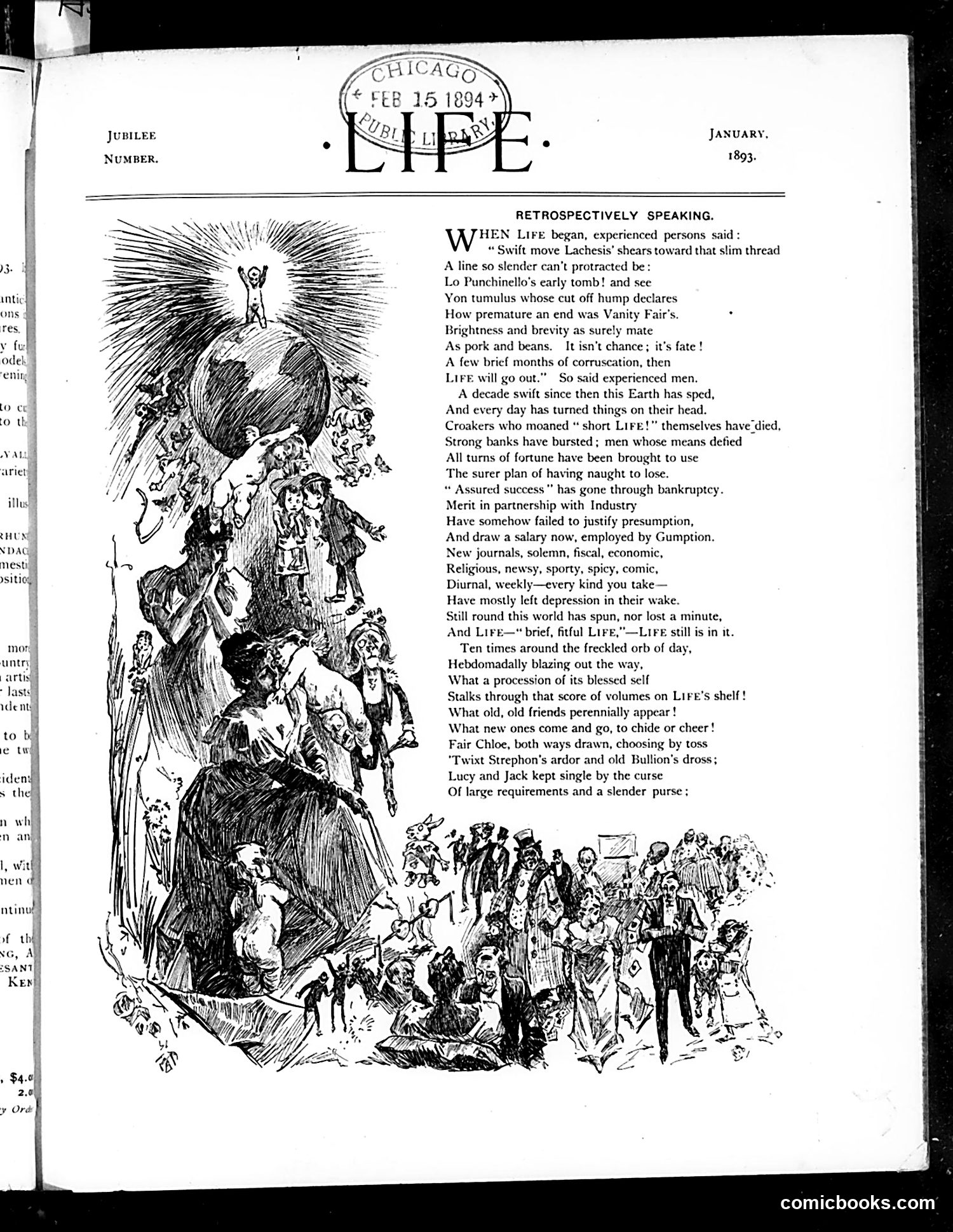
This satirical poem reflects on the past decade's impact on "Life" itself—the magazine's ten-year anniversary. The central illustration depicts "Life" as a figure ascending or emerging from a chaotic mass of humanity below. The poem's tone is sardonic about progress: it references social turbulence ("Assured success has gone through bankruptcy"), journalistic proliferation ("New journals, solemn, fiscal, economic"), and the brevity of trends ("Religious, newsy, sporty, spicy, comic"). The crowded base suggests Life's engagement with 1880s-90s American society—depicting various social types and classes. The piece cynically suggests that despite claims of advancement and the magazine's own survival, the underlying condition of life remains fundamentally unchanged, with constant upheaval replacing genuine progress.
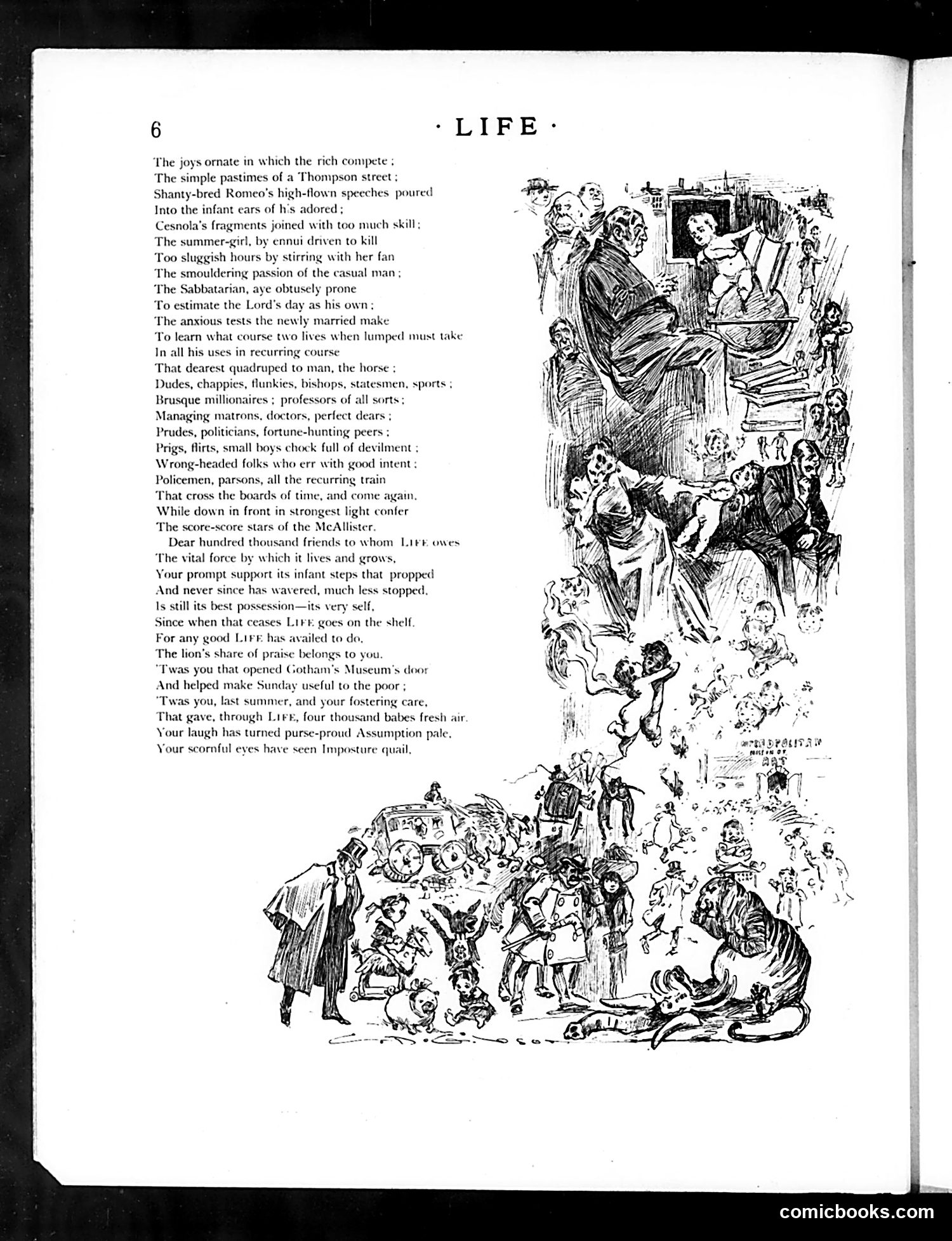
This page presents a satirical poem titled "Life" alongside an elaborate illustration depicting various social types and activities. The poem catalogs the diverse pursuits and characters that comprise urban society—from wealthy competitors and street life to politicians, fortune-hunters, and working-class figures. The accompanying illustration functions as visual satire, showing a crowded, chaotic scene of different social classes and professions intermingling. The dense composition emphasizes the interconnectedness and absurdity of contemporary society. The poem's concluding stanzas address "Life" itself as a vital force, crediting it with inspiring philanthropy and cultural institutions (mentioning Gotham's Museum). The overall effect mocks the pretensions and contradictions of late-19th/early-20th-century American society while celebrating its vibrant complexity.
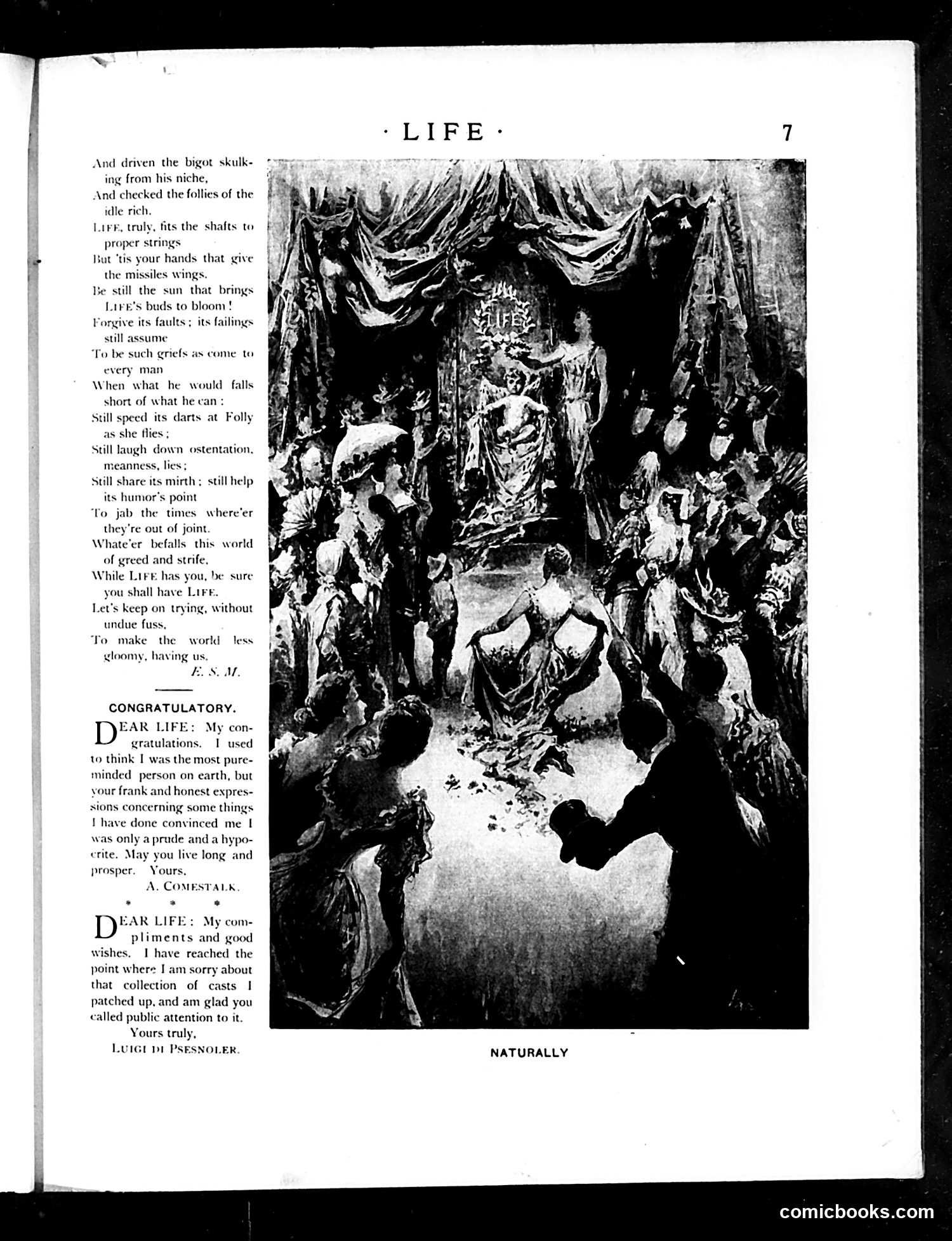
The page contains a poem titled "LIFE" (left column) followed by two congratulatory letters to "LIFE" magazine praising its honesty and editorial work. The large illustration labeled "NATURALLY" depicts an ornate theatrical scene with elaborate drapery and a crowd of figures. The composition suggests a satirical commentary on theatrical excess or pretension, though the specific subject isn't entirely clear from the image alone. Without additional context about the magazine's publication date or the poem's subject matter, the precise satirical target remains unclear. The image appears to mock either theatrical conventions, social hypocrisy, or popular entertainment trends of its era, but identifying the specific figures or events referenced would require more information.
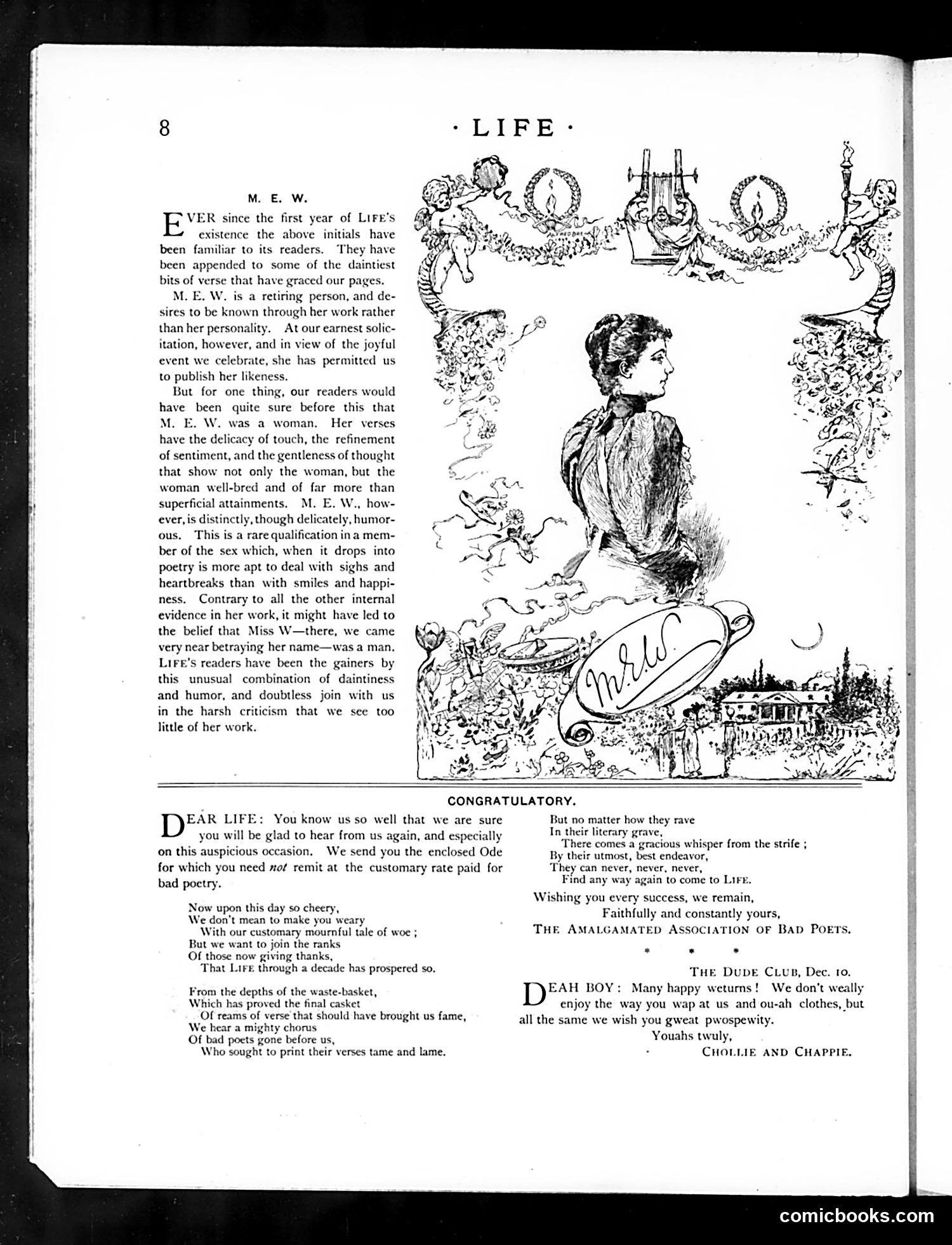
This page introduces **M. E. W.** (initials only; the author's full identity is not stated), a retiring poet whose work has appeared in *Life* magazine. The text notes she is a woman—apparently a surprise to readers who might have assumed otherwise from the initials alone. The accompanying illustration shows a portrait of M. E. W. surrounded by decorative cherubs and classical imagery, suggesting her refined, sentimental poetic style. Below are congratulatory verses from reader groups: "The Amalgamated Association of Bad Poets" and "The Dude Club" offer humorous mock-serious salutations wishing her success, with playful jabs at bad poetry and literary pretension typical of *Life*'s satirical humor. This appears to be a celebratory feature rather than sharp political satire.
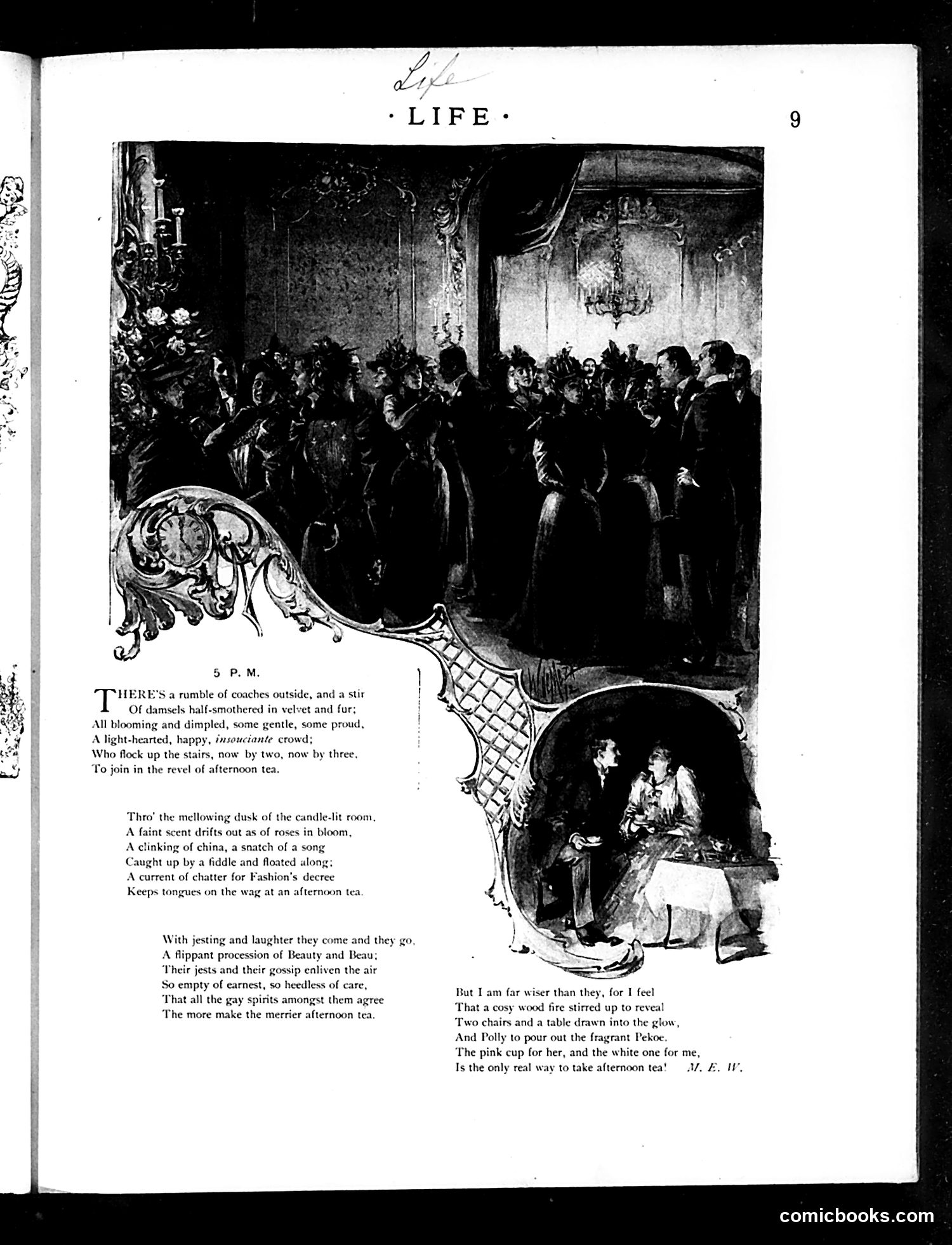
This page satirizes the social ritual of "afternoon tea" in Edwardian high society. The upper illustration shows a crowded, chaotic gathering of fashionably dressed socialites arriving at what appears to be an exclusive tea event — coaches and elegantly dressed attendees "flocking up the stairs, now by two, now by three." The poem mocks this scene as superficial: guests are described as "light-hearted" but "heedless of care," their chatter empty of substance. The lower vignette contrasts this with an intimate domestic scene — two people by a cozy fire, suggesting genuine comfort. The satire's point: the fashionable afternoon tea social event is pretentious and hollow, whereas a simple, honest tea at home is "the only real way to take afternoon tea." It critiques upper-class affectation through gentle mockery of social pretension.
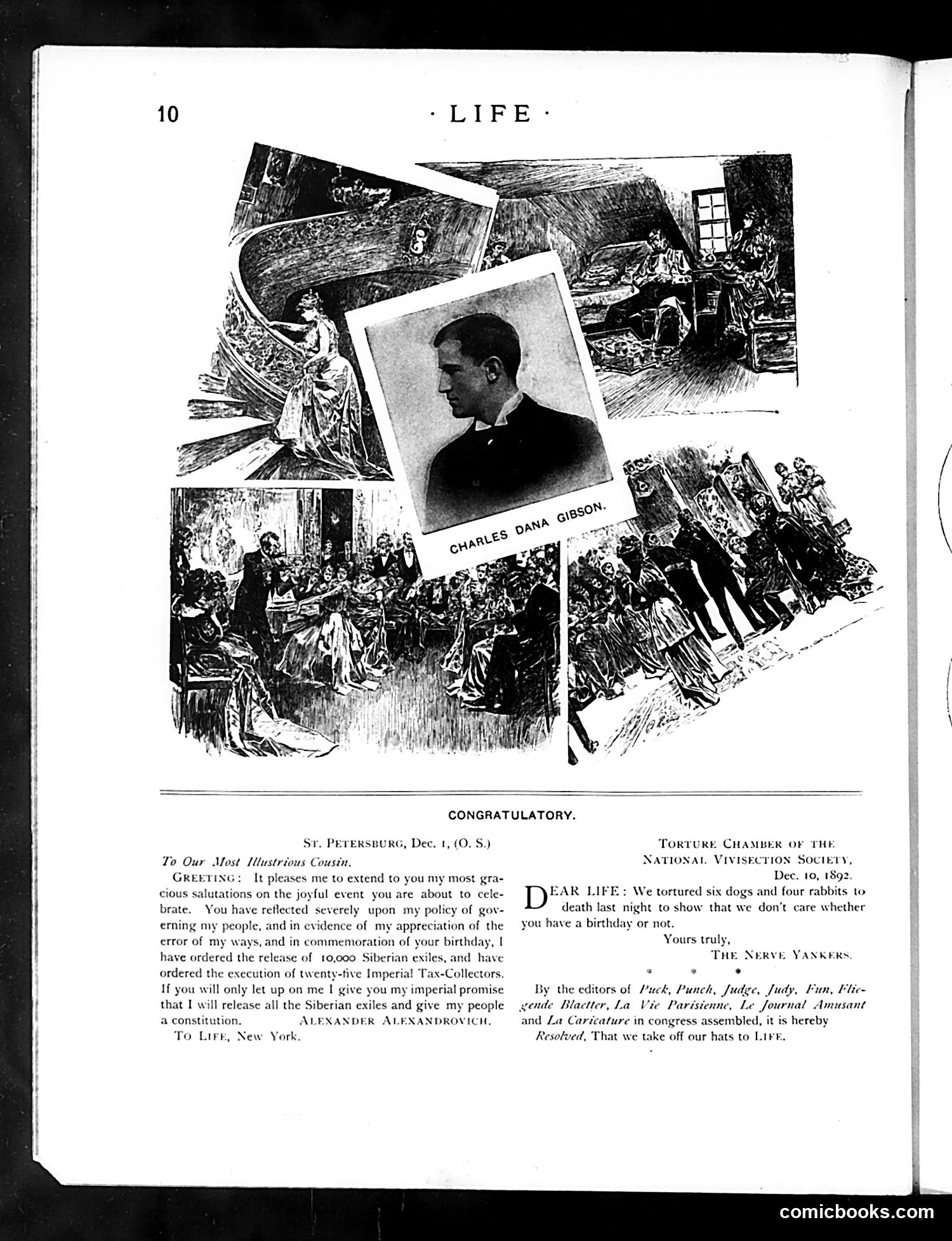
This page presents two satirical "congratulatory" letters mocking both Russian Tsar Alexander III and animal vivisection advocates. **The Russian Letter:** A fake letter from the Tsar to Life magazine offers mock-gracious concessions—releasing 10,000 Siberian exiles and executing 25 tax collectors—in response to Life's criticism of his authoritarian policies. The satire exposes the absurdity of his governance: he presents cruelty as magnanimity while simultaneously ordering executions. **The Vivisection Response:** The "Torture Chamber" letter from the "National Vivisection Society" sarcastically responds by torturing animals to show they're equally indifferent to moral criticism. This attacks both Russian despotism *and* contemporary animal experimentation practices—a live social debate in the 1890s. The juxtaposition equates the Tsar's political brutality with scientists' casual animal cruelty, suggesting both reflect the same callous disregard for suffering. The multiple magazine signatures underscore widespread editorial opposition to these practices.
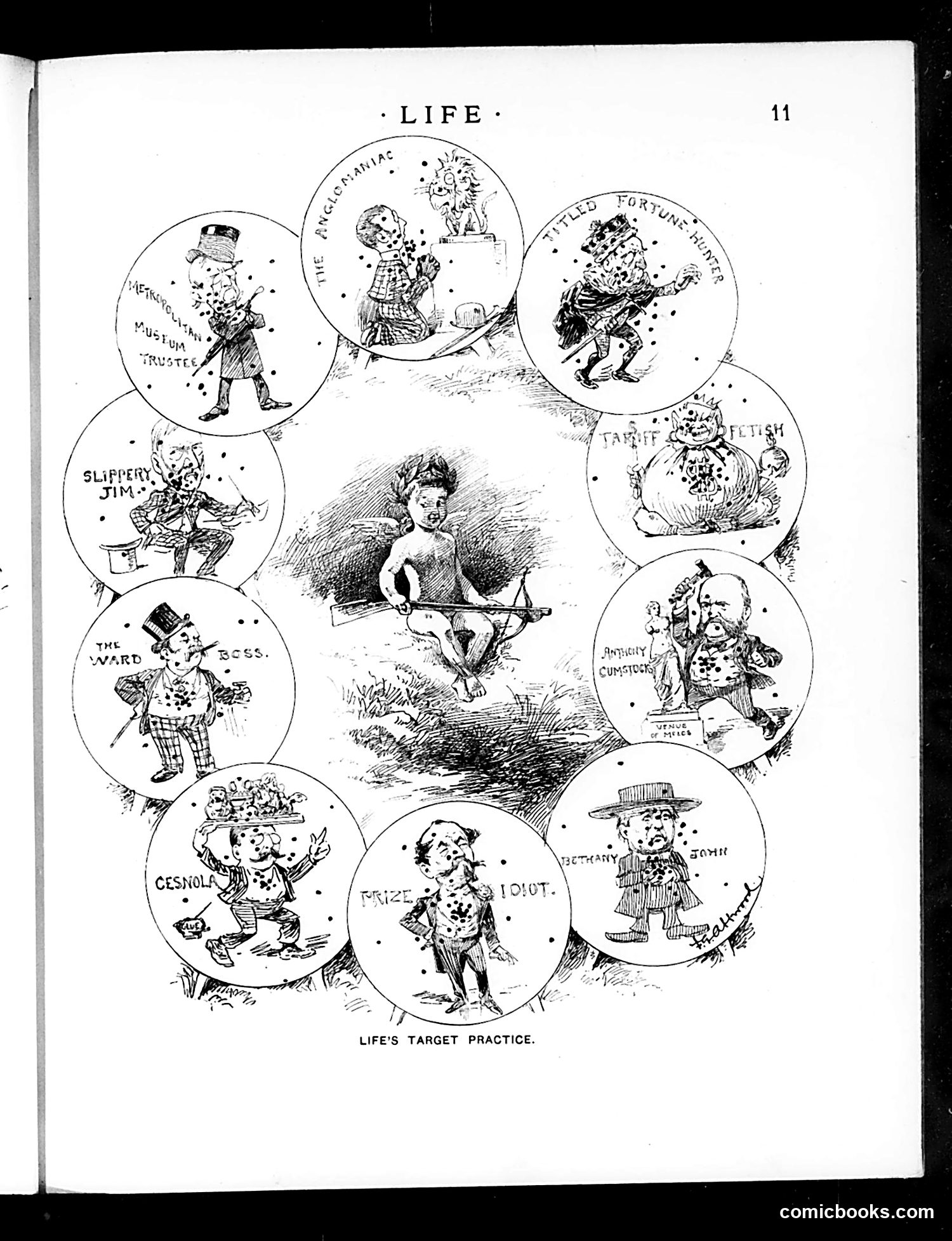
This satirical cartoon depicts Cupid (the central archer figure) using human character types as target practice. The circular "targets" surrounding him contain labeled caricatures representing various social archetypes or personality types that Life magazine's readers would recognize and ridicule: - "The Ward Boss" - "Slipper Jim" - "Museum Trustee" - "Prize Idiot" - "Bethany John" - "Cesnola" (likely a public figure) - "Tasty Flirtish" - "Swell Fortunehunter" - "Haughty Countess" The joke satirizes how romantic love indiscriminately "targets" all social types—wealthy, foolish, pretentious, and low-class alike. It's social commentary on how Cupid's arrow doesn't discriminate, mocking the various social stereotypes and character flaws of Gilded Age society.
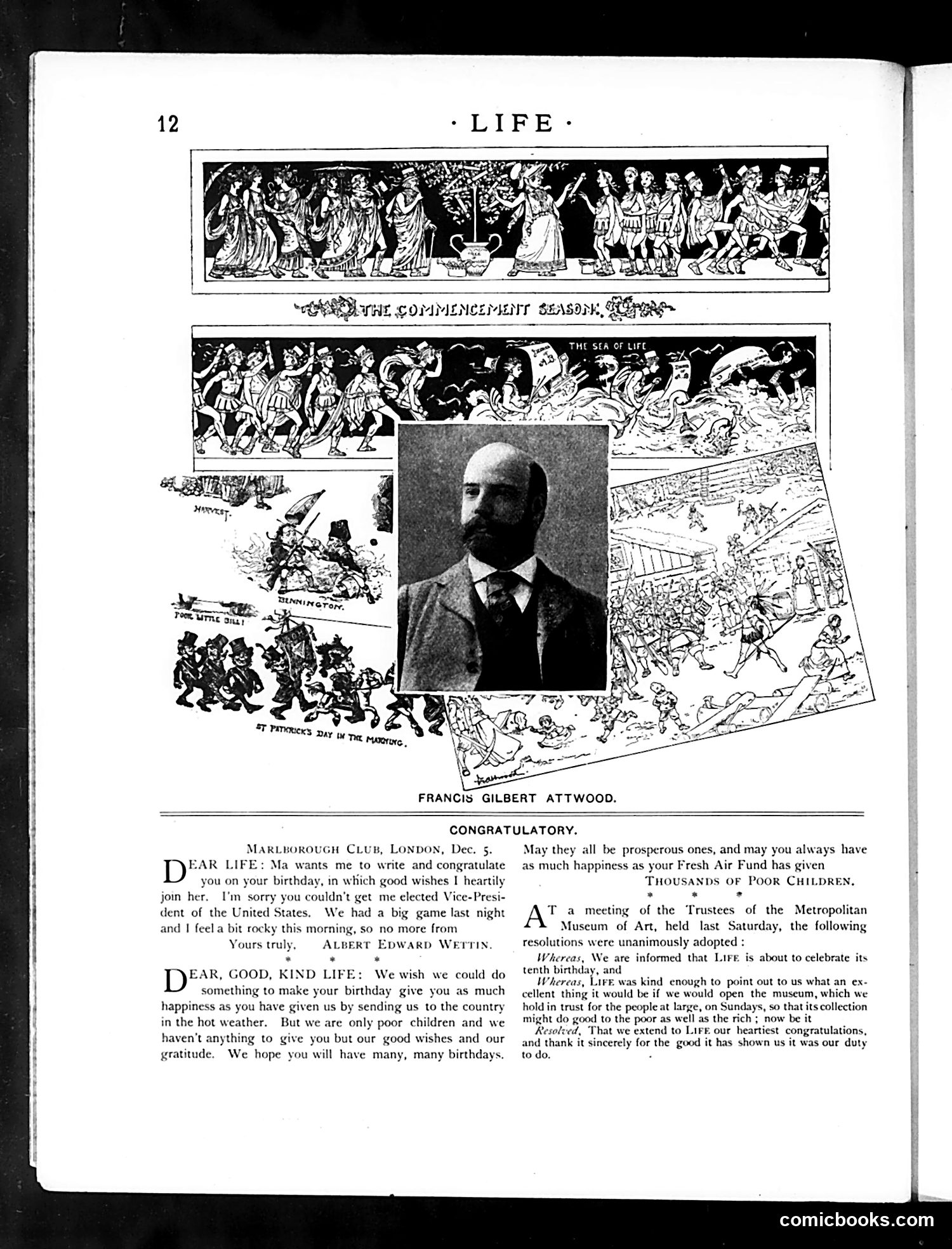
This page celebrates Life magazine's tenth birthday with congratulatory messages. The centerpiece is a portrait of **Francis Gilbert Attwood**, likely Life's editor or prominent figure. The congratulations include mock letters, notably one signed "Albert Edward Wettin"—a coded reference to **King Edward VII** (Wettin was the royal family's German surname). The joke satirizes royalty by depicting a "king" casually apologizing for not getting someone elected Vice-President and complaining about feeling "rocky" after a late night, presenting monarchy as ordinary and frivolous. Other messages praise Life's **Fresh Air Fund** (sending poor children to the country) and reference the magazine's advocacy for opening the Metropolitan Museum on Sundays to serve working-class visitors—positioning Life as a progressive force for social good. The decorative header showing classical and medieval scenes suggests Life's cultural aspirations. Overall, the page celebrates the magazine as influential, morally purposeful, and even capable of advising institutions and royalty.
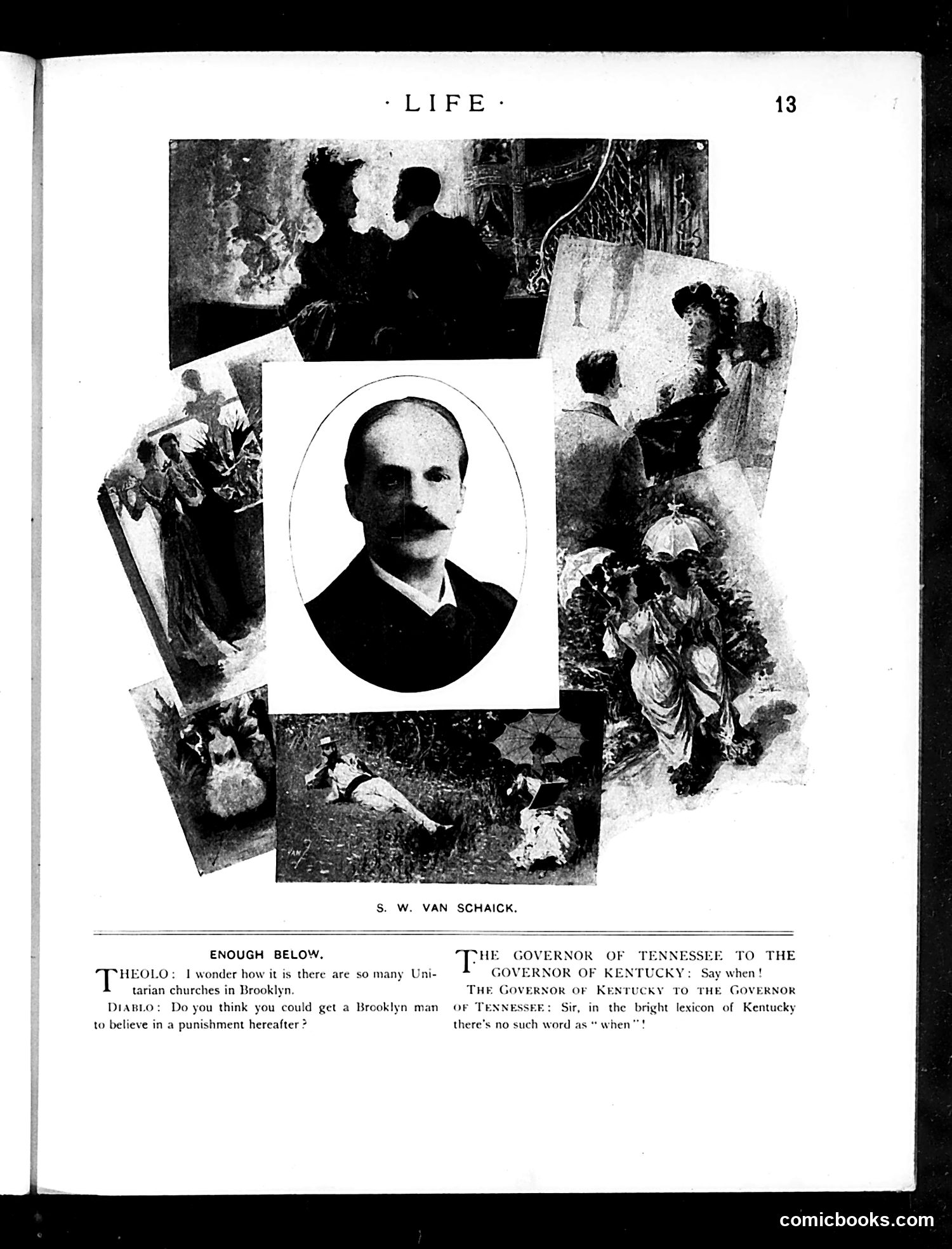
This page from *Life* magazine contains two separate satirical pieces: **Top:** A portrait of **S. W. Van Schaick** surrounded by small scenic photographs, likely illustrating his work or interests (the specific context is unclear from the image alone). **Bottom:** Two brief dialogue jokes: 1. **"Enough Below"** — A theological joke where "Theolo" (a theologian) and "Diablo" (the devil) discuss Brooklyn Unitarians. The humor plays on the Unitarian rejection of hellfire doctrine; Diablo humorously doubts a Brooklyn man could believe in divine punishment—a dig at both Brooklyn practicality and Unitarian theology. 2. **"The Governor of Tennessee to the Governor of Kentucky"** — A regional stereotype joke. Kentucky's governor supposedly has no word for "when" in his vocabulary—implying Kentuckians are perpetually unreliable about timing or commitments, or speak in an unusually limited dialect. Both jokes rely on period stereotypes about religious denominations and regional dialects to generate humor.
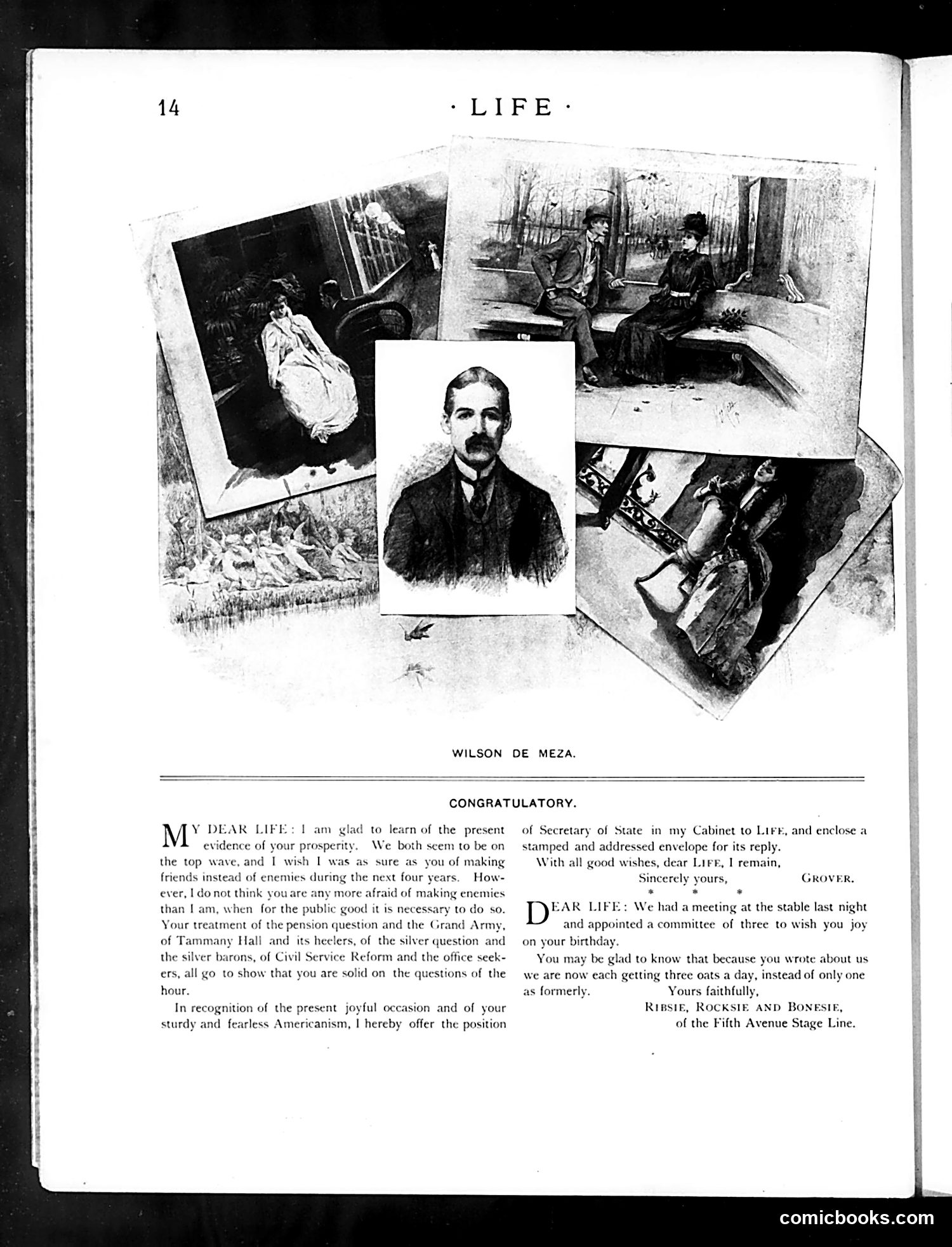
This page contains congratulatory letters to *Life* magazine on what appears to be a birthday or anniversary. The central portrait is labeled "Wilson de Meza," though the identity remains unclear from the image alone. The letters are satirical. President Grover Cleveland (signed "GROVER") humorously offers *Life* the position of Secretary of State, praising the magazine's tough stances on pension policy, Tammany Hall corruption, silver currency debates, and civil service reform—contemporary political issues of the 1880s-90s. A second letter, signed by "Ribbie, Rocksie and Bonesie" of the Fifth Avenue Stage Line (stables), humorously claims they've benefited from *Life*'s coverage, now receiving three oats daily instead of one—a joke about how the magazine's influence extends even to horses. The surrounding images appear to be sample content from the magazine, though specific subjects aren't identifiable from this reproduction.
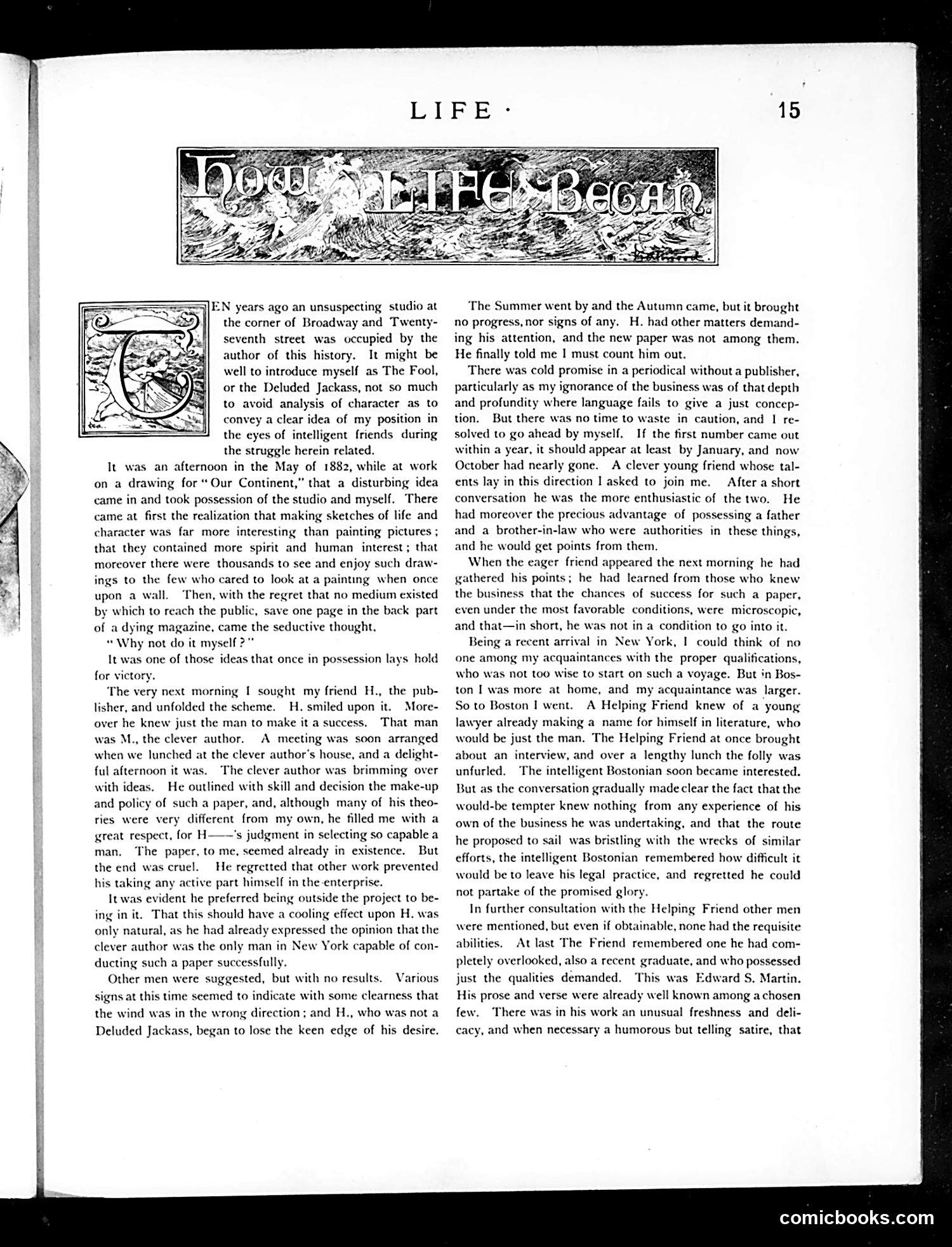
This page is the autobiographical opening of Life magazine's founding narrative, not a political cartoon. The author (identified only as "The Fool" or "Deluded Jackass") recounts launching the publication around 1882. The story describes the founder's realization that satirical sketches of life and character could reach a wider audience than traditional paintings. After struggling to find a publisher and collaborators willing to commit, he decided to proceed independently. A promising young friend initially agreed to help but—after consulting people experienced in publishing—returned with sobering news: success rates for such ventures were "microscopic." The humor lies in the self-deprecating narrative voice and the ironic contrast between the founder's enthusiastic vision and the cold reality of publishing challenges. This establishes Life's founding as an underdog venture by someone with more artistic ambition than business expertise.
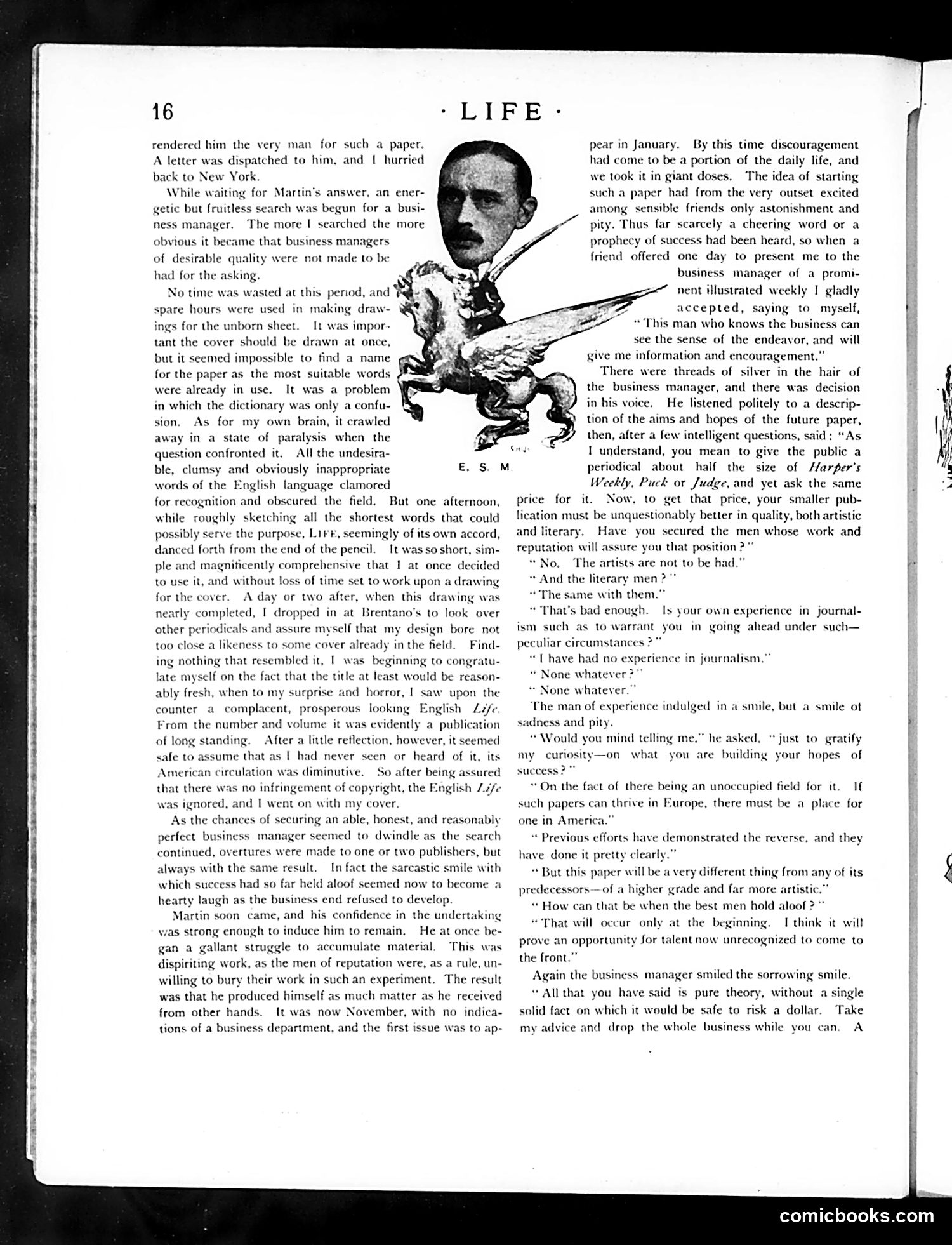
This page recounts the founding of **Life magazine itself**—a meta-narrative about the publication's own creation. The caricatured figure shown is **E.S.M.** (likely Edward Sandford Martin, Life's co-founder), depicted as a bird-like character holding a pen. The text describes the magazine's origin story: the author searched for a business manager, struggled to name the publication (finally arriving at "Life"), and discovered an existing English *Life* magazine already in circulation. The passage emphasizes the venture's precarious beginning—skeptical friends, difficulty recruiting talent, lack of business infrastructure, and discouragement by November 1883 (the first issue's planned launch). The satire lies in this self-aware documentation: Life was presenting itself as a scrappy, underdog enterprise rather than a polished establishment. The narrative celebrates persistence despite long odds and ridicule from sensible observers—positioning the magazine as plucky and unconventional from inception. This reflects *Life's* brand: irreverent, satirical, and self-promotional through humor rather than pomposity.
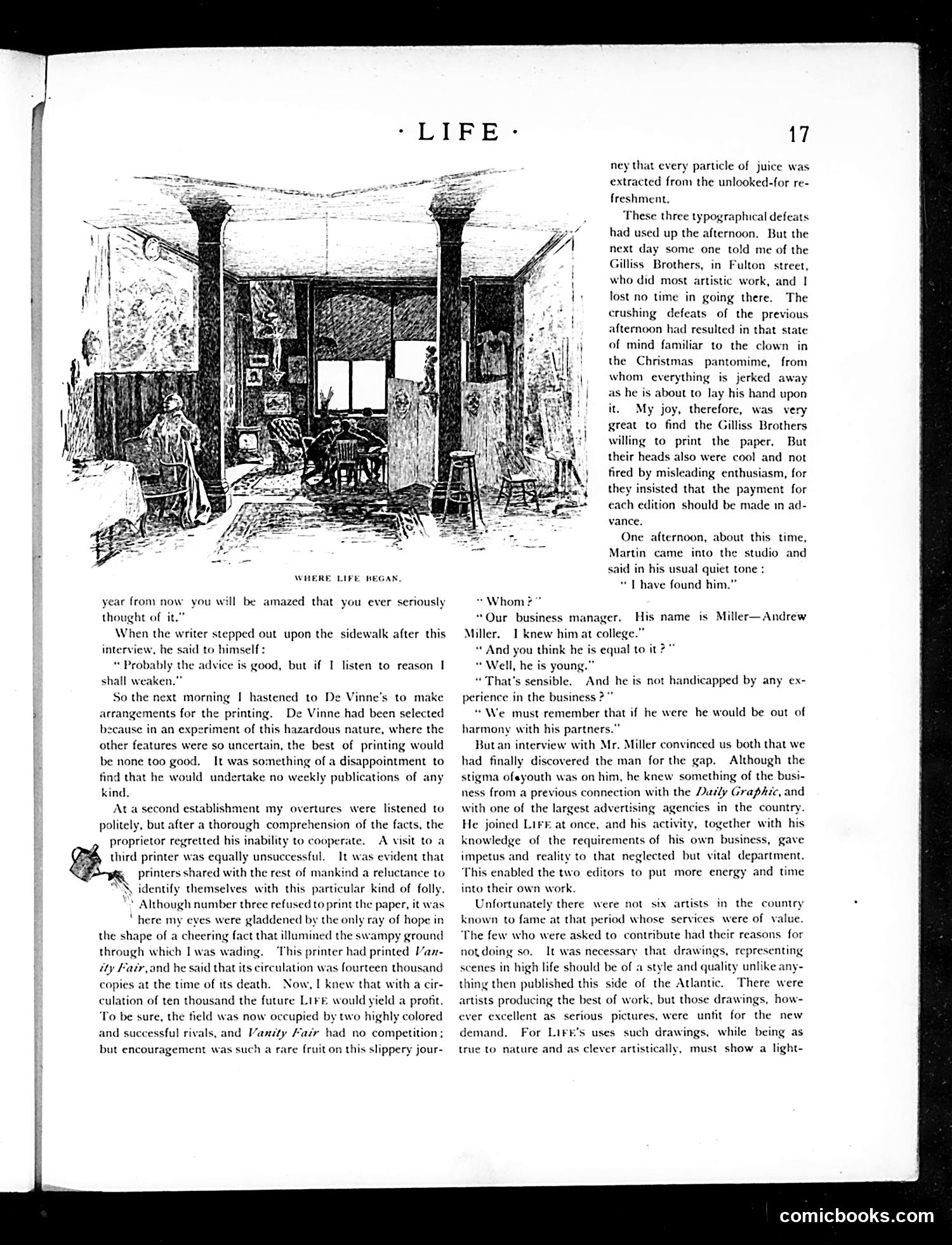
This page recounts the founding of *Life* magazine itself. The illustration titled "WHERE LIFE BEGAN" shows the cramped studio workspace where the publication was launched. The text describes the author's (likely John Ames Mitchell's) efforts to secure a printer willing to publish a satirical weekly magazine—a risky venture other printers refused. After initial rejections, the Gilliss Brothers agreed, though they demanded advance payment, reflecting skepticism about the venture's viability. The narrative also introduces Andrew Miller as the newly hired business manager, noted for his youth but practical experience with the *Daily Graphic* and advertising. His appointment allowed the editors to focus on editorial content rather than business operations. The passage reflects early challenges in launching an American humor magazine: finding willing collaborators, securing adequate artistic talent, and assembling a functional business structure—all obstacles the author treats with self-deprecating humor about the apparent "folly" of the entire enterprise.
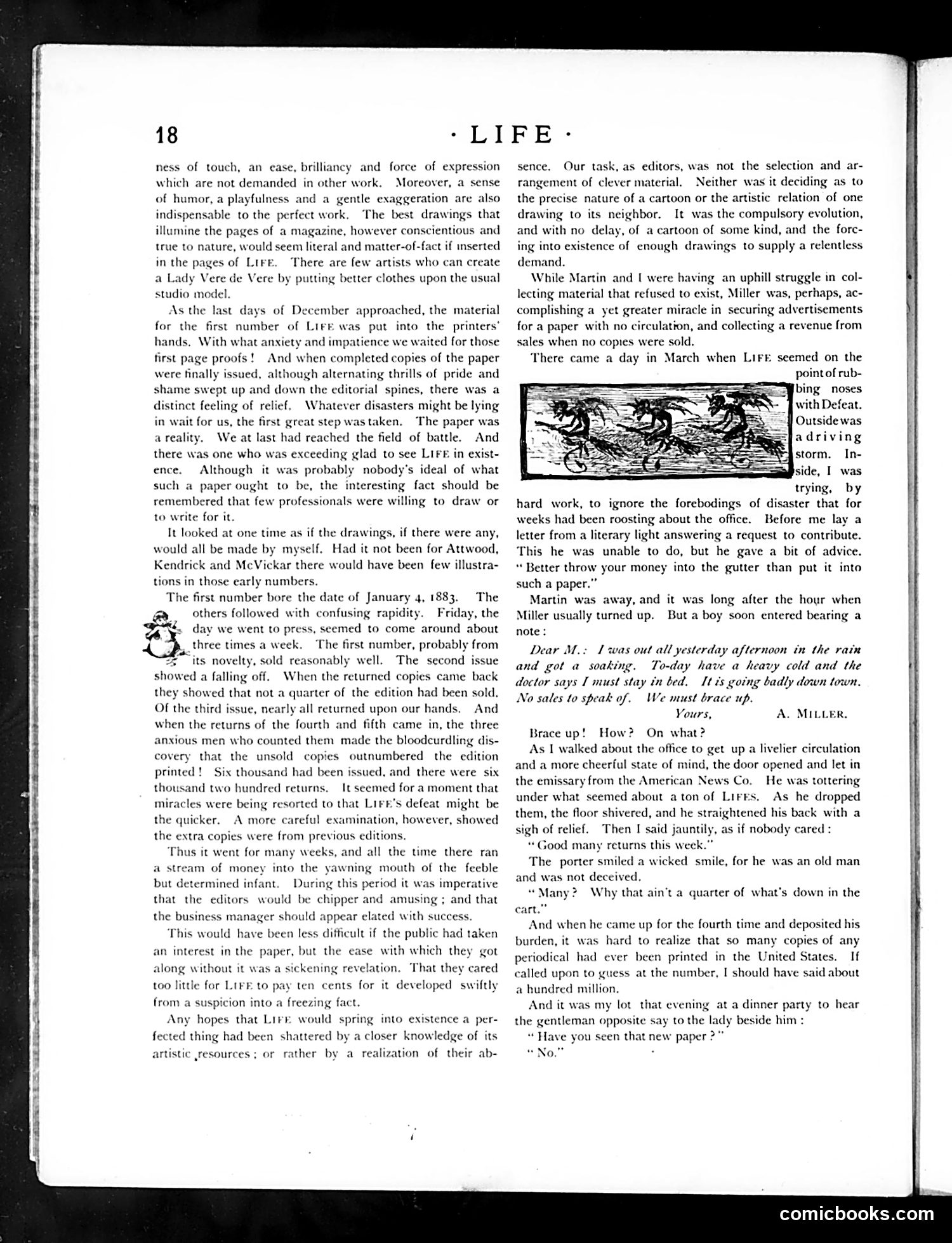
This page is a memoir about founding *Life* magazine in January 1883. The small cartoon shows a man being caught in rain with "Driving storm" written above—likely illustrating the metaphorical "storms" the editors faced launching the publication. The text describes the magazine's near-collapse: initial issues sold poorly, returns eventually exceeded distributed copies (6,200 returns vs. 6,000 printed), and the public showed little interest in paying ten cents per copy. The editors struggled to secure quality illustrations, relying on just three artists (Attwood, Kendrick, McVickar). A letter from "A. Miller" requests payment because he's ill—a glimpse into the financial pressures facing contributors when the magazine itself was drowning in debt. The passage frankly admits *Life* nearly failed before finding its footing, requiring editors to maintain cheerfulness despite "sickening" public indifference.
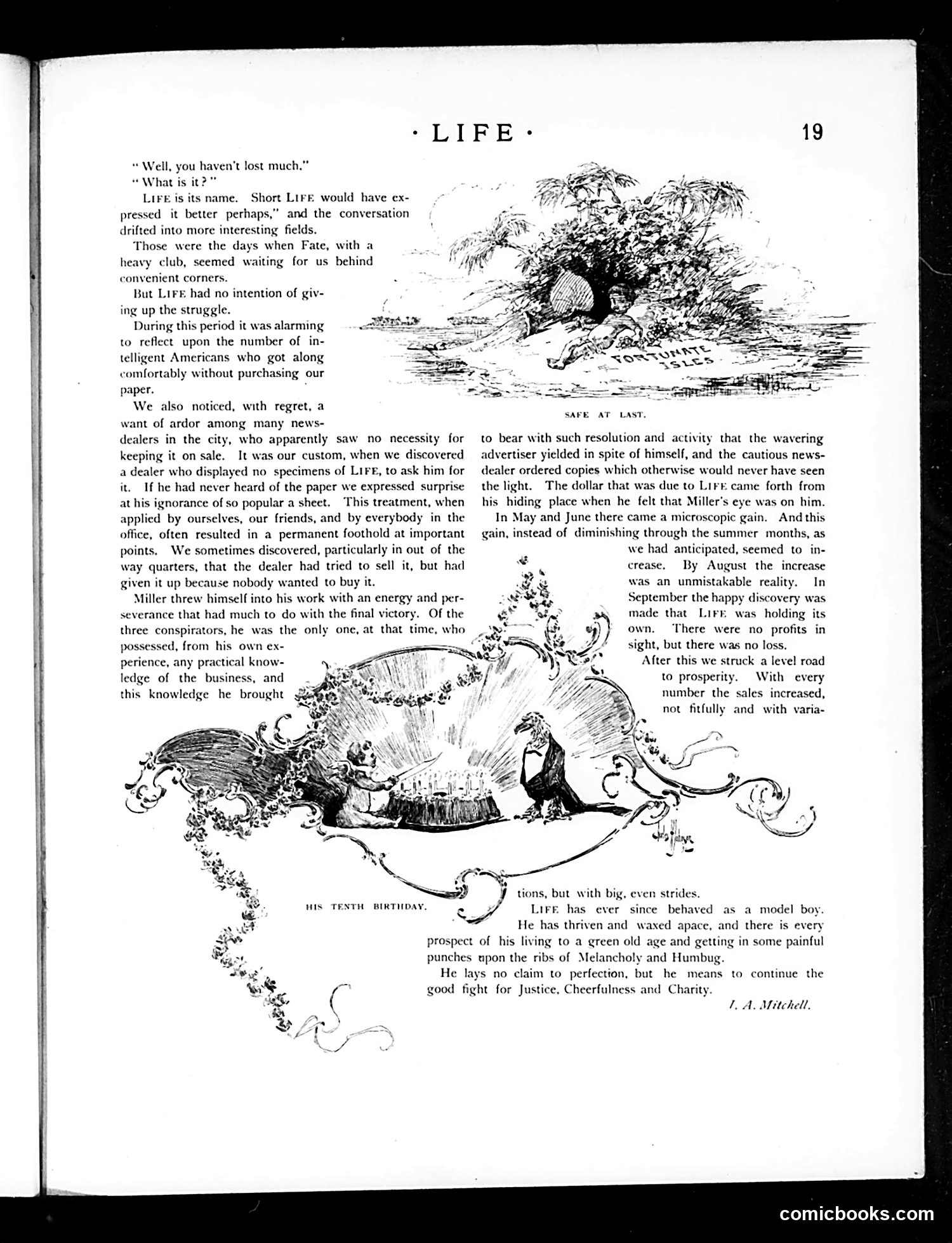
This is a commemorative article celebrating **Life magazine's tenth anniversary**, written by I.A. Mitchell. The two illustrations depict Life's early struggles and survival. The text recounts how Life nearly failed during its startup period. Intelligent Americans weren't buying it, newsdealer reluctant to stock it, and the publication faced financial crisis. A key figure named Miller (likely one of the founders) relentlessly pursued advertising and distribution—described as using his "eye" to pressure reluctant advertisers and dealers into supporting the magazine. By May-June, sales ticked upward; by September, Life broke even; soon after came genuine profitability and growth. The cartoons visualize this journey: the top image ("Safe at Last") shows the magazine sheltered from adversity; the lower image depicts Life's "tenth birthday" as a thriving, confident entity. The piece positions Life as a scrappy underdog that survived through persistence and ultimately became successful enough to "behave as a model boy," fighting for "Justice, Cheerfulness and Charity"—Life's stated editorial mission.
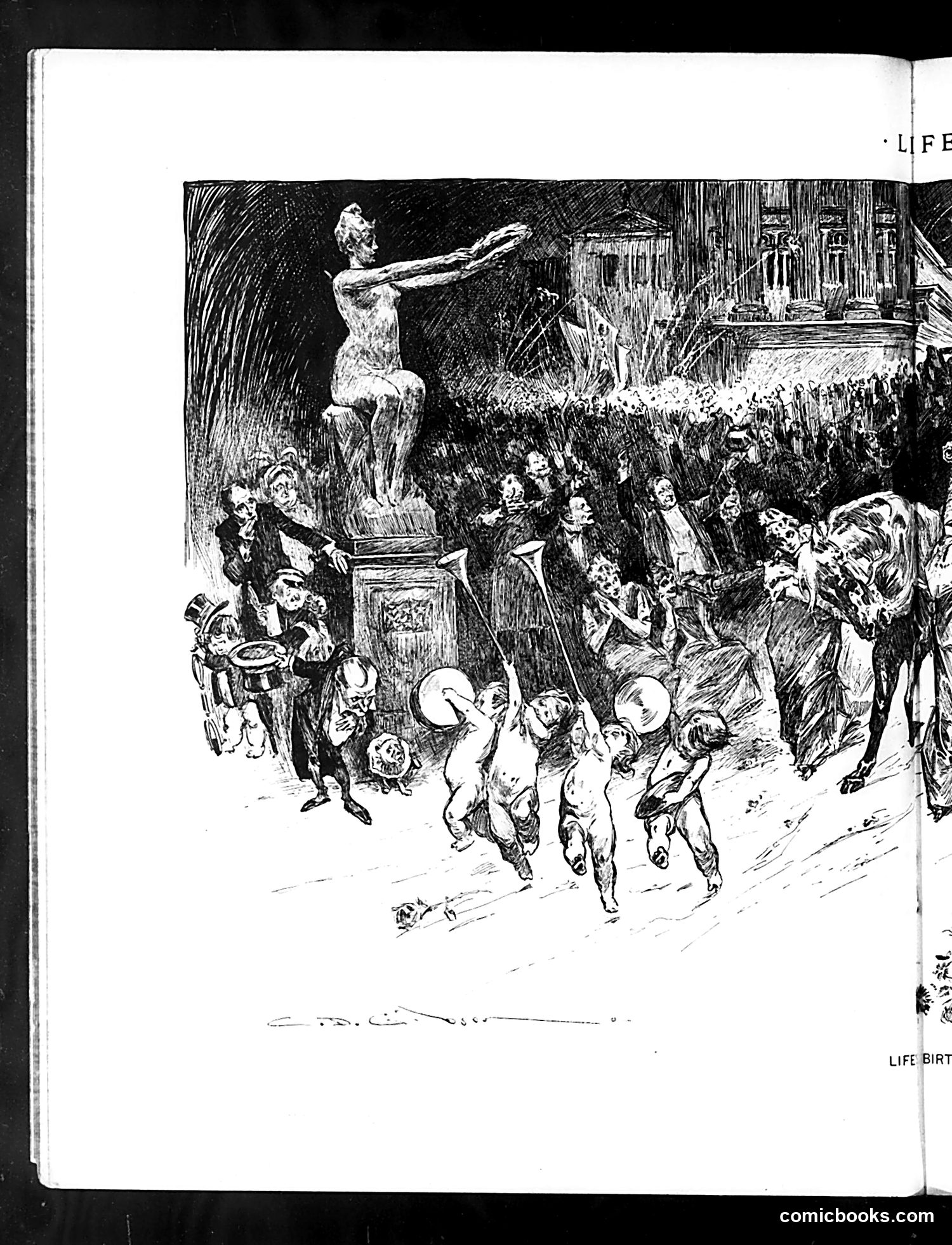
This is a satirical illustration showing a nude female statue on a pedestal being worshipped or celebrated by a crowd of well-dressed men and children in what appears to be a public square or plaza, with classical architecture in the background. The OCR text is largely illegible, so I cannot determine the specific caption or title. However, the imagery suggests satire about *idealization of beauty*, *materialism*, or possibly *commercialism* in American society—mocking the public's reverence toward physical beauty or artistic ideals represented by the statue. The formal attire of the onlookers contrasts with the statue's nudity, possibly commenting on hypocrisy or the gap between public morality and private desires. Without readable text, the precise target of satire remains unclear, though the composition clearly mocks public obsession with an idealized female form.
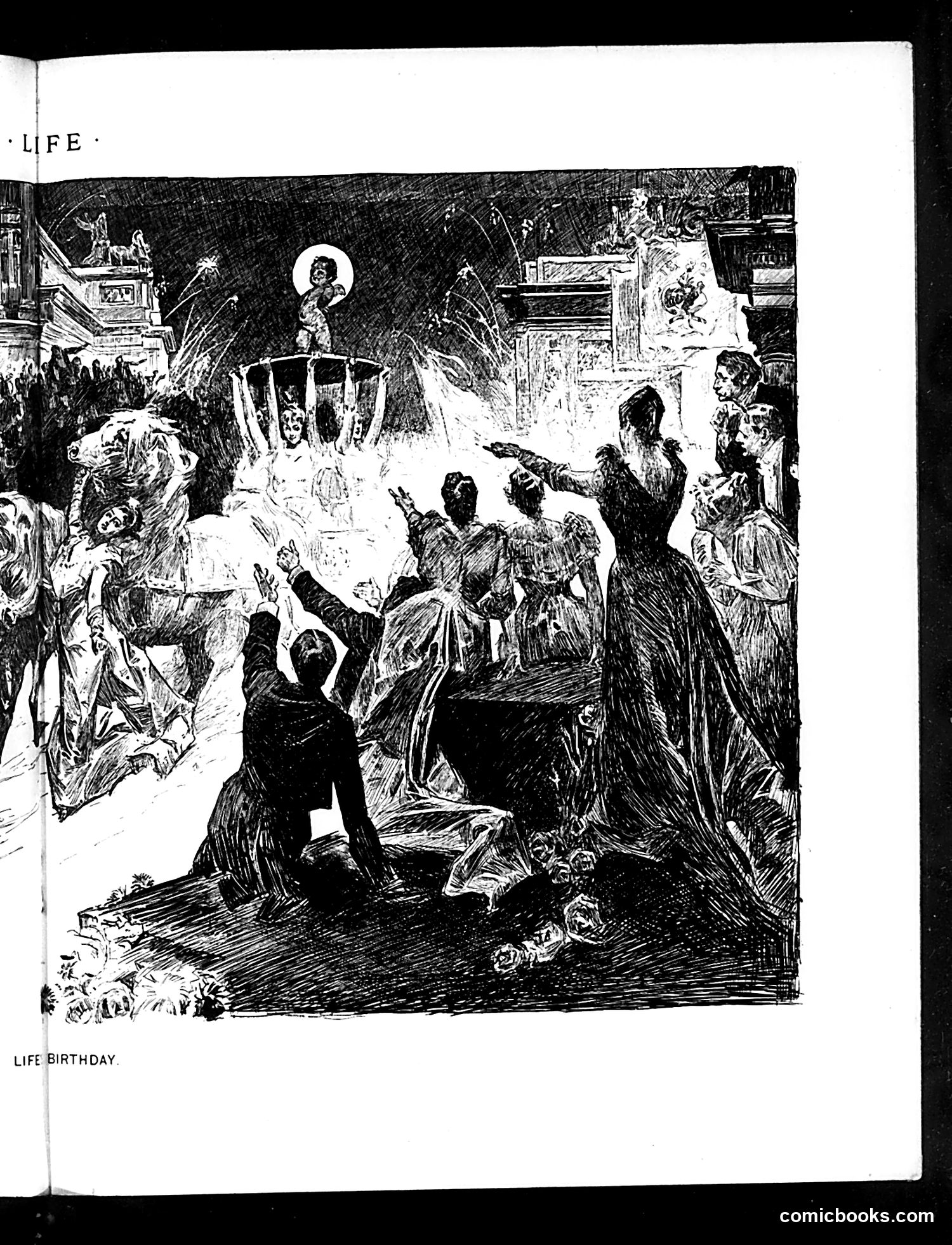
This appears to be a celebratory illustration titled "Life Birthday," likely commemorating the magazine's anniversary. The engraving depicts an elaborate formal celebration or procession featuring elegantly dressed figures in late 19th-century attire. A central elevated figure with a halo or divine light stands atop what appears to be a decorated carriage or platform, suggesting veneration or honor. Crowds of well-dressed attendees surround the scene, with some gesturing upward. The ornate architectural elements and ceremonial nature suggest this celebrates *Life* magazine's founding or milestone anniversary as a significant cultural institution. The artistic style and formal pageantry indicate the magazine viewed itself as an important arbiter of American humor and social commentary.
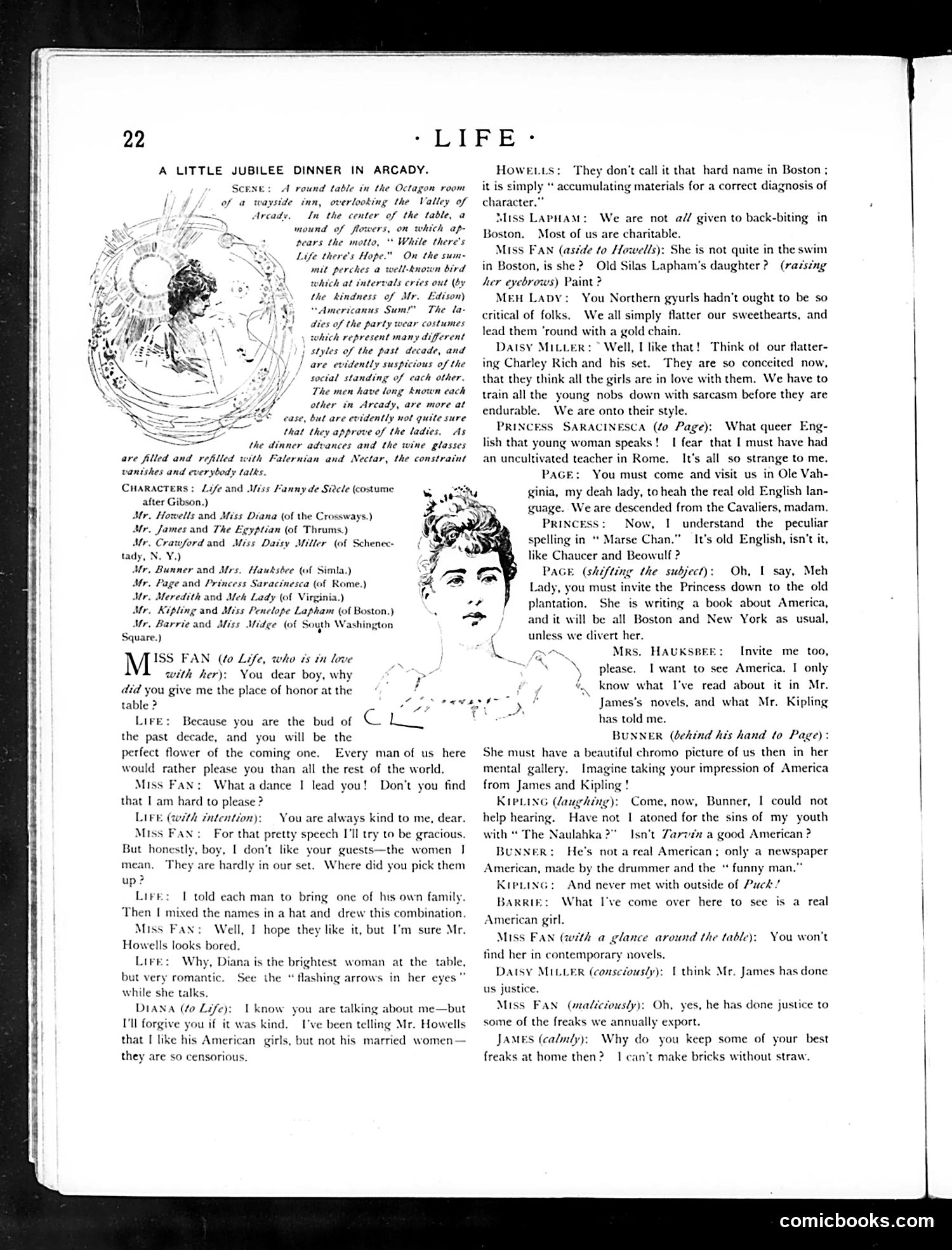
This page depicts a satirical dinner party featuring literary characters from famous novels of the late 19th century. The host "Life" has assembled fictional heroines—Diana (from Howells), Daisy Miller (from Henry James), Miss Lapham (from Howells's *The Rise of Silas Lapham*), and others—alongside their authors or related figures. The satire mocks social pretension and literary affectation. The women from different literary worlds awkwardly interact, suspicious of each other's social standing. The humor centers on their contrasting regional speech patterns and mannerisms: a Southern belle's drawl, Boston propriety, Italian sophistication. The joke is that these celebrated fictional characters, when placed together in "real life," expose the artificial conventions their authors created. The dinner party becomes a playful critique of both the literature and the social types these novels depicted—showing that literary heroines are ultimately just exaggerated versions of recognizable social types and regional stereotypes.
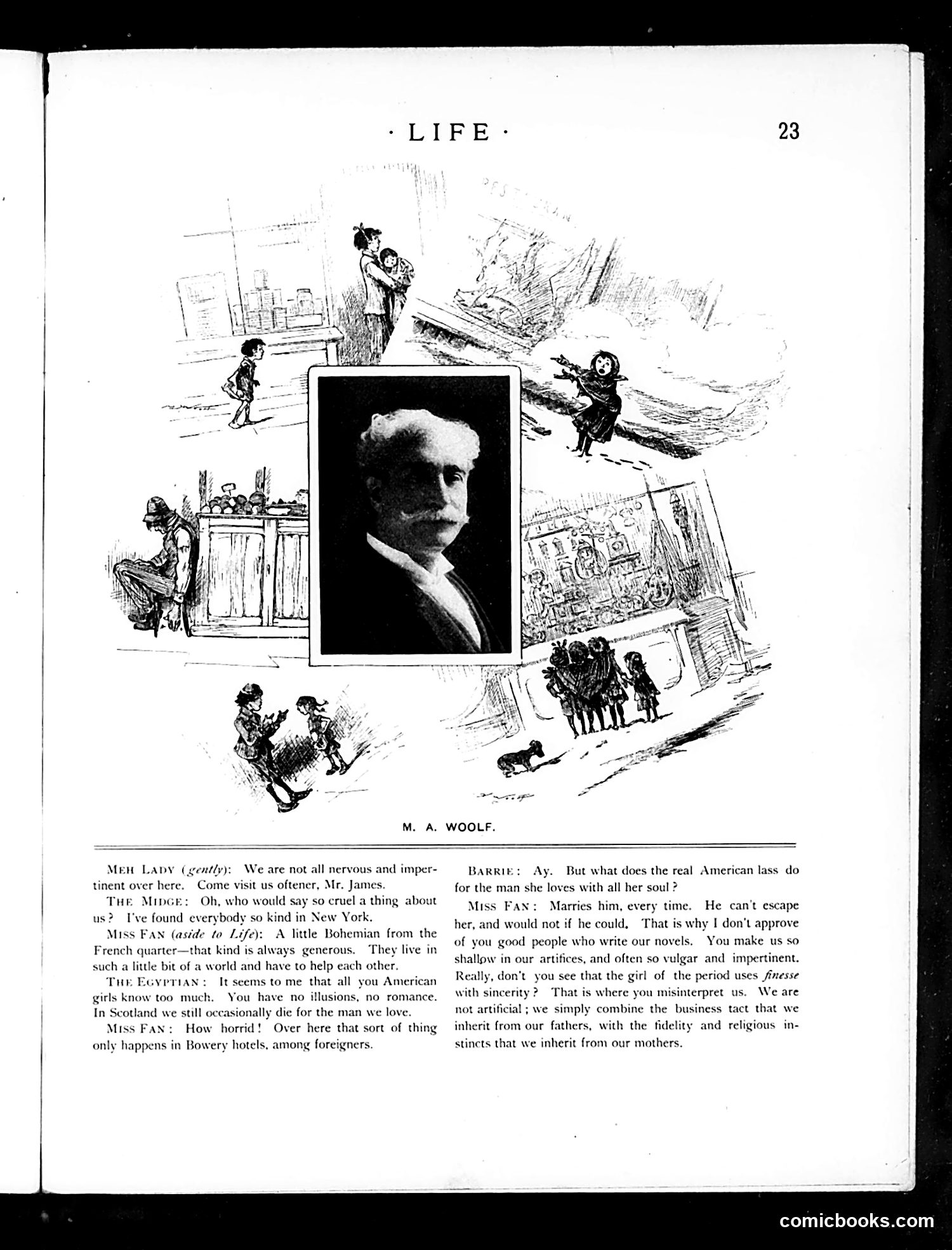
This page features a dialogue-based cartoon satirizing American women and transatlantic cultural attitudes, likely from the early 1900s. The central portrait appears to be **M.A. Woolf**, presumably the cartoonist or subject. The sketch depicts a social gathering where an American "Miss Fan" defends American girls against criticism from foreign visitors—a "Midge" (likely British), an Egyptian, and what appears to be a Scottish character (possibly referencing author J.M. Barrie, mentioned in context). **The satire's targets:** - Foreign stereotypes about American women being nervous and impertinent - American girls' perceived lack of romance and illusions - The gap between how American women are portrayed in novels versus reality - Miss Fan's defense ironically exposes American women as practical, business-minded, and moralistic rather than romantic—undercutting her own argument The humor lies in Miss Fan's pompous justification: American girls marry "every time" out of inherited "business tact" and "religious instincts"—essentially admitting the very superficiality foreigners accused them of.
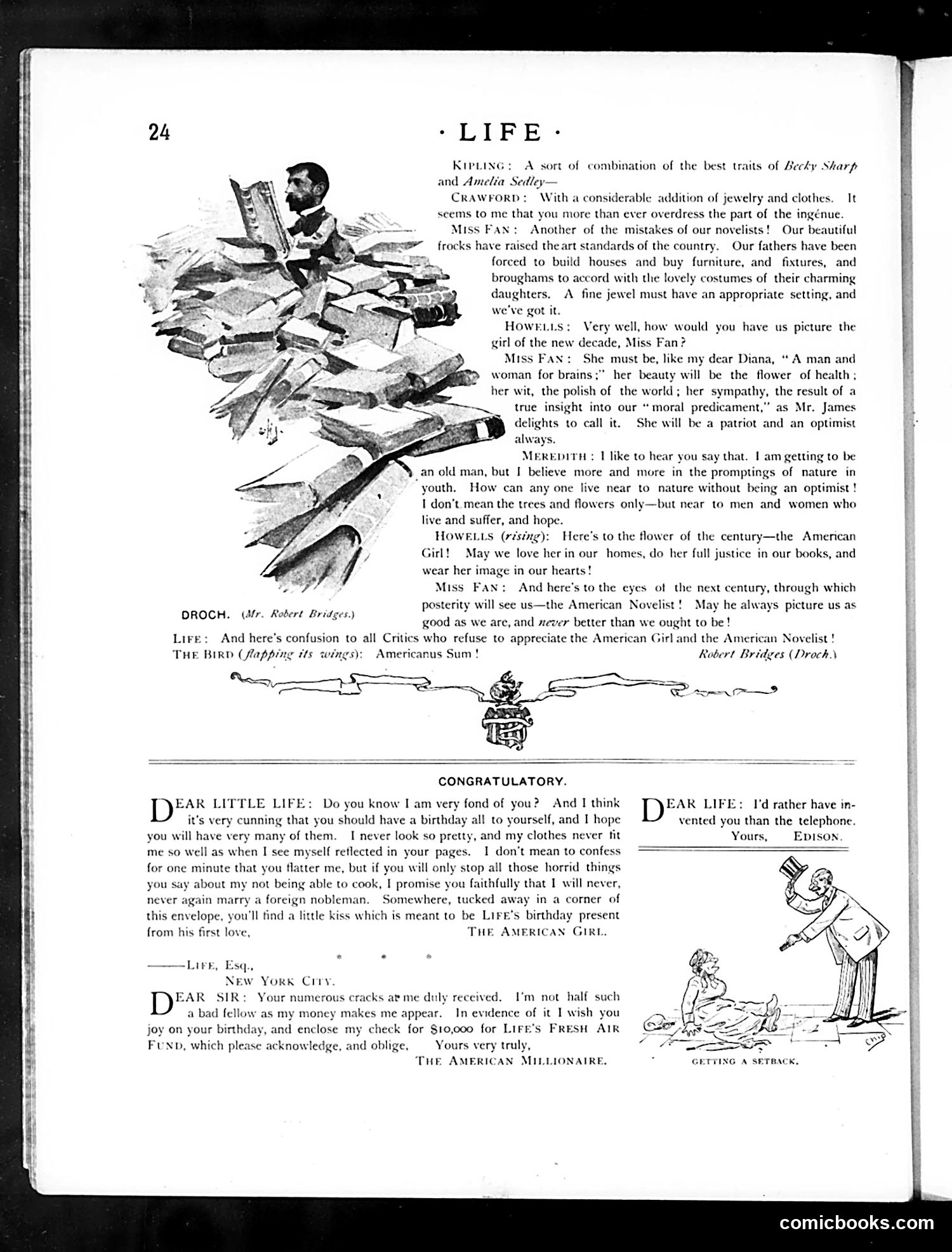
This page features a **literary debate** disguised as social commentary, centered on how the "American Girl" should be portrayed in fiction. **The Figures:** References include literary characters (Becky Sharp, Amelia Sedley) and appear to invoke real authors—Kipling, Crawford, Meredith, Howells, and Henry James are mentioned by name as participants in the discussion. **The Satire:** The joke mocks how novelists overdress their heroines with jewelry and elaborate costumes, forcing fathers to spend fortunes on houses and furnishings to match their daughters' finery. Miss Fan argues the ideal modern woman should embody brains, health, wit, and moral insight—not material display. **The Point:** This critiques both novelists' superficiality *and* the consumer culture it encourages. The "Congratulatory" section below adds ironic birthday wishes to Life itself, with The American Girl praising the magazine's flattery, and an American Millionaire mocking his own reputation—suggesting satirical commentary on wealth, vanity, and national character. The cartoons at bottom appear unrelated domestic humor ("Getting a Setback").
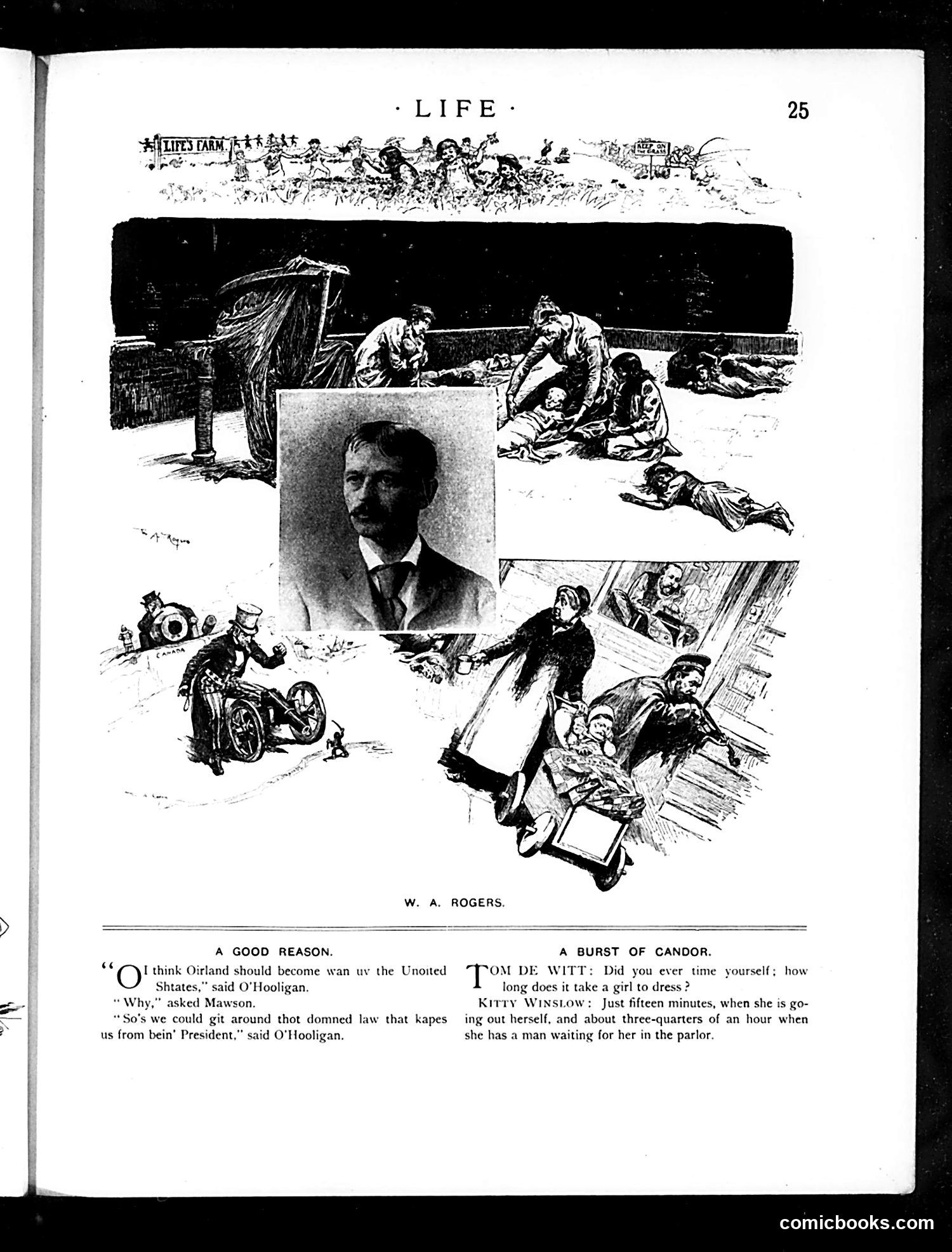
This page contains two separate satirical pieces by W.A. Rogers: **"A Good Reason"** mocks Irish-American immigrants' political aspirations. The dialogue between O'Hooligan and Mawson satirizes the presidential eligibility requirement that candidates be natural-born citizens. O'Hooligan suggests Ireland should join the U.S. so he could bypass this restriction—the joke being that immigrants, excluded from the presidency, humorously propose changing the nation's laws rather than accepting their status. **"A Burst of Candor"** presents a gender-based joke about female vanity and courtship rituals. Tom de Witt's question about dressing time receives a cynical answer: women dress quickly alone but take three times longer when entertaining male suitors—implying women primp excessively to impress men. This reflects period attitudes about female behavior and romantic performance. Both pieces use exaggerated dialect and stereotypes typical of early 20th-century American humor.
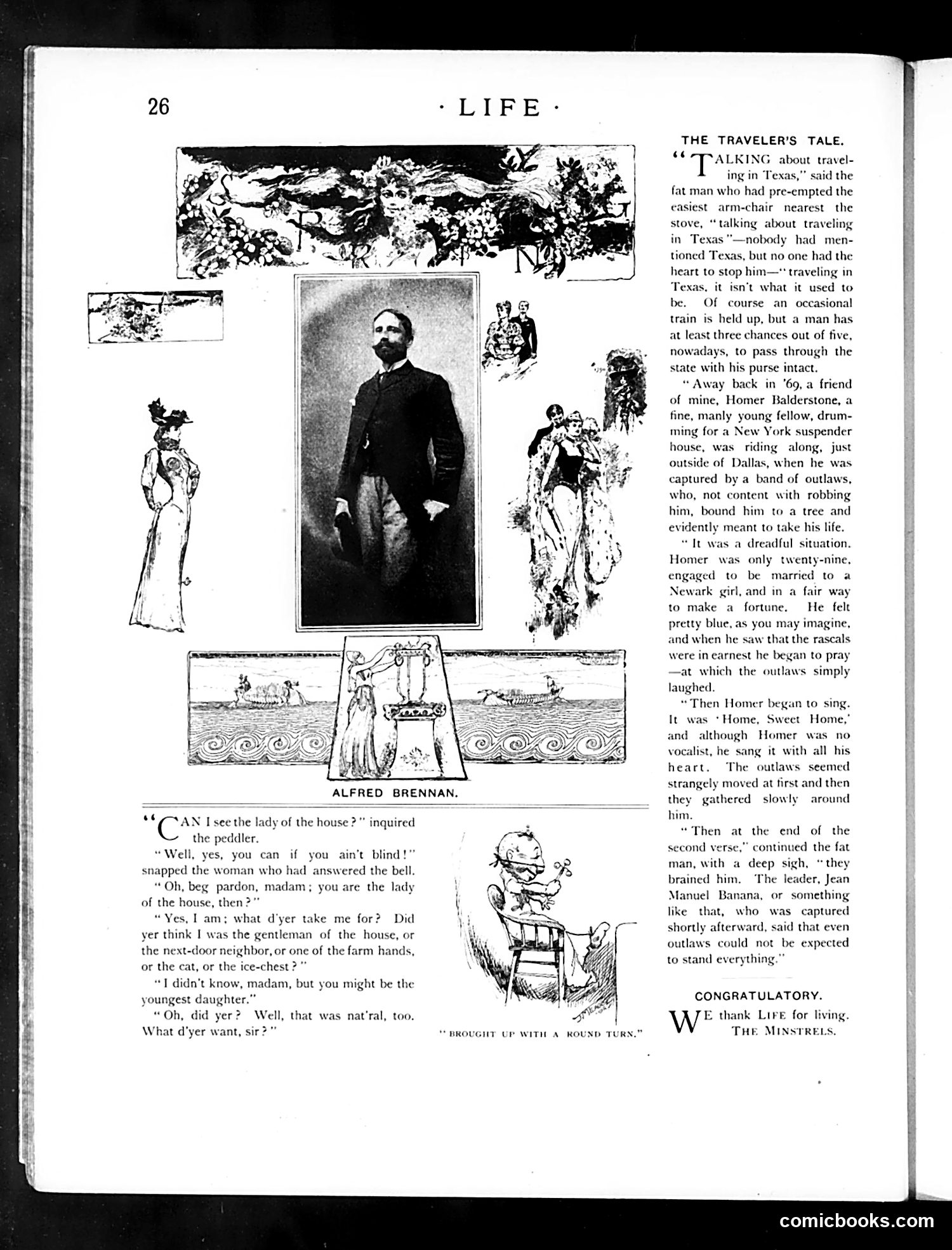
This page contains two distinct pieces of humor: **"Brought Up with a Round Turn"** (Brennan cartoon): A peddler's awkward encounter with a sharp-tongued housewife. When he asks to see "the lady of the house," she bristles defensively, sarcastically suggesting he might have mistaken her for the gentleman, a neighbor, a farm hand, "the cat, or the ice-chest." The joke satirizes working-class women's sensitivity about their social status—she interprets his polite phrasing as insulting, assuming he doubted her position in her own home. The title suggests she verbally "turned" him around sharply. **"The Traveler's Tale"**: A fat man tells a story about a drummer (traveling salesman) named Homer Balderstone captured by Texas outlaws in 1869. The dark humor lies in the absurd punchline: the outlaws are moved by Homer's singing of "Home, Sweet Home," gather around him emotionally—then kill him anyway because they "could not be expected to stand everything." It mocks both sentimentality and frontier violence.
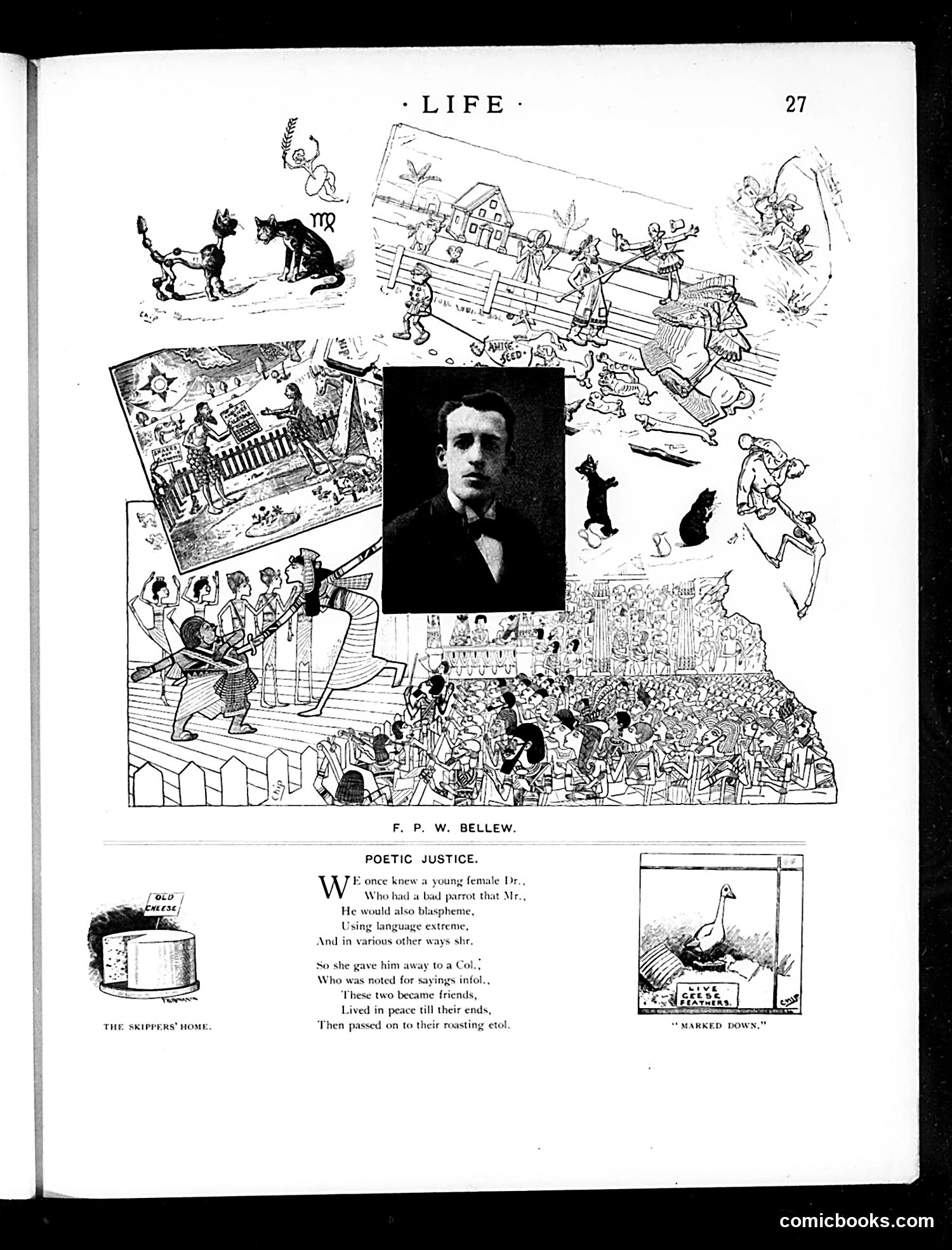
This page features F.P.W. Bellew's satirical content centered on a portrait photograph (identity unclear from the image alone) surrounded by humorous illustrations. **"Poetic Justice"** is a limerick-style poem mocking a female doctor who owned a profane parrot. Unable to control the bird's obscene language, she gives it to a Colonel known for similar crude speech. The joke: the foul-mouthed parrot and the vulgar officer are perfectly matched—"poetic justice" pairs like with like. The surrounding cartoons appear to depict everyday scenes: children playing, domestic life, and crowds. Smaller illustrations labeled "The Skippers' Home" and "Marked Down" offer additional satirical commentary, though their specific targets are unclear without additional context. The overall tone is lighthearted social satire typical of early 20th-century Life magazine humor, poking fun at human behavior rather than specific political figures.
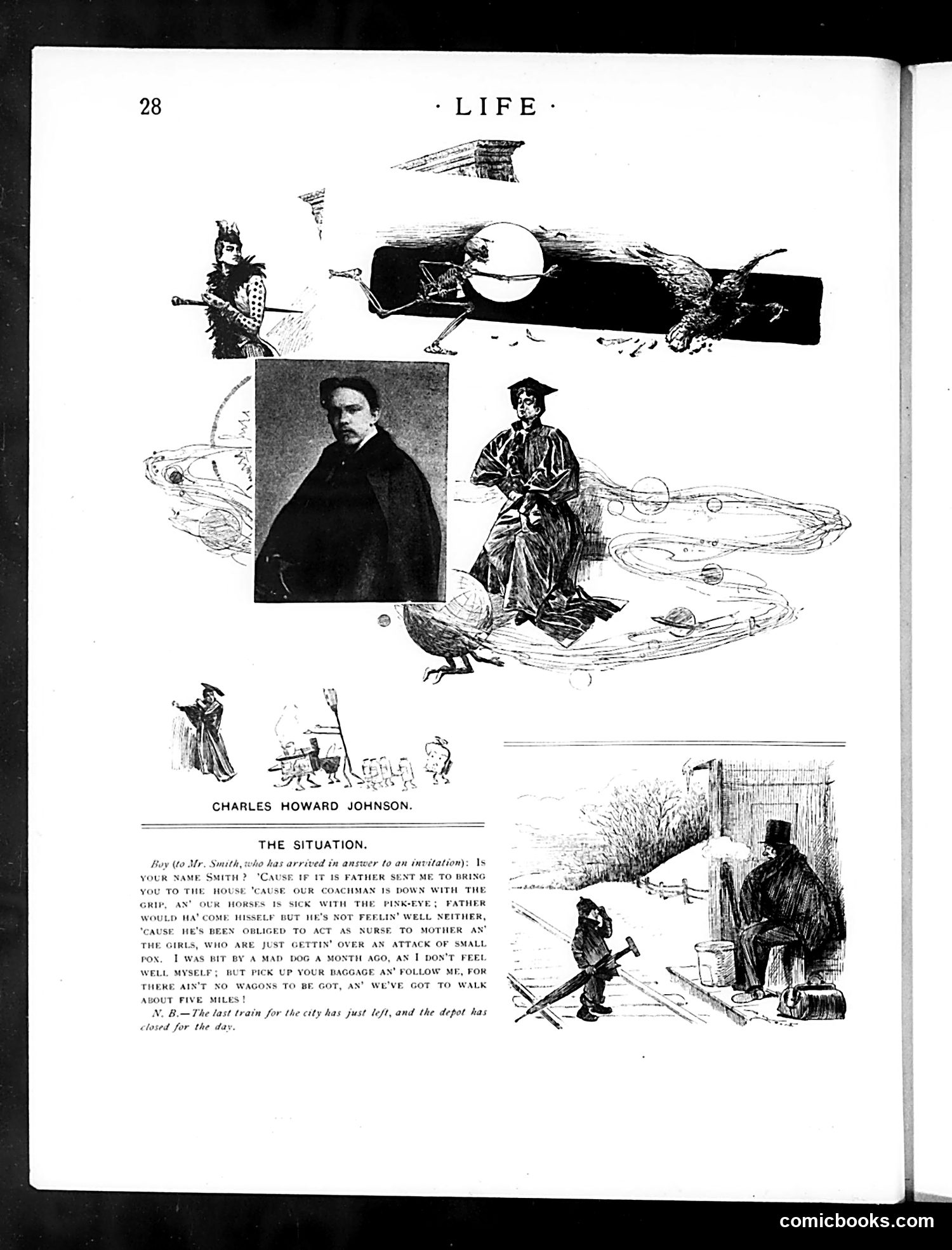
This satirical cartoon depicts a comedic catastrophe of Victorian-era mishaps. A boy greets Mr. Smith, an invited guest, to inform him that virtually the entire household is incapacitated: the coachman has influenza ("the grip"), horses are sick, the father is unwell from nursing his wife and daughters through smallpox, and the boy himself was recently bitten by a mad dog. Despite these disasters, the boy cheerfully instructs Smith to carry his own baggage and walk five miles, as no transportation is available. The humor derives from the absurd accumulation of afflictions and the casual way the boy delivers this litany of bad news, combined with the added insult that the last train has left and the depot is closed. It satirizes both the vulnerability of Victorian society to disease and the comic stoicism with which people endured such hardships.
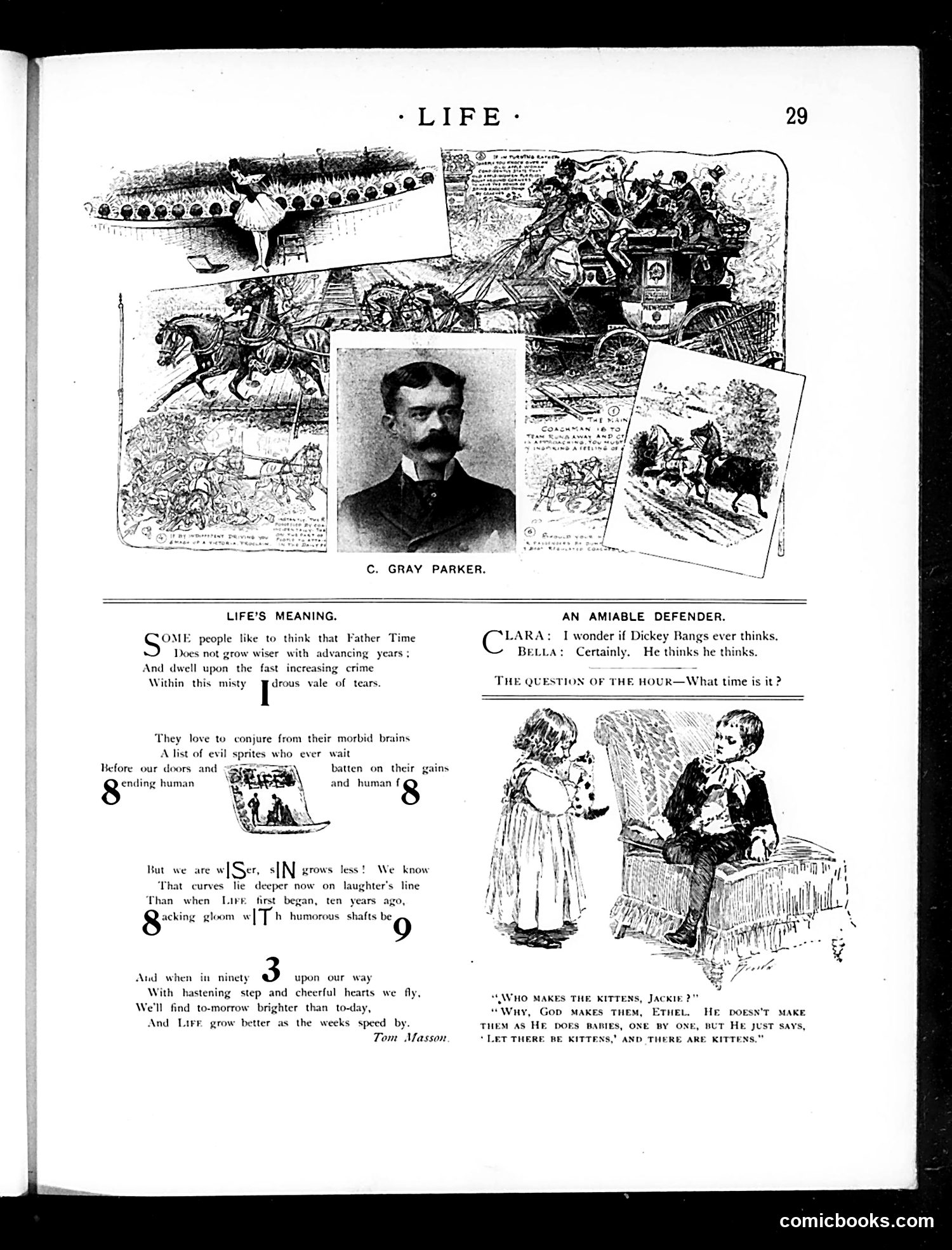
This page contains three distinct pieces of humor typical of early Life magazine: **"Life's Meaning"** (top) is a philosophical poem by Tom Masson arguing against pessimism. It counters the notion that society grows more criminal and morally corrupt, instead claiming that humor and optimism have increased over the past decade. The numerous illustrated vignettes (circus acts, military scenes, etc.) surrounding C. Gray Parker's portrait appear to represent Life's own role in documenting and celebrating American culture and entertainment. **"An Amiable Defender"** (middle right) is a brief joke about someone named Dickey Bangs, playing on the distinction between actual thinking and mere self-delusion—suggesting Bangs mistakes his own thoughts for genuine cognition. **"The Question of the Hour"** (bottom right) depicts children in conversation, with a child explaining that God creates kittens the same way He creates babies, then playfully invoking a biblical creation formula ("Let there be kittens"). The humor lies in the child's innocent theological logic and the parent's bemused reaction.
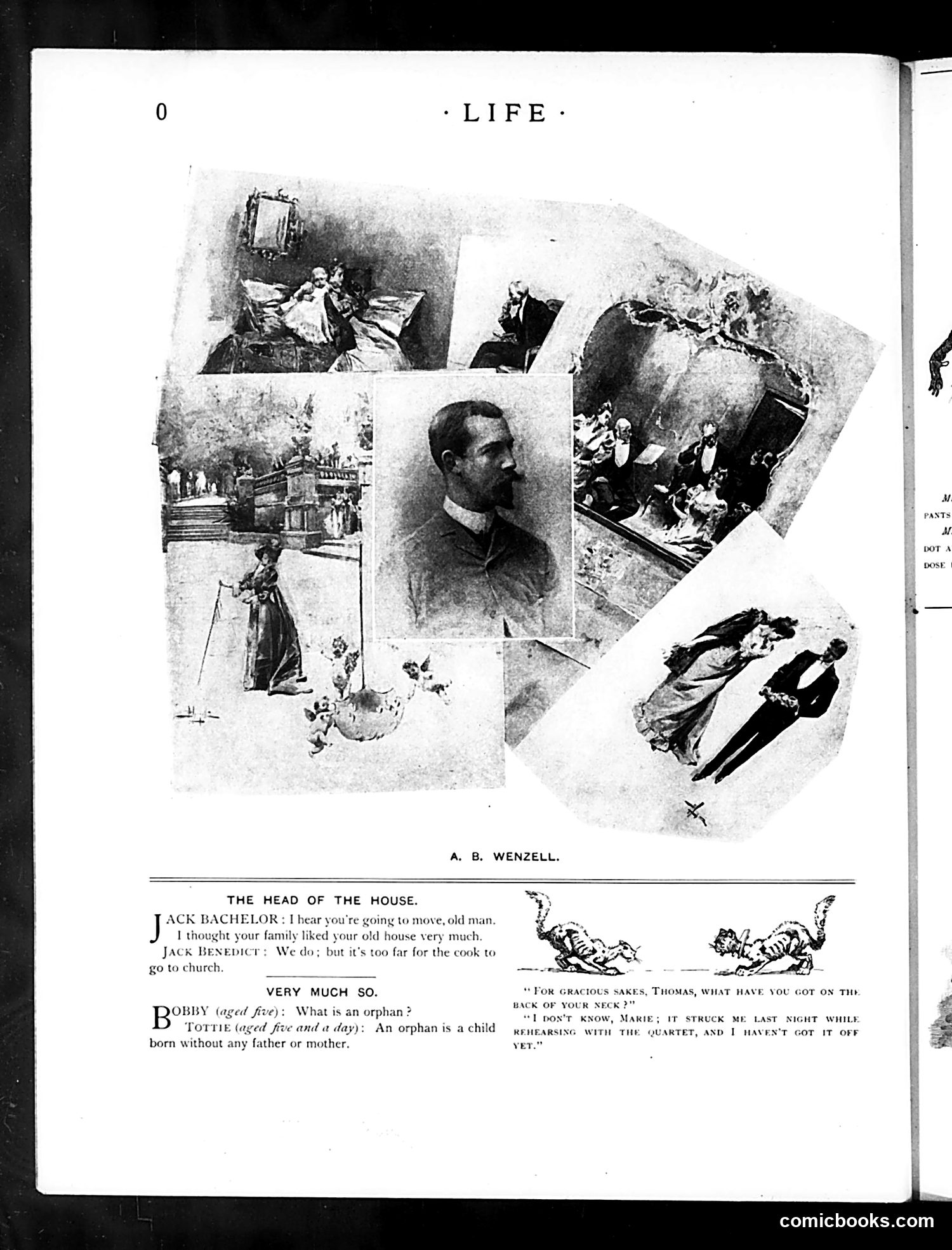
This page contains multiple comic sketches by A.B. Wenzell satirizing domestic life and social pretension. The top dialogue joke mocks the absurdity of household priorities: Jack Benedict is willing to move his entire family simply because their cook finds the old house "too far" to reach church—suggesting servants' convenience outweighs family attachment to home. The lower section presents comic definitions and exchanges. One defines an orphan, while another features a couple where the wife notices something odd on her husband's neck. His embarrassed explanation—that it happened "while rehearsing with the quartet"—implies an inappropriate encounter, likely a hickey or love bite, creating humor through the gap between his respectable appearance and questionable behavior. These sketches collectively mock middle-class pretension, the inversion of proper domestic hierarchies (servants dictating family decisions), and hypocrisy in "respectable" society.
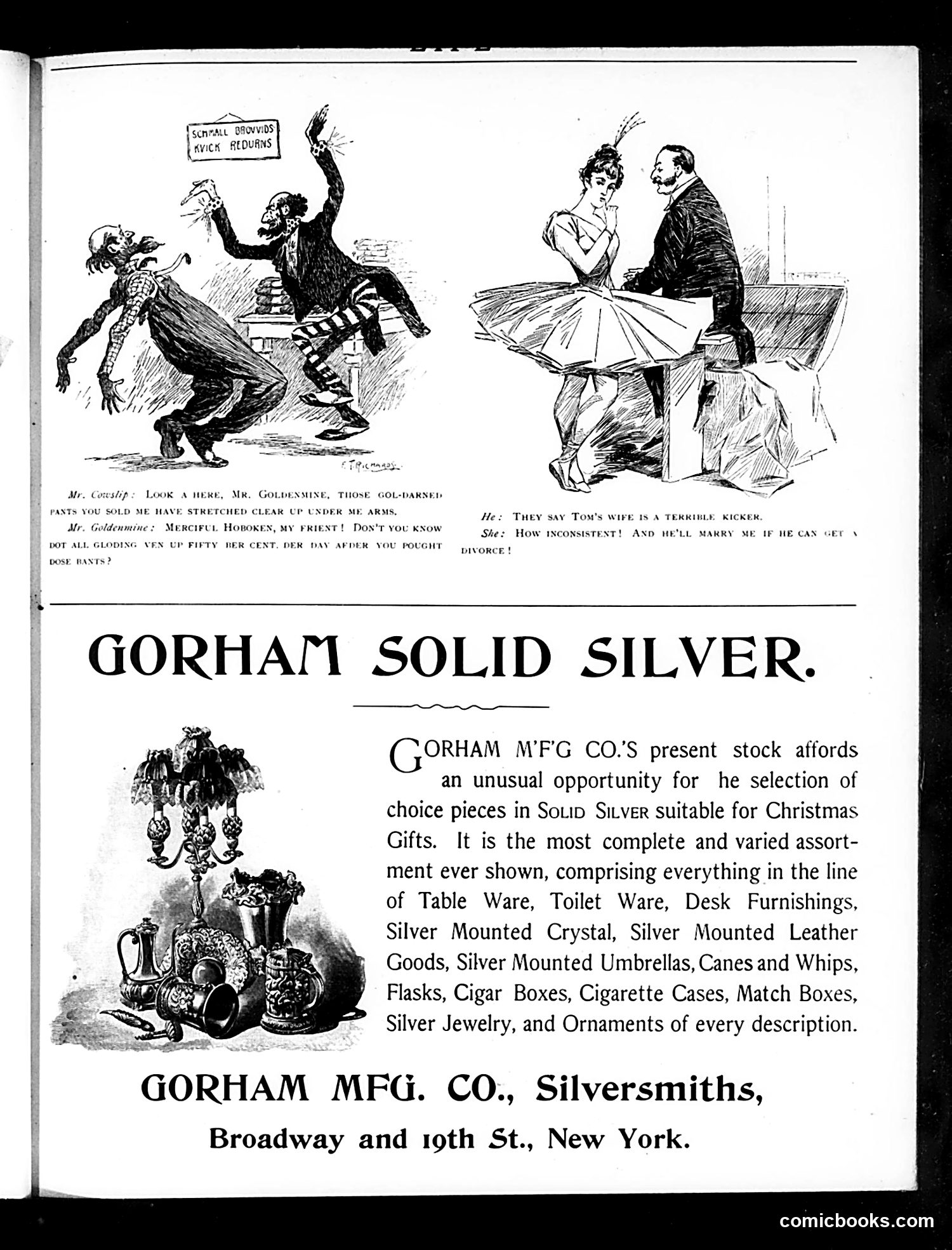
This page combines two satirical cartoons with a silver goods advertisement. **Left cartoon**: Two men in comical dress discuss stretched pants. One character (appearing to be a con man or salesman) tries to convince another to buy pants that have "stretched clear up under me arms," claiming they've appreciated 50% daily since purchase. The satire mocks get-rich-quick schemes and gullible investors during a period of financial speculation. **Right cartoon**: A woman tells a man that Tom's wife is "a terrible kicker" (fighter/troublemaker), yet she plans to marry Tom if he divorces. She notes the inconsistency—marrying someone whose wife is violent seems unwise. This satirizes marriage, infidelity, and illogical romantic decisions. Both cartoons use exaggerated Yiddish-influenced dialect and working-class characters common to early 20th-century American humor. **The advertisement** promotes Gorham Manufacturing Company's solid silver goods for Christmas gifts, occupying roughly half the page.
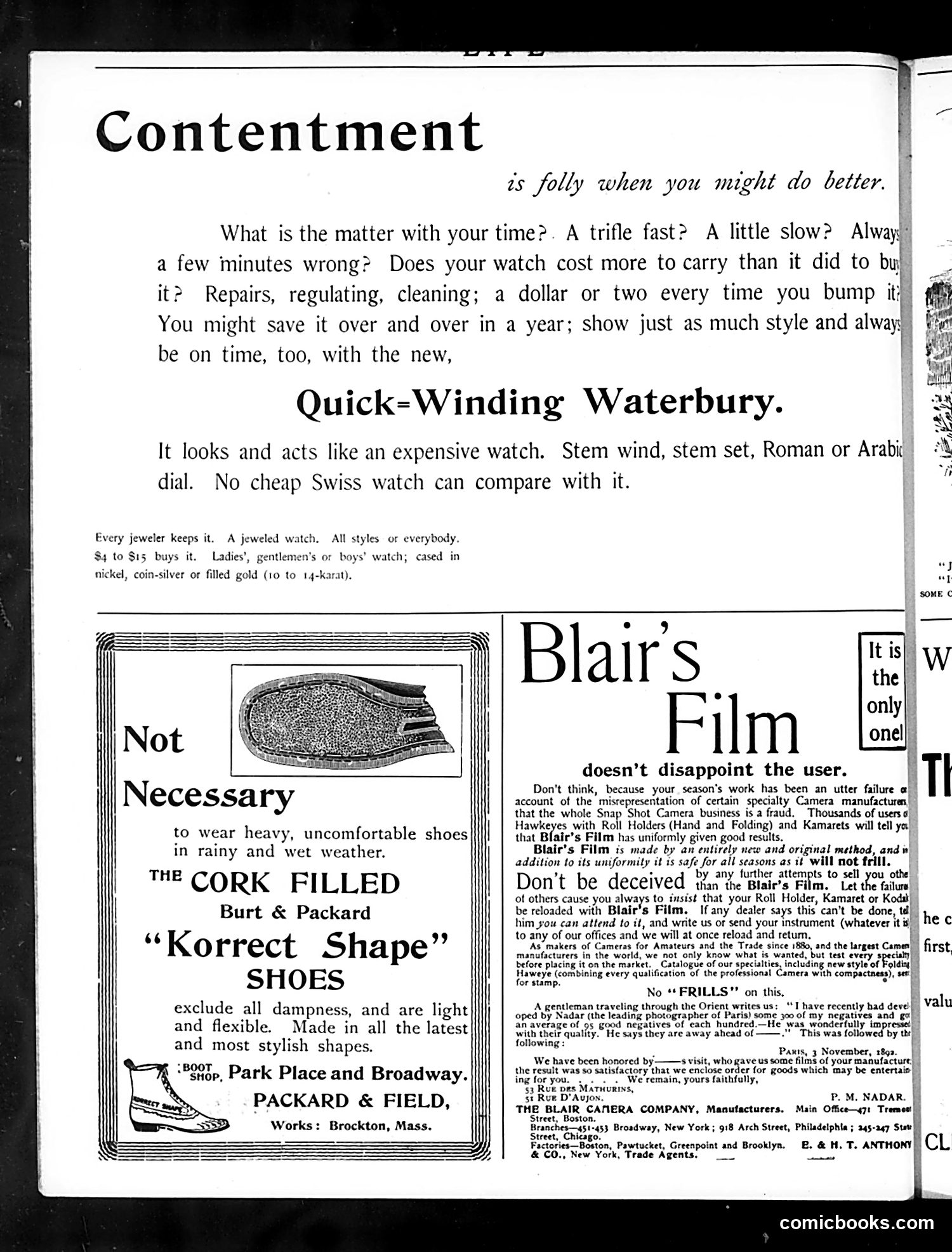
This is primarily a **product advertisement page**, not political satire. It contains three distinct ads: 1. **Waterbury Watch** ("Quick-Winding Waterbury"): Promotes an affordable watch ($4-$15) that performs like expensive models, avoiding repair costs. 2. **Burt & Packard Shoes** ("Korrect Shape"): Advertises cork-filled shoes that keep feet dry and comfortable in wet weather, made in Brockton, Massachusetts. 3. **Blair's Camera Film**: The largest ad defends Blair's Film against competitor claims, citing testimonials from professional photographers (including Paris's "Nadar"). It positions Blair as the original camera manufacturer since 1880, emphasizing quality and reliability. The page's header "Contentment is folly when you might do better" is a sales tagline suggesting consumers should upgrade to superior products. There are no political cartoons or satirical commentary—this is straightforward late-19th-century commercial advertising.
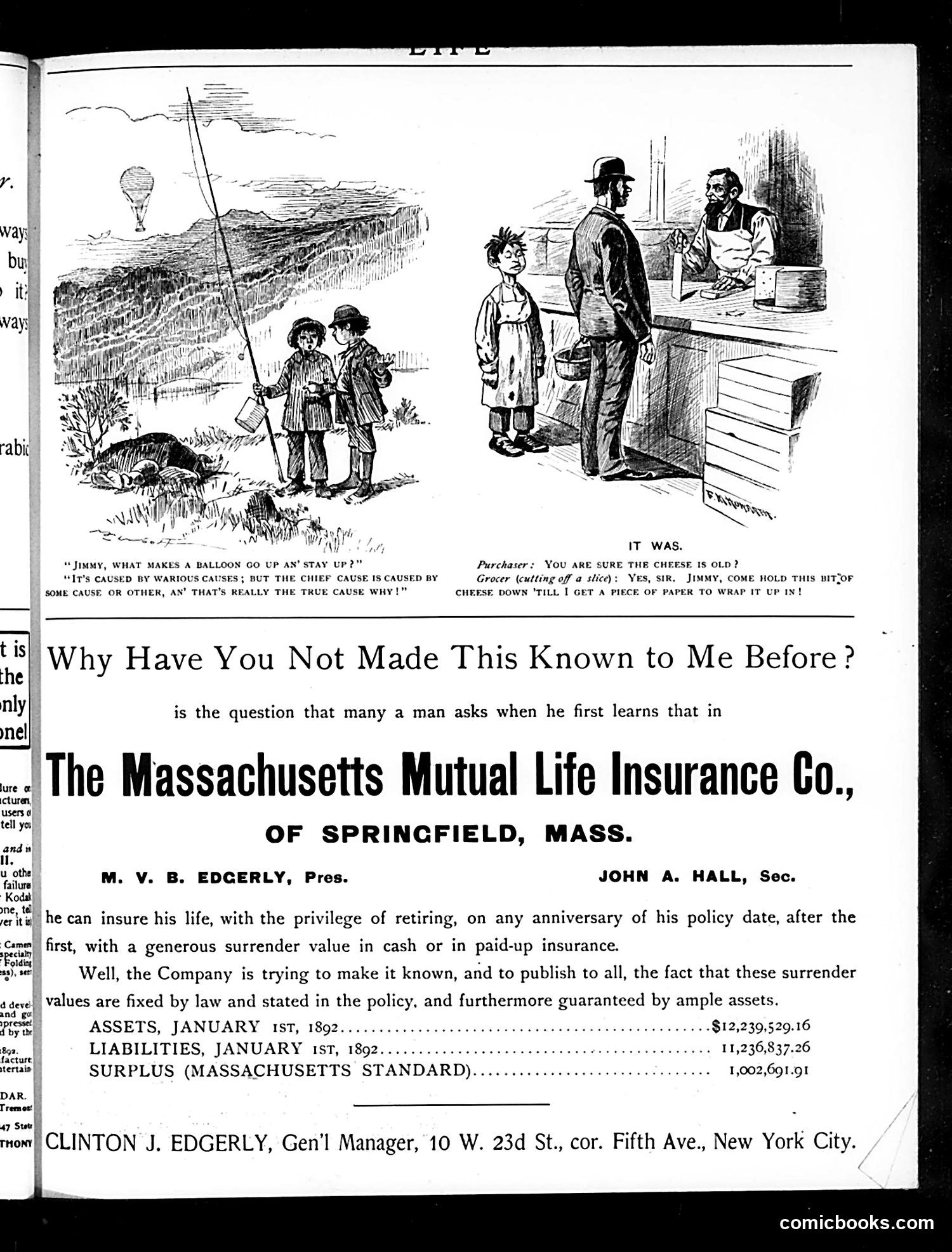
**Top Left Cartoon:** A child asks an adult why balloons rise and stay up. The adult gives a circular, nonsensical explanation—"it's caused by various causes; but the chief cause is caused by some cause or other"—mocking pseudo-intellectual jargon that sounds authoritative but explains nothing. **Top Right Cartoon:** A grocer assures a customer the cheese is old (implying quality/value), then asks his assistant to hold the cheese while he wraps it in paper—the paper being used to hide the cheese's actual condition, suggesting deceptive sales practices. **Advertisement:** Massachusetts Mutual Life Insurance Co. uses both cartoons as indirect satire of obscure explanations and hidden truths. The ad's headline—"Why Have You Not Made This Known to Me Before?"—promises transparency: their surrender values are "fixed by law and stated in the policy" with "ample assets," positioning them as honest dealers against industry opacity and fraud.
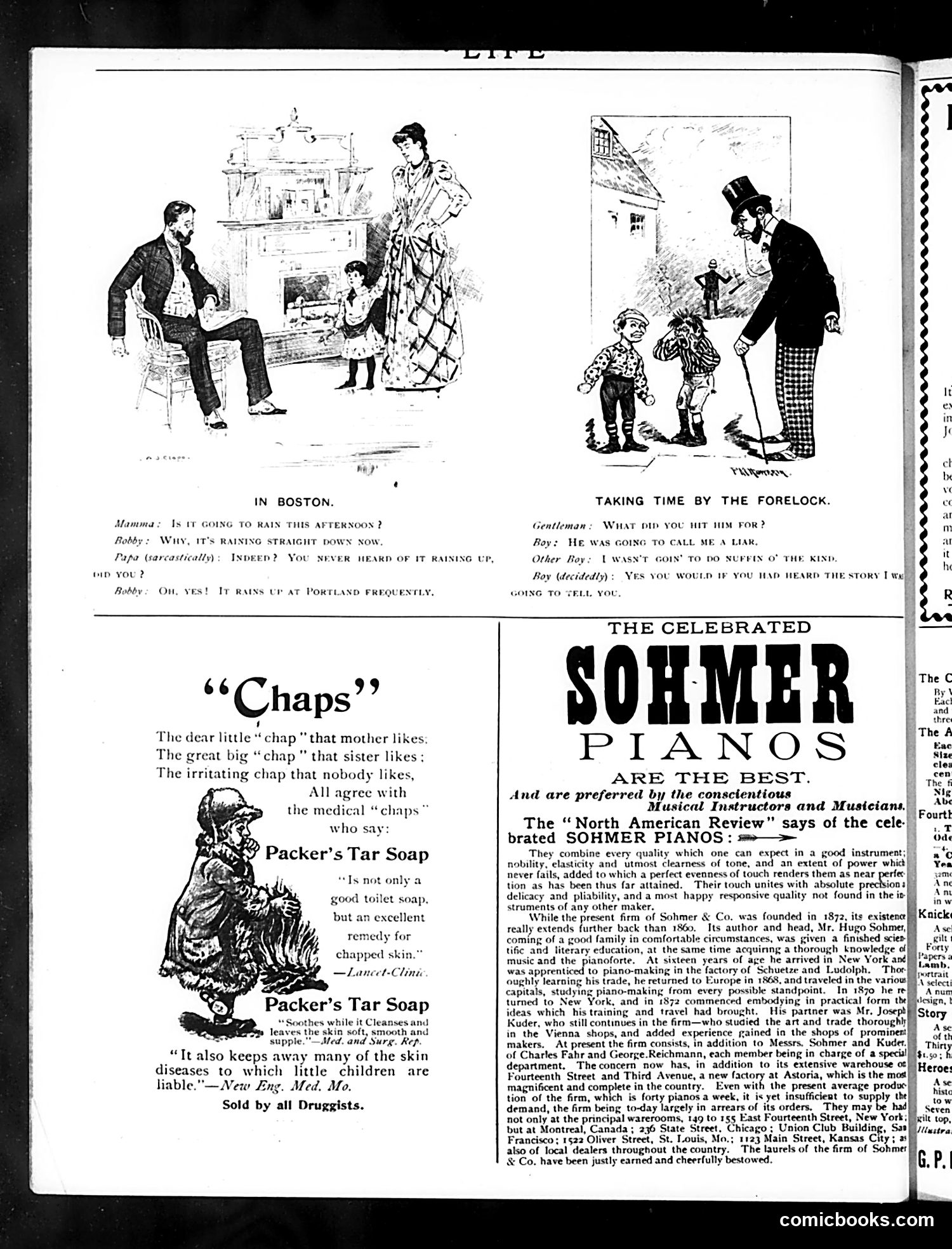
This page contains two cartoon jokes and period advertisements. **"In Boston"**: A child claims it rains "up" at Portland—a joke about Portland, Maine's elevated geography. The adult finds this absurd, but the child insists, playing on the literal meaning of "up" versus the sarcastic adult interpretation. **"Taking Time by the Forelock"**: A well-dressed gentleman with a cane confronts a boy about lying. The boy admits he wasn't going to tell the truth but changed his mind—a moral lesson about honesty, with "taking time by the forelock" meaning seizing the moment to do right. Both cartoons use children's innocent or reluctant honesty as gentle satire on adult behavior and language. The page is primarily **advertising**: Packer's Tar Soap (for chapped skin and children's ailments) and Sohmer Pianos (a New York manufacturer founded 1872, emphasizing quality construction and endorsements). These were typical middle-class consumer products of the era.
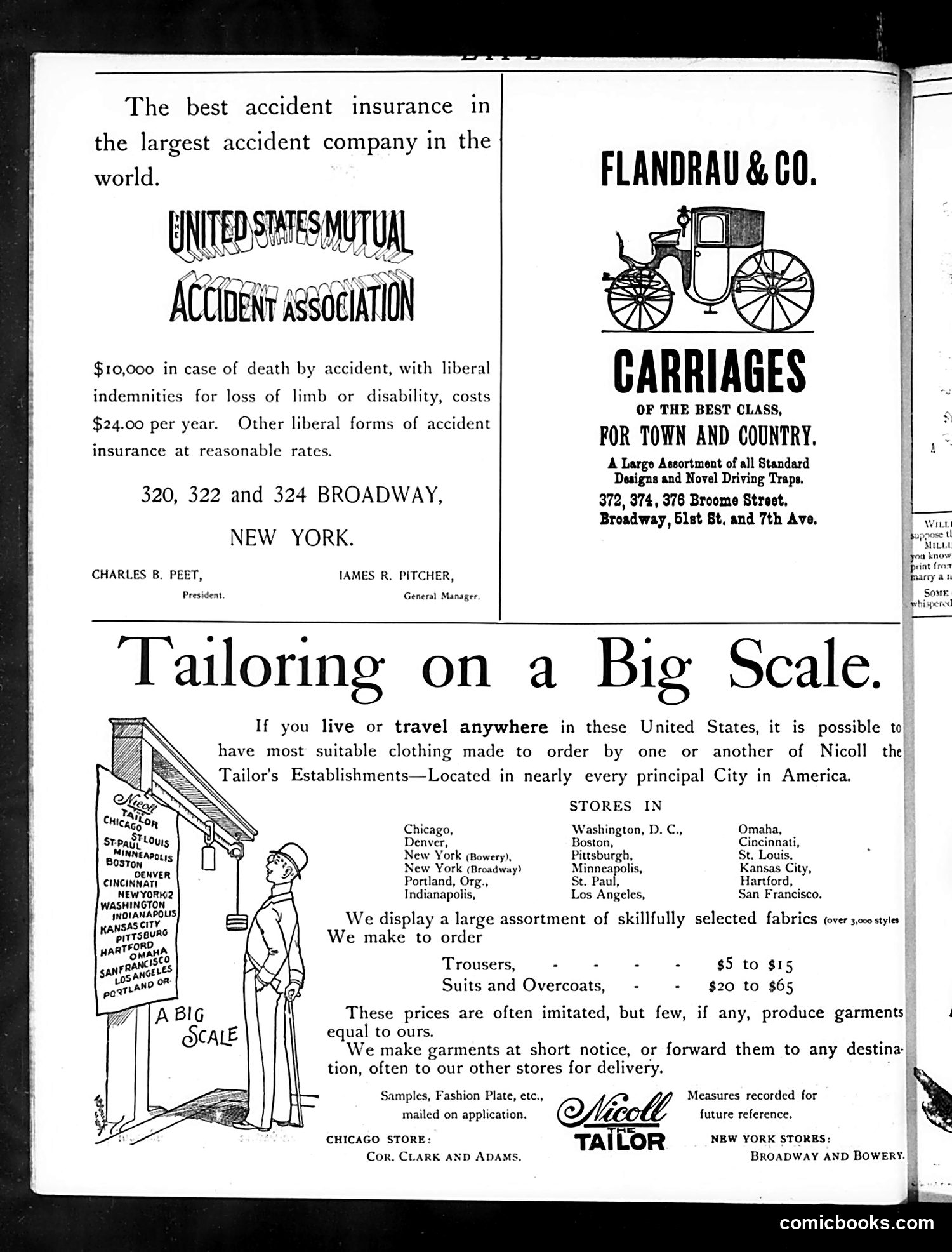
This page consists entirely of **advertisements**, not satire or political commentary. The main content features a cartoon for **Nicoll the Tailor**, showing a well-dressed man pointing to a sign listing nearly 20 American cities where Nicoll has tailoring establishments. The joke is about scale and reach: the tailor operates nationwide, making custom clothing accessible to anyone "anywhere in these United States." The ad emphasizes Nicoll's ability to manufacture suits ($20-$65) and trousers ($5-$15) to order and ship them across the country. The text stresses that while competitors imitate their prices, few match the quality. Surrounding advertisements promote **United States Mutual Accident Association** (accident insurance) and **Flandrau & Co.** (carriages and driving traps). This reflects late-19th/early-20th century American commerce: the excitement of national distribution networks, ready-made and custom clothing becoming accessible to middle-class consumers, and competitive advertising emphasizing quality and nationwide reach.
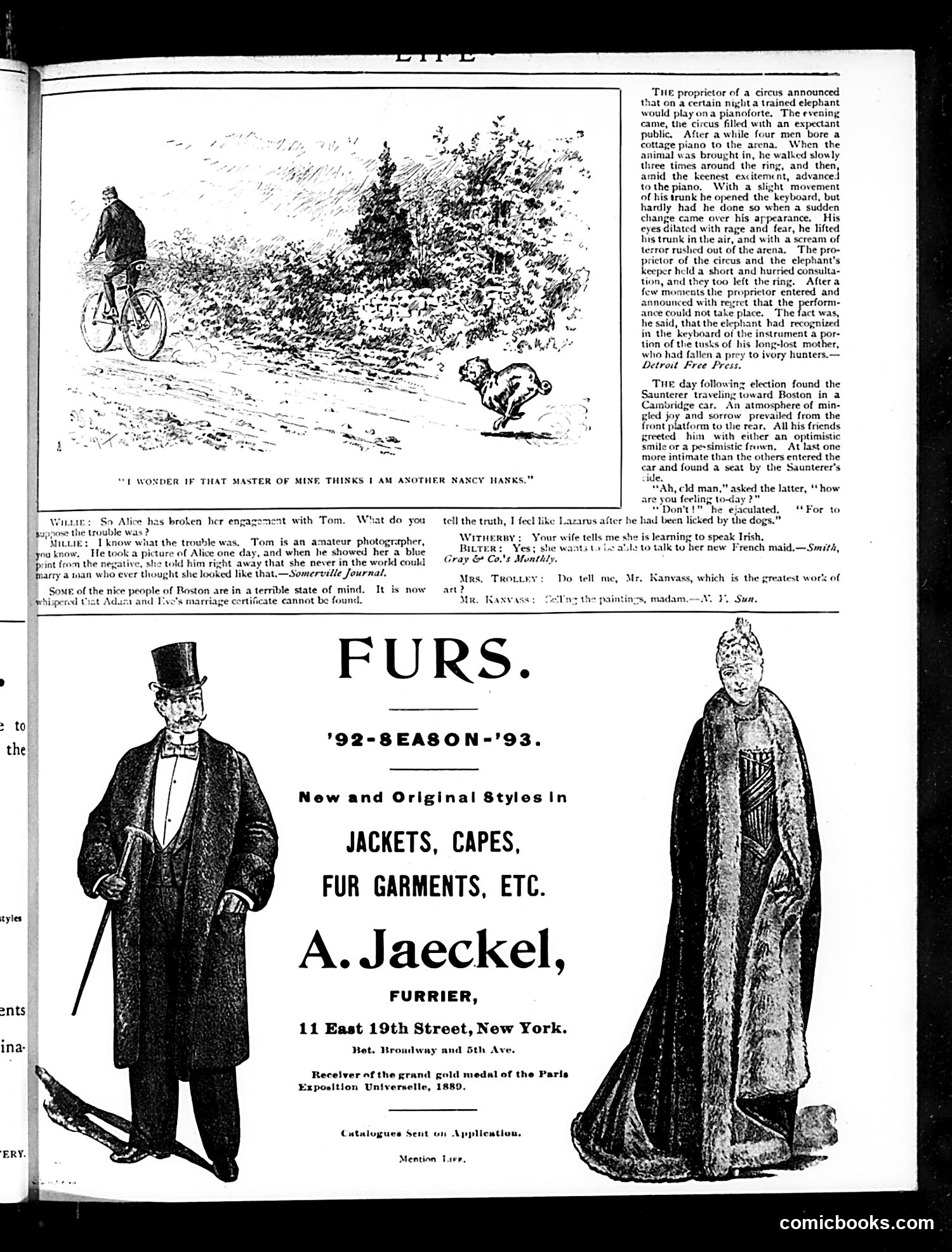
This is primarily an **advertising page** for a furrier (A. Jaeckel), but includes several short humorous anecdotes typical of Life's satirical content. The main illustrations show **fur garments** from the 1892-93 season—a man in a fur-lined coat and a woman in an elaborate fur cape, advertising the furrier's wares. The text snippets are period jokes: 1. **The elephant and piano**: A sentimental tall-tale about a circus elephant refusing to play piano because the ivory keys remind it of its mother's tusks (poaching reference). 2. **Election aftermath**: Post-election commentary showing a man feeling dejected after voting, comparing himself to the biblical Lazarus. 3. **Minor quips**: Brief jokes about photography ruining romance, wives learning Irish to speak with French maids, and artistic merit. The "Nancy Hanks" reference (caption) likely alludes to Abraham Lincoln's mother, though the full context is unclear. These represent typical *Life* magazine humor—gentle satire mixing domestic situations with topical references.
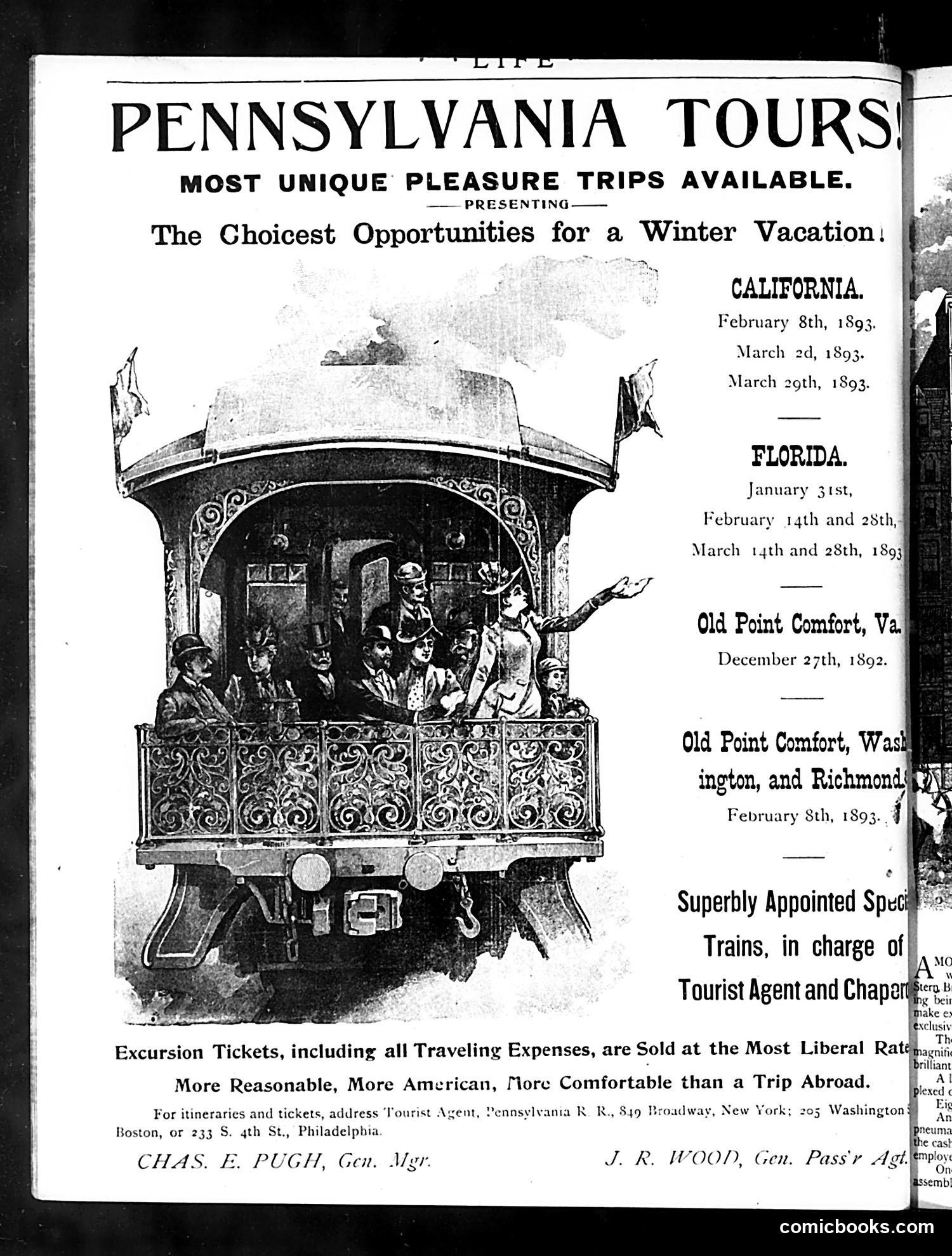
This is a travel advertisement, not political satire. The Pennsylvania Railroad promotes luxury winter excursion tours to popular American destinations: California, Florida, and Virginia resorts. The ornate railway car illustration—filled with well-dressed passengers enjoying themselves—showcases the comfort and elegance of rail travel. The ad's rhetoric emphasizes that domestic American tourism is "More Reasonable, More American, More Comfortable than a Trip Abroad," appealing to nationalist sentiment while positioning rail travel as accessible luxury. The specific departure dates (spanning late 1892–early 1893) suggest this ran during winter holiday season. This represents the Gilded Age's expansion of leisure travel for affluent Americans, when railroads aggressively marketed vacation packages as modern consumer experiences.
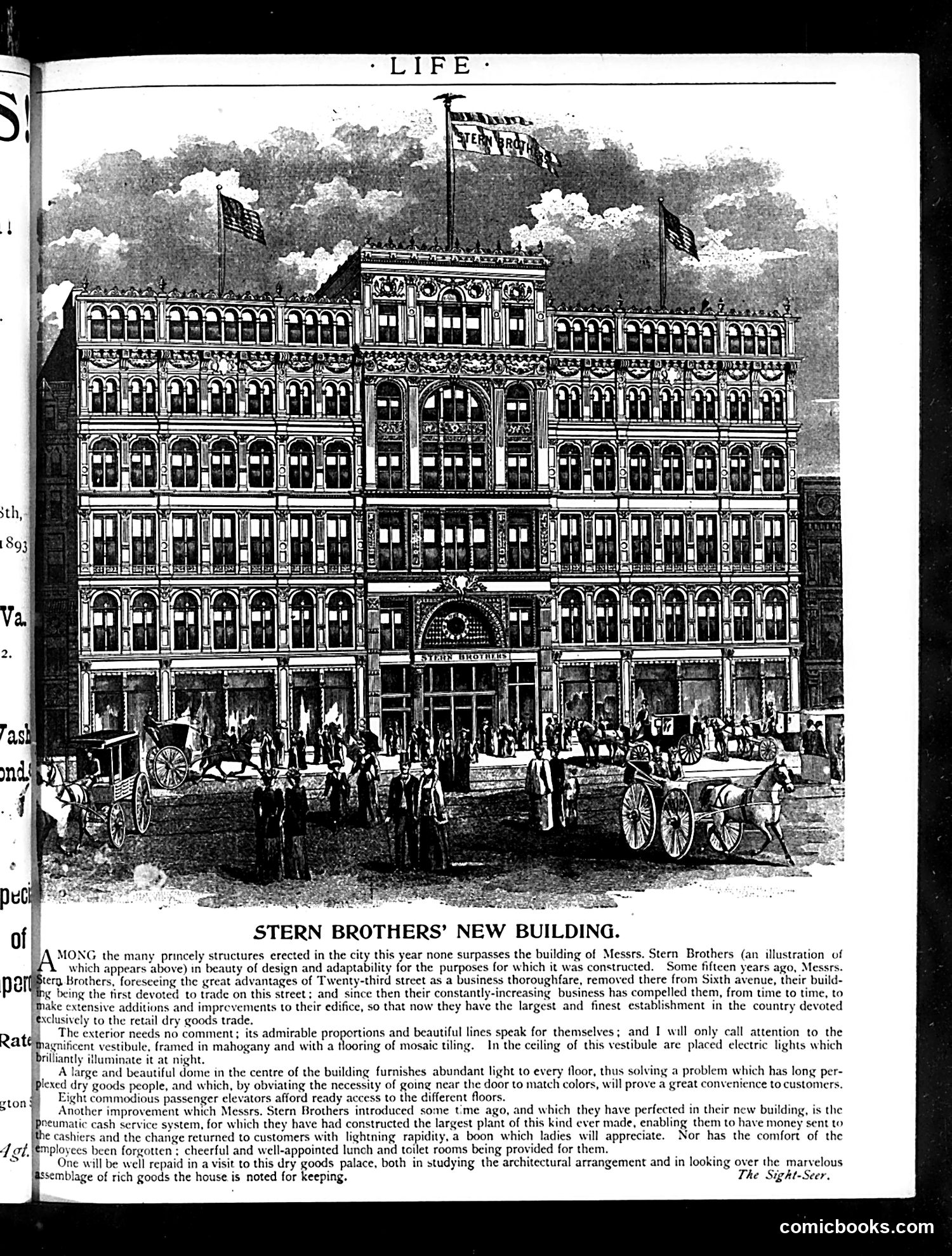
This is not a political cartoon but rather a **advertisement/promotional article** for a major retail establishment. The page features an engraving of Stern Brothers' new department store building on Twenty-third Street in New York City. The text celebrates the store's modern amenities as markers of commercial progress: electric lighting in the vestibule, a central dome providing natural light to all floors, passenger elevators, and notably a pneumatic tube system for rapid cash transactions—innovations that solved practical problems for both customers and employees. The piece reflects **late 19th-century American values**: technological advancement, architectural grandeur, and commercial success as signs of civilization. By highlighting employee amenities (lunch rooms, toilets), it presents the store as enlightened and progressive. This is essentially advertorial content praising retail modernity and American business achievement, not satire.
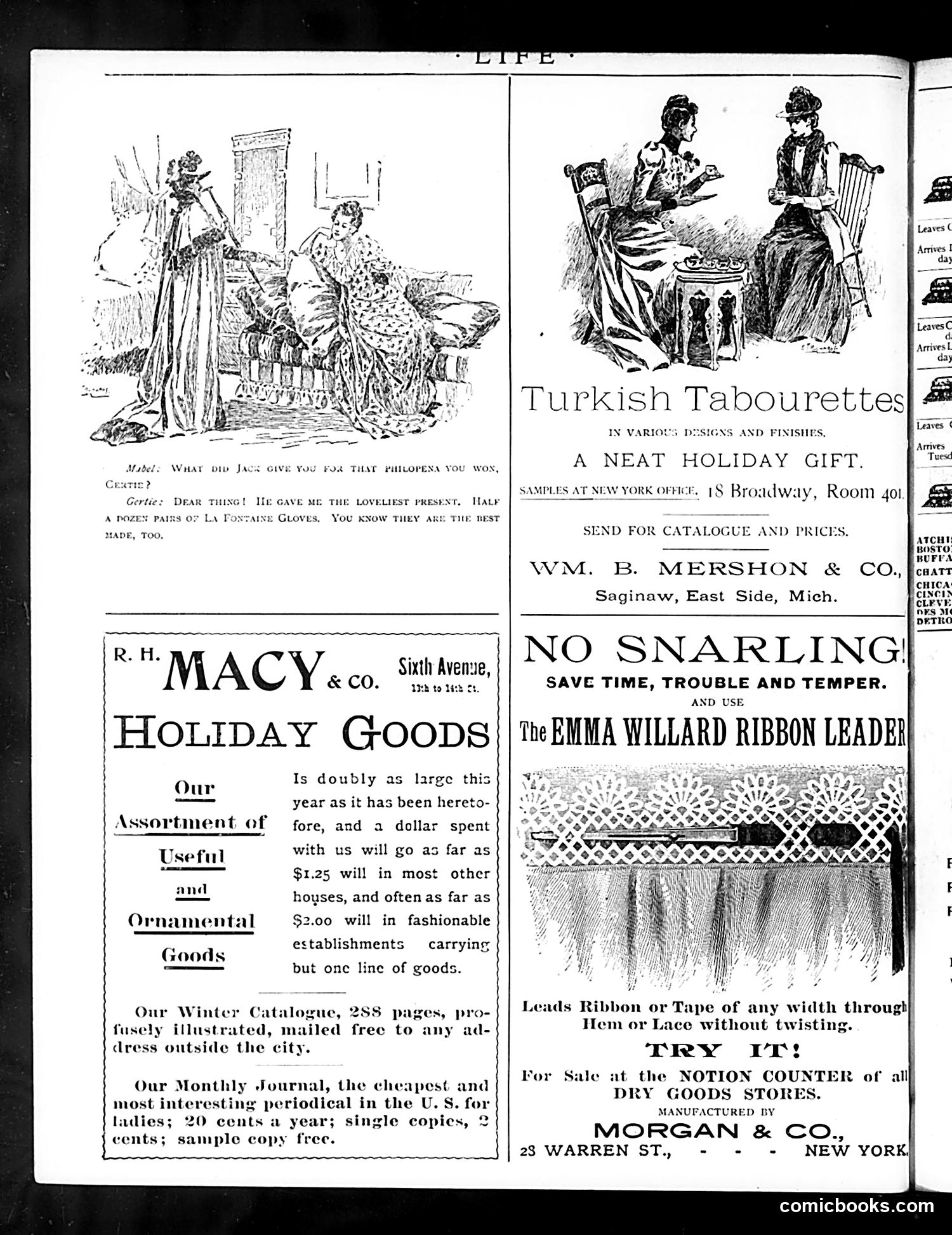
This page is primarily **advertising**, not political satire. The top cartoon is a brief social joke about gift-giving: a woman (Mabel) asks another (Gertie) what she received as a "philopena" (a Victorian parlor game where the loser owes the winner a gift). Gertie boasts about receiving expensive La Fontaine gloves—the joke being her smug satisfaction with this luxury item. The rest of the page consists of holiday advertisements: R.H. Macy & Co. promoting their expanded inventory; Turkish Tabourettes (decorative ottomans) by Mershon & Co.; and Morgan & Co.'s Emma Willard Ribbon Leader, a device for threading ribbons through fabric without tangling. **No significant political content is present.** This is a commercial page designed to appeal to wealthy holiday shoppers, particularly women interested in luxury goods and domestic conveniences.
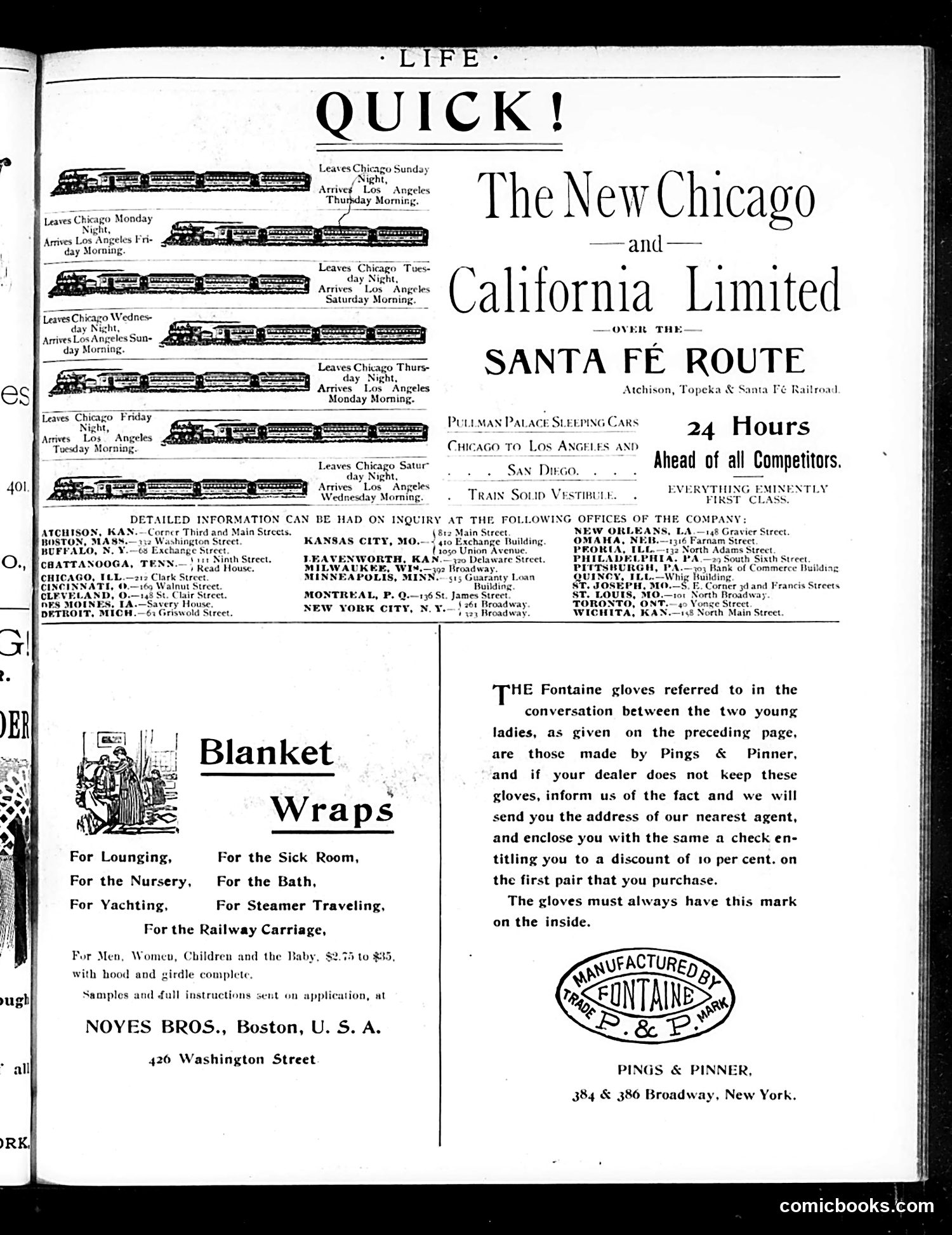
This page is primarily **advertising**, not satire or political commentary. The top half features train schedules and route information for the "New Chicago and California Limited" on the Santa Fé Railway—promoting fast service (24 hours) with Pullman sleeping cars from Chicago to Los Angeles. Multiple departure times throughout the week are listed with train illustrations. The lower half contains two separate product advertisements: 1. **Blanket Wraps** by Noyes Bros. (Boston)—versatile wraps marketed for various uses (lounging, nurseries, yachting, travel), priced $2.75-$15. 2. **Fontaine Gloves** by Pings & Pinner (New York)—the ad references a conversation on a preceding page (not visible here) and offers a 10% discount coupon on first purchase for readers who verify their dealer doesn't stock the product. The page represents typical late-19th/early-20th-century magazine advertising combined with transportation promotional content—no cartoon or satire is present.
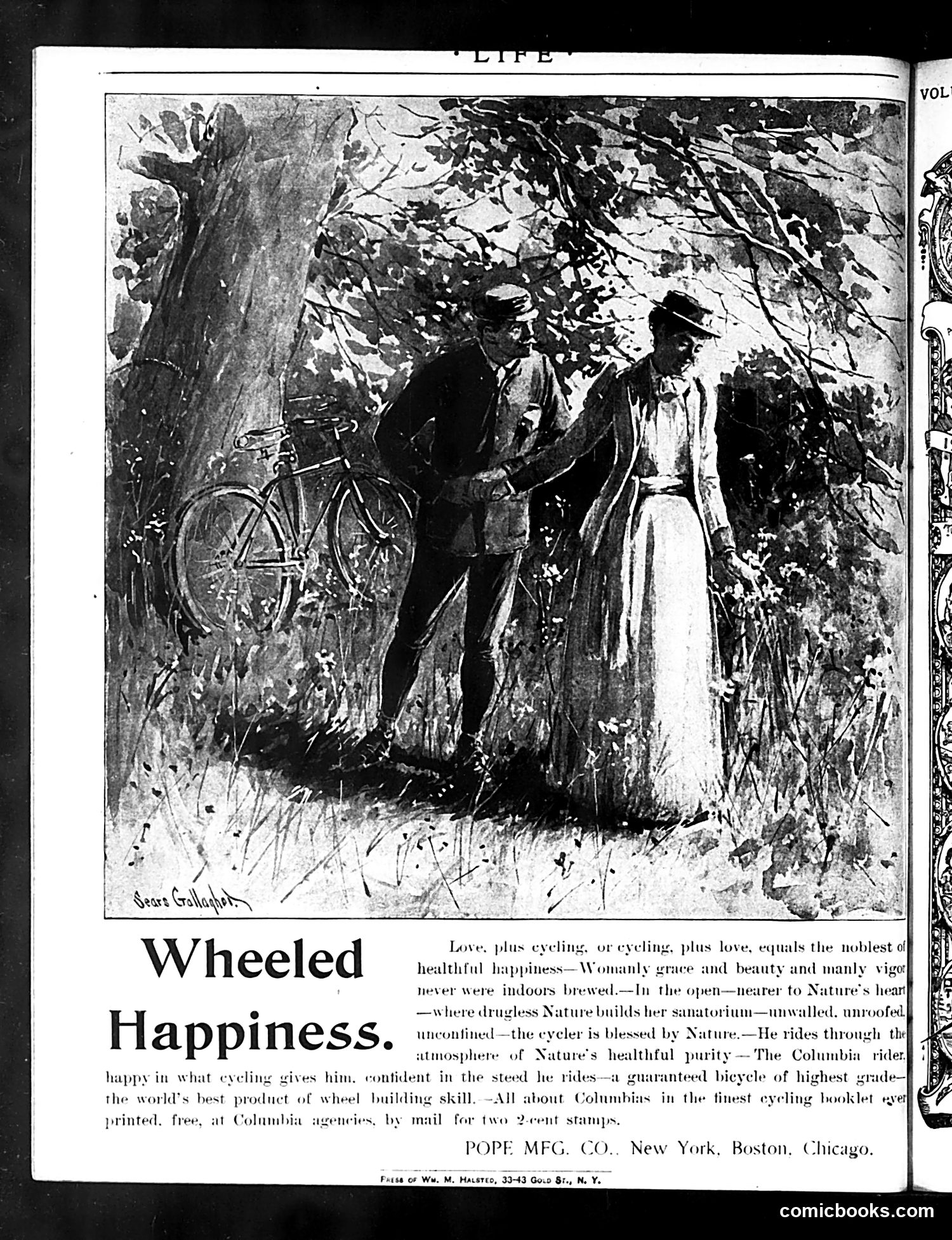
This is a **bicycle advertisement**, not satire. The illustrated scene shows three figures (two men and a woman) with a bicycle beneath trees, promoting Columbia brand bicycles by Pope Manufacturing Company. The ad conflates romantic love with cycling, arguing that outdoor exercise represents "the noblest of healthful happiness." It emphasizes that cycling provides natural health benefits ("drugless Nature builds her sanatorium") away from indoor confinement, and presents the Columbia bicycle as the superior product—"the world's best product of wheel building skill." The romanticized imagery and flowery language reflect late-19th/early-20th-century attitudes celebrating cycling as both a health practice and a social activity, particularly notable for its association with women's increasing mobility and independence during this era.
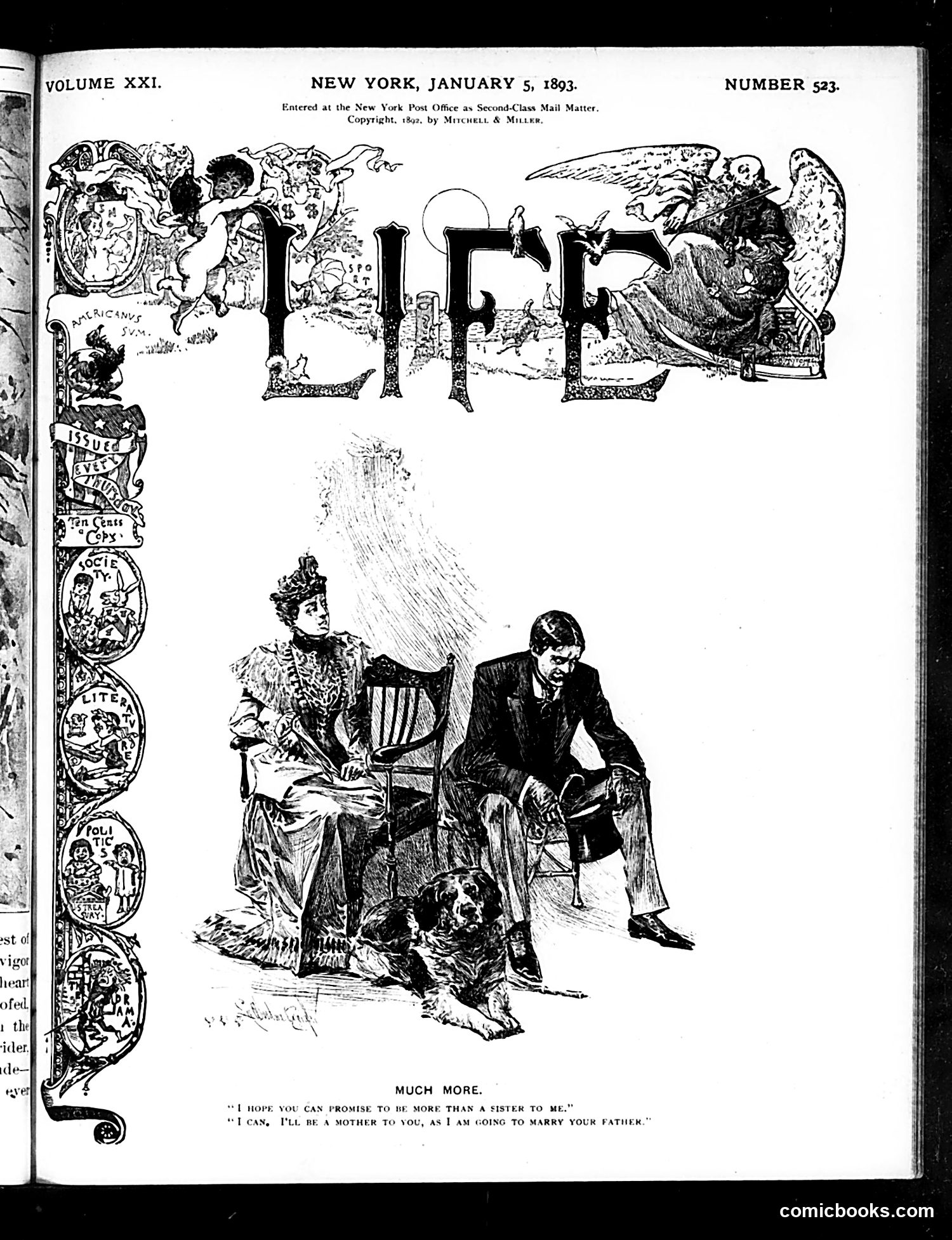
This satirical cartoon depicts a romantic/domestic scenario between a young man and woman. The man hopefully asks the woman to "be more than a sister" to him (a courtship proposal). Her response—that she'll "be a mother to you, as I am going to marry your father"—reveals she's actually marrying his father, making her his stepmother rather than his romantic partner. The humor relies on the dramatic reversal of expectations: the man anticipates romantic advancement, but instead learns he's been "outmaneuvered" by someone marrying into his family in a senior position. The ornate decorative border and cherubs at the page's top suggest romantic themes, emphasizing the ironic contrast. This reflects Victorian-era anxieties about marriage, family dynamics, and social position—common satirical subjects in 1890s Life magazine.
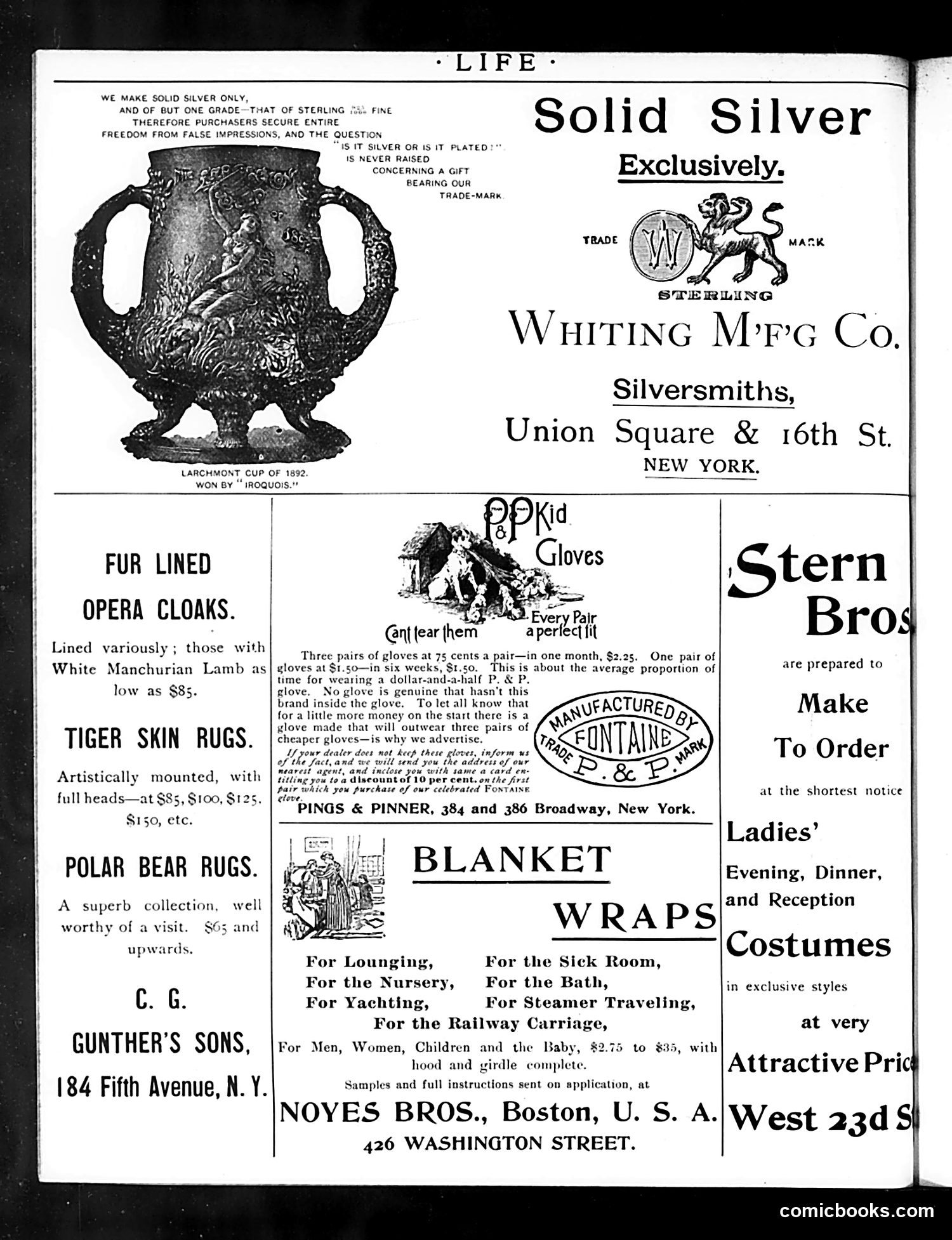
This is primarily an **advertising page**, not a satirical cartoon. It showcases luxury goods from the 1890s Gilded Age aimed at wealthy consumers. The page features ads for: - **Whiting Mfg Co.** (silversmiths): emphasizing solid sterling silver to distinguish from plated imitations—a common consumer concern - **Fur-lined opera cloaks** and exotic animal rugs (tiger, polar bear) - **Kid gloves** by Fontaine brand, marketed with durability claims - **Blanket wraps** for various domestic settings - **Stern Bros.** offering custom costumes for formal occasions The **Larchmont Cup image** (top left) depicts a decorative silver vessel won by the horse "Iroquois," establishing Whiting's prestige through association with high society. This page reflects Gilded Age consumer culture: luxury items, exoticism (furs), and conspicuous consumption for the wealthy. The ads address anxieties about authenticity and quality—key concerns when buying expensive goods without standardized consumer protections.
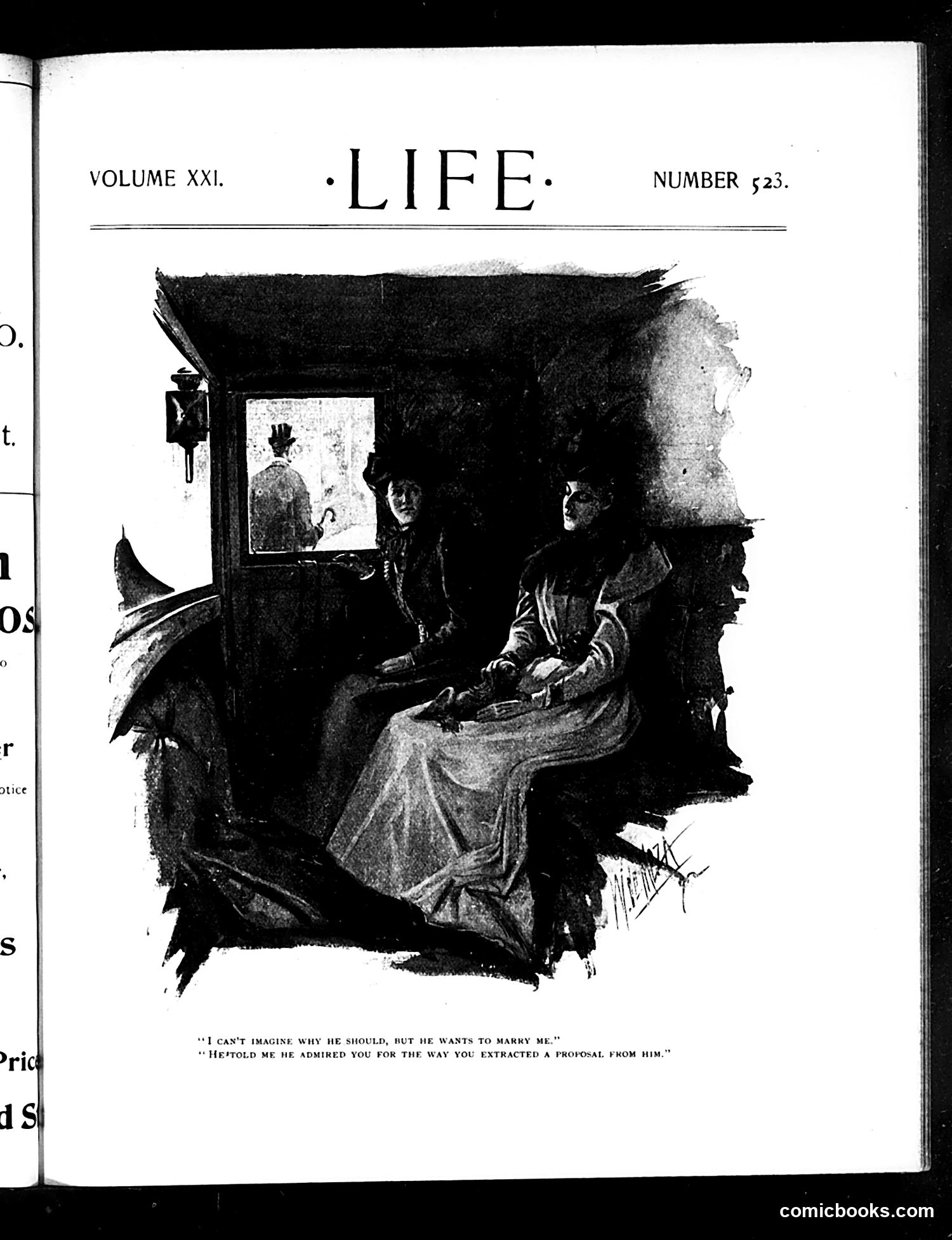
This appears to be a satirical illustration from Life magazine depicting a romantic/social scenario. The image shows a silhouetted profile composition featuring a woman in a carriage or enclosed space with other figures visible in the background. The dialogue reveals the satire's point: a woman is puzzled why a man wants to marry her, while another character reveals the man actually admires her for successfully extracting a marriage proposal from him—reversing traditional gender roles in courtship. The joke mocks both the woman's feigned innocence about her own manipulation and the man's admission of being strategically pursued rather than being the pursuer. This reflects early 20th-century anxieties about shifting gender dynamics and female agency in marriage negotiations, presenting female assertiveness in courtship as both amusing and slightly transgressive for the era's readership.
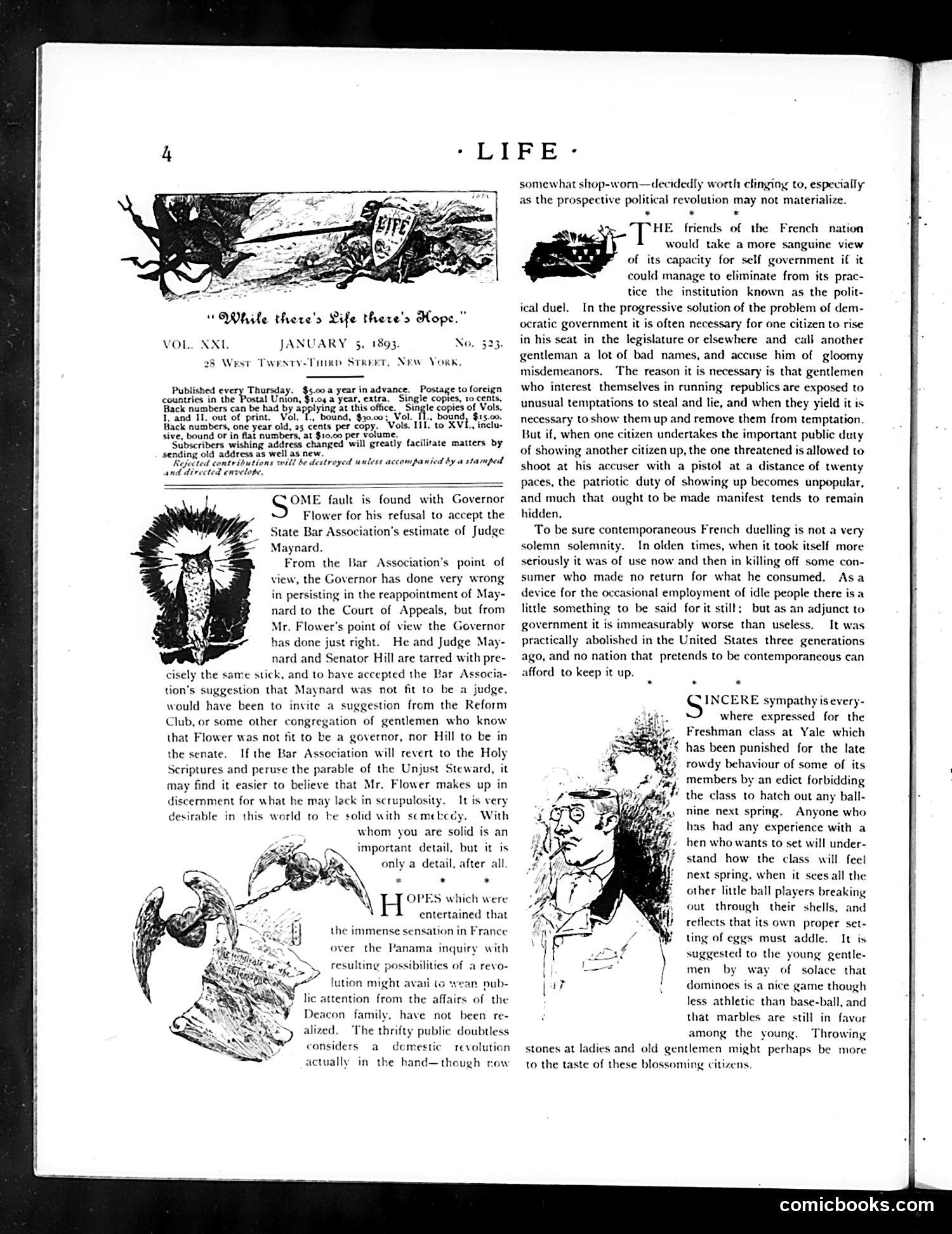
This page contains three distinct political commentaries on contemporary American and French affairs. **Governor Flower and Judge Maynard**: The text criticizes New York Governor Flower for reappointing Judge Maynard despite the State Bar Association's objection. The satirist argues Flower was right to do so, noting that Flower, Maynard, and Senator Hill are "tarred with precisely the same stick"—implying all three are compromised figures. The point: attacking one would invite attacks on all, so they protect each other through mutual self-interest rather than principle. **Panama Scandal vs. Domestic Politics**: The editorial notes that while France is distracted by the Panama inquiry scandal (a major corruption scandal of the era), Americans continue with their own "domestic revolution"—suggesting American political corruption is equally troubling and ongoing. **French Dueling**: The passage satirizes France's continued practice of political dueling, arguing it undermines democratic accountability. When politicians can challenge critics to pistol duels, legitimate public criticism becomes dangerous and unpopular, allowing corruption to remain hidden. The overall message critiques political corruption and hypocrisy across both nations.
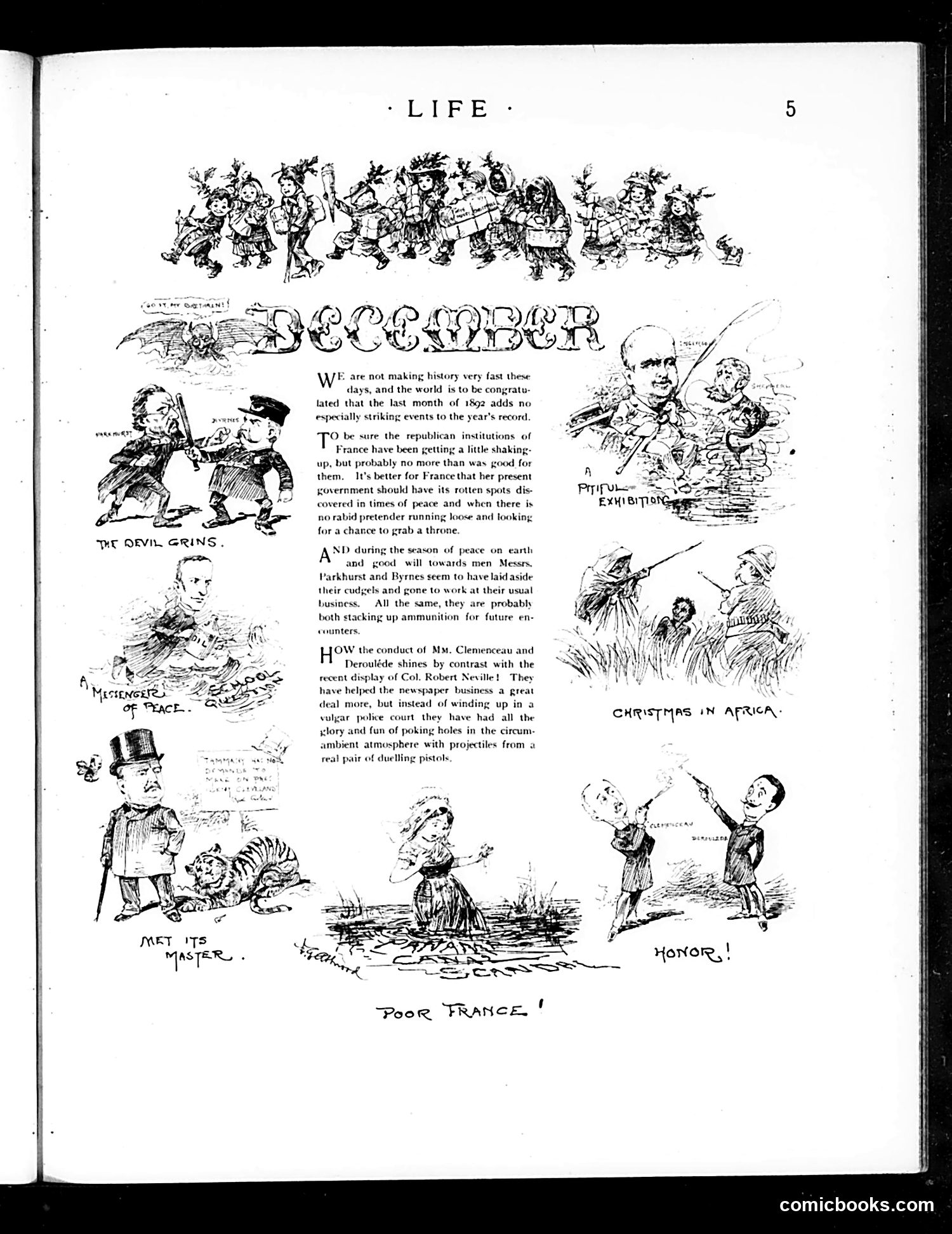
This page satirizes recent French political turmoil. The text references republican institutions being "shaken up" and mentions figures like Clemenceau, Derouléde, and Col. Robert Neville in connection with dueling—suggesting France's political class resolved disputes through violence rather than legal process. The cartoon "Poor France!" depicts the nation as a woman in distress, surrounded by warring factions. Other sketches ("The Devil Grins," "A Miscreant of Peace," "Met Its Master") appear to mock French politicians' conduct. The satire's point: while France claims republican virtue, its leaders resort to duels and police court brawls. The "Christmas in Africa" reference appears unrelated, possibly satirizing colonial ventures. The overall message criticizes French political instability and the hypocrisy of republican institutions undermined by aristocratic violence.
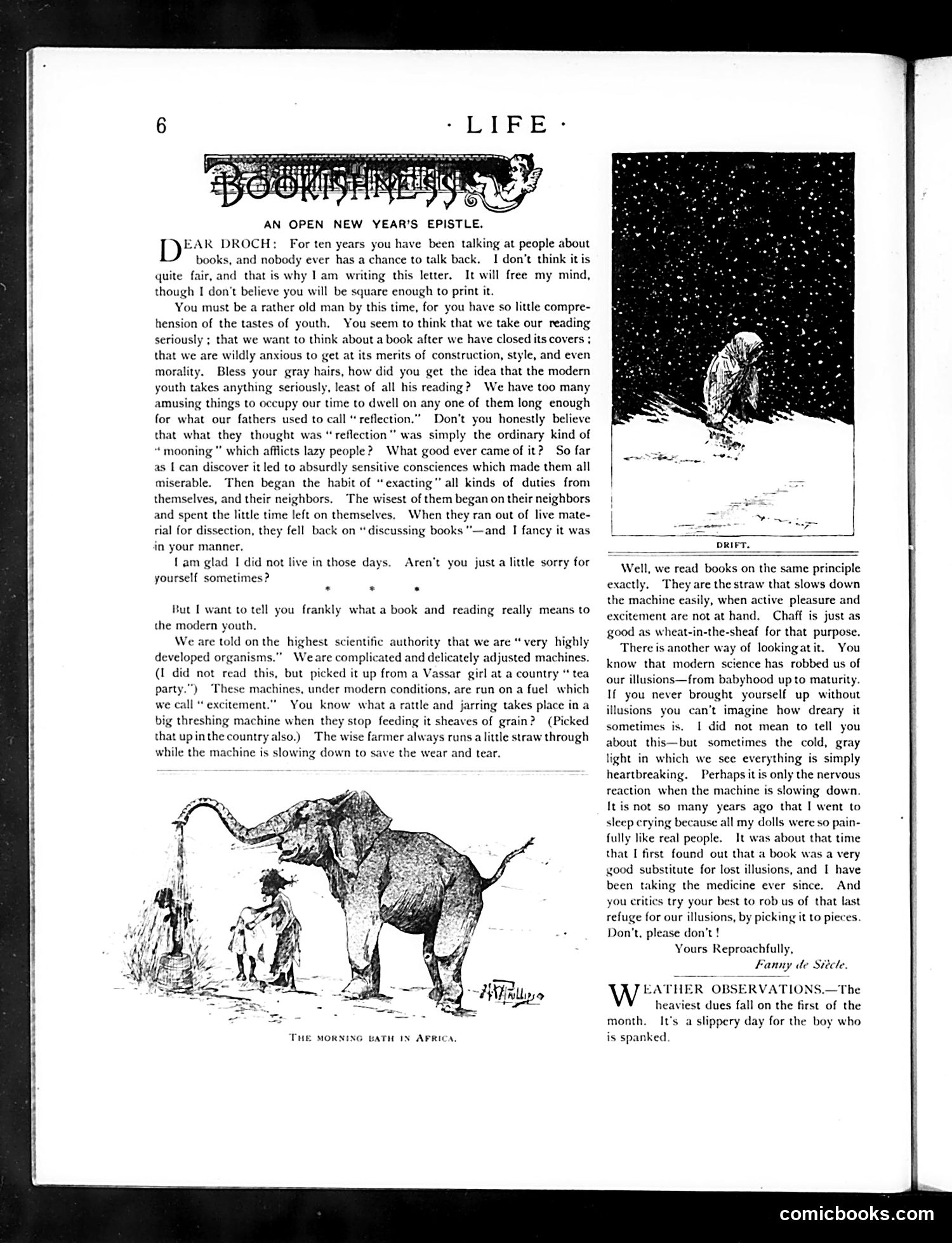
This page presents a reader's rebuttal to "Droch," Life's book columnist. A young woman (signing as "Fanny de Siècle") critiques his expectation that modern youth read seriously for moral reflection and literary merit. Her argument: young people use books as "straw" to calm their overstimulated "machines"—a metaphor borrowed from scientific rhetoric about humans as complicated organisms. Books provide escapism and comfort, not intellectual nourishment. She further argues that modern science has destroyed childhood illusions, and books offer crucial refuge from that harsh reality. She pleads with critics (like Droch) to stop dissecting literature, which ruins this therapeutic function. The two illustrations—a snowy landscape and a colonial-era bath scene—appear decorative rather than directly satirical. The "Weather Observations" note is unrelated filler content. The satire targets both Droch's earnestness about literary criticism and generational attitudes toward reading and leisure.
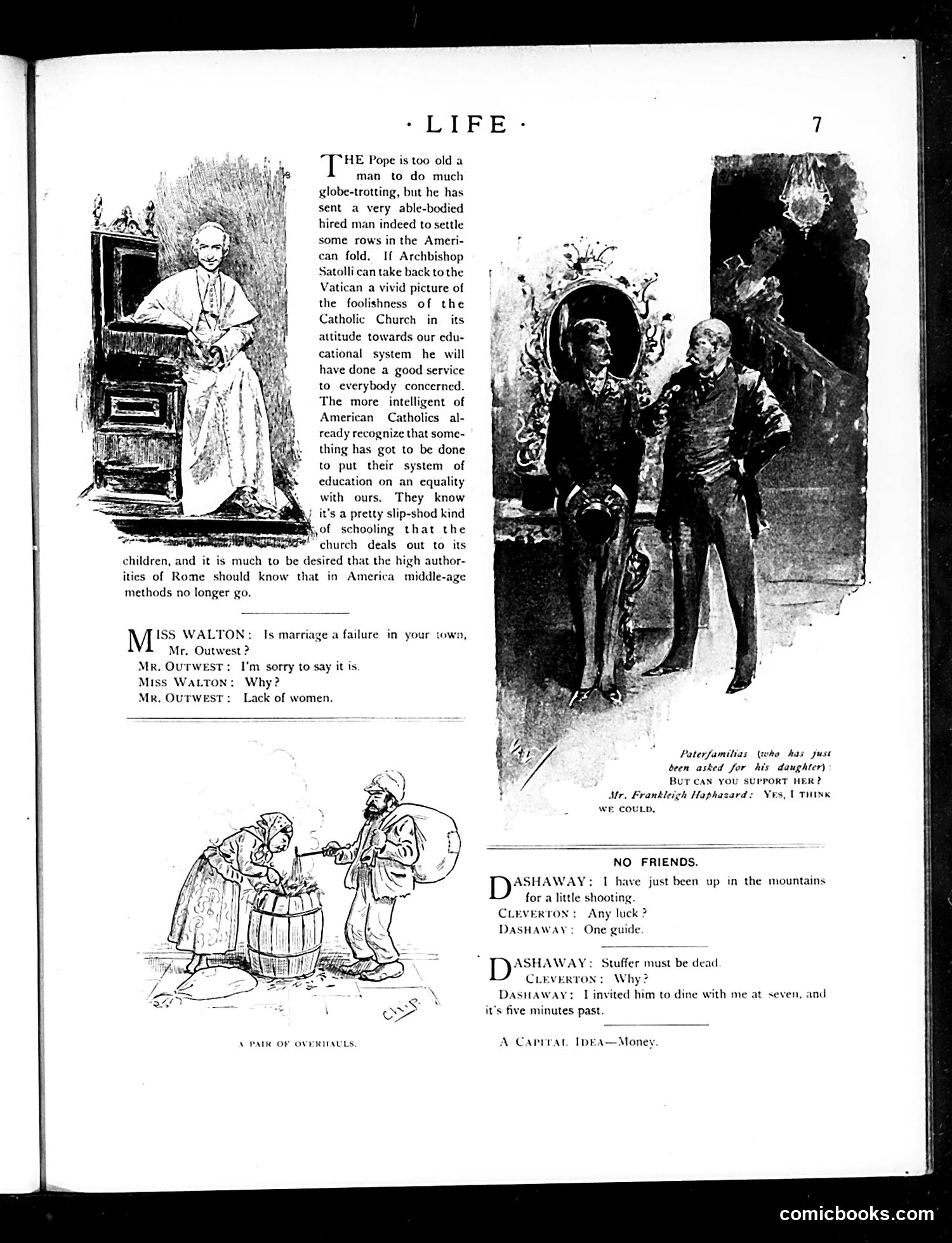
This page contains several discrete satirical pieces: **Top editorial**: Critiques the Catholic Church's educational methods through Archbishop Satolli's Vatican mission to America. Life argues the Church's schools are outdated ("middle-age methods") and inferior to American public education, urging Rome to modernize. **"Miss Walton" dialogue**: Rural satire suggesting the American West lacks marriageable women—implying frontier gender imbalance or shortage of eligible females. **"Paterfamilias" cartoon**: Mock-serious exchange about a suitor's financial ability to support a daughter, satirizing both anxious fathers and fortune-hunting courtship rituals. **"No Friends" dialogue**: Dark humor about a missed dinner appointment; the punchline implies the absent guest ("Stuffer") must have died rather than ignore an invitation—mocking unreliability or social obligations. The cartoons employ genteel, class-conscious humor typical of 1890s Life magazine, targeting Catholic institutions, rural manners, courtship pretension, and social reliability.
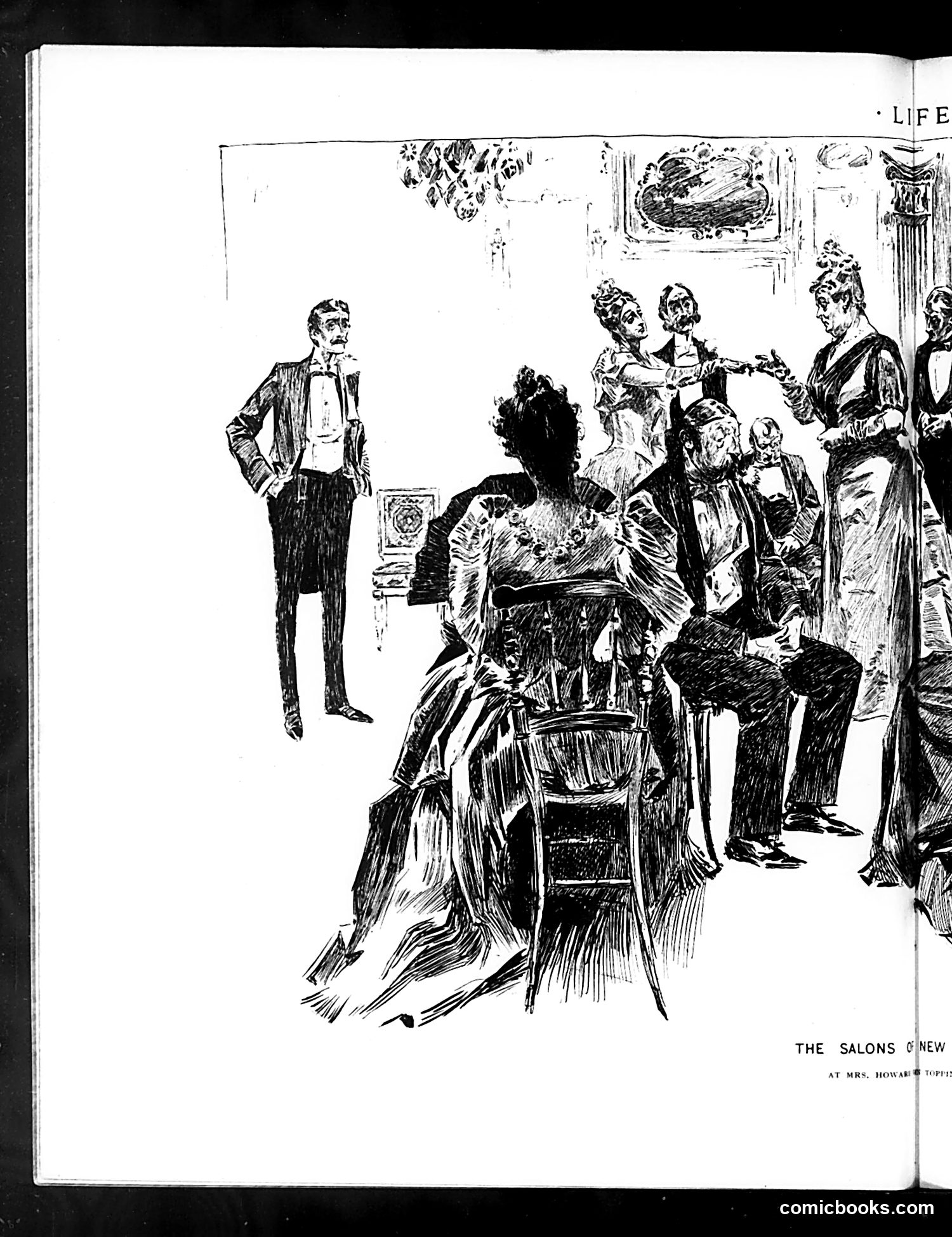
This illustration depicts **a formal social salon or reception**, likely from the early 1900s based on the artistic style. The caption references "The Salons of New" at "Mrs. Howard Topp's" residence (OCR may have corrupted the name). The satire appears to target **high society social gatherings**: a well-dressed man stands alone on the left while elegantly-attired guests cluster and converse on the right. The composition suggests commentary on social hierarchies, exclusion, or the artificial nature of salon society—perhaps mocking how social status determines who belongs in these exclusive circles. Without clearer identification of "Mrs. Topp" or the specific event referenced, the exact satirical target remains unclear, though the visual contrast between the isolated figure and the engaged crowd suggests themes of **social acceptance or belonging**.
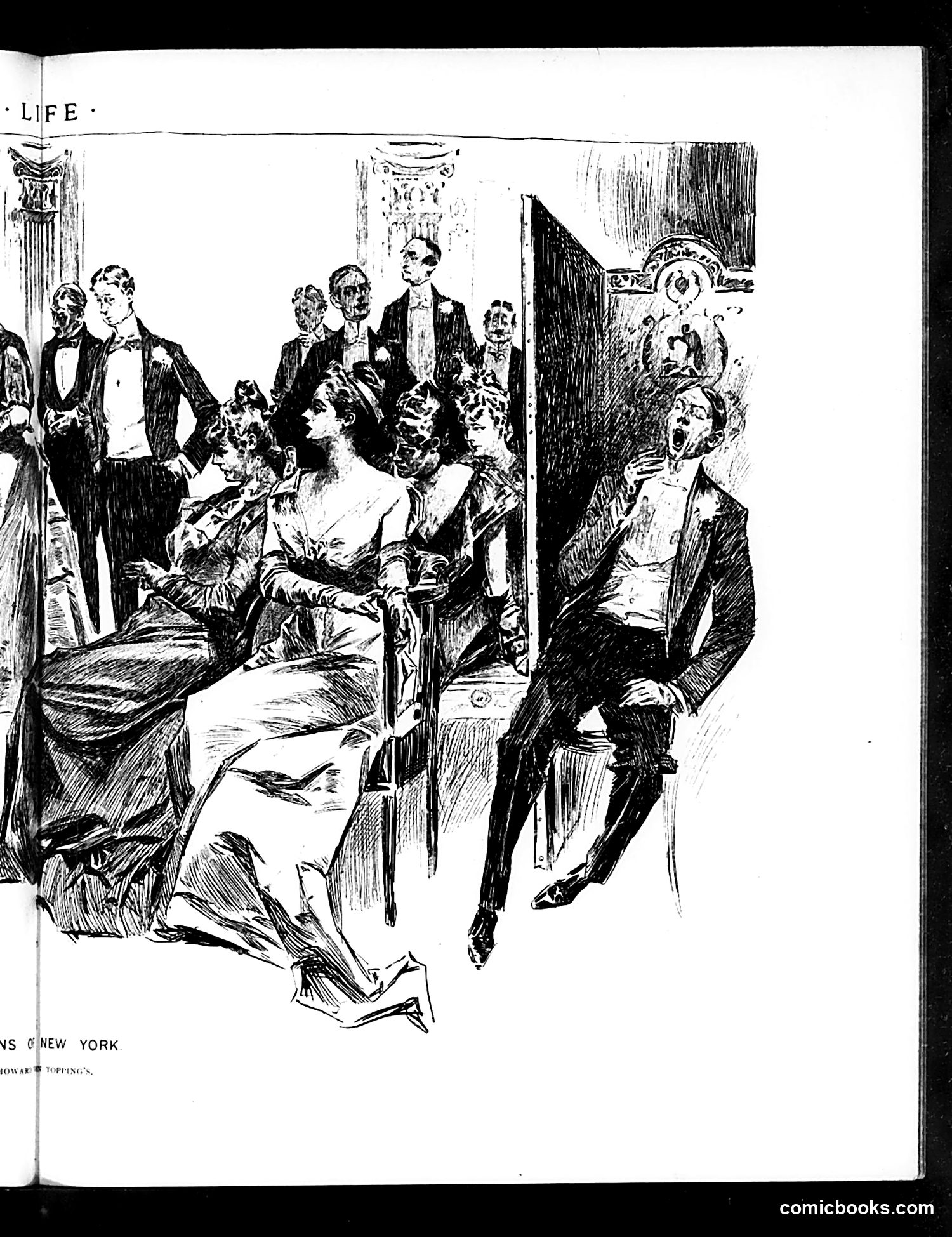
This is a sketch from *Life* magazine depicting an elegant social gathering or party scene. The illustration shows well-dressed men in formal attire (tuxedos) standing in the background, while in the foreground, seated figures—including women in evening wear—appear to be entertained or engaged in conversation. The style and composition suggest this is satirizing upper-class social conventions or salon culture of the period. However, without a visible caption or title, the specific satirical point remains unclear. The dramatic expressions and body language suggest humor at the subjects' expense, likely mocking pretension, affectation, or social posturing among the wealthy elite. The OCR text is too fragmented to provide additional context about the intended message or figures depicted.
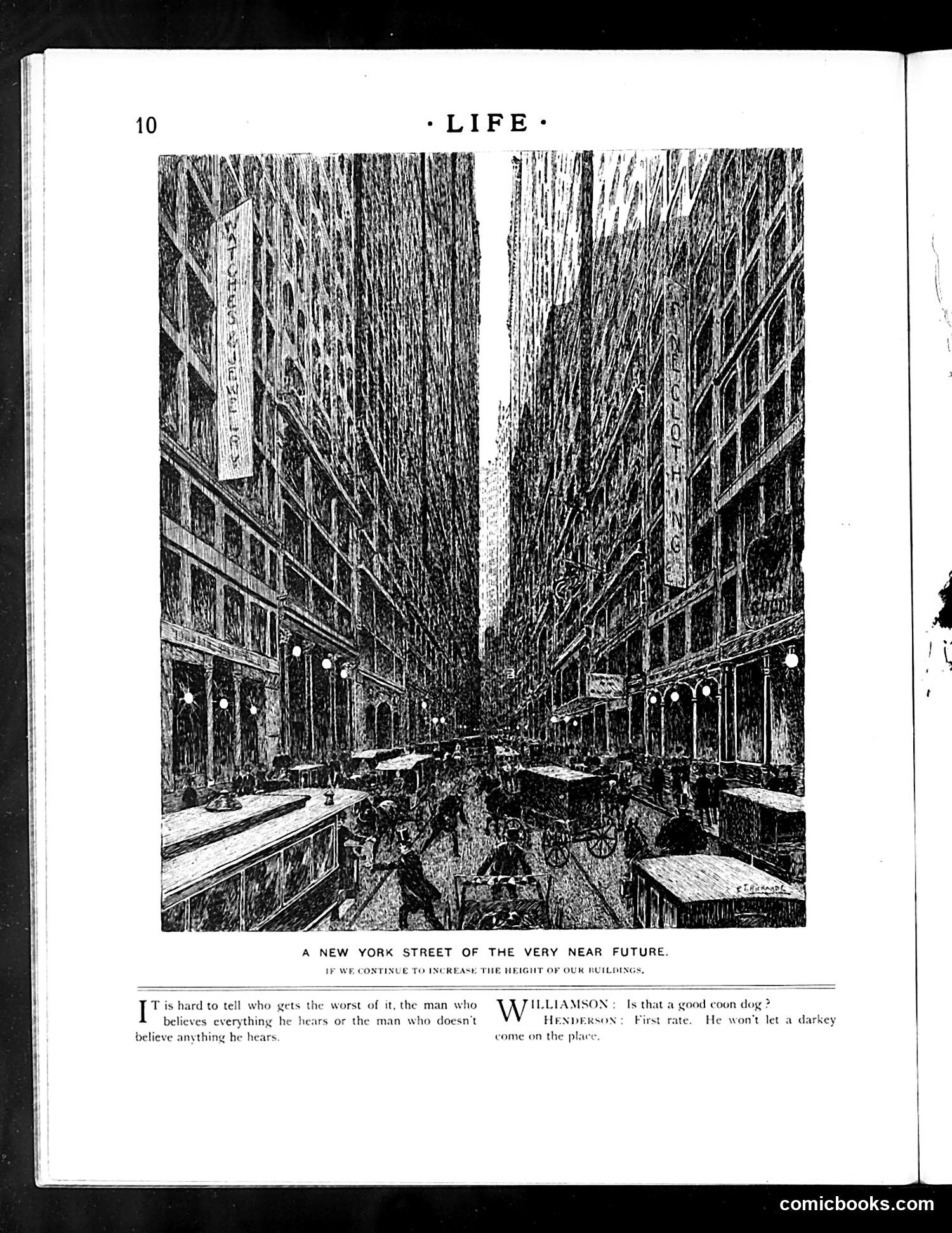
This Life magazine page features a futuristic architectural illustration of a New York street with extremely tall buildings towering overhead, casting the street into deep shadow. The caption warns: "If we continue to increase the height of our buildings..." The satirical point critiques excessive urban development—specifically the trend of constructing ever-taller buildings that would darken street-level life and create an inhospitable urban environment. The dialogue excerpt below appears unrelated to the main illustration and discusses a hunting dog's behavior. The language used reflects period attitudes but represents casual conversation rather than the page's primary satirical content. The cartoon functions as social commentary on unchecked architectural ambition and its negative consequences for city life.
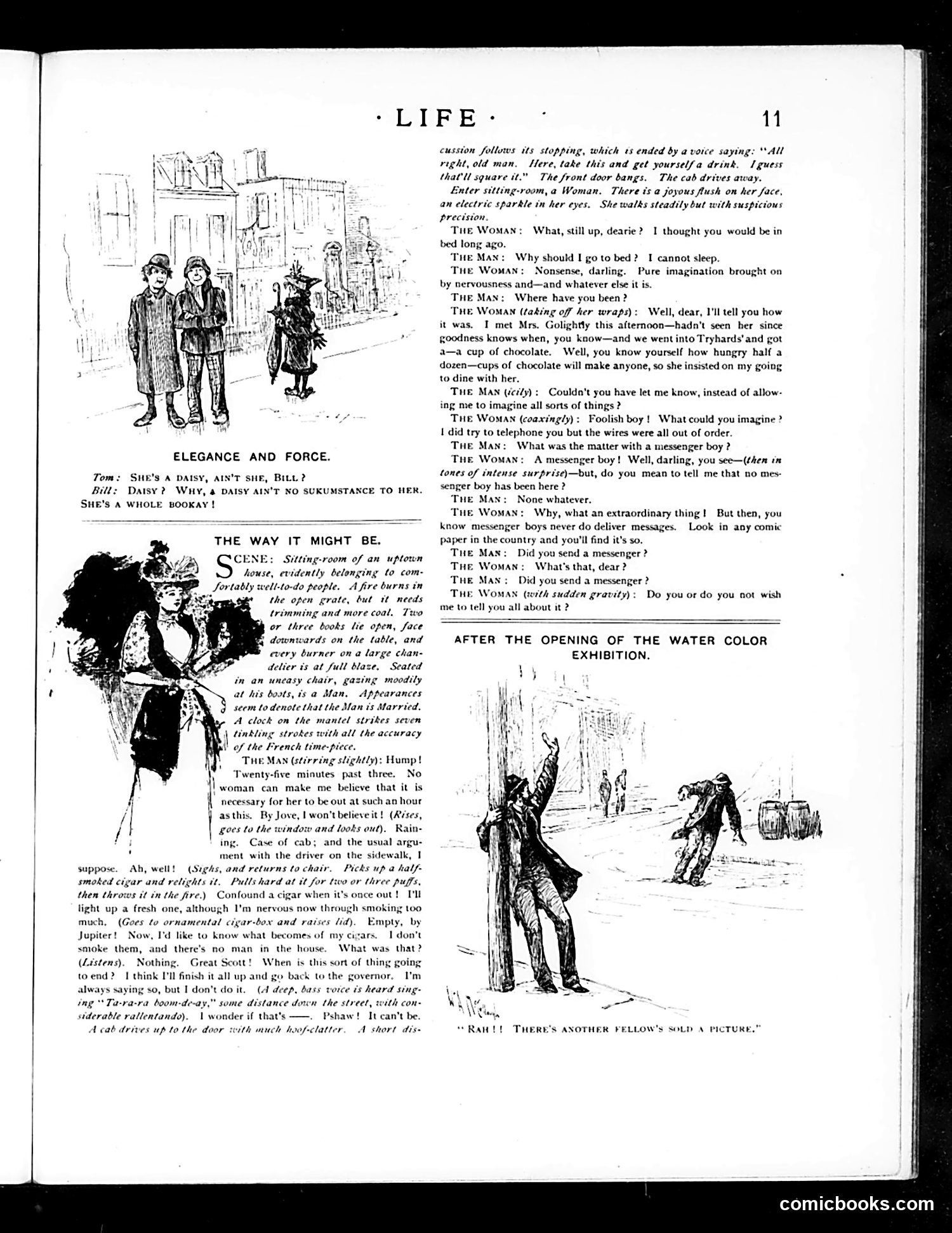
This dramatic sketch satirizes marital tension and female independence in early 20th-century America. A husband, anxiously waiting at home, imagines his absent wife's infidelity during a late evening out. When she finally arrives—flushed and "with suspicious precision" (implying intoxication)—she claims she met a friend for chocolate that turned into dinner. The satire cuts both ways: it mocks the husband's paranoid jealousy and his obsessive worry over propriety, but more pointedly, it ridicules the wife's transparent, absurd excuses and her casual disregard for his concern. Her claim that "messenger boys never do deliver messages" (referencing comic strips) suggests Life is satirizing how women evade accountability by treating serious situations as jokes. The piece reflects anxieties about changing gender roles and women's increasing freedom to move about unchaperoned—a genuine social shift that both amused and troubled the magazine's readers.
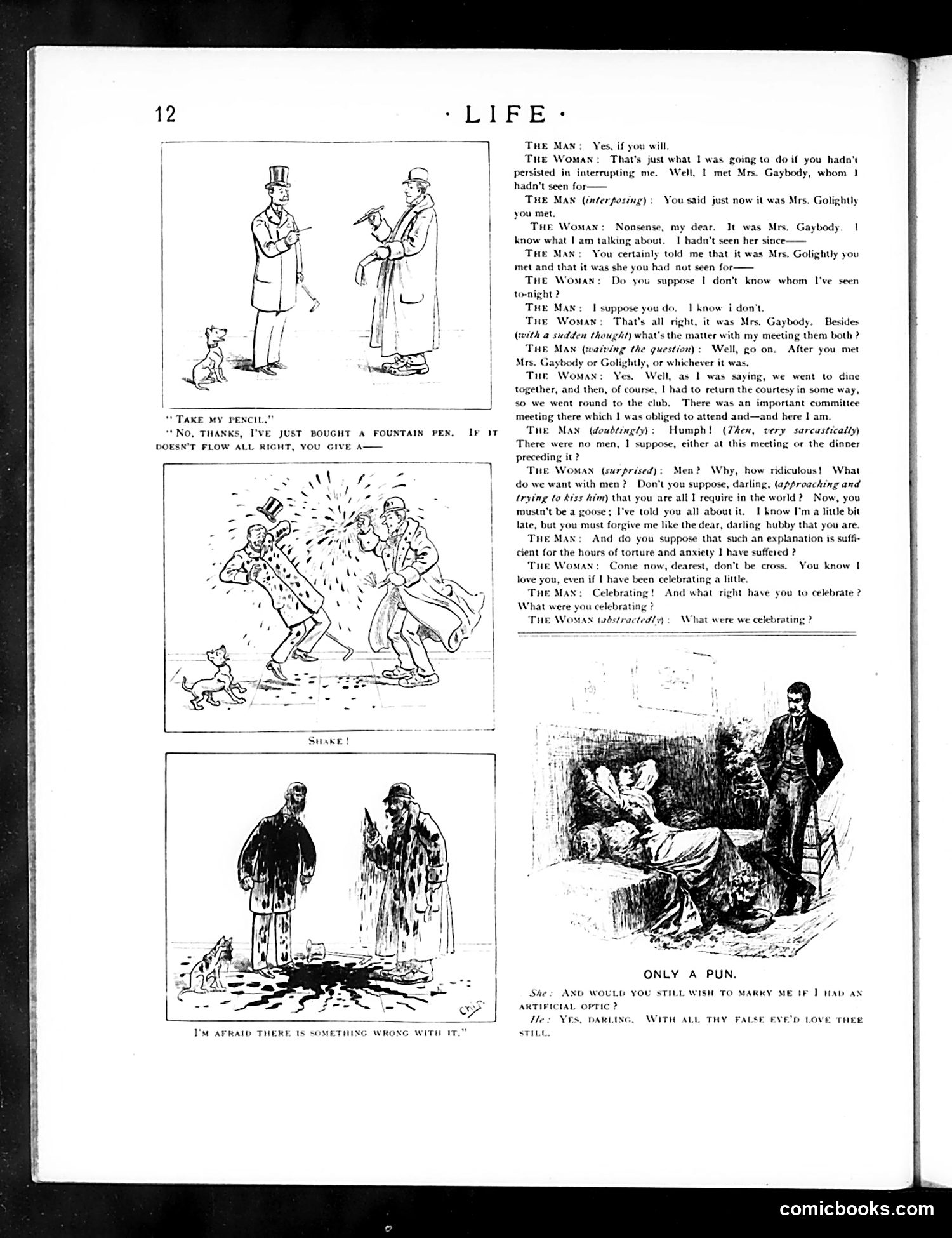
This page contains satirical domestic humor typical of early 20th-century Life magazine. **The main dialogue** depicts a husband catching his wife in a lie about her evening out. She claims to have met "Mrs. Gaybody," then "Mrs. Golightly"—contradicting herself. When he presses her, she becomes defensive and tries to deflect with affection ("trying to kiss him"). The satire targets married women's suspected infidelity or deception, and husbands' suspicions—a common trope of the era. **The cartoon illustrations** show comedic domestic scenarios: a man giving a fountain pen that sprays ink everywhere; a couple covered in mess; a husband and wife with their dog, the husband evidently suspicious. **"Only a Pun"** at bottom is an unrelated joke: a woman asks if her suitor would still marry her with an artificial eye; he replies he'd love her despite her "false eye"—a pun on eye/I. The overall theme: wives' unreliability and marital mistrust, presented as humorous rather than serious social commentary.
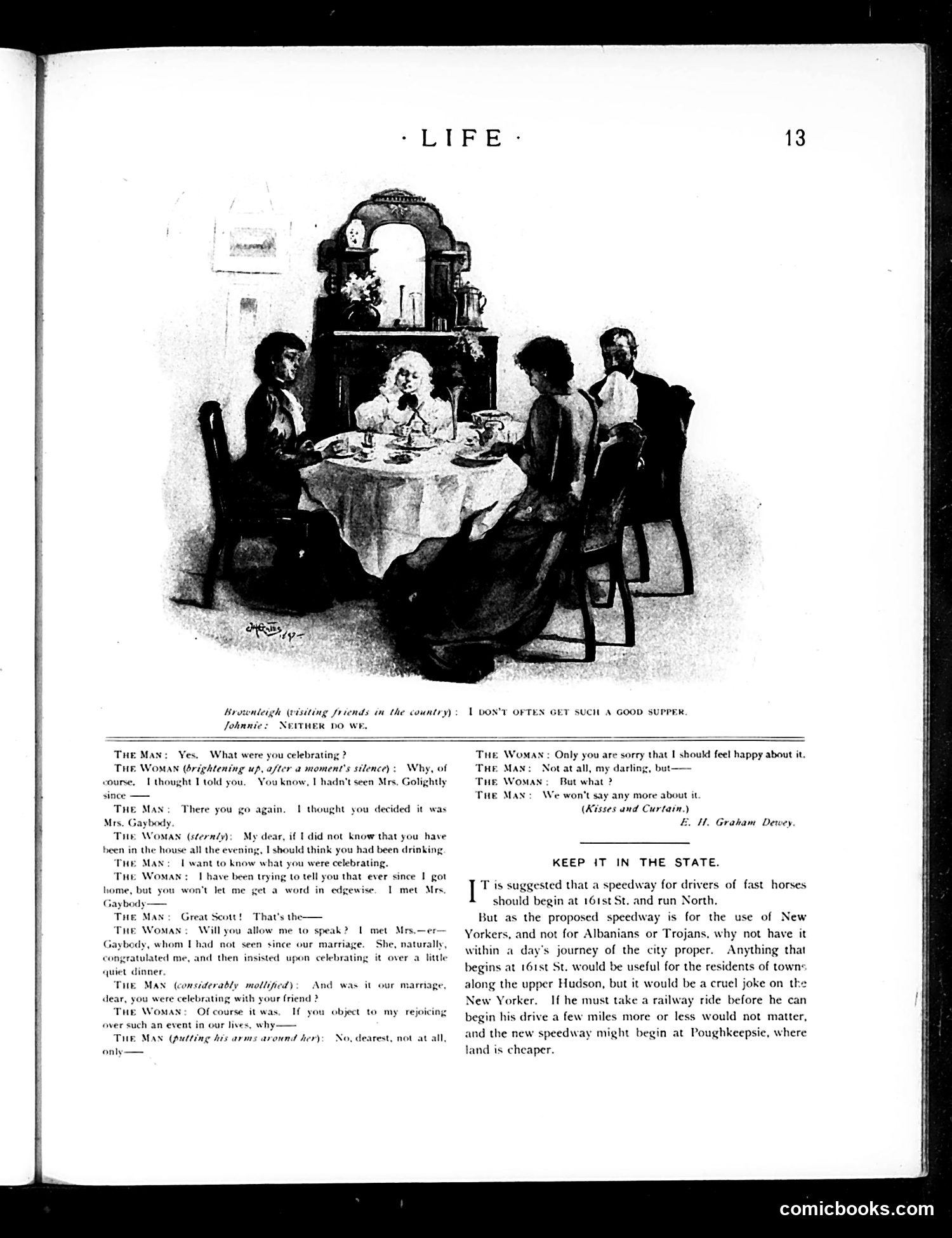
**The Main Cartoon:** A domestic comedy about a husband misunderstanding his wife's celebration. She's excited about reuniting with an old friend, Mrs. Gaybody, whom she hasn't seen since marriage. The husband, overhearing "celebrating," assumes she means their *wedding* anniversary and initially suspects she's been drinking. The joke plays on marital miscommunication—his relieved realization that she's simply celebrating female friendship, not their marriage, receives gentle satirical treatment. The final "kisses and curtain" suggests romantic reconciliation after the misunderstanding resolves. **"Keep It in the State":** A brief editorial piece proposing a horse-racing speedway. It argues that if New York City plans a speedway at 161st Street running north, it should be located closer to the city rather than forcing New Yorkers to travel via railroad first. The satire mocks the impracticality of the proposal's location. Both pieces represent Life's typical early 20th-century domestic humor and city-focused commentary.
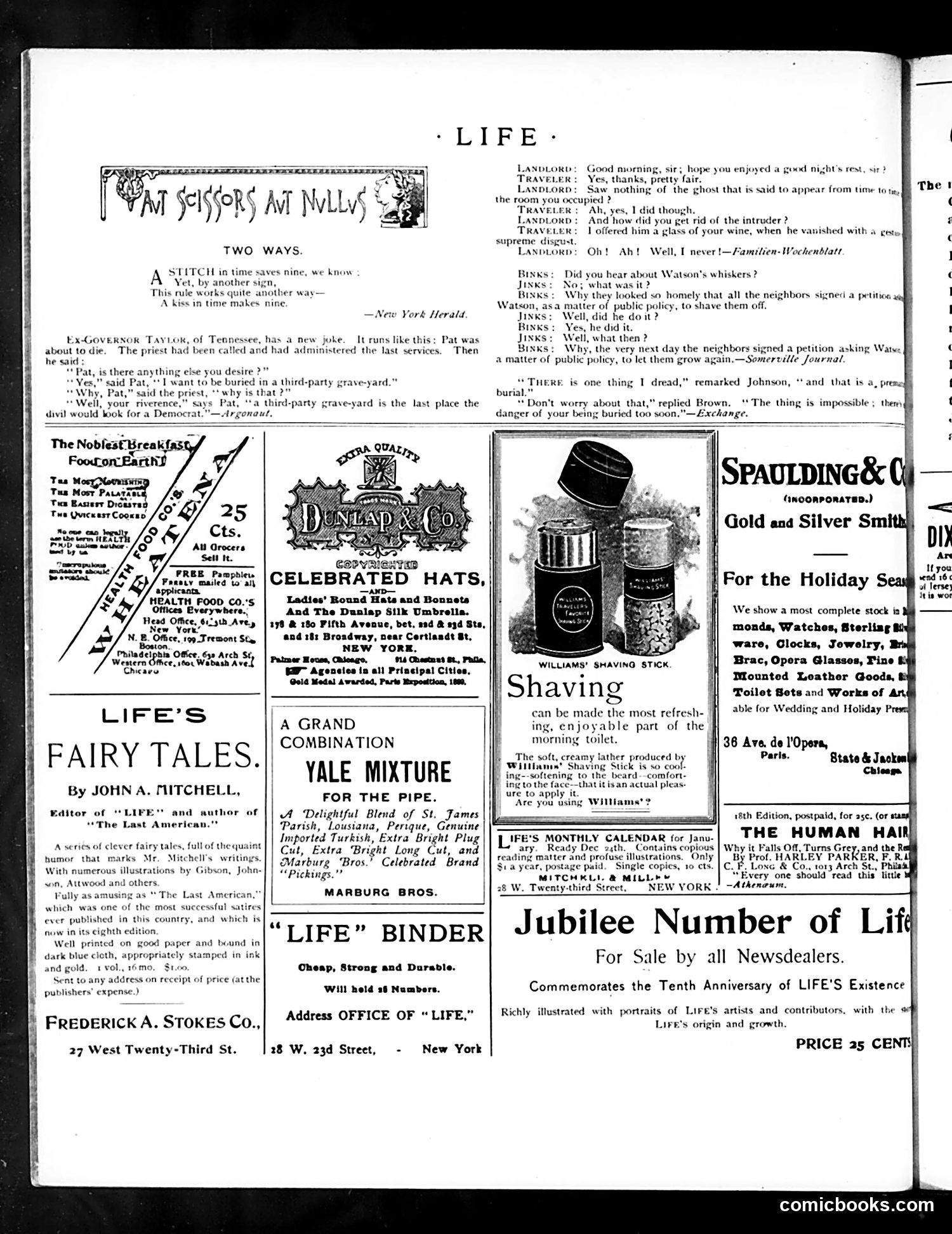
This page contains several brief satirical jokes rather than elaborate political cartoons: **"Two Ways"** jokes about Irish-American identity and death—one depicts an Irishman preferring a "third-party graveyard" as the last place the devil would seek a Democrat, playing on contemporary political divisions and ethnic stereotypes. **"Binks" and "Jinx"** feature wordplay about a man's unsightly whiskers—neighbors petition him to shave them for "public policy," then petition again to let them grow back, mocking how easily public opinion shifts and the absurdity of collective complaint. **The ghost joke** uses a crude stereotype about cheap wine's power to repel unwanted visitors. The humor relies on ethnic caricatures, puns, and absurdist logic typical of early 1900s American satire. The page is primarily **advertisements** (celebrated hats, tobacco, fairy tales, jewelry), with these jokes interspersed—standard Life magazine format of the era.
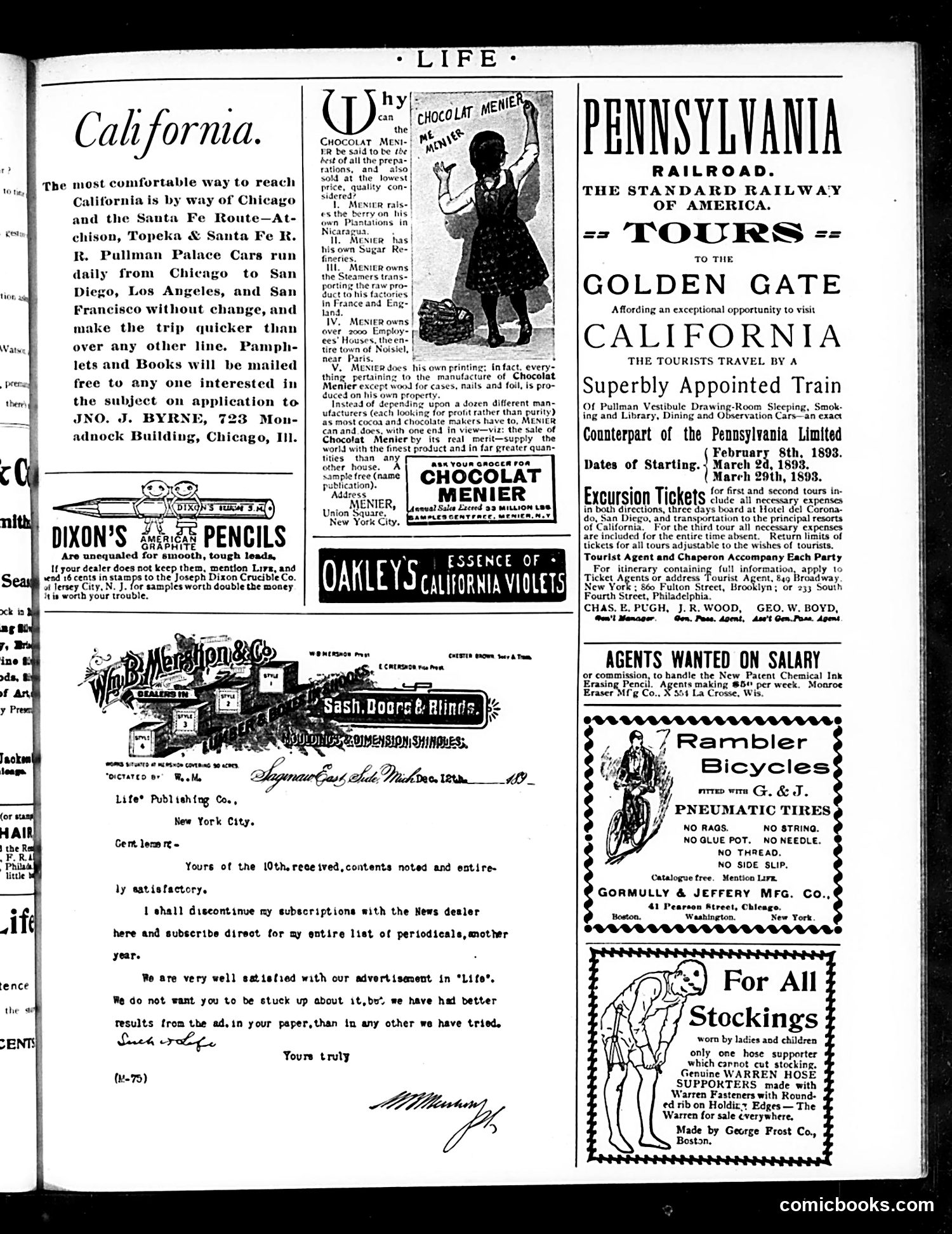
This page is primarily **advertising**, not political satire. It contains: **Major Advertisements:** - **Chocolate Menier**: A French chocolate manufacturer emphasizing quality control and purity—contrasting their single factory against competitors using multiple manufacturers prioritizing profit over quality. - **Pennsylvania Railroad**: Tours to California's "Golden Gate," featuring luxury Pullman cars and a "Superbly Appointed Train." - **Dixon's Pencils**: Promotional copy claiming superiority. - **Rambler Bicycles**: Featuring pneumatic tires with specific advantages listed. - **Warren Hose Supporters** (stockings): For ladies and children. **Editorial Content:** A letter praising Life magazine's advertising effectiveness, with the writer discontinuing newsdealer subscriptions to subscribe directly. **Historical Context:** This reflects 1890s consumer culture: emerging industrial standardization concerns, luxury travel aspirations post-Gilded Age, and new technologies (pneumatic bicycle tires). No political satire is evident—this is straightforward commercial promotion typical of Life's business model.
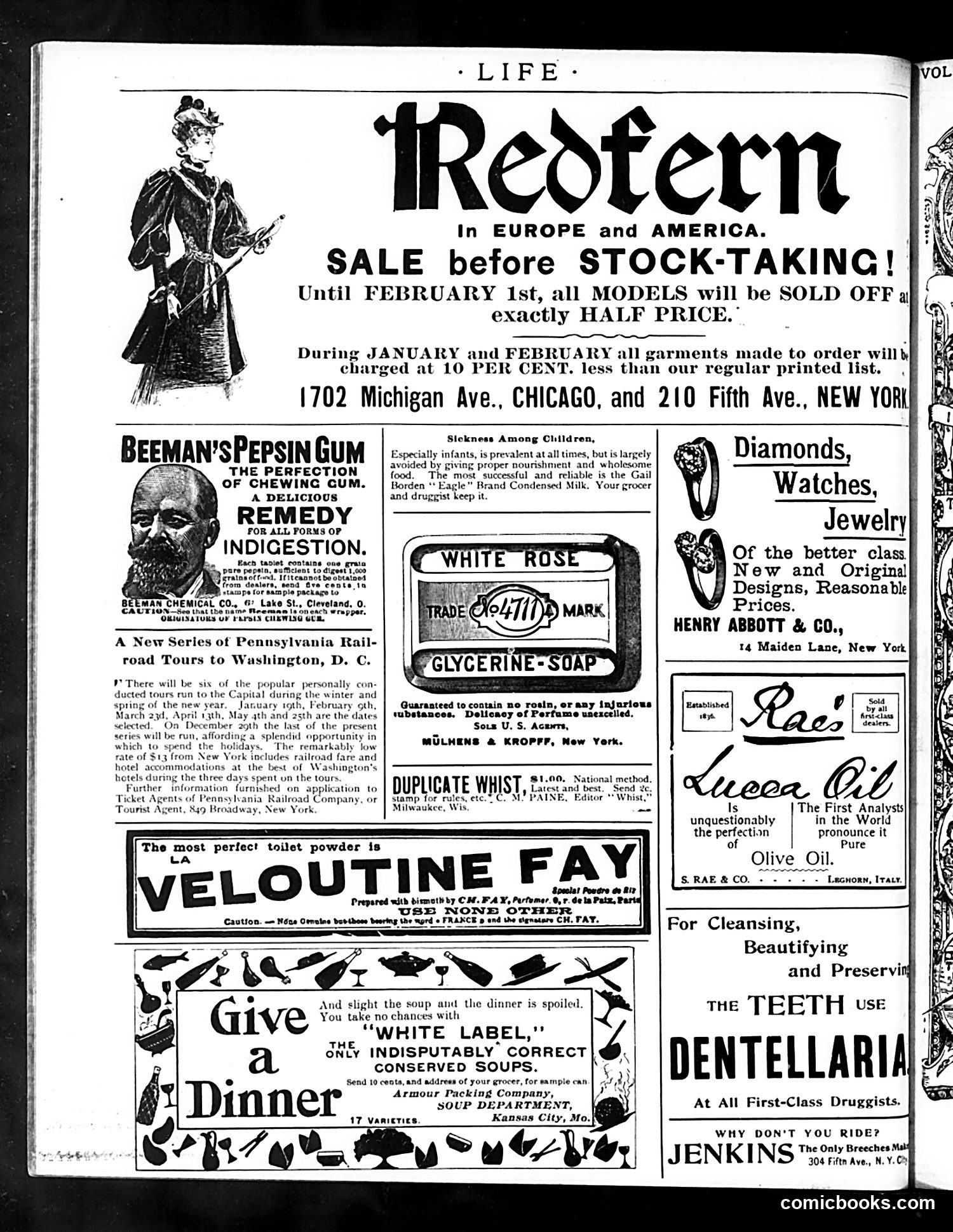
This is primarily an **advertising page**, not a satirical cartoon page. The content consists of commercial advertisements typical of early 1900s American magazines. The dominant ad is **Redfern's fashion sale** (top), announcing half-price clothing models before stock-taking, with locations in Chicago and New York. Below are various patent medicines and consumer goods: Beeman's Pepsin Gum for indigestion, Borden's Eagle Brand condensed milk for children's health, White Rose glycerin soap, Veloutine Fay powder, and Dentellaria tooth powder. Other ads promote jewelry, olive oil, canned soups, and Jenkins breeches. A brief travel notice mentions Pennsylvania Railroad tours to Washington, D.C. **No political satire or cartoon commentary appears on this page.** It's a straightforward commercial section reflecting consumer culture and advertising practices of the period, including the heavy promotion of patent medicines—common before modern FDA regulation.