
Life, 1893-01-05 · page 17 of 60
Life — January 5, 1893 — page 17: what you’re looking at
What you’re looking at
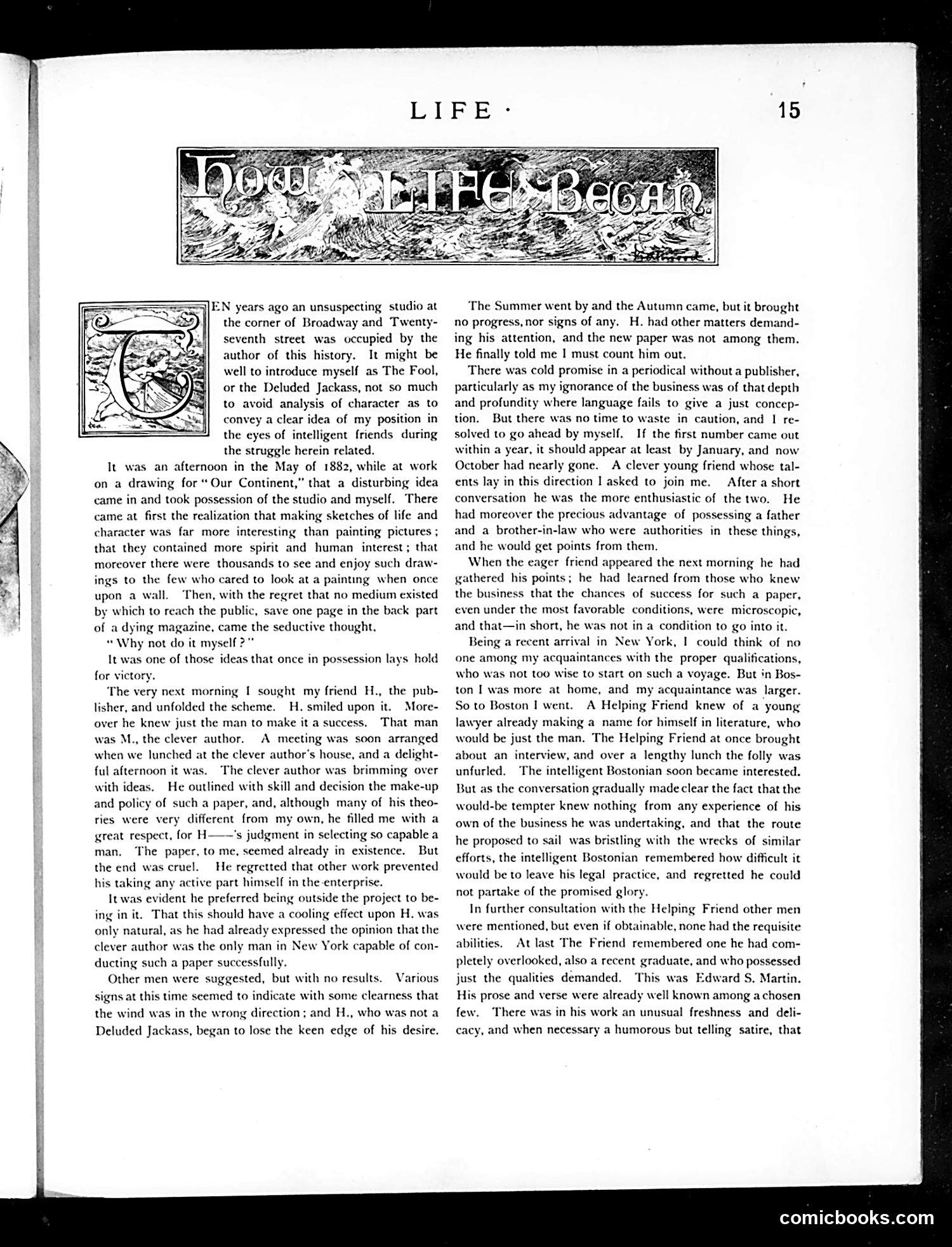
This page is the autobiographical opening of Life magazine's founding narrative, not a political cartoon. The author (identified only as "The Fool" or "Deluded Jackass") recounts launching the publication around 1882. The story describes the founder's realization that satirical sketches of life and character could reach a wider audience than traditional paintings. After struggling to find a publisher and collaborators willing to commit, he decided to proceed independently. A promising young friend initially agreed to help but—after consulting people experienced in publishing—returned with sobering news: success rates for such ventures were "microscopic." The humor lies in the self-deprecating narrative voice and the ironic contrast between the founder's enthusiastic vision and the cold reality of publishing challenges. This establishes Life's founding as an underdog venture by someone with more artistic ambition than business expertise.
📄 Transcribed text from this page (OCR, searchable)
Machine-transcribed from the original scan — historical spelling and the odd misread are preserved.
EN years ago an unsuspecting studio at the corner of Broadway and Twenty- seventh street was occupied by the author of this history. It might be well to introduce myself as The Fool, or the Deluded Jackass, not so much to avoid analysis of character as to convey a clear idea of my position in the of intelligent friends during the struggle herein related. an afternoon in the May of 1882, while at work on a drawing for “Our Continent,” that a disturbing idea came in and took possession of the studio and myself. There zation that making sketches of life and character was far more interesting than painting pictures ; that they contained more spirit and human interest; that moreover there were thousands to see and enjoy such draw- came at first the reali ings to the few who cared to look at a painting when once upon a wall. Then, with the regret that no medium existed by which to reach the public, save one page in the back part of a dying magazine, came the seductive thought, “ Why not do it myself?” It was one of those ideas that once in possession lays hold for victory. he very next morning [ sought my friend H., the pub- lisher, and unfolded the scheme. H. smiled upon it. More- over he knew just the man to make it a success. That man was M., the clever author. A meeting was soon arranged when we lunched at the clever author's house, and a delight- ful afternoon it was. The clever author was brimming over with ideas. He outlined with skill and decision the make-up and policy of such a paper, and, although many of his theo- ries were very different from my own, he filled me with a pect, for H——'s judgment in selecting so capable a man. ‘The paper, to me, seemed already in existence. But the end was cruel. He regretted that other work prevented his taking any active part himself in the-enterprise. It was evident he preferred being outside the project to be- ing in That this should have a cooling effect upon H. was only natural, as he had already expressed the opinion that the clever author was the only man in New York capable of con- great r ducting such a paper successfully. Other men were suggested, but with no results. signs at this time seemed to indicate with some clearness that the wind was in the wrong direction ; and H., who was not a Deluded Jackass, began to lose the keen edge of his desire. Various The Summer went by and the Autumn came, but it brought no progress, nor signs of any. H. had other matters demand- ing his attention, and the new paper was not among them. He finally told me I must count him out. There was cold promise in a periodical without a publisher, particularly as my ignorance of the business was of that depth and profundity where language fails to give a just concep- tion. But there was no time to waste in caution, and | re- solved to go ahead by myself. If the first number came out within a year, it should appear at least by January, and now October had nearly gone. A clever young friend whose tal- ents lay in this direction I asked to join me. After a short conversation he was the more enthusiastic of the two. He had moreover the precious advantage of possessing a father and a brother-in-law who were authorities in these things, and he would get points from them. When the eager friend appeared the next morning he had gathered his points; he had learned from those who knew the business that the chances of success for such a paper, even under the most favorable conditions, were microscopic, and that—in short, he was not in a condition to go into it. Being a recent arrival in New York, I could think of no one among my acquaintances with the proper qualifications, who was not too wise to start on such a voyage. But in Bos- ton I was more at home, and my acquaintance was larger. So to Boston I went. A Helping Friend knew of a young lawyer already making a name for himself in literature, who would be just the man. The Helping Friend at once brought about an interview, and over a lengthy lunch the folly was unfurled. The intelligent Bostonian soon became interested. But as the conversation gradually made clear the fact that the would-be tempter knew nothing from any experience of his own of the business he was undertaking, and that the route he proposed to sail was bristling with the wrecks of similar efforts, the intelligent Bostonian remembered how difficult it would be to leave his legal practice, and regretted he could not partake of the promised glory. In further consultation with the Helping Friend other men were mentioned, but even if obtainable, none had the requisite abilities. At last The Friend remembered one he had com- pletely overlooked, also a recent graduate, and who possessed just the qualities demanded. is Edward S. Martin. His prose and verse were already well known among achosen few. There was in his work an unusual freshness and deli- cacy, and when necessary a humorous but telling satire, that This wa comicbooks.com