
Life, 1893-01-05 · page 50 of 60
Life — January 5, 1893 — page 50: what you’re looking at
What you’re looking at
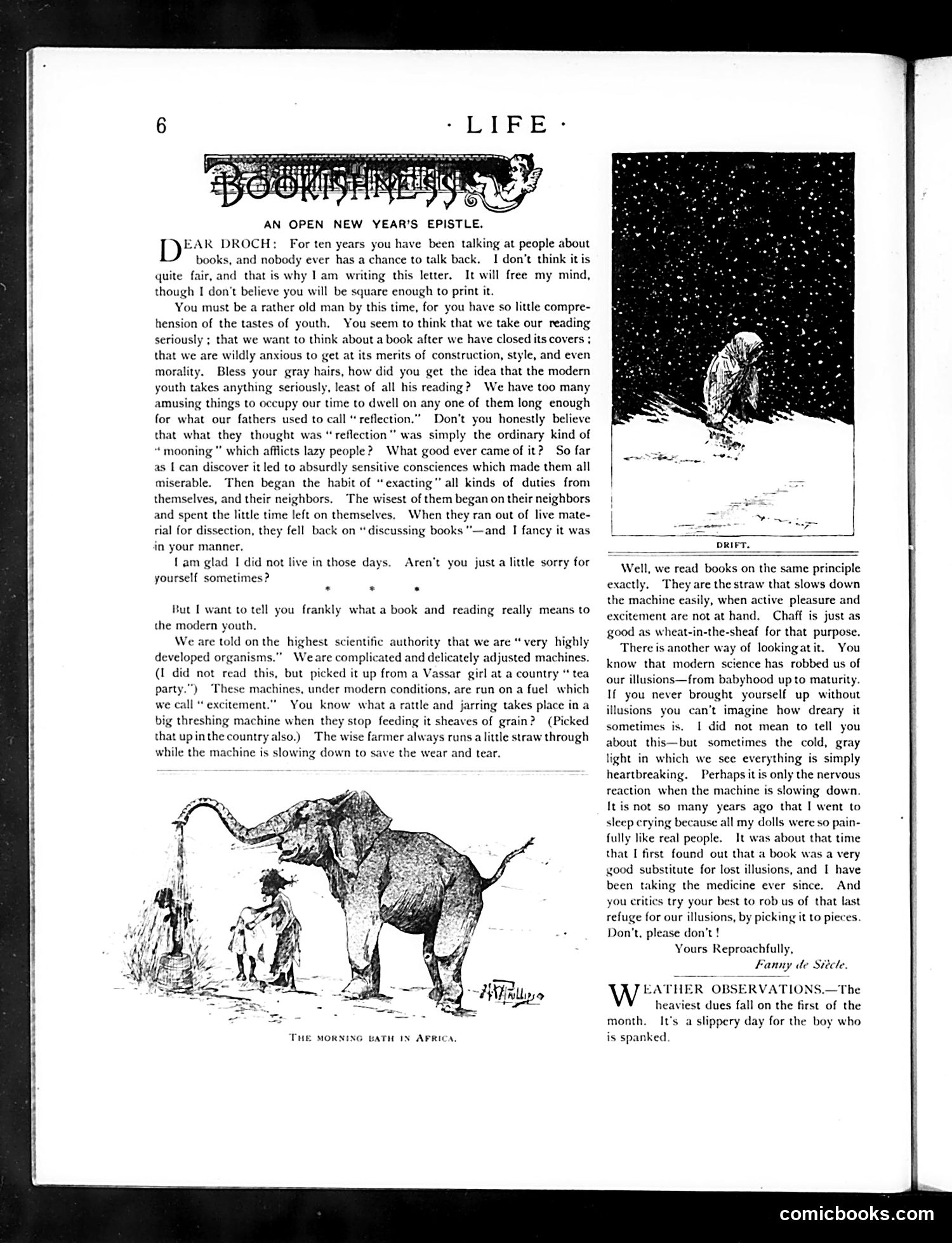
This page presents a reader's rebuttal to "Droch," Life's book columnist. A young woman (signing as "Fanny de Siècle") critiques his expectation that modern youth read seriously for moral reflection and literary merit. Her argument: young people use books as "straw" to calm their overstimulated "machines"—a metaphor borrowed from scientific rhetoric about humans as complicated organisms. Books provide escapism and comfort, not intellectual nourishment. She further argues that modern science has destroyed childhood illusions, and books offer crucial refuge from that harsh reality. She pleads with critics (like Droch) to stop dissecting literature, which ruins this therapeutic function. The two illustrations—a snowy landscape and a colonial-era bath scene—appear decorative rather than directly satirical. The "Weather Observations" note is unrelated filler content. The satire targets both Droch's earnestness about literary criticism and generational attitudes toward reading and leisure.
📄 Transcribed text from this page (OCR, searchable)
Machine-transcribed from the original scan — historical spelling and the odd misread are preserved.
AN OPEN NEW YEAR’S EPISTLE. D*™ R DROCH: For ten years you have been talking at people about books, and nobody ever has a chance to talk back. I don’t think itis quite fair, and that is why Lam writing this letter. It will free my mind, though I don't believe you will be square enough to print it. You must be a rather old man by this time, for you have so little compre- hension of the tastes of youth. You seem to think that we take our reading seriously ; that we want to think about a book after we have closed its covers ; that we are wildly anxious to get at its merits of construction, style, and even morality. Bless your gray hairs, how did you get the idea that the modern youth takes anything seriously, least of all his reading? We have too many amusing things to occupy our time to dwell on any one of them long enough for what our fathers used to call “reflection.” Don’t you honestly believe that what they thought was “reflection” was simply the ordinary kind of “mooning ” which afflicts lazy people? What good ever came of it? So far as I can discover it led to absurdly sensitive consciences which made them all miserable. Then began the habit of “exacting” all kinds of duties from themselves, and their neighbors. The wisest of them began on their neighbors and spent the little time left on themselves. When they ran out of live mate- rial for dissection, they fell back on “discussing books "—and I fancy it was in your manner. {am glad I did not live in those days. yourself sometimes? Aren't you just a little sorry for . . . But [want to tell you frankly what a book and reading really means to the modern youth, We are told on the highest scientific authority that we are “ very highly developed organisms.” Weare complicated and delicately adjusted machines. (I did not read this, but picked it up from a Vassar girl at a country “tea party.) These machines, under modern conditions, are run ona fuel which we call You know what a rattle and jarring takes place in a big threshing machine when they stop feeding it sheaves of grain? (Picked that upinthe country also.) The wise farmer always runs a little straw through while the machine is slowing down to save the wear and tear. excitement.” THE MORNING BATH IN AFRICA, DRIFT. Well, we read books on the s exactly. They are the straw that slows down the machine easily, when active pleasure and excitement are not at hand. Chaff is just as good as wheat-in-the-sheaf for that purpose. There is another way of lookingatit. You know that modern science has robbed us of our illusions—from babyhood up to maturity. If you never brought yourself up without illusions you can’t imagine how dreary it 1 did not mean to tell you about this—but sometimes the cold, gray light in which we see everything is simply heartbreaking. Perhaps it is only the nervous. reaction when the machine is slowing down. It is not so many years ago that I went to sleep crying because all my dolls were so pain- fully like real people. It was about that time that I first found out that a book was a very good substitute for lost illusions, and I have been taking the medicine ever since. And you critics try your best to rob us of that last refuge for our illusions, by picking it to pieces. Don't. please don’t ! Yours Reproachfully, Fanny de Stécle. sometimes is. W E OBSERVATIONS,—The heaviest dues fall on the first of the month. It’s a slippery day for the boy who is spanked comicbooks.com