
Life, 1893-01-05 · page 48 of 60
Life — January 5, 1893 — page 48: what you’re looking at
What you’re looking at
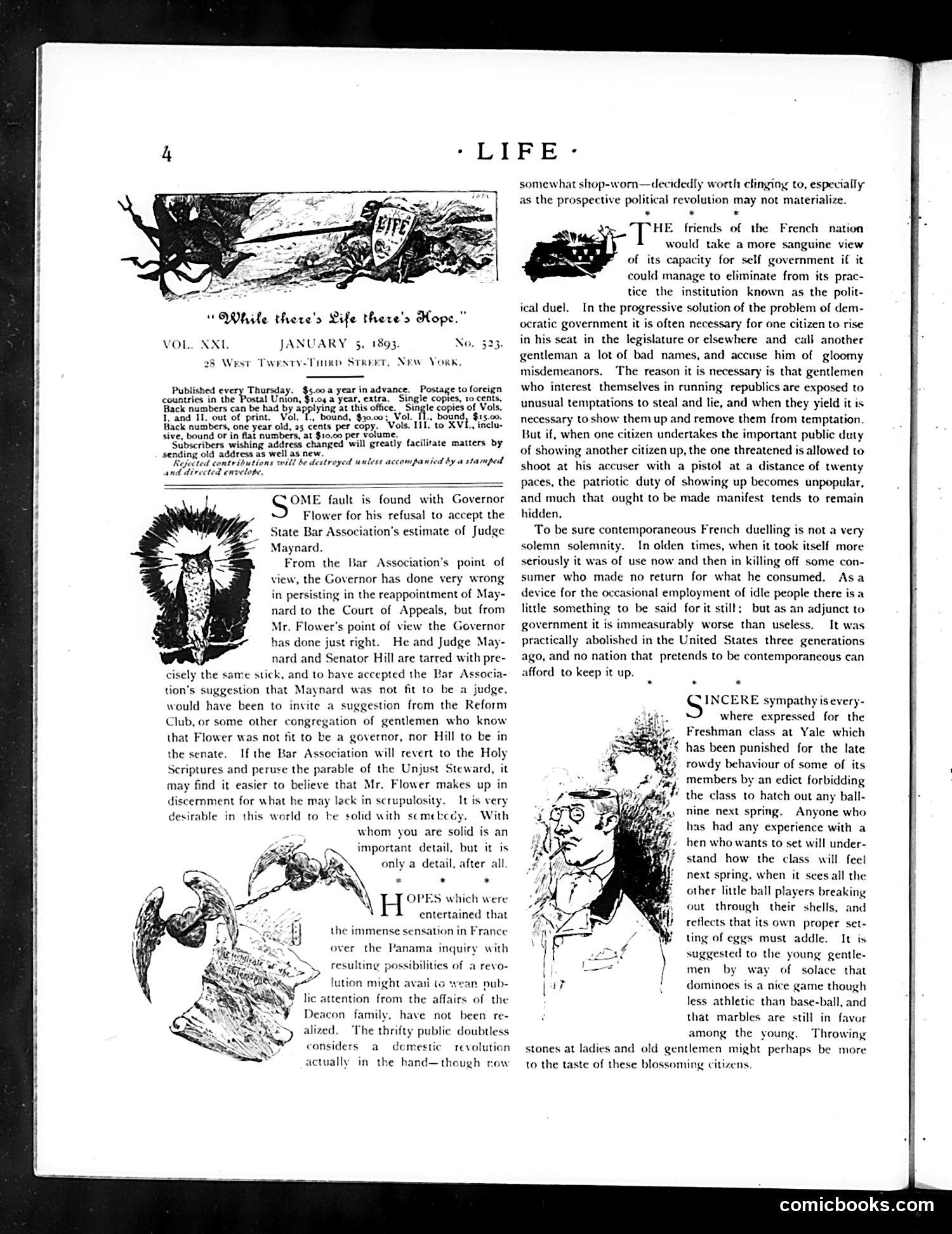
This page contains three distinct political commentaries on contemporary American and French affairs. **Governor Flower and Judge Maynard**: The text criticizes New York Governor Flower for reappointing Judge Maynard despite the State Bar Association's objection. The satirist argues Flower was right to do so, noting that Flower, Maynard, and Senator Hill are "tarred with precisely the same stick"—implying all three are compromised figures. The point: attacking one would invite attacks on all, so they protect each other through mutual self-interest rather than principle. **Panama Scandal vs. Domestic Politics**: The editorial notes that while France is distracted by the Panama inquiry scandal (a major corruption scandal of the era), Americans continue with their own "domestic revolution"—suggesting American political corruption is equally troubling and ongoing. **French Dueling**: The passage satirizes France's continued practice of political dueling, arguing it undermines democratic accountability. When politicians can challenge critics to pistol duels, legitimate public criticism becomes dangerous and unpopular, allowing corruption to remain hidden. The overall message critiques political corruption and hypocrisy across both nations.
📄 Transcribed text from this page (OCR, searchable)
Machine-transcribed from the original scan — historical spelling and the odd misread are preserved.
-LIFE-: “OWWhile there's Life there's Hope.” XXL 28 West VOL JANUARY 35, 1893. TWenty-THikD STREET, New York, Published every Thursday. $s.0oa year in advance. Postage to foreign countries in the Postal Union, $1.04 a Year, extra. Single copies, 10 cents, Back numbers can be had by applying at this office, Single copies of Vols. I, and II. out of print. Vol. [., bound, $30.00; Vol. Tl., bound, $15.00. Back numbers, one year old, a5 cents per copy. Vols. IIT. to XVI, inclu- sive, bound of in flat numbers, at $10.00 per volume. Subscribers wishing address changed will greatly facilitate matters by sending old address a3 well as new. Rejected contributions will be destroyed unless accompanied by a stamped and directed envelope, ~ OME fault is found with Governor Flower for his refusal to accept the State Bar Association's estimate of Judge Maynard. From the Bar Association's point of view, the Governor has done very wrong in persisting in the reappointment of May- nard to the Court of Appeals, but from Mr. Flower’s point of view the Governor has done just right. He and Judge May- nard and Senator Hill are tarred with pre- cisely the same stick, and to have accepted the Bar Associa- tion’s suggestion that Maynard was not fit to be a judge, would have been to invite a suggestion from the Reform Club, or some other congregation of gentlemen who know that Flower was not fit to be a governor, nor Hill to be in the senate. If the Bar Association will revert to the Holy Scriptures and peruse the parable of the Unjust Steward, it may find it easier to believe that Mr. Flower makes up in discernment for what he may lack in scrupulosity. It is very desirable in this world to be solid with scmekccy. With whom you are solid is an important detail, but it is only a detail, after all. * . * OPES which were entertained that the immense sensation in France over the Panama inquiry with resulting possibilities of a revo- lution might avai ic attention from the irs of the Deacon family, have not been re- alized. ‘The thrifty public doubtless considers a domestic 1" pub- revolution actually in the hand—though row somewhat shop-worn—decidedly worth clinging to, especially as the prospective political revolution may not materialize. . . . HE friends of the French nation would take a more sanguine view of its capacity for self government if it could manage to eliminate from its prac- tice the institution known as the polit- ical duel. In the progressive solution of the problem of dem- ocratic government it is often necessary for one citizen to rise in his seat in the legislature or elsewhere and call another gentleman a lot of bad names, and accuse him of gloomy misdemeanors. The reason it is necessary is that gentlemen who interest themselves in running republics are exposed to unusual temptations to steal and lie, and when they yield it is necessary to show them up and remove them from temptation. But if, when one citizen undertakes the important public duty of showing another citizen up, the one threatened is allowed to shoot at his accuser h a pistol at a distance of twenty paces, the patriotic duty of showing up becomes unpopular, and much that ought to be made manifest tends to remain hidden, To be sure contemporaneous French duelling is not a very solemn solemnity. In olden times, when it took itself more seriously it was of use now and then in killing off some con- sumer who made no return for what he consumed. Asa device for the occasional employment of idle people there is a little something to be said for it still; but as an adjunct to government it is immeasurably worse than useless. It was practically abolished in the United States three generations ago, and no nation that pretends to be contemporaneous can afford to keep it up. UJ S NCERE sympathy isevery- ube, where expressed for the ; Freshman class at Yale which has been punished for the late rowdy behaviour of some of its members by an edict forbidding the class to hatch out any ball- nine next spring. Anyone who bas had any experience with a hen who wants to set will under- stand how the class will feel next spring, when it sees all the other little ball players breaking out through their shells, and reflects that its own proper set- ting of eggs must addle. It is suggested to the young gentle- men by way of solace that dominoes is a nice game though less athletic than base-ball, and that marbles are still in favor among the young. Throwing stones at ladies and old gentlemen might perhaps be more to the taste of these blossoming citizens. comicbooks.com