
A complete issue · 18 pages · 1892
Life — May 5, 1892
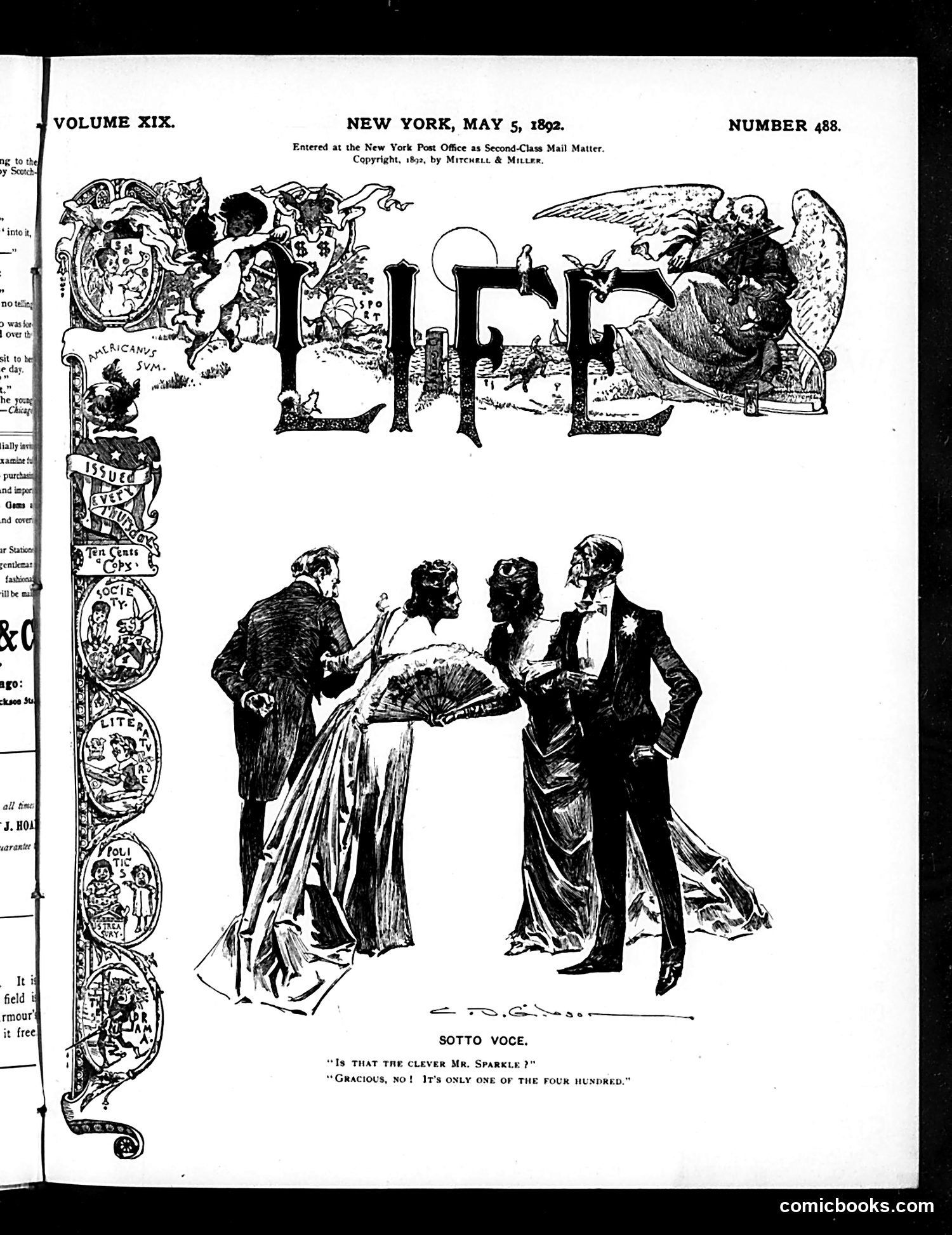
This page features a satirical cartoon titled "Sotto Voce" (Italian for "in a low voice," meaning spoken quietly or confidentially). The illustration shows four well-dressed men in formal evening wear engaged in social interaction at what appears to be a high-society gathering. The caption reads: "Is that the clever Mr. Sparkle?" / "Gracious, no! It's only one of the four hundred." The satire targets New York's elite social circles—specifically "the Four Hundred," a famous term for the city's most exclusive wealthy families (derived from the capacity of Mrs. Astor's ballroom). The joke mocks the pretentiousness of high society: someone mistakes an ordinary (though well-dressed) gentleman for the celebrated "Mr. Sparkle," only to learn he's merely part of the broader elite class, implying even minor society members are indistinguishable from one another.
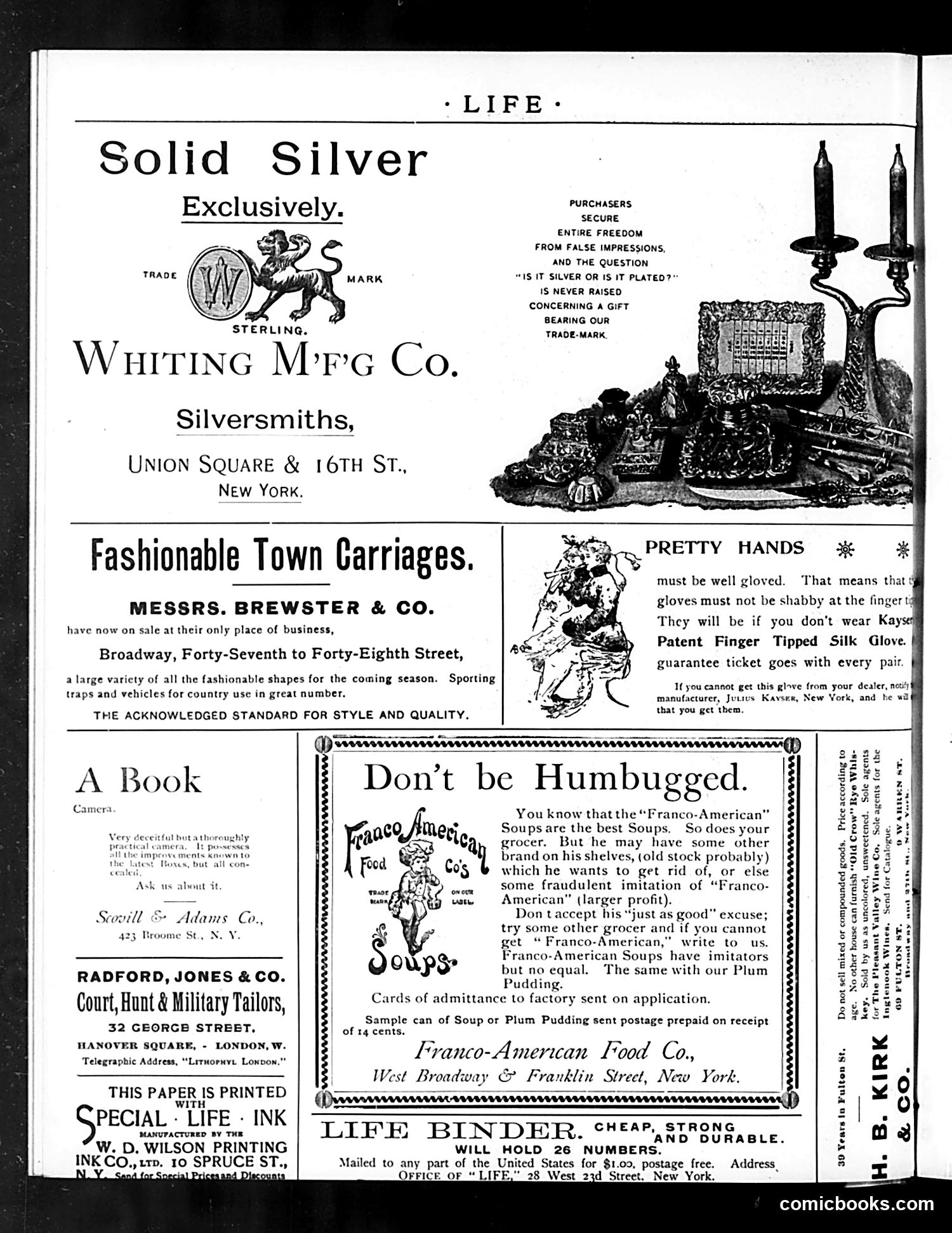
This page is primarily **advertising**, not political satire. It contains multiple commercial notices from the late 19th or early 20th century: **Main advertisements:** - Whiting MFG Co. (solid silver goods) - Brewster & Co. (fashionable carriages) - Franco-American Food Co. (soups and puddings) - Various other vendors (cameras, tailors, gloves) **The only satirical content** is the Franco-American Soups advertisement titled "Don't be Humbugged," which warns consumers against accepting inferior imitation products. It's a straightforward commercial jab at competitors rather than political commentary. The page reflects Life magazine's dual purpose: mixing satirical editorial content with paid advertisements to affluent readers.
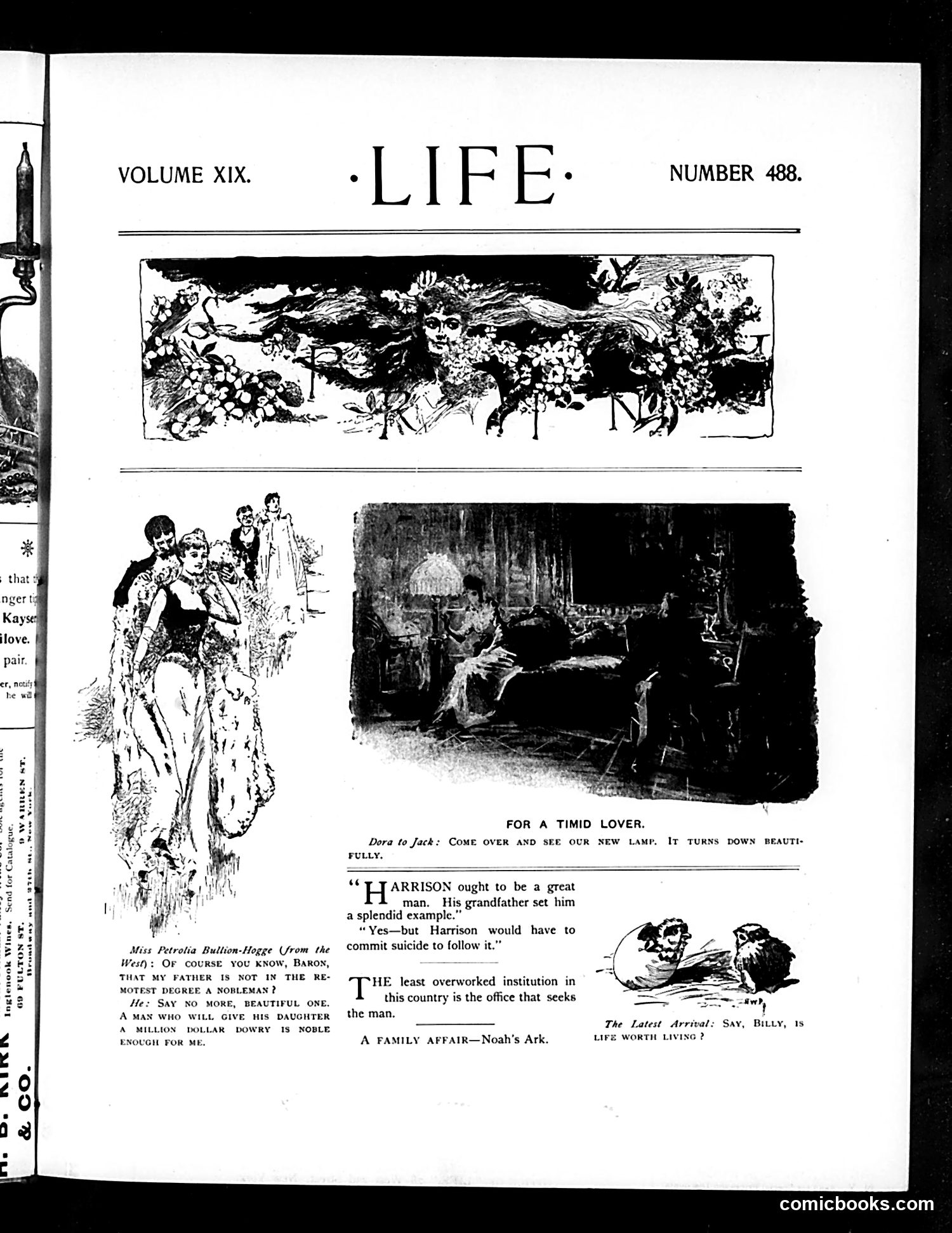
This page contains several satirical pieces typical of Life magazine's humor. The main cartoon titled "For a Timid Lover" depicts a domestic scene where a man is encouraged to show off a new lamp to his female companion—likely poking fun at masculine attempts at romantic gestures through material possessions rather than genuine affection. Below, brief jokes reference social commentary: one critiques ambition ("Harrison ought to be a great man"), another mocks office culture ("The least overworked institution...is the office that seeks the man"), and a third titled "A Family Affair: Noah's Ark" appears to make an unstated family-related joke. The illustrations emphasize domesticity and social relationships, characteristic of Life's focus on middle-class American life and its foibles.
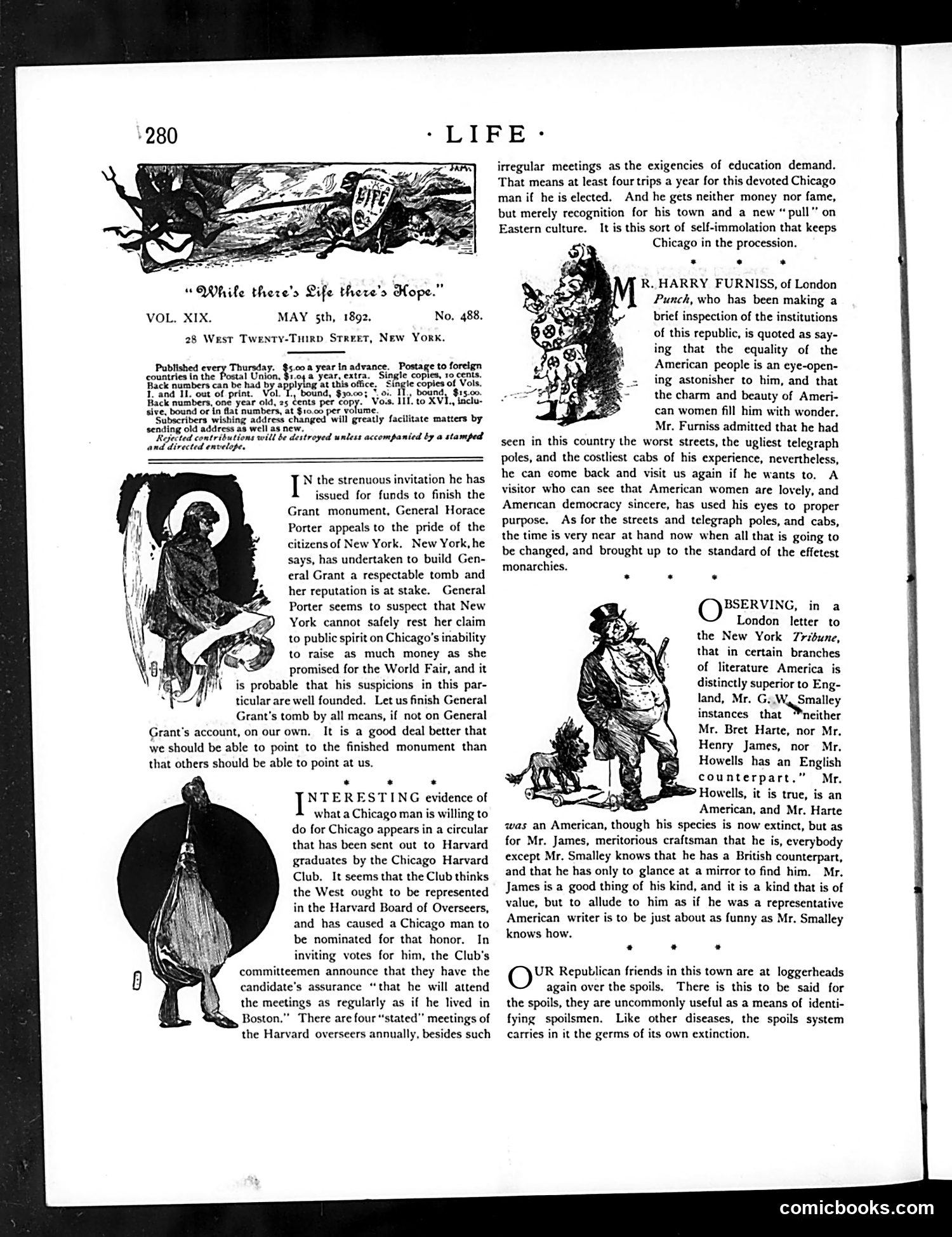
**Top Cartoon:** "While there's Life there's Hope" - appears to be a generic commentary on perseverance, using a skeletal or death-like figure. **Main Content:** The page discusses General Horace Porter and efforts to finish his Grant Monument in New York. The text expresses concern that New York cannot raise sufficient funds, suggesting Chicago's superior fundraising ability for the World's Fair. This is satirical commentary on inter-city rivalry between New York and Chicago. **Lower Section:** Discusses a Chicago man nominated for Harvard's Board of Overseers, with humor about his attendance at Boston meetings. Also includes observations comparing American and English literature figures (Bret Harte, Henry James, W.D. Howells), and criticism of Republican political spoils system as a disease-like problem. The satire targets civic pride, partisan politics, and cultural pretensions of the Gilded Age.
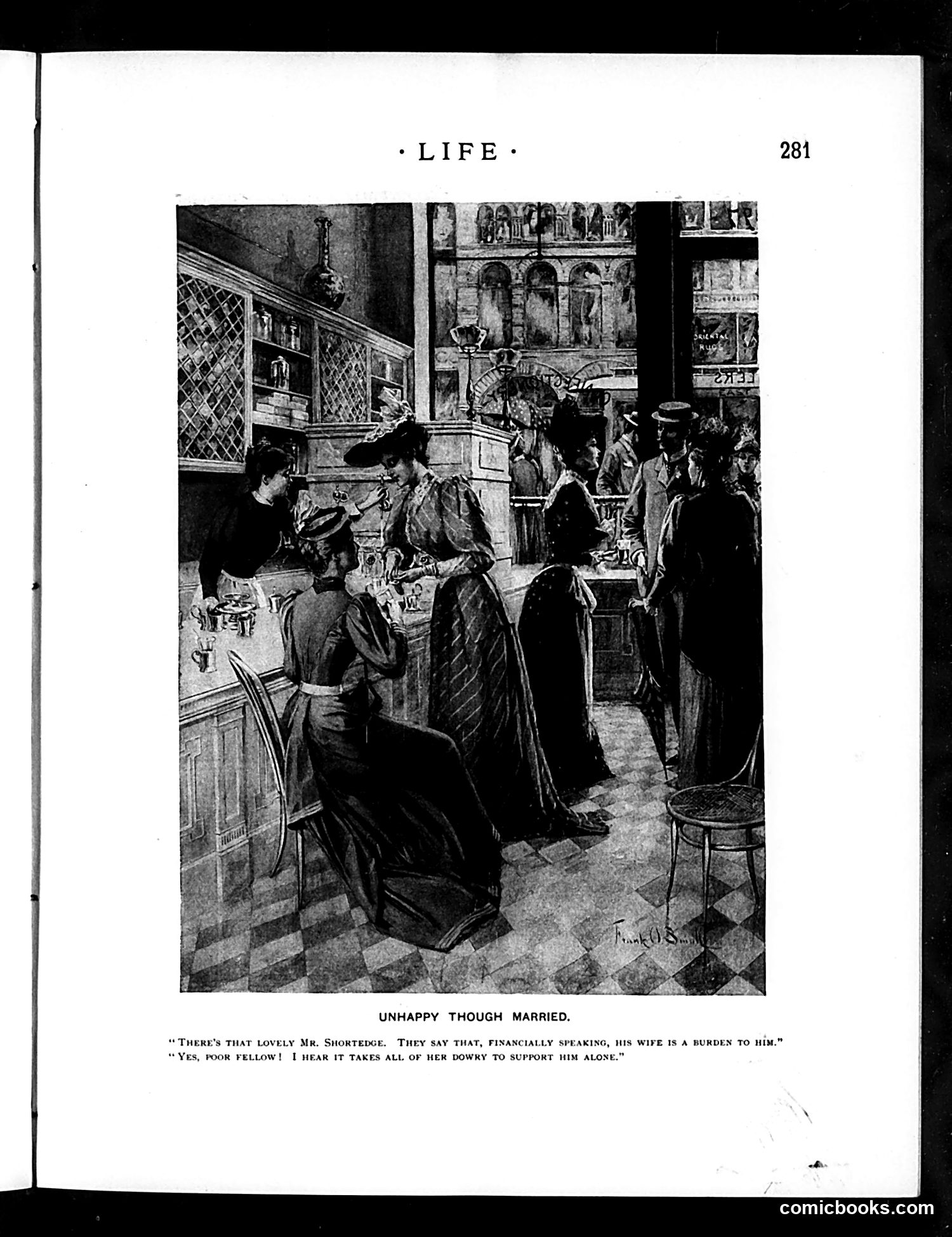
This illustration depicts a social scene in what appears to be an upscale establishment, likely a restaurant or café. The caption "UNHAPPY THOUGH MARRIED" introduces the subject, while the dialogue below reveals the satirical point: a man named Mr. Shortedge is allegedly a financial burden to his wife, requiring her dowry to support him. The satire targets the social anxieties of the era regarding marriage and financial dependency. The joke hinges on class dynamics—specifically, the uncomfortable reversal where a husband cannot support himself and instead relies on his wife's wealth. This mocks both Mr. Shortedge's financial inadequacy and broader social concerns about economic instability in marriages among the upper classes. The crowded, fashionable setting emphasizes that this failure is publicly visible.
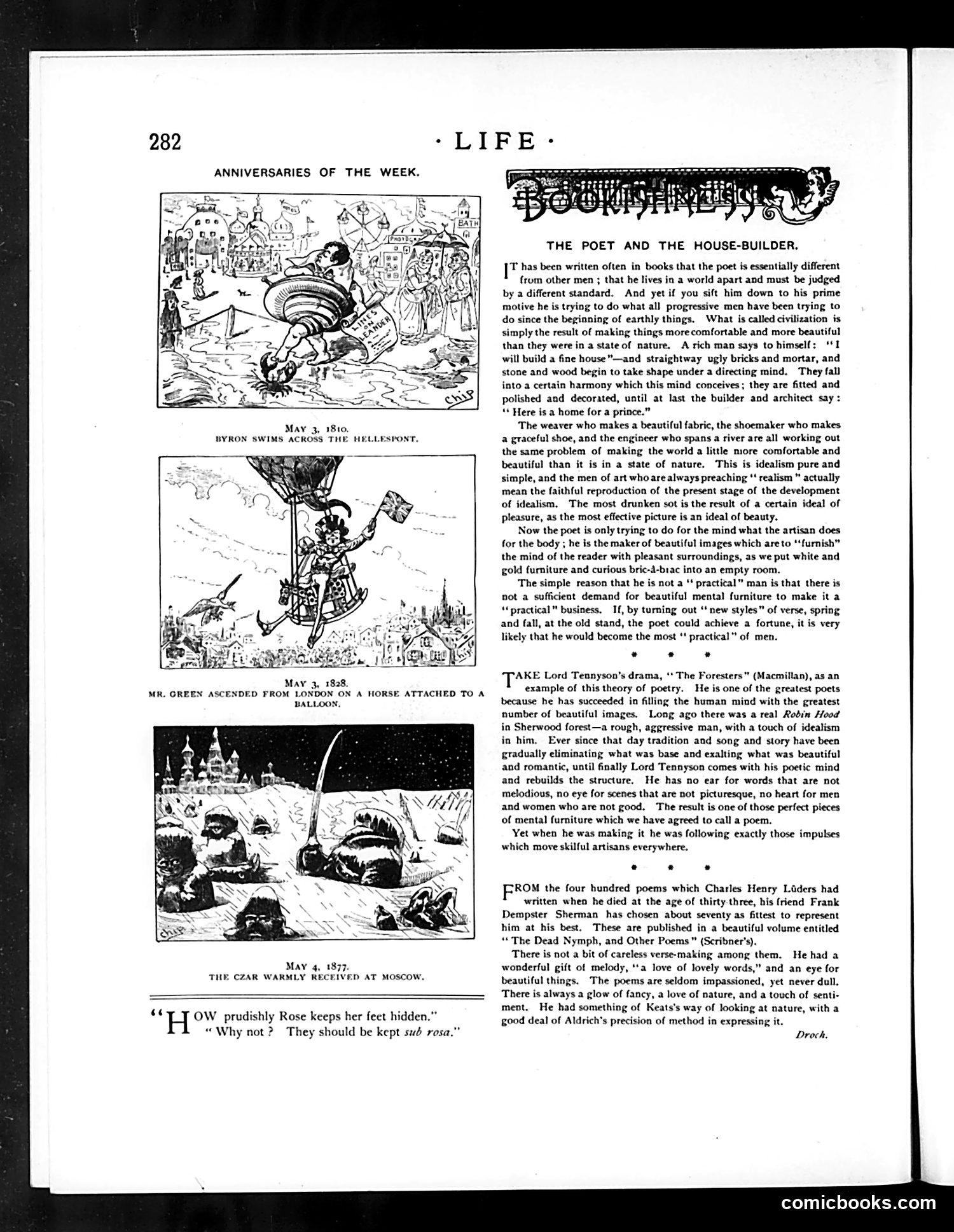
This page features **"Anniversaries of the Week"** — historical commemorative cartoons with captions: 1. **May 3, 1810**: Byron swimming across the Hellespont (a famous romantic exploit by poet Lord Byron) 2. **May 3, 1828**: Mr. Green ascending from London in a hot air balloon 3. **May 4, 1877**: The Czar warmly received at Moscow (likely celebrating Russian imperial relations) The main article, **"The Poet and the House-Builder,"** argues that poets aren't impractical dreamers but practical creators like engineers or architects—both shape the world beautifully. It cites Lord Tennyson's drama "The Foresters" as proof poets can create meaningful "mental furniture" for readers, making them neither purely idealistic nor merely commercial. A closing quote about Rose keeping her feet hidden suggests period social commentary about modesty.
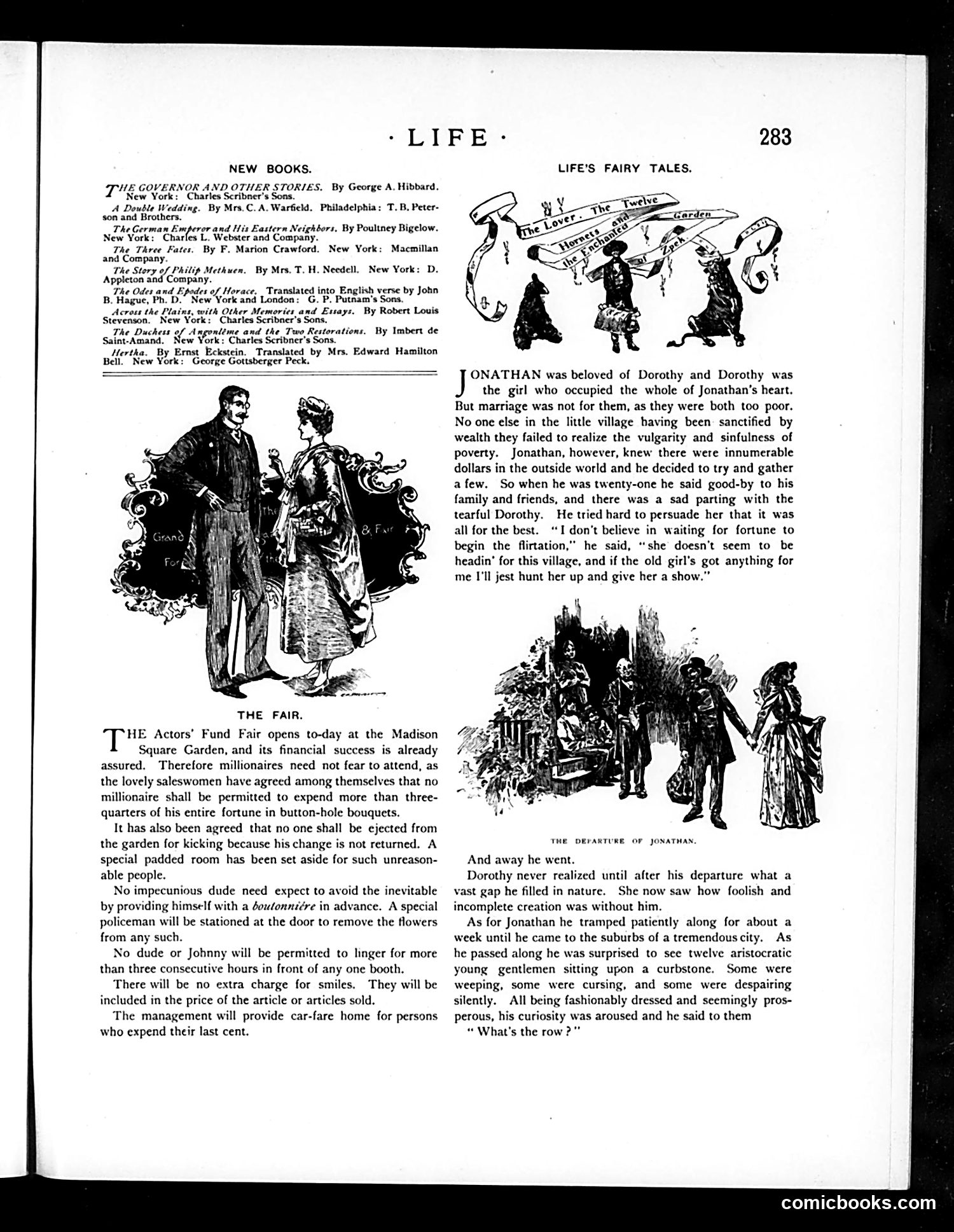
This page contains two distinct sections: **"The Fair"** (top): A satirical piece about the Actors' Fund Fair at Madison Square Garden. The humor relies on practical jokes about attendance—millionaires needn't fear spending money since saleswomen agreed to limit button-hole bouquet expenses to three-quarters of proceeds. The satire mocks wealthy attendees' penny-pinching despite their wealth, and pokes fun at various social types ("No impecunious dude," "No Sudie or Johnny"). It's typical early-20th-century Life magazine humor targeting the pretensions of the rich. **"Life's Fairy Tales"** (bottom): A serialized story titled "Jonathan" about a poor young man leaving his village sweetheart Dorothy to seek fortune. The accompanying illustrations show his departure. This appears to be sentimental fiction rather than satirical content, contrasting with the cynical social commentary above.
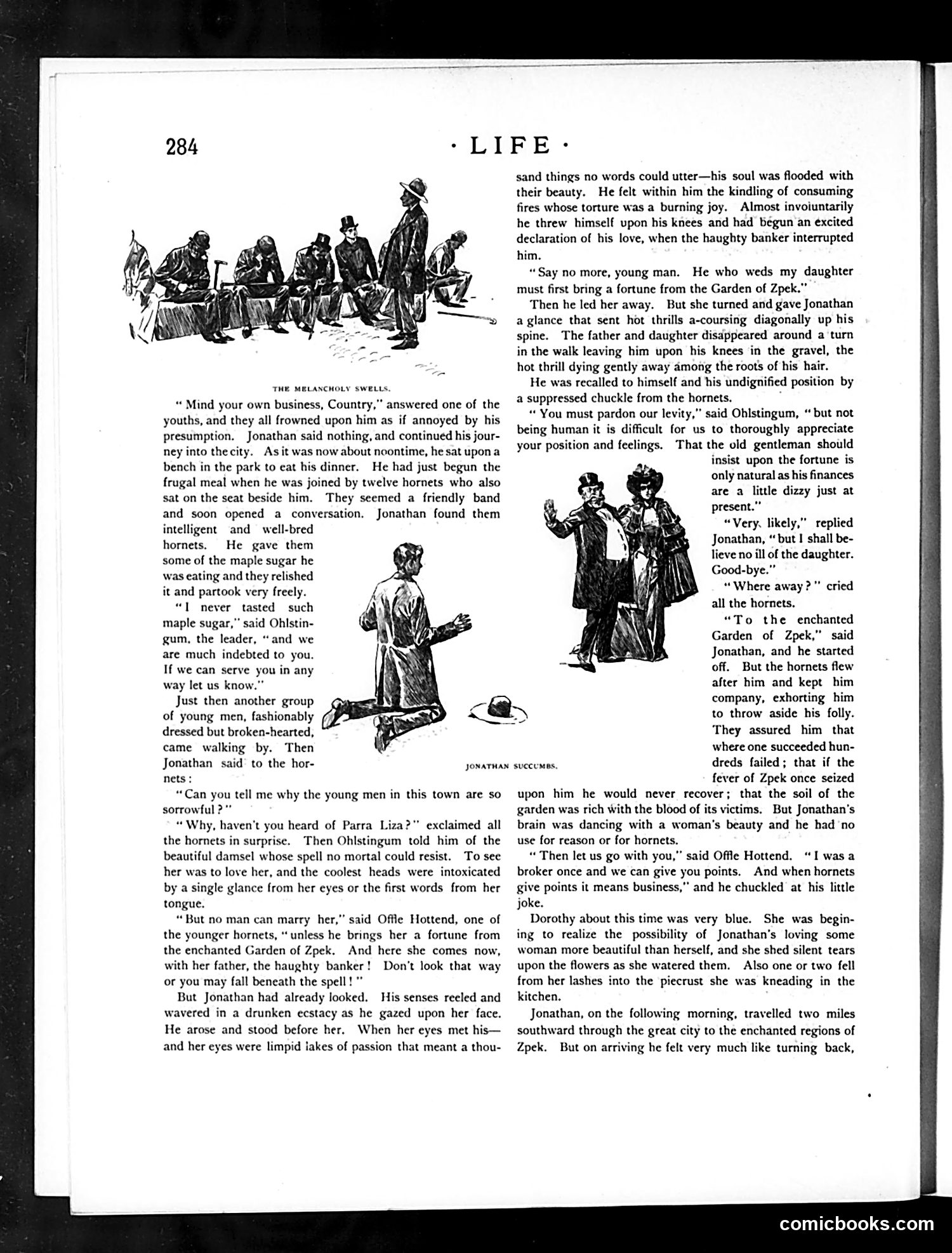
This appears to be a literary narrative page rather than political satire. The page contains illustrations accompanying a story about a character named Jonathan who encounters hornet riders in what seems to be a fantastical or allegorical tale. The main illustration labeled "THE MELANCHOLLY SWELLS" shows Jonathan meeting a group of young men on horseback who invite him to dine. A second illustration shows "JONATHAN SUCCEEDS" with figures in period dress. The narrative involves Jonathan being told he must obtain a fortune from the "enchanted Garden of Zpek" to marry a daughter, with various whimsical conditions attached. The story appears to be satirizing social pretension (the "swells" are fashionable young men) and romantic folly rather than addressing specific contemporary politics. Without additional context about the publication date or author, the specific satirical targets remain unclear.
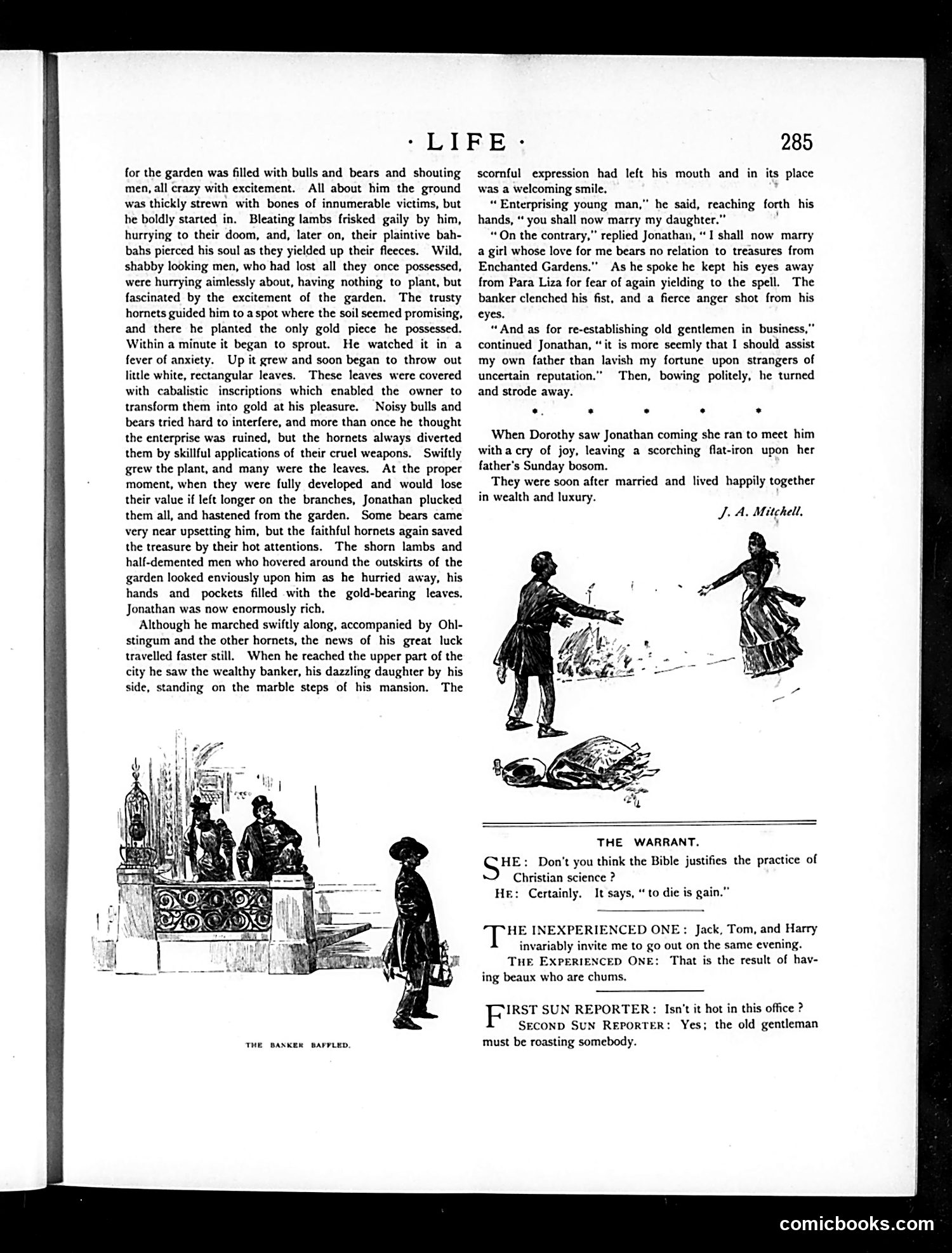
This page contains a serialized fantasy story by J.A. Mitchell about a magical garden that produces gold-bearing leaves. The narrative describes a protagonist who discovers enchanted plants and becomes wealthy through harvesting them. **The cartoons** are unrelated satirical pieces: 1. "The Banker Baffled" (lower left) shows a banker confronted by what appears to be a soldier or uniformed figure—likely satirizing banking institutions or financial authority figures of the era. 2. "The Warrant" section contains brief humorous dialogues about Christian Science, inexperienced versus experienced socialites, and overheated offices—typical period humor about contemporary social pretensions and discomforts. The illustrations are pen sketches typical of early 20th-century Life magazine's satirical style, combining fantasy fiction with topical social commentary.
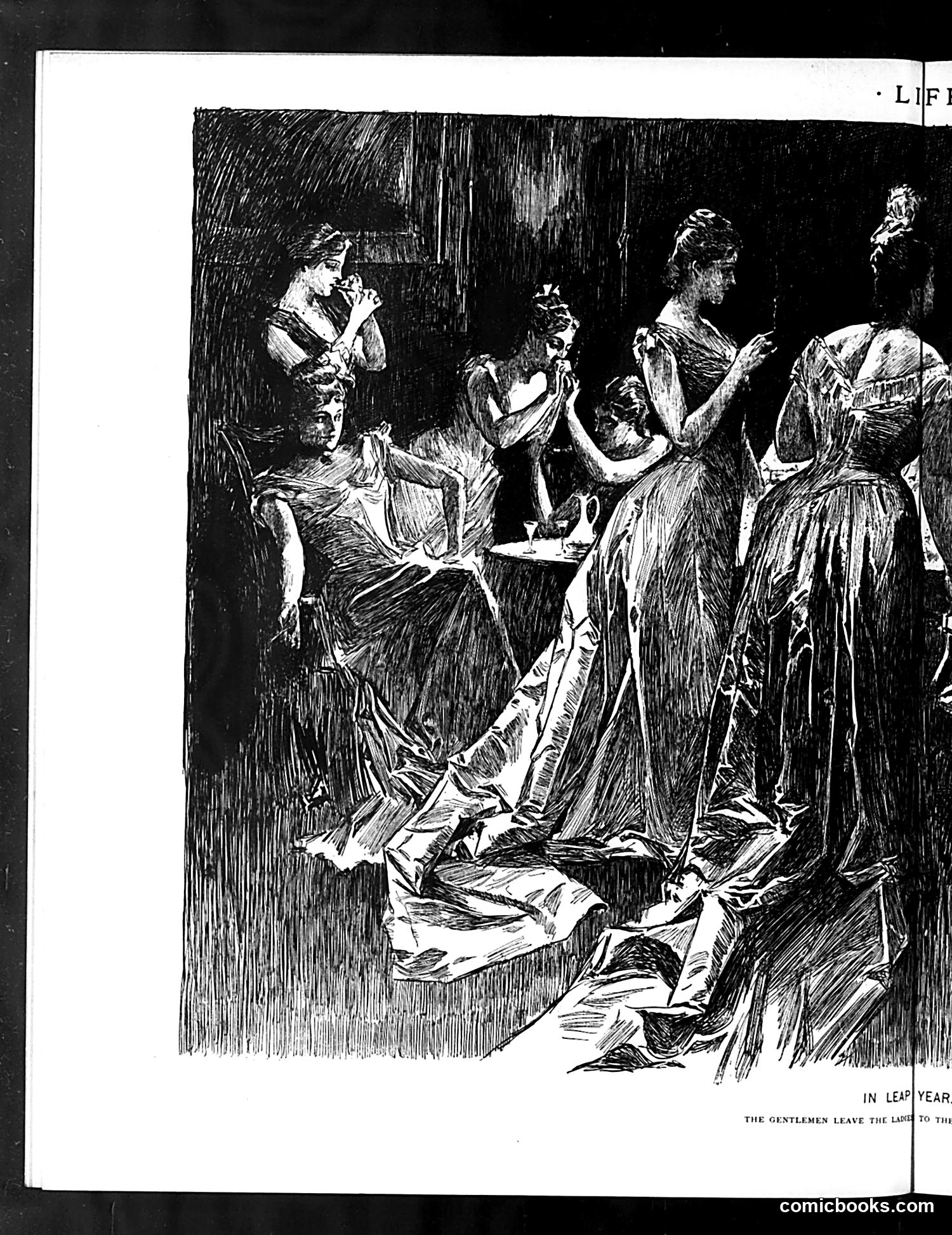
This appears to be an illustration from Life magazine depicting a social scene with multiple well-dressed women in early 20th-century attire and two men in formal wear at the bottom of the frame. The visible caption fragment reads "THE GENTLEMEN LEAVE THE LADIES TO THE..."—suggesting the image illustrates a social convention where men and women separated after dining. The satire likely comments on gender segregation practices of the era, where after-dinner social customs divided the sexes. The detailed rendering of the women's elaborate gowns and hairstyles, contrasted with the men's simpler formal dress, emphasizes the gendered dynamics of Victorian/Edwardian high society. Without the complete caption, the specific satirical point remains unclear, though it likely mocks either the artificiality of these social rituals or period attitudes about gender roles.
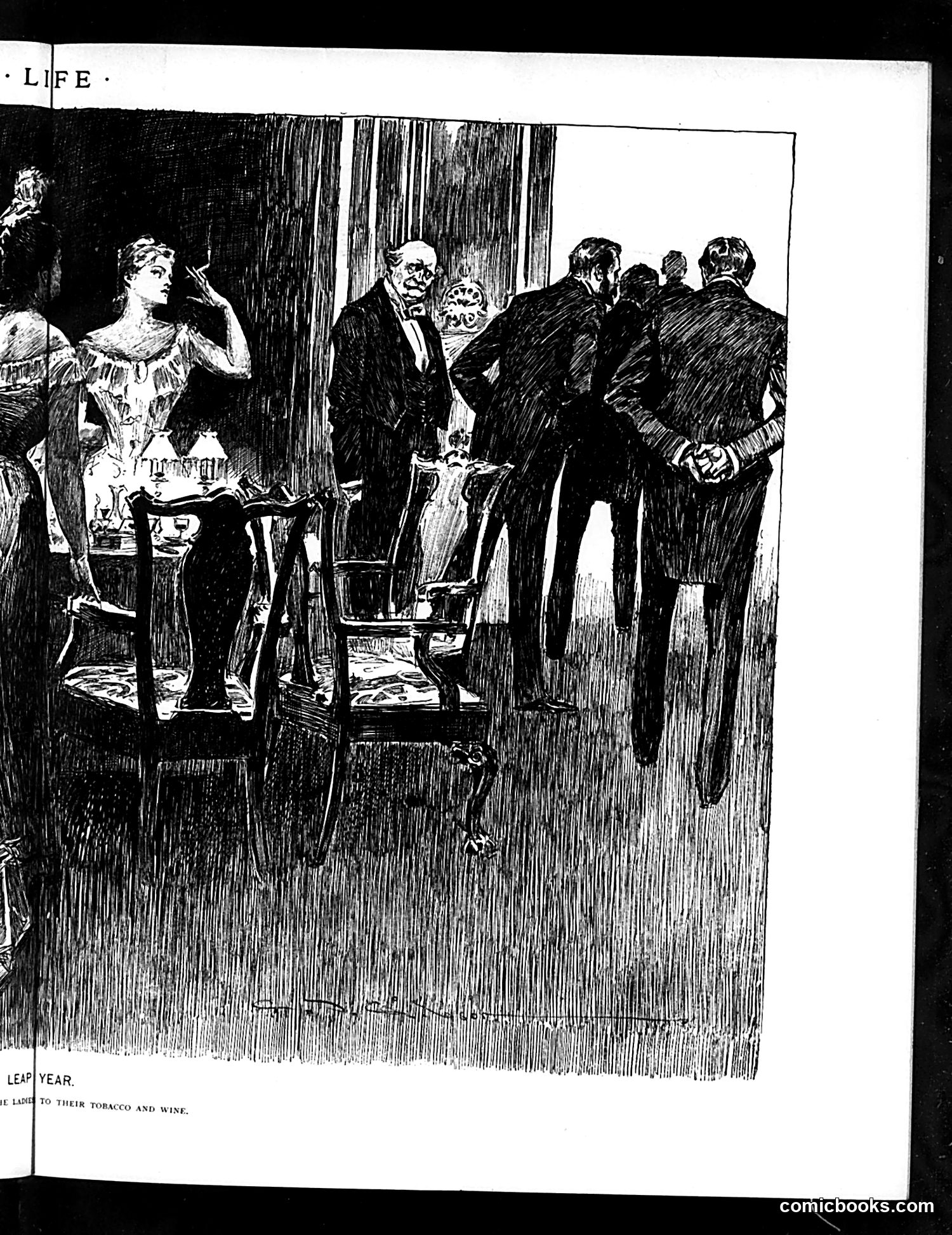
This is a satirical illustration from Life magazine depicting an upper-class social gathering. The image shows well-dressed men in formal attire conversing with an elegantly dressed woman seated on the left. A clock is visible in the background. The partially visible caption at bottom reads "...THEIR TOBACCO AND WINE," suggesting the cartoon satirizes genteel leisure activities among the wealthy elite. The specific identities of the figures are unclear from the image alone. However, the satire appears to target the refined pretensions and social rituals of the upper class—their devotion to leisure, tobacco, wine, and formal socializing. The formal poses and careful dress suggest mockery of their self-importance and adherence to social conventions. Without the complete caption or date, the specific political context remains uncertain.
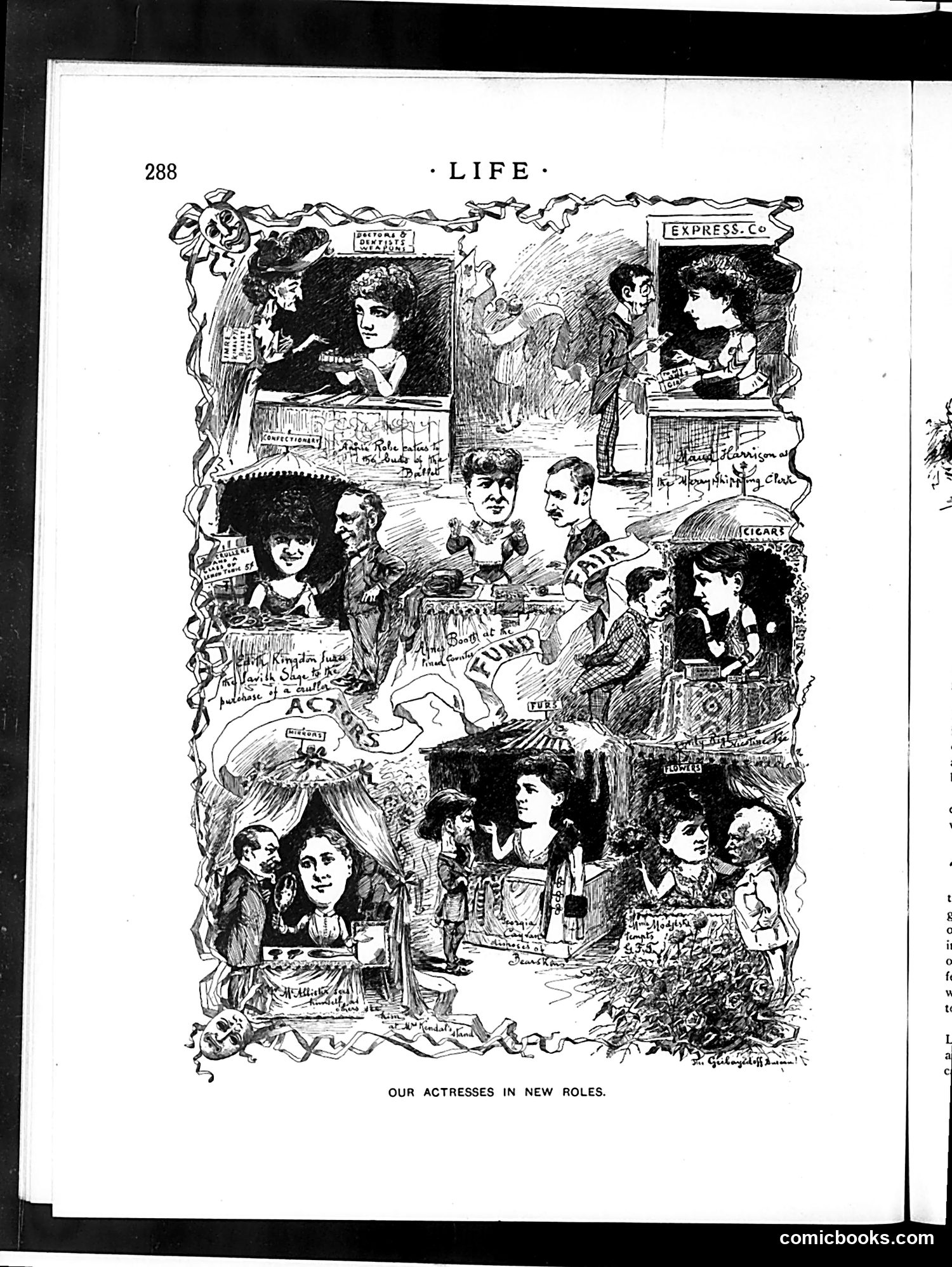
This is a satirical illustration titled "OUR ACTRESSES IN NEW ROLES" from Life magazine (page 288). The composite sketch shows multiple theatrical vignettes featuring various actresses in different dramatic scenarios—some at ticket windows, others in romantic or comedic scenes, arranged within an ornate decorative border. The satire appears to mock the theatrical world of the era, likely commenting on actresses' real-life personas versus their stage roles, or perhaps critiquing specific contemporary theatrical productions. Without clearer name identifications in the image, the specific actresses and particular roles referenced remain unclear. The decorative framing and multiple scene composition was typical of Life's visual humor style, presenting entertainment industry observations to its educated readership familiar with contemporary theater.
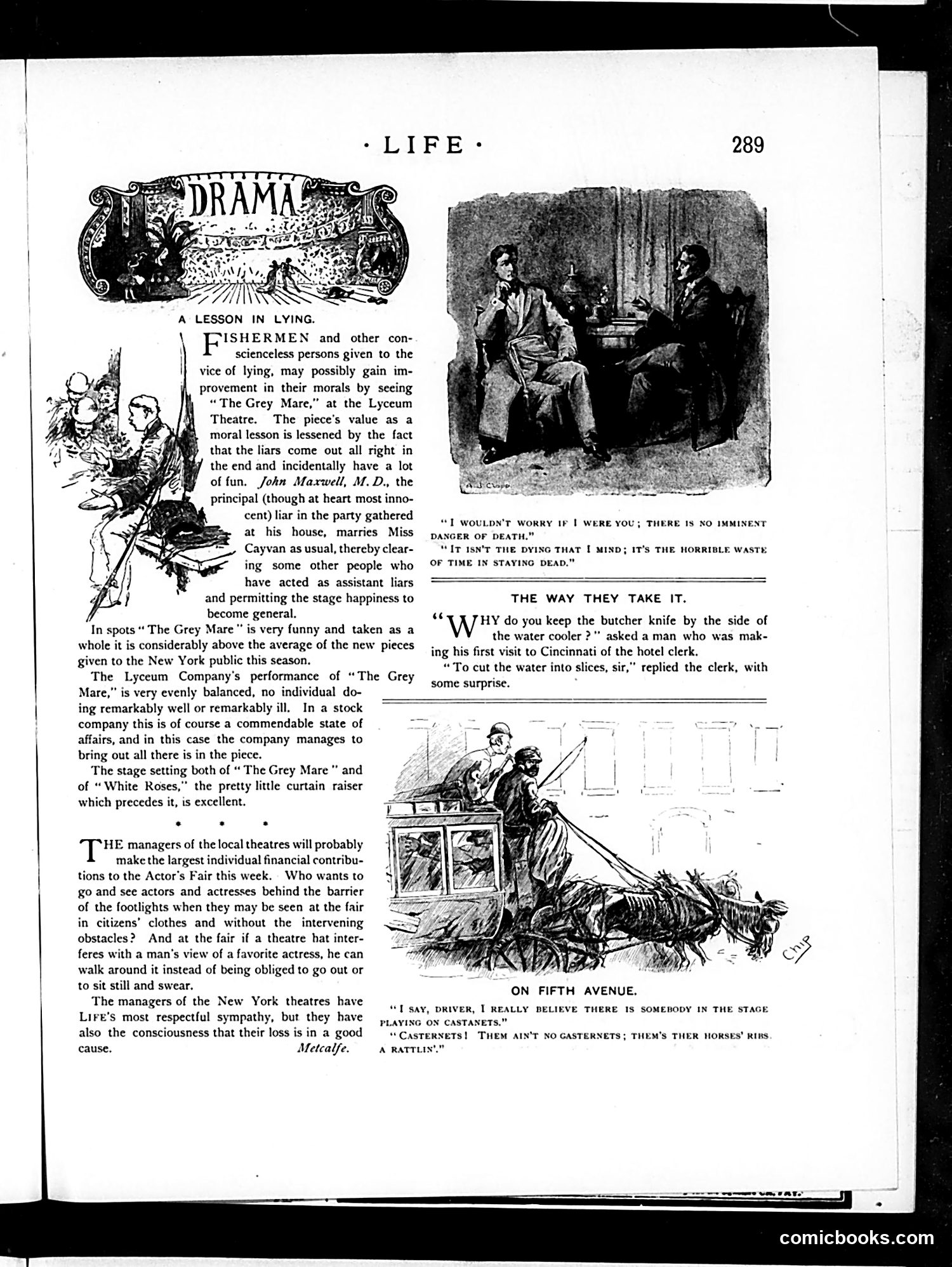
This page reviews the theatrical production "The Grey Mare" at the Lyceum Theatre, sardonically praising it as a "moral lesson in lying"—the joke being that the characters lie throughout but face no real consequences, making it a terrible moral example despite good intentions. The page includes three unrelated humorous anecdotes: 1. **"The Way They Take It"**: A hotel clerk in Cincinnati claims to cut water "into slices," a nonsensical response that mocks rural simplicity or deliberate absurdist humor. 2. **"On Fifth Avenue"**: A carriage driver mistakes the sound of horses' ribs rattling against their harnesses for castanets being played on stage, poking fun at urban-rural cultural misunderstandings. The theatrical review critiques how the play's moral message is undermined by its happy ending for liars. The satirical tone throughout reflects Life magazine's characteristic wit about contemporary social and cultural subjects.
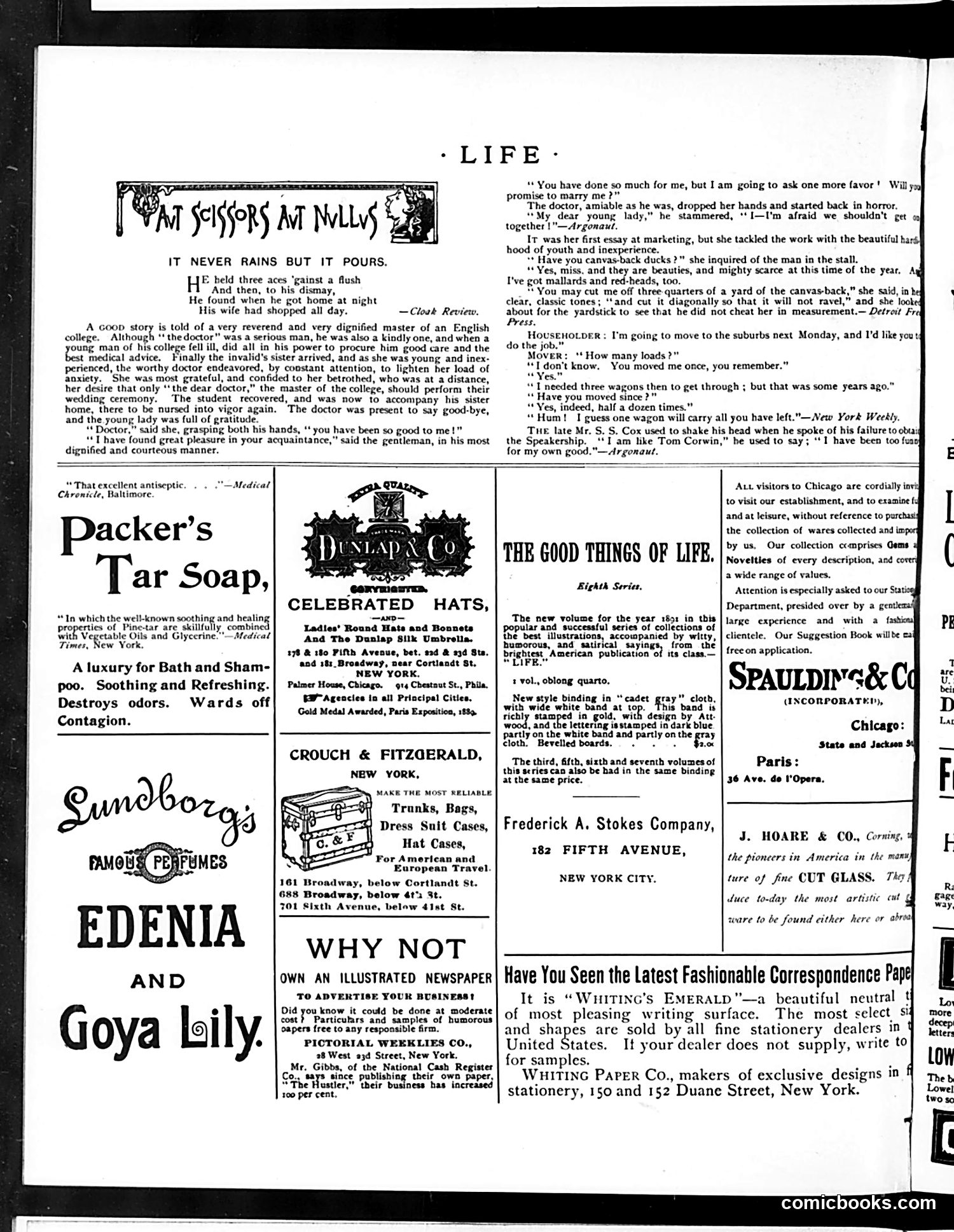
This page from *Life* magazine contains several humorous anecdotes satirizing domestic life and human folly: **"It Never Rains But It Pours"** (top) presents three brief stories mocking marital and social awkwardness. The opening poem jokes about a man's card loss coinciding with his wife's shopping spree. Two longer anecdotes follow: one satirizes a young woman's misplaced gratitude toward a college master (she offers to marry him as thanks), and another mocks a woman's ignorance of market terminology—she asks to buy canvas-back ducks "by the yard," treating poultry like fabric. **The S.S. Cox anecdote** references a real political figure, humorously claiming his repeated moving caused him to lose political ambition. The page is primarily **advertising**—Packer's Tar Soap, Dunlap Hats, Spaulding & Co., Sundborg's perfumes, and other period products occupy substantial space. These ads were the magazine's revenue source. The humor targets middle-class domestic confusion and pretension, typical of *Life*'s satirical approach to American society in this era.
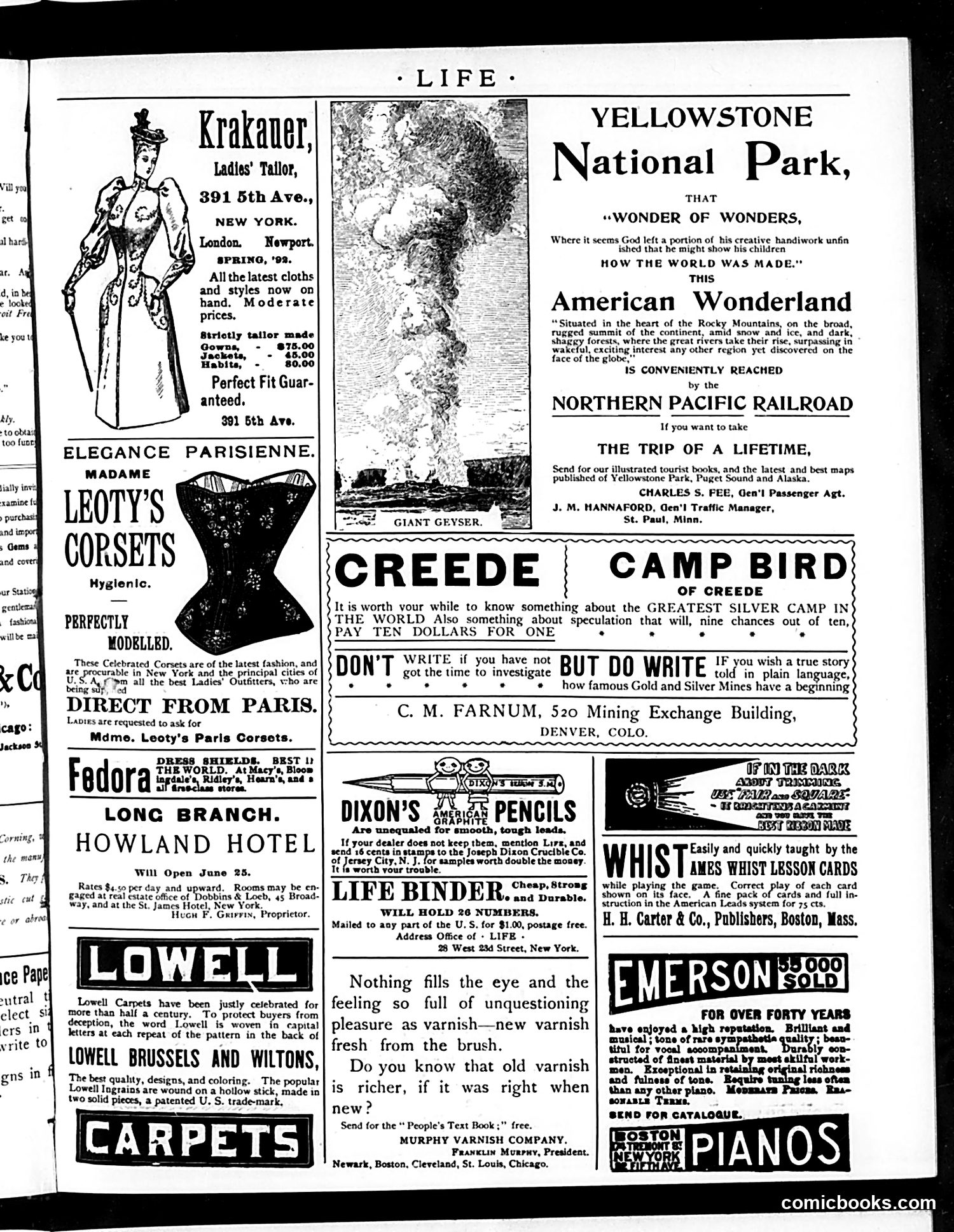
This is primarily an **advertising page** from Life magazine, not a political cartoon or satirical content. The page features commercial advertisements for various products and services typical of the 1890s era: ladies' tailoring, corsets, carpets, hotels, mining investment opportunities, pencils, varnish, pianos, and other goods. The largest advertisement promotes **Yellowstone National Park** via the Northern Pacific Railroad, describing it as "American Wonderland" and "the trip of a lifetime"—reflecting the era's promotion of Western tourism and railroad expansion as markers of progress. Other notable ads include mining camps in Colorado (Creede and Camp Bird), appealing to investors interested in silver and gold speculation, and various fashion/home goods marketed to wealthy consumers. There is **no apparent political satire or cartoon commentary** on this page. It represents straightforward commercial promotion typical of late 19th-century American magazines, which relied heavily on advertising revenue.
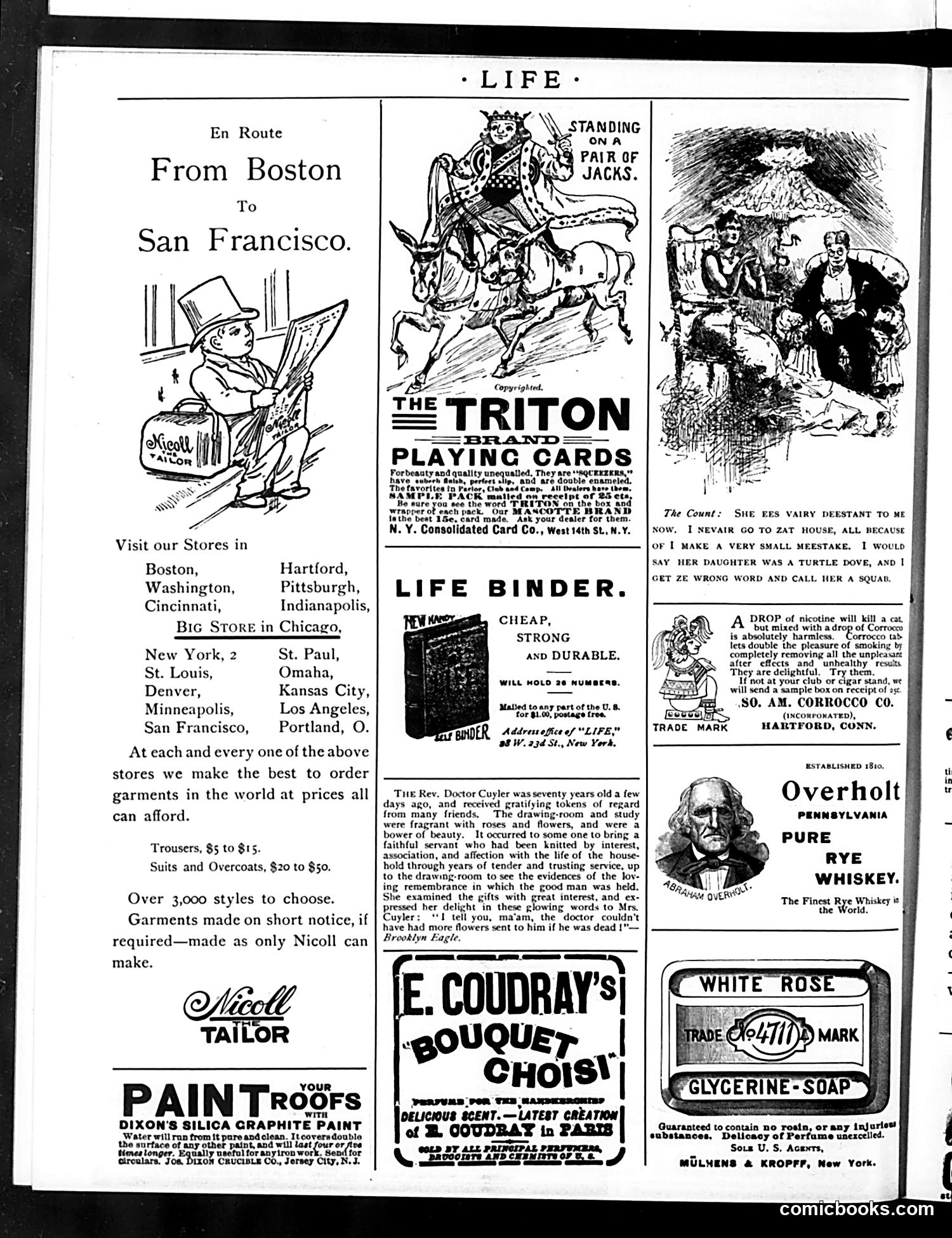
This is primarily an **advertising page** with one prominent cartoon. The main illustrated content is a social humor cartoon titled "Standing on a Pair of Jacks," featuring a figure in fancy dress (appearing to be a European nobleman or "count") balanced precariously on playing cards. Below the cartoon is accompanying text: a count claims he avoids visiting a certain house because he once made a verbal mistake—calling someone's daughter a "turtle dove" when he meant to say "squad" (unclear reference, possibly a translation joke or period slang). The humor appears to rely on continental European stereotyping and the pretension of aristocratic etiquette. The rest of the page consists of period advertisements: Nicoll tailoring, Dixon's paint, Triton playing cards, Life magazine subscriptions, Overholt whiskey, White Rose soap, and other products. One ad features a anecdote about Reverend Cuyler's 70th birthday, where a servant humorously remarks the flowers suggest he'd died. The cartoons are mild social satire targeting vanity and class pretension rather than political content.
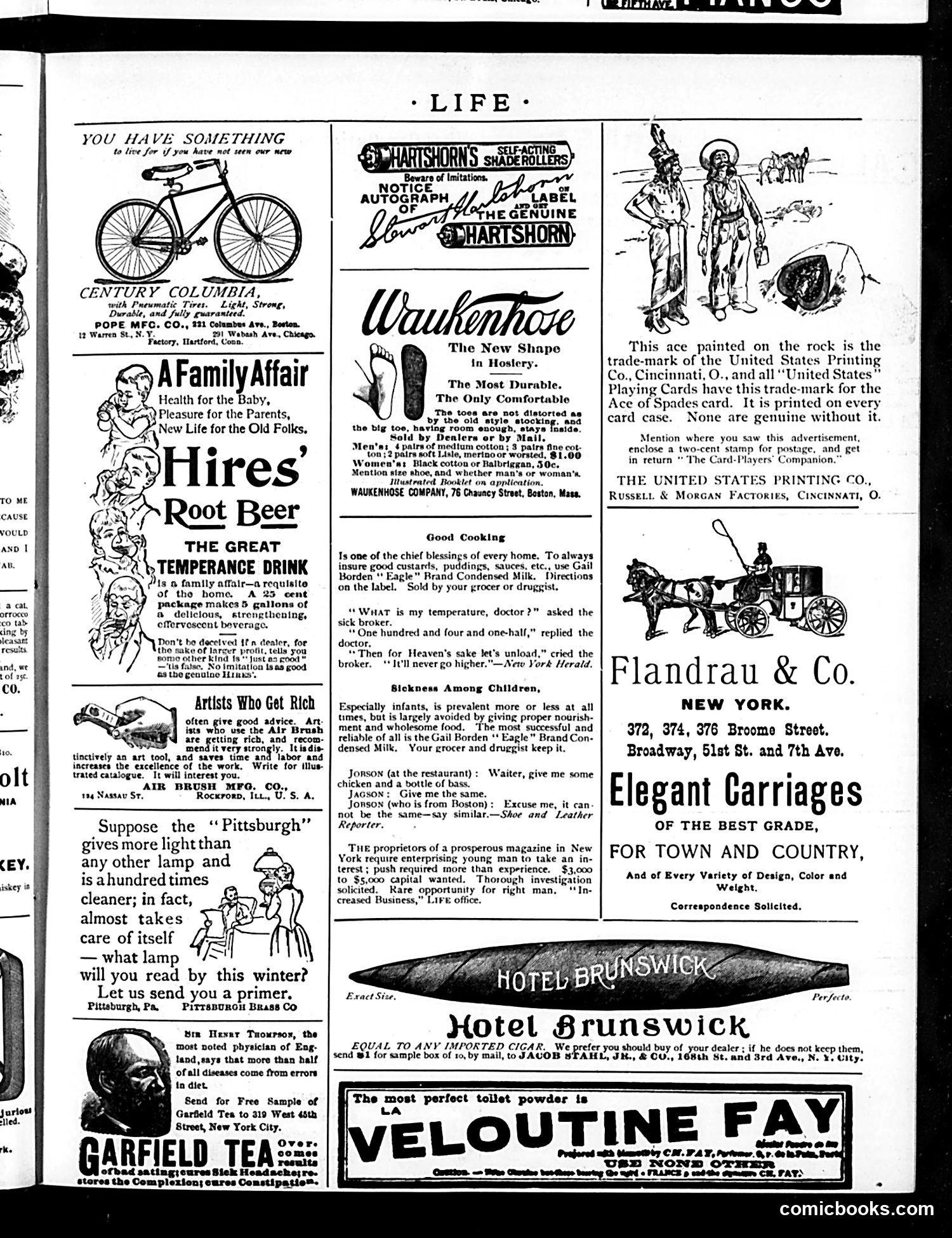
This is primarily an **advertising page** with minimal editorial content. The few jokes present are brief, conventional humor: **The Jokes:** - A broker's quip about stock temperatures (comparing financial prospects to fever readings) - A Boston man's pedantic correction of "chicken and bass" to "similar" rather than "same" **The Advertisements:** The page showcases late-19th-century consumer goods: bicycles, root beer, hosiery, condensed milk, carriages, hotels, and powder. Notable is the **Garfield Tea ad** featuring a physician endorsement—common practice before FDA regulations. **Historical Context:** These ads reveal what middle-class Americans purchased and valued: temperance drinks, "scientific" health products, and fashionable transportation. The **"Waukenhose" hosiery** advertisement for "The New Shape" suggests evolving women's fashion. The page contains no political satire or caricature—Life magazine here functions as a traditional advertising vehicle mixed with light domestic humor, typical of turn-of-the-century publications.
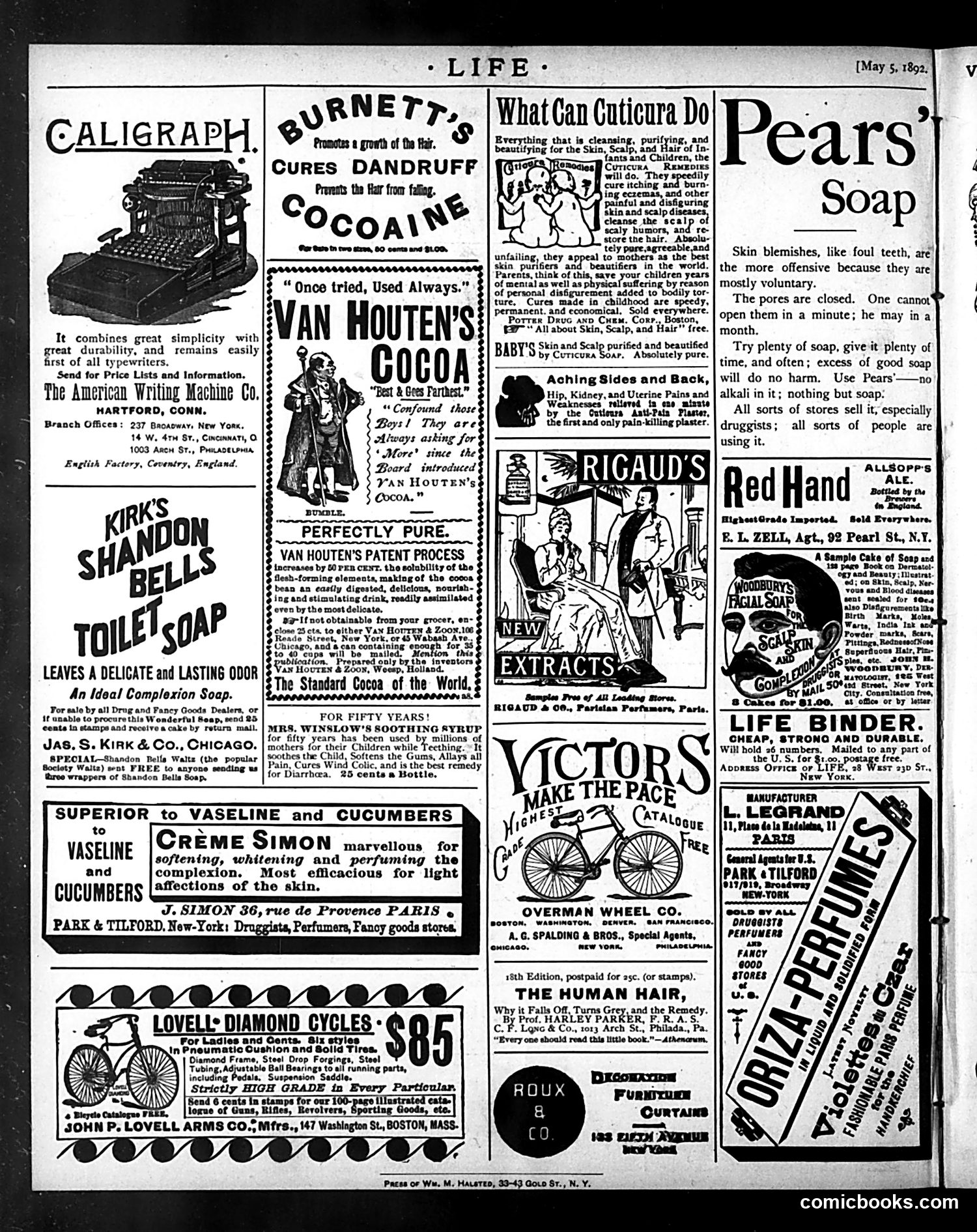
This is primarily a **product advertisement page** with no political cartoons or satire. The page displays numerous patent medicines and consumer goods typical of the 1890s, many making dubious health claims now recognized as fraudulent: - **Burnett's Cocoa** claims to cure dandruff - **Van Houten's Cocoa** advertises improved digestibility via patent process - **Mrs. Winslow's Soothing Syrup** (for teething infants) — now known to contain dangerous opioids - **Cuticura** products promise to cure skin conditions and hair loss - **Cutler's Pain Plaster** claims to relieve kidney and uterine pain instantly Other items include bicycles, typewriters, and grooming products like Pears' Soap. **Historical significance**: This page documents the pre-FDA era when manufacturers could make unsubstantiated medical claims without regulation. The advertisements reveal what 1890s consumers believed about health, hygiene, and commerce—and how readily they trusted unproven remedies.